← Free Thinking Through the Fourth Turning with Sasha Stone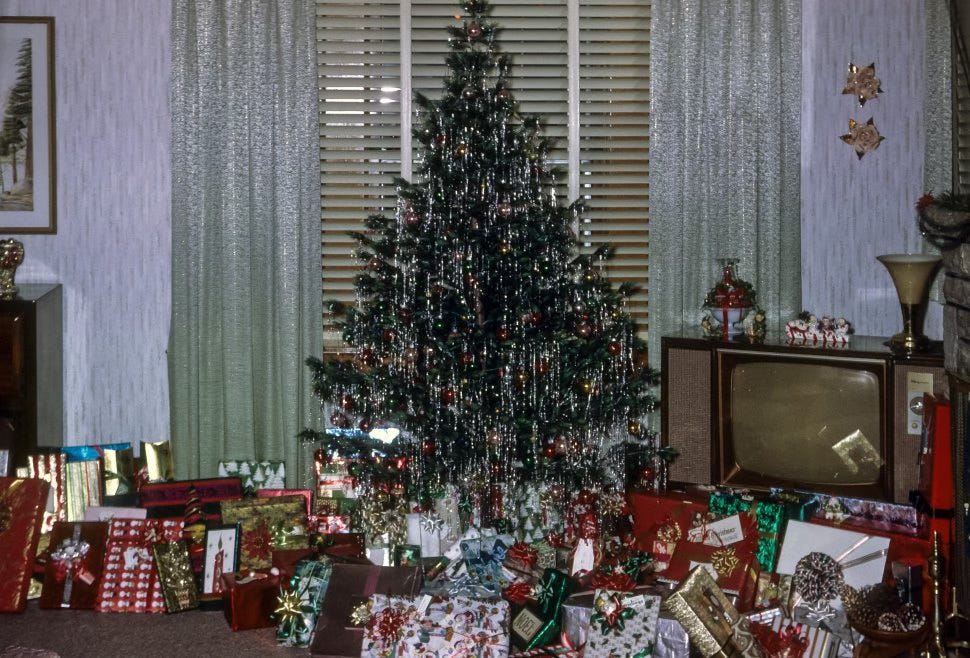
Free Thinking Through the Fourth Turning with Sasha Stone
What Christmas Meant to Me Then and What it Means Now
00:26:54
Loading summary
Transcript27 lines
- [00:01]
Sacha Stone
Hi, this is Free Thinking through the fourth Turning. My name is Sacha Stone. What Christmas meant to me then and what it means now. What a difference four years makes. It is my heart warm and world embracing Christmas, hope and aspiration that all of us, the high, the low, the rich, the poor, the admired, the despised, the loved, the hated, the civilized, the savage, may eventually be gathered together in a heaven of everlasting rest and peace and bliss. Except the inventor of the telephone, Mark Twain. Letter to the Editor New York Evening World, 23rd December 1890. If you grew up on the left, you grew up without religion. After the counterculture movement split from conventional religion in the 1960s, we'd done everything we knew how to do to fill up the eternal emptiness that had us chasing everything from sex, drugs and rock and roll, cults of the 1970s, gurus and ashrams, the self help movement, the mental health movement. And eventually we ended up back where we started. We found religion, but this time as the politics of identity, where our happiness depended on how we solved the problems of society, like racism, homophobia, transphobia, misogyny and climate change. It came from needing to feel good about ourselves and our world. But it was followed by anger and resentment when we could not convert the entire country to our way of life. The truth about the left is that they know no other way of life. This was the problem for Southerners after the Civil War. They too knew no other way of life and could not evolve out of their hatred, fear and hysteria. All they could do was preserve it by banishing those who threatened it. I wish I could say I've come out of these past several years with a renewed faith in humanity. The truth is exactly the opposite. What I saw was what collective fear, hatred and tribalism can do to otherwise decent people. I saw what we're all capable of when our power is threatened. I saw how easy it is to go along with the crowd even when what they're doing is wrong. I always thought the people I called my heroes were made of tougher stuff, better stuff, kinder stuff. I always thought my side was the side of the good guys who would be immune to group dehumanization. I also didn't think we would ever be the ruling class aristocracy sneering at the middle and working class, gathering all our culture, wealth, institutions and hogging them for ourselves. Now that the empire is in collapse, those with all the power are scrambling not just to explain it, but as a way to get back some of what's been taken. Good luck with that. 1. Take yet another agonizing, unbearable column by your typical leftist elite. Jill Filipovic, writing for the Guardian. It's time for a new approach to dealing with Trumpy relatives during the holidays. I cannot imagine being married to a man who would vote for someone like Trump. And if I were, I would probably get divorced. Because why in the world would you stay tied to someone who votes for a man who is happy to strip you of your most fundamental rights? I would struggle to be close friends with the kind of person who was either checked out enough or to not grasp with what Trump proposes, or who was okay with his policies of cruelty, his corruption, his immorality, and his plans to make America a far worse place. End quote. Worse than what, Jill? Indoctrinating children to choose their genders and then surgically and chemically sterilizing them? Or does it just come down to immigrants and their right to cross the border illegally by the millions, their safety and our safety be damned? Corruption? You mean like government censorship on a laptop? Or covering up the mental incapacity of the commander in chief for four years? Weaponizing the Department of Justice? Immorality? Like what exactly? Lying to the public via the propaganda press? Calling half the country garbage? Or white supremacists or Nazis? And what rights? The right to have an opinion without losing your job status or social standing? Your right to play in sports as a biological female without having to compete with biological men? Oh, of course not. She means abortion, as usual, honey, if you want an abortion, there's a pop up clinic down the street. People like Jill imagine half the country as insects in a jar, watching how they behave in tightly confined spaces, how they respond to being called racists, or how they are debanked or canceled off of social media. It's fun, right? To watch the insects get stressed and claw at the glass for a way out, she writes. If you're reading a newspaper column about American politics, you're already a much more informed person than a great many American voters. That doesn't speak particularly highly of the American electorate, but there's a lot of daylight between ignorant and evil. Attributing pro Trump voters to the former rather than the latter has probably helped many liberals tolerate holiday gatherings in a way that didn't feel possible in the aftermath of the shocking election eight years ago. End quote. The disgust drips from every word, even as she tries to make nice. Nice now that her ass has been handed to her in a historic, humiliating defeat. Trump won again. Jill eat that for breakfast. It isn't you people who have to learn to tolerate Trump voters. It's you who have to apologize to them for what you've done, not only to them, but to this country. You've destroyed every great thing you ever built. And listen to you now, pretending you still have the moral high ground. She then tries to explain why she's writing this at all. Retreating to ideological corners and expecting all spaces to be safe spaces has not served the progressive project particularly well. Gee, you think it also hasn't served progressives particularly well. Being challenged, uncomfortable, and sometimes even hurt is part of the work of being a person in the world. You don't say. And it is certainly part of the work of being an activist, or even a person who wishes to bend the future to their better vision. Yeah, go ahead and try it. Pushing people out is usually much less effective than pulling them in, and many on the left seem to be realizing that fact, albeit belatedly, myself included and grand. Quote to paraphrase a line from Carrie shut up, Jill. Just shut up. Shut up, Chris. Just shut up. These are the kinds of people I used to call home. I knew them, mingled with them, read them, RT'd them, was Facebook friends with them. Now they terrify me. They are the banality of evil. They are the side that would go along with segregation, even if they'll never admit it. They're the side that would lock arms as the Jews were carted off to camps. And no, they'll never see themselves that way, she writes. Quote, barring secession, national divorce, or a civil war, the hundreds of millions of Americans with diverse views and experiences are going to have to continue to live together. On my least generous days, I wish that weren't so, and that voters in blue states could be freed up to make our own rules and live our best lives. Yeah, like you aren't now. Realistically, though, every American will remain tied by nationality to millions of others who make terrible and sometimes cruel choices. Those in power who are carrying out the cruelty should be marginalized and stigmatized. But those who are only casting ballots are in a different category, worthy certainly of criticism and frustration for sure, but in many cases also worth an attempt at understanding. Or at least sharing a Christmas ham. Oh, poor deluded Jill. She has no idea what just happened, does she? It would do her a world of good to start opening her mind to reality, escape the fear bunker and start interfacing with the truth. She should read David Samuel's piece in Tablet one. I'll be writing about in more depth for my next piece, Rapid Onset Political Enlightenment, How Barack Obama built an omnipotent thought machine and how it was destroyed. Trump's head turn was a perfect example of an event that has no explanation outside the favor of the gods or whatever modern equivalent involving wind factors and directional probabilities you might prefer to the word God. Trump was fated to win, just as Achilles was fated to overcome Hector, because the gods, or if you prefer, the forces of cosmic randomness, were on his side on that day. At that moment, that move not only saved his life by allowing him to escape an assassin's bullet, it revitalized his chi and set in motion a series of subsequent events that generated a reordering of the entire world can't stop what's coming it ain't all waitin on you.
- [10:10]
Chris
I always figured when I got older, God would sort of come into my life somehow. And he didn't. And I don't blame Him. If I was Him, I'd have the same opinion of me that he does you.
- [10:33]
Jill Filipovic
You don't know what he thinks.
- [10:35]
Sacha Stone
What you got ain't nothing new. This country's hard on people.
- [10:45]
Chris
You can't stop what's coming.
- [10:49]
Sacha Stone
It ain't all waiting on you.
- [10:54]
Chris
That's vanity.
- [11:03]
Sacha Stone
A Christmas Story I was always the first to wake up on Christmas morning. It was almost like a job. I'd scramble into the living room before the sun even came up to gaze upon the abundance of treasures beneath the Christmas tree. I never believed Santa was real, but those presents got there somehow. It was my grandmother who enlisted my older sister to help her wrap all of the presents after the rest of us had gone to sleep. It was a magic trick she performed every Christmas to keep the illusion of Santa alive in our imaginations. She thought she had us fooled. We let her pretend it didn't matter, because every Christmas morning was a rare moment of pure joy. One after the other, we'd tear through the presents, not waiting for each person to finish before moving on to the next. Pure carnage. But oh, what fun. What I never really thought about much until recently was what Christmas really means. If it is only about driving the economy or buying stuff, then it isn't worth celebrating. But if it is about something much bigger than ourselves, a way to unify as one people under God, well, then it means something. I began thinking back on my life, on my childhood, and how religion fit into it. Most movies during the Hays Code era, before the 1960s and 1970s, were infused with Christian ideology, especially Christmas movies. And why wouldn't they be? George Bailey prays and It's a wonderful life. And an angel shows up to answer his prayers.
- [12:43]
Chris
Yeah. Merry Christmas. Glad you come. We got everything.
- [13:13]
Sacha Stone
Dear fathers in heaven, I'm not a praying man, but if you're up there.
- [13:22]
Jill Filipovic
And you can hear me.
- [13:25]
Chris
Show me.
- [13:26]
Sacha Stone
The way out at the end of my rope. Right. Show me the way.
- [13:33]
Chris
Oh, God.
- [13:35]
Sacha Stone
In a Charlie Brown Christmas, they sing about the newborn king, which is, of course, Jesus. That was something we all used to share as a country. It was a thread that united us along with being American citizens.
- [13:48]
Chris
Oh. Everything I touch gets ruined.
- [14:02]
Sacha Stone
I never thought it was such a bad little tree. It's not bad at all, really. Maybe it just needs a little love. Charlie Brown is a blockhead, but he did get a nice tree.
- [14:49]
Chris
What's going on here? Merry Christmas, Charlie Brown. Hark the herald angels sing Glory to the newborn king Peace on earth and mercy mile God and sinners reconciled Join the lonely nations rise Join the triumph of the spirit God with the telling host proclaim Christ is born in.
- [15:40]
Sacha Stone
We all watch these movies because we understood the foundational principles of what made America. That isn't true anymore. To even reference religion as I'm doing now is practically a revolutionary act. There is a new religion in town, a fundamentalist one that offers no path to redemption or forgiveness and demands total compliance. Or else, what does any of it mean to us now? Is it really just about the list of things we buy? Is it about the movies we all treasure every year? Is it about what unites us, not what divides us? Is it about something bigger than ourselves? Are we still even allowed to say Merry Christmas? I don't have the answers. I just know I was raised by a devout atheist who hated religion, and thus I never thought about Christmas other than as a way to give things and get things. But now, thanks to my 4 years of getting to know Trump supporters, I see that and many other things differently. I wandered out of darkness and despair toward what looked like a golden light of hope and optimism. Surrounded by people our ruling class deemed dangerous at best and human garbage at worst. I knew every step that brought me closer to them would be one more step that separated me from everyone and everything else.
- [17:06]
Donald Trump
It was Christmas Day. We boarded Air Force One in complete and total darkness. In the pitch black of night, we landed in war torn western Iraq. No lights on the Runway. There were hundreds of troops packed into a dining hall. They had absolutely no idea that the President and First lady were about to walk into that room. And when they did, it was a sight and a sound and a scene that I hope I never Forget that room absolutely erupted. That was the kind of patriotism President Trump brought back to our country. One of the young soldiers yelled from the back of the room, Mr. President, I reenlisted in the military because of you. And without missing a beat, the president said in son, I am here because of you.
- [18:05]
Sacha Stone
As I've written so often here. It was another Christmas movie, maybe the best one, that reminded me of what happened to me. It was the Grinch who Stole Christmas. The moral of that story is that you can't steal Christmas. It isn't something you can buy or attain. It isn't even something you can give.
- [18:50]
Chris
Christmas. Christmas Day welcome, welcome, welcome Christmas Day is in our grass.
- [19:07]
Jill Filipovic
But this. This sound wasn't sad. Why, the sound sounded glad. Every who down in Whoville, the tall and the small, was singing without any presence of torture. He hadn't stopped Christmas from coming. It came. Somehow or other, it came just the same. And the Grinch, with his Grinch feet, ice cold in the snow, stood puzzling and puzzling. How could it be so? It came without ribbons. It came without tags. It came without packages, boxes or bags. He puzzled and buzzed till his puzzler was sore. Then the Grinch thought of something he hadn't before. Maybe Christmas, he thought, doesn't come from a store. Maybe Christmas perhaps means a little bit more.
- [20:31]
Sacha Stone
That's why the who's in Whoville are still celebrating and singing. Even after the Grinch takes away every last symbol of Christmas, you couldn't take away the one thing that mattered most, what was in the hearts and minds of those celebrating. I can't call myself a Christian or even a person of faith. I lean in, and that's farther than I did before. But I also know I have learned the same lesson the Grinch did. I saw people who'd been abandoned by our political establishment, its institutions, its culture. People who should have been angry and bitter, but they weren't. They were happy. And that's how my heart grew and more why I think differently about Christmas now. It wasn't Trump supporters who demanded I pick a side. It was the left they have imagined an unbearable reality for most of us. Perhaps it comforts people like Jill Filipovic. But for the rest of us, we choose the better way. One that values forgiveness, redemption and humility, and one that allows us to say, even shout, merry Christmas.
- [21:44]
Chris
My mouth's bleeding. Birds. My mouth's bleeding. Zoodoo petals. Zuzu. There they are. Birds. What do you know about that? Merry Christmas. Well, Merry Christmas. Merry, merry. Yay. Yay. Hello, Benford Fox. Merry Christmas. Merry Christmas. Merry Christmas, George. Merry Christmas.
- [22:27]
Sacha Stone
So thank you, dear readers. When I say you saved me, I really mean it. You did. There but for the grace of God go I. Thank you for listening to my podcast, sashastone.substack.com I hope you have a wonderful Christmas or Happy Hanukkah if you're celebrating that and a happy New Year. And really, I mean it. From the bottom of my heart, thank you. Thank you for your letters, cards, for your donations, your subscriptions, your comments, your support. I honestly don't know where I'd be without you. And remember, to thine own self be true.
- [23:45]
Chris
Acquaintance be forgotten never brought to mind should old acquaintance be forgot. For old lands I For old lands I will take a cup of kind and surely you'll buy your pine cup and surely I'll buy mine we'll take a cup of kindness yet for all that time for all land will take a cup of pint for all the time will take Pick up kindness for all my hands down and there's a hand my trusted friend Give me a hand of thine we'll take a cup of kindness yet for old land will take account of kindness cup of kindness for all that hands on. Thank you so much. You guys are amazing. All the best. Merry Christmas and a happy New Year. Take care. See us.