Loading summary
Transcript156 lines
- [00:02]
A
The world's biggest story keeps getting bigger this week on up first, we're tracking the escalating war in Iran, rising oil prices and a global economy on edge as the conflict spills beyond Iran. Our host, Layla Fadel, is on the ground in Iraq. Listen each morning for three stories you need to start your day on up first on the NPR app or wherever you get your podcasts.
- [00:24]
B
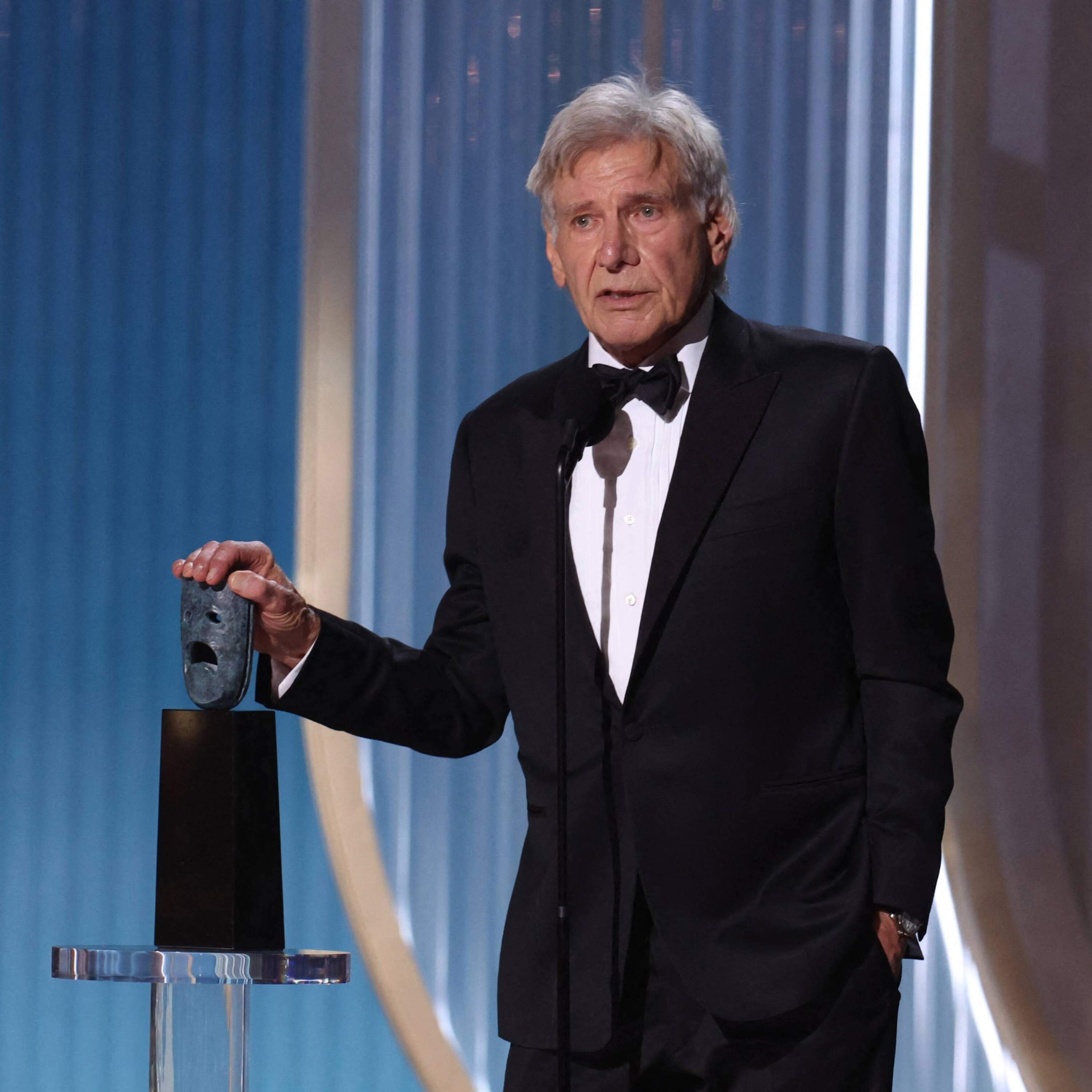
This is FRESH air. I'm Terry Gross. Is there anyone who doesn't know who Harrison Ford is? Probably not. Not after starring in the original and the sequels of Star wars, the Indiana Jones movies and Blade Runner. He's in his 80s, but in the last three years, you might have seen him in the final Indiana Jones film, the Dial of Destiny, the prequel to Yellowstone called 1923, and his current series, Shrinking. Three seasons of Shrinking are streaming on Apple tv, and it's been renewed for a fourth. He plays a therapist, Paul, who heads a practice that includes two other therapists, Jimmy, played by Jason Segel, and Gabby, played by Jessica Williams. Paul is at an age where most people have retired, but he doesn't want to. At the same time, he thinks maybe he needs to. He has Parkinson's disease. At first, the symptoms were relatively minor, but they've progressed. His hands shake so much it's difficult to put the toothpaste onto the toothbrush. Even more problematic because it affects his work. His shaky hands are making it difficult to take notes when he's talking with patients. Michael J. Fox is in a couple of episodes playing a man who has a more advanced case of Parkinson's and is very depressed. They first meet at a doctor's office where they're both patients. Paul is a gifted therapist, but it's hard for him to express emotion, and he has a dark and cynical sense of humor. In this scene from the current season, season three, Paul has returned to work after taking some time off because a UTI was causing hallucinations. So this scene is from his first day back at work. He's telling Jimmy he thinks it might be time to retire. In the past, Paul had asked Jimmy to tell him when he thought it was time. Now Jason Segel's character, Jimmy, speaks first.
- [02:15]
A
Hey, how was your first day back? Really great. I think it's time for me to stop being a therapist. Do you, Paul? I'm not gonna fall for that one twice. No, I'm serious. I took going away and coming back to see it. But it's time, Jimmy. I'm supposed to tell you that it's time. Well, we can do that if you. It's time for you to retire, Paul. Okay. Not the way I saw this going in my head. I'm gonna miss you. You mean so, so much to me. I've always wanted to tell you this one thing, and I'm gonna say, oh, Jesus, Jimmy, please. I'm not leaving now. I got patience to notify. I got referrals to make. It'll take months to wind down this practice. You only get to say goodbye once, and it's not today. Come on. I want pizza on the way home. Let's go.
- [03:26]
B
Let's go. Harrison Ford, welcome to FRESH air. It's such an honor to speak with you. Thank you for being here.
- [03:33]
A
Oh, how kind of you. Thank you for having me.
- [03:36]
B
Some people are surprised that you're continuing to act, you know, in your 80s. And Paul says after his Parkinson's has gotten worse and he's thinking of retiring, he says, I love my job more than anything, and I don't know who I am without it. Do you relate to that, or do you know who you are without your work?
- [03:56]
A
Yeah, I guess I do. But without my work, I really wouldn't know what to do with myself. Really?
- [04:04]
B
With your time?
- [04:06]
A
Well, I suppose I could fill my time, but I don't know what else I might do that would give me the kind of satisfaction and the kind of challenge that the work I'm doing does give me. I really do love the work.
- [04:23]
B
I don't blame you. It seems like it would be so fulfilling.
- [04:28]
A
Well, it constantly changes, and the people change and the mission and the opportunity change and just makes for an interesting way to live your life.
- [04:40]
B
And I love that you play your age because it's frustrating when, like, a beautiful woman plays somebody who's ugly by just not wearing as much makeup, but she's never ugly. Or a younger person has to play an older person by putting on prosthetics. Like, we have talented people who look like they're supposed to look. Can we cast them, please?
- [05:03]
A
Well, I felt that way when I was de aged in Indiana Jones, but sometimes it works. And I thought it worked in Indiana Jones that de aging part. But I'm happy to be the age I am, and I have no impulse to hide it.
- [05:27]
B
Well, speaking of Indiana Jones, so Dial of Destiny was like, 2023. It was released, and you're still super strong and agile in that. And then you had to go from that to not long after doing shrinking. And so in shrinking, you're physically compromised because of the Parkinson's disease. What was it like, for you and your body to be action hero strong, and then your hands are shaking too much to take notes.
- [06:03]
A
Well, I mean, it starts with the head of the character. What's in his head, what's in his mind. And I'm always aware of this physicalization of a character. And the Parkinson's or the various symptoms of Parkinson's do help characterize Paul. And so it's a. You know, it's an opportunity to use another means to create the character.
- [06:39]
B
Michael J. Fox is in the series, and you meet at a doctor's office. He's really depressed. Did he give you advice about how to play the role? And did.
- [06:51]
A
Nope.
- [06:52]
B
Really? You didn't ask them for advice?
- [06:54]
A
No, because every case is different, and my case is not yet described to me fully. My writers present symptomology and characteristics as they are writing, and so I'm sort of living with the symptoms I have been last described as having.
- [07:18]
B
Yeah. I mean, the thing about Parkinson's is that it affects everything, but it affects different parts of, like, there's a whole long list of things it affects, but everybody gets a different number of them and a different variation of them.
- [07:33]
A
Right, right.
- [07:35]
B
Those tremors everybody gets. Yeah.
- [07:37]
A
So, like, a true Parkinson's patient, I don't really know what's coming.
- [07:44]
B
Oh, that's interesting. You mean, like, what the writers have in store for you in terms of your symptoms?
- [07:50]
A
Yeah, you know, we. I have a general sense of how far it goes this season, but nothing specific yet. And that's. That's just the way our show works. We get a script probably, if we're lucky, a couple weeks ahead of time, but normally maybe just a couple of days or a week ahead of time.
- [08:21]
B
Did playing the role make you think about your body in a new way and think of what it would be like to not be able to control your movements?
- [08:33]
A
Not specifically. I'm. To be honest, no. There's parts of it I haven't thought through yet, really. And I. I think that might be similar to how I might react if I did have Parkinson's. I would want to know certain things and other things I would just not
- [08:54]
B
want to know so as to not
- [08:57]
A
obsess on them, so as to not be looking for them just.
- [09:03]
B
Right.
- [09:04]
A
Be happy enough with what you got.
- [09:07]
B
Mm. Paul, your character has a very cynical sense of humor. He's really funny. Very, like, dark retorts. And you have a very funny sense of humor. I heard you on Conan's podcast, and you will make Conan and the whole team laugh like so much and so hard. Do you ever punch up your lines or add, like, funny lines? Because honestly, like, your sense of humor is so good.
- [09:37]
A
Sure. Stuff comes up and we have really good writers and I love what they have to offer, but, you know, it's a collaborative atmosphere and I feel free to bring up any idea I have.
- [09:56]
B
Can you think of a line that you added in one of your movies or in.
- [10:01]
A
Oh, I guess the most famous. The one most well known and perhaps illustrative of where it comes from is the line in Star wars where Princess Leia tells me that she loves me and I say, I know, I know, instead of saying I love you too, which is the scripted line. Simply, the impulse was to be more in character. And George Lucas, who had written the line, was not so. Not so happy that I didn't give him the original version, but I really felt strongly about it. So he made me sit next to him when he previewed the film in a public movie theater in San Francisco. And it got a laugh, but it got a good laugh. And so he. He accepted it and left it in.
- [11:05]
B
So Juan has to play another scene from Shrinking. And this is from the first season, I think it's the pilot, actually. So Jimmy, who's one of the therapists in Paul's office, and he's played by Jason Segel, he's really annoyed with his patients for not changing when he's told them they have to change and stop doing the thing that's making them miserable. But this is just an expression of his disorientation and grief because his wife died a year or two ago in a car crash and he hasn't recovered. He hasn't been himself since her death. So this is the scene where he's talking to your character, Paul, and explaining why he's so angry. And also you'll hear Jessica Williams as therapist Gabby and Harrison Ford. You speak first.
- [11:58]
A
Hey, kid, how you doing? I'm normal. You know, it's a normal day. Normal day. Doing it, doing it normal style. Hey, you know what I was thinking, Paul?
- [12:10]
B
Is it about how you're just doing it normal style?
- [12:13]
A
What? What are you thinking? You guys ever get so mad at your patients that all of a sudden you just wanna shake em? Well, we don't shake em. No, I know, I know. I'm rooting for em. I am. I'm like, come on, you up person. You can change. And then they just never do. Compassion fatigue. We all hit those walls. You ask questions, you listen, you stay non judgmental and you don't make that face.
- [12:43]
B
Sorry.
- [12:44]
A
It's just. Look, we know what they should do. You know why? Cause it's pretty simple. I get sad when I do this thing. Maybe don't do that thing. We know the answer. Don't you ever want to just make them do it? Great idea. We just rob them of their autonomy. Any chance they have to help themselves. Right. And we become, what, psychological vigilantes?
- [13:06]
B
Oh, my God. I'm, like, sensing the sarcasm, but that sounds kind of badass. I like that scene a lot. So you haven't experienced, like, the body symptoms of Parkinson's, even though you have to portray them in your role, but you have experienced a whole lot of injuries that you sustained making movies, including on your last Indiana Jones film in 2023. So I'll run through a list of things that I've read, and you can confirm that you've had this. You ruptured a disk in Indiana Jones in the Temple of Doom, you tore a ligament in the Fugitive in Star wars, the Force Awakens, a hydraulic door closed on you. And you broke your leg and injured your ankle in Indian Jones on the Dial of Destiny, you injured your shoulder while you were rehearsing. So how are you dealing with pain?
- [14:02]
A
Pretty good. It sounds like I'm accident prone.
- [14:11]
B
Oh, not to me. It sounds like you're in movies where you do dangerous things and, of course, you'd get some injuries.
- [14:18]
A
Yeah, it's running, jumping, falling down.
- [14:21]
B
Yeah, there you go.
- [14:23]
A
And I gave at the office, let's put it that way.
- [14:29]
B
Because they made you do it?
- [14:31]
A
No, nobody makes me do it. You know, I make the choices of whether I want to do something. They'll often tell me, no, you can't do it.
- [14:41]
B
Like, don't do the stunt.
- [14:43]
A
Yeah, well, it's not a stunt if I'm doing it. It's by definition, not a stunt.
- [14:48]
B
But that doesn't mean it's not risky.
- [14:50]
A
Well, what it means is that I want the audience to be with the character through the activity that we're talking about. I don't want to have to hide the face of the character because it's a stunt guy. I want them to feel the blow. I want them to see the anxiety. I want them to be there when the decision is made or when the decision is missed. I just want them to be there. And it takes me being there to bring them along. I think.
- [15:21]
B
What's the closest you've come in real life to an action scene?
- [15:29]
A
I suppose we won't be satisfied unless we talk about the airplane Accident.
- [15:34]
B
It just occurred to me. That's what you might say.
- [15:36]
A
Yeah, well, I've got to face the music, don't I? But then let's just start by saying that it was a mechanical failure.
- [15:47]
B
And I'll mention here it was a World War II vintage plane.
- [15:51]
A
Yeah, it was a 74 year old airplane. I was 74 years old at the time. It was a beautiful day and I had just recovered from an earlier accident and had gone out with a bunch of guys on a mountain bike ride. And I came home and sitting in the hot tub and I tried to talk my wife into going with me for a ride because it was such a beautiful day. She demurred and had lunch with my daughter and asked her if she wanted to go and she said no. So I went by myself. And 400ft in the air above the airport, the engine quit. And it's my home airport. And I was familiar with the surrounding terrain, which is cluttered with houses, wires and cars and people. So I turned to a golf course that was there. And when I landed, my seatbelt pulled out of the place where it was secured. And so I got a major blow on the head, which resulted in a brain injury that was described to me that I didn't remember the moments because it was retrograde amnesia, a kind of protective device of the brain. So I don't really remember that much about it. I remember telling the tower when I declared the emergency that the instruction they gave me was not going to be followed because I didn't have enough altitude to do what they suggested I do. Anyway, that's the story in a nutshell.
- [17:32]
B
So you said it was a protective form of amnesia so you wouldn't have the memory of like falling and crashing. Are you grateful for that?
- [17:42]
A
I wasn't falling and crashing because I had my. In my ear was the very clear voice of one of my aviation mentors, Bob Hoover. Well, a famous pilot who always, when talking about mechanical failures or other kinds of failures, the advice was to fly the airplane as far into the crash as possible. You think about this thing when you're a pilot. You think about the potential, the possibility of it happening. And of course you train. So when it happened, it was not really a surprise. And I thought I knew what I had to do to handle it. So I just started doing the things that needed to be done.
- [18:37]
B
So you drove the plane into the ground to fly into the crash?
- [18:42]
A
No, I maneuvered the airplane using what gravity was going to give me and what the airplane could do, powered only by gravity. And to mitigate the consequence came at the ground. So that's what I did. I just, I picked a spot and was in the process of landing there. I had run out of energy to maintain lift. So it wasn't a smooth landing. It was, it was more of a crash. But I had not landed on anybody else and I had, I was in a clear space, you know, so I'd done what I needed to do.
- [19:32]
B
Did you think you were going to die?
- [19:34]
A
No, I did not. When the engine quit, I did not think. No. I just flew the airplane. I don't remember actually being scared.
- [19:45]
B
That's amazing. Yeah. What were your injuries?
- [19:53]
A
They were more than described in the newspaper, but I'm over them all. Thank you. Got my license back and continue to fly.
- [20:07]
B
Were you afraid to fly at all afterwards?
- [20:10]
A
No. No.
- [20:14]
B
You're really lucky that you have a mind that can sustain all these injuries and a plane crash and just keep going and not be afraid.
- [20:25]
A
I don't think. I'm not being afraid. I just, I don't put myself in a situation where I think there's going to be a adverse consequence. You know, I'm not a thrill seeker. I was a very, I am a very conservative pilot. So, you know, it's not, it's not that I do crazy stuff for the fun of it.
- [20:52]
B
This is exactly what I hear war correspondents say, that they're careful, they don't take unnecessary risks.
- [21:00]
A
Well, it's a dirty job, but somebody's gonna do it.
- [21:05]
B
Okay, time for a break. I have to reintroduce you. If you're just joining us, my guest is Harrison Ford, and he's now starring in the series Shrinking, which is Streaming on Apple TV. We'll be right back. This is FRESH AIR.
- [21:17]
C
This message comes from LinkedIn. Who knows an empty seat can cost small businesses more than just space. That's why LinkedIn Hiring Pro makes it easy to fill that seat with the right candidate, streamlining everything from posting jobs to shortlisting talent. Nearly 60% of businesses find someone to interview in the first week. Hire right the first time. Post your first job and get $100 off@LinkedIn.com nproffer terms and conditions apply.
- [21:48]
B
Hi, this is Molly Sievi Nesper, digital producer at FRESH air. And this is Terry Gross, host of the show. One of the things I do is write the weekly newsletter, and I'm a newsletter fan. I read it every Saturday after breakfast. The newsletter includes all the week shows, staff recommendations and Molly picks, timely highlights from the archive. It's a fun read.
- [22:07]
A
It's also the only place where we
- [22:08]
B
tell you what's coming up next week. An exclusive, so subscribe@whyy.org fresh air and look for an email from Molly every Saturday morning. So you live in la, but you also have a ranch in Wyoming where you spend a lot of time. And you've said that when you're asked about religion, you explained that nature is the equivalent of God or religion for you. When did you start thinking of nature that way?
- [22:38]
A
When I had to explain why I was not going to accept the invitation to go to Vietnam.
- [22:44]
B
You were drafted.
- [22:46]
A
I was facing being drafted and I hired a lawyer to represent me to the draft board. And I had to explain why I might qualify as a conscientious objector. I explained that I did not have a history of religious affiliation. My mother was Jewish, my father Catholic. To give me any ethical understanding. I was raised Democrat. So I'm quite happy to accept other people's versions of God. But I found in a Protestant theologian named Paul Tillich a sentence that said, if you have trouble with the word God, take whatever is central and most meaningful to your life and call that God. And to me, that was life itself. The complexity, the biodiversity, the incredible integration and complexity of nature to me seemed to be the same thing as God. And so I prepared a explanation that was probably so unusual that it found the edge of a desk and had a lot of things piled on top of it because it didn't fit a niche. They never got back to me. Basically, the draft board never got back to me.
- [24:52]
B
So you grew up in Chicago. Would you describe the neighborhood?
- [24:58]
A
I lived in a neighborhood of apartment buildings, four story apartment buildings. My father was working in advertising. We were comfortable, middle class kind of environment. My father was a radio actor. At a certain point in his life, he did a show on the vaudeville circuit with four or five other guys in the in a show that was called Gangbusters. And they did a different radio play each week and traveled the vaudeville circuit, stood around a microphone in tuxedos and did a radio play. That was his theatrical career. He later did a bit of writing and then became a producer and director of television commercials.
- [26:05]
B
Wow. Any ones I'd recognize each weekend because
- [26:09]
A
of my father's job, we would go to the Lincoln Park Zoo where he was in charge of doing live commercials for kennel ration dog food. And so I would go with my dad and I'd spend time with Marlon Perkins, who is the. Oh. Who ran the Lincoln Park Zoo and had a program called Zoo Parade, which was on every Saturday. So I got behind the scenes tours of the animal enclosures and might have been part of my sensitizing to nature. I think it is.
- [27:00]
B
What I want to do now is play a speech. When you got the sag, the Screen Actors Guild Lifetime Achievement Award. And it was a very moving speech. So this is an excerpt. This is very recent.
- [27:17]
A
In my third year of college, I was a little lost. I was failing at school. I felt isolated, alone. And then I found the company of people putting on plays, storytellers, people I once thought were misfits and geeks turned out to be my people. I found a calling, a life in storytelling, an identity in pretending to be other people. The work I do with other actors is one of the great joys of my life. My career is built on their work as well as the work of writers, directors, and every single cast member, every crew member I've ever been on the set with. I've had incredible collaborators at every step of the way. And being able to deliver the work we create together to an audience is an honor and a privilege. And because of that privilege, I've come to know myself.
- [28:52]
B
You were tearing up during that speech. Were you prepared for that?
- [29:00]
A
No, not really. I was trying not to do that.
- [29:10]
B
Why were you trying not to do it?
- [29:14]
A
Just because I wanted to convey an idea. I didn't want to posture.
- [29:21]
B
So you said on that that you thought that the theater people were misfits and geeks, but they turned out to be your people. What made you think of them as misfits and geeks?
- [29:33]
A
Oh, just ignorance, stupidity. I wasn't a student athlete. I wasn't a student, you know, involved in student government. I didn't find a place in the college culture environment. I was just mischaracterizing people that I didn't really know. That speech that I wrote was not crafted to be emotional. It just happened to me. And I feel slightly embarrassed by it because I have enough experience with these things to want to be able to manage not to be overcome.
- [30:40]
B
It was nice to see you be overcome because you were feeling it. You were feeling it for real. It didn't sound like a phony, you know, a phony award address where you express all these feelings that sound kind of. They can sometimes sound a little, you know, excessive or, you know, not deeply felt at the moment. Yours felt deeply felt at the moment, and people really responded to it.
- [31:10]
A
People are very generous to me.
- [31:14]
B
My guest is Harrison Ford and he's now starring in the series Shrinking, which is Streaming on Apple TV. We'll be right back. This is FRESH AIR.
- [31:23]
C
This message comes from LinkedIn. Who knows an empty seat can cost small businesses more than just space. That's why LinkedIn Hiring Pro makes it easy to fill that seat with the right candidate, streamlining everything from posting jobs to shortlisting talent. Nearly 60% of businesses find someone to interview in the first week hire right the first time. Post your first job and get $100 off@LinkedIn.com nproffer terms and conditions apply.
- [31:53]
B
So you were in season 18 of Gunsmoke, and it had like two more seasons after that. You weren't a regular. You were on, I think, two episodes. So this is in the 1970s already, and there were two more seasons after that. Did you grow up watching Gunsmoke?
- [32:12]
A
Not really, because my dad did television commercials. We had the first TV in our neighborhood, and I remember watching Ed Sullivan and shows like that. And I'm sure we did. I don't know if Gunsmoke was on at the time. I think, I think it was Gene Autry that I was seeing on television.
- [32:40]
B
I like Gene Autry more because it has songs in it. He sang. He was a singing cowboy, unlike James Arness. So in the episode that I'm going to play a clip from, you were one of the villains. You were one of the bad guys coming in, gunning from Marshall Dillon, who is out of town. And you know, you're threatening people, you're robbing people, you and your gang are taking over the town. And you stop in the saloon where, you know Miss Kitty who owns the saloon in Dodge City. She's always there. And of course she's there when you come in. And you and another of the villains are just kind of like taunting her. And so Miss Kitty is played by Amanda Blake, and she speaks. First name's Kitty Russell.
- [33:32]
A
My place. Hey, Ms. Russell, you happen to have a pack of cards around this here fancy house, Sam? All right, come on, let's get to biting.
- [33:43]
B
All right. So that's you.
- [33:46]
A
Oh, really? Wow.
- [33:48]
B
You don't recognize your voice?
- [33:52]
A
I don't remember any of it.
- [33:55]
B
It's temporary amnesia.
- [33:57]
A
I see.
- [33:59]
B
To protect yourself.
- [34:00]
A
Yeah, I'd have good reason.
- [34:05]
B
So you lost two teeth in gun smoke. One of your early injuries. What happened?
- [34:12]
A
I was supposed to be a bad guy and the sheriff was walking up the stairs, I guess I'm trying to remember now. And I was shooting out the window and I turned and saw the sheriff and shots were exchanged. And what happened was as I fell to the ground wounded. The gun dropped and then bounced up and hit me in the teeth and knocked out several of my teeth right in the front of my mouth. I was under contract to Universal at the time. And so I went to their dentist, the studio dentist, and he fixed up my teeth. And within about two months they started, they started falling apart and the studio didn't do anything about it. So I called his office and apparently the dentist that had worked on me had left the practice and his partner. Confessed he had no knowledge of where he'd gone. So I was stuck with teeth that were falling out of my mouth and I had to pay for my own replacements.
- [35:48]
B
Oh. Even though the studio had hired the dentist, you had to pay for his shoddy work.
- [35:53]
A
Yeah.
- [35:54]
B
Nice. So you worked for a couple of studios before them or you breaking the contract, which you always say was a good thing because they were hardly paying you anything. And they would have been hardly paying you anything for seven years because you had like a seven year contract. And that's when you started working with like Spielberg and Coppola and George Lucas. And what's interesting to me about that, among many other things, is that you had bad experiences at studios. And they're three of the people who created alternate studios, you know, and they had this vision that they didn't have to work with the existing studios. They could form their own production companies and their own studios. Do you think about that a lot, about how that was like the start of something brand new and you were a part of it?
- [36:50]
A
Yeah, I do. I don't think of it often, but I mean, I recognize that there was a change happening and that these guys were becoming important to the, to the business overall. No, it was exciting at the time to be, you know, even a small part of what was happening.
- [37:19]
B
My guest is Harrison Ford, and he's now starring in the series Shrinking, which is Streaming on Apple TV. We'll be right back. This is FRESH AIR.
- [37:28]
C
This message comes from LinkedIn. Who knows an empty seat can cost small businesses more than just space. That's why LinkedIn Hiring Pro makes it easy to fill that seat with the right candidate, streamlining everything from posting jobs to shortlisting talent. Nearly 60% of businesses find someone to interview in the first week. Hire right the first time, post your first job and get $100 off@LinkedIn.com nproffer terms and conditions apply.
- [37:58]
B
So after being in episodic TV like Gunsmoke and the Virginian and I think like the FBI, was that one of them?
- [38:04]
A
Oh, there were lots yeah, yeah.
- [38:07]
B
So then you got the part in American Graffiti where you're somebody who, like, loves to race cars, and it's not a big part, but it's a significant part. And American Graffiti kind of tangentially led to Star Wars. You were a carpenter in between because you weren't getting enough work. So you were working for Coppola as a carpenter doing something in his home or his office.
- [38:32]
A
Well, actually, I was working for Dean Tavoularis, who was Francis art director. And Francis had moved into new offices at Goldwyn Studios, and Dean had designed a. An entrance to the offices. And the studio mill wood shop had made all the pieces for this entrance. And Dean needed somebody to install it. And so he asked me if I would do him a favor because he couldn't find a carpenter to get it installed. I said that I would do the job, I'd be happy to do the job, but I only wanted to work at night because I didn't want to confuse the people in the office about whether I was a carpenter or an actor.
- [39:32]
B
You went to carpentry to be your side gig. You were an actor.
- [39:36]
A
Yeah, Well, I wanted them to think of me as an actor, but to think of me as a carpenter. So I was there sweeping up. I was just finishing the job when George Lucas walked in with Richard Dreyfuss, who had been in American Graffiti. We had. All of us who had been in American Graffiti had been told that we would not be considered for Star wars because George wanted new faces. And here he is having the first interview with Richard Dreyfuss, and I'm standing there in my carpenter's work belt, sweeping up the floor. But it turned out to be a fortuitous occasion because weeks later, I would end up being asked if I would do them a favor and read with the other actors who were being considered for the parts.
- [40:40]
B
So you'd just be feeding them the lines?
- [40:43]
A
That's right.
- [40:43]
B
But he was auditioning your partner, not you?
- [40:47]
A
That's correct. I never was told that I was ever to be considered. And then at the end of the process, I guess they ended up with two groups of three people that were in final consideration. And I've always been amused that in the second group, the character of Han Solo would have been played by Chris Walken.
- [41:16]
B
Oh, I would have.
- [41:18]
A
I would have loved to see that.
- [41:20]
B
Oh, gosh, that's so interesting.
- [41:23]
A
He's one of my favorite actors.
- [41:24]
B
He's so great. His lines readings are so unusual.
- [41:28]
A
Yeah, yeah.
- [41:30]
B
So you're surprised you got the part?
- [41:32]
A
Yeah, thrilled.
- [41:35]
B
So I'm gonna play a clip just so we get in the moment. So this is a scene from Star wars, the first one, in which Mark Hamill as Luke Skywalker and you as Han Solo along with Chewbacca are on the Death Star. And R2D2 and C3PO are there with you as well. And where you find out that Princess Leia is being held in detention and is likely to be killed. And the person, the Android, breaking the news to you is C3PO, who is portrayed by Anthony Daniels. I'm afraid she's scheduled to be terminated. Oh, no.
- [42:23]
A
We've got to do something. What are you talking about? The droids belong to her. She's the one in the message. We got to help her. Now, look, don't get any funny ideas. The old man wants us to wait right here. He didn't know she was here. We just found our way back into the detention block. I'm not going anywhere. They're going to execute her. Look, a few minutes ago, you said you didn't want to just wait here to be captured. Now all you want to do is stay. Marching into the detention area is not what I had in mind. But they're going to kill her. Better her than me. She's rich. Rich? Rich, powerful. Listen, if you were to rescue her, the reward would be what? Well, more wealth than you can imagine. I don't know. I can imagine quite a bit. You'll get it.
- [43:06]
B
All right. So what's your reaction to hearing that.
- [43:13]
A
It seems like a long time ago in a galaxy far, far away.
- [43:18]
B
Right. Did the script make sense to you without being able to Visualize Chewbacca or R2D2 or C3PO, or the special effects you didn't have. You just got what's called the sides, you know, like your part, and you didn't have a larger context, so it was probably hard to actually have an idea of what the film was like. But when you saw the film for the first time with the special effects and with the androids and with the, you know, like, stirring music behind it, what did you think?
- [43:52]
A
I was blown away. I mean, I was. I was really shocked by. By the power of the film when I saw it. You know, that we. We shot in England, and our English crew were not used to something like Star wars, and so they. They would. They were pretty sure that it was going to be a disaster. And we weren't far from that opinion ourselves, the actors. But it.
- [44:33]
B
You know, it did okay.
- [44:35]
A
Well, yeah, it did okay. Yeah.
- [44:38]
B
Elton John once asked you if you were going to write a memoir. I think that was after he wrote his. And you I've read that what you told him was that you didn't want to tell the truth, but you don't want to lie. And I thought that was an interesting position to take, especially in a time when a lot of people share absolutely everything.
- [45:02]
A
Yeah.
- [45:03]
B
Can you say more about that?
- [45:05]
A
Well, I don't think Elton thought I had the best answer because he was brutally honest about himself and I'm not prepared to be brutally honest about myself.
- [45:21]
B
Is it out of self protection or protection protecting other people or both?
- [45:26]
A
Probably both. Yeah. It's just I just don't think it's anybody's business anyway.
- [45:34]
B
So is it awkward for you to be interviewed all the time, like in this interview, and have things that are like, really private? I've tried to not invade your privacy.
- [45:47]
A
You know, you've been very gracious and I it's always a struggle, I think, to know how to control this volume of information about yourself.
- [46:02]
B
Well, it's been great to talk with you. Thank you so much. I really appreciate you coming back on our show.
- [46:07]
A
Oh, thank you. I really appreciate it.
- [46:10]
B
And congratulations on getting season four of Shrinking and congratulations on the SAG Lifetime Achievement Award and and congratulations on giving such a great acceptance speech.
- [46:21]
A
You're very kind. Thank you.
- [46:23]
B
Harrison Ford co stars in the series Shrinking Seasons one, two and three are streaming on Apple TV and it's been renewed for a fourth season. Tomorrow on FRESH air, we'll talk about how these days more and more Americans are betting on sports, but they're also betting on elections, award shows and even the removal of foreign leaders. Almost everything. Writer McKay Coppins went inside that gambling world for the Atlantic. He'll share what he found and how it changed his perspective on betting. I hope you'll join us to keep up with what's on the show and get highlights of our interviews. Follow us on Instagram @NPRFreshAir. FRESH air's executive producer is Sam Brigger. Our technical director and engineer is Audrey Bentham. Our interviews and reviews are produced and edited by Phyllis Myers and Maria Boldonado. Lauren Krenz, Teresa Madden, Monique Nazareth, Thea Chaloner, Susan Yakundi, Anna Bauman and Nico Gonzalez Whistler. Our digital media producer is Molly Sivi Nesper. Roberta Shorrock directs the show. Our co host is Tanya Mosley. I'm Terry Gross. This message comes from Mint Mobile. If you're tired of spending hundreds on big wireless bills, bogus fees and free perks. Mint Mobile might be right for you with plans starting from 15 bucks a month. Shop plans today@mintmobile.com Switch upfront payment of $45 for 3 month 5GB plan required New customer offer for first 3 months only, then full price plan options available, taxes and fees extra. See Mint Mobile for details.