← Fresh Air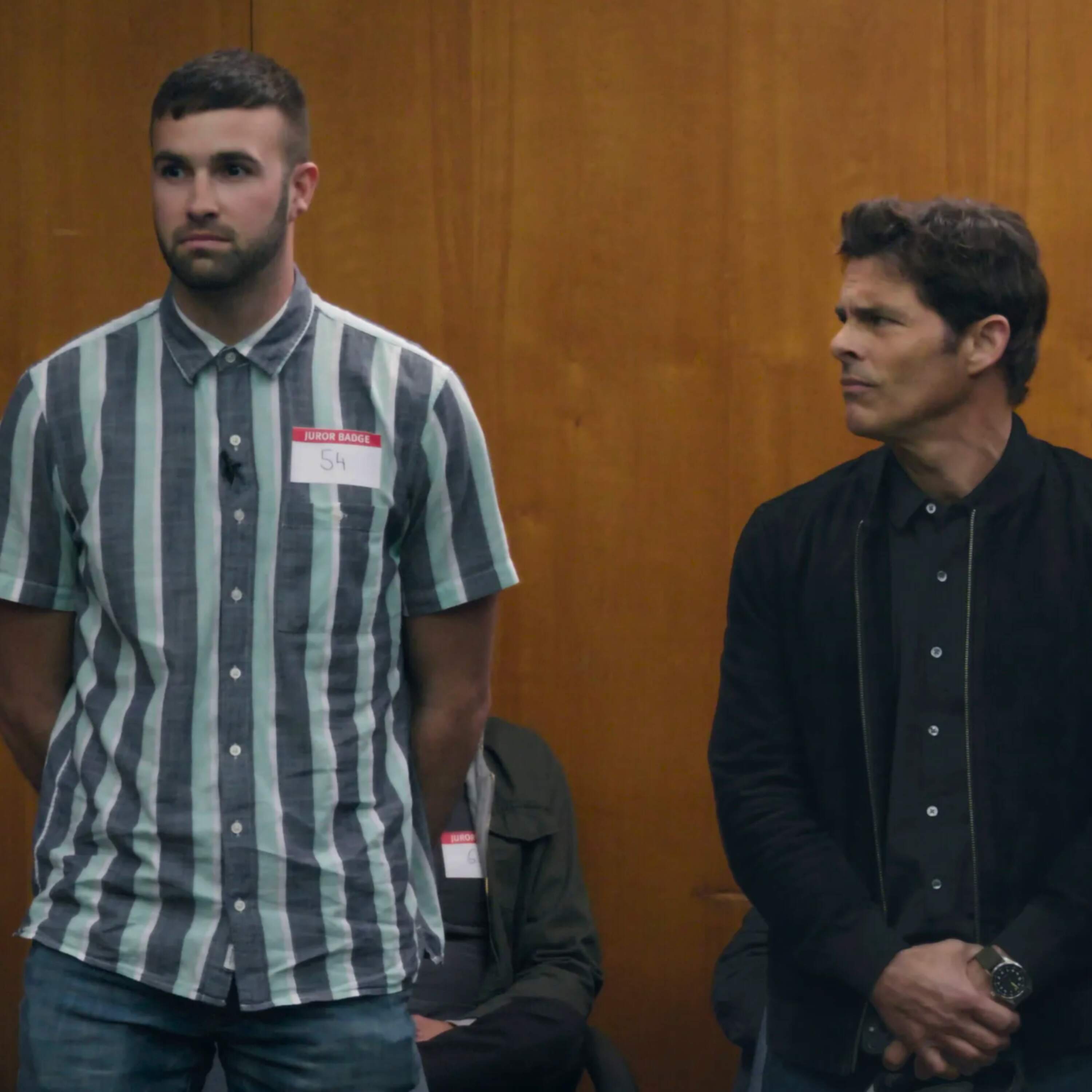
Loading summary
Transcript117 lines
- [00:00]
Announcer
This message comes from Capella University. That spark you feel, that's your drive. For more. Capella University's Flexpath learning format lets you earn your degree at your pace without putting life on pause. Learn more at Capella. Edu.
- [00:15]
David Biancolli
This is FRESH air. I'm David Biancooley. Jury Duty is the prime video streaming series about one unwitting regular guy who becomes part of a staged fake jury not knowing that everyone around him is a professional actor. Season two of Jury Duty premieres today on prime, but in a new setting, the corporate retreat of a fake hot sauce company called Rockin Grandmas, which is in the midst of a corporate takeover. Again, one lone employee knows nothing of the ruse and is surrounded by actors. The new season is called Jury Duty presents Company Retreat. Today we're going to Listen to our 2023 interview with James Marsden, the most well known of the actors in the original Jury Duty. In that show, a regular guy named Ronald Gladden had agreed to participate in a documentary about the experience of being a juror in an LA courtroom. He doesn't know that everyone around him, the rest of the jury, the judge, the witnesses, is an actor who is improvising. They're all kind of odd and their behavior is unpredictable. Even more so than in a regular reality show, Marsden plays a satirical, self absorbed version of himself, serving as an alternate juror. Marsden's other recent TV shows include Westworld and Dead to Me. And next month he joins the cast of Jon Hamm's Apple TV series, you, Friends and Neighbors. His films include The Notebook, the 2007 version of Hairspray, and Disney's Enchanted. He also played Cyclops in the X Men film franchise. We're going to listen to Marsden's interview with FRESH air Sam Brigger. Let's hear a clip from the original Jury Duty. The potential jurors are sitting in the courtroom waiting area and Ronald realizes that the man sitting next to him, his James Marston.
- [02:09]
James Marsden
Dude, that's where I know you're from. You're an ex man.
- [02:12]
Ira Glass
Oh,
- [02:14]
James Marsden
I've been thinking that this entire time. I didn't ask your name. Forgive me. Ronald. Ronald James. Pleasure. Nice to meet you. Yeah, I was trying to pinpoint it because I was like, I've seen you somewhere. Yeah, but I've been in like so much stuff. It's like X Men and Hairspray and Enchanted, Westworld and stuff like that, but Notebook. Oh, you're in Westworld. Yeah, yeah, I know him from the Notebook. He's in the Notebook.
- [02:43]
Actor/Performer
Nuh.
- [02:43]
James Marsden
What is he in the Notebook.
- [02:45]
Announcer
The other guy.
- [02:46]
James Marsden
He's the other guy. The guy she really should have got together with. Oh, my God, I haven't seen that movie in so long. I didn't even, I didn't realize I was looking at his socks over here. It looked like it said Sonic. And I'm in that movie Sonic. And I was like, does he have Sonic socks on? Shit. You're in the movie Sonic? Yeah, yeah. That's the one with the new one with Jim Carrey, right? Yeah, yeah, yeah. I heard that was not a good movie.
- [03:10]
Sam Brigger
That's a scene from Jury Duty with Ronald Gladden and my guest, James Marsden. James Marsden, welcome to FRESH air.
- [03:16]
James Marsden
Thank you, Sam. Happy to be here.
- [03:18]
Sam Brigger
It's great to have you here. So I just want to ask you first, when you heard about what the show was going to be about, did you have any reservations about doing it?
- [03:27]
James Marsden
I only had reservations. Yes, I did. Of course, it was a very ambitious conceit. I was approached by my friend David Bernad, who is a producer of the White Lotus. We've done a couple of projects together before. And he asked if I'd be interested in getting on a Zoom with Lee Eisenberg and Gene Stipnitsky at the Office, who I was a huge fan of that show. And he gave me sort of a basic one liner idea of the concept of the show, which is basically we're taking the Truman show and we're dropping it in the middle of jury duty. And I said, okay, well, let's expound on that. What's my part? What am I doing? And I got excited about all of the sort of improvisational element of the show and the sort of live theater part of the whole thing. So I'm a big Christopher guest fan. I loved the Larry Sanders Show. I love obviously Curb youb Enthusiasm and everything Larry David does. So it was, I was always looking for an opportunity to get in the room and play. But something like this was so unique, so different and original. And I was enthusiastic about being, being a part of something like this, but also apprehensive because I didn't know if it was going to work. And yeah, I had many reservations. And the biggest one was the wild card of this one human being who's being dropped into this situation that is all fake and manufactured and what that's going to be like. But I made it clear that it was important to me that I didn't want to be a part of a prank show. You know, I was not that I was not interested in being cruel or mean spirited at all. And they said, no, we're not interested in doing that either. What we're doing is we're creating a hero's journey for somebody. And what we're surrounding him with are these. This cast of bizarre, eccentric weirdos and hopefully carving out a path for him to become the leader at the end and have his 12 angry men moment where he inspires us all and unites us and then we pull the curtain back and celebrate him as a human being. And hopefully he.
- [05:40]
Sam Brigger
Show what it all about.
- [05:41]
James Marsden
Yeah, show him what it was all about and hopefully he takes that in stride. But who knows how he's going to react? So the sort of unknown was appealing to me, but it was also terrifying.
- [05:55]
Sam Brigger
So when you were thinking about making this satirical version of yourself, did you think about things about yourself that you don't really like very much and amplified them, or did you come up with like a completely different character? Like, what did you base that person on?
- [06:13]
James Marsden
You know, to me, it was just the idea of lampooning the cliche, you know, entitled, self absorbed, egocentric Hollywood actor was really exciting to me because I can, and I can, you know, I could do it as myself and hopefully by the end of it, everyone would know that I'm satirizing that character and it's not really me. There's something about playing someone who thinks that the world worships them when they actually don't at all. And watching that person, you know, get humiliated, fall on their face, get embarrassed by the lack of enthusiasm in the room. And I mean, this James Marston is always trying to get the conversation steered back to him because that's the only conversation he knows and it's the only conversation he's interested in.
- [07:07]
Roy Bookbinder
Right.
- [07:08]
Sam Brigger
Let's talk a little bit about the hero of the show, the real person, Ronald Gladden, like so much relied on this guy. Either it could have been a terrible experience for him or, like, I mean, he could have turned out to be a horrible person. It was a real tightrope walk, I think, to probably choosing the right.
- [07:23]
James Marsden
No, it was. I mean, there were a number of things that could have happened that would have torpedoed this whole endeavor. And we got really, really lucky with him, mostly with him, because he just is one of the kindest, empathetic, wonderful human beings that I've ever met. And he kind of took it all in stride and laughed it off and all the absurdity, the crazy things that are happening in the courtroom. So they did an amazing job of finding, finding him and Then we got to know him on day one, right when the camera started rolling. And I had only had a few days of rehearsal because I was finishing up Party down at the time. And the other cast members had another week and a half of rehearsals because it was very strategic on, very choreographed. Where do you sit? It's just intricate. And I remember thinking, just sweating bullets. Just like, I don't think I'm ready for this. I don't know if I'm gonna be funny. I don't wanna be the one to blow the whole thing.
- [08:25]
Roy Bookbinder
Yeah.
- [08:25]
James Marsden
But all they told us was, his name's Ronald Gladden. He's from San Diego. He's a solar panel contractor or something like that. And he's six foot six and have fun. And then, you know, the scripts say, this, and this is what happens. But you kind of had to be like water and flow and pivot when you needed to, because no one knew what he was going to say. No one would. No one knew if he would even recognize who I was.
- [09:00]
Sam Brigger
Well, he doesn't quite. At first, right?
- [09:02]
James Marsden
No, he doesn't. Which kind of comedy gold.
- [09:04]
Sam Brigger
Yeah.
- [09:04]
James Marsden
You know.
- [09:05]
Sam Brigger
Yeah. Well, I mean, that's a great part of that clip where he basically. You say, yeah, I was in Sonic. And he's like, oh, I heard that's a bad movie. Like, you. You must have wanted to crack up at that point.
- [09:16]
James Marsden
I did, but I knew that he just put a meatball right over a home plate for me to. You know, it was like, this is amazing that he just said that. And it gave me an opportunity to look as crestfallen as I could and sort of, you know, brush it off and remind him that I was in other stuff. And it was a big movie, and it did, you know, so it was perfect. I mean, it was really. There were moments where Ronald. There were scripted moments that he seemed to be ahead of us on, that he kind of led us to. There's a moment in that opening sequence where we're in the waiting room where Noah. There's an actor named Meki. He's one of our writers as well. Brilliant improv artist. And he plays Noah. He comes in and he says, hey, how do you. I need to get out of this. I'm going on a vacation with my girlfriend. Any ideas of how you can get out of this? And it's scripted that Noah proposes the idea that it's a good idea to present to the judge that you're racist, and that's why you should be let off. And before Mecky could Get to that beat. Ronald proposed. Hey, I saw this Family Guy episode where the guy says he's racist and tries to get out of jury duty with that.
- [10:34]
Sam Brigger
He also says, like, I don't know if I necessarily recommend doing this, but sure.
- [10:38]
James Marsden
Right. Right. Yeah. No, no. He was saying it sort of like laughing. Like, not. Yeah, don't do that kind of as a joke. Of course, he never expected this young man to actually use that tactic. And you see the terror in his eyes when Noah gets up in the voir dire and uses. You know. And that's the strategy that he goes for. Yeah, but it was really amazing because, you know, as. As much as you can prepare for something like this, there's 20, maybe 30% of it that is just like. You just gotta be nimble and go with the flow. And if you. If we want Ronald to take a left and he wants to take a right, you gotta take a right turn with him and adjust. And that was exciting and, like I said before, absolutely terrifying at the same time.
- [11:26]
Sam Brigger
I want to play a scene from the movie Enchanted. This is a Disney movie that spoofs the idea of Disney princesses and Prince Charming like, tropes. And you play Prince Edward. You and Giselle, who is played by Amy Adams, actually live in an animated world, a very Disney world. And the minute you meet, you sing a duet together and fall immediately in love. And your plan to get married, however, your stepmother doesn't want you to marry Giselle, so she pushes her down a magic well, and she lands up in the non animated, gritty world of New York City. I mean, gritty in a Disney sort of way, but. So she meets Patrick Dempsey and starts having feelings for him, and she starts to, like, learn to appreciate her new world. You've also jumped into the well to try to go find her, and here you finally have. And this is at Patrick Dempsey's apartment. He has a daughter. And this is when you see her for the first time.
- [12:25]
James Marsden
Giselle. Edward,
- [12:33]
David Biancolli
Could you.
- [12:34]
James Marsden
I'm sorry. Could you just be. Could you.
- [12:36]
Sam Brigger
Could you just be careful?
- [12:38]
Actor/Performer
You.
- [12:38]
Sam Brigger
What?
- [12:40]
James Marsden
You're the one who's been holding my Giselle captive.
- [12:42]
Interviewer (Terry Gross)
Just stay calm.
- [12:43]
James Marsden
No. Have you any last words before I dispatch you? You have got to be kidding me. Strange words. No, no, no. These are my friends. Oh. This is Morgan and Robert. This is Edward. I've been dreaming of a true love's kiss he sings too. And amiss I have begun to miss Pure and sweet Waiting to complete my love song yes, somewhere there's a maid I've Never met who was made who was maid to finish. What's wrong? You're not singing. Oh, I'm not. Well, I'm sorry. I was thinking. Thinking before we leave, there's one thing I would love to do. Oh, name it, my love, and it is done. I want to go on a date. A date? What's a date?
- [14:00]
Sam Brigger
That's my guest James Marsden in the movie Enchantment.
- [14:03]
James Marsden
It's so interesting just listening to the audio.
- [14:05]
Sam Brigger
Yeah, it's great audio. So you're doing like a sort of a Prince Charming voice there. Like, how. What are you doing?
- [14:15]
James Marsden
I mean, we went back and looked at all the old snow whites and. And, you know, the classic Disney princes and Sleeping Beauty, and they all had this sort of voice. You know, it was like. Like they loved the sound of their own voice and they loved I'm an actor or something. Yes, and yes, it was very, you know, back in the day, in the 40s or whatever, they were just taught to do, you know, speech. They had speech lessons. And what with the singing, I mean, I know that was an acapella bit, but when we actually recorded that song, I had vocal lessons from a coach who was taught operetta style singing. It was sort of Mario Lanza. You know, it wasn't. Because back in the. The older Disney movies, that's the kind of singing it was. It was a style of music or style of singing that I wasn't that familiar with and. And had to get up to speed. But, yes, it was. You know, I thought Edward was someone who always. Every. Every. Every statement is as simple or complex as it would be. Not that he was ever saying anything much complex, too complex. But had to be a proclamation, right?
- [15:28]
Ira Glass
Everything.
- [15:29]
James Marsden
I'll have a bagel, you know, and it had to have an exclamation point
- [15:34]
Roy Bookbinder
at the end of it.
- [15:35]
James Marsden
And I just think there was such a fun to be. Had to just be this unabashed, romantic prince who just is in love with being in love. He's in love with the idea of Giselle and he's love. And he's in love with his. The sound of his own voice and just goes through. Moves through life with just, you know, an optimism that's unmatched. And it was a lot of fun to play because obviously I'm wearing the big, giant puffy sleeves and swinging the sword and the hair is flopping around and, you know, just. It was a blast. It really was so much fun.
- [16:13]
Sam Brigger
You know, you've had quite a few roles where you play, like, the passed over romantic interest. Like there's this movie and the Notebook in particular. But you can even say like your character Teddy in Westworld, there's a little bit of that. Like, why did you think that you've had those roles? Were you typecast, do you think?
- [16:30]
James Marsden
I don't know. I mean, for a while it became, it started getting more traction than I ever had intended.
- [16:36]
Sam Brigger
Right.
- [16:37]
James Marsden
I mean, there were roles in between all of those big projects where I wasn't playing the, you know, the guy doesn't get the girl or the simp or whatever, you know, but it just so happens to be the ones that became big successes where there's ones with roles where, you know, whatever the movies I was playing, you know, the guy who ends up kind of getting cuckolded or whatever you want to call it. And it started to look pathological. Like I was choosing these on purpose and I'm like, no, no, no, no, no. This is not by design. It just sort of happened that way. So we didn't know Enchanted was gonna be just a massive hit. The Notebook became like, you know, this still to this day is incredible how the legs that that movie has.
- [17:22]
Ira Glass
Yeah.
- [17:24]
Sam Brigger
You know, I'm just wondering. I think it's objectively clear that you're a very attractive person. And I was wondering if you just like in your life did you ever have a realization of that, like and, and that that would mean that there would be sort of attention towards you, like maybe wanted attention or sometimes unwanted attention.
- [17:46]
James Marsden
Yeah, I guess there be there was a realization at some point. It's so funny though, because I was not that guy growing up. I really was not. I was goofy. I was, you know, I was the silly actor guy doing, doing bits. I didn't know how to get a good haircut. I didn't, you know, I didn't, I didn care what I was wearing. I just, you know, would have my shirt on inside out and mismatching socks. And it just, you know, in Oklahoma is like the girls want the like jock who's the quarterback of the football team is 6 foot 2 corn fed boy. And I was like this 145 pound shrimp who just was like, I can do a good Mike Myers. You know, it's not the sexiest thing in the world. I just never looked at myself that way until I turned about like 17 and it sort of started coming into myself and I started hearing it back from other people. Like, you know, I remember this girlfriend of mine, Leslie, in high school and she was like my pal. We were buddies and then when I got to senior year of high school, she was like, what happened to you? I'm like, what do you mean? She's like, you're actually kind of hot now. So it's like, wait, what? What does that even mean? And I wasn't the guy who was getting the girl in high school, and maybe that's why I was attracted to those role. But I did realize at some point that if you accept that as something that's part of your nature and it can be an absolute asset in this business, then embrace it and don't lead with it, don't rely on it as a crutch, and just treat it like it's a bonus. And I remember this acting coach once, I think there was an acting coach who came through Oklahoma once. I took his class and he said, he looked at me and he goes, you don't need to be thinking just something like marquee good looks, you know, superstar. He's like, you need to be thinking Jim Carrey because you look the way you do, but you need to be something else on the inside. I was like, yeah, actually, I relate to that way more. But you know, you could weaponize it a little bit in Hollywood. You can just be like, all right, hey, this is a good thing. It's gonna snare me some good roles and then I'm gonna show that I'm, there's, you know, more than meets the eye with my performance or with my take on it. And I never wanted to be the guy who was just cast as the good looking dude in a letter jacket.
- [20:11]
Sam Brigger
Well, James Marsden, it's been really great having you on. Thanks so much for being on FRESH AIR.
- [20:16]
James Marsden
Thank you for having me.
- [20:19]
David Biancolli
James Marsden in 2023, speaking with FRESH AIR's Sam Brigger. Marsden starred in the original Jury Duty and he's now one of the producers of season two, Jury Duty Company Retreat, which premieres today on Prime Video. Next, we remember blues singer, guitarist and captivating storyteller Roy Bookbinder. We listened Back to our 1987 interview with him and Justin Chang reviews the new film project Hail Mary. I'm David Biancooli and this is FRESH air.
- [20:50]
Announcer
This message comes from Betterment. You know, when you sell a stock or any investing asset and start to feel the dread of getting a surprise tax bill? Betterment's tax impact preview tool shows you the estimated tax impact of the sale so you can make informed tax smart investing decisions. Get started today@betterment.com investing involves risk performance, not guaranteed. Betterment is not a tax advisor nor should any information herein be considered tax advice, please consult a qualified tax professional.
- [21:20]
Sponsor/Advertiser
This message comes from Bombas. You need better socks and slippers and underwear because you should love what you wear every day. One purchased equals one donated. Go to bombus.com NPR and use code NPR for 20% off.
- [21:37]
Announcer
This message comes from Carvana Finance and buy your next vehicle with Carvana. Shop a huge selection, customize terms to fit your budget and buy completely online. No hassle, no pressure. Get the car you love the easy way with Carvana.
- [21:52]
Sponsor/Advertiser
This message comes from Grainger. Grainger knows that if you're the purchasing manager at a manufacturing plant, the only thing more important than having the right safety gear is having it there when you need it. That's why you can count on Grainger for auto reordering, helping ensure your team members always have cut resistant gloves on hand and each shift can run safely and efficiently. Call 1-800-GRAINGER, click grainger.com or just stop by Grainger for the ones who get it done.
- [22:20]
David Biancolli
Roy Bookbinder, the raconteur and acoustic musician known for playing Southern blues and hillbilly music, died March 3 at the age of 82. Known as the Traveling man or the Book, he picked up the guitar after a tour of duty in the US Navy, purchasing it in Italy. Once in the US he became part of the folk and blues revival in New York's Greenwich Village. He sought out and became a student and then a friend of blues and gospel musician Reverend Gary dav. Bookbinder also went south to track down one of his favorite performers, Pink Anderson, who had played for decades in medicine shows. Bookbinder's debut album, Travelin man, was released in the early 1970s on Adelphi Records to critical acclaim. Soon after, he took to the road for years in an Airstream motorhome, traveling to major blues and folk festivals in the US And Canada, and he also toured in Europe. He shared the stages with Bonnie Raitt, B.B. king, Doc Watson and more. In the late 1980s, he made nearly 30 appearances on Nashville, now on cable TV's the Nashville Network. He released more than a dozen albums overall, some on his own label, Peg leg Records. In 1987, Roy Bookbinder brought his guitar to Fresh AIR to visit with Terry Gross, play music and tell some great stories.
- [23:47]
Interviewer (Terry Gross)
Roy Bookbinder, welcome to Fresh air. And before we talk, can you get us started with a song?
- [23:52]
Roy Bookbinder
Sure can.
- [23:55]
Actor/Performer
Call me a dog when I'm gone. It's old black dog when I'm gone, But when I get home with a ten dollar bill it's daddy where you been sitting so long? Well, I've been all around Kentucky in the state of old Tennessee. Call me a dog when I'm gone Lord, Lord oh black dog when I'm gone When I get home with a ten dollar bill Is Daddy where you been so long? My daddy was a gambling man from the state of old Tennessee he told me to bet all of my money on Ace, Jack, that deuce and a tray. Go pick it, Roy. See that train it's come in carrying my baby away it's going off far to leave me Ain't never coming back my way and it's old black dog when I'm gone, Lord, Lord, it's old black dog when I'm gone But when I get home with a ten dollar bill Daddy where you so long.
- [26:18]
Interviewer (Terry Gross)
Black Dog Blues, performed by my guest, Roy Bookbinder. You know, I think there are a couple of traps that some white northern performers have fallen into when performing Southern based music. And I'm thinking, for instance, that some people seem to have almost lost their own voice when they sing. If they're singing black based music, they get a completely different voice and try to sound like an older black man from the South. And I wonder if it was ever hard for. For you to find your own voice in your singing.
- [26:44]
Roy Bookbinder
Well, I started out with very little and it's growing. I remember when Bob Dylan's first record came out, I said, okay, I'm going to be a singer. If he can get away with that, I'm going to get away with this. And back in the early 60s, I moved south when I was 18, the first time I joined the Navy. Ran away to sea and moved to Virginia. And I've been headed south ever since. And I've been lucky to have been associated with some great masters of the industry. Some of them knew they were masters and others didn't.
- [27:13]
Interviewer (Terry Gross)
Well, you spent some time trying to track down one of the musicians who you like most, Pink Anderson. And he's someone that probably a lot of our listeners aren't familiar with. Tell us a little bit about him and then I'll ask you to do a song by him.
- [27:26]
Roy Bookbinder
Pink Anderson was from Spartanburg, South Carolina. He made two records in 1929. That was that. He disappeared from the recording industry. He spent his entire career working medicine shows, little, little carnival deals throughout the South. He worked with Chief Thundercloud's medicine Show up until about 1959 when I met him. He was retired, had a heart attack and didn't tour at all. And when I met Pink, he was not in great shape. But me and my friend Paul Jeremiah started to visit him. And, you know, one point we realized the worst thing about his health was he was starving to death down there. And he started to play again. And we took him out on tour once before he died. And it was quite a deal. Pink Anderson's music, He was a carnival performer. And his songs were white, black and blue. You know, they were mixed up. The song that I'm going to do next, Traveling man, has become my theme song. And it's a song that everybody in the folk field always identified with. Pink Anderson, knowing that he probably didn't write it. But it's a song that goes back to minstrel shows. And it was probably a song written by a white man on Broadway. Like, so many times you get a song from a New York writer on Broadway. What was Tin Pan Alley? And it filters down to the rural community. And then it's found by some folklorist as what a find. It happened throughout the history of country music and blues.
- [28:53]
Interviewer (Terry Gross)
Can you do a song for us from Pink Anderson?
- [28:55]
Roy Bookbinder
This is the old Traveling man song. Came a Long way.
- [29:02]
Actor/Performer
Well, I just want to tell you about a man named Boone. His home was down in Tennessee. He made his living he was stealing chickens and anything that he could see that popeyed man has said he runs so fast that his feet never stayed in a row When a freight train passed didn't matter how fast he'd always get on board. He was a traveling man Certainly was a traveling man. He was the most travelingest man that ever was in that land. Traveled everywhere, known for many miles around. But he didn't get caught in. He never got whooped till the police shot him. You know that the police shot that man with a rifle. The bullet went through his head. People, they were coming from miles around Just as if that boy was dead. They telegram down south where his mama lived and she was all upset when with tears she walked up and opened up the coffin's lid. But that fool had disappeared. He was a traveling man Certainly was a traveling man. He was the most travelingest man ever in that land. Traveled everywhere, Known for many miles around. Didn't get called in and never got whooped till the police shot him. You know, this boy went down to the spring one day to get himself a pail of water. The distance that the rascal had to go was about two miles and a quarter. He got there and got his water and he started back, stumbled and fell down he ran back the house Got himself another bucket Caught the water before it touched the ground he was a traveling man Certainly was a traveling man he was the most travelingest man ever in that Traveled everywhere Known for many miles around he didn't get caught and he never got whooped until the police shot him. Now listen, this boy was out on a Titanic ship the day it was sinking down he was standing out by the railing from had his head hung down when that boy jumped overboard Everybody said he was a fool but about two minutes right after that While he was shooting dice in Liverpool he was a traveling man Certainly was a traveling man he was the most traveling est man ever in that land Traveled everywhere Known for many miles around but he didn't get caught in and never got whooped until the police shot him down Old picket Roy. Police caught the traveling man at last Then they had him up to hang One day the jurymen they all asked that man Just what did he have to say he begged the jurymen if they would bow their heads Bow their heads in prayer and then he crossed one leg and he winked one eye and he went up through the air he was a traveling man.
- [32:56]
Interviewer (Terry Gross)
Traveling man Did Pink Anderson teach you that one?
- [33:00]
Roy Bookbinder
Well, he didn't directly teach it to me, but I watched him play it right. He actually played it in a different key.
- [33:07]
Interviewer (Terry Gross)
Was he surprised to see you tracking him down, wanting to learn his songs? If he'd only recorded two songs, he must have been pretty obscure in musical terms.
- [33:15]
Roy Bookbinder
Oh, he went nuts when I went down there. I was sitting on his front porch. That's a long story. I don't have time to tell you the whole thing, but he came down the street and I walked up the street towards him. I was playing the guitar on his step. I looked at him, I said, you must be Pink Anderson. He said, how did you know that? I said, lady in the house said you went to the dry cleaners this morning. This is a dead end street and you're carrying clothes. He said, you been to college? I said, some. He thought I was pretty smart. I told him I've been looking for him for 36 hours. He asked me if I owed him money. I said, no, sir, I owe you money. He says, you do? How much? I said, $50. He says, give it. Cheers. I give him a $50 bill. He looked at it, snapped it twice, put it in his pocket. And then he inquired, how did it come to be that I had owed him this small fortune. I told him I made a record of one of his songs, he said, was it a hit? I said, you be the judge. We became real good friends. He told me before he died. He says, roy, that's what he always called me. I said, pink, he says, you know them old songs of mine you can almost play, right? I said, yeah. He says, well, I'm giving them to you. They're yours now. You just tell people, Pink Anderson, born and getting ready to die in Spartanburg, South Carolina, used to pick a guitar
- [34:22]
David Biancolli
and sing Roy Bookbinder in the FRESH air Studios in 1987. More after a break. This is FRESH AIR.
- [34:31]
Announcer
This message comes from Carvana, who makes car selling easy. Enter your license plate or vin, get a real offer in minutes and have your car picked up from your door. Sell your car the easy way with Carvana. Pickup fee may apply.
- [34:44]
Sponsor/Advertiser
This message comes from Grainger. Grainger knows that if you're the purchasing manager at a manufacturing plant, the only thing more important than having the right safety gear is having it there when you need it. That's why you can count on Grainger for auto reordering, helping ensure your team members always have cut resistant gloves on hand and each shift can run safely and efficiently. Call 1-800-GRAINGER Click grainger.com or just stop by Granger for the ones who get it done. This Message comes from Capital One, presenting sponsor of the 2026 Tiny Desk Contest. NPR Music's annual Tiny Desk Contest called on musicians from all corners of the country to submit an original song performed behind a desk. The lucky winner will play a Tiny Desk concert and headline a tour with NPR Music this summer. While the judges are busy reviewing the entries, you can follow along and choose your favorites. Explore a variety of original talent with videos performed everywhere from bedrooms to staircases to rooftops. See where this year's entries will take you@npr.org tinydeskcontest and travel even further with the Capital One Venture X card, offering premium benefits like a $300 annual Capital One travel credit, plus earn unlimited double miles on every purchase. What's in your wallet? Terms apply. See capitalone.com for details.
- [36:07]
Ira Glass
This is Ira Glass of this American Life. Do you know our show? Okay, well, either way, I'm gonna tell you about it. We make stories that hopefully pull you into the beginning with funny moments and feelings and people in surprising situations. And then you just wanna find out what is gonna happen and cannot stop listening. That's right. I'm talking about stories that make you miss appointments. This is American Life. Wherever you get your podcasts, let's Talk
- [36:32]
Interviewer (Terry Gross)
a little bit about Reverend Gary Davis, who you also met. And I think this was before Rediscovered. He had already been rediscovered.
- [36:42]
Roy Bookbinder
Oh, he was semi famous when I met him. He already was living in a little house in Jamaica, Queens.
- [36:47]
Interviewer (Terry Gross)
What's some of the strumming or finger picking style that you learned from him?
- [36:50]
Roy Bookbinder
Well, Reverend Davis, he had a number of styles. He had his simple little style like he did Candyman. And he did the cocaine blues and he did Delia. And then he'd get a little more complex in his blues, like the hesitation blues. Nickel is a nickel and a dime full of children ain't one of them mine. It was one of his other styles. And he had an instrumental style where he imitated the piano and played ragtime pieces. Which was really fascinating to the young guitar players that came around. There was a lot of interesting things going on in there. It took a lot of time for some of us to get it. Some longer than others.
- [37:30]
Interviewer (Terry Gross)
Most blues musicians have many stories to tell about getting ripped off while they were on the road. And I wonder if that was any worse for getting Gary Davis, since he was blind. And it would have been that much easier for people to take advantage.
- [37:43]
Roy Bookbinder
Well, he was taking advantage of a lot when he was singing on the streets for many years in Harlem. He'd lose guitars and what have you. First lesson, Reverend Davis told me. We got to our first room in house out somewhere near Chicago. And Reverend Davis was getting ready to go to bed. He says, now, Roy, you got to understand. He said, we're in a strange city and a strange house here. And I don't like the house much. I said, well, how come? He said, they're not taking care of this house? I said, well, how do you, blind man? I said, how do you know that? He said, well, the doorknob's loose. I checked it on the way in. He said, when you go to sleep, the first thing you do, he says, is you take out your knife. He reached in his pocket and pulled out a knife about 12 inches long. I about had a heart attack. He says, you take your knife and you put it under your pillow. He said, then you get your pocketbook. And he reached down his long jaws and pulled out his little leather purse. He kept all his money in. He always traveled with some money. He said, you put that inside your pillowcase. He said, somebody comes for your pocketbook, you know where your knife is. You go to sleep with your hand on your knife. And he goes to sleep. Next morning, about 5:30 in the morning, Reverend Davis was screaming, good God Almighty.
- [38:43]
Actor/Performer
Lord have mercy.
- [38:45]
Roy Bookbinder
That could mean anything. I said, reverend Davis, what's the matter? I mean, I was in dreamland. Get woken up like that. I mean, he was in his 70s, the old blind man, and he was hysterical. I said, what's the matter? He says, they done got my pocketbook. I said, oh, Lord have mercy. And we're crawling around the room and he's screaming, who got his pocketbook? How'd somebody get in this room? He knew that door wasn't good. And didn't you hear nobody? My heart was beating a mile a minute. I'm searching all over this room. Finally, I found his pocketbook under the bed. I says, reverend Davis. He says, roy. That's what he always called me. I said, I found your pocketbook. All the money's in there. Don't worry. He said, good God Almighty, where was my pocketbook? I said, you got to remember something when you go on the road. He says, what's that? I said, you went to sleep real late and you were tired, and I think you put your pocketbook underneath your pillowcase and your knife inside your pillowcase and you got it mixed up and your pocketbook fell behind your pillow onto the floor. Oh, he had a fit. Give me that pocketbook. Where's my knife? Put all this stuff away.
- [39:44]
Interviewer (Terry Gross)
Can you play us a song that you learned from Reverend Gary Davis?
- [39:48]
Roy Bookbinder
Yeah, let me play a song that I wrote in the style of Reverend Gary Davis. It was a song he always did called I'll Be all right Someday. And I loved that song. Always wanted to learn how to play it. Finally figured out the basics of it and came out with a little arrangement. And I decided I really couldn't. I didn't feel comfortable singing the words that he wrote for it. It was one of these biblical epics. He had some that went on for 15 minutes, you know, and we came out with this. It's called I'm Going Home Someday.
- [40:25]
Actor/Performer
If my road is rocky and my journey's rough if I stumble and I fall well, I'll pick myself up Keep marching forward and I'll drive these blues
- [40:44]
Roy Bookbinder
away
- [40:48]
Actor/Performer
I've been a gambling man I've been a cheat I've often lost my way I've seen the darkness Want to see the light Trying to start a
- [41:05]
Roy Bookbinder
brand new day
- [41:09]
Actor/Performer
yes, I'm going home I'm going home I'm going home someday Temptation casts Won't take no devil ride I'm going home someday Wind is blowing hard Rain is coming down and I can't keep myself warm, but I'll keep searching for better days than a sheltered port from the storm. I'm going home. I'm going home, I'm going home someday. Temptations cast aside won't take no devil right? I'm going home someday. Going to see my mother, going to see my father, Going to see my baby brother, too. And when I get there, I won't have to worry. I'll know just what to do. I'm going home, I'm going home, I'm going home, I say temptation cast aside won't take no devil ride. I'm going home someday.
- [43:07]
Interviewer (Terry Gross)
Great song.
- [43:08]
James Marsden
Thank you.
- [43:09]
David Biancolli
Roy Bookbinder visiting the FRESH air Studios in 1987. He died March 3rd at age 82. Coming up, Justin Chang reviews the new Ryan Gosling film project Hail Mary. This is FRESH air.
- [43:24]
Announcer
This message comes from Carvana, who makes car selling easy. Enter your license plate or vin, get a real offer in minutes and have your car picked up from your door. Sell your car the easy way with Carvana. Pickup fee may apply.
- [43:37]
Sponsor/Advertiser
This message comes from Granger. Granger knows that as an H Vac technician, you and your digital multimeter are in high demand. So when a noisy office H Vac turns out to be a failing blower motor, you don't break a sweat. With Grainger's Easy to Use website and product information, you can select the product you need to keep everything humming right along. Call 1-800-GRAINGER, click grainger.com or just stop by Grainger for the ones who get it done. This Message comes from Capital One, presenting sponsor of the 2026 Tiny Desk Contest. NPR Music's annual Tiny Desk Contest called on musicians from all corners of the country to submit an original song performed behind a desk. The lucky winner will play a Tiny Desk concert and headline a tour with NPR Music this summer. While the judges are busy reviewing the entries, you can follow along and choose your favorites. Explore a variety of original talent with videos performed everywhere from bedrooms to staircases to rooftops. See where this year's entries will take you@npr.org tinydeskcontest and travel even further with the Capital One Venture X card, offering premium benefits like a $300 annual capital one travel credit, plus earn unlimited double miles on every purchase. What's in your wallet? Terms apply. See capitalone.com for details.
- [45:01]
Ira Glass
This is Ira Glass of this American Life. Do you know our show? Okay, well, either way, I'm going to tell you about it. We make stories that hopefully pull you in at the beginning with funny moments and feelings and people in surprising situations and then you just want to find what is going to happen and cannot stop listening. That's right. I'm talking about stories that make you miss appointments. This is American life.
- [45:23]
David Biancolli
Wherever you get your podcasts Ryan Gosling played an astronaut eight years ago in the Neil Armstrong drama First Man. He returns to space in the new science fiction adventure project Hail Mary, but this time he's playing a scientist on a lonely mission to save Earth from destruction. The movie was directed by Phil Lord and Christopher Miller of the animated Spider Verse series, and it's based on a novel by Andy Weir, author of the Martian. Project. Hail Mary opens in theaters this week and our film critic Justin Chang has this review.
- [45:58]
Justin Chang
Project Hail Mary is about an astronaut who finds himself abandoned in outer space, where he bonds with a cute alien who tries to help him save Earth from climate change. I hate to describe a movie as a mashup of this and that, but sometimes there's no way around it. This film is basically the Martian meets ET by way of interstellar. That's a handy way of summing up its appeal, but it also points to its very real limitations. I had high hopes for Project Hail Mary, but it's the most derivative and carefully manufactured crowd pleaser I've seen in a while. It doesn't feel like storytelling so much as mechanical engineering. Somewhere millions of miles from Earth, an astronaut named Ryland Grace, played by Ryan Gosling, awakens from a years long coma to find himself all alone on an unmanned spacecraft. The two other astronauts on board are dead and Grace has temporary amnesia with no idea who or where he is. It's a fairly chilling premise on paper, but from the start the movie plays the situation for laughs. Grace flails and falls all over the place. Gravity is in full effect. But although Gosling is a nimble physical comedian, I had trouble buying his performance. Grace might be all alone in space, but he seems to be mugging for the camera as if he knew there was an audience watching him. In time, Grace's memories begin to return. In regular flashbacks, we see him back on Earth teaching middle school science. He's approached by a government official named Eva Straat, a terrific Sandra Houler who wants to recruit him for a top secret mission called Project Hail Mary. She knows that years ago Grace was one of the most important molecular biologists in the U.S. long story short, the sun is being devoured by aggressive microbes called astrophage. If nothing is done, the resulting global cooling will wipe out a huge chunk of Earth's population. Over the next few decades, Grace was chosen to join a crew of astronauts who would venture into deep space seeking a solution to the astrophage problem. Now, with his colleagues dead, he really is Earth's last hope. Before long, the movie's ET Component kicks in. Grace meets an alien from another spaceship who looks a bit like a crab made of sandstone and whom he nicknames Rocky. Rocky's home planet Arid, is also being threatened by astrophage, and in time, he and Grace become friends and team up to save their respective worlds. That isn't easy, since Rocky and Grace don't speak the same language, but Grace devises a clever communication system using laptop voice translation software. In this scene, Rocky that's the gifted puppeteer James Ortiz doing the voice and movements, encases himself in a protective airtight ball and comes aboard Grace's ship.
- [49:06]
Sam Brigger
Hi Grace, you're in a ball.
- [49:09]
James Marsden
So Rocky no die in Grace atmosphere. I come up.
- [49:12]
Ira Glass
Oh, you're coming up foreign for me,
- [49:14]
Actor/Performer
Detective Grace and Rocky big science how
- [49:16]
James Marsden
to kill Astro together. I keep going this way. This room boring Science save Earth, save Eris.
- [49:23]
Actor/Performer
Good plan.
- [49:24]
James Marsden
Put this down here. Question Amaze, amaze, amaze. Rocky want to see human technology? Dirty, dirty, dirty, dirty, dirty.
- [49:33]
Actor/Performer
Why room so messy?
- [49:34]
James Marsden
I wasn't expecting company, was I?
- [49:37]
Justin Chang
Like the Martian, Project Hail Mary was adapted by the screenwriter Drew Goddard from a novel by Andy Weir. But any comparison between the two only makes the Martian look better. In that 2015 film, the director Ridley Scott let the comedy rise naturally from an inherently tense and suspenseful story. But Project Hail Mary was directed by the duo of Phil Lord and Christopher Miller, who specialize in zippy irreverence. I've loved many of their earlier comedies, from 21 Jump street to the Lego Movie and also their work as producers on the mind bending spider verse films. Here they've made a buddy comedy about saving the world, and although Rocky and Grace's bond has a lot of charm and moments of deeper connection, it's also more than a little exhausting. The tone of the story is so flippant and the emotional beats so preordained that the larger stakes pretty much evaporate. It's as if the filmmakers had cooked up an elaborate world threatening scenario just so that our protagonist could go off and have a close encounter of the therapeutic kind. You could say something similar about Interstellar, but Christopher Nolan's film had an operatic power and a crazy conviction that compelled you to believe in it. Project Hail Mary feels glib and earthbound by comparison. It has a couple of strikingly shot set pieces, including a harrowing visit to another planet that might hold the key to survival. But the movie, for all its wondrous production design, doesn't have the hypnotic visual power of the best space epics. It never clues you in to what Grace must surely, on some level, be experiencing the terrifying vastness of outer space and the fear of never being able to find your way home.
- [51:33]
David Biancolli
Justin Chang is a film critic for the New Yorker. He reviewed Project Hail Mary, starring Ryan Gosling, on Monday's show, actor Riz Ahmed on his new prime video series, Bait, playing a British Pakistani actor auditioning to be the next James Bond. He's also a writer and creator on the series, and he stars in a new film adaptation of Shakespeare's Hamlet. Hope you can join us. For Terry Gross and Tanya Mosley, I'm David Biancooli.
- [52:03]
Announcer
This message comes from Instacart Instacart makes grocery shopping easier. And just because you're not doing the shopping yourself doesn't mean you don't care how it's done. With Instacart Shopper Notes, you can add details about what you want right in the app, like extra crispy rotisserie chicken or lettuce you'd pick yourself. Just leave a note so your shopper can get it right without having to ask. Download the Instacart app and shop today.
- [52:27]
Ira Glass
This is Ira Glass of this American Life. Do you know our show? Okay, well, either way, I'm going to tell you about it. We make stories that hopefully pull you into the beginning with funny moments and feelings and people in surprising situations. And then you just want to find out what is going to happen and cannot stop listening. That's right. I'm talking about stories that make you miss appointments. This is American Life. Wherever you get your podcasts.