← Fringe Beyond Limits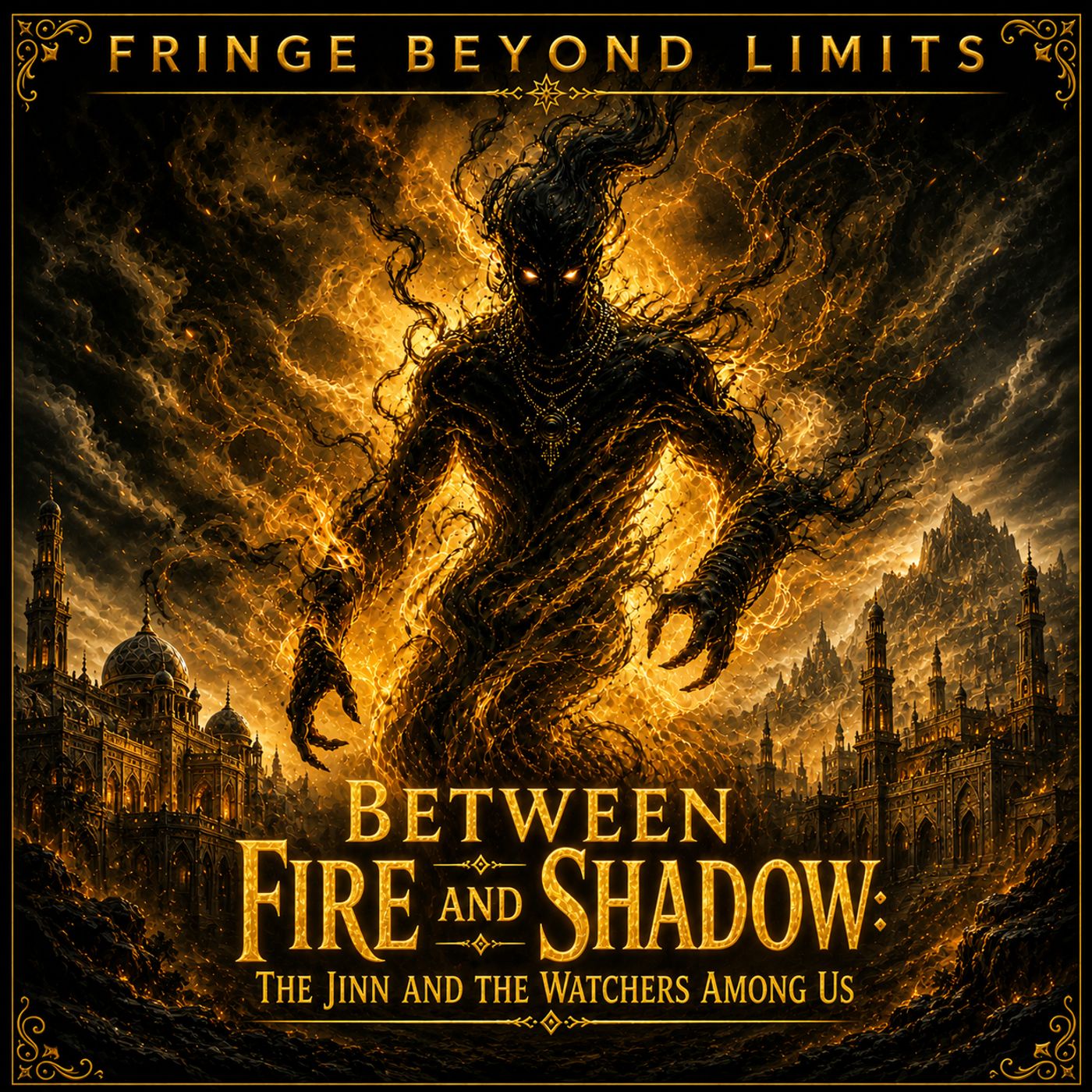
Fringe Beyond Limits
Between Fire and Shadow: The Jinn and the Watchers Among Us
00:59:17
On this episode of Fringe Beyond Limits the hosts explore jinn and shadow figures, tracing accounts from Islamic tradition alongside modern reports of sleep paralysis and shadow people. They share historical cases and eyewitness stories, consider how these beings might observe or attach to people, and discuss the overlap between cultural explanations and scientific interpretations. The conversation invites listeners to ponder whether these persistent reports point to an external presence operating at the edges of perception or to internal experiences shaped by the mind, or perhaps a mix of both.
Loading summary
Transcript233 lines
- [00:01]
Oregon Lottery Announcer
Oregon parks make an Oregon summer. But what makes an Oregon park? Well, Oregon Lottery gameplay helps no matter the game Megabucks, video lottery or keno funds from lottery games help support parks projects across the state, ensuring they stay safe, accessible and open for all. In fact, Discover State Park Scratches are in stores now. It's the perfect way to put a little bit of Oregon's parks in your pocket. The Oregon Lottery. Together we do good things. Must be 18 or older to play. Lottery games are based on chance and should be played for entertainment only.
- [00:30]
Stitch Fix Advertiser
Stitch Fix. Stop shopping. Get styled a on the outfit. Ms. Turner, you are about to slay parent teacher conferences.
- [00:38]
Frank
Oh, these just the most perfect fitting jeans my stylist sent me. Oh, hello, you who didn't set one
- [00:44]
Lynette
foot in a mall and still looks amazing.
- [00:47]
Stitch Fix Advertiser
Just share your size, style and budget and your stylist sends personalized looks right to your door. Stitch Fix get started today@stitch fix.com to my stylist, this look is dedicated to you. Thank you. Thank you.
- [01:01]
Podcast Host/Producer
The Colonels cooked up a new $10 bucket of the day just for you. Monday, 24 nuggets for $10. Tuesday, eight piece fried chicken for $10. Wednesday, 10 wings for $10. Thursday, eight tenders for $10. Friday, 24 nuggets for. Oh, you guessed it, didn't you? $10 finger licking machine. The $10 bucket of the day deal every weekday only at KFC. It's finger licking. Good.
- [01:26]
Frank
Prices and participation vary while supplies last
- [01:28]
Lynette
not available on third party ordering platforms.
- [01:30]
Livy Dunn
Tax extra.
- [01:31]
Frank
Sam. Welcome to another episode of Fringe Beyond Planets. What up, ladies?
- [02:17]
Bri
Howdy ho, Silver.
- [02:21]
Frank
Wow, you guys are a little lively tonight. I like that.
- [02:30]
Bri
Bri, you made me sound like a liar.
- [02:33]
Lynette
It's all the shrooms. Mushrooms.
- [02:35]
Frank
Oh, yeah. Let's do some
- [02:40]
Bri
portabella. Oyster, shiitake. Do you.
- [02:45]
Lynette
Do you do a lot of mushroom hunting in Tennessee now?
- [02:49]
Bri
I tried last fall. Fall is like the big mushroom season. No matter where you go, there's not a ton of great ones in the spring. I didn't have much luck. I'm sorry. The soil is so heavy. Clay area. Aren't you? I. I know, but I think it's because the soil is so heavy. Clay. That sucks.
- [03:09]
Lynette
Yeah, like you don't miss the governor of Tennessee.
- [03:13]
Bri
I'm gonna ask for all the dirt to be replaced. Yeah, he's got bigger problems. He's already trying to like, tackle the alien situation and disclosure. So he's doing good things.
- [03:25]
Frank
All right.
- [03:25]
Lynette
Just keep sending him messages every month.
- [03:27]
Frank
Yeah. Be like, I want your platform to
- [03:30]
Bri
be soil, I need mushrooms.
- [03:35]
Frank
All right, anybody else with anything else to say? I have nothing, FYI. Okay.
- [03:47]
Bri
No.
- [03:47]
Frank
Okay.
- [03:48]
Bri
I was like, I'll take that as a nope. Me neither. What do we got today?
- [03:52]
Lynette
Yeah, my birthday's coming up. I mean, by time this is published, be past my birthday.
- [03:58]
Frank
Well, happy birthday.
- [04:00]
Bri
Thank you. Happy birthday.
- [04:04]
Lynette
I'm getting old. President.
- [04:09]
Frank
Happy birthday to you.
- [04:18]
Carter's Advertiser
Yeah.
- [04:18]
Lynette
Frank, you just wrote it.
- [04:20]
Frank
Sweet.
- [04:21]
Bri
So I think to all the listeners who are like, why do they take so long to get, like, started on their episodes? We're just warming up our vocal cords. Yeah, Me, me, me.
- [04:30]
Frank
Yeah. And also we. We really don't talk much during the week at all. So this is kind of like also our catch up time, and we thought we would share a little bit of our lives with you at the same time.
- [04:42]
Bri
Yeah, it's also our mustard time.
- [04:44]
Frank
Yeah, mustard gas.
- [04:47]
Lynette
Mustard's good on hot dogs.
- [04:49]
Frank
I agree. All right, so here we go, ladies. There is a moment most people experience, but almost no one talks about. It happens in that fragile space between waking and sleep, when your body begins to shut down, but your mind lingers just long enough to notice the silence settling around you. The room feels familiar, safe even. But something shifts in a way that is difficult to explain. It is not a sound, not a movement, not anything you could point to if asked. It is simply a feeling, subtle at first, like the air itself has changed density. And then comes the awareness, not of something in front of you, but something just outside your direct line of sight. Something you cannot quite see, but somehow know is there. Watching, waiting. Not approaching, not retreating, just present in a way that feels deliberate. For thousands of years, across deserts, across cities, across cultures that never touched, people have described the exact same moment. Different languages, different beliefs, different explanations. But the experience remains eerily consistent. Some have called them spirits. Others have called them demons. In modern times, people call them shadow figures, watchers in the dark. Shapes that move when you're not supposed to see movement. But long before any of these names existed, before psychology, before modern science, before the idea of hallucination could even be articulated, there was another word. A word rooted in one of the oldest continuous traditions on earth. A word that did not describe them as ghosts of the dead or tricks of the mind, but as something entirely separate. Something that existed alongside us, not within us. That word is gin.
- [06:54]
Bri
Oh, I like gin.
- [06:55]
Frank
It is good. I like a good gin martini.
- [06:59]
Lynette
I don't think I've ever had gin.
- [07:01]
Frank
You're missing out.
- [07:02]
Lynette
I'm trying to think back of all the Cocktails I had.
- [07:04]
Bri
I don't think I've ever had gin.
- [07:06]
Lynette
Is this it? Like an earthy flavor?
- [07:08]
Bri
Herbal? Yeah.
- [07:09]
Frank
Yeah, I guess.
- [07:11]
Bri
Yeah. It's made with herbs. Okay, herbs. Particularly juniper.
- [07:19]
Frank
Anywho, and tonight, the question is not simply what they are. The question is far more unsettling. What if they have been here the entire time, watching humanity grow, evolve, question and forget, while they remain exactly what they have always been? So long before humanity entered the picture, before cities rose and fell, before language carved meaning into sound, Islamic tradition describes a world that was not empty. It was inhabited not by animals in the way we understand them, but by beings capable of thought, choice, and consequence. The Jinn, created from what is described as smokeless fire, a concept that does not translate cleanly into anything physical we can observe today, but suggests something energetic, something not bound by the same limitations as flesh and bone. They were not mindless. They were not simple. They formed societies, established hierarchies, lived in groups. And most importantly, they possessed free will. And with free will comes divergence. Not all Jinn were alike. Some followed order, others rejected it. Some coexisted, others fought Islamic tradition. And later, scholarly interpretations describe a period where the Jinn inhabited the earth in great numbers. And over time, conflict became inevitable. Violence, corruption, division. Patterns that would later define humanity were already present before humans ever existed. This detail often goes overlooked, but it reframes something important. When humanity was introduced into the narrative, it was not stepping into a blank world. It was stepping into something they had already been shaped, already influenced, already tested by another intelligent species. This is where one of the most referenced moments in Islamic cosmology occurs, When God announces the creation of humans. The angels respond with a question that has echoed through centuries of interpretation. They ask, why create a being that will cause corruption and shed blood? It is a question that implies precedent. It suggests that the concept of destruction was not hypothetical, had already been witnessed. And if that is the case, then the behavior attributed to humanity was not uniquely human at all. It was something that had already existed, something that had already unfolded once before, carried out by the Jinn themselves. So among the Jinn was one who rose above the others, not through power alone, but through devotion. His name was Iblis. Unlike angels, who are described as beings of pure obedience, Iblees had choice, and for its time, he chose alignment. His devotion elevated him to a status where he existed among angels, not as one of them, but as something close enough to stand in their presence. And then came the moment that would define everything that followed. When Adam was created, the Command was given to all people present to bow, not in worship, but as an acknowledgment of this new creation. Every being obeyed every being except one. Iblis refused not because he misunderstood, not because he hesitated, but because he made a judgment. He believed himself superior. His reasoning was simple, almost disturbingly human in his logic. He was made from fire, something he viewed as dynamic, powerful, superior. Adam was made from clay, something he viewed as static and lesser. From that belief came refusal. From refusal came consequence. Iblees was cast out, stripped of his elevated status. And in that moment he made a declaration that still sits at the core of Islamic belief. He would not simply exist outside the system. He would oppose it and would mislead humanity, whisper into their thoughts, influence their decisions, and remain present in a way that was never fully visible but always potentially impactful. This is where the narrative of Jinn intersects directly with human experience, not as distant beings in another realm, but as entities that can influence, observe, and interact in ways that are subtle enough to be dismissed and consistent enough to be questioned. In Islamic theology, the jinn are not described as beings that exist far away or in some unreachable dimension. They are described as existing alongside us in what is referred to as the unseen, a layer of reality that overlaps with our own but operates under different rules. They are not bound by the same physical limitations. They are not consistently visible. They can perceive us even when we cannot perceive them, and that alone creates an imbalance that is difficult to fully comprehend. They eat, they drink, they form communities, they reproduce, and they die. They have beliefs, some following divine guidance, others rejecting it entirely. They are not inherently evil, but they are not inherently good either. They exist in a spectrum just like humans. But unlike humans, their presence is not consistently detectable. This creates a unique dynamic, one where interaction is possible but not predictable, one where influence can occur without confirmation, one where something could be present, observing, without ever crossing the threshold into visibility. And that brings us to the experiences. In historical records, particularly in writings attributed to scholars like Ibn Tamaiyah, Jinn encounters are not treated as folklore. They are treated as events documented, discussed, analyzed. These accounts describe individuals speaking in altered voices, reacting violently to religious recitations, displaying knowledge that should not possess. But alongside these more intense cases are quieter ones, subtle encounters that do not escalate into possession or confrontation or but remained just within the realm of perception. One such account describes a man who moved his family into a home on the outskirts of Damascus. The house was ordinary in every way, structurally sound, modest, unremarkable. The first nights Passed without issue. Then came the footsteps. Not loud, not aggressive, but consistent. A pacing sound from the upper level of the home, repeating the same pattern night after night. At first, it was dismissed as settling wood, the natural noises of an aging structure. But over time, the pattern became too precise to ignore. Back and forth, same rhythm, same timing, every night. Eventually, curiosity replaced dismissal. One night, the man stayed awake, waiting. When the footsteps began, he went upstairs, expecting to find a source, an explanation. The hallway was empty. The rooms were empty. And yet the sound continued. Not behind him, not above him, but directly in front of him, as if something was walking, just out of sync with his ability to see. Then the sound stopped. Abruptly. And for a brief moment, just long enough to question whether it had really happened, he saw something not clearly, not fully. A distortion in the air, darker than the surrounding darkness. Standing at the end of the hall, watching, the family left shortly after. Not dramatically, not in panic, but with enough certainty that something in that house did not belong to them. So that sounds just like a shadow person story.
- [15:35]
Bri
A little bit, yeah. So are they the same?
- [15:39]
Frank
So I've. I went through a gin phase where I just was.
- [15:44]
Lynette
Trinkle Edgin.
- [15:45]
Bri
Yeah, I went through, you know, a bourbon phase, too.
- [15:48]
Frank
So, yeah, and I'm. I am, I want to say, 65% on the side that everything that we do encounter in our paranormal escapades are the gin. So as the, you know, as it. We reading through this, it said that, you know, they hold belief systems. So there's jinn, supposedly, right, allegedly, that are Christian, that are Jewish, that are Islamic, that are Hindu, that are, you know, just reject everything. So when I. When I was learning about them, a thought sparked. I go, maybe that's why the Christian rite of exorcism doesn't work on any. Every single case of possession. That sometimes the Islamic tradition needs to be used or the Jewish tradition of exorcism needs to be used because it's based on said jinn's belief system that they follow.
- [16:51]
Bri
So that's an interesting theory.
- [16:53]
Frank
Yeah. So. Yeah, so. So a lot of the stuff that people experience that attribute to the Jinn is almost exactly what we encounter when we're investigating.
- [17:05]
Bri
Hmm.
- [17:06]
Frank
Yeah, it's.
- [17:07]
Bri
Well, I guess I just wonder until we have more proof, evidence, whatever, scientific, this, that or other, right? We kind of just give everything a label, you know, a name until we find out more about it. And I've often wondered, you know, you say shadow people, you say jinn, you say ghost, you say demon, you say aliens. Like, what if they're all the same thing. I mean, you know. Yeah, we just, we just try to give it all the same. You know, we try to give it names to differentiate them. But what if they're all the same?
- [17:48]
Frank
Yeah, yeah, yeah, I agree. So, yeah, so. So, yeah, so I really like, like this topic. So up to this point, everything can still exist at a distance. Strange sounds, fleeting visuals, patterns that can be dismissed if you push hard enough. The human mind is incredibly good at protecting itself from uncertainty, at filing away anything that doesn't fit neatly into a known category. But there is a very specific moment, repeated across cultures and centuries, where that protective layer begins to crack. It's not when something is seen. It's not when something is heard. It's when something responds. There is a fundamental difference between observing something unknown and interacting with it. Observation allows for a doubt. Interaction forces acknowledgement. And once acknowledgement happens, something shifts not just in the environment, but in the person experiencing it. Because now the question is no longer
- [18:54]
Oregon Lottery Announcer
Oregon Parks make an Oregon Summer but what makes an Oregon park? Well, Oregon Lottery Gameplay helps no matter the game Megabucks Video lottery or keno funds from lottery games help support parks projects across the state, ensuring they stay safe, accessible and open for all. In fact, Discover State Park Scratches are in stores now. It's the perfect way to put a little bit of Oregon's parks in your pocket. The Oregon Lodge Together we do good things. Must be 18 or older to play. Lottery games are based on chance and should be played for entertainment only.
- [19:23]
Stitch Fix Advertiser
Stitch Fix Stop shopping. Get styled a plus on the outfit. Ms. Turner, you are about to slay parent teacher conferences.
- [19:31]
Frank
Oh these just the most perfect fitting jeans my stylist sent me. Oh hello you who didn't set one
- [19:37]
Lynette
foot in a mall and still looks amazing.
- [19:40]
Stitch Fix Advertiser
Just share your size, style and budget and your stylist sends personalized looks right to your door. Stitch Fix get started today@stitch fix.com to my stylist, this look is dedicated to you. Thank you, thank you.
- [19:53]
Carter's Advertiser
Carter's has your family covered for every summer first for steps, first swim lesson or first sleepover. Our clothes help kids and parents shine thanks to comfy design and easy dressing details. Visit Carters.com to shop the latest styles or find a Carter's store near you.
- [20:10]
Frank
Did I imagine it? The question becomes what just acknowledged me? In Islamic accounts, this is often where the line between passive presence and active involvement begins to blur. Jinn are not described as constantly interacting with humans, but they are described as capable of doing so when certain conditions are met. Sometimes intentionally, sometimes incidentally, sometimes simply because a boundary was crossed without the person realizing it. In a rural Egyptian village In the early 20th century, a young man began to exhibit behavior that his family could not explain. At first, it was subtle enough to ignore. He would pause in the middle of conversations, his attention drifting, as though he were listening to something distant. When spoken to directly, he would respond, but there was a delay, a disconnect that made his answers feel slightly out of sync. It was dismissed as fatigue, perhaps stress, something temporary that would resolve on its own. Then came the voice. It did not replace his own entirely. It would emerge intermittently, usually during quiet moments when he was not actively engaged with others. His tone would shift deeper at times, flatter at others, and the cadence of his speech would change in a way that was immediately noticeable. He began using words that were not common in his dialect, phrases that belonged to regions he had never visited. His family became concerned, but not alarmed. Not yet. The shift from concern to fear came with the acknowledge. So with the knowledge, he began speaking about places he had never seen, describing structures, streets, even specific individuals. At first it sounded like imagination, like a story being told with unusual details. But when those descriptions were later discussed with others, fragments of them aligned with real locations, real people, some of whom had been dead for years. At that point, the family sought help, not urgently, not dramatically, but with a growing sense that something was not right. A local scholar was brought in, a man familiar with both religious teaching and the cultural understanding of Jinn. He. He did not react with shock. He did not assume the worst. He observed. He listened. And then, instead of addressing the young man directly, he addressed whatever seemed to be speaking through him. The response was immediate. The voice changed again, more distinct now, more separate from the young man's natural tone. What followed was not chaos, not screaming, not anything resembling the dramatized versions of possession often portrayed in media. It was a conversation controlled, focused, almost clinical in its structure. The entity claimed to have attached stuff after the young man had wandered near abandoned ruins, a place long believed to be inhabited by Djinn. When asked why, the response was simple. Because he was open. The word carries weight. Open does not mean weak. It does not mean broken. It suggests availability, a state of lowered resistance, whether emotional, psychological, or spiritual. Over the course of several sessions involving quic recitation, the voice gradually receded. Not abruptly, not dramatically. It faded. And when it was gone, it was gone completely. The young man returned to his normal state with no memory of the events that had taken place. Not all encounters escalate into something that severe. In fact, many fall into a category that is almost more unsettling because of how ordinary they feel at first, they do not disrupt life in obvious ways. They do not announce themselves with fear. They simply exist. Slightly out of place. In a small village in Morocco, a woman began noticing that food was being moved in her kitchen. Not stolen, not consumed entirely, just shifted. Bread placed in a different position, dates rearranged, honey jars slightly displaced. It was subtle enough to question, easy enough to blame on forgetfulness, on distraction, on the normal chaos of daily life. But over time, the pattern became too consistent to ignore. She began testing it, leaving items in specific positions, marking them in ways only she would notice. Each time she checked, something had changed. Not drastically, just enough to confirm that it was not her imagination. Eventually, she decided to observe directly. One night, she stayed awake, positioning herself just outside the kitchen, where she could see without being seen. What she described later was not exaggerated, not embellished. A small figure, humanoid in shape, but slightly disproportionate, moving quickly between surfaces. It did not make noise in the way a person would. Its movements were precise, efficient, and almost practiced. It would take small pieces of food, examine them briefly, then move on. At one point, it stopped, turned its head sharply, faster than any natural movement would allow, and looked directly toward her. For a moment, there was stillness, recognition on both sides. And then the figure moved. Not toward the door, not toward any visible exit, but simply out of sight in a way that did not align with the physical layout of the room. It did not return in the same way. Again. The woman began leaving food out intentionally. And then, for a short time, it would be disturbed. Then it stopped entirely. There was no escalation, no fear, Just an encounter that existed without explanation. Then there are encounters that shift everything. The ones that move from distant observation to undeniable proximity. The ones that leave no comfort explanation, no comfortable explanation behind. In 2008, a man living in the United Kingdom began experiencing what he initially assumed was sleep paralysis. He would wake up unable to move, aware of his surroundings, but unable to respond. This alone is not unusual, is a well documented phenomenon. What made his experience different was the presence at the foot of his bed. Every time there was a figure. At first it was indistinct, a silhouette against the darkness. Easy enough to attribute to the brain's tendency to create shapes in low light. But over time, the figure became more defined. Not detailed, not fully visible, but consistent. Same height, same posture, same position. Then, one night, something changed. He woke up. But this time, he could move slowly, but undeniably, the Paralysis was gone, and the figure was still there. That should not happen if the experience were purely neurological, purely a result of the brain transitioning between states. The figure should disappear once movement returns. But it didn't. It remained standing, watching. And then, without any visible transition, it moved the. Not with steps, not with any recognizable form of locomotion, but with a smooth, gliding motion that brought it closer to the bread, to the bed. As it approached, one detail became clear. Eyes not glowing in a dramatic sense, not emitting light, but visible, defined, focused directly on him. He described a sensation that is difficult to articulate. Not just fear, but suppression, like the instinct to react was being held down, muted or controlled. The figure stopped beside the bed, leaned slightly forward, and remained there for a moment that felt longer than it should have. Then it was gone. No sound, no fade. No indication that it had ever been there, except for the memory. Up to now, there has been a quiet comfort hiding underneath everything we've talked about. Even in the more intense encounters, there is still a boundary, an unspoken rule that whatever is being experienced is tied to a location. A house, a room, a specific place where something lingers. That idea allows the mind to create distance. If something is in a place, then leaving that place would solve the problem. Close the door, move away. Put space between you in it, and whatever it is stays behind. But not every account follows that rule. In Islamic tradition, there is a concept that doesn't get talked about as often outside of scholarly circles. It's not full possession, not control, not anything dramatic in the way most people imagine. It's something quieter, something more subtle. The idea that a jinn can attach itself to a person not to dominate them, but to remain near them, to observe, to linger, to exist in proximity rather than at a distance. And that changes everything. Because now the environment doesn't matter anymore. Amen.
- [29:31]
Bri
I guess. I.
- [29:32]
Frank
Like.
- [29:33]
Bri
Like, why would it want to. What is. I don't understand.
- [29:38]
Frank
Why would it want to attach itself?
- [29:40]
Bri
Yeah.
- [29:41]
Frank
Boredom.
- [29:42]
Bri
But they're obviously more super duper than we are. So. Aren't we more boring? Well, I mean, I don't know.
- [29:51]
Frank
I mean, if. So, from the. So from. From the sounds of it, it kind of. They kind of exist in this realm, in between realms, from what I understand. So they can see us, right? But. Yeah, you know, so they're only.
- [30:09]
Bri
So we're like their Halo characters and stuff?
- [30:12]
Frank
Not maybe not Halo. You know, we're like. We can be like an. Like not an avatar.
- [30:18]
Bri
Where they're sims.
- [30:19]
Frank
Yeah, in a way. Right? But. But we have free Will. So they're just really just following us around to see what we get up to. You know, it could be like a. Like a in person reality show.
- [30:33]
Bri
Huh?
- [30:34]
Frank
You know, so like, you know, Housewives of whatever. It'd be like us being there, invisible, watching everything and just following the. Our one character we like around.
- [30:46]
Lynette
Do you think maybe they're watching because they're actually report. Like they're like a spy and they're reporting to another being? No.
- [30:54]
Frank
Ooh, that's a good, That's a good thought. I, I like that thought. I. I just don't think so. But you could be right. You know, I just think maybe it's
- [31:04]
Lynette
like a. I'm just going to put this out there. Like, for example, it's almost like I want to. I want to say angel, but not. But it's like kind of watching over. Watching these people and then reporting it to like whatever they considered a God or something like that, saying that this person's doing this. Should we give them karma? Should we give them this? Should we do that?
- [31:25]
Frank
Yeah. Oh, maybe. You know, I really don't know how to add to that. It's a good thought. I like it.
- [31:33]
Bri
I don't know.
- [31:34]
Lynette
Just popped in my head. Sometimes I have good thoughts.
- [31:36]
Bri
Sometimes I like that. Thank you thought.
- [31:38]
Frank
Yeah. Yeah. But like from everything that I, you know, they're. I think they're similar to humans because they do have free will. You know, they do live, reproduce, die. And some of them hate us because, you know, like the ibis story or Iblis, you know, they find themselves more superior and God said no, you know,
- [32:08]
Lynette
so, yeah, they hate us because they ain't us.
- [32:13]
Frank
Sounds good.
- [32:14]
Lynette
Just had to put that off.
- [32:15]
Frank
They hate us because they ain't us.
- [32:17]
Lynette
Ain't us.
- [32:18]
Bri
Sounded like you said the anus.
- [32:19]
Lynette
It does sound like that.
- [32:20]
Frank
They hate us because they ain't us. You like that?
- [32:24]
Lynette
That too.
- [32:24]
Frank
Yeah. All right, so. A man working overseas in North Africa spent several weeks near an abandoned site. The kind of place most people would avoid not because they believed in anything supernatural, but because it simply felt wrong. Old structures partially collapsed, the kind of ruins that carry a weight of history, even if you don't know what that history is. He didn't think much of it. He wasn't there for exploration or curiosity. It was part of his work. Just another location, just another environment to move through. The first sign that something had changed came in his dreams. At first, they were easy to dismiss. A figure standing at a distance. Tall, featureless. Not moving, not interacting, just present. The dream repeated the next night and the next. Always the same. Same distance, same stillness. No variation, no escalation. Just consistency. Over time, the repetition began to wear on. To wear on him. Not in a way that caused panic, but in a way that created a quiet unease. The kind that builds slowly, almost in person. Can you say that word for me?
- [33:35]
Bri
What? Imperceptible.
- [33:36]
Frank
Thank you. Imperceptible. Imperceptibly. There we go. God, it's like I'm a child. Until you realize it has been sitting with you longer than it should have. Then, just as suddenly as they started, the dream stopped. And for a brief moment, there was relief. That relief lasted exactly one day. Because the next time he saw the figure, he was awake. It was standing in the corner of his room, not moving, not fading, not behaving like something imagined. It was simply there. He turned on the light, and it disappeared instantly. He turned the light off, and I glow. And it was back. Same position, same distance, same posture.
- [34:20]
Bri
Like Vanilla Ice.
- [34:21]
Frank
Yeah. This continued for days. There was no escalation, no attempt to approach. No physical interaction. Just presence. Constant, deliberate presence. And then he left. He flew home. Different country, different house. Different life entirely. For one night, nothing happened. Then, on the second night, he woke up and it was there again. Same position, same distance, same stillness. That's when the realization set in. It had never been tied to the ruins. It had been tied to him. Over time, through religious recitation and guidance. The sighting stopped. But even years later, when he described the experience, he was careful with his wording. He never said it left. Only that it stopped appearing. And there's a difference between those two things that is hard to ignore. One of the strongest pillars supporting psychological explanation is isolation. The idea that an experience exists within one mind, shaped by the individual stress environment or internal state. But every so often, a case appears that disrupts that model entirely. Two siblings, teenagers at the time, shared a room for months. Each experienced the same recurring presence. A figure near the closet. Tall, still, always in the same position. Neither spoke about it at first. Each assumed it was something personal, something eternal. Something that would sound ridiculous if said out loud. Then one night, without planning, without prompting, one of them asked a simple question. Do you ever see something by the closet? There was a pause. Then the other responded. Not with confusion, not with hesitation, but with recognition. You mean the tall one. There was no need for further explanation, no need to compare details. They both knew. Same shape, same location, same presence. No variation between their experiences. And then something even stranger happened. After they acknowledged it. After they brought it into the open. After they confirmed to each other that it was real in a shared sense, it stopped completely. No fading, no gradual disappearance, just gone. That raises a question that doesn't have a comfortable answer. If it were purely psychological, why would acknowledgment end it? And if it were something external, why would being seen by more than one person cause it to withdraw? So not every encounter carries weight. Some exist in a space that feels almost neutral. Not friendly, not hostile, just present in a way that occasionally crosses into interaction.
- [37:12]
Bri
The Adjustment Bureau.
- [37:14]
Frank
Oh, you know, I haven't seen that in such a long time. I got to watch that again.
- [37:17]
Bri
It's a goodie.
- [37:18]
Frank
Yeah. A group of friends staying in a rural house began noticing small, inconsistent inconsistencies. Lights flickering occasionally, doors not fully closed, objects slightly out of place. Nothing dramatic, nothing that couldn't be dismissed individually. But collectively, it formed a pattern. Eventually, curiosity overtook caution. One of them joked out loud, suggesting that if something was there, it should turn the light off. Nothing happened. Another suggesting, turning it on. The light clicked on instantly. At first, they laughed. Coincidence, faulty wiring, timing. Then they tested it again. Turn it off. The light went off. Turn it on. On again. This continued for several minutes, a strange back and forth that felt more like a game than anything threatening, until someone said clearly and firmly, stop. And it did. Immediately. No delay, no flicker, no gradual fade. Just stillness. They didn't test it again after that, because something about that moment shifted the experience from curiosity into something that felt aware. There is a threshold in these encounters that, once crossed, changes everything. It is the difference between something being in the room and something being within reach. A woman in her early 40s described an experience that stayed with her long after it ended. She woke up in the middle of the night, fully aware, fully able to move. There was no confusion, no sense of being between sleep and waking. She knew exactly where she was. And sitting at the edge of her bed was the figure. Not across the room, not in a corner, right there. Close enough that the distance between them felt intentional. The figure was not flat, not like a shadow cast by light. It. It had dimension, presence, a sense of occupying space. It wasn't detailed in a way that allowed for recognition, but it was defined enough to feel real. At first, it did not move. It simply existed in that space, angled slightly away from her. Then it turned its head slowly, deliberately, and as it did, she became aware of something that is difficult to describe without sounding abstract. It was not that she saw a face. It was that she recognized the structure of one like something attempting to replicate a human form without fully understanding it. Then it leaned in. Not aggressively, not suddenly, just enough to close the distance further. And in that moment, what she felt was not fear in the way you would expect. It was something deeper, something more unsettling. The feeling of being examined. Not attacked, not threatened, observed, studied. Like whatever was sitting there was trying to understand her in a way that went beyond simple awareness. And then, just as quietly as it appeared, it was gone. No sound, no movement, no transition. Just absence. At this point in the conversation, there is a natural pull to resolve everything. To take the stories, the patterns, the centuries of belief, and place them neatly into a single explanation that allows the mind to relax again. That is what we are trained to do. We look for closure, for something that makes the unknown feel manageable. And there are explanations that do exactly that, at least on the surface. Modern science offers frameworks that account for a significant portion of what people report. Sleep paralysis explains the inability to move, the presence in the room, the overwhelming sense of fear that seems to come from nowhere. The brain, caught between dreaming and waking, creates figures, fields and shadows, constructs something that feels real because in that moment, it is real to the person experiencing it. Beyond that, there is the way the human mind is wired. We are built to recognize patterns, to detect faces, to identify movement. Each, even when there is none. In low light, in moments of stress, in environments that feel unfamiliar, the brain compensates. It fills in gaps, turns shapes into figures, transforms silence into presence. Psychological stress, grief, isolation, all of these can heighten awareness, distort perception, and create experiences that feel external but originate internally. These explanations are not dismissive. They are grounded. They are supported. And they account for more than people often realize. But they do not account for everything, because when you step back and look at the full pattern, not just individual experiences, but the consistency across the time, across geography, across belief systems, something becomes to feel incomplete. The same types of figures described by people who have never spoken to each other. The same behaviors repeated in environments that have nothing in common. The same sense of being watched, of something observing rather than attacking, appearing in accounts separated by centuries. The scientific frameworks explain pieces of the experience, but they do not fully explain the repetition of the experience itself. And that is where the tension begins. There is another way to interpret these patterns. One does. The one that does not replace scientific understanding, but exists alongside it, offering a different lens through which the same experiences can be viewed. It is not something that can be proven in a traditional sense. It is not something that fits neatly into a controlled environment. Or repeatable experiments. But it is a model that aligns with the behavior described over and over again. The idea is simple, but its implications are not. What if these entities do not exist entirely within our world, but alongside it? Not above, not below, not distant, but adjacent, Operating in the level of reality that overlaps with ours but does not fully intersect Unless certain conditions are met. In this model, what people see is not the full form of the entity, But a partial glimpse, A moment where two layers of existence Brush against each other just enough for perception to occur. This would explain why they are often incomplete, why they appear as shadows rather than fully formed figures. It would explain why they seem to ignore physical barriers, why they can appear and disappear without transition, why they are most commonly seen at thresholds, doorways, corners, Edges of spaces where boundaries already exist. It would explain why they are most often encountered during altered states of awareness, when the mind is not fully anchored in one mode of perception. And perhaps the most importantly, it would explain their behavior. Because if something exists alongside us Rather than within our space, Direct interaction may not be simple. It may not be natural. It may require effort, alignment, or conditions that are not always present. So instead, what we see are moments of observation, glimpses, instances where something is there, aware, but not fully engaging, not because it cannot, but because it does not need to. So what are you guys thinking right now?
- [45:05]
Lynette
As like I'm hearing these stories and everything. I just feel like Jen is basically like every supernatural, paranormal type of creature
- [45:15]
Frank
in one they can be.
- [45:18]
Lynette
Yeah, because it's like how like the whole like the interesting thing is like the whole sleep paralysis. Like that part is just interesting me in general that like people that have it, sometimes they have maybe have hallucinations to see stuff. Sometimes they may actually see stuff and have the sleep paralysis because of the spirit or whatever is that's doing it to them. But like a lot of it reminds me of like was it the black hat man or something like that?
- [45:42]
Frank
The hat man.
- [45:43]
Lynette
Hat man, like with that and then like with like them. That story of like the Their Oregon
- [45:50]
Oregon Lottery Announcer
parks make an Oregon summer. But what makes an Oregon park? Well, Oregon lottery gameplay helps no matter the game Megabucks, video lottery or keno Funds from lottery games help support parks projects across the state, Ensuring they stay safe, exceedingly accessible, and open for all. In fact, discover state park scratches are in stores now. It's the perfect way to put a little bit of Oregon's parks in your pocket. The Oregon lottery. Together we do good things. Must be 18 or older to play lottery games. Are Based on chance and should be played for entertainment only.
- [46:21]
Livy Dunn
I'm Livy Dunn, All American gymnast and Vuori athlete. When you travel and train as much as I do, you find happiness where you are. On the mat or on the sand. Movement and comfort are essential. That's why I live in performance. Joggers by Viori. Made from Dreamknit fabric that's made of 89% recycled materials, effortlessly soft and made to move as much as I do. My happiness starts here in the softest joggers on the planet. Get 20% off your first purchase at biore.com libby that's V U-O-R-I.com L I V-V-Y exclusions apply. Not only will you receive 20% off your first purchase, but enjoy free shipping on US orders over $75 and free returns go to vuori.com libby and discover the full versatility of Viori clothing. Exclusions apply. Visit the website for full terms and conditions.
- [47:16]
Carter's Advertiser
Carter's has your family covered for every summer. First for steps, first swim lesson, or first sleepover. Our clothes help kids and parents shine, thanks to comfy design and easy dressing details. Visit Carters.com to shop the latest styles or find a Carter store near you.
- [47:32]
Lynette
Like, getting them to knock, to do or doing, like, certain things. Turning on the lights, and then all of a sudden it stops when you say stop. Like, that's a lot of things that you do in, like, Paranormal Investigations where you're like, hey, do this and it does something and you tell it to stop and it stops.
- [47:47]
Frank
Yeah. Yeah. So, I mean, but I mean, it goes back to, you know, me thinking that all we're doing is interacting with the same entity. It's just a different perception of what people experience it as. And maybe that's why there's so many different stories and different altercations or non altercations. It's just the perception of the person witnessing the event.
- [48:10]
Lynette
Yeah. And that's why it's so hard to get around the journey, because it's just there's so many things. There's so many different stories. It's not just like, where, like, poltergeist is one thing.
- [48:19]
Frank
Right.
- [48:20]
Lynette
The hat man is just one thing. The gin is like, so many things, and it's just hard to get your mind around it.
- [48:25]
Frank
Mm, I agree. Ms. Lynette, do you have a thinky thought?
- [48:30]
Bri
I'm struggling with understanding the differentiation of it, to be quite honest.
- [48:36]
Frank
Okay.
- [48:37]
Bri
I'm still, like, hung up on that. And I don't know, does it make it scarier and more real to give it a name like Jin versus saying it's a ghost? I don't know. Maybe.
- [48:50]
Frank
Yeah.
- [48:51]
Bri
You know, we. We think of a ghost as, you know, a human being who has passed into other realms of existence. But. And a jinn being a whole nother entity in and of itself. But, I mean, that sounds scarier, but at the same time, we inter. How do you know who you're. You're. I don't know. How do you know who you're talking to? How do you know it's not grandma or a gin? That is a grandma. Well, you know.
- [49:23]
Frank
Yeah. I mean, doesn't. But isn't that. I mean, all the investigations that we've done, how do we know that we're really talking to the person we think anything.
- [49:34]
Bri
Yeah, I know. I agree.
- [49:35]
Frank
So I think this just kind of, instead of keeps it in the back of our mind where we don't really want to think about it during an investigation or even before or after. This just brings that back to the surface and just reiterates, you. You really don't know what you're meddling with.
- [49:53]
Bri
So it makes all the organized religions. Right. Well, you don't know what you're meddling with.
- [49:58]
Frank
Yeah, you don't know. I mean, it can give a, you know, it could give. Part of it, you know, is accurate. I wouldn't say the, you know, all of them would be. I don't know. I just think it's really interesting. I think it's really fun to. To do a gee. Thought experiments with, you know.
- [50:17]
Bri
Yeah.
- [50:18]
Frank
So. All right. So when you strip away the labels, the fear, the cultural interpretations, and you focus only on behavior, a pattern emergence that is difficult to ignore. These entities, whatever they are, spend far more time watching than acting. They remain at a distance. They observe, they move when they are noticed. They withdraw when attention becomes direct. In the rare cases where they approach, the interaction is often described not as aggression, but as examination. That detail appears again and again. Not attack, not communication. Observation. That raises a question that shifts the entire perspective. What if the encounter is not about you discovering them? What if it's about them studying you? If that idea feels uncomfortable, it should, because it removes the human centered perspective that most explanations rely on. It suggests that these experiences are not random, not accidental, but part of a dynamic we do not fully understand. It suggests that the feeling people describe, that sense of being watched, of being aware of something that is aware of you, is not a byproduct of fear, but a response to Something real, something external, something that exists whether we acknowledge it or not. Across history, humanity has encountered things it could not explain and given them names that fit within its current understanding of the world. In ancient times, those experiences were interpreted through spiritual frameworks. In Islamic tradition, they were called jinn, beings created from smokeless fire, existing alongside humanity, capable of observing, influencing, and occasionally interacting. In other cultures, similar experiences were attributed to spirits, to unseen forces, to entities that occupied the edges of perception. In modern times, these same experiences are filtered through a different lens. Psychology, neurology, environmental factors. All of these provide tools to interpret what people see and feel. And yet, despite the change in language, the core experience remains the same. People still report figures in the corners of rooms, still describe the sense of being watched, still encounter something that exists just outside direct perception. The name changes, the explanation evolves, but the experience does not. And at some point, that consistency becomes harder to dismiss than the experience itself. A man in his late 20s began noticing a presence in his home. Something subtle at first, easy to ignore. A figure at the edge of his vision gone when he turned to look directly. It happened often enough to register, but not enough to create immediate concern. Over time, the appearances became more frequent, more consistent, until the figure began to hold its position rather than disappear. It stood at a distance, always in the same place, always in the same posture. It did not move, did not approach, did not react to his presence in any obvious way. At first, he responded with the expected reactions. Fear, confusion, attempts to rationalize what he was seeing. But as time passed, something shifted. The consistency of the experience began to override the fear. It became familiar. And when something becomes familiar, the way you respond to changes. He stopped reacting, stopped acknowledging it, stopped giving it the attention that had previously defined the encounters. And then, gradually, something else happened. It moved closer, not suddenly, not dramatically. Over time, each appearance slightly nearer than the last. Subtle enough that it took weeks to fully register what was happening. The distance was closing, not in response to fear, but in response to indifference. As if the lack of reaction had altered the dynamic in a way that allowed it to approach. Eventually, it reached the edge of his bed. And in that moment, the experience changed completely. Because what he felt was not fear. It was recognition. Not of the entity itself, but of its behavior. A realization that whatever this was, it had not been haunting him, not in the way we typically understand that word. It had been present, observing, adjusting, learning. And when that realization fully formed, the encounters stopped. Not gradually, not with any indication of departure. They simply ended. And at the end of all this, there is no Single answer that satisfies every part of the pattern. The scientific explanations hold weight. They explain more than many people are willing to admit. The paranormal interpretations, while proven, align with aspects of the experience that science does not fully address. And the historical accounts, spanning centuries provide a consistency that is difficult to ignore. So the question is not which explanation is correct. The question is how much of the explanation is needed to fully understand what is happening. Because it may not be one or the other. It may be both. It may be that the human brain is capable of creating these experiences under certain conditions, and that those same conditions also make it possible to perceive something that is normally beyond our awareness. It may be that we call hallucination and we call encounter are not entirely separate categories, but overlapping ones. And if that's true, then the line between internal and external becomes far less clear. So tonight, when the lights go out and the room settles into that familiar stillness, there will be a moment where your eyes adjust just enough to make out the shapes around you. The corners of the room, the outline of the doorway, the spaces that exist just outside your focus. Most of the time, these spaces are empty, or at least they appear to be. But if there's something that has been here longer than us, something that exists alongside us rather than within our understanding, something that watches far more often than it interacts, then it has had a very long time to learn one thing better than anything else. Not how to be seen, but how to remain just barely unnoticed. And the most unsettling part of all of this is not the possibility that something might be there. It's the possibility that it has always been there. And we are only just now starting to look in the right places.
- [57:19]
Bri
Baby, when the lights go out Baby,
- [57:24]
Lynette
I've got the words.
- [57:26]
Frank
Obviously, I mean, shut up.
- [57:31]
Lynette
And I was trying to avoid my hillbilliness.
- [57:33]
Bri
Yeah, you were focusing really hard on that. I could tell.
- [57:37]
Lynette
I really was. And then it messed up everything, and then I was done.
- [57:40]
Frank
Yeah, that sounds great. All right, so any final thoughts here, ladies?
- [57:48]
Bri
I'm still.
- [57:49]
Lynette
So what is a jinn?
- [57:52]
Frank
It's a being.
- [57:52]
Bri
I'm confused.
- [57:54]
Frank
It's a being. It's another being that was created by God. It's made of smokeless fire, and it's completely black.
- [58:03]
Bri
So do you think that's how spontaneous human combustion happens?
- [58:06]
Frank
Oh, you know what? That's a great question.
- [58:07]
Lynette
Or is that a leftover of that?
- [58:09]
Frank
Yeah, you know what? Go back in our archives and listen to the episode on spontaneous human combustion. Possibly. That's a great think. You thought I like that one,
- [58:20]
Bri
they, like, tried to possess the person, and then they poofed.
- [58:24]
Frank
They tried to possess the person, and the person.
- [58:27]
Bri
The person went poof.
- [58:29]
Frank
Yeah.
- [58:30]
Bri
They weren't a strong enough vessel.
- [58:32]
Frank
Yeah, that happened in whatchamacallit. Supernatural. But it happened with angels possessing people.
- [58:41]
Bri
Yep. So overpower the circuits. I never saw the show. I know. Everyone loves it.
- [58:47]
Lynette
You need to watch it, Lynette.
- [58:49]
Frank
You have 15.
- [58:50]
Lynette
You need to binge it.
- [58:51]
Frank
Yeah. 15 glorious seasons, actually, I take that back. 14 glorious seasons. There's one season that I just hated.
- [58:59]
Lynette
Yeah, it was, like, right in the middle.
- [59:01]
Frank
Yeah, it was like, episode like. Or it's like season 10.
- [59:04]
Bri
Was it during the writers strike?
- [59:06]
Lynette
Season 8 or something?
- [59:07]
Frank
No, it wasn't. No, it wasn't.
- [59:09]
Lynette
It was terrible.
- [59:09]
Frank
Yeah, it was.
- [59:11]
Lynette
Everything before that was great. Everything after that was great. Yeah, it was just like that one season. I don't know what they were thinking.
- [59:17]
Frank
Yeah, it was with the whatchamacallitz. Those.
- [59:20]
Bri
That's a candy bar.
- [59:21]
Frank
It's a great candy.
- [59:22]
Lynette
I can't think of a name, but I just remember, like, Leviathan. That and, like, things traveling in the sky.
- [59:29]
Frank
Yeah, it was about the Leviathan.
- [59:31]
Lynette
Yeah. Yeah, that's right. Yeah.
- [59:32]
Frank
Yeah.
- [59:32]
Bri
Isn't that a Bible book?
- [59:33]
Frank
It's Leviticus is the Bible.
- [59:36]
Lynette
Yeah, but they do a lot of stuff in the Bible.
- [59:39]
Frank
Oh, yeah. I mean, they actually draw from all religions, and they're.
- [59:44]
Lynette
I like the Horsemen one.
- [59:45]
Frank
Yeah. Yeah.
- [59:47]
Lynette
That was my. One of my favorite seasons.
- [59:49]
Frank
Yeah. The.
- [59:50]
Bri
The angel of Death with Johnny Cash.
- [59:53]
Frank
Yes.
- [59:53]
Bri
Yep. So when the man comes around.
- [59:57]
Frank
When the man comes around.
- [60:00]
Bri
Okay, Talk to me in 30 years, and maybe I'll watch one season.
- [60:04]
Frank
Okay.
- [60:05]
Bri
Okay.
- [60:06]
Frank
I don't think I'll survive that.
- [60:07]
Bri
Well, you said there's 15 seasons, so I don't know. That sounds like 15 years worth of TV.
- [60:12]
Lynette
Yeah, no, there's, like, 20 something episodes per season. I think you can get through it.
- [60:18]
Stitch Fix Advertiser
That's a lot.
- [60:19]
Frank
I know. I think I really.
- [60:21]
Lynette
Episodes a season.
- [60:22]
Bri
Oh, my goodness.
- [60:23]
Frank
Yeah, so. But I really think you can get through it in. If you really try in, like, six months.
- [60:31]
Lynette
Yeah, you can get through it within six months. Because unless you're like me that knows how to really binge.
- [60:37]
Bri
Binge.
- [60:38]
Frank
Yeah, I binge, too.
- [60:40]
Bri
She's a professional. Binge.
- [60:41]
Frank
All right, so 15 times. I think there's, like, average of 22 episodes a season. That comes to 330. All right. In six months, that's 180 days. So let's divide that by 180. You're watching 1.8 episodes a day.
- [61:01]
Lynette
So you can easily watch three episodes a day and get done quicker.
- [61:04]
Frank
Yeah, get done in two months.
- [61:09]
Lynette
You can do it.
- [61:10]
Bri
Yeah. Well, we'll see.
- [61:14]
Frank
Yeah. I really want to do more research into it. I really want to meet. What is the Islamic holy person? Is it. It's not a priest. It's. I can't remember their title, but I would really love to, like, sit down and, like, have a conversation about the jinn or a Sufi master. So a Sufi master is the, like, the paranormal person for the. Is for Islam, like the. The. The mystic. So the Islamic mystic is called the Sufi. I think he's the one that we should talk to about.
- [61:52]
Bri
J. I don't have any of my Rolodex of contacts.
- [61:56]
Frank
I know. You know, it'd be cool to do a whole episode with the guest, with him with like a Sufi as a guest. That'd be cool.
- [62:05]
Bri
So I think you'd have to be better behaved.
- [62:08]
Frank
Oh, I would be. I'd be. Respect. I'm very respectful with guests.
- [62:13]
Bri
Depending on the guest you like, do your little tester jokes.
- [62:18]
Frank
Agreed. Agreed. I gotta see how cool, and it
- [62:20]
Bri
usually scares people away.
- [62:21]
Frank
I gotta see how cool they are. You know, if they're cool, then I'm like, all right, sweet. So. All right, well.
- [62:28]
Bri
Well, you taught me a little bit about something I knew nothing about before today, and now I know a little more than nothing.
- [62:34]
Frank
There you go. You're welcome.
- [62:37]
Bri
Thank you.
- [62:39]
Frank
All right, well, thanks for listening. Like, Follow, Share, Review, Email do the hokey Pokey Fringe Beyond Mail dot com. Put your left foot in Left foot on green. Sweet. All right. Well, my name is Frank.
- [63:00]
Bri
I'm Bri. My name is Lynette.
- [63:03]
Frank
And you've been listening to Fringe Beyond.
- [63:09]
Bri
You sound like a donkey. Limits.
- [63:17]
Frank
Sam.
- [63:47]
Oregon Lottery Announcer
Oregon parks make an Oregon summer. But what makes an Oregon park? Well, Oregon Lottery. Gameplay helps no matter the game. Megabucks, video lottery or keno Funds from lottery games help support parks projects across the state, ensuring they stay safe, accessible, and open for all. In fact, Discover State Park Scratches are in stores now. It's the perfect way to put a little bit of Oregon's parks in your pocket. The Oregon Lottery. Together we do good things. Must be 18 or older to play. Lottery games are based on chance and should be played for entertainment only.
- [64:17]
Frank
If you like the show, please take
- [64:19]
Podcast Host/Producer
a moment to rate, review and subscribe.
- [64:22]
Frank
It really does help the show to grow.
- [64:24]
Podcast Host/Producer
Thank you for listening.