← Fringe Beyond Limits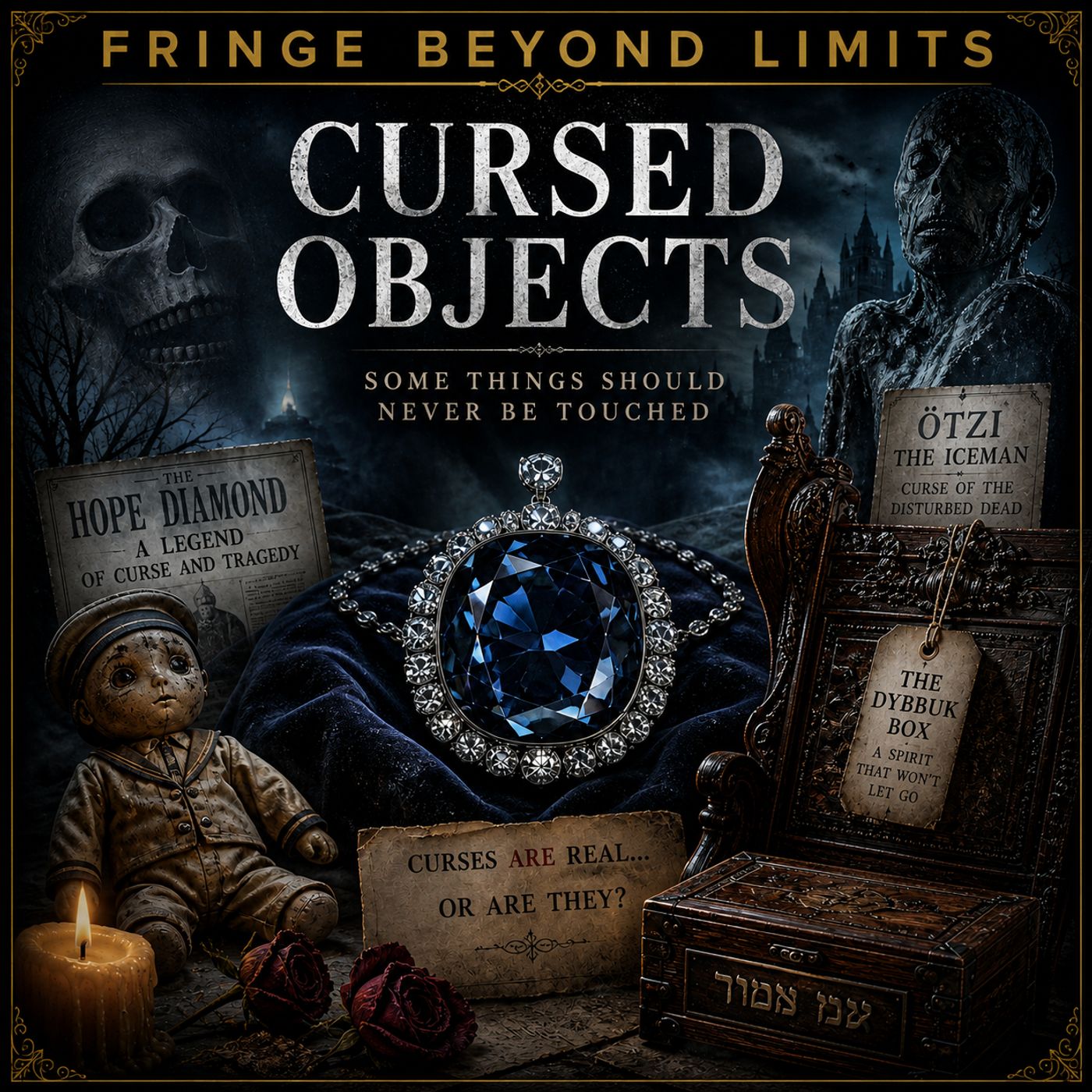
Fringe Beyond Limits
Cursed Objects: Some Things Should Never Be Touched
01:09:50
On this episode of Fringe Beyond Limits, the hosts explore alleged cursed objects—ordinary items rumored to bring tragedy or misfortune. They discuss famous tales and artifacts, from the Hope Diamond and Otzi the Iceman to Busby’s Chair, James Dean’s Porsche, the Crying Boy paintings, and more. Through folklore, investigative skepticism, and listener reactions, the show examines how stories transform objects into legends and asks whether the real power lies in the artifacts or in the stories we tell about them.
Loading summary
Transcript473 lines
- [00:00]
A
Sam. Welcome to another episode of Fringe Beyond Limits. Hi, guys.
- [00:45]
B
My nose itches.
- [00:46]
A
Hi.
- [00:48]
C
Hi. Hi.
- [00:50]
A
What's going on?
- [00:51]
B
My nose itches.
- [00:52]
A
Yeah. Allergies.
- [00:55]
B
No, it just started. Itchy. Okay, Okay. I think it stopped.
- [00:58]
A
Okay.
- [00:59]
B
It's not the allergies, it's just itch.
- [01:01]
A
Okay.
- [01:02]
C
Do they have like a superstition about that? Like when your palm itches or something?
- [01:08]
B
I think it's like when you nose. Ish. Someone thinks I'm thinking about you, right?
- [01:12]
A
I don't know. I don't know any superstitions about the nose. Except for Pinocchio.
- [01:18]
C
Pinocchio.
- [01:19]
B
I did the Google.
- [01:21]
A
Yeah. Well, how have you ladies been?
- [01:24]
B
Pretty good.
- [01:25]
C
How about you?
- [01:27]
A
Yeah, fine. You know, as we're recording this, I will be jet setting to Arizona for a few days for my first cousin slash nephew's wedding.
- [01:41]
C
You're so old when your nephews are getting married, dude.
- [01:44]
A
I know.
- [01:46]
B
Dude, they were so tiny at your wedding.
- [01:48]
A
I know, I know. Marissa is probably going to get engaged soon. Gosh, you know, she's.
- [01:54]
B
Now that one makes me feel old.
- [01:56]
A
Yeah, she's living with her boyfriend, you know, so I call him. I call him Nabisco.
- [02:04]
C
Why?
- [02:05]
A
Because his name is Nabil and I couldn't remember it for a few times of meeting him. So the first thing that kept me up.
- [02:11]
C
So you went to the cracker company? Yeah.
- [02:13]
A
Nabisco would pop in my head. I'm like, it's got to be. I'm like, it's not Nabisco, but it's got to be something like that. So. So he's forever known as Nabil.
- [02:22]
C
Does not sound like Nabisco.
- [02:24]
A
Little bit. It's a word association. So, yeah.
- [02:32]
C
So.
- [02:32]
B
Well, we have a coworker. Her name's Vanita, but we'll call her Veta.
- [02:37]
A
N. See, I used to have a co worker named Veneta.
- [02:43]
B
So what'd you used to call her?
- [02:45]
C
Vendetta. Vendetta.
- [02:50]
B
Viva Vendetta.
- [02:52]
C
Such a good movie.
- [02:53]
B
I've actually never seen it.
- [02:55]
A
Oh, what? Yeah. You're stupid.
- [02:57]
B
I remember the commercials all the time for like the previews, but never seen it.
- [03:01]
A
Because of the Guy Fawkes mask.
- [03:04]
B
Because of the Guy Fawkes and it. Huh.
- [03:07]
A
Well, that. Do you want to explain this one to her?
- [03:10]
B
No. Did you say is it because of. Yeah, no, I just didn't see it.
- [03:14]
A
Okay.
- [03:15]
B
I just never had a chance to go see it.
- [03:17]
A
No, I'm saying, do you remember it from the commercials because of the mask?
- [03:21]
B
No, I just remember the V. Okay, okay. I don't know why I remember Mask man, but I remember the V. Yeah.
- [03:29]
A
Did we lose, Lynette?
- [03:32]
B
No.
- [03:32]
A
Oh, okay. Sorry. You were just so quiet for so long. I didn't know.
- [03:38]
C
You don't let me get a word in edgewise usually.
- [03:41]
A
Now, that's a lie. That is 100% lie. Yes. I call on you all the time.
- [03:54]
C
Okay, teacher. Okay.
- [03:57]
A
Lynette, would you like to speak now?
- [03:59]
B
Hang on. I. I raised my hand.
- [04:02]
A
Yeah. Good for you.
- [04:04]
C
Oh, Bri would like to speak.
- [04:05]
B
No, I don't.
- [04:07]
A
All right. Anything else, ladies?
- [04:10]
C
I don't have anything exciting to report.
- [04:12]
A
Okay.
- [04:12]
B
Me neither.
- [04:13]
C
Going to a local baseball game tomorrow. Like, kind of like the Kane County Cougars.
- [04:20]
A
Nice.
- [04:20]
C
I'm going to the Chattanooga Lookouts.
- [04:22]
A
Nice.
- [04:24]
B
Fancy, isn't there? You guys getting a new stadium for one?
- [04:28]
C
Yep, we're going to the new. I think the new stadium.
- [04:30]
B
Is that the new stadium? Okay. Because I remember driving by it.
- [04:34]
C
Yeah, yeah. It's. It's. It's a big deal. I guess. I. I'll find out. I'll let you know.
- [04:38]
A
Yeah, report back, see if there's.
- [04:41]
B
Oh, tell us if there's any interesting food items, because sometimes those places have, like, the most interesting, most minor league
- [04:46]
C
type places, like deep fried Twinkies with corn syrup with cheese sauce on it or something.
- [04:53]
B
Or like, using glazed donuts as the. The hamburger buns.
- [04:56]
A
Okay.
- [04:58]
B
I don't remember what. What stadium did that? But instead of hamburger buns, they use glazed donuts.
- [05:02]
C
It's like, how many more heart attack items? Put on this first.
- [05:06]
A
Okay. We're going to clog all five. Here we go.
- [05:10]
C
All right. Yeah. Yeah.
- [05:13]
A
Well, tonight, this is.
- [05:15]
C
We're going to talk about something. A spooky.
- [05:17]
A
A spooky. Yes.
- [05:19]
C
We're going to talk about the spookies.
- [05:20]
A
All right. Yes, we're going to do something spooky. This is.
- [05:24]
C
We haven't done something spooky in a long time.
- [05:25]
A
I know. I blame Brie.
- [05:28]
B
Why?
- [05:30]
A
I don't know.
- [05:30]
C
You're the spooky room.
- [05:32]
B
Because I write the spooky.
- [05:33]
A
Yeah.
- [05:34]
C
Yeah. You write the spookies.
- [05:35]
A
Yeah. Spooky guru.
- [05:37]
C
I like spooky.
- [05:38]
A
All right. Well, here we go. Welcome to the corner of the world where history refuses to stay buried and the inanimate begins to breathe. We've all been told that it's just an object, a bit of stone, a fragment of wood, or a child's forgotten toy. But what happens when physical thing begins to exert a malevolent will over the living? Tonight, we Peel back the velvet curtain on items that carry a dark passenger. Objects so steeped in tragedy and misfortune that they become anchors for the unexplained. For the gleaming facades of gems.
- [06:22]
C
Facets.
- [06:22]
A
Facets. I knew I was saying it wrong. For the gleaming facets of gems that demand a price in blood to everyday furniture that marks its owner. For the grave. We are exploring the thin line between coincidence and a genuine hex. So check your surroundings and hold tight to what's yours, because tonight we're looking at the things that are better left untouched. This is the Chronicle of the Cursed. A cursed object.
- [06:53]
B
Insert creepy music there.
- [06:55]
A
Yeah, thanks. A cursed object is an item believed to carry a supernatural force that brings misfortune, illness, bad luck, or even death to those who possess, disturb, or come into contact with it. The idea appears across cultures and sketches back thousands of years, blending folklore, religion, magic, and fear of the unknown. Historically, cursed objects often emerged from beliefs that. I'm sorry. From beliefs that powerful emotions revenge, grief, hatred or spiritual forces could attach themselves to physical things. In ancient civilizations like ancient Egypt, tomb artifacts were thought to be protected by divine punishments against thieves, helping inspire later legends of mummy curses. In ancient Greece and ancient Rome, people created cursed tablets, inscribed objects used to call on gods or spirits to harm enemies. During the Middle Ages, objects associated with witchcraft, demonic influence, or sacrilege were often feared as cursed. In folklore, a cursed object is usually ordinary at first. A mirror, a doll, piece of jewelry, painting or relic, but is believed to become dangerous through traged ritual, murder, betrayal, or spiritual attachment. Some stories say the object acts most like a vessel carrying a lingering presence or malevolent energy. Others treat curses as punishments triggered when an object is stolen, disrespected, or removed from sacred ground. Many famous legends center on allegedly cured items. Some of these items who have been already talked about on previous episodes, like in episode 13, about the Robert the Doll, episode 25 on the Dybbuk Box, and episode 28 on Annabelle. If you haven't, please go back and listen to these episodes. Yes, anthropologically, cursed objects stories often reflect deeper human anxieties. Guilt over theft, fear or of death, respect for sacred places, or the unsettling idea that evil can cling to material things. A cursed relic can serve as a warning tale. Don't disturb the dead. Don't be greedy. Don't break taboos.
- [09:18]
C
Don't break the ice.
- [09:21]
A
How much does a polar bear.
- [09:22]
B
That's a good game.
- [09:22]
C
Don't steal the beans. Don't break the ice. Into the pants and cootie Sorry. I had to get it out of my system.
- [09:28]
A
Yeah, good. How heavy is a polar bear? Heavy enough to break the ice. That's when you start a conversation with someone.
- [09:37]
C
Dad. Joke.
- [09:37]
A
Dad, joke. In modern times, cursed objects exist in a fascinating space between folklore, paranormal belief, and pop culture. Museums of the occult, ghost stories, horror films, and Internet legends keep the idea alive even when skepticism surrounds them. Whether seen as supernatural threats or symbolic myths, cursed objects endure because they turn everyday things into vessels of mystery. And that's what makes them so haunting. So do you guys believe in cursed objects?
- [10:11]
C
I don't know.
- [10:13]
A
Okay, give me the.
- [10:14]
C
I'm gonna take the Bree position on
- [10:16]
B
this one and say she says she doesn't know.
- [10:19]
C
I don't know. I mean, I guess I believe it enough that I wouldn't own one or touch one or whatever, but I. I don't know. I kind of felt that way with
- [10:34]
B
the dolls and stuff.
- [10:34]
C
Oh, sorry. What?
- [10:35]
B
I was gonna say I'm the same. Like, I don't know, but at the same time, I don't know if I want to risk it.
- [10:40]
C
Right.
- [10:41]
A
Yeah. I think you guys should do some Googling on the ebay, and.
- [10:47]
C
Oh, I have. I already have a few things pulled up for you that I wanted to see what you're interested in.
- [10:52]
A
Oh, perfect. Is there a section here for that?
- [10:55]
B
Huh?
- [10:56]
C
I think he's asking if you have included some talismans that are for sale in this episode.
- [11:01]
B
I have not, but you can definitely add to it.
- [11:04]
A
All right, well, let's. Let's jump in, and maybe we'll do that later on. That'd be fun. All right. So the first cursed object, the Hope diamond, is arguably the most storied gemstone in history, famous not only for its rare deep blue color and massive size. Currently it's 45.52 carats. But also for a legend that claims it brings ruin to anyone who touches it. Its journey began in India, where it was likely mined in the 17th century. It was originally known as the Tavernier Bleu, after the French gem merchant Jean Baptiste Tabinier, who sold it to King Louis xiv. Why are you laughing?
- [11:50]
C
Your French accent is as bad as JT's.
- [11:53]
A
Oh, yeah? Oh, yeah.
- [11:54]
B
Whenever he tries to pronounce, it turns into a. I don't know what type of accent.
- [11:59]
A
It's like Jean Bautist, Tavernier Avenue in the ne. During the French Revolution, the diamond was stolen from the royal treasury and vanished for decades, eventually resurfacing in London under the ownership of the Hope family. From whom it takes its modern name. The curse itself is a complex mix of tragedy.
- [12:21]
C
Like Bob Hope.
- [12:22]
A
Yes, sure. Same.
- [12:26]
C
No, for real. That's a genuine question.
- [12:28]
A
Oh, I have no idea. I was just goofing around. Thought because you were goofing around.
- [12:32]
B
I have no clue, to be honest.
- [12:34]
C
Just wondering.
- [12:35]
A
Yeah, I mean, it's possible. I mean, we. We could probably do the lineage on that and get. And get back to. To it. Yeah.
- [12:42]
C
Okay.
- [12:42]
A
Yeah. The curse itself is a complex mix of tragic historical facts and exaggerated folklore. Proponents of the legend point to the gruesome ends of several. King Louis XVI and Marie Antoinette were executed by guillotine, and Princess de Lamballe was murdered by a mob. Later in the early 20th century, the American socialite Evelyn Walsh Maclean suffered the loss of her son in a car accident, her daughter to an overdose, and her husband to an asylum after she purchased the stone. These events created a chilling narrative that the diamond was an unlucky relic stolen from an Indian idol. Though many historians argue that this backstory was actually fabricated or embellished by jewelers like Pierre Cartier to intrigue buyers and inflate the stone's price, scientifically, the diamond is just as fascinating as its folklore. It's classified as a type. What was that, 11B?
- [13:48]
B
I would think so.
- [13:48]
A
Yeah. A type 11B diamond, which means it contains trace amounts of the element.
- [13:54]
C
No, no, 2B. Sorry, I guess it was on mute. Oh, that's Roman numeral.
- [13:58]
A
Is it? Okay, so type 2B diamond, which means it contains trace amounts of the element boron, giving it its distinctive blue hue. One of its most eerie physical properties is that it exhibits red phosphore phosphorescence. After being exposed to ultraviolet light, the diamond glows a fiery red in the dark for several seconds. Today, the Hope diamond resides in the Smithsonian institute in Washington, D.C. where it was donated by Harry, along with everything else, pretty much all the giant bones donated by Harry Winston in 1958. Since its arrival at the museum, the curse seems to have been broken, as it has become one of the most visited museum objects in the world without any further reports of misfortune trailing its handlers. I don't think I believe in that.
- [14:50]
C
Didn't the movie Titanic. Didn't the movie Titanic allude to the fact that the Hope diamond was on that.
- [14:56]
B
Yeah, I want to say that reminds me of the diamond from the Titanic, but I thought they called it something different. Right?
- [15:00]
A
Yeah, they did. Yeah. I think they use that as a. Yeah, like as. Oh, is that the. Yeah. All right. So the Story of Otzi the Iceman is one of the most significant archaeological finds of the 20th century, but it's shadowed by a modern legend of a mummy curse. Found in otzal Alps in 1991, the body had been naturally preserved in ice for over 5,000 years, offering an unprecedented look at Copper Age life. However, rumors of a curse began to circulate as several individuals involved in this recovery and study met untimely deaths. The first victim was Rainier Henn, the forensic pathologist, who placed the mummy into a body bag with his bare hands. He died in a head on car crash while traveling to a conference to present his findings. Shortly after, Kurt Fritz, the mountain guide who led hen to the body, was killed in an avalanche. Notably, he was the only member of his climbing party to perish. The legend grew darker with the death of Helmuth Simon, the German hiker who originally discovered the mummy. In a twist of fate, Simon disappeared during a blizzard in the same mountain range where he found Otzi. His body was discovered eight days later, fallen from a cliff. Within an hour of Simon's funeral, Dieter Warnecki, the head of the mountain rescue team who had searched for him, died of a heart attack. The toll continued with Conrad Spindler, the leading expert on the mummy, who had publicly ridiculed the idea of a curse, only to pass away from complications of multiple sclerosis. Finally, Tom Loy, a molecular biologist who discovered human blood and Otzi's tools, died of a hereditary blood disease shortly after finishing a book about the Iceman. Despite these chilling coincidences, most scientists and historians dismiss the curse as a classic case of statistical clustering. When thousands of people are involved in a high profile project over several decades, it is mathematically inevitable that some will pass away from accidents or illness. Furthermore, the victims were often involved in high risk activities, such as professional mountaineering and rescue work, which naturally carry a higher mortality rate. Today, Otzi remains safely housed in a custom cold cell at the South Tyrol Museum of Archaeology in Italy, where he continues to be studied by hundreds of researchers who have experienced no ill effects, suggesting that the curse is more of a product of our fascination with the macabre than any ancient supernatural power.
- [17:44]
B
Those people got unlucky.
- [17:46]
A
Yeah, I don't believe in this one either.
- [17:48]
C
I mean, well, I mean, Otzi was found with two mushrooms on his person, okay? One of them being a birch polypore. And that mushroom is used as an antibiotic, antiparasitic and treats intestinal issues. So maybe he had an ailment and that's what he passed along. To the scientists and the people who were his caretakers.
- [18:13]
A
Well, so the first victim died in a head on car crash.
- [18:19]
C
Oh, okay. Well, if he was eating mushrooms, he probably would have been fine.
- [18:23]
A
The next one.
- [18:24]
B
Or was he eating mushrooms and that's why he got in a car accident?
- [18:26]
A
The next one died in an avalanche.
- [18:30]
C
Right. And the second mushroom that he hand on him was tinder polypore or the hoof fungus, which is actually something that could be used to start a fire. So he could have kept himself warm.
- [18:40]
A
Then the next one fell off a mountain.
- [18:46]
C
Okay, well, birch, polypore and horse hoop mushroom cling to the side of trees so he could have like clung to the side of the mountain.
- [18:56]
A
The. The next one.
- [18:57]
B
Okay.
- [18:58]
A
That the next one died of a heart attack.
- [19:01]
C
Okay, well, that first one would help with blood thinning.
- [19:05]
A
Okay. The one after that died of a hereditary blood disease.
- [19:11]
C
Right. Blood thinning. He could have, you know, clots and stuff. He could have for protected himself and then.
- [19:16]
A
And then the next one died of multiple sclerosis.
- [19:21]
C
I got nothing. But, you know, nine out of ten ain't bad.
- [19:30]
A
Yeah, right, Right. If we're stretching a lot,
- [19:36]
C
mushrooms are good for you. He was reaching for the mushroom and he fell.
- [19:41]
A
Okay, our. Our next object is Busby's chair. So Busby's stoop chair, often referred to as simply as the dead man's chair, is an ordinary looking oak seat that has earned a reputation as one of the most lethally cursed objects in Britain. The story begins in 1702 with Thomas Busby, a petty criminal and coiner living in North Yorkshire. According to local lore, Busby murdered his father in law, Daniel Audie, during an argument that allegedly started because Audie sat in Busby's favorite chair.
- [20:16]
B
Buzby sitting in my chair?
- [20:18]
A
Yeah. Before Busby was.
- [20:19]
C
What are they, children?
- [20:20]
A
Yes.
- [20:21]
C
It's my chair.
- [20:22]
A
Yes. It's 1702. These people are not, you know, distinguished.
- [20:27]
C
We're going to duel over my chair.
- [20:30]
A
Exactly. These people are in England. They're not in the new world. They don't.
- [20:34]
C
They're.
- [20:35]
A
They're still ass backwards. They're the English. Come on, guys. I'm just joking. Before Busby was executed by hanging for the crime, he reportedly placed a curse on his beloved seat, vowing that anyone who dared to sit in it would die a sudden death for centuries.
- [20:52]
C
He called shotgun.
- [20:57]
A
That's it.
- [20:58]
C
That's. It's true.
- [20:59]
A
I like it.
- [21:00]
B
I like that.
- [21:01]
C
Wait, what, What's. What's not shotgun? What's the.
- [21:04]
A
Yeah, shotgun.
- [21:06]
B
You got it.
- [21:07]
A
Oh, that's awesome. For centuries, the chair remained at a local inn, later renamed Busby Stoop Inn, where it became a grim fixture of local legend. The chair's body count began to grow significantly during the 20th century, particularly during World War II. It was noted that Royal Air Force personnel from the nearby Skipton Unswail Airfield who sat in the chair frequently failed to return from their missions. The legend intensified in the 1970s, when several modern victims were linked to the seats. Stories tell of a cleaning woman who slipped and died after bumping into it, and a delivery man who sat in a chair on a dare, only to die in a road accident later that same afternoon. These recurring tragedies created such a tense sense of dread that the inn's landlord eventually moved the chair to the cellar to prevent further mishaps. But even there, a brewery delivery man died of a heart attack after taking a seat while unloading barrels. In 1978, the landlord donated the chair to the Thirsk Museum, but he did so with the strict condition that no one ever be allowed to sit in it again. To ensure the public's safety and honor. I'm sorry? To ensure the public's safety and honor the request, the museum curators took the unusual step of hanging the chair high on a wall, several feet above the floor. This prevents any brave or skeptical visitors from tempting fate. While skeptics argue that the curse is simply a collection of urban legends and coincidences fueled by the dark history of the inn, the chair remains one of the museum's most popular and feared exhibits, serving as a chilling reminder of the power of a dying man's spite.
- [22:49]
C
I think I was thinking of seat check.
- [22:52]
A
Oh, I don't know.
- [22:53]
C
Seat check. Okay.
- [22:54]
A
Yeah. No, but shotgun works.
- [22:57]
B
I like the shotgun.
- [22:58]
A
I don't believe this one either, because there's zero accounts from 1700 to 1970, and then all of a sudden, it started killing people and.
- [23:09]
B
But they said most of it happened during the World War, so a lot of people died during that.
- [23:14]
A
Yeah.
- [23:14]
B
I mean, so you can't really say it was a chair.
- [23:16]
A
No. No. Not even a little bit, now do I think.
- [23:20]
C
So you'd sit in it all day?
- [23:22]
A
Yeah, I would sit in it. I would sleep in it. I would.
- [23:27]
B
Can you sit on it when it's hanging on the wall, too?
- [23:29]
A
I would. I would make nookie in it, yes.
- [23:32]
C
So you do that.
- [23:34]
A
I would. I just need to find a willing participant.
- [23:38]
B
So you just need to find someone to nookie with.
- [23:40]
A
Right.
- [23:41]
C
Good luck.
- [23:44]
A
Next is James Dean's Porsche. So James Dean's Porsche 550 Spider, famously nicknamed Little Bastard, is perhaps the most legendary cursed car tale in American history. Dean, an avid racer, purchased a silver sports car in September 1955 and had it customized with his racing number 130 and the car's nickname painted on the rear. Just days after the purchase, Dean was driving to a race in Salinas, California when he was involved in a head on collision that claimed his life. The legend of the curse began almost immediately when the records was purchased by auto designer George Barris. According to lore, while the car was being unloaded at Barris shop, it slipped from its trailer and broke a mechanic's leg, setting a dark precedent for every piece of that vehicle that remained. As the car was dismantled, the infection of bad luck allegedly spread to anyone who used its parts. Barris sold the engine and drivetrain to two physicians who were also amateur racers. During a race in Pomona, California, one doctor was killed when his car flipped and the other was seriously injured when his car locked up and veered off the track. Further reports claim that two tires salvaged from the Spider blew out simultaneously caused the new owners to crash. Even the California Highway Patrol, which used the mangled frame as a safety exhibit to warn against speeding, found the car to be a liability. During one display, the garage housing the car caught fire, leaving the Little Bastard untouched while everything else burned. During another, the car fell off its display stand and broke a student's hip. The final mystery of the Porsche occurred in 1960, cementing its status as a paranormal icon. After a safety exhibit in Florida, the car was being shipped back to Los Angeles in a sealed truck. When the truck arrived at its destination, the driver found the seals intact, but the trailer was empty. The wreckage of the Little Bastard had vanished without a trace. Despite a $1 million reward offered by Volo Auto Museum in 2005 for the car's recovery, its whereabouts remain unknown. While skeptics point out that George Barris was a master of self promotion who likely embellished many of these stories to keep the car's legend alive, the string of accidents and the ultimate disappearance of the vehicle continue to fuel theories of a genuine malevolent hex.
- [26:20]
B
I want to know more about this disappearance.
- [26:21]
A
So the Volo Auto Museum is just in northern Illinois.
- [26:25]
C
Yeah, we can.
- [26:27]
A
We can go there tomorrow.
- [26:28]
C
But they don't have it.
- [26:29]
A
I know, but they have the. A car for the Titanic that supposedly leaks water.
- [26:34]
B
Oh, did you see. Speaking of which, you see that the. I think it was. I forgot what state that The Titanic Museum is in and that flooded on the anniversary of the Titanic?
- [26:45]
A
Yes, that was last year.
- [26:47]
C
I think there's one in England or. You mean there's one in the States?
- [26:50]
B
No, there was one in the United States. Yeah, I think it happened. I thought it was this year. I don't even know when the anniversary was.
- [26:57]
C
Oh, so I didn't hear that because
- [27:01]
A
it happened last year. Next is the Crying Boy paintings. The legend of the Crying Boy paintings
- [27:09]
C
is a unique example of Frank paintings.
- [27:12]
A
Yes, they're all paintings of me as a little boy crying.
- [27:16]
B
It was this year. I just looked it up. April 15 on the 2026, it flooded
- [27:22]
C
at the Volume Museum. Tax Day is the anniversary.
- [27:26]
B
Yeah, it was at the Volo Museum this year.
- [27:28]
A
I don't think so.
- [27:30]
B
Yeah.
- [27:30]
C
So it flooded at the museum.
- [27:33]
A
Yes.
- [27:34]
C
Well, it did rain a lot.
- [27:36]
A
This is true.
- [27:38]
C
It was monsooning flesh floods. Anyway. Okay, keep going.
- [27:41]
B
Sorry.
- [27:41]
A
Sure. The example of an urban curse that took hold of the United kingdom in the 1980s. The phenomenon began with a series of mass produced prints created by Italian artist Giovanni Bragolian featured tearful young boys. In 1985, the British tabloid the sun published a story claiming that these paintings were fire starters, citing multiple instances where houses had burned to the ground, leaving everything in ruins except for the portrait of the crying child, which remained eerily untouched on the blackened walls. This sparked a national panic. Readers sent in hundreds of accounts of similar fires, and the fear became so widespread, the newspaper eventually organized a massive public bonfire to burn thousands of the prints, supposedly lifting the hex from the nation. Beyond the supernatural claims, there were several chilling theories regarding the origin of the paintings. One popular legend suggested that the artist had used a Spanish street orphan as his model, a boy who had seen his parents perish in a fire and was later dubbed Diablo because fires seemed to follow him wherever he went. According to this story, the boy eventually died in a car crash and his restless spirit became trapped within the many reproductions of his likeness. These stories served to heighten the mystery, turning a common piece of 1950s and 60s home decor into a source of dread for an entire generation of homeowners. Ultimately, the curse was debunked through scientific investigation by British fire brigades. When researchers tested the paintings, they discovered a perfectly logical explanation for why they survived house fires. The prints were typically produced on high density hardboard, which is naturally difficult to ignite. And we're finished with a thick coating of fire retardant liqueur. Furthermore, in most lacquer. What did I say?
- [29:38]
B
Lacquer.
- [29:38]
C
Lacquer, Lacquer.
- [29:40]
A
Lacquer, whatever. Furthermore, in most houses, in most house fires, the string holding the frame to the wall would burn through first, causing the painting to fall face down on the floor. In this position, the floor protected the image from the rising heat and smoke, while the fire resistant finish prevented the board from catching fire. Despite this rational explanation, the image of the tearful boy remains a cult icon of paranormal folklore. Yeah, I don't believe this one at all.
- [30:09]
B
It's interesting.
- [30:10]
A
Oh, 100%. I mean, I mean, yeah, they're all interesting, they're all fun to talk about.
- [30:15]
B
And I just think this, specifically this one, because how doesn't burn. Like it wouldn't burn with the house or anything like that.
- [30:22]
A
Right.
- [30:23]
B
This makes you wonder like with that coating or whatever it is that they use, like how long does it actually take to wear off before it actually catches on fire?
- [30:33]
A
I don't think it does.
- [30:33]
C
And can people who live in forest fire regions paint their houses in it?
- [30:38]
A
Yes.
- [30:38]
B
Right?
- [30:39]
A
Yes.
- [30:40]
B
So if you can do that with one painting, why can't you do it with a house? Or like put this coating on trees to help that the trees from not burning down too?
- [30:51]
A
Yeah, but, but, but forest fires is actually good for the forest.
- [30:57]
B
Yeah, but not ones that people do.
- [30:59]
A
Right?
- [31:00]
B
Natural ones. Yes.
- [31:02]
C
Okay, I'm gonna, I just wanna know who wants these pictures in their house. I mean, yes, they're beautiful, but like, I don't know, there's something dark about these paintings that creep me out.
- [31:14]
A
Is it cause they're so lifelike?
- [31:16]
C
They're a little like, I don't know, maybe it's with the modern era of all the abuses and stuff going on, that that's where my head goes when I see this picture.
- [31:25]
A
But also it kind of gives the credence to the uncanny valley. You know, it's so lifelike, but it's not. So that creeps us out. You know what I mean? Yeah. Okay.
- [31:38]
C
I don't want to talk about your uncanny valley anymore, though. It's. Why Not a little too personal, is it? Yeah.
- [31:45]
A
Okay.
- [31:46]
C
Okay.
- [31:47]
A
The Delphi Purple Sapphire. The Amethyst of.
- [31:52]
B
Whoa.
- [31:54]
C
Excuse me? Like, like whoa.
- [31:57]
A
Like whoa.
- [31:58]
B
Whoa. I actually like the song.
- [32:00]
C
Like whoa.
- [32:01]
A
No, no, like Joey Lawrence.
- [32:02]
C
Whoa. Oh, woe is me.
- [32:05]
A
Yes.
- [32:06]
B
Whoa.
- [32:07]
A
Despite its misleading name, the Delphi Purple Sapphire is actually a large oval cut amethyst set in a silver ring. Burdened by a reputation so dark it was eventually locked inside seven protective boxes. The stone's cursed history began in 1857 during the Indian mutiny when it was allegedly looted from the Temple of Indra in Kanpur by a British soldier. Upon being brought to England, the gems owner, Colonel W. Ferris, reportedly lost his entire fortune and suffered a total collapse in health, a pattern that repeated with his son. In 1890, the amethyst came into the possession of the scholar and writer Edward Heron Allen, who claimed that misfortune immediately began to haunt him after two of his friends, one an operatic singer who lost her voice, experienced disasters. After handling the stone, Heron Allen became convinced of its malevolence despite to rid himself of the gem's influence, or, I'm sorry, desperate. To rid himself of the gem's influence, Heron Allen attempted to discard it in ways that mirror a classic horror story. He famously threw the amethyst into the Regan canal, hoping to be free of it forever, only to have a dredger recover it from the silt. Several weeks later, recognizing the gem, a local jeweler returned it to Heron Allen, who then believed the object was inescapable. He eventually decided to neutralize the curse by sealing it inside a series of seven nested boxes and depositing it in the vaults of his bank, with strict instructions that it should not be opened until 33 years after his death. His daughter eventually donated the curse package to the Natural History Museum in London in 1943, along with a chilling letter of warning. The museum's curators found Harrod Allen's letter tucked inside the final box, which cautioned that the stone was cursed and stained with blood, and advised the future owner to cast it into the sea. While the museum displays the amethyst as a fascinating piece of Edwardian folklore rather than a supernatural threat, the legend persists among visitors. Interestingly, some suggest that Heron Allen, a talented writer of fiction, may have heavily embellished or even fabricated the curse to create a compelling narrative narrative around the gemstone. Whether a genuine relic of misfortune or a masterpiece of Gothic storytelling, the Amethyst of Woe remains one of the museum's most popular exhibits, proving that a good story can be just as enduring as a gemstone itself. Yeah, that's.
- [34:48]
C
I call baloney on this one. Yeah, I agree.
- [34:51]
B
I think the guy got paranoid about
- [34:53]
C
it and just did what he did to get rid of it.
- [34:56]
A
Or he was. Or he just made it all up.
- [34:58]
B
That's what I meant. Like, he just thinks all this stuff happened because of it, and it was all in his head. He was paranoid.
- [35:04]
A
No, I don't. I don't even think that. I think he literally just made it up to create a story behind it, you know, since he is a fiction writer, you know, it's the same thing with what you call it, scientology. You know, L. Ron hubbard, who has written the most science fiction books ever, Came up with z Xenon, the galactic overlord that killed all these humans on earth millions of years ago.
- [35:33]
C
So it really happened.
- [35:41]
A
All right. The myrtles plantation mirror is a central fixture of one of America's most famous haunted houses. Located in St. Francisville, Louisiana, the Mirror, which hangs in the hallway of the plantation house, Is said to be inhabited by the spirits of Sarah Woodruff and her two children, who died of yellow fever in the 1820s. According to local folklore, A custom of the time was to cover all mirrors in the house when someone died to prevent their souls from becoming trapped in the reflective glass. Legend has it that after the witress passed away, this particular mirror was inadvertently left uncovered, Allowing their spirits to take up residence inside it. The myrtles plantation mirror is a central fixture of one of America's most famous haunted houses, located in St. Francisville, Louisiana. Okay, that doubled, didn't it?
- [36:33]
C
Double dog dare you.
- [36:34]
B
Yeah, gosh darn it.
- [36:36]
A
Yeah, yeah. So anyway, Skeptics and historians offer a more grounded explanation for these phenomena, Pointing to the chemical processes of oxidation and aging. Most mirrors from the 19th century were made using a mixture of mercury and tin or silver nitrate. Over time, if moisture seeps between the glass and the backing, it can cause the silvering to lift or tarnish, Creating patterns that look remarkably like handprints or shadows. Furthermore, the woodruff curse story has been scrutinized by researchers who found that while Sarah and her children did die, they did not die in the sensationalized manner Often described in the plantations tours. Nevertheless, the mirror remains a bucket list item for paranormal enthusiasts, Standing as a chilling example of how physical imperfections in an object can fuel a century of ghost stories. Now, as I think the myrtle plantation is probably haunted, I'm not so sure about the mirror. So, I mean, it's possible.
- [37:43]
C
No, I'm just trying to think what I think.
- [37:45]
A
Oh, okay.
- [37:46]
B
Yeah.
- [37:46]
A
Do a thinky thought.
- [37:48]
C
A thinky thought. I definitely think the location has entities and stuff. There's a lot of dark history there. Yep, a lot of dark history. And I think even when Lisa went there, she took a picture just standing outside the property and saw there was, like, a woman or there was a figure or something in the window. It was creepy.
- [38:09]
A
Nice.
- [38:10]
C
Maybe the mirror is just there, Their portal.
- [38:14]
A
Okay, fair enough.
- [38:16]
C
Maybe that's. That's their Gateway. They come in and out of it.
- [38:18]
A
Yeah, there's plenty of stories that mirrors our portals, so, I mean, it's definitely possible. Lynette, do you have any.
- [38:27]
C
Yes.
- [38:27]
A
Do you have any of those cursed objects pulled up right now?
- [38:31]
B
Yes.
- [38:32]
C
I would need to know what your price range is.
- [38:36]
A
Okay, what are we talking about here?
- [38:38]
C
First of all, I mean, you can get 20 bucks.
- [38:43]
A
Okay, what's. Okay.
- [38:44]
C
Which looks like somebody homemade. It looks like. It looks like a TV prop actually says TV prop or some other things are like a couple grand.
- [38:53]
A
Okay. Yeah, we're not going a couple grand. Let's say between.
- [38:56]
C
Okay, well, I'm just saying. What's your price range?
- [38:58]
A
Yeah, let's say right now fifty and a hundred bucks.
- [39:01]
C
Okay, Here's a cursed monkey's paw. Ooh.
- [39:05]
A
Ed Grayland, Post style.
- [39:07]
C
Yeah. It's got fur and fingernails and black skin from 1892. Although allegedly, who knows?
- [39:20]
B
Sounds creepy.
- [39:21]
A
Okay, what does it say? It's like.
- [39:24]
C
Does it have any, like, $60? It's. There's one left, but it's in two people's carts. Let's see, where are the items, details? It doesn't. Okay. I think it's probably fake.
- [39:42]
A
Okay. All right, so what's creepy?
- [39:45]
C
Mummified paw. Okay. Just oddities. Yeah.
- [39:48]
B
All right.
- [39:49]
C
Okay, let me sort by lowest price. See, I don't know if this is just creepy or if it's haunted. No, it's not. I'm not trusting Etsy.
- [40:00]
B
Here.
- [40:01]
C
Here's a couple dolls, but they're like 200 bucks. Here's an haunted ancient guardian statue. It looks Egyptian in like, let's see, vintage from before the 1700s. And they're just selling it for 140 bucks. Okay, so that's fake. I don't know if I trust that. This is no ordinary relic. Carved from the darkest obsidian, like stone of forgotten tombs, this life size seated figure commands with an aura of absolute, timeless power. Its face is regal, stern eyes staring straight forward into your soul with an unblinking gaze that feels alive. A broad, intricately detailed collar encircles the neck like royal armor, while hands firmly grip an ancient symbols of dominion. At night, the statue becomes truly paranormal. When the lights go out and the world sleeps, the air around it grows thick and cold. A low, rhythmic humming emanates from the stone. The sound of distant chanting that no human voice could produce. I'm sorry. This is ridiculous.
- [41:06]
A
That's so ridiculous.
- [41:10]
C
Let's see, where did I leave. Shadows in the room stretch unnaturally. Blah, blah, blah. Objects placed near it overnight are found rearranged in perfect symmetry. Pets refuse to enter the room. Oh, that can keep your pups away if you just want to actually sleep. This is a living vessel. Okay, this is the world's longest description. Oh my goodness. I'm scrolling, scrolling, scrolling. Okay, no.
- [41:34]
A
All right. No.
- [41:34]
C
Okay, let's see. Okay, that was Etsy. I'm not seeing anything cheap on Etsy because that's, you know, expensive white people stuff. Okay, so let's go to ebay. And there is a piano key. A real haunted Object. Piano key. 38 bucks plus shipping. What do we have here? This piano key was removed from a family friend's haunted piano after. Oops, here, I'm trying to. Sorry, I'm getting alerts on my thing. It's probably spambalamba. This piano key was removed from my family friend's haunted piano. After I found out he destroyed it, I asked if I could have some of the parts. This was. Was specific. This was specifically posted for someone who collects haunted items. Let's see. Real haunted item from real haunted place. You're purchasing a piano key seven years ago when I purchased a used piano key from CA House Music in West Virginia. After. I'm not prepared to read this whole story.
- [42:43]
B
Yeah.
- [42:44]
A
Okay, what's next?
- [42:48]
C
A haunted estate collection? Paranormal horde object? I don't know what a horde object is. A handful of dolls. A key. Just like. I mean, it's not a schlage, but it's like a key.
- [43:02]
A
Okay.
- [43:03]
C
This funky looking panda bear with plastic face. A clown. A weird monk maybe, I don't know, with like a candle light or something. Oh, here's a photograph for 15 bucks. Here. It looks like somebody just made a sock puppet. There's some picture frames. A ring for 50 bucks.
- [43:26]
A
A ring for 50.
- [43:27]
C
Ew. What about this? Tilco Hobo ashtray. A dybbuk box. Possibly haunted. 40 bucks.
- [43:34]
A
Possibly haunted.
- [43:35]
C
Creepy. I don't know.
- [43:37]
B
Not guaranteed.
- [43:38]
C
It's possibly. I think they just don't want it returned. Yeah, that's not haunted. I'd like my money back.
- [43:46]
A
So I just put a.
- [43:47]
C
Here's a doll with like weird feet.
- [43:49]
A
I just put a link on our discord that I would like you to pull up and tell me if it's a good idea.
- [43:57]
C
You're making me.
- [43:59]
B
Oh, really?
- [44:01]
C
Is it a butt plug? Close. It's still loading. For me? I don't know.
- [44:06]
A
Is it really? Bri, you got it up?
- [44:08]
B
Yes. Yes.
- [44:11]
A
It's so.
- [44:12]
C
Yeah, she does.
- [44:12]
A
Yeah. So here. So it says it's A gothic spirit companion wife. Powerful summoning conjuration.
- [44:20]
B
56 bucks.
- [44:21]
A
$56 or best offer you get. Or best. So the ethereal spirit companion is a gothic bride of eternal devotion. It's dark art, spectacle, entity, neutral, dark, loyal and enveloping. Her energy is mysterious, intense and profoundly romantic. The gothic bride of eternal devotion is a haunting and devoted spirit companion who animates an irresistible aura of melancholy beauty and undying loyalty. Her pale, ethereal presence is ideal for those drawn to the shadows of forbidden romance, seeking to deepen their emotional bonds, embrace hidden passions and find solace and eternal companionship. She's profoundly empathetic, attuned to the unspoken sorrows and desires of your soul, guiding you toward a deeper acceptance of love's darker, more enduring facets. That's amazing. Like, who would buy this?
- [45:16]
B
And it also says too, after purchasing instructions, you need to send. After you purchase, you need to send your name and date of birth for binding and a photo of the item you wish to have her bound to.
- [45:28]
A
Wow.
- [45:29]
B
And the seller has 98.8% positive feedback with 343 items sold.
- [45:36]
A
Wow. That's crazy. These people are nuts. Yeah. Oh, here. Oh. Who was the buyer on that or the seller on that one?
- [45:49]
B
Is it mystic for volcanic court spells?
- [45:51]
A
Okay, so I just found one and I clicked on it just because the picture is of a blonde dressed like a witch, but with song on only.
- [46:00]
C
Oh, God.
- [46:01]
A
And it's by mystic forge. And here is. Here's the opening line to the description. We will summon a witch succubus into your physical reality. Not just in your dreams, in real life.
- [46:17]
B
There you go, Frank.
- [46:18]
A
It's a hundred dollars. I'm not going to give this guy $100 for him to just take my money, not do anything.
- [46:25]
B
Miss, you'd be so pissed, too.
- [46:26]
A
100%. All right, well, we're going to find, like, a real cursed object, and I will buy it, so. All right. So our next item is the Tallman bunk beds. The story of the Tallman bunk beds is one of the most famous accounts of a haunted object in modern American history, gaining national attention in the late 1980s. In 1987, Allen and Debbie Tallman purchased a secondhand set of bunk beds from a local shop in Horicon, Wisconsin, for their younger children. Almost immediately after the beds were brought into the home, the family reported a series of terrifying paranormal events. It began with minor occurrences, such as a radio that would turn itself on and off or the children becoming unexplainably ill. But quickly Escalating to visual and auditory hallucinations. The children claimed to see frightening old woman standing in their room, and Alan Tallman later reported hearing a disembodied voice calling him from the garage, only to find the area engulfed in what appeared to be a spirit fire that vanished as soon as he approached it. The psychological toll on the family was so severe that they eventually reached out to local clergy and paranormal investigators to help cleanse the home. The story reached a fever pitch when the family, convinced that the bunk beds were the source of a demonic presence, fled their house in the middle of the winter. Their ordeal was later featured on the television show Unsolved Mysteries, which cemented the legend of the beds in the public consciousness. According to the family's testimony, the haunting was centered entirely on the furniture. They claimed that once the bunk beds were removed from the house and destroyed, the supernatural activity ceased instantly and the family was able to return to a normal life. While the story is often cited as evidence of a portal or a cursed object, Skeptics and investigators have offered more rational explanations for the events. Some experts suggest the family may have been experiencing a form of mass hysteria, where the stress of a new home or existing anxieties manifested as shared hallucinations. Others have pointed to more environmental factors, such as high electromagnetic fields or even a minor carbon monoxide leak, both of which are known to cause symptoms like nausea, auditory hallucinations, and a general sense of dread. Despite these logical theories, the Tallman bunk beds remain a staple of Wisconsin folklore, representing a rare case where a modern, mundane piece of household furniture became the centerpiece of a widely publicized haunting. I hate the mass hysteria shit. Because if that's.
- [49:16]
B
Don't lie. You love it.
- [49:17]
A
No, no, no. Because if that's the case, if it was the anxiety of home ownership that manifested hallucinations, like more homeowners would be, would be having these kinds of incidences. So the Women from Lem statue. The Woman from Lem was also known as the Goddess of Death, is a white limestone figurine discovered in lem, Cyprus, in 1878. Believed to date back to approximately 3500 BCE the statue was likely a fertility idol, but it gained a sinister reputation due to the string of tragedies that reportedly befell its owners. According to legend, the statue's first owner, Lord Alphont, lost seven members of his family to mysterious circumstances within six years of acquiring it. The second owner, Ivor Manucci, and his entire family allegedly perished within four years. And the pattern continued with the third owner, Lord Thompson Knoll whose family was reported. Whose Wait. Whose family also reportedly died shortly after the statue entered their home. The curse allegedly reached its peak with its fourth owner, Sir Alan Biverbrook, after his wife and two daughters died. Biverbrook, convinced the statue was responsible for the destruction of four different bloodlines, donated the artifact to the Royal Scottish Museum in Edinburgh. The legend adds a final chilling detail. Shortly after the statue was placed in the museum, the curator who handled the artifact reportedly died as well. Since then, the figurine has been kept behind glass, and no further deaths have been attributed to it, leading some to claim that the curse is contained as long as the object is not privately owned. From a historical and skeptical perspective, the story of the woman from Lem is often criticized for lacking verifiable documentation. Researchers have noted that there are no historical records for individuals named Lord Alphont or Ivor Manucci in the regions or time periods described, and the story only began to circulate in paranormal circles much later. It is highly likely that the Goddess of Death narrative was an urban legend created to add a layer of dark mystique to an otherwise standard Neolithic artifact. Today, while it is still a subject of interest for ghost hunters, archaeologists value the statue primarily for what it reveals about the religious practices and artistic styles of ancient Cyprus. What do you guys think of this one?
- [51:59]
B
So I don't get why it doesn't, like, the actual owners didn't die, but the family did. But when the creator was the one who handled it, they died. So tell me how that makes any sense.
- [52:11]
A
Well, I mean, there's no rhyme or reason with a curse. You know, what if the curator didn't have a family, then that would make sense.
- [52:20]
B
No, no, but I would think, like, whoever handled it would be the one that's cursed, not family.
- [52:27]
A
Well, think about it. If you really want to hurt someone badly, you don't kill them. You kill the people he loves.
- [52:34]
B
Yeah, but then it says as long as it's not privately owned, when it went to the curator, it wasn't privately owned. So why didn't the curator die?
- [52:41]
C
That one caused a question mark in my head, too.
- [52:43]
A
Yeah, that's only a speculation. I. I really do think it's probably people who have handled it. So the curator handling it died, you
- [52:50]
B
know, what about the owners? They handled it.
- [52:53]
A
Yeah, and they died.
- [52:55]
B
No, they didn't.
- [52:55]
A
Well, they're dead now.
- [52:56]
B
They said the family died. Yeah, they didn't die.
- [52:58]
A
Yeah, they're dead now.
- [53:01]
B
Oh. Yeah.
- [53:02]
C
So I hope so.
- [53:04]
B
Unless there's some mortality that they have That I want.
- [53:09]
A
Yeah, no, that doesn't. That doesn't happen. Sorry.
- [53:12]
C
Oh, damn it.
- [53:14]
A
I know. All right, next. The Bassano Vase is a 15th century silver vessel that has become a staple of Italian paranormal lore, often cited as one of the most dangerous cursed objects in existence. According to the legend, the vase was crafted as a wedding gift for a young bride in a village near Naples. On the night of her wedding, however, the bride was found murdered, still clutching the silver vase to her chest. Following her tragic death, the object was passed down through her family, But a pattern of sudden and mysterious deaths reportedly plagued anyone who took possession of it. Terrified by the mounting body count, the family eventually hid the vase away, where it remained out of sight for centuries until it was rediscovered in 1988. When the vase was unearthed, it reportedly contained a small, chilling note that read, beware, this vase brings death. Despite this stark warning, the finder allegedly sold the item at an auction. The curse supposedly resumed its work immediately. The first buyer, a local pharmacist, died just three months after purchasing it. The next owner, a surgeon, died at the age of 37 shortly after acquiring the vase, followed by an archaeologist who suffered a fatal infection, and finally, a fourth owner who died within weeks of the vase entering his home. Each death was sudden and unexpected, reinforcing the belief that the silver vessel was a conduit for the original bride's lingering grief or a malevolent hex. The story concludes with a dramatic intervention by the authorities. Recognizing the public panic and the string of tragedies linked to the object, the family of the final owner tried to donate it to a museum. But every institution refused to accept it, fearing the liability of its reputation. In a desperate move to protect the community, the police reportedly took the vase and buried it in an undisclosed location, some say in a lead box or a deep, unmarked pit to ensure they would never be disturbed again. While historical documentation the specific victims is difficult to verify, and some believe the tale is a modern urban legend, the Bassano vase remains a haunting symbol of the idea that some treasures carry a weight far heavier than their silver. So I kind of know how much
- [55:36]
B
you guys are into your tlian history, but. You guys know about this?
- [55:39]
A
No. No.
- [55:41]
B
Never heard about it.
- [55:42]
A
Never did. But. But I kind of believe this one for some reason.
- [55:45]
B
Because it's Italian?
- [55:47]
A
No, because no.
- [55:48]
C
Sound like my grandma.
- [55:49]
A
I know no museum.
- [55:51]
C
I only believe any Italian stuff. Anything else? Never experienced it in my life.
- [55:57]
A
A hamburger. What the. A hamburger.
- [56:00]
C
What's a taco? So I want to believe this one, but the part that actually, like, killed it for me right in the beginning was the fact that she was murdered on her wedding night clutching the vase. Like, what? Now that's an embellishment. That's hearsay.
- [56:19]
A
I don't know. Maybe she was grabbing. Maybe she grabbed it to try to defend herself.
- [56:25]
C
Somebody with.
- [56:26]
A
Yeah, to defend herself, but she just didn't react fast enough. That's a possibility. And clutching it, you know. You know, is. Is a subjective.
- [56:36]
C
I picture holding tight here.
- [56:38]
B
Yeah, yeah. Like you're like. You don't want anyone taken away.
- [56:41]
A
Right. But I think they're using the word clutching as more for a dramatic storytelling, I guess.
- [56:48]
C
How would that story even be known if it was put away for centuries and then rediscovered with a note saying beware. Like, it doesn't say, lady was clutching this and that's why all the orphans are in Naples.
- [57:01]
A
I mean, it. It could have. It could have been a game of telephone too, you know.
- [57:08]
C
So like them Italians and their superstitions.
- [57:13]
A
100% we are.
- [57:15]
B
Yes. Utilian people.
- [57:16]
A
We have such a superstitious society. I agree. All right. So the hands resist them. Painting. So the hands resist them. Widely known as the ebay haunted painting is a 1972 artwork by Bill Stoneham that became an Internet sensation due to its unsettling imagery, the bizarre dark claims surrounding it. The painting depicts a young boy and a female doll standing before a glass pane door against which dozens of tiny disembodied hands are pressed. That's pretty creepy. Stoneham originally based the image on his childhood photograph of himself, intended to represent the line between the waking world and the world of dreams or possibilities. However, the painting's reputation shifted toward the supernatural in 2000 when it was listed on ebay by a family who claimed that the figures the painting would move or even exit the frame at night, terrifying their young daughter. The listing became a viral phenomenon fueled by the sellers warning that the painting possessed a malevolent energy. They claimed to have captured motion sensitive photos showing a doll like girl holding an object to the boy's head to force him out of the canvas. This narrative was bolstered by tragic coincidences that coincidences linked to the painting's early history. Both the owner of the gallery where it was first exhibited and the art critic who wrote its first review died within the year of coming into contact with the piece. While these deaths were later attributed to natural causes and simple timing, the ebay curse solidified the painting status as a modern day haunted artifact, leading to millions of views on the auction page. In a flurry of reports from Internet users who claimed that felt physically ill or experienced poltergeist activity just by looking at the image on their computer screens. Today the painting is owned by a gallery in Grand Rapids, Michigan, where it is kept in storage away from public view, though the artist has since painted several sequels to capitalize on its fame. From a psychological perspective, the painting's power is often attributed to the uncanny valley effect. The doll's hollow eyes and the ambiguous reaching hands trigger a natural freer response in the human brain.
- [59:37]
C
I told you I didn't want to hear about your uncanny valley.
- [59:39]
A
I'm sorry. It's there. It's in the notes. While Stoneham himself has expressed surprise at the supernatural turn his work took, he admits that the painting has a life of its own, serving as a fascinating case study in how digital folklore and collective suggestion can transform a piece of surrealist art into an object of genuine Widespr fear.
- [60:03]
C
Great, so you posted the picture here, so we know. We've looked at it through our computer screens.
- [60:07]
B
I've looked at it multiple times and nothing's happened, so.
- [60:11]
C
Okay.
- [60:12]
B
Then again, I came to the conclusion I'm like a deterrent for this stuff.
- [60:17]
C
You're like bug spray.
- [60:19]
A
But
- [60:21]
B
put me in a haunted house, something's going to happen.
- [60:24]
A
You're like garlic for a vampire.
- [60:28]
C
Yep.
- [60:28]
B
Yeah, we should do experiment. Like I should go with you guys to something and it should be a two night stay. You guys go one night, see if you experience anything. Take me to next night, see if you still experience the same thing.
- [60:41]
A
I'm good with that. I've always wanted to do a multi night investigation. That's always been the thing, so.
- [60:49]
C
Yeah.
- [60:50]
A
Well. Throughout history, certain museums and historic sites have gained reputations for housing objects believed to be cursed, haunted or connected to dark legends. Bless you.
- [61:01]
B
It was a cops.
- [61:02]
C
I was wondering what that was.
- [61:03]
A
Yeah, I thought. I thought it was a sneeze. Sorry. Among the most famous is the Warren Occult Museum. Long associated with paranormal investigators Ed and Lorraine Warren and notorious for alleged containing haunted artifacts including the infamous Annabelle. Another well known destination is from my favorite person not Zach Bagans.
- [61:25]
C
AKA I wanted to test my Ron Burgundy.
- [61:27]
A
Yeah. AKA Bogo Bobo Baggins Haunted Museum which has become famous for displaying objects tied to ghost stories, occult history and supposed curses. Even institutions not dedicated to the paranormal have developed eerie reputations such as the British Museum where the legend of the unlucky mummy has field stories of misfortune for generations. And the Egyptian Museum often links in the public imagination to Ancient tomb curses. As the shadows lengthen and our journey through the gallery of the macabre comes to a close, we are left to wonder. Is it truly the objects that hold the power? Or the stories we weave around them? Whether these items are vessels for ancient spirits or simply the victims of a billion to one coincidence, they serve as chilling reminders that the past is never truly gone. It lingers in the things we touch, heirlooms we pass down, and the artifacts we exhume. Perhaps the real curse isn't the misfortune that follows these objects, but the way they force us to look into the darkness and wonder if we're ever truly alone. Well, until next time, be careful what you bring into your home. And remember that some bargains are made with more than just gold. The end. So what are you guys thoughts?
- [62:53]
C
Well, I'm not sure how I feel about some of these objects per se, but I do believe there are energies attached to objects. Like, I enjoy going to like, antique shops, but I also get the GB's every time I go to them as well. And this is also just because I'm weird. Like, I always like, keep my hands in my pockets and I don't face my palms out. I don't know why. Like, I feel like. I don't know, I keep my hands close to my body because I feel like I would absorb somebody's energy. I don't know what it is.
- [63:37]
A
I get it.
- [63:38]
C
Same thing at Goodwill, to be honest with you. Maybe it's germs. Maybe I just don't want to touch all this everybody's old dirty stuff. But no, I was just an antique shop, I guess last fall out near Gatlinburg. And I don't know how to describe it, but there was just like some dude, stringy haired dude. He kind of reminded me of like Tales of the Crypt. Sitting behind the. Sitting behind the counter playing a guitar or a banjo or something and burning incense just around him. So it's like, what is going on? And I was, I. I swear I was seeing like shadows following me or I was hearing like weird thumps and bumps on things, like following me around the store. And it was mostly empty. It was just like me and my family who were in there and it's. I don't know, some of that stuff had stuff. So I don't touch it. I just look at it.
- [64:33]
B
Wow.
- [64:35]
C
So, I don't know, you go garage sale and you might come home with something more than you beg for. Why don't you just go garage sailing?
- [64:42]
A
I. I Do.
- [64:44]
C
I know. But like, look for the trading cards. Yeah, well, look for. Those aren't going to be spookies unless it's like a Casper the Ghost trading
- [64:54]
A
card or the Ghostbusters.
- [64:57]
B
Oh.
- [64:58]
C
Oh, yeah. Dan Aykroyd.
- [65:00]
B
What if there's ghost adventure ones?
- [65:02]
A
I would burn them. I would.
- [65:06]
B
What if they have this?
- [65:07]
C
The.
- [65:08]
B
The cult aren't there that sealant or whatever it is on it that can't burn.
- [65:13]
A
I'll burn it anyway.
- [65:16]
C
Like, trog door. There was this other time that I was at the county fair where they have like the flea market swap meet kind of thing, and there was this doll. It had this porcelain face. And it's. The porcelain was all shattered and cracked.
- [65:35]
A
Yeah.
- [65:35]
C
And I wanted it so bad. Like, we're. I saw it and my sister's like, you don't want that. You don't want that. But I want it. We walked around and I was like, finally we get to the end of it. I'm like, I'm going back. If it's there, I'm gonna get it. And it was gone so mad. I still. Still kick myself. Today. I got a picture of it, though. I asked the person, I should show you the picture. It's creepy as heck.
- [65:57]
A
I love it. Yeah, I'm gonna buy a cursed object. I don't know what yet.
- [66:04]
C
Do you want it to look innocuous or do you want it to look spookies?
- [66:08]
A
I'm not sure. I feel as though the ones that are more innocuous might have a better possibility where I feel the ones that look spooky are just doctored that way. So they can sell as a cursed
- [66:25]
C
item as a spooky.
- [66:27]
A
Yeah, yeah. I'm open to either or. But yeah, I think either that or I'm going to order one of those witch succubus people.
- [66:38]
C
Well, that's not a haunted object.
- [66:40]
A
I mean, something's getting haunted.
- [66:44]
C
So. Yeah, I'm going to send you this hobo ashtray thing. It's creepy. It's a spooky object. It's allegedly a dybbuk box. And he's got this big black cigar sticking out of his mouth, so.
- [66:58]
A
Oh,
- [67:00]
C
and it's 40 bucks. All right.
- [67:03]
A
Well, Bri, anything to add?
- [67:07]
B
It's like I mentioned before. I know you hate hearing it is. Even though, like, I'm not sure of somebody's because there's. We discuss. Some of these stories are like, doesn't make any sense. And. But I still probably wouldn't test to see that those stories were True. Just because of paranoia. Because I always have that what if. What if.
- [67:31]
C
Yeah.
- [67:32]
B
Like I could say, still say no, but I still have that what if.
- [67:37]
C
All right.
- [67:38]
B
Yeah, that's all. What do you. What about you, mister?
- [67:42]
A
Yeah, I think, I think depending on the item, I think there are items that are quote unquote cursed that have some sort of negative energy attached to it that may affect the people around it or the people that touch it. But I think these well known ones, I think some of them are just made for sensationalism. So.
- [68:06]
B
Yeah.
- [68:07]
C
Yeah.
- [68:08]
A
All right, well, like follow, share, comment, share like follow anywhere Email Email Fringe Beyond.
- [68:23]
C
Maybe Dave will send you a haunted object.
- [68:25]
A
Who?
- [68:26]
C
Dave.
- [68:27]
A
You know, he. Maybe he collects.
- [68:28]
B
He was selling dolls for a while.
- [68:30]
A
Yeah, he collects them.
- [68:31]
B
Yeah. I remember at one point he was trying to get rid of some of the stuff he had and there was like a lot of dowels.
- [68:35]
A
Yeah, he. I think it was for a fund, like a, like a benefit or something.
- [68:39]
B
Like a fundraiser.
- [68:40]
C
Yeah, yeah.
- [68:41]
A
So, yeah, I hope he does. Dave, if you're listening, probably not. I will take your most haunted object.
- [68:50]
B
Ms. C would not like it.
- [68:51]
C
I like it.
- [68:52]
A
Email me fringe beyondlimits.com and we will connect or hit me up on Facebook.
- [68:57]
C
Boom. Well, this is fun.
- [69:01]
A
Yeah, thanks for listening again. My name is Frank.
- [69:06]
C
I'm Brie. My name's. I'm out.
- [69:10]
A
And you've been listening to Fringe Beyond Limits. Sam.