← Fringe Beyond Limits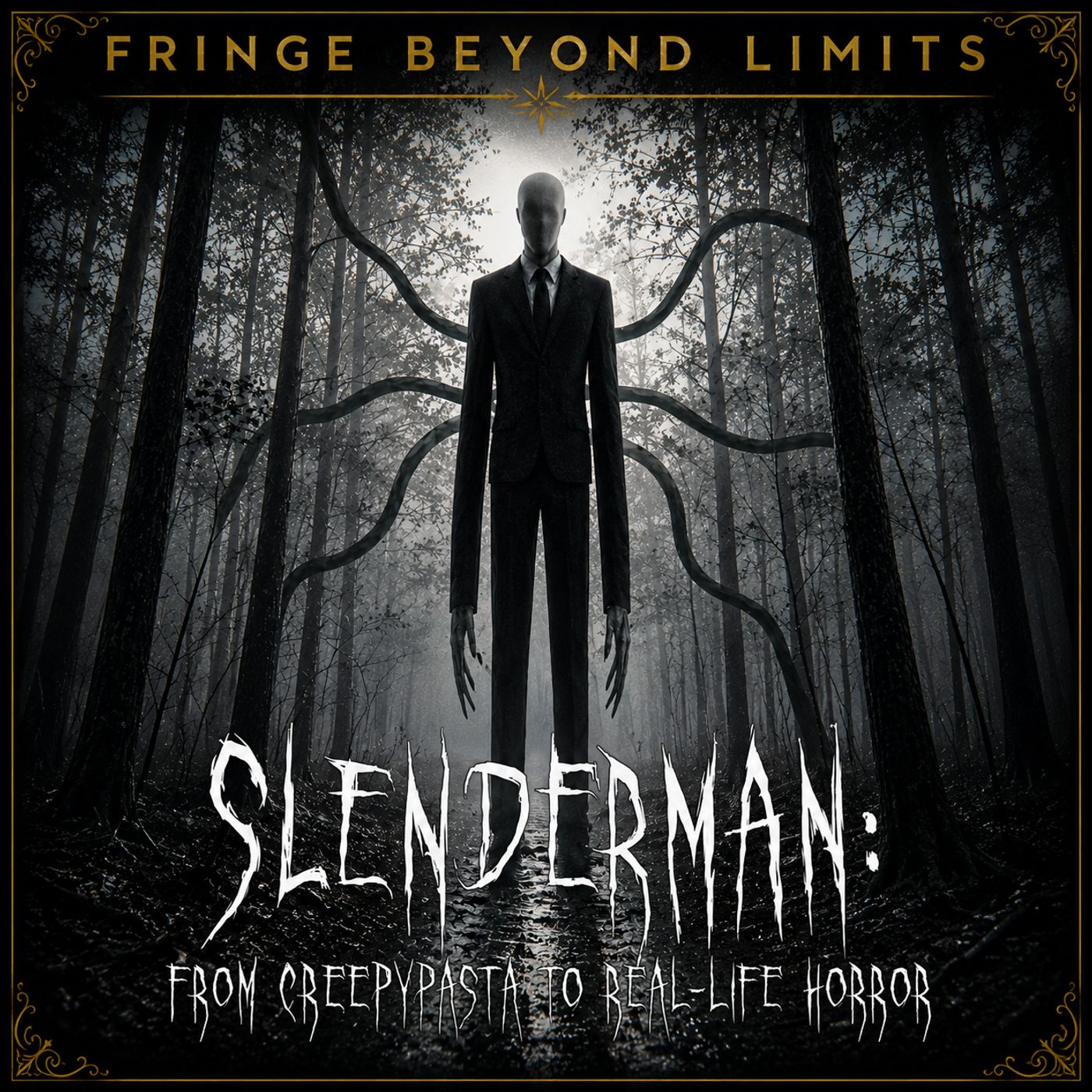
Fringe Beyond Limits
Slenderman: From Creepypasta to Real-Life Horror
00:57:17
Hosts of Fringe Beyond Limits unpack the Slenderman phenomenon, tracing its origin as a 2009 creepypasta and how it grew into modern internet folklore. They cover Slenderman's characteristics and cultural spread, and examine the 2014 Waukesha stabbing, discussing mental health, legal outcomes, and parental responsibility. Expect candid conversation, dark humor, and reflections on how digital stories can blur the line between fiction and reality.
Loading summary
Transcript378 lines
- [00:01]
Announcer
When it comes to what your family
- [00:02]
Lynette
eats and drinks, you know your choices matter.
- [00:05]
Commercial Voice
You're the expert because you know what fits your life.
- [00:09]
Announcer
And getting it right starts with good information.
- [00:12]
Frank
That's why America's beverage companies are sharing more information about our ingredients@goodtokonofacts.org no spin, no judgments.
- [00:22]
Commercial Voice
Just the facts straight from the experts. For more than 140 beverage ingredients, visit
- [00:28]
Announcer
goodtonofacts.org Oregon Parks make an Oregon summer. But what makes an Oregon park? Well, Oregon Lottery Gameplay helps no matter the game Megabucks, video lottery or keno funds from lottery games help support parks projects across the state, ensuring they stay safe, accessible, and open for all. In fact, Discover State Park Scratches are in stores now. It's the perfect way to put a little bit of Oregon's parks in your pocket. The Oregon Lottery. Together, we do good things. Must be 18 or older to play. Lottery games are based on chance and should be played for entertainment only.
- [01:02]
Sponsor Voice
From backyard barbecues to homegrown herbs, the best parts of summer. Start at Lowe's right now. Get three fairy Morse 1.3 quart vegetables and herbs for just $12. Plus get four bags of Miracle Gro 0.75 cubic foot garden soil for only $10. Whether you're planting something new or giving your garden a refresh, now's the time to make the most of your outdoor space. Save more on what you need this summer at Lowe's. We help you save valid through 624 while supplies last selection varies by location. Excludes Alaska and Hawaii.
- [01:31]
Frank
Sam,
- [02:06]
Lynette
Welcome to another episode of Fringe.
- [02:15]
Brie
Nice.
- [02:16]
Lynette
How'd we do?
- [02:17]
Frank
Was that good?
- [02:19]
Brie
So beautiful. Made me cry.
- [02:22]
Frank
Thanks.
- [02:23]
Lynette
It's good to be back again.
- [02:24]
Brie
Don't ever do that again again.
- [02:28]
Frank
Another episode San Bri in studio.
- [02:32]
Brie
I'm there in spirit.
- [02:34]
Lynette
Yeah.
- [02:34]
Brie
Well, you guys got the Ouija board going.
- [02:36]
Lynette
I'm there. Yeah. Let's keep in touch.
- [02:39]
Frank
Okay. You know what?
- [02:43]
Lynette
Take a bite.
- [02:44]
Frank
No, I will not stay in touch. Sorry.
- [02:48]
Brie
Well, that sucks for you, doesn't it?
- [02:49]
Frank
Probably so.
- [02:51]
Lynette
Yep.
- [02:51]
Frank
All right. Well, ladies, what's was Crackalagin?
- [02:57]
Lynette
Why is it so damn cold in this state?
- [02:59]
Brie
Dude, because it's shitty state.
- [03:01]
Lynette
It's so cold.
- [03:03]
Frank
Dude, it's so nice. Are you kidding me?
- [03:05]
Brie
It's cold. Driving to work, I was freezing all day.
- [03:08]
Frank
It was 45 degrees.
- [03:10]
Lynette
Yeah, but the wind was, like, blowing a bajillion miles an hour.
- [03:13]
Frank
Yeah, I know, but, like, I had the windows like a quarter of the way down blasting some music and the heat.
- [03:21]
Lynette
I don't mind like the heat cranked and the windows down. Yeah, that's kind of nice.
- [03:24]
Frank
I do that. My wife hates it.
- [03:25]
Lynette
Oh, yeah.
- [03:26]
Frank
I do that all the time.
- [03:28]
Brie
I do that sometimes.
- [03:29]
Lynette
Yeah. I mean, you just butt warmer on.
- [03:31]
Sponsor Voice
Yeah.
- [03:31]
Frank
You just find that balance. Oh, this is great. Oh, God, such a. Such a waste.
- [03:39]
Lynette
Well, it's better than the other way. You don't have the air conditioning on and the wind was open. That's just stupid.
- [03:44]
Frank
Yeah. Do you think, well, we could do that in the summertime?
- [03:47]
Lynette
No, you don't want to do that. That's dumb. Because it's humid up here.
- [03:50]
Frank
Yeah, it is humid up here.
- [03:52]
Brie
Yeah.
- [03:53]
Lynette
All right.
- [03:53]
Frank
Anything. Anything funnish here?
- [03:56]
Lynette
There was a rose breasted gros beak in my backyard.
- [04:04]
Frank
A rose breasted cross beak.
- [04:07]
Lynette
Gross.
- [04:08]
Frank
G. A gross beak?
- [04:10]
Lynette
Yeah. A boy and a girl. They were cute.
- [04:13]
Frank
A boy and a girl. How could you tell the difference?
- [04:15]
Lynette
The boy had the red boobs that.
- [04:17]
Frank
That drops. That drops. Okay.
- [04:22]
Brie
See, Frank, look what you're missing on bird watching.
- [04:25]
Guest
Yeah.
- [04:25]
Lynette
You'd be talking about breasts all day and tits. Yeah.
- [04:28]
Frank
Yeah. No, I.
- [04:29]
Brie
You could be looking at tits all day.
- [04:30]
Frank
Yeah. Not the right ones.
- [04:35]
Lynette
They have too. You could. You can get if you want. Oh, there are a lot of woodcocks. Cockadoodle doodle do.
- [04:49]
Frank
All right. I'm gonna leave the McDonald's farm now.
- [04:53]
Lynette
It's like, what?
- [04:53]
Frank
Yeah, that. That stumped you?
- [05:01]
Lynette
I need your face,
- [05:05]
Frank
Ms. Brie.
- [05:07]
Brie
Yeah.
- [05:07]
Frank
Do you have anything in your backyard? And red breasts. Would you like to add to this?
- [05:14]
Brie
No, but I do have a cock on video. Going cock a do a doo.
- [05:18]
Frank
You have a cock on what?
- [05:20]
Brie
On video going cock a doodle doo
- [05:21]
Frank
going cock a doodle do.
- [05:23]
Lynette
Brian.
- [05:23]
Brie
Yeah.
- [05:23]
Frank
Yeah. Is that Brian?
- [05:25]
Lynette
No.
- [05:25]
Brie
A cock.
- [05:26]
Frank
Yeah, I guess. I guess you're right. Brian's is so small. We call it a wee wee.
- [05:32]
Lynette
Oh, got it.
- [05:33]
Brie
Yeah, he does call it a wee wee.
- [05:35]
Frank
I told you.
- [05:36]
Lynette
Oh, wow. So sexy. Yeah.
- [05:41]
Brie
I even tell him, like, why are you saying that? Why are you saying, like, or dick or penis? He goes, why not? Wee wee? I'm like, oh, my God.
- [05:47]
Frank
Hey, baby, let me use this wee wee on you. Like, I don't know how you would approach that.
- [05:55]
Lynette
You run away, remember?
- [05:56]
Brie
You're like, if, like, people didn't say cuss words, how they would talk dirty.
- [06:00]
Lynette
Oh, yeah, that's true.
- [06:01]
Frank
Hey, baby, let me see. Let me see if you can handle this. PP.
- [06:14]
Lynette
Wow. How do we get off the rail?
- [06:15]
Frank
I have no idea. Well, maybe from your stories. I'm talking about birds, me too.
- [06:20]
Brie
You brought up cocktail.
- [06:21]
Frank
Yeah. This is what happens. You derailed me.
- [06:25]
Lynette
Well, you should have better tracks.
- [06:28]
Frank
You were the penny on my trash.
- [06:30]
Lynette
You're welcome.
- [06:31]
Frank
Thanks. So, anyway, Tonight's topic is Ms. Brie Slenderman. Something I've never been called. Yes.
- [06:46]
Lynette
Yeah, so I honestly don't know much about Slenderman.
- [06:49]
Frank
You know, I remember watching that documentary about the girls. That's my thing in Wisconsin. The murders or the attempted murder.
- [06:58]
Lynette
Yeah. I still don't know.
- [06:59]
Commercial Voice
No.
- [06:59]
Lynette
Oh, I'm sure it's a real thing.
- [07:01]
Brie
You'll get. You'll get the information.
- [07:03]
Frank
Yeah, it's actually pretty. Pretty interesting. Yeah. So it was made up.
- [07:08]
Lynette
Was it?
- [07:09]
Frank
Creepy pasta. Right. It was like.
- [07:11]
Lynette
Oh, you know, you're.
- [07:11]
Brie
You're talking about the whole episode right now.
- [07:13]
Frank
Okay, fine. I'll just start. Jesus Christ. I'm just trying to fill Ms. Lynette in.
- [07:17]
Lynette
Well, I'll get filled.
- [07:18]
Announcer
You'll learn.
- [07:19]
Frank
I'm sure you will. She was my niece, so with all that talk. All right, so here we go. Slenderman. Some stories are passed down through generations, whispered in the dark, carried by word of mouth, shaped by time. But others are born in different kind of darkness. The glow of a computer screen deep within the endless corners of the Internet. This is where our story begins. In 2009, a series of altered photographs appeared online. Ordinary images of children at play, except for one detail. In the background stood a figure, tall, unnaturally thin, dressed in a black suit. And where a face should have been, there was nothing. At first, it was just a creation, an idea brought to life by Eric Knudsen on a forum known as Something Awful. But stories have a way of growing, especially the ones that tap into something deeper, something primal. People begin adding to it. New sightings, new accounts, new fears. And before long, the line between fiction and reality begin to blur. They say he watches from a distance that appears where he shouldn't, at the edge of forests, in the background of photographs, just beyond what you think you saw. Some claim that once you notice him, he notices you back. Tonight we explore the legend of Slender Man. A modern myth born in pixels and paranoia. A faceless figure that doesn't just haunt stories, but lingers in the spaces where imagination and fear collide. So if you're alone, you might want to check what's behind you. Because sometimes the scariest stories are the ones we create ourselves. Slenderman originated on June 10, 2009, when Eric Knudsen, using the username Victor Surge, posted images on the Internet forum something awful as part of a Photoshop contest themed around creating paranormal images. The contest encouraged users to take ordinary photographs and add supernatural elements. And Knutson submitted two black and white images of children in which he inserted a tall, faceless, shadowy figure lurking in the background. What made his entry especially effective was not the images themselves, but the accompanying text, written in a style that mimicked historical records or police documents documentation. These captions implied that something unnatural had occurred, referencing disappearances and suggesting that the figure had been present during disturbing events. The character of Slender man was influenced by a mix of early horror traditions and folklore ideas. Knudsen drew inspiration from shadowy, faceless entities found in urban legends. The Men in Black concept of emotionless suited figures, and broader themes from cosmic horror, especially the work of HP Lovecraft, which emphasizes unknowable forces beyond human understanding. The result was a character with no clear origin, motive or identity, something intentionally vague and unsettling. After the initial post, Slenderman quickly evolved beyond its original creator. Users on Something Awful began expanding the idea by creating additional images, fake documents and stories, turning it into a collaborative myth rather than a single authored creation. This community driven storytelling helped establish recurring traits for Slender man, such as his tendency to target children, his association with forests and isolated places, and the idea that he could appear in photographs before tragedies occur. Because there is no official version of the story, the myth grew freely and unpredictably. The character gained even more popularity with YouTube series Marble Hornets, which presented Slenderman under the name the Operator in A Smooth Operator. Smooth Criminal.
- [11:40]
Lynette
Oh.
- [11:44]
Frank
Under the name the Operator in a found footage style that made the events feel realistic.
- [11:49]
Lynette
Did you watch it?
- [11:50]
Frank
I did not.
- [11:52]
Lynette
I like found footage styles.
- [11:54]
Frank
Me too. I am a fan. This approach helped blur the line between fiction and reality for many viewers and played a major role in spreading the legend beyond Internet forums. Over time, Slenderman became one of the earliest and most influential examples of Internet born folklore, demonstrating how a fictional concept can rapidly evolve into a widely recognized modern myth through collective storytelling. The physical description of Slender man is deliberately inconsistent across stories, which is part of what makes him so unsettling. But there are several core features that most depictions agree on.
- [12:30]
Lynette
Is he slim?
- [12:31]
Frank
He is typically described as slim, shady, extremely tall, unnaturally thin humanoid figure, often estimated to be between 6 and 15ft tall. That's excessively different depending on the story.
- [12:43]
Lynette
Hmm.
- [12:44]
Frank
His proportions are exaggerated with long elongated limbs that sometimes appear jointless or unnaturally flexible, giving him an almost inhuman silhouette when he stands or moves.
- [12:56]
Lynette
Kind of like the Babadook a little bit.
- [12:58]
Frank
Babadook.
- [12:59]
Lynette
Babadook.
- [13:00]
Frank
Babadook One of his most defining traits is his lack of a face.
- [13:05]
Lynette
How does he eat?
- [13:06]
Frank
Through his butthole? Okay, yep, in nearly all versions, Slender Man's head is completely blank, just like mine. No eyes, nose, mouth or any visible features.
- [13:17]
Lynette
How are you talking to us then? Through your butthole?
- [13:19]
Frank
Through my butthole. This absence of identity is central to his unsettling presence because it removes any sense of emotion or intention that a face would normally communicate. Instead of skin texture or facial structure, his head appears smooth and featureless, almost like a mannequin or void. He is almost always depicted wearing a formal black suit, typically paired with a white dress shirt and dark tie.
- [13:46]
Lynette
He is a sharp dressed man.
- [13:48]
Frank
Every girl is crazy about a sharp dressed man. The suit is usually clean, simple and outdated in style, which contrasts sharply with his unnatural body. The clothing gives him a strange human disguise effect, as if he is attempting or failing to blend into Oregon Parks
- [14:08]
Announcer
make an Oregon Summer but what makes an Oregon park well, Oregon Lottery Gameplay helps no matter the game Megabucks, video lottery or Keno funds from lottery games help support parks projects across the state, ensuring they stay safe, accessible and open for all. In fact, Discover State Park Scratches are in stores now. It's the perfect way to put a little bit of Oregon's parks in your pocket. The Oregon Lottery Together we do good things. Must be 18 or older to play Lottery games are based on chance and should be played for entertainment only.
- [14:37]
Brie
MeTV is America's number one classic TV entertainment network, airing over 60 of the greatest TV series every week. Now METV presents the Golden Girls of Summer, showcasing the best of the Golden Girls. Watch Dorothy, Blanche, Rose and Sophia weeknights on MeTV at 10pm 9 Central. Log on to metv.com now to find out where to watch MeTV. Free over the air and on cable, satellite and select streaming services. METV is memorable entertainment Television Carter's has
- [15:08]
Commercial Voice
your family covered for every summer first first steps, first swim lesson or first sleepover. Our clothes help kids and parents have their best summer ever. Thanks to comfy design and easy dressing details, generations of families have trusted our must haves for babies, toddlers and kids designed to shine season after season. Visit Carters.com to shop the latest styles or find a Carter store near you.
- [15:37]
Guest
This podcast is sponsored by talkspace. Last year, I went through many different life changes. I needed to take a pause and examine how I was feeling in the inside to better show up for the ones who need me to be my best version of myself. When you're navigating life's changes. Talkspace can help Talkspace is the number one rated online therapy, bringing you professional support from licensed therapists and psychiatry providers that you can access anytime, anywhere. Living a busy life, navigating a long distance relationship, becoming a first stepfather, Talkspace made all of those journeys possible. I could speak with my therapist in the office. I could speak of my therapist in the comfort of my home. I was never alone. Talkspace works with most major insurers and most insured members have a zero dollar copay. No insurance, no problem. Now get $80 off your first month with promo code space80 when you go to talkspace.com match with a licensed therapist today at talkspace.com save $80 with code
- [16:35]
Frank
space80@talkspace.com despite this, the suit often appears slightly disordered, as though it doesn't properly fit his elongated frame. Aw, I know he has got to
- [16:47]
Lynette
get better tailor better tail.
- [16:48]
Frank
I was just thinking that Another recurring element in modern interpretations is the presence of additional appendages.
- [16:55]
Lynette
What? Ew.
- [16:59]
Frank
Many versions of Slenderman include long tentacle like limbs emerging from his back.
- [17:04]
Lynette
Okay, this is not going where I thought it was going.
- [17:06]
Frank
These are often described as black, shadowy, and flexible, and they move independently of his body. In some stories, they are used for grabbing, restraining, or manipulating victims, while in others they simply ripple or hang behind him like extra limbs. However, this feature was not part of the original image created by Eric Knudsen and was added later as the mythology expanded through Internet storytelling. His body is also frequently described as unnaturally smooth or undefined, sometimes appearing to blend into shadows or distort the surrounding environment. In certain interpretations, he seems to shift slightly when observed far too long, as if his form is unstable or not fully present in physical reality. This contributes to the idea that Slenderman is not simply a creature in a suit, but something that may not fully belong in the human world at all. Because Slenderman is a product of collaborative Internet folklore rather than a single fixed canon, his appearance can vary between stories, games, and videos. However, the consistent core elements extreme height, faceless head, black suit, and an unnaturally thin body remain central to his identity and are what make him instantly recognizable as a modern horror figure.
- [18:26]
Lynette
He's just misunderstood.
- [18:28]
Frank
I think so too. He just wants to play with you.
- [18:30]
Lynette
Yeah, yeah. And his appendages and.
- [18:33]
Frank
Well, I mean, depends how he uses them. Slender Man's behavior is most often described as that of a silent stalker rather than a direct attacker. In many versions of the myth, he observes his targets from a distance for long periods of time Often appearing at the edges of forests, behind trees, or in the background of photographs.
- [18:54]
Lynette
I should look at my bird photos.
- [18:56]
Guest
You know what?
- [18:57]
Frank
You should. I bet you he's in every single one of them, giving you the photo.
- [19:01]
Brie
I was looking at the breast.
- [19:02]
Lynette
Oh, yeah, well.
- [19:03]
Brie
Oh, I thought he was looking at the breast.
- [19:05]
Frank
No, he's just giving Lynette the bird.
- [19:07]
Lynette
Fair.
- [19:09]
Frank
This gradual, watchful present creates the impression that he studies individuals before taking any further action. He is frequently associated with targeting vulnerable people, especially children or those who are isolated. And his presence tends to become more frequent and intrusive as time passes. A major part of his abilities involves psychological influence. Stories often describe victims experiencing increasingly increasing paranoia, anxiety, and a constant feeling of being watched. Some accounts include memory gaps, confusion, and disturbing nightmares that worsen with continued exposure to him. In certain interpretations, simply seeing Slender man, whether in person, images or video, can begin to affect a person's mental state, sometimes leading to what fans refer to as Slender Sickness, a gradual breakdown of perception and sanity. I think that's what I had last week. Slenderman is also commonly portrayed as having unusual interactions with technology. He often appears in photographs or video recordings, even when not visibly present at that time, suggesting he may be more easily captured by cameras than by the human eye. In some stories, his presence causes distortions in recordings, such as static glitches or blurred imagery. This reinforces the idea that he does not fully exist within normal physical perception and may operate partly outside of conventional reality. Physically, Slender man is typically described as moving in ways that defy normal human limitations. He is often silent, even in dense environments. It may move with extreme speed or appear to teleport from one location to another. Some interpretations suggest he does not truly walk at all, but instead reappears wherever he intends to be, making it seem as though he can manipulate space or distance. His unnatural movement adds to the sense that he does not follow the rules of the physical world.
- [21:08]
Lynette
He's a rule breaker.
- [21:10]
Frank
Do you think that maybe him walking or appearing to move so weird is because he kind of glitches in and out, so you're not catching his entire movement, but just certain points of it?
- [21:26]
Lynette
No, I think he's got to walk over the trees.
- [21:28]
Frank
Oh, he's that tall. Oh, all right, all right.
- [21:32]
Lynette
No, I thought he was glitchy.
- [21:33]
Frank
Yeah, glitchy, glitchy, glitchy, glitchy, wobbre.
- [21:39]
Brie
Wasn't there an episode we talked about? Glitch?
- [21:42]
Lynette
Like.
- [21:43]
Brie
Like things glitching time, glitching or something like that?
- [21:45]
Frank
Yeah, the time. What you call It. It was the. Was it the time episode way back?
- [21:52]
Brie
I think that was like, where there's like, you may see like, glitches in time or like, glitches. You know what I'm talking about.
- [21:59]
Frank
Was it. It was. Yeah, it was time glitches.
- [22:01]
Lynette
No, but. Yeah, but
- [22:04]
Brie
I think it's gonna bug Lynette more than me.
- [22:06]
Lynette
It is.
- [22:10]
Frank
Yes, it is.
- [22:11]
Lynette
Yes, it is. What?
- [22:13]
Frank
Time on my side.
- [22:14]
Lynette
Oh, yeah.
- [22:15]
Brie
Time's on everyone's side. Maybe sometimes.
- [22:17]
Frank
Another common element in later versions of the myth is his ability to influence or control humans.
- [22:23]
Lynette
Often referred to the Veil Keepers. The veil keepers, episode 13 last year.
- [22:28]
Frank
Yeah, the Veil Keepers. That's right. So these individuals are usually depicted as people who have been mentally broken or manipulated into serving him, sometimes carrying out violent or disturbing actions on his behalf. In some stories, the control develops gradually through psychological pressure, while in others, it is portrayed as a more direct supernatural influence that strips individuals of their identity.
- [22:53]
Lynette
So they studied MK Ultra procedure.
- [22:57]
Frank
I think that's where it originated. They found Slenderman was like, oh, we
- [23:00]
Brie
can do that from 2009.
- [23:01]
Lynette
Yep, yeah, yep.
- [23:04]
Frank
In more expanded versions of the legend, Slender man is also associated with reality distortion. His presence is sometimes said to cause unnatural environmental effects, such as dense fog, distorted landscapes, or areas that feel endless or disoriented. People nearby may experience confusion, altered perception of time, or the sense that space itself is behaving incorrectly. These abilities emphasize the idea that he is not just a creature within the world, but something that can subtly alter how the world is experienced. Overall, Slender Man's behavior and abilities are intentionally vague and inconsistent, which allows the myth to remain flexible across different stories. What remains consistent is the idea that he is a quiet, observing presence that gradually influences the mind, distorts perception, and becomes more powerful the longer someone is aware of him. There aren't any verified real world first hand accounts of Slender Man's sightings in the sense of credible, factual evidence. Slenderman is a fictional character created by Eric Knudson, and anything described as a sighting comes from fictional storytelling, roleplay, or Internet horror communities, not documented reality. They said there are many first person style accounts written online that are meant to feel real. These come mainly from creepypasta stories, forums and series like Marble Hornets. They're written as if someone actually experienced Slenderman, which is part of what makes the myth effective. Here are a few examples of how these accounts are typically described. The Forest Encounter Narratives Many stories describe someone hiking or walking along who begins to notice a tall figure standing far away between trees. The figure Appearing closer each time they look back. A growing sense of dread or being watched. These accounts often end with a person fleeing, losing time or claiming they can't fully remember what happened. Photograph Discovery stories Another common type involves someone reviewing photos later and noticing a tall, faceless figure in the background that wasn't seen at the time. Distortions or blurring around the figure. Multiple photos showing the figure getting closer. This style directly reflects how Slender man was originally created through edited images. Ongoing stalking accounts. Some fictional first person stories describe a longer experience. Repeated sightings near the person's home or school. Nightmares involving the same figure. Increasing paranoia and anxiety. These narratives are often suggested that once someone notices Slender man, he continues to follow them. Found footage style video accounts. Series like Marble Hornets present events as if they were real recordings. Characters document strange figures appearing in the background. Memory gaps and confusion. Footage becoming distorted when Slenderman is near. These are among the most convincing firsthand style accounts, even though they are scripted. Important context. Even though these stories are written in a realistic tone, they are fictional by design, meant to imitate real testimony for horror effect, part of a collaborative storytelling culture. There is no credible evidence that Slenderman exists or has been seen in real life. Reported sightings are better understood as creative writing, Internet roleplay, and misinterpretations of ordinary experiences. Why do they feel real? Well, these accounts can feel convincing because they use techniques like first person narration, everyday settings, gradual escalation instead of sudden horror. This mirrors how real eyewitness accounts are often told, which blurs the line between fiction and reality.
- [27:09]
Lynette
So are you going to say my least favorite word, which is. Rhymes with vulpa? I was gonna say shmulpa.
- [27:23]
Frank
I mean, this is a classic case of that. I mean, I almost feel as though, like, tulpas are more real than the.
- [27:35]
Lynette
He said it, he said it. You know that. Just like tapas.
- [27:46]
Frank
All right, so the Slender man stabbing. For years, Slenderman remained exactly what he was meant to be. A story. A chilling, ever evolving piece of Internet folklore that thrived on imagination, creativity, and the thrill of being scared from a safe distance. From forum posts on something awful to videos like marble hornets, the legend grew, pulling more people into its web with each retelling. But what happens when a story stops feeling like a story? When the line between fiction and reality begins to blur? Not on a screen, not in comment sections, but in real life. In 2014, in the quiet city of Waukesha.
- [28:31]
Lynette
Is that Wisconsin?
- [28:32]
Frank
Yep.
- [28:33]
Lynette
Again.
- [28:34]
Frank
Again.
- [28:35]
Lynette
Serial killers and cryptids and brats and
- [28:40]
Brie
cheese and of brats and cheese.
- [28:44]
Frank
So in the Steve Walker show, that question became something far more disturbing than anyone could have imagined. What had once been a fictional figure born on the Internet was suddenly being spoken about in police reports, courtrooms, and national headlines. Yeah.
- [29:01]
Brie
Oh, yeah.
- [29:01]
Lynette
Really?
- [29:02]
Frank
Yeah, yeah, 100%. This is all real.
- [29:04]
Lynette
Okay.
- [29:05]
Frank
The 2014 stabbing in Waukesha involved three 12 year old girls whose relationships developed over several years and played a significant role in the events that followed. Peyton Lautner, often called Bella, was described as friendly, empathetic, and socially well adjusted, because this time it wasn't just a story anymore. She met Morgan Geiser in elementary school and became one of her closest friends, in part because Morgan struggled socially and had difficulty forming connections with other children. Peyton's willingness to include Morgan helped establish a strong bond between them, with Peyton often acting as a stabilizing presence in Morgan's life. Their friendship appeared genuine, but it was also somewhat unbalanced. Peyton was more socially confident, while Morgan was more withdrawn, imaginative, and prone to intense interests. Morgan later developed a close friendship with Anissa Weir, who lived nearby. The two bonded quickly over their shared fascination with fantasy horror stories and online creepypasta content, particularly the fictional character Slenderman. Unlike Peyton, who reportedly found these stories frightening and did not fully engage with them, Morgan and Anissa became deeply immersed in this online world. Their friendship reinforced their shared beliefs and interests, creating a feedback loop in which the line between fiction and reality began to blur over time. They spent long periods discussing Slender man, reading stories and imagining scenarios in which he was real, and observing them. As the trio spent time together, subtle divisions emerged. While all three girls socialized as a group, Morgan and Anise's connection grew increasingly intense and exclusive, often centered on their shared fixation. Peyton, though still considered a friend, was somewhat on the outside of this dynamic. Importantly, Morgan's mental health was deteriorating during this period. She later showed signs consistent with early onset schizophrenia, including delusional thinking and difficulty distinguishing reality from imagination. Anissa, while not diagnosed with the same condition, became influenced by Borgen's belief and participated in reinforcing them. Together, they began to view Peyton not just as a friend, but as someone who could be useful to fulfill what they believed was a necessary act to appease Slender Man.
- [31:43]
Lynette
I don't like where this is going.
- [31:44]
Frank
Yeah, you. You're not. You're not. In the. In the months leading up to the attack in Waukesha, the plan formed gradually through a combination of obsession, fear, and reinforcement between Morgan Geyser and Anissa Weir. Both girls spent extensive time reading and discussing online creepypasta stories, particularly those centered on Slenderman. What began as curiosity evolved into belief, especially for Morgan, who started to experience delusional thinking and became convinced that Slender man was real, could observe them, and posed a threat to their families if they did not prove their loyalty. Anissa, while not experiencing the same level of psychosis, adopted and reinforced those beliefs through their close friendship. Together, they created a shared narrative in which they were potential proxies of Slenderman and needed to commit a violent act to earn his approval and ensure their own safety. As early as late 2013, the girls began discussing the idea of killing someone as a form of offering. They ultimately chose Peyton Lautner, largely because she was accessible and trusted them. Their planning was not a single moment of decision, but rather an evolving process with multiple abandoned attempts. At one point, they considered killing Peyton during a sleepover by attacking her while she slept. But they hesitated, partly out of fear of being caught and partly due to uncertainty about carrying out the act. On another occasion, they discussed luring her into a bathroom and committing the attack there, again abandoning the idea when it became too risky or emotionally difficult. These failed attempts show that although the intent was present, they struggled with the practical and psychological barriers of committing the crime. In the days immediately before the attack, their thinking became more focused and urgent. They revisited their plan, repeatedly, discussing details such as where the attack should occur, how they would carry it out, and what they would do afterward. A key element of their plan involved traveling on foot after the attack to what they believed was Slenderman's mansion, which they imagined to be located in the Nicollet National Forest, a real forest that they incorporated into their fictional belief system. They prepared mentally for a long journey, believing that once they proved themselves, they would be taken in and protected by Slenderman. The final opportunity arose on May 30, 2014, when Peyton attended a birthday sleepover at Morgan's house. Throughout that evening, Morgan and Anissa were aware that this was their chance to carry out the plan. Even then, they hesitated. According to later accounts, they initially intended to kill Peyton while she slept that night, but they lost their nerve. Instead, they decided to wait until the next day, believing that committing the act in a more secluded outdoor setting would reduce their risk of interruption or immediate capture. By the morning of May 31, their plan had solidified. They would take Peyton to a nearby park and wooded area under the pretense of normal play, isolate her, and carry out the attack there. The girls first went to a nearby park, where they spent time playing and acting casually, maintaining the appearance of an ordinary outing beneath that surface. However, Morgan and Anissa had already agreed that this would be the day they would carry out their plan, which they believed was necessary to satisfy Slenderman. After some time at the park, they suggested going into a more secluded wooded area, presenting it as a part of a game. Peyton, trusting both girls, followed without realizing the danger. Once in the woods, the girls began playing hide and seek, a strategy meant to isolate Peyton and create the opportunity for the attack. At a chosen moment when Peyton was vulnerable and off guard, Morgan suddenly lunged at her and forced her to the ground. As Peyton struggled to understand what was happening, Morgan produced a kitchen knife and began stabbing her while Anissa remained nearby, encouraging the act rather than intervening. The attack was prolonged and deliberate rather than impulsive. In total, Peyton was stabbed 19 times, sustaining wounds across her arms, legs and torso. Some injuries were defensive, indicating that she attempted to protect herself, while others struck critical areas. One wound narrowly missed a major artery near her heart by less than a millimeter, an injury that doctors later said would likely have been fatal had it been slightly deeper or differently placed. After the stabbing, Peyton was left severely injured and bleeding in the wooded area. Morgan and Anissa briefly interacted with her, telling her to remain still and that they would go to get help, statements that were misleading as they had no intention of returning. Instead, they left her alone, believing that she would die from her injuries. They then began walking away from the scene, intending to travel on foot toward what they believed was Slenderman's mansion, which they imagined to be located in the distant Nicollet National Forest. Meanwhile, Peyton, despite her severe injuries, demonstrated remarkable determination. She managed to slowly crawl out of the wooded area and reach a nearby road, where she was eventually discovered by a passing cyclist who immediately contacted emergency emergency services. Peyton was rushed to a hospital where she underwent extensive emergency surgery to treat her life threatening injuries. Medical professionals later confirmed that her survival was extraordinary given the severity of the attack. The events of that morning were especially shocking, not only because of the brutality involved, but also because the calculated nature of the assault and the young age of everyone involved. What appeared to be a routine day among friends turned into a premeditated act of violence carried out under the influence of a deeply distorted beliefs, leaving lasting physical and psychological consequences for the victim
- [38:19]
Announcer
and profound legal Oregon parks make an Oregon summer. But what makes an Oregon park? Well, Oregon Lottery Gameplay helps no matter the game Megabucks video lottery or keno funds from lottery games help support parks projects across the state, ensuring they stay safe, accessible and open for all. In fact. Discussion State park scratches are in stores now. It's the perfect way to put a little bit of Oregon's parks in your pocket. The Oregon Lottery Together we do good things. Must be 18 or older to play. Lottery games are based on chance and should be played for entertainment only.
- [38:51]
Commercial Voice
Carter's has your family covered for every summer first first steps, first swim lesson or first sleepover. Our clothes help kids and parents have their best summer ever. Thanks to comfy design and easy dressing details. Generations of families have trusted our must haves for babies, toddlers and kids designed to shine season after season. Visit Carters.com to shop the latest styles or find a Carter store near you.
- [39:20]
Frank
Show Social repercussions for the per Perpetu Perpetrators Perpetrators thank you the Aftermath Stabbing unfolded rapidly and had long lasting legal, psychological and social consequences for everyone. Invol Shortly after leaving Peyton Louder in the woods, Morgan Geyser and Anissa Weier were located by the police later that same day while walking along a highway. When questioned, both girls openly admitted to the attack and explained that they had committed it to appease Slenderman, whom they believed was real and capable of harming them or their families. Their calm and matter of fact descriptions during early interviews drew national attention, particularly because of their age and the seemingly calculated reasoning behind the crime. As the case moved into the legal system, it quickly became controversial due to the decision to charge both girls as adults, despite them being only 12 years old at the time. Over the following years, extensive psychological evaluations were conducted. Morgan Geyser was diagnosed with early onset schizophrenia and experts testified that she had been experiencing significant delusions and a break from reality, including confirmed beliefs that Slenderman existed and was exerting influence over her. Anissa Weyer, while not diagnosed with schizophrenia, was found to have shared delusional disorder and to be highly susceptible to Morgan's influence. Ultimately, both girls entered pleas of not guilty by reason of mental disease or defect. The court accepted these findings, meaning they were not convicted in the traditional sense, but were instead committed to psychiatric institutions for treatment and supervision. The Sentencing that the sentencing outcomes reflected differences in their mental health assessments. Morgan Geyser was committed to a mental health facility for up to four years, reflecting the severity of her condition in the perceived 40.
- [41:20]
Lynette
Yeah, sounded like you said four.
- [41:22]
Frank
Sorry, sorry, 40. Severity of her condition and the perceived ongoing risk she posed, Anissa Weyer received a commitment of up to 25 years. These sentences were indeterminate, meaning their release would depend on regular evaluations of their mental health and risk to the public rather than a fixed prison term. Over time Both cases continued to evolve. Anissa Weier was granted conditional release in 2021 after demonstrating progress in treatment and stability under supervision. Morgan Geyser remained institutionalized longer and was only conditionally released years later under strict conditions, though her case has continued to be closely monitored due to concerns about her compliance and safety.
- [42:10]
Brie
That was last year, right?
- [42:12]
Frank
I think so. I think it was. Meanwhile, Peyton Lautner's recovery became a significant part of the aftermath narrative. After undergoing multiple surgeries and spending time in intensive care, she was able to leave the hospital within about a week, an outcome many considered remarkable, given the severity of her injuries. Physically, she recovered well, but the psychological impact was substantial. In later years, she spoke publicly about the lasting trauma of the attack, including anxiety and ongoing fear. Despite this, she demonstrated resilience by returning to school, rebuilding her life, and even expressing interest in pursuing a career in medicine, inspired in part by the care she received.
- [43:00]
Lynette
The.
- [43:02]
Frank
Yeah, I'm surprised you didn't hear about this.
- [43:05]
Brie
There's even a. Was it on Netflix? It was documentary about this, too.
- [43:08]
Frank
I think it's on HBO.
- [43:10]
Brie
Yeah, I think it's HBO. Max.
- [43:12]
Lynette
Yeah.
- [43:12]
Frank
Yeah, but.
- [43:13]
Lynette
But, like, they were told 25 and 40 years, and they get out in, like, 10.
- [43:17]
Frank
Well, it's, you know, it's conditional based on the progress they make. You know, I mean, you have to have that in, because if you, you know, hypothetically, if they are mentally now, okay. And understand and have the treatment, and they can be. They are safe to themselves and the public, you know, why keep them in a mental institution when they weren't committed as stable people? Like, lack of a better word. Like, I get it. I mean, that's one of the, you know, that's the good and bad behind, you know, behind the insane whatchamacallit.
- [43:58]
Brie
Insane Clown Posse.
- [44:00]
Frank
Yes, Insane Clown Posse. Get your faygo out and start chugging. No, but behind the whole insane whatchamacallit.
- [44:13]
Brie
I'm having such a insanity plea or.
- [44:16]
Frank
Yeah, you know.
- [44:16]
Lynette
Yeah, like.
- [44:19]
Frank
Like, I understand, you know, but if you're gonna be deemed not mentally competent during it, I mean.
- [44:27]
Lynette
Yeah, but I don't know. I'm just thinking.
- [44:30]
Frank
And in all honesty, they're 12 years old. I don't think they should have been tried as adults to begin with.
- [44:35]
Lynette
Yeah, but who is the. The serial killer who killed his grandparents? Why can't I think of his name right now?
- [44:40]
Frank
Killed his grand.
- [44:41]
Lynette
Killed his grandparents. The co ed guy.
- [44:45]
Brie
Oh, the tall dude. I can't think of his name.
- [44:48]
Lynette
I can't think of his name.
- [44:48]
Brie
Hold on the co Ed killer.
- [44:51]
Frank
Kemper. Yeah, yeah, Ed Kemper.
- [44:53]
Lynette
He killed his grandparents as a youth. He did. Went to hospital, got, quote, fixed and then went on to kill what, not eight, nine more people, plus his mom and his mom's friend.
- [45:04]
Frank
Yeah, but his mom was the catalyst of why he was the way he was.
- [45:08]
Lynette
Okay, well, the Internet was the catalyst for. You can't get away from the interwebs.
- [45:12]
Brie
But I mean, I guess time will tell if they actually were. Were treated correctly or not.
- [45:17]
Lynette
Yeah, but then what?
- [45:19]
Brie
Unfortunately, yeah.
- [45:21]
Frank
Another 12 year old gets stabbed. I mean, I mean, I don't know. You know, I don't have the. Yeah, I, I wish I did. I wish I could tell you what's right and what's wrong, what should have. I don't. But.
- [45:31]
Brie
So the thing that. Sorry, no, go ahead.
- [45:34]
Frank
No, go.
- [45:34]
Brie
I'll say the thing that gets me is they allow the whole insanity of the mental thing for the court. They allowed them not guilty, whatever, because of it. But it specifically states in there that they had times when they were in their head, they were like, oh, maybe we shouldn't do this, maybe we shouldn't do this, maybe we shouldn't. So in other words, they did have that mental capacity to know that what they were doing is wrong, Right?
- [46:01]
Frank
Yeah. But the mental clarity they had then slowly dissolved over time and they got to the point where they were truly mentally ill during the time of the stabbing. You know, that was. They were still on, on the fence because of the mental clarity they still held on to. But over time it just kept deteriorating. You know, like I can say, yeah, when I, when they were 10 years old, they didn't have anything but. Or it. But at 12 now they do. You can't really refer back in time like, well, you're okay then. Why aren't you okay now? You know what I mean? So I think that's why is that. That, that mental clarity just went out the door. The more and more they dove deep into this fantasy world.
- [46:55]
Lynette
Keep your kids off the Internet, don't
- [46:58]
Frank
listen to podcasts, don't listen to our, don't let them listen to our podcast, number one. But no, I, I don't think that answer. I think the, the answer is just be more involved with your kids. You know, have a relationship with them. And don't get me wrong, I had a great relationship with my, my mom, not my dad. But there's not. I wouldn't tell my mom everything, but she knew enough to know that I was not crazy.
- [47:26]
Brie
No,
- [47:29]
Frank
maybe she knew I Just was in denial. But. But you know what I mean?
- [47:33]
Brie
Like.
- [47:33]
Frank
Like, you could have a very healthy relationship and not know everything, but just know that your kid's okay, you know?
- [47:40]
Lynette
Don't.
- [47:40]
Frank
I think number one thing is don't be your. Don't be their best friend.
- [47:43]
Lynette
I think you're a parent.
- [47:44]
Frank
Yeah. You're a parent. Be a parent. You're supposed to not be liked. You're supposed to be told, you're ruining my life.
- [47:51]
Lynette
Right. You know I hate you, right?
- [47:53]
Frank
Right. You know fucking hate this place. Good. I'm happy you do.
- [47:57]
Lynette
Like, good. We'll be friends when you're 30, right?
- [47:59]
Frank
Exactly. When you're 25 and you get your first job and you could have a legal drink. Guess what? We'll go out to the bar. We'll have a bottle of wine, or bottle.
- [48:08]
Lynette
We'll be friends then. But until then.
- [48:09]
Frank
Exactly.
- [48:10]
Lynette
I hate your face, too.
- [48:11]
Frank
100%. 100.
- [48:14]
Brie
So I hate your face.
- [48:17]
Frank
So, yeah, I mean, I guess that's the. The moral of the story. Just be more. And be. Be more of a parent than a friend. Yeah.
- [48:25]
Lynette
All right.
- [48:26]
Frank
Anything else you guys want to add before I move on?
- [48:28]
Commercial Voice
No.
- [48:28]
Lynette
I like your graceful transitions.
- [48:30]
Frank
Oh, thanks.
- [48:31]
Announcer
Yep.
- [48:31]
Brie
Yep. Very lovely.
- [48:32]
Lynette
In the beginning.
- [48:34]
Frank
In the beginning, there was darkness. God said, let there be love.
- [48:40]
Lynette
Let there be a podcast.
- [48:41]
Frank
Let there be a podcast. Fringe Beyond Limits was launched.
- [48:45]
Lynette
Yeah,
- [48:48]
Frank
I could keep going. I don't want to.
- [48:50]
Lynette
I don't want to.
- [48:52]
Frank
Slenderman as a modern folklore is often used by scholars as a clear example of how storytelling has evolved in the digital age. Unlike traditional legends that developed over generations through oral storytelling, Slenderman emerged almost instantly online in 2009 through a single post by Eric Cadutson on Something Awful and then expanded through thousands of contributors across the Internet. Despite having a known origin, it functions like older folklore because it is collectively shaped, constantly changing, and not controlled by one author. One of the defining features of Slenderman as folklore is its collaborative nature. After the original images were posted, other users began adding to their own stories, edited photos, fake documents, and personal encounters. This process mirrors how traditional myths evolve, with each storyteller modifying details to suit their audience. However, instead of word of mouth transmission, Slenderman spreads through forums, social media, videos, and digital art. This allows the legend to evolve much faster and reach a global audience almost instantly. Another key aspect is decentralization. There is no official version of Slender Man's story, no single book, authority, or canon that defines him. Different interpretations can contradict each other, yet all are accepted as part of the myth. This flexibility is similar to older legends like the Boogeyman. Do you remember? Do you ever see the movie Porky's? No. All right, never mind. So legends like the Boogeyman, which also changes form depending on the culture. Slender Man's lack of fixed rules, his unclear origins, motives and abilities, makes him adaptable and easy for others to reinterpret. Slender man also reflects contemporary fears, which is a hallmark of folklore. Traditional legends often embody the anxieties of their time, and Slender man does the same for the digital digital era. He is frequently associated with surveillance, loss of control, and the blurring of reality and fiction. Fear is tied to constant connectivity and media exposure. His ability to appear in photos or videos mirrors modern concerns about technology, while his stalking behavior reflects deeper psychological fears of being watched or followed. The role or immersive and realistic storytelling is another important factor. Projects like Marble Hornets presented Slenderman through found footage style videos that felt authentic, making audiences question what was real. This technique is similar to older folklore that was told as if it were true, but digital media enhances the effect. Through visuals, editing and interactive engagement, viewers could comment, theorize, and even contribute to the narrative in real time. Additionally, Slender man demonstrates how folklore can cross media boundaries. The character moved from a forum post to YouTube series, video games, and eventually films like Slenderman. Each new format added layers to the myth while reaching different audiences. This kind of multimedia evolution is a defining trait of modern folklore, where stories are not limited to a single medium, but spread across platforms. Finally, Slenderman highlights both the power and risks of digital folklore. While it showcases creativity and global collaboration, it also raises questions about how immersive fiction can affect perception, particularly among younger or vulnerable audiences. The 2014 incident in Waukesha is often cited in discussions about this topic, though it is important to recognize that such cases are extremely rare and involve complex psychological factors beyond exposure to a fictional story. Overall, Slender man represents a shift in how myths are created and shared. He is not just a character, but a process, an evolving participatory narrative shaped by the Internet. As a result, he is widely considered one of the first true examples of fully digital born folklore, illustrating how modern technology has just transformed the way humans create, spread, and experience stories.
- [53:19]
Lynette
Where are the bodies? Slender Man?
- [53:21]
Frank
Where are the bodies? Did they hit the floor?
- [53:25]
Brie
I was thinking the exact same thing.
- [53:32]
Frank
She's so. She's so strange.
- [53:38]
Lynette
That's why we love her.
- [53:39]
Sponsor Voice
I know.
- [53:40]
Frank
I love her so much. In the end, Slender man is more than just a story. He's a reflection of how fear evolves with us, born from a single idea by Eric Knudsen on something awful, he became something far larger than anyone could have predicted. A faceless figure shaped not by one mind, but by thousands. A legend that grew not in ancient forests or forgotten villages, but across screens and threads and shared imagination. And maybe that's what makes him so unsettling. Because unlike the monsters of the past, we know exactly where Slender man came from. We watched him being created. We helped build him, and yet he still feels like something we don't fully understand. Stories like this remind us that fear doesn't need to be real to feel real. That the mind can fill in the blanks far better than anything we could ever see. And sometimes, the more we try to define something, the more it slips into the unknown. So whether Slender man is just a piece of Internet folklore or something that lingers a little deeper in our imagination, one thing is certain. Once a story takes hold, it doesn't simply disappear. It waits. It spreads. It grows. And sometimes it watches. Sleep well tonight, ladies and gentlemen.
- [55:05]
Lynette
I will.
- [55:06]
Frank
So do you think. And I want to actually dive into this. What? What are you laughing at?
- [55:15]
Lynette
I just said I think you thought.
- [55:16]
Frank
Okay, what was you thinking? Thought. Go ahead.
- [55:18]
Lynette
Go ahead.
- [55:18]
Brie
I thought she was doing a sniffing
- [55:20]
Lynette
thing on the mic. No, I was trying to stifle a laugh.
- [55:23]
Frank
Yeah, go ahead.
- [55:26]
Lynette
What if Slenderman is just a gin? And that's where they got the slim gin stab into a Slim Jim.
- [55:39]
Brie
I don't know whether to say that's like a bad dad joke or what. Like
- [55:45]
Frank
times like this. I wish we had video.
- [55:49]
Brie
Can you say that I'm weird?
- [55:51]
Frank
My reactions to some of the things that come out of these ladies mouths. Jesus, I let you go for that. Like, I stopped my thought so you could share that.
- [56:06]
Brie
You should have known that she. When she was laughing, that it wasn't gonna be like her normal thinking.
- [56:11]
Frank
Well, I didn't know what she was laughing at. So I'm like, all right, let's. This should be good. And. Yeah, good.
- [56:20]
Lynette
What were you thinking?
- [56:22]
Frank
I was wondering if there's other stories, like folklore, that are not exactly like Slender man, but have similar comparisons and how these entities may always morph a little bit when they come back into the zeitgeist of the era, you know, so like, they just change a little bit at a time. So like 200 years ago, it could have been. He could have been fat. I don't know. You know, a thousand years ago, he could have been wearing tribal instead of a suit, you know, and I Wonder if these entities are real. Not tulpas, but actual real entities that just kind of change their appearance as time goes on. And they're really there influencing. Let it be a psychological or just allowing themselves to be discovered by people like Eric Knudsen, who thought it was something that just came to mind where he was more or less possibly influenced.
- [57:19]
Lynette
Right. Because thoughts don't every thought that has been ever thunk. So my thought wasn't original. It came from somewhere.
- [57:26]
Frank
It did come from somewhere.
- [57:27]
Lynette
Someone had the same thought somewhere.
- [57:29]
Frank
Yeah.
- [57:29]
Lynette
So, yeah, he just picked up on a thought that's already been thunk. Yeah. And he just put it into physical image in existence. Yeah.
- [57:38]
Frank
Yeah. Where do thoughts go once you have them?
- [57:43]
Brie
Butthole.
- [57:44]
Frank
Okay, that was such a bright answer.
- [57:48]
Brie
You said butthole earlier, so I just figured I'd mention it again.
- [57:50]
Frank
Yeah, I know, but thank you. But that's just how I was talking to you guys was through my butthole.
- [57:57]
Brie
And that's how Sundart man eats. Apparent calling to you too, is through his butthole.
- [58:00]
Frank
Did you guys ever see the south park where they did that?
- [58:02]
Lynette
No.
- [58:03]
Frank
Oh, so instead of, like, eating and. And pooping out of your butthole, they would eat through their butthole and poop out of their mouth.
- [58:13]
Lynette
That show is so dumb. I can't believe I used to watch this.
- [58:15]
Frank
It's so great. It's fantastic.
- [58:20]
Brie
So what was the name of the poop? I just want to go.
- [58:28]
Lynette
Oh, gosh.
- [58:29]
Frank
What was his name?
- [58:31]
Lynette
I don't know. You have a Google machine at your fingertips.
- [58:34]
Frank
Yeah. Bree's our Google master. Our master Googler.
- [58:38]
Lynette
Also, I don't want that on my Google search history.
- [58:43]
Brie
Mr. Hanky.
- [58:44]
Frank
Mr. Hank. I was thinking Mr. Handy for some reason.
- [58:47]
Brie
Mr. Hankey. The Christmas.
- [58:48]
Frank
I know. That's why I didn't say that.
- [58:50]
Lynette
There you go.
- [58:54]
Frank
All right. Well, that's. Slenderman's always a fascinating topic. Just because something that supposedly just created out of thin air has run rampant with so many different things and then.
- [59:08]
Brie
And pretty much came to, like, girls trying to stab a girl to death, like that was supposed to be their friend.
- [59:15]
Frank
It kind of. Kind of makes me think of the. The Zozo demon.
- [59:20]
Lynette
Yeah.
- [59:21]
Frank
You know, we do have to do a Ouija board and ask for Zozo. Zozo.
- [59:27]
Lynette
What it. What if it's just Azaz?
- [59:29]
Frank
Like Oz? Like the jail. Welcome to Oz.
- [59:33]
Lynette
Or.
- [59:33]
Brie
Or the wizard of Oz.
- [59:35]
Frank
The wizard of Oz. Think it's the wizard coming through?
- [59:37]
Lynette
It might be. Oh, but he's on the other side of the mirror. That's why it came through a zozo.
- [59:43]
Frank
Oh, it's in reverse. Or what if it's just ooze or zoo?
- [59:53]
Lynette
He's just dyslexic. Zoos. All right, well, we'll see if his Slender man shows up in other things. Yeah, I think it's just a djinn. It's a watcher.
- [60:07]
Brie
It's.
- [60:08]
Frank
You know what? It might be something ancient. Maybe it's just a gin from Ethiopia.
- [60:13]
Lynette
Yeah, well, sharp dressed man, he listened to ZZ Top, though, too.
- [60:17]
Announcer
Yeah.
- [60:17]
Lynette
Yeah. Yep.
- [60:18]
Frank
Maybe that's what Zozo is, just minus do's. Maybe they use the O as, like, an underscore. So it's zz.
- [60:25]
Lynette
No. Oh, I like that. And he gets the ooh.
- [60:28]
Sponsor Voice
Yeah.
- [60:32]
Frank
All right, we are definitely off the rails. And I have no idea what we're talking about, so.
- [60:37]
Brie
All right, well, thanks, everyone, for listening.
- [60:40]
Frank
Yeah, thanks for listening.
- [60:41]
Lynette
Don't forget to snap into a Slim Jim.
- [60:44]
Frank
Don't forget to eat me.
- [60:46]
Sponsor Voice
Yeah, please.
- [60:47]
Lynette
I'm a vegetarian.
- [60:49]
Frank
Not hit, unfollow me. Just don't hit unfollow. Hit, follow. Leave a five star rating.
- [60:57]
Lynette
Oh, if you can't have fun, life's not worth living. Come on.
- [60:59]
Frank
And you can find us on Apple Podcasts.
- [61:02]
Brie
And he keeps going. He's ignoring us.
- [61:04]
Frank
Amazon, wherever you get your podcast, we shall be there forever and ever and ever and ever.
- [61:12]
Lynette
Unless the Internet goes down.
- [61:14]
Frank
Amen. I don't know what else.
- [61:21]
Lynette
I can't believe I flew into town for this.
- [61:23]
Frank
I can't believe you came over for this. All right, well, my name is Frank.
- [61:32]
Brie
I'm Brie.
- [61:33]
Lynette
My name is Lynette.
- [61:34]
Frank
And you've been listening to Fringe Beyond Limits.
- [61:43]
Lynette
Sa.
- [62:19]
Announcer
Oregon parks make an Oregon summer. But what makes an Oregon park? Well, Oregon Lottery gameplay helps. No matter the game. Megabucks, video lottery or keno. Funds from lottery games help support parks projects across the state, ensuring they stay safe access and open for all. In fact, Discover State Park Scratches are in stores now. It's the perfect way to put a little bit of Oregon's parks in your pocket. The Oregon Lottery. Together, we do good things. Must be 18 or older to play. Lottery games are based on chance and should be played for entertainment only.
- [62:50]
Frank
If you like the show, please take a moment to rate, review and subscribe. It really does help the show to grow. Thank you for listening.