← Fringe Beyond Limits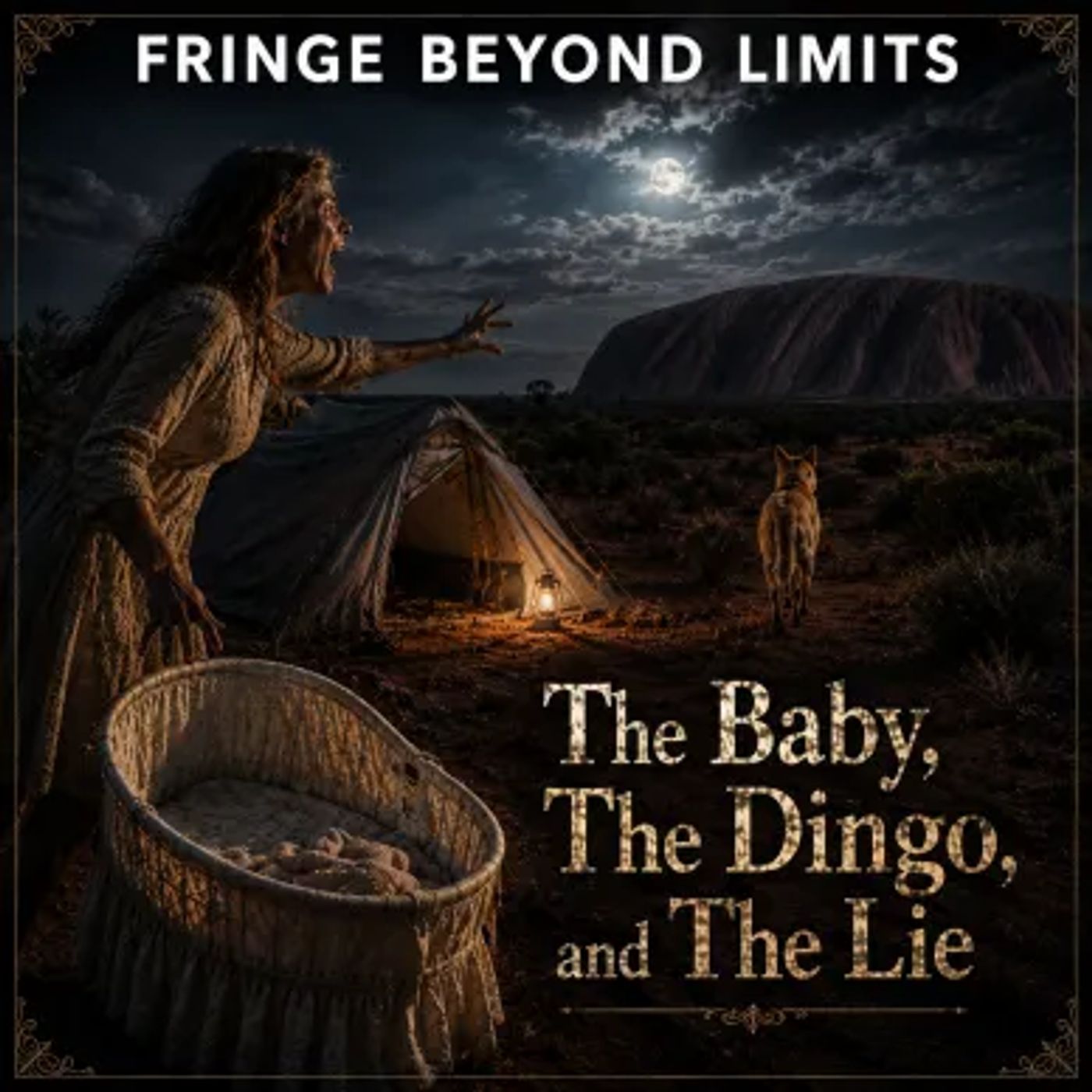
Fringe Beyond Limits
The Baby, The Dingo, and The Lie
01:03:28
On a cold August night in 1980, nine-week-old Azaria Chamberlain vanished from a campsite near Uluru, prompting Lindy Chamberlain's famous cry: "The dingo's got my baby." What followed was a decades-long saga of sensational media coverage, flawed forensic science, and public hysteria that culminated in wrongful convictions. After years of legal battles, inquiries, and the discovery of missing evidence, the Chamberlains were ultimately exonerated and Azaria's death was officially attributed to a dingo in 2012. This episode explores confirmation bias, junk science, and the heavy human cost of mass judgment.
Loading summary
Transcript375 lines
- [00:00]
A
Avoiding your unfinished home projects because you're not sure where to start. Thumbtack knows homes. So you don't have to. Don't know the difference between matte paint finish and satin or what that clunking sound from your dryer is. With Thumbtack, you don't have to be a home pro. You just have to hire one. You can hire top rated pros, see price estimates and read reviews all on the app. Download today, every team, every topic, everywhere.
- [00:25]
B
This is Believe. Sam. Welcome to another episode of Fringe Beyond Pivots.
- [01:11]
C
Hi.
- [01:11]
D
Hi.
- [01:14]
C
I was like, is there a delay?
- [01:16]
D
Is this spring being awkward?
- [01:18]
B
I just wanted you guys to start the show off this time.
- [01:22]
C
Hi, guys. How's everybody's week going?
- [01:24]
B
Fantastic.
- [01:25]
C
Thanks. Oh, yeah.
- [01:28]
B
Yeah.
- [01:28]
C
Anything new?
- [01:28]
B
Yeah, yeah. Let me tell you what's new here at W670, the fringe. So. Yeah.
- [01:38]
C
Yeah.
- [01:41]
B
Nothing new. Tomorrow's my anniversary.
- [01:43]
C
Happy anniversary. Happy anniversary.
- [01:46]
B
15 years.
- [01:48]
C
Oh, my word.
- [01:50]
D
I can't believe she was able to survive you that long.
- [01:52]
B
Are you kidding me? It's so long to suffer without dying. I'm telling you,
- [01:59]
C
you got nothing for her.
- [02:01]
B
And what about you guys? Anything new? Fun, Exciting?
- [02:04]
C
My power's back on.
- [02:07]
D
That's new and exciting.
- [02:09]
B
That is great.
- [02:11]
C
Yeah. 110 degree heat indices. Yeah, I know. You guys are pretty bad too.
- [02:17]
B
Yeah. Yeah. One of my co workers, he is of Swedish descent and his first name is Lars. His AC broke yesterday and he's got three dogs. Oh, I know. I feel horrible for him. And he's thinking it might be nine to ten grand to. To get a new one. I think he'll need a new one.
- [02:47]
C
Gosh.
- [02:48]
B
Yeah. Yeah.
- [02:50]
C
Does he have a basement?
- [02:51]
B
Yeah, he does.
- [02:52]
C
Okay. At least he can hide there.
- [02:53]
B
Yeah. So he's.
- [02:54]
C
Maybe.
- [02:54]
B
Yeah. So this morning he came in, he's like. Yeah. You know, slept in the basement. It was 77 degrees there. But I was, you know, it was. We had a dehumidifier. Dehumidifier going and, you know, it was. I was able to sleep. I'm like, all right.
- [03:07]
C
I was like, the dehumidifier will take the wetness out, but it's just going to pump out more hot air, unfortunately.
- [03:13]
B
Yeah. Yeah. So.
- [03:15]
C
Well, I hope Lars finds something quick.
- [03:19]
B
Yeah.
- [03:19]
C
Or the weather breaks. One of the two.
- [03:21]
B
Yeah. I just hope the weather breaks.
- [03:24]
D
I was gonna say the weather be similar to what your wedding was.
- [03:27]
B
Yeah.
- [03:28]
D
It would be when you were stranded out there by yourself.
- [03:31]
B
Yeah. Fifteen years later, the exact same goddamn weather. That's funny.
- [03:35]
D
And I would Laugh. You get stranded outside of your house for like a good, like 20 minutes, no joke.
- [03:41]
B
By. By the time we were eating dinner, I had sweat through everything, including my jacket.
- [03:49]
C
That's. That's some serious moisture.
- [03:53]
B
It was. So luckily I was wearing a. I was wearing a black on black on black.
- [03:59]
C
So no wonder you were melting. Melting. Melting.
- [04:02]
B
Yeah. Yeah. What, you think, like, the white shirt would have made a difference?
- [04:06]
C
Oh, well.
- [04:08]
D
Well, we also stranded you outside for like a good 20 minutes.
- [04:11]
B
I know, I know. I remember. So. All right.
- [04:17]
D
You can blame my grandparents and your mom for that.
- [04:19]
B
Yeah, yeah. And they're all dead now, so, you know, good.
- [04:24]
C
Oh, gee.
- [04:27]
B
So. All right, well, let's jump into tonight's topic. I don't think I know this one.
- [04:33]
C
No, I.
- [04:34]
B
It. It sounds.
- [04:35]
C
You were born before all of us.
- [04:37]
B
I know, I know, but this only happened when I was two years old, it looks like. So. I've heard the saying a lot, but I never knew where it came from.
- [04:49]
D
The first time I heard it was on a podcast that we both listened to, actually.
- [04:53]
B
Yeah, I probably skipped over that episode
- [04:55]
D
you probably have because I thought I was weird. I'm like, what the hell is this? This mean? And then I read. I, like, listened to him like, oh, yeah. Okay.
- [05:02]
B
Yeah. So.
- [05:04]
D
So.
- [05:04]
B
The dingo ate my baby.
- [05:08]
D
How did that go again?
- [05:09]
B
The dingo ate my baby.
- [05:12]
D
Okay.
- [05:12]
B
Yeah. All right, Good. All right. So. On a freezing August night in 1980, deep in the pitch black heart of the Australian outback, a nine week old baby vanished into the desert night without a trace. There was no body, no weapon, and no logical motive. Only a mother's terrified scream, shattering the silence of the campsite. The dingoes got my baby. It was a claim so bizarre and unprecedented that it instantly divided a nation, igniting a mystery that would take 32 agonizing years to truly solve. Did a wild animal actually commit the unthinkable? Or was that frantic cry the opening line of a perfectly orchestrated cover up? Within days, the tragedy transformed from a standard missing persons case into a dark national obsession. To a skeptical public and a desperate police force, the truth seemed far more sinister than a predator in the night. Soon the investigation was swallowed by a toxic web of secret forensic experiments, aggressive police raids, and hushed whispers of religious cult sacrifices. Every piece of evidence became a blood stains that weren't actually blood. Fabric tears that looked suspiciously clean, and a grieving mother whose hauntingly calm demeanor left everyone asking the same terrifying question. This is a story where nothing is, as it seems, a psychological and legal puzzle. That forces you to look past the sensationalized headlines and ask yourself, when a tragedy strikes in the absolute middle of nowhere, how do you separate absolute fact from a beautifully constructed lie? So what? I don't think I've ever seen a dingo. Like, what is a dingo?
- [07:02]
C
I describe.
- [07:03]
D
And there. But it almost looks like a fox. Like a bigger version of a fox.
- [07:07]
B
Hold on.
- [07:08]
C
It's an African wild dog, or. Well, I guess it's not limited to Africa, but it's a wild dog. Obviously it's in Australia here, but. No.
- [07:20]
D
Yeah, it's just like a little bigger version of. Like a little bit bigger version of a fox. Yeah, to me.
- [07:26]
B
Yeah, that's a cute.
- [07:27]
D
That's native to Australia.
- [07:28]
B
What makes him a dingo, not a dog.
- [07:31]
D
Like, maybe they're in the dog family. So technically.
- [07:36]
C
Yeah, it's like, what makes it a wolf but not a dog. Yeah, yeah, fair enough.
- [07:41]
B
Fair enough. All right, so. Lindy Chamberlain was born March 4, 1948, in Wakatani, New Zealand, but relocated to Victoria, Australia, when she was just 20 months old. Because her father was a pastor for the Seventh Day Adventist Church, her childhood was defined by frequent moves, often relocating once a year as her father was reassigned to shepherd different congregations across the country. After completing her secondary education In Benalla in 1965, she worked a variety of everyday jobs, including waitressing, bookkeeping, and working as a shop assistant and receptionist. Alongside these jobs, Lindy developed a strong talent for textile work, eventually attending Launceston Technical College, where she earned a formal certificate in dressmaking, tailoring and drafting. Michael Lee Chamberlain was born in New Zealand and grew up in a Methodist household before exploring and ultimately converting to the Seventh Day Adventist faith as a young man. Driven by this new calling, he moved to Australia in 1965 to formally study theology at Avondale College, the denomination's primary tertiary institution, and graduated with his degree in 1969. In 1968, during the final years of his studies, Michael met Lindy Murchison and the couple married on November 18, 1969. Over the next decade, Lindy balanced her role as a busy clergyman's wife with raising their two sons, Aiden and Reagan, as Michael's career as minister required the family to move frequently, leading congregations in Tasmania and northern Queensland before they eventually settled in the remote mining town of Mount Issa, Queensland, in 1978. In addition to his pastoral work, Michael was highly creative and deeply interested in communication and media. Throughout the mid to late 1970s, he branched out into writing radio scripts and contributing written pieces to local Newspapers such as the Cairns Post. By 1980, Michael was established as the head minister for the local Seventh Day Adventist Church in Mount Issa where he was well known community figure. As for Lindy, she was able to alterize her tailoring skills and ran a successful home business specializing in custom made to order wedding dresses. While she while also remaining highly active in her local church community, friends from this period remembered her as a devoted mother who desperately wanted a daughter. That wish came true on June 11, 1980 with the birth of Azria Chantal Lauren Chamberlain. That's a lot of names.
- [10:31]
D
Yep.
- [10:32]
B
And that's a weird first name.
- [10:34]
D
Azaria sounds like diarrhea.
- [10:37]
C
Oh, wow. You went there, that's the first thing
- [10:41]
D
that popped in my head was Azaria diarrhea.
- [10:43]
B
Okay, so. Azaria was born June 11, 1980 at Mount Issa Hospital in Queensland, weighing 6 pounds 5.5 ounces. At birth, she was a completely healthy baby girl. Her parents, Lyndy and Michael, were thrilled to have a daughter after raising their two older sons, Aiden and Regan. Because Lindy was a skilled dressmaker, she meticulously crafted Azaria's clothing herself. This included beautifully detailed embroidered white jumpsuit and a little black dress which she used for a formal medical checkup. On Saturday, August 16, 1980, just two months after Azaria's birthday, the Chamberlain family arrived at the Uluru campsite to begin their family vacation. Pitching their large canvas tent near the base of the famous monolithic rock formation. That very evening, Michael and Lindy noticed wild dingoes roaming unusually close to the campsites. Unbeknownst to the family, at that time, the local dingo population had become increasingly bold and aggressive around humans, largely because tourists frequently fed them despite warnings from park rangers. First of all, what is a dingo? A dingo is a lean, athletic wild canine native to Australia that looks similar to a domestic dog, but shares closer ancestral ties to wolves. They typically stand about 2ft tall at the shoulder, weigh about 22 to 43 pounds, and are most famous for their distinctive sandy ginger coat, erect triangular ears and bushy tail. Exceptionally agile dingles possess high flexibility. I'm sorry, highly flexible wrists and hips that allow them to climb trees and rocks with ease. And unlike domestic dogs, they communicate through mournful wolf like howls rather than barking. Now back to the story.
- [12:35]
C
Hold on. They can climb trees?
- [12:38]
B
I guess so, yep.
- [12:40]
C
Say what? Okay, yeah.
- [12:43]
B
I mean, so can bears. Bears can climb trees.
- [12:45]
D
I, I know, but usually stuff in the canines can't. So it's interesting.
- [12:51]
C
He's got flexible Wrists.
- [12:54]
D
Hello?
- [12:55]
B
Hello. I'm here. So on Sunday, August 17, 1980, the Chamberlain family spent the daytime hours exploring the natural wonders of Uluru. Michael took their six year old son Aiden to climb the rock formation, while Lindy stayed below with 4 year old Regan and baby Azerea. Later that afternoon, while Lindy was walking with the children near the area's fertility caves, she spotted a large wild dingo. Watching them intently, the animal seemed completely unafraid of humans and slunk away slowly only after she tried to shoo it off. By 7:30pm the the family gathered at the communal campground barbecue area to cook dinner, where they sat and chatted warmly with other campers. Around 7:45pm After Azaria fell asleep while being breastfed, Lindy walked a short distance back to the family tent to lay her newborn down in a bassinet alongside her sleeping son Reagan, before returning to the barbecue pit to finish her meal. Only 15 minutes later, a sharp, unusual baby's cry cut through the desert air from the direction of the tents, prompting Lindy to immediate head back to investigate. As she approached, she spotted a wild dingo forcefully backing its way out of the tent's zipped flap while shaking something heavy in its jaws. Because the area was poorly lit, Lindy could not see exactly what the animal was carrying before it darted off into the pitch black desert scrub. Rushing inside the tent, she discovered the bassinet was empty and found pools of wet blood on the disheveled blankets. In a state of absolute shock and panic, Lindy sprinted back toward the barbecue area, screaming the desperate words that would echo throughout history. My God. My God, the dingo's got my baby.
- [14:49]
C
Your acting skills.
- [14:51]
B
I know, I'm a bad actor. I know
- [14:56]
C
more ways than one. You're a bad actor.
- [14:59]
D
I was waiting for you to do a little more of a feminine voice, but that didn't.
- [15:03]
B
My God. My God. The dingo stopped my baby. Is that better?
- [15:09]
D
No, he lost the accent, but I'll go ahead, keep going.
- [15:12]
B
All right, so first of all, that would be terrifying if that was the truth.
- [15:17]
C
Well, like, if you know, your child's in there and you see a dog in there in the first place, like, right. Not. What could it have, Like a sandwich. Come on.
- [15:25]
B
Right. Yeah, it's got their back. They needed supplies out in the wild, so we're gonna.
- [15:32]
C
Yeah, it's like, oh, I really needed a pillow.
- [15:34]
B
Yeah. God damn it. So soft. So EBT found Lindy Chamberlain's terrifying realization that her daughter was gone. The Luru campsite erupted into A state of urgent, desperate chaos. Within minutes of her frantic screams, roughly 300 nearby campers, park rangers and tourists abandoned their dinners and formed an impromptu shoulder to shoulder human chain. Armed with whatever flashlights and torches they could find, they swept through the dark forest scrub in freezing nighttime temperatures, desperately calling out the infant's name. Really?
- [16:08]
C
Yeah.
- [16:09]
B
Is it three month old going to say, oh, yeah?
- [16:11]
C
Over here, Mommy, Daddy, over here?
- [16:14]
D
Right.
- [16:15]
B
Chief park ranger Derek Roth immediately summoned local indigenous trackers from the Anangu community, whose renowned tracking expertise provide vital. In the dim light, the trackers successfully identified the distinct paw prints of a large dinghy leading away from the Chamberlain tent. Alongside those tracks, they found physical impressions in the stand indicating where a heavy weighted object had been repeatedly set down, as well as the faint, unmistakable weave pattern of knitted fabric dragging through the dust. However, just as the trackers were closing in on the direction the animal had fled, a sudden, fierce desert dust storm swept across the plains, completely obliterating the physical tasks, physical tracks, and forcing the search party to halt. The search officially shifted from a rescue mission to a grim recovery operation. But it yielded absolutely Nothing until exactly one week later, on August 24, 1980, a tourist named Wally Goodwin. Is that not the most Australian name?
- [17:17]
D
Wally.
- [17:18]
C
Wally.
- [17:19]
D
Well, I can't even do Australian. Wally.
- [17:21]
B
Hi, my name is Wally Godwin.
- [17:24]
D
I just think of the Disney movie Wall E.
- [17:28]
B
All right, so Wally Godwin was exploring a rocky area at the base of Uluru, about 4km away from the campsite, when he stumbled upon a discarded bundle of clothing hidden among some boulders. He discovered Azaria's blood stained clothing, her jumpsuit, which was unzipped to the elbow, a singlet and her nappy. I'm assuming that's diaper.
- [17:53]
C
Yes.
- [17:53]
B
Okay. Strangely, the garments were largely turned inside out. But the small knitted matinee jacket that Lindy insisted her daughter had been wearing over the jumpsuit was entirely missing. The police immediately seized the items, but because the jacket could not be found suspicious, investigators began to construct a narrative that Lindy had fabricated its existence to stall them. This initial discovery, paired with the missing jacket, laid the unfortunate groundwork for the legal system to doubt the dingo attack entirely and ultimately pivot toward a murder investigation. So the first inquest into Ezerea Chamberlain's disappearance began in Alice Springs in December of 1980 and concluded in February 1981 under Magistrate Dennis Barrett. In an extraordinary move to manage immense public interest, it it became the first Australian inquest to be broadcast live on television. After a thorough review of the Initial police findings, witness statements and physical evidence, Barrett explicitly cleared Lindy and Michael Chamberlain of any involvement. He officially ruled out that Ezrea had been taken from her tent and killed by a wild dingo. Oh, he officially ruled that. Okay. Regarding the baby's bloodied clothes, which were found a week later near a dingle layer, Barrett concluded that while a dingle caused the death, an unknown person or persons had later interfered with the garments, explaining why they were found neatly unbuttoned on live television. The magistrate even took the unusual step of offering his direct condolences to the family, publicly sympathizing with them over the vicious whispering campaigns that they had endured. Despite this clear legal vindication, the inquest failed to put the matter to rest. Due to a perfect storm of public skepticism and police dissatisfaction, the live broadcast did little to quell the rumors swirling among urban Australians, many of whom found it fundamentally impossible to believe that a wild dog could sneak into a tent, carry away a nine week old baby without waking her sleeping brother and consume the body concurrently. What? What's up?
- [20:02]
C
I don't know. Like, kids sleep like rocks,
- [20:06]
B
but I think they're saying so from, from the, from the image that, that I have is that the dingo went into the tent, grabbed the baby and started like mauling it right away. That baby, even for a brief moment, would be crying hysterically because they found blood inside the tent. So it had to have gotten harmed right away. That kid would have woken up with that. It's not like we're just, you know, casually walking by and bumping into a chair. You know, it would have been high pitched screaming.
- [20:43]
D
Yeah, they said there was a high pitched cry. Yeah, that glitter her. That something was going on.
- [20:48]
C
So.
- [20:49]
B
Yeah, so I, I really.
- [20:52]
C
No, but I mean like the other kid.
- [20:54]
B
Yeah, yeah, right. That high pitched cry should have woken that kid up is what. Is what I'm.
- [20:59]
D
Because they were able to hear from outside the tent by. With everybody else.
- [21:05]
C
I don't know. I know some kids can sleep through, you know, a mariachi band.
- [21:12]
D
So like, is that what they call it nowadays?
- [21:16]
B
All right. Mariachi band with my wife later.
- [21:21]
C
That's not what. What are we not talking about that. You don't know what a mariachi band is?
- [21:28]
B
No, I do.
- [21:29]
D
We do. We're just making fun.
- [21:31]
B
Yeah, we're just teasing. Just.
- [21:33]
C
You're make less fun. Okay, stop.
- [21:38]
B
All right.
- [21:38]
C
Concurrently. Put your dingo wrists away.
- [21:40]
B
I'll put my dingo somewhere.
- [21:43]
D
Oh, God.
- [21:44]
B
Concurrently. Northern Territory police investigators deeply unhappy with the verdict and believing Barrett's sympathy had clouded his judgment, kept their investigate investigation active. Under Operation Ayers Rock, they began bypassing local channels to send physical evidence to British forensic experts in search of a breakthrough. Within months, these overseas experts claimed to discover traces of fetal blood inside the family car and on Lindy's shoes. Though this forensic science was later proven to be completely flawed and fabricated, it gave the Northern Territory Supreme Court the leverage it needed to quash the first inquest's results, opening the door to a second inquiry and the disastrous wrongful conviction that followed. Between late 1981 and early 1982, the case shifted from a tragic local incident into a hostile criminal investigation. Dismayed by the first inquisitive verdict that a dingo was responsible, the Northern Territory police launched Operation Ayers Rock to actively build a murder case against Lindy Chamberlain. The resulting escalation included aggressive raids, junk science discoveries, and a second inquest that completely overturned the family's reality. The entire momentum of the case changed when investigators began receiving findings from overseas specialists, most notably British forensic pathologist James Cameron.
- [23:11]
C
Movie theater. I was going to say the movie director.
- [23:15]
B
Using ultraviolet violet photography on Azaria's recovered jumpsuit, Cameron claimed to see a bloody adult handprint and concluded that the baby's throat had been cut with a sharp instrument, like scissors. Armed with this new theory, the Northern Territory Chief Minister officially ordered the case to reopen in September 1981. I'm curious how you could come to
- [23:38]
C
that conclusion by just infrared light or ultraviolet. Right. Or whatever.
- [23:43]
B
Yeah. And just by examining a handprint. Like you can't.
- [23:50]
C
Yeah.
- [23:51]
B
Again, I am not a forensic scientist, but I did stay at a Holiday Inn Express, and my limited knowledge says that's not possible, so take that with what you want. So, days later, police executed a series of intense raids on the Chamberlain home. They seized dozens of personal items, including clothes, sharp objects, and Lindy's shoes. Most dramatically, authorities seized the family car, a yellow Holden Tirana. Wow. What is that?
- [24:25]
C
I don't know.
- [24:26]
B
And flew it via military aircraft to Alice Springs for exhaustive testing. You know what I'm starting to learn now about Australia? They waste way too much money on the stupidest thing.
- [24:40]
C
Ostrich or emus.
- [24:42]
B
Right, Dingles. Yeah, they bring the military into everything.
- [24:48]
C
They should have hired the emus.
- [24:50]
B
Yeah.
- [24:51]
D
I mean, the military is just so bored that they gotta do something.
- [24:55]
B
What if. What if the emu took the baby?
- [24:58]
D
Oh, yeah, we forgot about the emus.
- [25:02]
B
The plot thickens. With this new evidence in hand, the Supreme Court of the Northern Territory officially quashed the findings of the first inquest and a second inquiry began in Darwin in December 1981 under Coroner Gerard Galvin. God, that's another great Australian name.
- [25:21]
C
Gerard.
- [25:22]
B
Gerard. Hey, Gerard.
- [25:25]
D
That was not. That was an Irish accent.
- [25:29]
B
I have no idea. I. I don't know what voice. I'm just doing whatever comes in my head and my, my voice does something
- [25:36]
D
because, I mean, there's Gerard Butler.
- [25:37]
B
I think it's because I'm missing a thyroid. I think that might be the reason why.
- [25:41]
D
Sure, yeah, I'll go with it.
- [25:44]
B
So this proceeding was entirely different in tone and direction from the first. It relied heavily on the narrative built by the new forensic team. The prosecution's barrister, Day Sturges, laid out a chilling and highly circumstantial timeline. He argued that Lindy had slipped away from the campsite barbecue for less than 10 minutes, taken Azaria to the front seat of the Holden Tarana, cut her throat with scissors, hidden the body in a camera bag and then returned to the camp to stage the dingo cry. They further argue that the Chamberlains later buried the baby, dug her up, removed her clothing and deliberately damaged and rubbed the garments in dirt to simulate. To simulate a wild animal attack. The Chamberlain's defense team vehemently fought these claims. They pointed out that a camper named Sally Lowe explicitly testified she heard Azaria cry when Lindy was sitting at the barbecue, proving Lindy could not have been murdering her child in a car at that moment. The defense argued that a 10 minute window was physically impossible for a mother to commit murder, clean up a massive amount of blood, hide a body and perfectly compose herself. However, the pseudo scientific weight of the blood evidence and the authoritative claims of the overseas experts heavily swayed the court. On February 2, 1982, Coroner Galvin concluded that the evidence was sufficient to put the parents on trial. He officially committed Lindy Chamberlain to stand trial for murder and Michael Chamberlain as an accessory after the fact, setting the stage for one of the most infamous wrongful convictions in history. This is so crazy. Like, the prosecutor's story is just as bad as JFK's magic bullet. You know what I mean?
- [27:38]
C
Yeah, yeah.
- [27:39]
B
Like you're saying, in 10 minutes, this mother, for no reason, remember?
- [27:45]
C
No reason. Yeah.
- [27:47]
B
Ran to the tent, took her baby to the car, slit her throat, hit her, composed herself, cleaned up blood, and then went back to the campsite like nothing happened.
- [27:59]
D
Don't get as. Don't get. She had also set a crime scene too, in that process.
- [28:03]
B
Yeah, So, I mean, that's a.
- [28:07]
D
Makes total sense. 10 minutes.
- [28:08]
C
It's like, yeah.
- [28:10]
D
Only took 10 minutes.
- [28:12]
B
Like. Like, was there, like, no common sense back in 1982?
- [28:18]
D
Apparently not.
- [28:20]
B
I mean, yeah. So beyond the complex forensic battles and chaotic courtroom drama, the wrongful conviction of Lindsey Chamberlain was deeply driven by a parallel wave of religious prejudice and social alienation. Long before a jury ever heard the flawed scientific evidence, the Chamberlains were tried and found guilty in the court of public opinion. Completely isolated by a society that did not understand them. Because Michael Chamberlain was a minister for the Seventh Day Adventist Church, a minority Christian denomination heavily misunderstood by mainstream 1980s Australia, hostile gossip quickly filled the information vacuum. This cultural divide transformed a deeply tragic mystery into a sensationalized narrative of dark rituals, completely twisting the family's private religious practices and stoic grief into a sinister caricature of guilt. To fully understand how this miscarriage of justice occurred, it's essential to examine the toxic cult rumors and profound cultural isolation that stripped a grieving mother of her humanity and primed a nation to believe the impossible. The rumors started as small town gossip in Mount Issa, where the Chamberlains lived, and quickly rippled across Australia via talkback radio and tabloid newspapers. Because the public broadly believed wild dingoes were too timid to attack a human or carry off a 10 pound baby, people immediately looked for an alternative explanation. Within weeks of the disappearance, entirely fabricated stories emerged claiming that azariah meant sacrifice in the wilderness in Hebrew. So fucking stupid.
- [29:59]
C
What? I guess they didn't have the Internet or, like, a rabbi to go talk to. Like what?
- [30:05]
B
I'm pretty sure they could have phoned a friend in Israel or something.
- [30:11]
C
That's. Wow.
- [30:13]
B
Yeah. Around the same time, the fact that Lindy had dressed Azaria in a black outfit for a medical checkup was twisted into proof that she was dressing the baby in a ritualistic uniform. Why? Because it's black?
- [30:28]
C
You're victim blaming because of the color clothes she's wearing? What? Come on.
- [30:33]
D
Okay.
- [30:34]
C
Some of these details I've never heard or, you know, I didn't know. This is kind of mind blowing.
- [30:40]
B
Yeah. By the time the first official coroner's inquest opened in late 1980, the gossip had grown so toxic that it was actively steering the police investigation. Investigators openly operated under the assumption that Lindy was a religious nut who had killed her child. The rumors had become so rampant by February 1981 that when Magistrate Dennis Barrett delivered his televised verdict ruling that a dingo took the baby, he spent a significant portion of his speech explicitly calling out the public. He noted that the Chamberlains had been Subjected to months of innuendos, suspicion and probably the most malice gossip ever witnessed in the country. When the first verdict was quash and the case moved toward a criminal trial in 1982, the rumors reached their absolute peak. Tabloids frequently publish zoomed in close up photos of Lindy's face, analyzing her calm demeanor as an unmotherly and sinister. It was during this period that the most extreme lies became treated as common facts by the public. That the Chamberlains kept a child sized coffin in their home and that they had a family bible with a passage about a woman murdering her son underlined in red ink. Like how would they know this? Like there's no way.
- [32:01]
C
But also, why do people even believe in tabloid cr? Oh my God, this is so frustrating. Like, can you imagine being in her shoes?
- [32:09]
B
Yeah. I mean I remember going to Dominic's as a kid, seeing the sun newspaper where, what was it, a baby bat? Human was born. And I'm like, holy shit. But I was also nine years old.
- [32:23]
C
Right.
- [32:24]
B
These are grown adults. But you know what though, it's, it's kind of funny that this took place in the early 80s and in the US something similar was running rampant in the 80s. The satanic panic.
- [32:37]
C
That is true.
- [32:38]
D
It was the Memphis Three.
- [32:40]
B
Yeah.
- [32:41]
D
Which is another good episode for future.
- [32:43]
B
What were you going to say, Lynette?
- [32:45]
C
No, I was sitting here trying to scratch my head like what. What else is going on in the world at this time? That would either it was a dry news cycle or there's something similar going on elsewhere. And yeah, you hit the nail on the head. I couldn't think of it.
- [32:59]
B
Yeah, yeah. So the trial of Lindy and Michael Chamberlain, which began in Darwin in September of 1982, quickly earned the title of Australia's trial of the century. As the nation became completely divided and swept up in an absolute media circus. The prosecution, led by Ian Barker qc, lacked a body, a weapon or a clear motive, relying instead on highly speculative narrative backed by what was presented as infallible forensic science. Crucial to their case was the testimony of forensic biologist Joy Kuhl, who claimed to have found extensive traces of newborn fetal hemoglobin under the dashboard and on the floorboards of the Chamberlain's Holden Tirana. Arguing this proved Lindy had cut Azaria's throat in the front seat. Would there still be fetal hemoglobin three months after you were born?
- [33:56]
D
I don't think so.
- [33:57]
B
I don't think so either. Again, with my limited knowledge of staying at a Halidane Express, I don't think so. So, additionally, British specialist Professor James Cameron. I always think of the director when I say his name.
- [34:13]
D
Yeah.
- [34:14]
B
Testified that ultraviolet lightning revealed a bloody adult handpr print on Azria's jumpsuit and confidently asserted that the damage to the collar was caused by a human using scissors rather than animal teeth. To further discredit the defense, the prosecution brought up in dingo experts, quote unquote, who claimed wild dingoes were physically incapable of carrying a heavy bundle like a baby over long distances or stripping a child of its clothes. I don't think so.
- [34:46]
C
I would disagree. Plus, they also said that the local trackers saw several times where there was pit stops.
- [34:54]
B
Yeah, yeah. Dragging of a fabric.
- [34:56]
C
Yeah, yeah, yeah.
- [34:58]
D
And during that time, too, they even said that they were very aggressive and territorial during that time period, like wherever they were at, like.
- [35:06]
C
Yeah, right.
- [35:08]
B
You are correct.
- [35:09]
D
Come on, people.
- [35:10]
B
The defense team, led by John Phillips qc, fought hard, but was systematically overwhelmed by the authoritative aura of the Crown's scientific experts. They called eyewitness Sally Lowe, who testified with absolute certainty that she had heard Azaria cry out from the tent while Lindy was sitting right next to her at the campsite barbecue, which provided Lindy with a rock solid alibi for the prosecution's supposed timeline of the murder. The defense also brought in eminent experts like Professor Barry Boucher, who strongly challenged Joy Cool's testing methods and warned the court that her chemical tests were notorious for producing false positives. Though the jury ultimately chose to believe the prosecution, in October 29, 1982, after nearly seven hours of deliberation, the jury returned a shocking verdict, finding Lindy guilty of murder and Michael guilty of being an accessory after the fact. Lindy, who was heavily. Who was heavily pregnant at the time, was immediately sentenced to life in prison with hard labor and sent to Darwin's maximum security Baremont prison, while Michael received an 18 month suspended sentence to care for their young sons.
- [36:27]
C
Just what. Yeah, they still do hard labor.
- [36:31]
B
I mean, this is 1982. It's like it was yesterday, so.
- [36:34]
C
Well, it was close enough to yesterday. I didn't know if it was close enough to yesterday.
- [36:38]
B
Neither one of you born in 1982.
- [36:41]
C
I was a thought, okay, I was
- [36:43]
D
born eight years later.
- [36:44]
B
Yeah. All right.
- [36:45]
C
It was just two years later. So I was a.
- [36:47]
B
Thought me being four years old, I have very distinct memories of this case. I was actually a alternate juror, I want to say.
- [36:56]
D
Were you there?
- [36:56]
B
Yeah, I was an alternate juror.
- [36:59]
C
You were the sleeping child.
- [37:00]
B
I was.
- [37:02]
C
Didn't wake up. He.
- [37:03]
D
He was a test. He had testimony because he was. He had real life interactions with the Dingles.
- [37:09]
B
I was. Well, only in my dingo. So just three weeks later, Lindy gave birth to her daughter Kayla, who was taken from her arms almost immediately and placed into foster care. Why? Why wouldn't it go to the dad?
- [37:24]
C
Because dad was still serving his sentence.
- [37:25]
B
No, it says. It says Michael received.
- [37:27]
C
Oh, it was suspended.
- [37:29]
B
To care for their.
- [37:29]
C
Yeah, you're right. Good point.
- [37:31]
B
Yeah, that's weird. So placed in the foster care, compounding the immense tragedy of a mother who had already lost one child to nature and was now losing another to a deeply flawed justice system. Following the devastating verdict, the Chamberlains launched a grueling legal battle to overturn their convictions. But the Australian judicial system repeatedly closed its doors on them. In April 1983, the Federal Court of Australia unanimously rejected Lindy and Michael's initial appeal, ruling that the jury had been entitled to believe the prosecution's expert forensic witnesses over those of the defense. Undeterred, their legal team escalated the matter to the highest court in the land. But in February 1984, the High Court of Australia also rejected their case in a heartbreaking narrow 3 to 2 split decision. With all legal avenues exhausted, public sentiment across Australia began a massive shift as grassroots Chamberlain innocence committees formed nationwide, deeply disturbed by the shaky circumstantial evidence that sent a mother to prison. A massive petition containing over 131,000 signatures demanding Lindy's immediate release was formally presented to the Governor General of Australia, Sir Ninian Stephen. Another great Australian name.
- [38:51]
C
Is it?
- [38:52]
B
Yeah, it is. Ninian. Hey, Ninian, your turn, you know. However, the government ultimately denied the petition, leaving Lindy to continue serving her life sentence of hard labor at Malawa Training center for Women in Sydney, separated from her newborn daughter and young sons. Like, here's the thing. There is literally zero evidence of what the prosecution presented.
- [39:18]
C
Right? Nothing.
- [39:19]
B
Like, they didn't find the body, they didn't find the murder weapon, and they have no real motive outside of the Seventh Day Adventist people sacrificing babies, which.
- [39:35]
C
Right, and you have several other witnesses, but forget the witness testimony.
- [39:40]
B
Right, Right. Like, I don't understand how. How a prosecutor and a judge would allow this to go without throwing it out. That makes no sense to me. But then again, I don't have a thyroid, so maybe I need to know what's going on. So. All right, so. The years between 1986 and 1988 marked the dramatic collapse of the prosecution's case against the Chamberlains. While Lindy was serving the fourth Year of her life sentence at Darwin's Barram Prison. A completely unrelated tragedy at Uluru finally exposed the truth and forced the Australian justice system to confront a catastrophic failure. In early February 1986, an English tourist named David Brett fell to his death from the top of Uluru during an evening climb. Because of the vast scrubby terrain at the base of the of the rock, it took police eight days to locate his remains. God, that's such an Australian word. Scrubby terrain. Like you never describe anything in Europe or the US Or Canada, you know, as a scrubby terrain. That's so fun. So Fred's body was discovered in an isolated area known to be heavily populated by dingo layers. As police searched the surrounding brush to recover missing bones, they had been scattered by animals. An officer spotted a tiny piece of weathered fabric half buried in the red dirt. It was immediately identified as Azaria's missing knitted matinee jacket, the very item of clothing Lindy had insisted her daughter was wearing, but which the prosecution had claimed was a fabrication to explain why there was no dingo saliva on the baby's main jumpsuit. The discovery completely shattered the Crown's narrative and proved that the clothes had been stripped by an animal and neatly arranged by humans. Recognizing the immense political and legal crisis at hand, the Chief Minister of the Northern Territory ordered Lindy's immediate release on February 7, 1986. Remission of her sentence and the establishment of a royal commission led by Justice Trevor Morling. The 1987 Morling Inquiry conducted an exhaustive independent review of the evidence. The inquiry thoroughly debunked the original trial's forensic science, proving that the alleged newborn fetal blood in the family car was actually an industrial sound deadening compound sprayed during manufacturing, and that the alleged bloody handprint on the jumpsuit was just red desert dust and sweat.
- [42:23]
C
What the bleepity bleep bleep bleep. What?
- [42:26]
B
Who the is doing these tests? Cameron was Coyote out there doing these tests?
- [42:35]
C
James Cameron. There's oil that was mistaken for fetal blood. Fetal hemoglob, whatever you said.
- [42:44]
B
Yeah, yeah, yeah, yeah. And desert dust and sweat was the bloody handprint. What the fuck were they supposed to look at this evidence?
- [42:57]
C
Oh, my gosh.
- [42:58]
D
Maybe they're missing a thyroid too.
- [43:00]
B
They're missing more than the thyroid. They're missing a couple.
- [43:04]
C
Their frontal lobe.
- [43:06]
B
Jesus Christ. Were these like patients that were lobotomized and then, you know, okay, you can go ahead and prosecute this. Holy shit. That's so fucking aggravating. All right, so following the release of the morning report, which concluded there was serious doubt about the Chamberlain's guilt, the Northern Territory government issued the couple an official pardon. However, Lindy and Michael continued to fight for absolute legal clearance. Their multi year battle culminated on September 15, 1988, when the Northern Territory Court of Criminal Appeals unanimously overturned all convictions against them. The court officially quashed the verdicts, declaring the Chamberlains completely innocent and. And legally erasing the stains of a trial that had been thoroughly corrupted by junk science, confirmation bias and public hysteria. Did they also get money because she lost, what, four or five years of her life?
- [44:02]
D
Yeah.
- [44:02]
C
And did the prosecution get penalized?
- [44:06]
B
No, that never happened.
- [44:07]
C
Fined, lose her job, anything? Lose her?
- [44:10]
B
No, that doesn't happen. The government doesn't get punished, which they should. I agree.
- [44:18]
D
Just.
- [44:18]
C
Whoops. I'm sorry.
- [44:20]
B
Yeah.
- [44:21]
C
And then. Oh, you also need to have additional legal fees to fight to clear your case after we fubbed up your life.
- [44:28]
B
Yeah. You know, you know what I would ask for? I would be like, all right, whatever money you're giving me, give me half. But I want the judge and the prosecution in here so I can shame them for an hour.
- [44:41]
D
It's a little slap on the wrist.
- [44:43]
C
No, you know, bad.
- [44:45]
B
You know, they probably went on, you know, to serve in, you know, the, the government afterwards.
- [44:52]
C
Promotions fail upwards.
- [44:54]
B
Yeah, yeah. This is what happens when you have a country run by convicts. You know that, you know, Australia is all a bunch of convicts. Right.
- [45:03]
C
It's a penal colony.
- [45:04]
B
Yeah.
- [45:04]
D
Or was.
- [45:04]
B
Yeah. It's still.
- [45:06]
C
Yeah, but see, here's the thing. They also know that everything in your brother can kill you in Australia, but they refuse to believe it. This one time, like, if this happened even 50 years earlier, like, you know, how many. We've all played Oregon Trail? How many times have you been bitten by a rattlesnake? And you know what I mean?
- [45:27]
B
Yeah, No.
- [45:28]
C
A bear gets mauled, you trampled by a bison or whatever. Well, technically, 50 years earlier, the emus were running wild. So like. So they would have been. It would have been a whole different story. They would have been like, we are going to go to war with the dingoes. 50 years earlier.
- [45:43]
B
Yeah. And they probably still would have lost that battle.
- [45:46]
C
Yeah. Oh, yeah, absolutely.
- [45:48]
B
All right. Even after their names were criminally clear, the Chamberlains faced an incredibly slow and agonizing process to achieve total historical and administrative closure. The immense trauma, years of intense public scrutiny and the grueling legal battles had taken a severe emotional toll on the ultimately fracturing Michael and Lindy's relationship and leading to their divorce in 1991. Yeah, I see. Yeah, I see that.
- [46:14]
C
Yeah. Sue for more damages.
- [46:16]
B
Yeah. Furthermore, the Northern Territory legal system dragged its feet on establishing a definitive cause of death. A third coroner inquest held in 1995 returned deeply frustrating open verdict, officially stating that while the convictions were gone, the exact cause of Ezra's death technically remained unknown. It took nearly two more decades of advocacy, fueled by an increase in documented wild dingo attacks on humans, including the tragic death of a nine year old boy in Fraser island in 2001, to force authorities to reopen the case. Finally, during a fourth inquest in June 2012, Northern Territory Coroner Elizabeth Morris delivered an emotional ruling that officially and legally amended Azaria's death certificate to state that she had died as a direct result of being attacked and taken by a dingo. This final administrative correction gave Lindy and her family absolute vindication and official closure, bringing a formal end to a painful 32 year saga.
- [47:23]
D
Damn, like the detective took 32 years even after they were like, recently released.
- [47:31]
B
Listen, I.
- [47:32]
D
They still fought it like I am
- [47:34]
B
borderline fucking stupid and I could have told you that the dingo ate my baby.
- [47:45]
C
So that's really frustrating.
- [47:46]
B
Yeah. The wrongful conviction of Lindy Chamberlain in 1982 is widely taught in legal and forensic science programs, is a textbook example of confirmation bias, poorly calibrated laboratory tests and junk science. Because prosecutors lacked a body, a weapon, a confession or a motive, they relied almost entirely on forensic evidence that was later proven to be completely false. The specific forensic errors that led to the miscarriage of justice can be broken down in three major categories. So the car blood illusion. The most damning evidence presented by the prosecution was the claim that a massive amount of infant blood was found sprayed underneath the dashboard, on the floorboards and inside the glove box of the Chamberlain family yellow Holden Tirana. The prosecution argued this proved that Lindy had taken Azaria into the front seat and cut her throat. The error, A forensic investigator used a presumptive screening chemical called orthotolidine. This chemical is designed to detect the presence of hemoglobin, but it is highly sensitive and notorious for creating false positives because it reacts to many common household substances. During the 1987 Royal Commission inquiry, independent testing revealed that what investigators claim was baby blood was actually a combination of soundproofing compounds sprayed under the dashboard during manufacturing copper dust from the mining town of Mount Issa, where the family lived and spilled milkshake. Furthermore, a substance found on a pair of scissors that prosecutors claimed was fetal hemoglobin was actually an everyday household adhesive.
- [49:34]
C
I. I don't even know how that makes sense.
- [49:35]
B
I. I don't either. No, I don't either. So the fabric scissor cut theory, I'm
- [49:44]
C
just wondering, like, I know they say glue is made out of horseshoes, but what kind of glue was that? The adhesive?
- [49:50]
B
Yeah, it was people.
- [49:51]
C
People glue.
- [49:52]
B
Yeah, it was baby blood adhesive.
- [49:55]
C
Yep. Oh, gosh.
- [49:56]
D
Yeah.
- [49:57]
B
Azaria's jumpsuit, singlet and nappy were recovered one week after her disappearance. The prosecution called a textile expert, Professor Malcolm Chaikin, to prove that a wild animal could not have stripped the clothes off the baby. The error. Professor Chaikin testified with absolute certainty that the damage to the jumpsuit consisted of clean straight cuts by a pair of scissors, implying a human head had cut the clothes off the child. He also claimed there was no trace of dingle saliva on the garments.
- [50:29]
C
You know, it also doesn't make sense, like, why would a parent cut the clothes off their child? Like unbutton and unsnap them? Like, why would you cut them off a child? Yeah, that makes no sense.
- [50:45]
B
Nope, did not think of that. But you're absolutely correct, because if you're going to bury it, you know, you don't want to keep the clothes. That's just more evidence. But you're absolutely right. Did not think of that.
- [50:56]
C
Right. You have to. Whatever. This whole thing is insane.
- [51:00]
B
Yeah. So fucking insane. So the expert analysis was entirely visual and lacked rigorous scientific testing. When proper veterinary and textile experts later examined their clothing, they demonstrated that dingled teeth in easily slice through fabric in sharp, clean lines that mimic scissor cuts. Furthermore, the garment did not have clear signs of animal dragging, sand and crusty and fabric fraying, consistent with a predator attack, which the initial forensic team chose to ignore or downplay. Here's my question, and it could be maybe an Australia rules thing. But doesn't the defense get to call in their own experts and analyze Be their own experts?
- [51:46]
D
I would think so. But like you said, I don't know how Australia's court system is.
- [51:49]
B
Yeah, penal colony, who knows? All right, so the third thing. The flawed ultraviolet photography. The prosecution relied on a British forensic expert, Dr. James Cameron, who claimed to have discovered hidden evidence on Azaria's jumpsuit using ultraviolet light photography. The error. Dr. Cameron testified that the UV photos revealed the distinct bloody handprint of a small adult hand on the jumpsuit, suggesting someone had held the baby while her throat was cut. He also argued the blood flow patterns on the clothes proved the baby was upright when she died, contradicting a dingo drag attack. The bloody handprint was a complete illusion caused by the way the fabric was folded. Shadows and the degradation of the bloodstains under the UV light. Subsequent independent reviews found that no hand print existed and that the blood flow patterns were entirely consistent with the baby being carried horizontally in an animal's jaws. So the takeaway.
- [52:50]
C
But. But also, like, who is going to. If you're going to murder a sleeping child, you're going to hold them up vertically, cut their throat, and then cut their clothes off. What?
- [53:04]
B
Yeah. You haven't, like, you haven't read that?
- [53:07]
C
None of this. What? I mean, I don't know how to murder people, but I know you don't, like, hold something up in the air.
- [53:16]
B
No.
- [53:17]
C
With outstretched arms.
- [53:18]
D
Yeah.
- [53:18]
B
No, no, no, no, no. You hold them straight up over you so the blood drips on you and you just create as much evidence against you as possible. That's what you do.
- [53:30]
C
I got it. Okay.
- [53:31]
B
I. I learned. I learned that staying at the holiday innings bus, they had a whole.
- [53:35]
C
Oh, okay.
- [53:35]
B
They had a whole class on it.
- [53:38]
D
I feel like I should stay at the Hotel Express.
- [53:40]
B
Yeah, yeah, yeah. It was a great session. So the takeaway, the primary systemic error was that the Northern Territory forensic team formed a hypothesis that Lindy was guilty and selectively gathered or interpreted data to fit that narrative. They consistently treated highly sensitive, non specific presumptive tests as definitive conf. Confirmatory proof of murder, ignoring the environmental and biological realities of wild animal behavior. But you know what, though? This way of thinking is still exists in our criminal justice system today, even in other.
- [54:17]
D
Go ahead.
- [54:18]
C
No, go ahead.
- [54:19]
D
I was gonna say it's just one of those things like, that's wrong with the world. Like, we learn history. We like, okay, this, we shouldn't do this. That's why we're supposed to learn history. And so school. But yet we still repeat everything. This is one of many things that we keep repeating over and over again,
- [54:34]
C
but no one learns.
- [54:36]
B
Yeah, yeah. I mean, how many times police call someone in for questioning and they. They know for a fact he's guilty,
- [54:45]
D
but they need someone. They just need someone arrested because they're getting that pressure.
- [54:49]
B
Yeah. And then also, if you ever get called, never talk to the police. That's what I have learned watching all these true crime shows. If you get called in, you ask for a lawyer. You don't. You don't.
- [55:01]
C
Well, that's why they say everything can and will be used against you. If they can, you know, but here's the thing.
- [55:07]
B
It's like people who get like wrongfully prosecuted, like their initial thought is, you know what, I'm going to go in, I'm going to explain everything, you know, and just, you know.
- [55:17]
C
Yeah, I'm going to try and help.
- [55:18]
B
Yeah, no, you're going to do 15 to 20 years. That's what's going to happen. Get a lawyer and call it a day. And never take a polygraph test. A polygraph test is not admissible in court. So I don't know why the police always try to get you to take one if it's not admissible. It could only hurt me. I hate people.
- [55:42]
D
We know.
- [55:43]
B
Your soapbox is so tall today for some reason. It is when I get onto this because I really hate.
- [55:49]
C
You're spicy today.
- [55:51]
B
Injustice, wrongful accusations and verdicts. It really, really bugs me because people get so tunnel visioned that they think they know what's going on. It's just like with what we do in ghost hunting the people that we've met. Oh, it's this for sure. No, it's not.
- [56:10]
C
Ball of lightning.
- [56:12]
B
Yeah, ball lightning and mass hysteria and swamp gas. Stupid.
- [56:19]
C
But like, I know you say that like we have these shortcomings in, in law, but it's still even in our science, like there has been evidence that has come forward that has substantiated or at least opened the question to maybe human beings have been on this planet a lot longer than we've thought. You know, our science, scientific communities, like once they say, oh, that, that science has been discovered, there's nothing more to learn, we're not opening the book on it again. And that's the exact opposite of what the scientific method is all supposed to do. You know what I mean? So it's just, it's frustrating because it's, we feel like we have it all figured out or we want to believe because that that's where safety or security comes from is we want to believe that we have the answers. So whether it's dominion or, or science or you know, the political landscape and things like that, it's just if you question someone's insecurity. No, it's.
- [57:21]
B
I, I love that there's a nice. I love that soapbox for you.
- [57:25]
C
Just a little one.
- [57:26]
B
I, I love that soapbox for you.
- [57:29]
C
Thank you. I showered today.
- [57:31]
B
Yeah. Awesome. All right. So decades after the final gavel fell, the disappearance of Ezra Chamberlain remains much more than historical tragedy. It stands as a mirror reflecting the dark corners of human psychology and public hysteria. The Final correction of her death certificate in 2012 officially closed the legal case. But it left behind profound, unsettling questions that still demand answers when a crisis breaks. How easily can our own hidden biases blind us to the plain truth? If a tragedy of this magnitude happened today in our hyper connected world of social media and instant judgment, would we react any differently? Or would the digital courtroom convict an innocent parent even faster than the tabloids of 1980? The enduring legacy of the Chamberlain saga forces us to confront a chilling reality that about the nature of truth itself. When panic sets in and a narrative becomes too sensational to ignore, are we actually searching for justice or are we just looking for a monster that fits our fears? So something similar to this did happen recently, but not recent. It happened about 15 years ago, but that's. Oh God. Her name just left my brain. Casey Anthony.
- [58:50]
C
Yeah.
- [58:50]
B
You know, like, I don't, like I didn't pay attention to the, to the court stuff, to the trial. I didn't read anything about the trial. So I don't know one way or the other if she really is guilty or not, but that it did the exact same thing 15 years ago.
- [59:08]
C
Has it really been 15 years already with that? Yeah, I guess so.
- [59:11]
B
The only reason I know that is that after Missy and I got married, we went to New Buffalo and as we were checking into our hotel room and turned the TV on, the. The verdict.
- [59:24]
C
The verdict came on.
- [59:25]
B
Yeah, that's the only reason why I know that. So.
- [59:28]
C
Oh, it coincides with your anniversary. Isn't that cute? Yeah, yeah. I mean, you know, I remember people losing their shit when that verdict came out. Like, again, like, even with her case, like just, you know, Ouija man, Sony and Brian Thompson, like, everyone has, like, they jump on the bandwagon, they make their split decision, this person's guilty, this person's innocent, or this person's justified, this person's not. Like it's, you know, like, I don't think we're any better off. Think we're any further ahead than we were 40 years ago?
- [60:03]
B
No, no, no. As. As soon as someone gets picked up for said crime opinion, the public's opinion thinks that they're guilty. Even though our system is so fallible in so many different ways. For some reason, as soon as some. Someone's picked up, like, oh, they got it right again. No, they probably didn't.
- [60:23]
D
Yeah, and with social media too. Social media just makes everything way worse than what it really is.
- [60:28]
C
Oh yeah, it's just.
- [60:30]
B
Yeah. I can't wait for like boomers are getting tricked by AI on Facebook all the fucking time.
- [60:39]
D
So that makes me giggle.
- [60:40]
B
Yeah, I mean, it drives me crazy.
- [60:44]
C
Well, you know what?
- [60:45]
B
I learned a lot. This is a. I did not know the story, and now I know where the saying, the dingo ate my baby came from. So, you know, I'm happy that justice finally played out and won, but it should not have been that difficult.
- [61:06]
D
Over 30. It took 30 years, and it should not have took 30 years.
- [61:10]
B
No, the detective should have.
- [61:12]
C
So would you go to Australia?
- [61:15]
B
No.
- [61:15]
D
Yes.
- [61:16]
B
No. Absolutely not. Listen, I am too old and weak.
- [61:23]
D
I'm just going so I can hang out with the emus, dingoes, the kangaroos, and the koalas.
- [61:28]
C
Nope.
- [61:29]
B
Too many things that want to kill me, and I can't fight anymore. So even the population with me.
- [61:35]
D
As long as I avoid spiders, I'm good.
- [61:38]
B
Listen, I love Australian people. They're fantastic. Have you ever hung out with them? They're so much fun, but I'm just not going to Australia. Like, I'll meet them halfway, like Hawaii. Like, I don't. You know.
- [61:50]
C
There you go. Okay.
- [61:51]
B
Yeah. You know, but I'm not going to Australia, so.
- [61:55]
C
Especially if you end up on the wrong side of the law. Yeah, you're in trouble.
- [61:59]
B
You know, my buddy, I grew up with, his sister used to have foreign exchange students stay with her all the time, and a lot of them were Australian girls. So I got to know, like, Australian people. I mean, at least those, you know, what, four or five people, pretty well. A lot of fun, you know, they're good people.
- [62:22]
C
And you still can't do their accent as much. That's right.
- [62:26]
B
I can't do accent, period.
- [62:28]
D
He can't even do his own Italian
- [62:29]
B
accent, so I can't do anything. I just sound like a crazy person, so.
- [62:35]
C
Nailed it.
- [62:35]
B
Nailed it. Thanks. All right, any other soapboxes for this evening?
- [62:41]
D
No.
- [62:43]
C
Don't go camping with a child in the outback.
- [62:46]
B
I want my baby back, baby back, baby back, baby back ribs. Oh, God, I do want an awesome blossom. That sounds actually really good right now.
- [62:54]
C
That does sound really good.
- [62:55]
D
Ooh.
- [62:56]
B
All right, well, thanks for listening. Go ahead, like, share, review, follow, share again, share one more time and then follow three more times. So my name is Frank.
- [63:12]
D
I'm Bri.
- [63:14]
C
My name is Lynette.
- [63:15]
B
And you've been listening to Fringe Beyond Limits. Sam Sat.