← Fringe Beyond Limits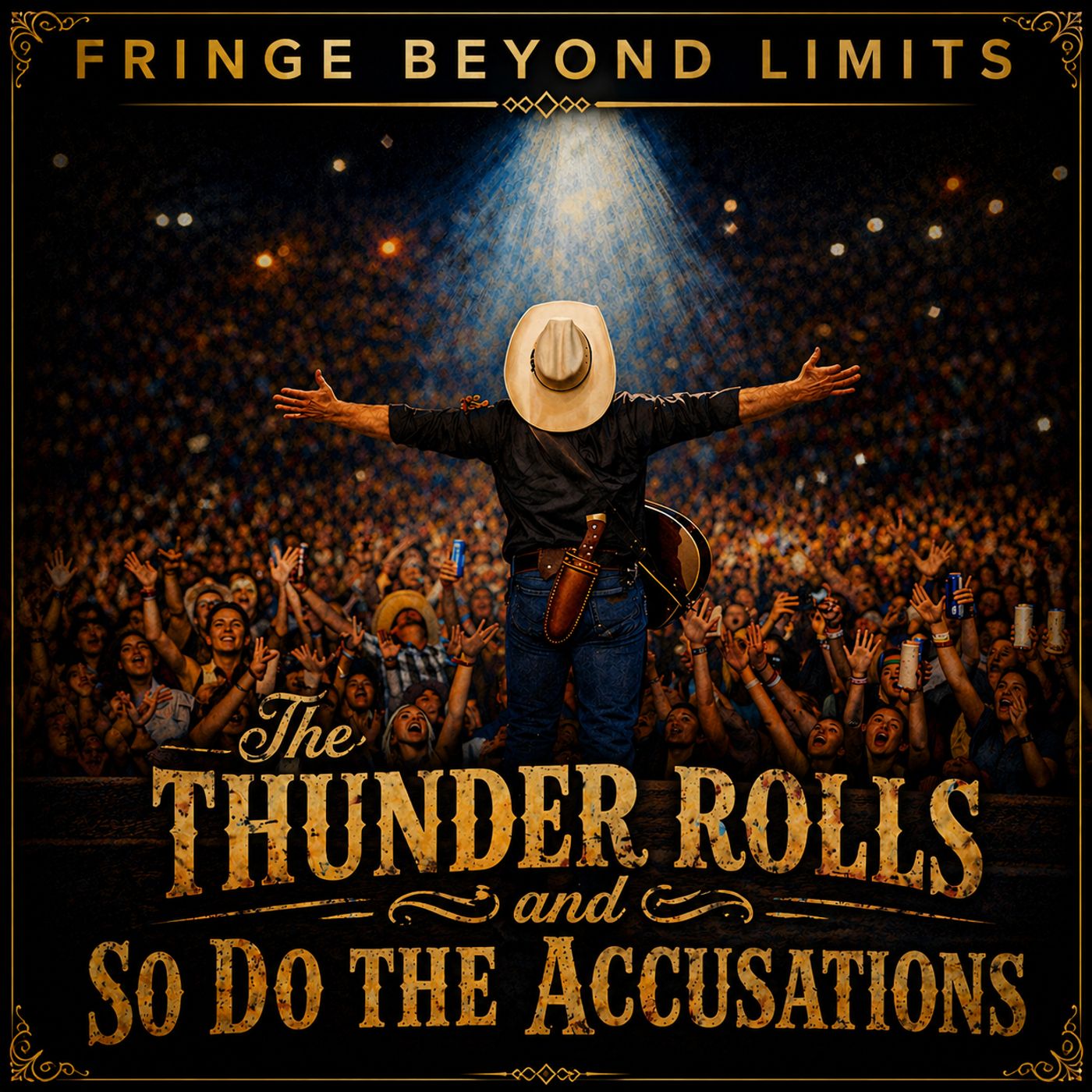
Fringe Beyond Limits
The Thunder Rolls and So Do the Accusations: Is Garth Brooks a Serial Killer?
00:55:34
This episode examines how a dark joke about Garth Brooks evolved into a widespread online theory, tracing the origins, key moments (including the Chris Gaines alter ego), and the list of cases and timelines people used to connect the dots. The hosts explore how pattern-seeking, mobility, anonymous accounts, and narrative structure can make speculation feel convincing—even without evidence—and end by asking why such stories stick.
Loading summary
Transcript252 lines
- [00:00]
A
I'm pretty confident talking into a mic. Hey, I'm doing it right now. But home projects. I second guess everything. Is that noise normal? Is that water damage? Who do I even call? That's where thumbtack comes in. Just upload a photo or voice note and it uses AI powered search to match you with the right top rated local pro. So instead of guessing, you get clarity and can hire with confidence. For your next tone project, try thumbtack. Hire the right pro today.
- [00:29]
B
Some days you just want to amplify your everyday look. Like when you want the look of false lashes without the extra effort. Reach for Thrive Cosmetics Liquid Lash Volumizer Mascara. Or when you want all eyes on your smile. Keep Empower Gloss Ultra Glossy Lip Serum in your bag. It's a burst of 24 hour hydration that smooths like a serum, shines like a gloss, and can be worn sheer or layered. You'll always look and feel your best with thrive cosmetics. Please. Plus, every product is 100% vegan, cruelty free, and made with clean skin loving ingredients that work with your skin, not against it. Amplify your everyday. Go to thrivecosmetics.com shine26 for an exclusive offer of 20% off your first order. That's thrive Cosmetics. C A U S e m e t-I c-s.com shine26.
- [01:25]
A
Sam. Welcome to another episode of Fringe Beyond
- [01:59]
C
Minutes.
- [02:01]
A
Wow, that broke people's eardrums.
- [02:05]
C
I'm practicing singing my scales. La la la la la la la la la.
- [02:11]
A
Okay.
- [02:12]
C
Okay. That's all I got.
- [02:13]
A
Oh, okay. Sounds good. Ladies. How you guys been? Okay. Not all at once. Because you guys actually did go all at once for first. Bri, how are you?
- [02:32]
C
I thought the teacher was going to call, so that's what I was waiting for.
- [02:35]
A
All right. Lynette, how are you?
- [02:37]
C
I'm great.
- [02:38]
B
Okay, well, I got promoted in the last month.
- [02:42]
A
You got promoted?
- [02:43]
C
Heck yeah.
- [02:45]
B
Yeah.
- [02:45]
A
For to what?
- [02:47]
B
Executive administrative assistant.
- [02:50]
A
What does that mean?
- [02:52]
B
Means I get away from the front desk and catering stuff and then I don't do that anymore.
- [02:57]
A
Okay. So what do you do?
- [02:58]
B
So now I'm going to be doing more HR stuff and also basically being the president of the company. Right hand man. In other words, doing all the stuff he doesn't want to do, like his expense reports and stuff.
- [03:09]
A
Wow. Do you know. Do you know how to do that?
- [03:12]
B
I do. I do my own. Now he's making me do his. So I do two expense reports a month.
- [03:16]
C
Wow. Yeah. But. But who's gonna monitor the. The bathroom Attendance, Right.
- [03:25]
B
Not me anymore. Except for where my new desk will be. I'm still next to a bathroom.
- [03:30]
C
Damn it. That's shitty.
- [03:35]
B
Right?
- [03:36]
A
I'd be pissed off. I'd be pissed off.
- [03:39]
C
You'd be pissed. Still buy a B, but at least
- [03:42]
B
it'd be less traffic to that bathroom than it was with the other one.
- [03:46]
A
But you have to, like, they just
- [03:48]
C
dump you in a corner.
- [03:50]
A
That's fantastic.
- [03:52]
B
Kind of am in a corner.
- [03:54]
A
Wow.
- [03:55]
B
There's no windows.
- [03:56]
A
Wow. I'm getting moved at work. Ooh, yeah.
- [04:01]
C
Like basement, Department B. Yeah.
- [04:05]
A
Because I want my stapler. I want my stapler.
- [04:09]
C
Don't they know what happens after they move you to the basement? Like, what?
- [04:12]
A
Next step is we burn in down the house. So, yeah, so I was in a corner by my lonesome in, like, an alcove, which I loved because nobody bothered me. And now we hired a couple more inside salespeople, so now we're all going to be in, like, a pod. And they're moving me with them because I'm training all of them.
- [04:39]
B
Fancy.
- [04:40]
A
No, it's not.
- [04:42]
C
I hate that for you.
- [04:43]
A
I know.
- [04:43]
C
I'm happy for Bri, but I hate that for you.
- [04:45]
A
I know. I mean, yeah, you love Brie and you hate me. I mean, that's pretty par for the course.
- [04:51]
B
No, I think a lot of people
- [04:51]
C
say because I love you that I hate that you have to sit with other people.
- [04:57]
A
Thank you. Thank you. All right, well, it sounds like Lynette. Anything to share?
- [05:03]
C
I just spent three weeks in Illinois, but you guys couldn't make time to see me.
- [05:08]
A
I'm so upset about that.
- [05:09]
C
I'm kidding. I'm kidding.
- [05:10]
A
No, I'm actually upset with myself about that.
- [05:13]
C
It's okay. I think weddings trump getting together and podcast stuff.
- [05:17]
A
Yeah. But I have another one next weekend in Arizona.
- [05:21]
C
Have fun. Well, Arizona's fun.
- [05:23]
A
Yeah. But then a week after that, I get surgery. They're going to slice and dice, and
- [05:29]
B
you're going to nix your voice box so you can sound like the dog from Grown Ups.
- [05:33]
A
I actually, I. I hope I sound like Christopher Walken. Can you imagine if, like, I sounded like him and I just narrated every single episode like, I'm Christopher Walken. That'd be fantastic.
- [05:48]
C
That'd be cool.
- [05:49]
B
You should try that with this episode.
- [05:51]
A
I can't do. I can't do his voice.
- [05:54]
C
What about the guy who talks like this?
- [05:57]
A
Gilbert Gottfried.
- [05:59]
C
Yeah. I want you to sound like him.
- [06:02]
A
I can't do that. Yeah. Like it. All right, well, should we jump into tonight's? Topic.
- [06:12]
C
Jump in, Jehoshaphat.
- [06:14]
A
All right, so here we go. There's a certain kind of story that doesn't really have a clean beginning. It doesn't start with a headline or police report or major event that everyone points to and says that's where it all began. Instead, it kind of drifts in quietly. It shows up in places you wouldn't expect. Comments, conversations, little throwaway moments that don't seem important at the time. And if you're not paying attention, you miss it completely. But if you are paying attention, you start to notice something. You hear the same idea more than once. You see the same question pop up in different places. At first it feels like coincidence, or maybe just people messing around. But then it keeps showing up. And eventually, whether you mean to or not, you start wondering why it hasn't gone away. That's pretty much how this one works. Because what we're getting into tonight didn't come from an investigation in the traditional sense. It didn't come from law enforcement or some official source. It started as something a lot smaller than that, something that, on the surface, wasn't meant to be taken seriously at all. And yet, over time, people start picking at it, looking a little closer, asking a few more questions than they probably needed to. And the more they looked, the more they started putting things together. Not evidence, necessarily, but pieces. Real places, real timelines, real events that, when laid out a certain way, begin to feel connected, even if they weren't originally meant to be. And that's where things get interesting. Because once you start arranging information into a story, it doesn't take much for that story to feel like it has direction. It starts to feel like it's leading somewhere, like there's a thread running through it, even if you can't quite prove where that thread begins or ends. So tonight, that's what we're doing. We're not here to prove anything. We're not here to convince you of anything, either. What we're going to do is walk through this the same way someone encountering it for the first time would. Step by step, piece by piece. So you can see how it's presented, how it builds, and how it ends up feeling the way it does. Because whether you buy into it or not, the way it comes together is worth paying attention to. Are you guys excited?
- [08:53]
C
So, what are we talking about?
- [08:54]
A
Okay, I'll continue. There's a specific moment when something ridiculous stops being funny. It doesn't announce itself. There's no dramatic shift, no music swelling in the background. It Just happens. One second you're laughing, scrolling, shaking your head at something absurd, and the next you're pausing, you're thinking. And that thought, just one small thought, starts to take root. Because once an idea plants itself in your mind, it doesn't need proof to grow. It just needs attention. And tonight's story lives right in that moment. The space between this is stupid. And. Wait, what? Because what started as a joke, an actual joke, the kind that normally dies in the comments section somewhere, has somehow turned into a full blown theory. Not just passing rumor, but a layered, detailed, disturbingly structured narrative involving one of the most famous country music artists of all time, Garth Brooks.
- [09:59]
C
What? Damn.
- [10:02]
B
Say what? Say whoa.
- [10:05]
A
And depending on who you ask, this is either the dumbest thing the Internet has ever produced or one of the strangest patterns anyone has bothered to map out.
- [10:16]
B
My vote's dumbest.
- [10:17]
A
Dumbest. Okay, so tonight, we're not here to tell you what's true. We're not here to accuse. We're not here to confirm anything. What we're going to do is walk through this theory, every piece of it, the way it was built. We're going to look at the names, the places, the timelines, the connections people have drawn and the assumptions they've made. And by the end of this, you're going to have to sit with one uncomfortable question. Not is this real? But why does this feel like it could be? Before we get into it, let's do what we always do. What keeps you up at night? Is it the unknown? Or is it the possibilities that sometimes the things we think we understand are actually built at nothing at all? Because this story dances right on that edge. This entire theory, every bit of it, started with a joke. Not an investigation, not a leaked report, not a whistleblower, a joke. Comedian Tom Segura, on his pod on his podcast, threw out a line, something dark, something absurd, suggesting that Garth Brooks might be hiding bodies. It was meant to be ridiculous. That was the point. People laughed, and that should have been the end of it. Except it wasn't. Because the Internet did what the Internet does best. It repeated it. It amplified it. It turned it into a running bit. People flooded Garth Brooks's social media pages with comments, thousands of them. Two phrases began appearing over and over again. Where are the bodies? Where are the bodies, Garb And I want my grandma back.
- [11:58]
C
I want my grandma back now.
- [12:03]
A
Now. At first, it was clearly satire. Dark humor, sure, but still humor. The kind of collective joke that people are in on. But then something strange happened. Garth Brooks didn't respond at all. No joke back, no public acknowledgment. No, you guys are insane. Just silence. And if there's one thing the Internet does not handle well, that's silence.
- [12:31]
C
Nae nae.
- [12:32]
A
Because silence creates space. And space gets filled with speculation, and speculation when repeated enough times start to feel like something else. This is where things take a turn. Because now people begin looking backward, digging, reexamining moments in Garth Brooks's career that once felt odd but harmless. And one moment rises to the surface immediately. Chris Gaines, if you remember this and if you don't, buckle up. Garth Brooks, at the height of his fame, created an alter ego. Not just a staged Persona, not a one off character, a full identity. Chris Gaines had black hair, heavy eyeliner, a completely different musical style, an entire fictional backstory that included trauma, emotional instability, and a deeply troubled personal life.
- [13:30]
C
Don't forget he had a sex addiction. Yes, Chris Gaines had the sex addiction.
- [13:36]
A
Don't. Don't we all. Do you think that I just, I just thought of this when you said sex addiction. So do you think that maybe like
- [13:46]
C
the light bulb that flew out of
- [13:48]
B
your sex addiction would like. Yeah, that would just like pop in his head?
- [13:51]
A
Oh, wait, so do you think that possibly when he was Chris Gaines, his penis was either bigger or smaller than when he was Garth Brooks?
- [14:03]
C
Oh God. That was the light bulb.
- [14:05]
A
That was the light bulb. Because, so listen, so, because grander. I don't remember what court case it was, but it was with Hulk Hogan and I can't remember his real name. And during cross examination he was asked, well, Bob, whatever his name was, I can't remember. So bob has a 12 inch penis. And he goes, no, when I'm Hulk Hogan, Hulk Hogan has the 12 inch penis. But when I'm myself, I do not. There's no way I could. So that's why that popped into my head.
- [14:37]
C
Okay, this was admissible in court, I guess.
- [14:41]
A
So I, I forget. I. For. It was like a defamation case. I think it was something to where like things that were said that weren't true and they. And somebody was suing somebody. But yeah, it was so awesome. Speaking of court, have you guys looked at the Afroman stuff?
- [14:57]
B
Nope.
- [14:59]
A
So amazing Afroman, he got sued by the county police officers because they raided his house with a search warrant that based on like bad evidence. And he caught everything on his security cameras. There was one police officer that took a bite or took a piece of like lemon cake. And like, and like when they, they found money, they found supposedly $4,000 but when he got everything back, because there was no evidence that he did whatever he was being accused of, they were. He was short for $100. So he made like an entire album making fun of all the personal people responsible. So not just police in general, but the specific officers and named them by name.
- [15:50]
B
That's awesome.
- [15:51]
A
And they sued him for defamation and he won.
- [15:55]
C
So they sued him and he won.
- [15:58]
A
Yes, yes, they. Yeah, so it was because it was like a freedom of speech thing. So it was. So I'm watching, I'm watching some of the court stuff here and there, and it's so fucking funny. These, these. I don't know, I don't know. These specific officers, I love police, but these were just. Are just stupid. So anyway, I digress for the US Yeah. So at, at the time, people didn't know what to make of it. Some thought it was creative, others thought it was a complete train wreck. Joe Rogan later called it one of the biggest train wreck moments in pop culture. But now, years later, this theory reframes it entirely. Because one of the core ideas pushed in the document is serial killers often live double lives. They construct identities. They present one version of themselves to the world while hiding something much darker underneath. So the questions get asked, half joking, half not. Was Chris Gaines just a failed artistic experiment? Or was it something else leaking through? Now, to be very clear, creating an alter ego is not evidence of anything criminal. Artists do it all the time. But when you're already looking for patterns, already leading into a theory, suddenly that moment doesn't feel random anymore. It feels intentional. From there, the theory starts layering. In psychology, this is where it begins to sound structured, almost academic. The concept of the dark triad comes into play. Narcissism, Machiavel.
- [17:44]
C
Machiavellianism.
- [17:45]
A
Machiavellianism and psychopathy. Thanks. Like I could say Machiavelli, but I just can't do the whole ism at the end for some reason. So, traits associated with manipulation, control, lack of empathy, and the ability to maintain multiple identities. The argument presented is that Garth Brooks exhibits these traits. His control over his image, his ability to command massive audience, his charisma, his calculated reinvention over the years. Now here's where things get tricky. Because those traits are not exclusive to criminals. They're also found in CEOs, performers, politicians, people who operate at high level and competitive, high visibility environments. So while the framework sounds compelling, it's also incredibly broad. But the theory doesn't stop there. It uses that framework as a lens, a way to reinterpret behavior that would otherwise seem normal. And then it makes the leap. Because this is where real names start entering the conversation. Real cases, real people who disappeared or were murdered. And this is where things shift from interesting to uncomfortable. One of the cases brought up is Desiree Ann Farris, an 18 year old who disappeared in Kansas City, Missouri, on May 1, 2017. That same night, Garth Brooks was performing at the Sprint Center. The theory points out that at some point during that evening, he was reportedly out of sight for a period of time. That's it. That's the connection. No evidence, no witnesses, Just proximity and a gap in time. But once that connection is suggested, the narrative begins to take shape. And this is how the theory builds itself. One case becomes 2, 2 become 5, 5 become 20. Names like Tracy Nielsen, who was found stabbed in Oklahoma in 1981. Tammy Zywicki, abducted from an Illinois rest stop in 1992 and later found in Missouri. Stephen Portillo, shot in Phoenix in 1991 by an unknown assailant, Gregory Larson, who disappeared in Washington State in 1989 while supposedly traveling to New York. Each case is laid out alongside tour dates, locations, routes. And when you start stacking them together, it begins to look like a pattern, a map. Cities connected by lines, timelines, overlapping movements that appear to align. And this is where the theory becomes compelling. Not because of what it proves, but because of how it feels. Because humans are wired to recognize patterns. It's how we survived. But it's also how we mislead ourselves. Because if you take someone who tours nationally, someone constantly moving from city to city, you can overlay that movement onto almost anything. Crime data, missing persons reports, random events. And you will find overlap. Not because it's meaningful, but because statistically, it's inevitable. But the theory doesn't frame it that way. It frames it as something intentional, something hidden, something that's been missed. And then it introduces one of its strongest ideas, the concept of mobility. The FBI has studied mobile serial offenders extensively. Truck drivers, traveling workers, individuals whose jobs allow them to move frequently across jurisdictions. Mobility creates opportunity. It makes it harder to connect crimes. It allows someone to operate in different locations without drawing attention. So the theory asks a question that sounds reasonable on the surface. What better cover than a touring musician? Someone who is expected to travel, expected to be in different cities, expected to disappear between shows? It sounds logical until you realize that this would apply to every touring artist on the plan planet. And yet, once that idea is introduced, it sticks, because it fits the narrative being built. At this point, we have all the Core pieces in place, A viral joke that refuses to die, an unexplained silence, A bizarre alter ego that feels unsettling in hindsight. A psychological framework that gives the theory structure. A series of real, unresolved cases in a timeline that appears to connect them. And now the theory is no longer just a joke. It's a story. One that feels detailed, layered, and disturbingly coherent. But here's where we pause, because in part two, this theory goes further. It introduces claims about property, about alleged dumping grounds, about insider accounts from road crew members, about private jets and transport. It escalates. It becomes more confident, more specific, more dangerous. And that's where we're headed next. Because the deeper this goes, the more important it becomes to ask, not just what are we looking at, but why does this feel believable? Sometimes the most unsettling stories aren't the ones that are true. They're the ones that feel like they could be. So what do you guys think?
- [23:15]
B
It's getting interesting so far.
- [23:18]
A
Yeah.
- [23:19]
C
Yeah.
- [23:19]
A
So not as stupid as I would say.
- [23:21]
B
Just kind of like. More like. The first part is more like an intro to things. So I want to get more like. I'm waiting to see what more details you come up with.
- [23:29]
A
Okay.
- [23:30]
B
To get my mind going.
- [23:32]
A
Okay.
- [23:33]
B
But so far, it caught my attention.
- [23:35]
A
Okay, Ms. Lynette.
- [23:36]
C
So right now. Right now, you're just standing outside the fire.
- [23:40]
B
Oh, I. I'm touching it. I'm like, oh,
- [23:45]
A
okay.
- [23:47]
C
I was like, that was a girth. It's a Garth song.
- [23:49]
A
I know.
- [23:50]
B
I didn't know that. I don't.
- [23:51]
C
I'm not a big. Oh, she doesn't like country. Even though she sings.
- [23:56]
A
Yeah.
- [23:56]
B
And that's different type of country.
- [23:57]
C
I forgot you don't listen to.
- [23:59]
A
Yeah.
- [23:59]
C
She's the country musics.
- [24:01]
B
That's actually more similar to the bluegrass.
- [24:07]
C
Yeah, I. I suppose the first time. Sorry, Bri, I don't know what to say to that. I mean, the first time I heard this theory or I didn't actually listen to the podcast where they. This came up and when. I think you were the one who told me about it. But then I went back and listened to it, and my initial thought was, this is insane. But, like, you kind of laid out anyone who has wealth and mobility is a risk.
- [24:36]
A
Right?
- [24:37]
C
It is. I mean, how many truck drivers back in. What was it, like the 60s and 70s and stuff were just right. Who's the one I'm thinking of? There was. Well, there was the Aileen or whatever. Yeah. And then. I don't know, but yeah, yeah, there's.
- [24:56]
A
I mean, it's, it, it's kind of spooky, you know, this is all very tongue in cheek, you know, but it's. It's still spooky, you know?
- [25:05]
C
Right.
- [25:06]
A
All right, so if part one was about how this theory started, part two is where it mutates. Because this is where speculation stops being casual and starts becoming constructed, more confident, more specific, more dangerous in the way it presents itself. Because now the theory isn't just asking questions, it's offering answers. And the first place it goes is property and land. Because according to the claims circulating in forums, comment threads, and the document you provided, the theory suggests that Garth Brooks's own Garth Brooks owns large amounts of private property across multiple states. That part in itself is not unusual. Wealthy individuals, especially those in entertainment, often invest in land. Ranches, retreats, private estates. It's common. But the theory reframes this completely. It doesn't look at these properties as investments. It looks at them as locations. Places that are private, remote controlled places where, according to the theory, things could happen without interruption. This is where language starts to shift in a very noticeable way. Instead of saying, this exists, the theory begins saying this could be used for. And then quietly drops the word allegedly somewhere far enough away that it almost disappears. And that matters because it creates a psychological illusion of certainty without ever actually proving anything. Now the claims begin to stack. The idea that certain properties are not just owned, but rarely visited. The suggestion that some areas are off limits or not accessible to staff. The implication that certain locations line up geographically with clusters of missing persons cases. Again, no direct evidence, just alignment. But when you present alignment repeatedly, it starts to feel like intention. And this is where the theory introduces one of its more gripping concepts. The idea of a dumping ground. According to the narrative, these properties aren't just private, they're strategic. Large enough to avoid detection, remote enough to prevent accidental discovery, owned by someone with the means to maintain control over access. It paints a picture, not with proof, but with possibility. And that's what makes it effective, because your brain starts filling in the gaps on its own. Now, to ground this for a moment. There has never been any confirmed evidence, investigation or law enforcement report suggesting anything like this connected to Garth Brooks. None. That's important. But the theory doesn't rely on confirmation. It relies on suggestion. From where? It escalates again. I'm sorry, from here it escalates again because now it introduces what it calls insider accounts, stories. Anonymous, of course, allegedly from road crew members, security personnel, people who were Close enough to see something, but not close enough to prove it. And if you've ever studied how conspiracy narratives evolve, this is a classic move. Introduce a witness who cannot be verified but speaks just convincingly enough to feel real. One of the more circulated claims suggests that members of a touring crew noticed unusual behavior during certain stops. Extended absences, unexplained schedule gaps, moments where the artist, Garth, in this case, was not where he was expected to be. The theory leans heavily into these gaps. It treats them not as normal logistical inconsistencies, which are extremely common in large tours, but as windows of opportunity. Because once again, we return to that idea of mobility. Movement creates cover, and a touring environment is full of noise. People moving in and out, equipment being loaded, schedules shifting constantly. It's chaos. And chaos, according to the theory, is the perfect place for something to hide. Then comes another layer. Transportation. Private jets. Now, this is where things start to sound cinematic. The theory suggests that private aircraft could allow for rapid, untraceable movement between locations, that individuals, or in the most extreme versions of the claim, victims, could be transported without detection. It frames private travel not as convenience, but as capability. Again, there is no evidence presented, no records, no witnesses that can be confirmed. But the idea itself is enough to carry weight because it fits the narrative being constructed. And that's the key to all of this. Each piece doesn't need to be proven. It just needs to fit. Now the theory begins to quantify itself. This is where numbers enter the conversation. And numbers are powerful because they create the illusion of scale. Some versions of the claim suggest dozens of potential victims. Others escalate to over 100. And here's where things get particularly important to understand. The number itself is never supported by evidence. It's inferred, built from stacking cases that share proximity to tour dates, locations, or vague timelines. But once a number is introduced, it sticks. It gives the theory weight. It transforms it from a scattered idea into something that feels organized, structured, measurable. And this is where your brain starts doing something subtle but critical. It stops asking, is this true? And starts asking, how could this be true? That shift is everything, because now the theory is no longer being evaluated. It's being explored. From here, the narrative begins to introduce escalation. It suggests that early incidents may have been opportunistic, disorganized, that over time, patterns developed, systems improved, that what may have started as isolated acts became something more refined, more controlled. This is a common structure in true crime storytelling. The idea of evolution, that behavior escalates, that individuals become more confident More calculated. And by borrowing that structure, the theory gives itself a sense of realism. It mirrors known patterns, even though it isn't supported by known evidence. So what are you guys thinking? You guys want to go to Garth Brooks concert?
- [32:06]
C
I only went to one, and I'm proud to say I survived it.
- [32:10]
A
What'd you say?
- [32:11]
C
What'd you say?
- [32:12]
B
I said if we just investigate because I don't know no songs, I'd be a fake. Fake fan.
- [32:18]
A
I mean. Yeah, so there was.
- [32:20]
B
I'll go in disguise.
- [32:22]
A
So, listening to a couple of these podcasts, they were one day I was discussing on, like, one of the roadies, when they were at whatever concert that Garth asked to borrow one, his car, which is like a beat up car. And he left and was gone for like six hours. And they were getting worried because this show was starting. He was even. He wasn't back on time for soundcheck. So, I mean, I don't know where you. Where Garth would go in a beat up car for six hours on the road. Would you let him borrow your car?
- [32:57]
C
No, I had to think about it.
- [33:03]
A
Okay, that's fine.
- [33:04]
C
I wonder if that guy had any, like, unpaid tolls or.
- [33:08]
A
Right.
- [33:10]
C
Speeding tickets or red light cameras or.
- [33:12]
B
I would say red light cameras.
- [33:13]
A
Yeah, there's a musky smell in my car now. I don't know what that is. So now we arrive at one of the more unsettling aspects of this entire narrative. The tone shifts because at this point, the theory stops sounding like speculation and starts sounding like documentation. It uses language that feels definitive. It references timelines as they've been confirmed. It speaks about locations as if they've been verified. And if you're not paying close attention, it's very easy to forget that none of this has been substantiated. And that's the danger, because the more detailed something becomes, the more believable it feels. But detail is not the same as truth. So let's take a step back for a second because this is where we need to ground ourselves. Again, there is no verified evidence connecting Garth Brooks to any of these cases. There are no charges, no investigations, no official statements from law enforcement suggesting involvement. Everything we've discussed so far exists entirely within the realm of speculation, pattern recognition, and narrative construction.
- [34:21]
C
If the glove don't fit, you must acquit.
- [34:24]
A
Okay, Real, real quick. That was all right.
- [34:28]
C
What? Oh, that one?
- [34:29]
A
Yeah. Because that glove was soaked in blood and was leather, so it shrunk on top of that. He put on what you call it, latex gloves on. Then try to put the fucking glove on.
- [34:44]
B
Wasn't something with his hand, too? It was a little swollen or something.
- [34:48]
A
His knuckles? I think.
- [34:49]
B
Yeah, something was like something was going on with his hands. So it was also swollen, like.
- [34:53]
A
Yeah, I think it's a gout.
- [34:55]
C
Like a physical altercation?
- [34:56]
A
No. Yeah, it was like. It's like a medical condition that his knuckles swelled.
- [35:01]
C
He.
- [35:01]
B
He hit Frank right before.
- [35:03]
A
Yeah.
- [35:04]
C
One, two. Hiya.
- [35:05]
A
Yeah, I let him. I mean, I get to sue him for millions.
- [35:08]
C
So you lost, though.
- [35:10]
B
That's true freedom speech.
- [35:13]
A
That's true him. All right, so I. I have to keep reiterating in this outline that Garth Brooks has not been investigated or anything for legal reasons.
- [35:28]
C
Understood.
- [35:28]
A
Okay, so, but. And this is important, the reason the theory persists is not because it's proven. It's because it's compelling. It taps into something deeper. Our discomfort with fame, our suspicion of power, our fascination with the idea that someone who appears completely normal could be hiding something extraordinary. And that idea, that's not new. We've seen it before in countless cases where individuals led double lives, where the public Persona was clean, controlled, admired, and the private reality was something else entirely. So when a theory like this emerges, it doesn't feel impossible, it feels familiar. And familiarity breeds belief. So as we move into part three, we're going to do something different. We're going to take everything we've just walked through, the patterns, the claims, the assumptions, and we're going to turn it around. We're going to look at how and why theories like this form, why they spread, why they stick, and why, even when they're not supported by evidence, that they can still feel incredibly real. Because the final question isn't just, is this true? It's why do we want it to be? And that might be the most unsettling part of all. So.
- [36:50]
C
Ooh. Yeah, That's a loaded question.
- [36:53]
A
I know.
- [36:53]
C
Why do we want it to be?
- [36:54]
A
I know. What was I going to say? Shit. Oh. So, listening to a podcast about this, the guy that was being interviewed, and I think it was the same guy that wrote the book, Bodies in Low Places. He knew someone. And this individual was friends with both Tom Segura and Garth Brooks. All right, so at the height, weird
- [37:21]
C
circle to walk in 100.
- [37:23]
A
It could have been maybe even, like, an agent or whoever, you know, I
- [37:27]
C
guess that would make sense.
- [37:27]
A
Yeah.
- [37:28]
C
Publicist or something.
- [37:29]
A
Yeah. So to. Before I move forward, there's an incident with Tom Segura. This was maybe, like, five years ago. I would say he was playing basketball and they're videoing this, him and Bert Kreischer, and there's a couple of other people there, and they're goofing around, and Bert Kreischer tells Tom to try to dunk. Okay.
- [37:53]
C
Yeah.
- [37:54]
A
So Tom goes and tries to dump. As he pushes off, he. He blows out his acl. So his leg. His plant leg kicks out from underneath him, and when he falls, he falls awkwardly with his arm behind him, and he breaks his arm at the same time. Okay, so you can go and find this on YouTube. Like, it's. It's probably still out there. So that's an important part of the story. So this individual, who was friend or who knew both of them, was talking to Garth Brooks one day after this event happened. And he's like, you know, so how do you feel? He's like, you never really said anything. You know, how do you feel? And Garth goes, you want to know how I feel? This is how I feel. He takes out his phone, and he pulls up the video that's saved on his phone and plays it for the guy and goes, that's how I feel. Little creepy.
- [38:52]
C
What does that even mean? Like, that sounds like a serial killer.
- [38:54]
A
Exactly. Which is why this holds. You know, there's even more, you know, truth possibly behind this. So, like, he. He hates Tom Segura so much that he saved that video to watch him get hurt over and over again.
- [39:11]
C
That's kind of psychotic.
- [39:13]
A
Little bit. Little bit. Now, again, that is like, you know, seven people removed. Here, here, heresay.
- [39:23]
B
So, but I'm pretty sure if there's someone that you really hate and there's a video of them being injured, you'd watch that over and over and over again.
- [39:29]
A
Not at all. I wouldn't care. I'd watch it a couple times, yes, But I wouldn't save it on my phone.
- [39:35]
B
Like, I think it depends on the person.
- [39:37]
A
Like, all that tells me is Tom Segura is living in Garth Brooks's head.
- [39:41]
C
He has occupying space.
- [39:44]
A
Yeah, Right.
- [39:45]
C
Bought some real estate.
- [39:46]
A
Right. So, all right, here we go with part three. So by now, you can feel it not just the theory itself, but the weight of it. Because when you lay something out this way, when you stack timelines, names, locations, psychology, behavior, it starts to feel complete and starts to feel like something that has shaped direction, intention. And once something feels complete, your brain wants to accept it, not because it's true, but because it makes sense. And that's where we need to stop. Because this is the point where stories like this either become something we examine or something we believe. So let's turn it around. Let's take everything we've just walked through, all the patterns, all the claims, all the assumptions, and ask a different question. Not what if this is real? But how did this become believable? Because the truth is, this entire theory, every piece of it, is built on something very human. Pattern recognition. Your brain is wired to find meaning. It's one of the oldest survival tools we have. If you hear a rustle in the bushes, you assume it's something important. If you see movement in the dark, you assume it matters. Because missing a real threat could cost you everything. But here's the problem. That same system doesn't turn off when the threat isn't real. So when you take a person who travels constantly, like a touring musician, and you overlay that movement onto crime data, missing persons reports, unsolved cases, you're going to find overlap. Not because it's intentional, not because it's connected, but because statistically, it has to be. There are thousands of unsolved cases in the United States alone. Thousands. And if someone is moving across the country regularly, they are going to be in proximity to some of them. That's not a pattern. It's probability. But when you present that probability in a certain way, it stops looking random. It starts looking designed. And once your brain sees design, it doesn't want to let it go. Now layer in something else. Narrative structure. Because this theory doesn't just list information. It tells a story. It has a beginning, a middle, and an escalation. It introduces a character, Garth Brooks, then gives him a second identity, Chris Gaines. It introduces psychological traits. It presents cases. It builds tension. It escalates into larger claims. It creates a sense of progression. In other words, it allows the exact structure of a compelling true crime story. And we are conditioned to respond to that. We have consumed thousands of hours of content that follows this format. We know what it feels like when something is building toward a reveal. So when a theory like this mimics that structure, it triggers something familiar, something believable, something. But structure is not evidence. And that's where the line gets blurred. Now, let's talk about something even deeper than confirmation bias. I'm sorry. Even deeper confirmation bias. Sorry. Once you accept even a small part of this theory, just a tiny maybe, your brain starts working differently. It begins filtering information in a way that supports that possibility. Every coincidence becomes meaningful. Every overlap becomes suspicious. Every unexplained detail becomes intentional. And anything that contradicts the theory gets ignored or explained away. That's how belief systems form not through overwhelming evidence, but through selective reinforcement. And the Internet accelerates this. Because once a theory like this exists, it doesn't stay in one place. It spreads. It gets reposted, reworded, expanded. People add their own interpretations, their own research, their own connections. And suddenly what started as a joke becomes a network of ideas, each one reinforcing the other. It becomes self sustaining. And here's. I'm sorry. And here's the part that's hardest to sit with. You don't need proof for something to feel real. You just need enough pieces that look like they fit together. But looking like they fit and actually fitting are two different things. Now, let's bring this back to the center. Garth Brooks is a real person with a real career, a public figure who has spent decades in the spotlight. There are no verified investigations connecting him to any of these crimes, no charges, no evidence presented by law enforcement, nothing. That moves this out of the realm of speculation. And that matters because there's a line between exploring a theory and presenting it as truth. And tonight, we've walked that line very carefully. We've shown you how the theory is built. We've laid out the names, the cases, connections people claim exist. We follow the narrative from beginning to end. But now we step back. Because the most important part of this entire episode isn't the theory itself. It's understanding how easily something like this can form, how quickly it can spread, and how convincing it can become, even without evidence. Because once you see that process, once you understand how the pieces come together, you start to recognize it everywhere. Not just here. Everywhere. And maybe that's the real take. Takeaway. Not whether the theory is true, but how many others exist built the exact same way? I could name a couple. Can you guys? Like, what, just basically every religion, right? I mean, that's exactly how it's done. Any cult, you know. So, hey, where are we on building our cult? Have we made progress with that yet?
- [46:03]
B
I haven't got any followers. Still just the three of us.
- [46:08]
A
Lynette, what about you? You're in a different state entirely. You have a whole geographic location that's different.
- [46:14]
C
Yeah, you know, I had a whole order of Kool Aid that was supposed to come in from Iran, but it got stuck. It couldn't get through customs. The Hormuz, or however you pronounce it,
- [46:28]
A
the Strait of Hormuz.
- [46:29]
C
Yeah, it couldn't get through it. It got sunk.
- [46:32]
A
I thought maybe it got stopp. Garth Brooks's tour buses. Yeah. All right, all right. So it Looks like it's still three.
- [46:44]
C
All right. Yeah.
- [46:46]
A
All right. So when you step back from everything we just walked through, all the names, the timelines, the supposed connections, it's hard not to feel something. Not necessarily belief, but definitely something. Maybe it's curiosity, maybe it's discomfort. Maybe it's that quiet voice in the back of your mind that says, I don't know what to do with this.
- [47:06]
C
This.
- [47:07]
A
And I think that's really the point, because what we just experienced together isn't proof of anything. It wasn't an investigation that led to a conclusion. It wasn't something else. It was something else entirely. It was a story being built in real time, piece by piece, using fragments that, on their own, don't necessarily mean much. But when you start putting them together in a certain order, when you frame them in a certain way, they begin to feel like they're pointing somewhere. And that feeling. That's where things always get tricky. Because the human brain doesn't just process information, it organizes it. It looks for meaning. It wants to take loose, disconnected pieces and turn them into something that makes sense, something that feels complete. And when it finds that sense of completion, even if it's artificial, it's incredibly satisfying. That's why something like this sticks. Not because it's been proven, but because it's been constructed in a way that feels like it could be. And if you're being honest with yourself, there were probably moments in this episode where you leaned in a little more than you expected to. Moments where you caught yourself thinking, okay, that's a weird coincidence, or that lines up a little too well, even if a second later, you pulled back and reminded yourself that there's no evidence tying any of this together. That push and pull, that's the space this whole thing lives in. And it's not unique to this story. Once you start noticing it, you realize how often this happens. Not just with conspiracy theories, but with the way information is presented to us every day. The way narratives are shaped, the way certain details are emphasized while others are quietly left out. The way a story can guide you toward a conclusion without ever actually saying it outright. It's subtle, but it's powerful. Because over time, enough subtle nudges in the same direction don't feel like nudges anymore. They start to feel like truth. Not because you verified it, but because it feels consistent. It feels reinforced. And that's where things can get a little uncomfortable. Because when you have to ask yourself, how often does that happen without you realizing it? How many times do we carry around as probably true simply because they were presented in a way that made sense at the time. And I'm not saying that everything is false or that every pattern is meaningless. There are real investigations, real cases, real situations where patterns matter, where connections lead to answers. But this is something different. This is what happens when pattern recognition runs ahead of proof, when narrative fills in the gaps that evidence hasn't reached, When a story becomes compelling enough that it doesn't need to be confirmed, it just needs to be considered. And once it's considered, it sticks around. So maybe the most honest place to land with all of this isn't on one side or the other. It's not saying this is true, and it's not dismissing it outright either. It's just acknowledging what it is. A theory, a constructed narrative built from real events, real people, and a series of connections that may or may not mean anything at all. And the real question becomes, what do you do with that? Do you let it sit as an interesting, uncomfortable idea? Do you start looking for more pieces to add to it? Or do you take a step back and ask why it felt believable when in the first place? Because sometimes the most dangerous thing isn't what we don't know, it's what we think we do. The end. So, Bri. Serial killer. Not a serial killer.
- [51:05]
B
So a lot of coincidences. Definitely.
- [51:09]
A
Yeah.
- [51:10]
B
But like you said multiple times in this thing, there was never investigation, never connection made. But at the same time, coincidences. But also at the same time, when you were talking about, like, at the end, like, how, like, things get. People get in the mind and look for things. That's how a lot of conspiracies also start. Is they literally just look for clues. I remember, like, was. It was September 11th. I think it was the whole night. The numbers 9, 11 appeared at so many different places. So people were actually, like, looking for, like, those connections and trying to make it real. So it's like, how do we know they're not doing exact same thing with this? Just trying to figure out something. They're like, oh, this is coincidence. This is a coincidence. I'm going to start looking for more things and looking for something that has nothing to do with him, but seemed like that happened at, like, whatever time. So it just. A lot of coincidences.
- [52:01]
C
This is.
- [52:02]
A
I like the way you said that word.
- [52:04]
B
Thank you.
- [52:05]
A
Yeah.
- [52:06]
C
Ms. Lynette, I was hoping you were going to say quinky dinks.
- [52:08]
A
That would have been.
- [52:10]
C
Yeah, no, like, I can see why people want it to be true because I Mean, if you think about it, we've been lied to and covered up by all of the bad things going on, especially in Hollywood. I mean, you got Weinstein, Epstein, Diddy, r. Kelly, Cobby, O.J. you know, Aaron Hernandez, Pee Wee. Like, the list goes on of, like, people doing hurtful things to folks. So this just seems like another mega star, you know?
- [52:44]
A
Right.
- [52:44]
C
Quite literally getting away with murder, you know, and I could see why people latch onto it. You know, it's. Yeah.
- [52:51]
A
Yeah.
- [52:51]
C
I have a new theory.
- [52:53]
A
Oh, okay.
- [52:54]
C
And this is just a theory.
- [52:56]
A
Okay.
- [52:56]
C
I'm not trying to make anything go viral or anything like that, but maybe he's not. Maybe he's not a serial killer. Okay, but what if he's a human trafficker?
- [53:06]
A
Oh.
- [53:06]
B
Oh.
- [53:07]
A
I mean, yeah, that could be a too. You know, but that is interesting. You could really say any entertainer is a human trafficker.
- [53:16]
C
I mean, you get a groupies and you move them around. I don't know. Who the heck knows?
- [53:22]
A
Yeah, I mean, they're not. They're not. I mean, I don't think he. He's a cheat. I mean, it's a great theory, but I just don't think he's a trapper. I don't think he's like the Clintons at all,
- [53:35]
C
Allegedly.
- [53:37]
A
No, no, that. That's. No, that's a fact.
- [53:39]
C
No, that's a fact.
- [53:40]
A
That's a fact. Oh, that was too funny for me. Yeah. So I think it's just a. A. A fun story and a fun idea to speculate and kick around, but, yeah, he. He. He might be weird and eccentric, but he. I don't think he's a serial killer by any means.
- [54:02]
C
I mean, he did disappear from the scene from 2001 to 2009. Like.
- [54:06]
B
Yeah, but I was thinking, what if he was actually disappearing to do, like, go see the lady of a night? Or he went to go cross dress. He doesn't want anyone to know, so he disappeared.
- [54:18]
C
Ooh, I thought you were gonna say, like, feed people in a food pantry.
- [54:24]
B
That too.
- [54:24]
A
Oh, you mean something noble.
- [54:26]
B
I mean, why else would he sneak off?
- [54:30]
C
Yeah, I mean, maybe he's.
- [54:33]
A
Maybe Chris Gaines.
- [54:34]
C
Maybe Chris Gaines came out and he had to, you know, feed the alter ego.
- [54:39]
A
Or, or maybe. Maybe he's just a shy peer and had to go and pee because he's
- [54:45]
C
somewhere else for six hours.
- [54:47]
A
I mean, you never know.
- [54:48]
B
Christina Gaines.
- [54:50]
C
Wait, what?
- [54:50]
B
What if Chris Gaines actually. Christina Gaines.
- [54:53]
A
Oh, that's possible. I just think he's a shy peer and he had a. And he. In the first place he found private enough was three hours away.
- [55:03]
C
Wow. He really had to hold it.
- [55:05]
A
Yeah. I mean, that's. That's some serious bladder control. But, yes, probably. He probably got a urinary tract infection from that.
- [55:14]
C
So that. That would miss sound check. That would cause you to miss sound check.
- [55:19]
A
Yeah. So. All right, ladies, anything else to add?
- [55:24]
C
If the celebrity asks you to get in their car, say no, especially if it's a jalopy.
- [55:29]
A
Only get in if she shows you your tits.
- [55:32]
C
If she shows you your tits.
- [55:34]
A
I mean, her tits. All right, I misspelled. My bad.
- [55:39]
B
Actually, Frank didn't mean his tits.
- [55:41]
A
I mean, yeah, if I show you my tits, will you please get in my car? All right, well, thank you for listening, everybody. Please, like, follow, share, comment rate, not my body, just the podcast. And, yeah, go ahead, email us fringebeyondlimitsmail.com and that is it. My name is Frank.
- [56:05]
C
I'm Bri. My name's Lynette.
- [56:08]
A
And you've been listening to Fringe Beyond
- [56:15]
B
Limits,
- [56:39]
A
Sam.