← Fringe Beyond Limits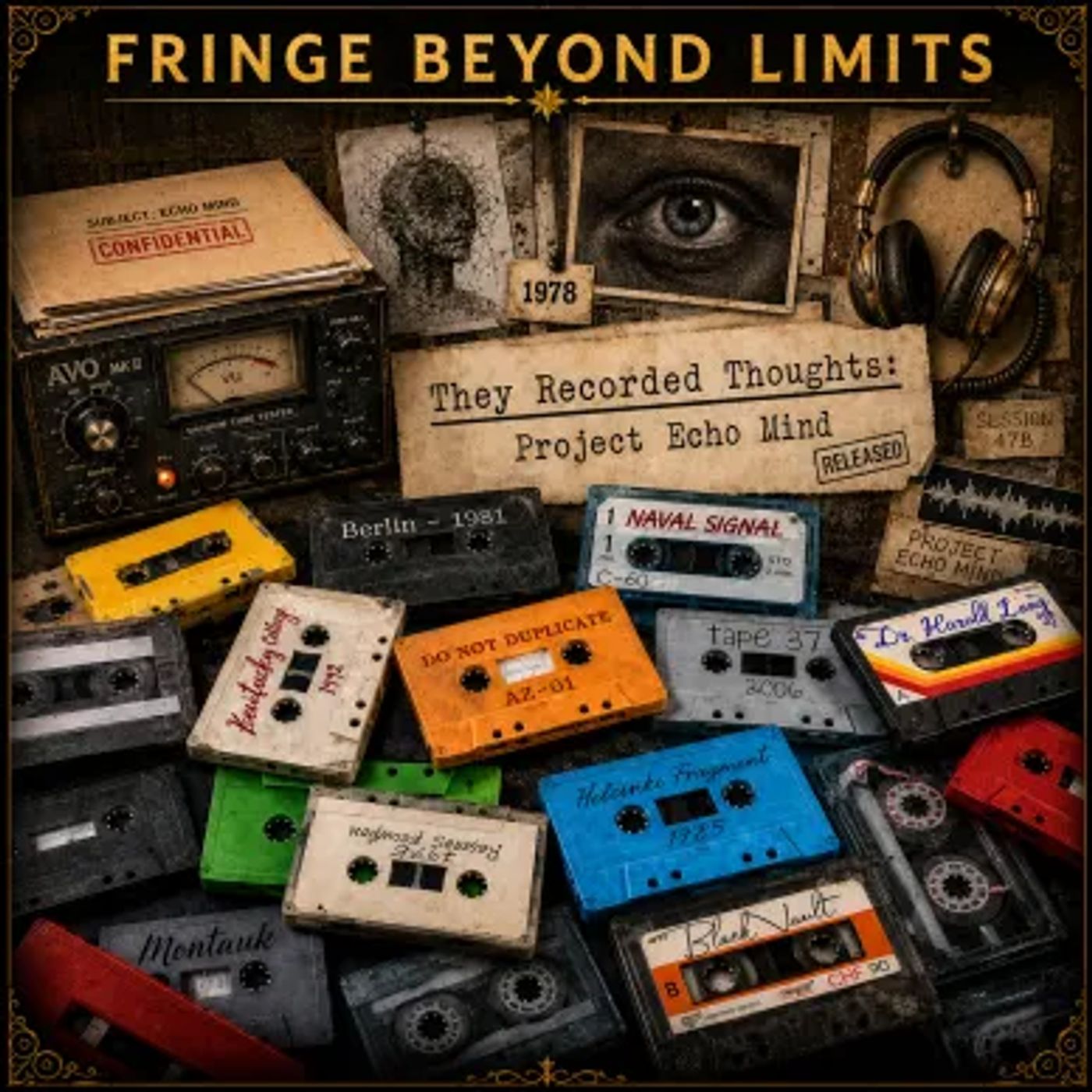
Fringe Beyond Limits
They Recorded Thoughts: Project Echo Mind
01:09:54
In this episode of Fringe Beyond Limits, the hosts investigate Project Echo Mind — a purported Cold War program that claimed to record human thoughts onto magnetic tape. They recount Dr. Harold Lange's experiments, famous tapes and their eerie effects, and explore scientific, paranormal, and ethical theories about whether consciousness can leave a measurable imprint.
Loading summary
Transcript360 lines
- [00:00]
Jerry Maldonado
I started Ornod in 2013 and we make bike apparel. The best part of Shopify for me is our ability to run the business as essentially non technical people. We're able to admin everything on the back end, front end and sell things online easily. If Shopify were a bike accessory, I think it would actually be the bicycle. It's the thing that you do the thing on. We run the business on Shopify so start your free trial on shopify.com.
- [00:29]
Capella University Announcer
there's a fire inside you you can't ignore. Stand still. Not a chance. You're a lifelong learner who's come this far. Now we are here to help you keep going further. Capella University. What can't you do? Visit Capella Edu to learn more.
- [00:44]
Thumbtack Advertiser
I'm pretty confident talking into a mic. Hey, I'm doing it right now. But home projects, I second guess everything. Is that noise normal? Is that water damage? Who do I even call? That's where thumbtack comes in. Just upload a photo or voice note and it uses AI powered search to match you with the right top rated local pro. So instead of guessing, you get clarity and can hire with confidence. For your next tone project, try thumbtack. Hire the right pro. Today.
- [01:23]
Lynette
Sat to another episode of Fringe Beyond Limits.
- [01:56]
Frank
Wow, you hit those high notes very well.
- [02:00]
Lynette
I have been practicing my opera singing. Ah, yeah.
- [02:03]
Frank
And you're Italian.
- [02:05]
Lynette
Yeah.
- [02:08]
Frank
Awesome. How's everyone doing tonight?
- [02:10]
Lynette
Pretty good.
- [02:11]
Frank
Yeah, I'm good. All right, good. Anything fun and exciting?
- [02:16]
Brie
Yesterday my work had a food truck come in and we had to get our food in the rain.
- [02:21]
Frank
Okay, what kind of food?
- [02:22]
Brie
There's a big ass puddle right in the foot. Another, I don't know if you heard of it. Culinary gangster.
- [02:27]
Frank
What kind of food?
- [02:27]
Lynette
Sounds cool.
- [02:28]
Brie
They had different burgers. They had chicken sandwiches, like fried chicken sandwiches. They had gyros. And then you get a side which is either fries, cheese fries, or a thing called gangster fries, which is cheese ranch bacon with seasoning. Looks really good. I should have gotten those. I got regular cheese fries.
- [02:45]
Frank
Yeah, you should have gotten those and should have.
- [02:48]
Brie
Yeah. They had a gangster burger called that had like jalapenos in it. There's like a jalapeno popper burger.
- [02:55]
Lynette
I've had their euros before. They're really good.
- [02:57]
Frank
Yeah, yeah. I'm a big spicy guy because. So those jalapeno burgers sound.
- [03:02]
Brie
Yeah.
- [03:02]
Frank
Fantastic.
- [03:03]
Brie
I think it was the gangster one that everyone's like, oh, that has a kick to it. You probably would like that one.
- [03:08]
Frank
Yeah, yeah.
- [03:12]
Brie
But it Was. It was fun time. Other than the fact that everyone got poured on.
- [03:15]
Frank
All right, so you had a soggy burger and soggy fries.
- [03:17]
Lynette
I was gonna say soggy fries.
- [03:18]
Brie
I got in before everything got soggy.
- [03:20]
Frank
Ah.
- [03:21]
Shannon Maldonado
All right.
- [03:22]
Brie
I got my food. I went right inside.
- [03:27]
Lynette
All right, Ms. Lynette, you, like, can you pull that food truck right up to the front door?
- [03:32]
Frank
Yeah.
- [03:33]
Brie
It's funny. We were like that when they.
- [03:34]
Lynette
When it came.
- [03:35]
Brie
It wasn't raining yet. It was like a little pause in the break from yesterday because there was raining, like, throughout the day, and it was raining. By time the food was ready like that. They were ready for us and everything. It was already downpouring, so we're like, maybe if they can, like, scoot, because we have, like, a little garage deck door.
- [03:50]
Lynette
Yeah. Like, can you.
- [03:51]
Brie
Are you guys, like. We already set everything up. We can't.
- [03:53]
Lynette
I'm like, yeah, the oil's already hot. They can't drive around the parking lot.
- [03:58]
Brie
Yeah. They had the motor already, like, connected for, like, the stove and stuff and. Yeah.
- [04:03]
Frank
Did you guys know it's an el nino?
- [04:04]
Lynette
U I. They've been talking about it a lot.
- [04:07]
Frank
It's a super nino.
- [04:09]
Brie
I've heard of a super baby.
- [04:11]
Frank
Yeah. Do you guys know what el nino is?
- [04:14]
Lynette
A super baby.
- [04:15]
Frank
I used to think it was just some Hispanic kid peeing in the Pacific Ocean, and it's not. It's the warming of the waters and. Yeah. And it's. It's an extreme one. So it's a super nino.
- [04:30]
Lynette
Thomas killing would be so proud of you.
- [04:32]
Frank
I know, right? Weather talk. So. All right, Lynette, Anything fun? Exciting? I have no.
- [04:42]
Lynette
I just got back from Florida at a fraternity convocation.
- [04:47]
Frank
Okay. Reliving that.
- [04:49]
Brie
How is that?
- [04:50]
Lynette
I'm old. All the kids are drinking, like, plastic bottle booze, and we brought a bottle of Blanton's, like, no, thanks.
- [05:04]
Frank
Oh, that's fantastic.
- [05:06]
Lynette
They're like, do we shoot this Blanton's? I'm like, if you shoot this blanton's, I'm going to shoot you. Metaphorically speaking.
- [05:14]
Frank
Right, Right. Allegedly.
- [05:16]
Lynette
Yeah.
- [05:16]
Frank
All right.
- [05:17]
Lynette
Yeah. So that was fun. Went to Disney.
- [05:20]
Frank
Yeah.
- [05:21]
Lynette
Did three parks.
- [05:23]
Frank
Wow.
- [05:23]
Lynette
Plus, so we did animal kingdom, Epcot, and then Magic kingdom. And then I keep wanting to call it Downtown Disney, but what's it called now?
- [05:32]
Brie
Disney.
- [05:33]
Lynette
Disney springs. And then did Disney Springs for dinner. And the real fuel temperature was 103 degrees, so I don't know how we survived.
- [05:40]
Frank
Yeah. Didn't you used to work there?
- [05:43]
Lynette
I did 20 some odd years ago. Like, the reality hit me. I was like, oh, God, I haven't been here in like 20 years.
- [05:51]
Frank
Wow. All right. Did you relive your youth? Show the hubby around? I used to work here. No, this is different. Back then.
- [06:00]
Lynette
No, he was tied up in the fraternity stuff. I went with another one of person's wives. So just her and I.
- [06:07]
Frank
Well, I'm happy.
- [06:08]
Brie
It sounds like a blast.
- [06:09]
Lynette
It was fun. It was good. Drank halfway around the world. Only halfway.
- [06:15]
Frank
Yeah, that's, that's, that's not too bad.
- [06:17]
Brie
It's difficult during the whole entire thing, man.
- [06:20]
Lynette
Yeah. And a thousand degrees out. Yeah. Yeah.
- [06:22]
Brie
You. It would be like after the half one, you probably. That's probably when you start feeling.
- [06:27]
Lynette
I started to feel gross after I had like the coconut cream coffee drink and I was like, I shouldn't. Okay.
- [06:31]
Brie
That doesn't even sound good in the heat.
- [06:35]
Lynette
Yeah, it sounded good. And then I realized, oh, it's 100 degrees out here. This is disgusting. Cement mixer.
- [06:41]
Frank
That's. That's. Yeah. All right, well onto our topic for tonight, I guess after. Yeah, after that.
- [06:48]
Brie
Because.
- [06:49]
Lynette
Rough segue.
- [06:50]
Frank
Yeah, that is. Thank you for that. So it began with a hum. Not the hum of electricity or faulty tape, but something deeper, organic, intentional. A resonance that seemed to know it was being heard. The year was 1973. Buried beneath the research parks of Menlo Park, California was a low profile lab operating under a series of rotating names and non existent departments. The kind of place where paper trails go to die. Inside, a reel to reel recorder clicked into motion. No one spoke, no music played. And yet when the tape was played back, there was something there. A voice, if you could call it that. Not formed with lips or tongue. It was more like a pressure, a presence. A whispered phrase that several technicians would later claim to have heard in their head before it ever played aloud. They're listening. And maybe we were. That moment would become the unofficial genesis of what came to be known in select intelligence circles as Project EchoMind. A classified cold War experiment that sought to capture telepathy on tape. Not metaphorically, but literally. It was a time when governments weren't just trying to control the battlefield. They were trying to control the mind. And this project, if it asked the could human thought leave a trace? Could it be recorded, stored and played back? What followed were decades of whispered reports, experimental technologies, missing reels, and deeply unsettling outcomes. This isn't just the story of a secret program. It's the story of sound without a source. Messages without mouths and minds that may have Been speaking to one another without ever making a sound. Welcome to Fringe beyond limits. And this is the story of the Telepathic Tapes. This is Project Echo Mind.
- [08:57]
Lynette
Have you guys heard of this?
- [08:58]
Frank
I have not. And I'm. I'm all in this sounds.
- [09:03]
Lynette
You're interested to know where your tax dollars went?
- [09:07]
Frank
Yeah, you know, did you know, like, taxes is the only thing you spend money on that you don't get a receipt for?
- [09:13]
Brie
Yeah, that's.
- [09:14]
Lynette
That's really interesting.
- [09:15]
Frank
Yeah. So I would like to know. I would like an itemized receipt and where my money went, please.
- [09:21]
Lynette
Yep, yep.
- [09:22]
Brie
Every little detail. Where does, like, what buildings it goes into, whose pockets it goes into.
- [09:28]
Frank
So listening to another podcast with. They had this ex CIA agent on there and they were talking about when Doge was going through all the fine print and like, where all our money was going. And it was like ridiculous things like $50 million for condoms in the Congo and stuff like that.
- [09:49]
Lynette
Right.
- [09:50]
Frank
Well, the CIA was explaining that's not where the money is really going. It's really going to these black ops and just labeled under these ridiculous things. So that kind of like, oh, all right, so we're not frivolously spending people are just stealing our money.
- [10:11]
Lynette
Yeah, yeah.
- [10:12]
Frank
So I found that really interesting. So. All right. In the shadowy years following World War II, a new kind of battlefield emerged. One that didn't rely on missiles, but on mines. The Cold War wasn't just about nuclear supremacy. It was a psychological, ideological invisible. The United States and the Soviet Union were locked in a silent arms race for influence over human thought itself. Control the mind and you control the soldier, the civilian, the enemy. Enter MK Ultra, a name now synonymous with COVID psychological warfare. But while the public now knows fragments of its horrors, the LSD trials, hypnosis sessions, memory wiping, drugs, few are aware of what came next. Buried deeper, cloaked in even greater secrecy, something codenamed Project EchoMind. According to heavily redacted documents and whistleblower accounts, Project EchoMind wasn't just interested in altering thoughts. It wanted to record them. Not behavior, not language. Actual neural signals, the raw pulse of consciousness. The theory was about. I'm sorry. The theory was both radical and terrifying. That under specific conditions, human thought, emotionally charged ones, could create electromagnetic signatures. And that with the right tools, those mental signals could be captured and even played back. Not everyone in the intelligence community believed it, but in the early 1970s, the CIA was desperate enough to fund the fringe. Psychics, parapsychologists, audio engineers, and one man who would become the accidental pioneer of what would later be called the telepathic tapes. Dr. Harold Lang. Lang wasn't a spy. He wasn't even a government man. He was a brilliant but eccentric audio engineer stationed at a civilian research facility in Menlo Park, California. A site quietly funded through backchannels tied to DARPA and Office of Naval Research grants. His specialty, developing high sensitive recording devices for monitoring neural and trained entrainment in brainwave harmonics. Lange was obsessed with the possibility of brainwave communication. Not just interpreting it through EEGs, but capturing it on magnetic tape. He designed a hybrid system. Magnetometers designed to pick up ultra low frequency activity. Custom amplifiers to avoid distortion, and reel to reel analog tape units modified to record micro variations most engineers would write off as noise. But Langdon dismissed the noise. He listened. He studied. He cataloged. And one day, during a controlled test involving two subjects attempting nonverbal mental synchronization, he played the tape back. What he heard changed everything. A low thrum followed by sharp frequency spikes. And then, according to Lang's notes, a sudden sensation of intrusion. Like a thought. That wasn't mine. He didn't write it off. He tested it again and again. Eventually, his recordings revealed a pattern. One that seemed to match the exact moments when two subjects reported attempting to mentally send ideas, images, or emotions to one another. That was the moment Ling's quiet project became classified. What had started as fringe science was now national security. Echomind was born. Lang's lab was absorbed. The project was restructured. New names were brought in. Neuroscientists, signal analysts, linguists. What they were chasing was no longer theoretical. If human thought left a fingerprint on the electromagnetic spectrum, they were going to find it and weaponize it. And so began a secretive race to capture something never captured before. The sound of thought.
- [14:21]
Lynette
Like, how terrifying is that?
- [14:23]
Frank
That is super terrifying. So what if. What if our phones, our smartphones, are designed to capture our thoughts? It's not really listening to us in a vocal sense, but in a mental sense.
- [14:41]
Brie
I feel like it's already doing that.
- [14:43]
Frank
That's what I'm saying. Because there are times where I will have a thought of something off the wall the next day. I'm scrolling through said thing and it pops up.
- [14:56]
Brie
Yeah. And it's something that you never even said out loud. So it's like, how did they know?
- [15:00]
Frank
Right. That's crazy.
- [15:02]
Lynette
Really good thinky thoughts.
- [15:04]
Frank
Yeah. Yeah. They're stealing.
- [15:06]
Lynette
Think about the lotto numbers.
- [15:08]
Thumbtack Advertiser
Yeah. They're.
- [15:08]
Frank
They're. They're stealing our thinky thoughts. That's why shit's getting created that was my idea.
- [15:15]
Lynette
I know. They stole your ideas before you could even formulate it.
- [15:17]
Frank
God damn that.
- [15:19]
Lynette
You gotta patent your thoughts.
- [15:21]
Frank
I know. I'm gonna have to patent this sex robot that I've been thinking of.
- [15:27]
Lynette
It's already been created.
- [15:28]
Frank
God damn it. Again.
- [15:31]
Lynette
China and Japan already have them. Yeah.
- [15:33]
Brie
Too slow, Frank.
- [15:35]
Frank
No, I was too horny, that's what it was. All right, so what do thoughts sound like? It's a question most neuroscientists. What was that?
- [15:51]
Lynette
Sounds like aol.
- [15:52]
Frank
Sounds like a hippo. Almost like. That's weird.
- [15:56]
Brie
Did you see a hippo?
- [15:57]
Frank
Yeah.
- [15:59]
Brie
I don't even think a hippos sound like that.
- [16:01]
Frank
What do they sound like? Do you know?
- [16:03]
Brie
E. Or remind me more of. Like a donkey.
- [16:06]
Frank
Well, that's what happens when you cross a hippo with a donkey. That's the sound it makes.
- [16:10]
Lynette
A donkeypotamus.
- [16:11]
Frank
There you go. It's really close to a donkey punch. But no, it's a donkeypotamus. So thoughts are internal, invisible. They don't make sound in any conventional sense. But the engineers and analysts behind Project Echo Mine weren't looking for conventional answers. They weren't chasing words. They were chasing resonance. When Dr. Harold Ling first played back the now famous experimental tapes, he wasn't expecting anything remarkable. The reel to reel recorder hissed with low frequency static and undulating electromagnetic traces.
- [16:47]
Lynette
Undulating, Undulating.
- [16:49]
Frank
What did I say?
- [16:50]
Lynette
I don't know what you.
- [16:51]
Thumbtack Advertiser
Okay.
- [16:52]
Frank
The byproduct of a dual subject telepathy trial. Here's where it gets even weirder. According to leaked reports, the recordings contain layers of sound, low frequency hums, strange oscillations, and occasionally what some describe as faint distorted voices or music. One researcher called it a soundscape of the mind. Witness accounts from test subjects who listened to these tapes are even more chilling. In one documented case, a subject claimed to suddenly recall childhood memories that hadn't thought of in decades. While another described visions of locations they'd never visited but could accurately describe. Afterward, the contents of the telepathic telepathic tapes remain shrouded in mystery. But leaked descriptions provide a fascinating glimpse into their nature. The recordings are said to contain multiple A dog's love letter to his squeaky avocado.
- [17:45]
Pet Insurance Narrator
Dearest squeaky avocado, my heart yearns to chew thee. Alas, I've devoured a small action figure and have taken ill, unable to partake in our jubilant squeakings. Worry not, has I. I am on the mend and lemonade. Pet insurance covered 90% of the veterinarian's cost. I recommend all the cats and dogs of the land. Get a'@lemonade.com pet soon my tummy will be unburdened and we shall frolic once more.
- [18:10]
Shannon Maldonado
Yours, Jerry My name is Shannon Maldonado. I'm the founder of Yaoi, a gift shop from the lens of artists and handmade objects. I chose Shopify because when I was testing other platforms it was definitely one of the most user friendly. It was important to me to think about where we would be in the future. All of the the tools for reading your sales, like planning inventory, they're just right there on your dashboard. For anyone starting a small business, the biggest thing I can tell you is it doesn't have to be perfect. Shopify can help you build upon it. Start your free trial on shopify.com there's
- [18:41]
Capella University Announcer
a fire inside you you can't ignore. Stand still. Not a chance. You're a lifelong learner who's come this far. Now we are here to help you keep going further Capella University what can't you do? Visit capella.edu to learn more.
- [18:56]
Frank
Layers of audio phenomena. These include low frequency hums and oscillations, often described as eerily rhythmic. Some believe these are brainwave imprints converted into audible frequencies. Distorted voices on some tapes, faint, unidentifiable voices emerge, speaking in fragmented sentences that seem to correlate with the thoughts or emotions of individuals present during the recording session, an ambient noise with a psychological impact. Researchers noted that some listeners reported distinct physical and emotional reactions, such as a sense of euphoria, sudden anxiety, or the sensation of being watched. One particularly striking report described a tape that, when played back, induced vivid imagery of a dense forest in listeners, even among those who had never been in such an environment. A pair of test subjects reported seeing flashes of deep forest green and the faint scene of pine. One of them, while still hooked to the monitoring device, whispered, did you see it too? This tape was later linked to an experiment where the subject was visualizing the Amazon rainforest. Additionally, there have been claims of recordings featuring complex, faintly musical tones that seem to shift depending on the listener's emotional state. Some parapsychologists hypothi hypothesize, thank you Hypothesized this could represent an interaction between the tape's signals and the listener's brain activity, creating a dynamic feedback loop. Overall, the tapes seem to possess a unique ability to evoke specific memories or emotions, further complicating efforts to determine whether these effects are the result of suggestive psychological phenomena or Genuine telepathic imprints.
- [20:48]
Lynette
This made me think of a thinky thought. Okay, so if the recorded thoughts have these expressions of frequency and oscillations and hums and gets you to visualize when you're listening to it back, what are we potentially telling ourselves when we listen to, like, meditation music or sleep sounds, like binaural beats or solfeggio frequencies? Are we actually talking to our brain? Is that another language that our brain is understanding because it makes us feel relaxed or it makes us fall into a dream space because we can visualize, you know, what we're. What we're hearing?
- [21:31]
Frank
Maybe. I mean, yeah. I mean, maybe that's the language of the brain, right? Just these green frequencies, right? Is that what you're saying?
- [21:38]
Lynette
Yeah, yeah. Without having to use words. Certain frequencies or vibration oscillations is a language in and of itself. And that's why we use certain, like, 5 hertz and, you know, 7 hertz or whatever. And that's what brings us into our theta state for sleeping and things like that. Because it's talking to our brain to tell it to wind down or to relax or to focus and concentrate. Because there's also, you know, frequencies out there that help you stay focused so your ADD doesn't go out of control and you can, like, get your paper done or write your, you know, do what you need to do for work.
- [22:14]
Frank
Right. I think if that's the case, my. Oh, boy, my brain frequency stutters a lot.
- [22:22]
Lynette
Zero.
- [22:23]
Frank
Like, it just. It just stutters.
- [22:25]
Lynette
You know, it's flatline. Flatline with a blip.
- [22:28]
Frank
Yeah, it has a horrible lisp and just stutters. Yeah.
- [22:32]
Brie
Misty would not like that one bit.
- [22:33]
Frank
Right.
- [22:34]
Lynette
She's been trying to fix you for years.
- [22:36]
Frank
Yeah. Yeah. Good luck. Well, that's an interesting thinking thought. I wonder if we can figure out how to do these on our own and try to capture our own thoughts on tape.
- [22:53]
Lynette
I don't know.
- [22:54]
Frank
Yeah, I wonder if we could figure that out. Well, I know what I'm going to chat GPT later. So there's one tape that Lang played back for visiting analysts. A copy labeled only trial 5amirror sync. According to a surviving account, the tape began with the usual noise until one technician, without warning, stepped back from the console and asked who else thought of fire just now. Moments later, the second subject in a completely different room began describing the sensation of heat and burning wood. No flames, no fire alarm, just synchronized cognition mirrored by spikes on the magnetic recording that to this day remain unexplained. Ling noted in his logs that the tape doesn't sound like anything. It feels like something. What's the most unsettling about the tapes is not what you hear, but what you feel. Multiple controlled listeners described somatic responses. Goosebumps, nausea, a pressure behind the eyes, Even though there is no traditional sound triggering these sensations. Some psychologists hypoth. Why can't I say that word?
- [24:07]
Lynette
Because English is not your first language. Hypothesized.
- [24:10]
Frank
Hypothesized that the tapes were acting as a kind of psychological carrier wave, Delivering embedded emotional data directly into the brain's interpretive centers. Others feared something more esoteric, that the human mind, when in the right state, might just process the tape, but might not just process the tape, but interface with it. Project ectomind soon categorized tapes into three levels. Class 1, Neural Echoes, Residual frequency pulses believed to originate from brainwave activity. Class 2, emotional imprints, recordings that consistently trigger specific emotional responses across test groups. And then class three, interactive fields. Rare tapes where listeners reported two way experiences as if they were recording, was aware it was being heard. These weren't just files. I know that's creepy.
- [25:03]
Lynette
Yeah.
- [25:04]
Frank
These weren't just files. They were experiences. And the team believed that they were getting closer to something profound, not just a way to record consciousness, but to preserve and replace states of mind. What they didn't yet understand was the risk. I wonder if these tapes can be found, like on YouTube or somewhere and we can, like, do our own experiment. It's something to chatgpt. So by the mid-1980s, Project Echo mine was no longer just theory in development. It had evolved into a quietly growing archive of inexplicable recordings. Magnetic tapes that, depending on who you asked, were either groundbreaking data on cognitive resonance or dangerous psychic anomalies. At best locked away forever. They called them echo class artifacts. And while most were buried in filing cabinets in government vaults, A few slipped through the cracks, whispered about in back channels, Referenced in obscure journals, or leaked by those who had heard and couldn't forget. Here are five of the most infamous ones. So, the Berlin tape from 1981. Cold War tensions were at a boiling point. A Soviet psychic, known only by the alias Nikolai defected to the west and was allegedly brought to a CIA black site in Berlin. There he was asked to attempt contact with his handler, still behind the iron curtain. Using only thought, the session was recorded. What came back wasn't a message, not in any traditional sense, But a disjointed, almost emotional transmission. Low droning pulses, Fragmented vocal fragments, Alternating between Russian and what some analysts describe as non language. Several CIA operatives who reviewed the recording experienced disturbing symptoms. Vertigo, sudden paranoia, even hallucinations of places they claimed they'd never seen, yet were later verified as actual Soviet locations. One operative collapsed mid playback and later described the tape as not a message I received, but a memory I wasn't supposed to have. And there is the Helsinki fragment. In 1985, a lesser known recording with an eerie twist, captured during a parapsychology symposium in Helsinki, researchers were attempting to record subtle energy fields during a synchronized breathing exercise. The tape that emerged didn't just include rhythmic patterns. It included words in three Finnish, Russian, and English. None were spoken aloud. None were part of the experiment. When one researcher asked aloud during playback, what are you? The tape glitched and whispered back, unity. Yeah. Some attendees fainted. Others refused to be near the tape again. It was later displayed at a psychic phenomenon exhibit in Austria, but disappeared in transit, never to resurface.
- [28:11]
Lynette
I'm pretty sure Bill Gates has it.
- [28:12]
Frank
You think so?
- [28:13]
Lynette
I don't know.
- [28:15]
Brie
Hey, you never know.
- [28:16]
Frank
To those who heard it, the memory remains vivid. Not like a sound you recall, more like a feeling that follows you. What if that was the. The greater consciousness that we're all just a part of?
- [28:30]
Lynette
Maybe.
- [28:32]
Frank
Next is the Kentucky College Experiments, 1992. Not all echo mine inspired experiments were governmental. In the early 90s, a psychology professor at a small liberal arts college in Kentucky replicated Lange's design. Using homemade equipment, frequency filters, crude magnetometers, and analog tape decks. The test involved student volunteers paired in isolated rooms. One attempted to transmit mental images, the other to receive astonishedly. When the tapes were played back, several participants described matching sensations and imagery. One student reported a vivid impression of a red balloon drifting in a blue sky, the exact image their partner had focused on. Another accurately repeated a phrase that had only been thought, not spoken. During the session, the professor published a brief paper in a fringe psychology journal. It was largely ignored, but the tapes remained in private possession. According to one student still haunted by the experience, they're not recordings. They're echoes of something that's still happening. The Black vault tape. In 1998, discovered in a decommissioned government research facility in Virginia, the so called Black Vault tape was quietly leaked online in the early 2000s through the. Through this site, the Black Vault, a repository for declassified and anonymously uploaded intelligence documents. The recording was brief, under five minutes. But it disturbed nearly everyone who heard it. Fragmented cries, a pulsing, rhythmic thump, like a heartbeat. Voices unintelligible, but unmistakably human. Layered and echoing, as if trapped behind the walls. Listeners Reported physical symptoms, nausea, pressure behind the eyes, even hallucinations of shadowy figures in the room. The tape was quickly pulled under circ. I'm sorry, pulled from circulation. To this day, no one knows who recorded it or what happened in that room, but many believe it was a result of an echo class experiment gone horribly wrong. A moment when something didn't just get recorded, it got out. So I wonder if this pressure behind the eyes is possibly your third eye getting overwhelmed.
- [30:59]
Lynette
That makes sense. I would. And then think of it that way.
- [31:02]
Frank
Yeah, right.
- [31:02]
Lynette
Yeah.
- [31:03]
Frank
So I just kind of. That kind of just popped in my head just because I'm just seeing pressure behind the eyes, you know, sinus, maybe headaches, and then, you know. Or if it's psychic ability, it would involve your third eye.
- [31:16]
Lynette
Yeah, I guess I. When I first read it or whatever, I. I literally was thinking immediately behind the eyeballs. But you bring up a good point. Maybe some people don't discern between. Right, you know, the middle of your forehead, pressure. That kind of feels like a mask. You know what I mean?
- [31:34]
Frank
Yeah, that's exactly what I was thinking.
- [31:35]
Lynette
Yeah, yeah. Maybe that also set the groundwork for the Havana syndrome stuff.
- [31:43]
Frank
Yeah.
- [31:45]
Lynette
All right.
- [31:46]
Frank
Tape 37. And this is in 2006, Sedona, Arizona. A large scale group meditation involving over 400 participants focused on global peace and heart resonate resonance. Unbeknownst to the crowd, a small group of researchers, followers of Lang's work, had placed modified magnetic recorders around the perimeter of the site. What they captured became known as Tape 37. When played back, listeners describe overwhelming emotional responses, waves of warmth and peace, intense euphoria. Some even wept without understanding why. But the strangest part, the recordings seemed to respond to listeners. Played alone, it felt subtle. Played in groups, especially during meditation, the volume, tone and pacing shifted. One Analyst later wrote, Tape 37 doesn't play. It participates. To this day, the tape is circulated among niche metaphysical circles, always with a warning. Only listen if you're open. By the early 2000s, Project EchoMind had vanished from budget loves and oversight files. But the recordings, the artifacts, the whispers, they never really left. They remain in archives, in addicts, in the memories of those who have heard them. Not as audio, but as something embedded in the listener. Something that doesn't fade. So after tape 37, something changes. Up to this point, the recordings follow a relatively clear pattern. They are tied to identifiable locations, structured experiments, and at least some level of documentation. Even when the results are difficult to explain, there is still a framework holding them together. But as you continue digging into Project EchoMind, that framework begins to fade. Not every recording appears in official logs. Some are referenced only briefly in internal notes. Others surfaced years later, disconnected from any formal experiment. In a few cases, the only record of their existence comes from the individuals who claim to have heard them firsthand. There is no consistent timeline, standardized labeling, or clear chain of custody. Instead, these recordings exist on the margins, passed between researchers, stored outside official archives, or mentioned once and never formally acknowledged again. And yet, despite the lack of structure, the patterns don't disappear. If anything, they become more pronounced and more difficult to ignore. Taken together, these lesser known tapes suggest that Project Echo Mine was not as contained as it may have appeared. What began as a controlled attempt to study thought and cognition may have expanded into something far less predictable. Not a clean series of experiments, but a program that was at some point no longer entirely under control. So did I tell you guys that they're really close to being able to visually, visually see our dreams and thoughts? So, like they're gonna be able to hook your brain up to whatever, EEG machine or whatever and be able to display your dreams on a screen. That'd be pretty cool.
- [35:08]
Brie
Like, I wonder how accurate it'll be because you know how some dreams you remember and some dreams you don't.
- [35:13]
Frank
Right?
- [35:14]
Brie
Like the ones that you don't remember. I wonder if you like, actually see those. Like. Right, that's actually real.
- [35:19]
Lynette
Well, I even have a theory about the dreams that you don't really remember is because there actually might not be language or structure to store that dream in your memory because it's so ethereal, there isn't words to describe what you experienced.
- [35:34]
Frank
Yeah, that's a good point.
- [35:36]
Lynette
So can a computer put together some super abstract. That would be interesting to see what they turn out for some of those really bizarre dreams.
- [35:46]
Frank
Yeah. So the next step of AI is AGI. Have you guys heard of this? So AI, Artificial intelligence. AGI is artificial general intelligence to where AI is going to be able to do things just as good and even better than a human. So I'm wondering if right now AI can't do it, but. All right, the next evolution, AGI would be able to be able to put together those. I can't think of the word now that I want to use. Abstract, like abstract thought, be able to put it into visual content.
- [36:27]
Lynette
Yeah, yeah, Interesting. We're really trying to push ourselves out of existence here, you know, so the
- [36:34]
Frank
more and more I think about it, I just don't think that AI will be able to be sentient, you know, I just. I just.
- [36:44]
Lynette
Have you ever had some deep conversations with your AI bots?
- [36:48]
Frank
Yeah, I have. And it's. It's uncanny, you know, but it's learning patterns, you know, and it needs someone to program it to do something. I just. I don't know. I don't know. The more and more I look into it and like read about it, the more I really start to think that it just isn't possible. I could be wrong.
- [37:10]
Lynette
But how do you prove you're sentient? Like, how do you really prove it? How do you know that you're not a product of your programming?
- [37:17]
Frank
I think therefore I am.
- [37:19]
Lynette
Okay, so a computer thinks and therefore it is.
- [37:22]
Brie
Isn't that part of a song?
- [37:23]
Frank
I don't think it. It thinks independently though.
- [37:27]
Lynette
Maybe not yet. But again, a g. Whatever you said.
- [37:30]
Frank
AGI yeah, yeah. And again, I could be wrong. I'm just throwing out my opinion and you could be a hundred percent right, you know, and maybe, maybe you're right. Maybe it's just. It needs next evolution to start that. That kickoff into thinking independently. Who knows?
- [37:51]
Lynette
I mean, people at present day still don't think animals have sentience too. So like when, when is it ever going to be enough just because they can't communicate in the words that we do? I don't know, like.
- [38:03]
Frank
Right, I agree, I agree. And I think those people have never had a pet before because I mean, even having a bird, you can see that it has its own thoughts and feelings.
- [38:15]
Lynette
I'm going to get you a pet bird.
- [38:17]
Frank
Oh, I will. I'll eat it. All right. So. Shortly after the initial success of Ling's lab based recordings, researchers sought to test whether environmental variables played a role in telepathic resonance. The Redwood Session was conducted deep within a northern California forest, far from electromagnetic interference and urban noise. Participants were placed in isolation within the forest and instructed to enter synchronized meditative states at a predetermined time. Recording equipment was distributed across the area, calibrated to detect ultra low frequency fluctuations. The resulting tape was unlike anything recorded in the lab. It contained natural ambient sound, wind, distant movement, environmental noise, intermittent harmonic tones not present during the original recording. A low frequency resonance that intensified during peak synchronization periods. Listeners later reported a strong sensation of presence despite the absence of human voices. The feeling that the environment itself was aware of the participants. A subtle but persistent awareness of being observed not by a person, but by something undefined. This tape introduced a new and unsettling possibility that telepathic resonance might not be limited to human minds, but could Involve the environment itself as a medium or even a participant. So what if this is the feelings and the resonance of what you can visually conceptualize when you take DMT and go into that other realm? I mean, what if those vibrations are always around us? We're just not. We don't have the tools or the mindset anymore to be able to link into it. But DMT allows us to go there physically with our consciousness.
- [40:18]
Lynette
I'm trying to follow the line that you're drawing. I'm sorry.
- [40:21]
Frank
That's okay. We can move on.
- [40:25]
Lynette
It always comes down to DMT with you.
- [40:28]
Frank
Oh, absolutely. Oh, I found places in the States that we can go to as retreats.
- [40:40]
Lynette
Cool.
- [40:41]
Brie
I like how he was waiting for our reactions to this.
- [40:44]
Frank
Like, you're saying, let's go. Let's go do the drink, the ayahuasca.
- [40:50]
Brie
I can't. Sorry.
- [40:51]
Frank
I know you can't.
- [40:52]
Brie
Stupid Lynette. You don't have an excuse.
- [40:55]
Frank
Yeah, this is true. This is true. So, moving on. The Montauk tape is one of the most controversial entries in the broader echo Mine narrative, largely because it is alleged connection to the long rumored Montauk project, a series of fringe experiments said to take place at Camp Hero, New York. According to scattered accounts, the tape was recorded during an experiment involving a subject placed in what was described as a psychic amplification chair. The goal was not to receive thoughts, but to project them outward with enough intensity to interact with the physical world. During the session, the subject was instructed to visualize increasingly complex scenarios. First simple objects, then environments, and eventually entire constructed realities. The tape itself does not contain clear voices. Instead, it's described as layered tonal interference. Overlapping frequencies that seem to phase in and out of sync, Sudden bursts of chaotic signal distortion. But what makes it unique is the listener response. Multiple individuals who reviewed the recording reported experiencing fragmented mental imagery that didn't self generated. A sensation of falling into someone else's imagination. A brief inability to distinguish between internal thought and external stimulus. One technician reportedly removed his headset mid playback and said, this isn't being recorded. It's still happening. Some researchers believe this tape represents a shift from capturing thought to capturing active cognition in motion.
- [42:39]
Lynette
Well, this goes back to like, your latest theory is that we're just all swimming in a pool of consciousness, right? So it might have been, quote, recorded in the past, but what is the definition of past?
- [42:53]
Frank
Right.
- [42:53]
Lynette
You know what I mean? It's all happening at the same time, right?
- [42:58]
Frank
Like we've said about time, many times, that it all is happening at the Same time. We're just seeing it. We're just experiencing it in a linear form.
- [43:07]
Lynette
I really want to know what that feels like. Feels like to hear one of these tapes.
- [43:11]
Frank
Yeah, me too.
- [43:12]
Lynette
I really want to know.
- [43:13]
Frank
Yeah, yeah. We have to. We're going to have to.
- [43:16]
Lynette
You might be able to do the. What was the one that they said was actually up on the Internet? Was that tape 37?
- [43:22]
Frank
37. I think it was.
- [43:23]
Lynette
Yeah.
- [43:23]
Thumbtack Advertiser
Yeah, yeah.
- [43:24]
Lynette
And Also with tape 37, being in Sedona, like everyone has, at least in the spiritual community, knows Sedona to be kind of this pinnacle, hot point of. Of energetic frequency and vibration. And I'm wondering if that tape not only picked up the group that was working there, but the amplified resonance of the area.
- [43:45]
Frank
Yeah, I would. I would say yes. Yeah, yeah. There's somewhere else we should go to as well.
- [43:51]
Lynette
I've been there once with, like, family. It's beautiful. But I'd like to go there for the metaphysical stuff.
- [43:57]
Frank
Yeah. So my. My cousin lives in Phoenix.
- [44:01]
Lynette
Yeah.
- [44:02]
Frank
So I think it's like a three hour drive from Phoenix, something like that. So I wonder if we can stay with him. Just fly out there, stay with him.
- [44:11]
Lynette
Like, hi, we're crashing.
- [44:12]
Frank
Yeah, hi, guys. And bye. We're gone for the day, so. All right, so. The naval signal tape was reportedly captured aboard a US Naval research vessel conducting sonar mapping operations in the North Atlantic. Initially dismissed as interference, the recording contained rhythmic pulse patterns that did not match any known marine signal, mechanical system, or environmental anomaly. The pulses were evenly spaced but dynamically modulated, layered with faint harmonic tones beneath the primary signal. Responsive to proximity, changing subtle when crew members entered the room. What began as technical curiosity quickly escalated. Crew members exposed to repeated playback reported shared dream sequences involving a submerged structure, a recurring visual or geometric architecture beneath the ocean floor, a persistent sensation of being observed from below. Most strikingly, these reports came from individuals who had not discussed the tape with one another. The recording was eventually classified and removed from circulation. Official documentation attributes the anomaly to equipment malfunction. Unofficial. I agreed. I hate how it's. Oh, just the equipment malfunction. It's just, you know, a swamp gas. It's just, you know. Ball lightning.
- [45:36]
Brie
I was gonna say ball lightning.
- [45:41]
Lynette
Yeah. We're all visualizing a structure underneath the ocean floor. Ball lightning. Yeah.
- [45:46]
Frank
Ball lightning. Swamp gas. No, that was just my ass. Okay.
- [45:50]
Brie
That's
- [45:52]
Frank
so Uno.
- [45:53]
Brie
That was Donkey and Shrek.
- [45:55]
Frank
Yes, that too.
- [45:57]
Brie
Yep.
- [45:57]
Lynette
Yep.
- [45:58]
Frank
Unofficial accounts suggest something else entirely. That the signal wasn't random. It was structured and possibly responsive. By the mid-1980s, the recordings had become increasingly difficult to categorize. What began as structured experiments had expanded.
- [46:14]
Capella University Announcer
There's a fire inside you you can't ignore. Stand still. Not a chance. You're a lifelong learner who's come this far. Now we are here to help you keep going further. Capella University. What can't you do? Visit capella.edu to learn more to environments,
- [46:30]
Frank
conditions and outcomes that no longer followed a consistent model. The variables had changed, the results had changed. And in some cases, it was no longer clear what was being recorded. But even then, the project was still active, still being studied, still. Still, at least in part, understood what came later would be different. So by now you're probably scratching your head and wondering, what exactly were the telepathic tapes? For decades, researchers have debated whether Project Echo Mine uncovered something truly extraordinary, or whether the phenomenon was simply misunderstood noise cloaked in the allure of Cold War mystique. The question boils down to this. Can human consciousness leave a measurable imprint on the environment? And if so, can it be recorded? Oh, I wonder if this is what also. Oh, shit, I just had it. Oh, the haunting that's just on replay. What is that called again?
- [47:30]
Lynette
Residual.
- [47:30]
Frank
Residual haunting is as well just. Are the person's thoughts and emotions just imprinted in that location. So I wonder if we can pick that up with some equipment.
- [47:44]
Lynette
Yeah, because if you expand on that, it's not just. It's the feeling you get when you're in those places, when you're in those rooms or touching this object, that you can have a flash of a visual in your mind out of the blue, for no reason. You can feel a sense of vertigo or pressure. And. Yeah, I mean, maybe it's not just tapes. Maybe like you said, like, stones can record, objects can record.
- [48:12]
Frank
Yeah, Yeah. I mean, how many times has that happened to me where I'm like, I am feeling this when I touch X and then we don't know anything until we go do some more research? Like. Oh, yeah, that makes sense. So, yeah. So am I like a human recorder?
- [48:27]
Lynette
Yeah. No, you're more like the needle on the. That reads the recording.
- [48:31]
Frank
Ah, that's. That's. That's a good analogy. I like that.
- [48:34]
Lynette
Yeah.
- [48:35]
Frank
So one of the most grounded theories suggest that the recordings captured not thoughts themselves, but electromagnetic residues of intense brain activity. The human brain, after all, does emit electrical signals, the same ones measured in EEG machines. Proponents of this theory argue that under the right conditions, high emotional arousal, synchronized intention, extreme mental focus, those signals might Interact with nearby electronics in ways we don't fully understand. Lang's equipment was designed to detect extremely low frequency fields, the kind generated by both natural phenomena and biological processes. If a person's brain emitted a spike of coherent electromagnetic energy during deep concentration, could it leave a trace? Maybe. But skeptics point out EM signals degrade fast. They're faint, messy, and prone to interference. Capturing them clearly, especially without invasive tech, would be more impossible. And yet something was captured repeatedly across locations and equipment types. That's what keeps this theory alive. You know, I hate that. That the brain is the one thing we know the least amount. And you're just going to jump to like, well, they degrade fast and, you know, they're faint and messy. Well, yeah, with our technology that we currently have. But who's to say that our technology just isn't sophisticated enough to capture them?
- [50:06]
Brie
Because the ball lightning.
- [50:08]
Frank
Ball lightning. Swamp ass. All right, so where was. All right, there we go. So then there's the skeptics favorite hypothesis. Auditory. Our brain's tendency to find meaning in meaningless stimuli. We've all heard it before. The voice in white noise. The pattern static. The face on the moon. Applied here, the argument is that these tapes contained nothing more than random fluctuations and machine noise. But when paired with the suggestion of telepathy or in an emotionally charged environment, our minds filled in the gaps we projected, meeting into chaos. Supporters of this view cite the power of expectation. If a listener expects to hear a message, they often will. But this doesn't explain everything. Why did unrelated listeners report the same emotions? Why did some tapes provoke identical physiological reactions across subjects? At a certain point, coincidence begins to look like correlation. For those willing to stretch into the fringes of theoretical physics, there's another model. Speculative, yes, but compelling. That consciousness is not bound to the brain, but part of a shared field. This is where quantum entanglement enters the discussion.
- [51:31]
Lynette
Your favorite part?
- [51:32]
Frank
It is. This is.
- [51:33]
Lynette
You're getting the goosebumps.
- [51:35]
Frank
I am. Some researchers, including fringe physicist Dr. Eleanor Vassi, proposed that thoughts, especially when shared between two emotionally bonded people, might entangle in a way similar to paired particles. If one fires, the other responds, even at a distance. She argued that certain brain states may leave thought fingerprints in the environment, and that magnetic tape, with its sensitivity to field fluctuations, might serve as a crude recording medium.
- [52:06]
Lynette
Oh, that's like me and my sister.
- [52:08]
Frank
Yeah, exactly. That is true.
- [52:10]
Lynette
We're shared brain particles.
- [52:12]
Frank
You guys do share a lot more than just brain particles. So it sounds wild, but quantum biology is no longer science fiction. Experiments have shown that some birds may navigate using quantum entangled particles. And human consciousness remains, even now, only partially understood. Could Project EchoMind have stumbled into the biological quantum event? Maybe. But even Dr. Vassi admitted that, if true, we're recording ghosts in a machine. Glimpses of sentient energy we don't have words for outside the lab. In the realm of metaphysics, Project Echomine has become a favorite among paranormal theorists. They speak of. I can't say that word. Of egregores. Egregores.
- [53:04]
Lynette
Yeah.
- [53:04]
Frank
All right. Thought.
- [53:05]
Lynette
I don't know.
- [53:06]
Frank
Yeah, sounds good.
- [53:06]
Brie
I was like, sure, sure.
- [53:08]
Frank
So they're thought forms that take on life through collective attention. They point to rituals, meditation groups, and ancient traditions that teach thought as energy, intention as force. To them, the tapes didn't just record thoughts. They recorded consciousness. One recurring theme across reports was the sense that the tapes weren't just passive recordings. They were interactive, observing, reacting. Some even described them as sentient in a primitive, ambient way, like they retained a piece of the person who made them, not a copy, a presence. Which leads to one final question. If we can record a thought, can we trap one? Officially, there's no record of Project Echo Mine ever existing. No budget trail, no paper trail, no project code in CIA's historical index.
- [54:01]
Lynette
No receipts.
- [54:03]
Frank
The name doesn't appear in the declassified MK Ultra files. Not even in the ones where subjects were dosed with LSD and interrogated under strobe lights. Which begs the question, was Echo Mine buried, or was it never meant to be found? After the 1980s, references to Lang became scarce. Internal memos stopped mentioning his name. Grant references vanished. His personal research journals, which once circulated among a few fringe academic circles, are now almost impossible to track down. Some believe he was folded into a deeper, more compartmentalized layer of government work, one where even names weren't kept. Others say he left entirely, that he'd grown afraid of what the tapes had begun to do. Not to the subjects, to the listeners. Either way, at some point, the trail on Dr. Lang simply and abruptly ends. A handful of researchers who continued Lang's work reported intense psychological fatigue after extended sessions with the Class 2 and 3 tapes. One developed a persistent belief that the tapes were mirroring him, changing slightly each time he played them. Yeah, you heard that right. One analyst became convinced that certain tapes were changing over time, subtly altering in tone and structure with each playback. Another suffered a complete mental breakdown, claiming he could hear people's thoughts when he slept. He reported hearing internal dialogues during sleep, thoughts that did not feel entirely self generated. Whether These were symptoms of obsession or exposure. No one can say for sure, but they were enough to bring the recording back under Locke and Key. By the early 1990s, access to the tapes was restricted, sessions were reduced, and eventually the project disappeared from view. So I had a thought with some of these researchers saying that the tapes changed over time. Well, going back to this double slit experiment, that reality doesn't make a choice until it's observed, right? So what if us observing these recorded thoughts changes over time because of that? Because we're finally observing it more than once, over and over and over again. So they did a. I forget how they tested this, but they tested that the past can be changed just by observing it. So when light is traveling from another galaxy, let's say it's 100 million miles away, and it gets to another solar system or galaxy, it has to go around it to get to us, right? Well, it could either go to the left or to the right. And it doesn't make that decision until we observe it. So that light that originated a hundred million years ago, that's getting to us, isn't deciding to go around another galaxy until we observe it?
- [57:16]
Lynette
What?
- [57:17]
Frank
No.
- [57:18]
Lynette
What?
- [57:19]
Frank
No. Did I not make sense?
- [57:21]
Lynette
No, it made sense, but I don't.
- [57:24]
Pet Insurance Narrator
What?
- [57:25]
Frank
Okay, I was just making sure I made sense.
- [57:27]
Brie
So I'm lost.
- [57:29]
Frank
All right. So, like, you don't know what a double slit experiment is, do you?
- [57:34]
Brie
I mean, I've heard you've talked about it before.
- [57:36]
Frank
Yeah, but do you remember what it is?
- [57:38]
Brie
I don't remember. No.
- [57:39]
Frank
So they would shoot a electron at a sensor plate. Yeah, sensor plate. And in between it, they had piece of paper with two slits in it. All right. And when it was not being observed, it would give a certain pattern on the sensor plate. Okay.
- [58:01]
Lynette
When it was, it would be scattered.
- [58:03]
Brie
Yeah, I like Lynette's demonstration.
- [58:06]
Lynette
I'm trying to.
- [58:06]
Frank
Her spirit figures.
- [58:07]
Lynette
I'm trying to Italian visualize it for you, Jules.
- [58:12]
Frank
You know, do this. Go and watch a YouTube video. It's like 10 minutes long. And then. Yeah, it's much better because I can't. I'm really bad at explaining it.
- [58:21]
Brie
Okie dokie.
- [58:22]
Frank
Okay.
- [58:22]
Lynette
Basically, when you look at the light or you look at it, it looks different than when you're not looking at it.
- [58:28]
Brie
Got it.
- [58:28]
Frank
Yeah.
- [58:29]
Lynette
They organize and then they disorganize. It's kind of like a video game where it's. The scene renders in front of you. You could see the area, but like all this behind you, you can't see until you turn around and then it renders. You know what I mean? If you think of it like in a video game, type of.
- [58:45]
Brie
Okay, that makes sense.
- [58:47]
Frank
You sure?
- [58:47]
Brie
Thank you, Lynette.
- [58:51]
Lynette
So, continuing on, you didn't finish your thoughts, so we'll just continue.
- [58:55]
Frank
Yeah, we're just going to continue. So not every recording was achieved during the life of the program. Some surfaced later without classification or documentation, and interestingly enough, without any clear connection to formal experiment. One of those recordings would come to be known as the Lang Personal Reel. Unlike the other tapes, this one was never part of an official experiment. The Lang Personal Reel was allegedly discovered after Dr. Harold Lang's abrupt disappearance. It had no label, no date, and no accompanying notes. Just a single reel stored separately from the rest of his work. When analyzed, the recording showed none of the typical structures seen in echomind sessions. No calibration tones, subject markers, or experimental cues. Just a gradual emergence of signal. Listeners described it not as an event, but as a state. A slow, gradual buildup of low frequency pressure. A continuous, evolving, unbroken waveform that subtly fluctuates over time. No identifiable events. And beneath it all, a persistent emotional presence that was difficult to define. What disturbed analysts wasn't what they heard, but what they felt. Across multiple listeners, reports were remarkably consistent. A sense of disorientation, as if trying to recall something just out of reach. A feeling described as identity drift. The impression of a mind attempting to stabilize itself. Allegedly, some listeners later described the experience as feeling less like a message and more like encountering a person struggling to hold onto their own sense of identity. Others reported a similar impression, that the recording felt like a minded motion, but without a stable sense of self behind it. The prevailing theory is that Lang may have used himself as a subject attempting to record his own internal state without a sender or receiver. If true, this would be the only known instance of a closed loop consciousness recording. A mind observing itself. Gary. Despite the project's disappearance, its fingerprint and underlying premise has not completely vanished. Evolved echoes can be found in the margins of more recent programs. In 2009, DARPA initiated the Silent Talk program, an effort to decode neural signals of pre speech communication, effectively translating, though effectively translating thought into communicable data. While details remain limited, the program demonstrated early success in interpreting pre speech neural signals, though it has since gone quiet publicly, with many believing the research continued under more classified initiatives. In 2013, the BRAIN initiative brought together government agencies, the NIH, private research institutions, and military partners to map, influence, and manipulate neural activity at unprecedented levels. Still active today, The Brain Initiative has significantly advanced our understanding of neural mapping, enabling scientists to record and stimulate brain activity with increasing precision, though the full scope of its application remains far from complete. That's scary.
- [62:27]
Lynette
You should ask Missy about it.
- [62:29]
Frank
I should.
- [62:30]
Lynette
I wonder if she knows anything about it.
- [62:31]
Frank
Yeah, I will.
- [62:33]
Lynette
She's on the inside, right?
- [62:37]
Frank
If she is, she's kept me a great distance away.
- [62:41]
Lynette
She's testing it right now.
- [62:43]
Brie
Missy.
- [62:44]
Frank
I told her I can be bought, no problem.
- [62:48]
Lynette
Your face is for sale.
- [62:50]
Frank
That's right. I'll get a face tattoo of some sort of brand. And today, non invasive BCIS brain computer interfaces are capable of detecting intention through electrical signals alone, allowing users to control devices without physical interaction. Now commercially available in early forums, these devices can already detect basic intent and control external systems, with rapid advancements suggesting a future where thought to device communication becomes increasingly seamless.
- [63:26]
Lynette
Your cell phone.
- [63:27]
Frank
That's right. The language is different now. More sanitized. Cognitive enhancement, neural translation, biosignal mapping. But the goal still eerily. Record the mind, decode it, predict it, influence it. The question isn't whether EchoMind is still active. It's whether it ever really stopped. Rumors persist that copies of the telepathic tapes or versions of the technology have made their way into the hands of private contract contractors, tech companies and fringe neuroscience labs.
- [64:02]
Lynette
Bill Gates and Zuckerberg.
- [64:04]
Frank
Zuckerberg and Bill Gates. If true, the implications are staggering. A company with access to the true emotional or cognitive imprinting could revolutionize or weaponize human communication. Imagine personalized advertising that bypasses language. Digital interfaces that read your desire before you move. Or more terrifyingly, interrogation tools that don't ask questions, they just listen. If even a portion of the underlying principles provide viable, the implications would be significant. Communication that bypasses language entirely. Interfaces that respond to intention before action. And systems capable of interpreting emotional states in real time or in more controlled settings. Interrogation methods that require no questions, only observation. There is one final entry associated with Project EchoMind. If it exists at all, it does so at the very edge of the record. It appears only once in a heavily redacted internal reference labeled AZ01. Do not duplicate. No origin is listed. No experiment described. No personnel are identified. Only a brief notation indicated that the tape was reviewed once and never again. Allegedly, according to fragmented secondhand accounts, the playback session was terminated almost immediately. Observers reported a sudden spike in signal intensity across all monitoring equipment. Immediate psychological distress among those present. An overwhelming sense the recording was not passive. Additionally, according to these alleged secondhand accounts, the playback session did not last long. The Session was terminated without analysis. No transcript was produced. No surviving copies has surfaced or been verified.
- [66:02]
Lynette
What, like why?
- [66:04]
Frank
Yeah, I don't. Yeah, like what?
- [66:06]
Lynette
Unless the message is, you're fucking around with stuff you shouldn't be. Stop this right now.
- [66:13]
Frank
Maybe they tapped.
- [66:13]
Lynette
Or we'll laser beam you.
- [66:16]
Frank
Maybe they tapped into Bigfoot. And Bigfoot's like, yo, none of this.
- [66:21]
Lynette
That's why they're gonna squat you.
- [66:23]
Frank
Yeah, that's right. And then in 2028, that's why I'm voting for Bigfoot.
- [66:28]
Brie
Bigfoot for president, so.
- [66:31]
Frank
But one phrase that would, that has persisted, passed through informal channels, even formally recorded or written down, a single observation from someone present in the room. It said it wasn't just a recording. It knew we were listening. When Archive Zero is real. Oh, I'm sorry. Whether Archive zero is real, misidentified, or entirely fabricated remains unknown. But within the Echo Mind narrative, it serves as a boundary, the point where experimentation may have crossed into something else entirely. If Project Echo Mind was successful, even marginally, why would it vanish? One theory. It worked too well. When you begin to decode the fabric of consciousness, you're no longer just doing science. You're trespassing on something sacred, something volatile. If the tapes didn't just capture sound, but something closer to the souleven a trace of identity, then those who listen to too long may have heard more than what they bargained for. Some say Project Echo mine wasn't buried. It was quarantined. And whatever it found, we weren't ready for. They wanted to record thought, not metaphor, not mirror. Metaphorical insight or behavior prediction. Literal magnetic traces of consciousness imprinted like fingerprints on spinning reels of tape. And maybe they did. Maybe Project Echo Mind discovered something profound. Maybe it proved that consciousness leaves residue, that emotion carves shape into the electromagnetic ether. That intention isn't silent. It resonates. But if that's true, what else are we leaving behind? What if your moments of deepest emotion, rage, love, grief. Don't simply vanish into your skull, but echo outward? Measurable, recordable, repeatable. What if a trace of you, your unis, can outlive your voice? Some say these tapes captured trauma. Others, transcendence. Some believe they were mirrors. Others, prisons. Maybe that's why the project disappeared. Because once you learn how to play the mind like a record, someone eventually learns how to scratch it. So was Project Echo Mind abandoned, or was it quarantined? Maybe we weren't ready to answer the question that we were asking. What happens when the machine doesn't just Record you, it remembers you. We may never know how far the project went or how close they came to building a machine that didn't just listen to the mind, but spoke back. But one thing's for sure. Somewhere out there, those tapes still exist. And they're still listening.
- [69:23]
Brie
Ooh,
- [69:25]
Frank
that was a. That was a fun one. I like that.
- [69:29]
Lynette
Yay.
- [69:29]
Brie
I'm actually shocked that you didn't know anything about it.
- [69:31]
Frank
Yeah, me too. But I mean, you know, I don't listen to or even remember everything, so I may have heard it. I don't. I have zero recollection of ever hearing anything like that, but that was fun. What are your final thoughts?
- [69:47]
Brie
Stay quiet and block out your mind for the rest of your life.
- [69:51]
Lynette
You gonna wear a tinfoil hat?
- [69:54]
Brie
No, we should wear a colander.
- [69:56]
Lynette
Oh.
- [69:57]
Frank
Oh, like the Spaghetti Monster religion.
- [70:00]
Brie
Yep.
- [70:00]
Frank
Maybe that's why they were in that religion, just to block out the echo.
- [70:05]
Brie
It could be. We should ask somebody if the. If anyone listening is in that religion, let us know.
- [70:11]
Frank
Yeah, send me a. A membership card, please. I want to be a card carrying Pastafarian.
- [70:19]
Lynette
Oh, yeah, right. Well, it sounds to me like they proved like that's what you do when you go paranormal investigating.
- [70:27]
Brie
Yeah, it's very similar. Yeah. Like everything, like they talked about kept thinking similar of like paranormal investigations.
- [70:34]
Frank
Yeah. Yeah, that's what, you know, EVPs are just thoughts being picked up or thoughts that were left there from someone else.
- [70:43]
Lynette
And what if they're with their thoughts from the person you're like, physically standing next to?
- [70:47]
Frank
Right, right.
- [70:48]
Lynette
What if it's not disembodied? What if it's.
- [70:52]
Brie
You should experiment with that. When we do, next time we do an evp, be like, was anyone thinking about that answer?
- [70:57]
Lynette
He's gonna be like, colander hats.
- [70:59]
Frank
Colander.
- [71:01]
Lynette
Yeah.
- [71:01]
Brie
If Brian was with us, it'd be naked.
- [71:04]
Lynette
Yeah, well, we would know it was him right away.
- [71:06]
Brie
We wouldn't even have to guess like that was Brian.
- [71:09]
Frank
Yeah, for sure. So, all right, anything else to add?
- [71:15]
Brie
Nope.
- [71:16]
Lynette
Try and google some of these tapes, see if you can find one.
- [71:19]
Frank
I am, I am. I would love to sit there and listen to them. Like we all put our noise canceling headphones on and just listen. Hmm. All right, well, thanks for listening. Like, follow, share, review all the above.
- [71:35]
Lynette
Read our minds.
- [71:36]
Frank
Read our minds.
- [71:37]
Brie
Oh, don't read Frank's mind.
- [71:39]
Frank
Probably not.
- [71:40]
Lynette
Probably pretty interesting.
- [71:42]
Brie
Maybe it would be. But at the same time, you may be scarred Horror.
- [71:45]
Lynette
Scarred the horror.
- [71:48]
Frank
All right, well, my name is Frank.
- [71:51]
Brie
I'm Brie.
- [71:52]
Lynette
My name's Lynette. And you've been listening to Fringe Beyond Limits,
- [72:22]
Frank
Sam.