Podcast
Future of Education Podcast
Hosted by MacKenzie Price · EN
The Future of Education Podcast is the place to find out what's happening in schools. Our guests are wide and varied, from educators, entrepreneurs, athletes, celebrities, influencers and most importantly-our students! They all have one thing in common- they are passionate about reinventing education to make it relevant and efficient.
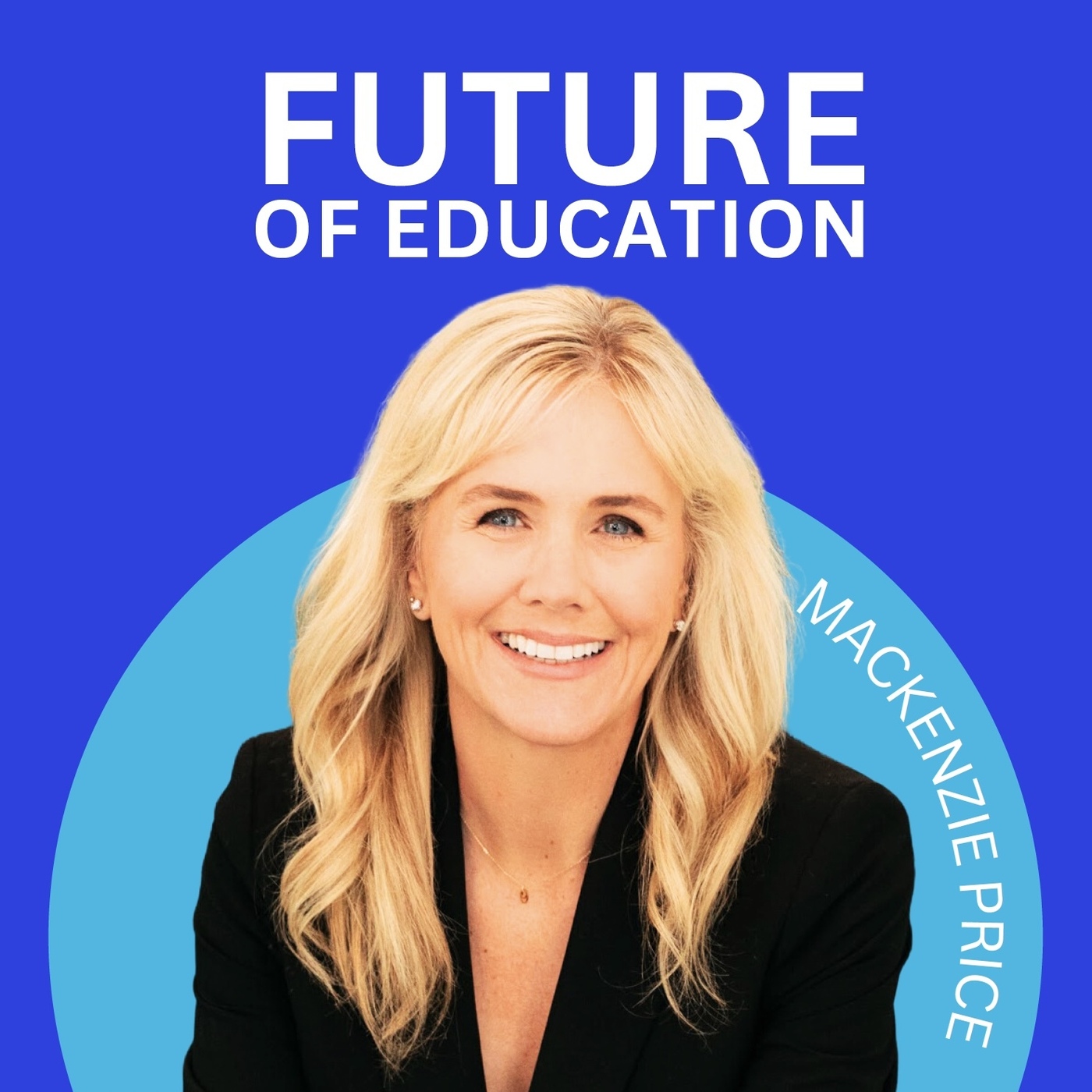
Our host, MacKenzie Price, is the Co-Founder of 2hr Learning (2hourlearning.com) and some of the top-performing schools in the country. 2 Hour Learning is a groundbreaking school model that is reshaping the landscape of K-12 education. It's powered by AI technology, enabling schools to provide personalized curriculum to students. Our K-12 schools perform in the top 2% nationwide by leveraging this personalize model to help students love school, learn twice as much, and build life skills. MacKenzie is at the forefront of educational transformation, striving for a balanced and enriching learning experience for every child. She graduated with a BA in Psychology from Stanford University and resides in Austin, Texas, with her husband and two daughters.
The Future of Education podcast is produced by 7 Lyons Media (7LyonsMedia.com). Please send press inquiries to mkp@2hourlearning.com.
29episodes
Episodes
Newest firstAll episodes
S E345: "I'm Not Smart": How Identity Labels Trap Our Kids
4w ago00:30:09Tap to summarizeWhat happens when a child decides by the first grade that they simply aren’t the "smart" one?When Elle brought home a family portrait labeling her sister as smart and herself as dumb, her teachers and parents feared she had already been put in a box. But an unconventional school model and a tactical "confidence anchor" completely flipped her trajectory.Now a graduating senior, Alpha Valedictorian Elle joins MacKenzie to share her incredible journey from struggling student to history-making researcher. She breaks down the exact psychological shifts that unlocked her potential, the reality of building a massive teen dating app with AI, and what happened when she hounded a top scientist to run a study that is now up for publication in the world's leading scientific journal.
Transcribe →S2E344: Does AI Belong in a Montessori Classroom?
4w ago00:31:58Tap to summarizeMany Montessori apologists decry the use of AI in the classroom, claiming this type of technology is harmful to the learning experience. But our latest experiment actually proves the opposite. We just opened Montessorium, a school that combines the learning technology of Alpha Schools with the classical Montessori method of teaching. Anna Smiley, Lead Guide at Montessorium, joins MacKenzie to break down the real-world results of this model so far—and how AI can actually enhance, not replace, child-led learning.
Transcribe →S2E343: The "Pay to Read" Method (+ 4 Other Unconventional Ways to Raise Bookworms)
Jun 3000:10:04Tap to summarizeIn an era of instant dopamine hits like TikTok, YouTube, and ChatGPT summaries, getting a kid to crack open a book feels like a losing battle. But it doesn't have to be!In this episode, MacKenzie breaks down the exact strategies used to build high-agency, avid readers—including a highly controversial, hyper-effective, science-backed weapon: paying kids to read.For parents who want to build a lifelong reading muscle in their kids, this episode's 5 easy strategies are a great way to get started this summer.
Transcribe →S2E342: Why Traditional Discipline Makes Kids Worse: The Behavioral Science You Need To Know
Jun 2700:26:37Tap to summarizeTraditional discipline punishes disruptive students by isolating them. But bad behavior is actually just a data point.In this episode, I sit down with Matt Shenker—a licensed therapist, the Lead Guide at Alpha Scottsdale, and a behavioral science expert with years of experience specializing in ADHD. Matt breaks down a massive systemic flaw: the education system doesn't have a knowledge gap when it comes to behavior management...it has an implementation gap.This episode is a goldmine for any parent or educator who deals with challenging behavior (hint: it's all of us!), offering extremely practical shifts that truly change how we achieve positive growth.
Transcribe →S2E341: When Your Middle Schoolers Pitch You a Podcast Episode, You Say Yes
Jun 2400:21:16Tap to summarizeThe story of how today’s episode came to be perfectly illustrates student agency in action: An email from one of our GT School students, Everest, popped up in my inbox asking to come on the show.She wanted to teach our audience the exact tools and techniques her first-year team used to absolutely crush it at the National Quiz Bowl Championship—placing in the top 100 in the country despite having one of the youngest average ages in the entire competition.Because we back student agency 100%, we headed straight to the studio. In this episode, MacKenzie sits down with the entire GT School Quiz Bowl team to break down how a group of rookies out-thought legacy teams that have been drilling for years.
Transcribe →S2E340: We Hired Our Student (From Video Game Obsession to Tech Founder)
Jun 1900:29:39Tap to summarizeMost schools expel students for hacking their network. We gave this one a job.In this episode, I sit down with Austin, an Alpha High junior who did the unthinkable: he successfully hacked into our academic platform, completely redesigned it over a weekend, and now manages a team of six adult software developers to build a brand new AP exam EdTech tool.Austin's journey began as a typical video game-obsessed kid. But following his passions, affinities, and talents led him to somewhere remarkable and unexpected. If you want to know what happens when you stop underestimating teenagers and start giving them real autonomy, this conversation is a must-watch.
Transcribe →S2E339: The Pygmalion Effect: 8 Rules for Raising Limitless Kids
Jun 1700:15:48Tap to summarizeMost parents love their kids, but far fewer truly believe in them.In this episode, Mackenzie breaks down the Pygmalion Effect, a powerful psychological phenomenon proving that children will quite literally grow or shrink to fit the expectations we set for them.If you want to intentionally raise the ceiling for your child, stop building comfortable cages around them. Tune in to learn the 8 core principles every parent needs to live by to unlock their child's true, self-driven potential.What we cover:Why casual phrases like "he's just not a math kid" become permanent psychological shackles.The 1968 classroom experiment that proved belief alters academic reality.The 8 "rules to live by" for raising autonomous, motivated, and resilient children.
Transcribe →S2E338: Debt-Free Paths to Six-Figure Careers with Hannah Maruyama (Part 2)
Jun 1100:29:32Tap to summarizeWhat are we actually paying for when we write a check for higher education? Is it the elite network? The critical thinking skills? The chance for our kids to meet a future spouse?In Part 2 of this eye-opening interview, Mackenzie continues her conversation with Hannah Maruyama, the founder of Degree Free, to completely dismantle the remaining nostalgic myths surrounding the college campus. Hannah drops a series of shocking industry statistics—from a critical thinking test that 45% of colleges failed, to the reality that 25% of college professors are on welfare benefits.But it’s not all bad news. Hannah shifts the conversation to the incredible, high-paying blueprints available right now for young adults willing to skip the system. From tuition-free watchmaking at the Rolex Institute to remote tech paths that scale into $250k roles within five years, this episode provides the exact roadmap parents need to help their kids launch successfully into the real world.
Transcribe →S2E337: The $100K Mistake: The Case Against College (with Hannah Maruyama)
Jun 1000:30:28Tap to summarizeHigher education is an $848 billion industry, and families are falling into the default trap of buying degrees that don't match the modern job market.In this episode, Mackenzie sits down with Hannah Maruyama, the founder of Degree Free. Hannah has helped over 18,000 families dismantle the "one-size-fits-all" approach to post-grad paths. She breaks down how only 6% to 10% of jobs in the U.S. actually legally require a degree, and why traditional K-12 schooling has turned into a marketing funnel for universities rather than a place for actual education.Tune in to learn how to help your teenager reverse-engineer a successful career based on the life they actually want to live—without the unnecessary debt.
Transcribe →S2E336: 4 Summer Strategies for Real-World Growth (90s Inspired)
Jun 200:17:44Tap to summarizeSummer is right around the corner, and as parents, we always find ourselves in the same debate: How do we keep our kids growing without making their break feel like summer school? In this episode, Mackenzie breaks down four practical, low-pressure strategies to build a genuine culture of learning in your home this summer. Plus, this episode is packed with tangible, actionable examples designed to teach your kids autonomy, resilience, and curiosity. Like letting your kids completely navigate your next family airport trip or starting a weekly "failure report" at the dinner table. Tune in to find out how you can build a family culture of learning this summer.
Transcribe →