← Future of Life Institute Podcast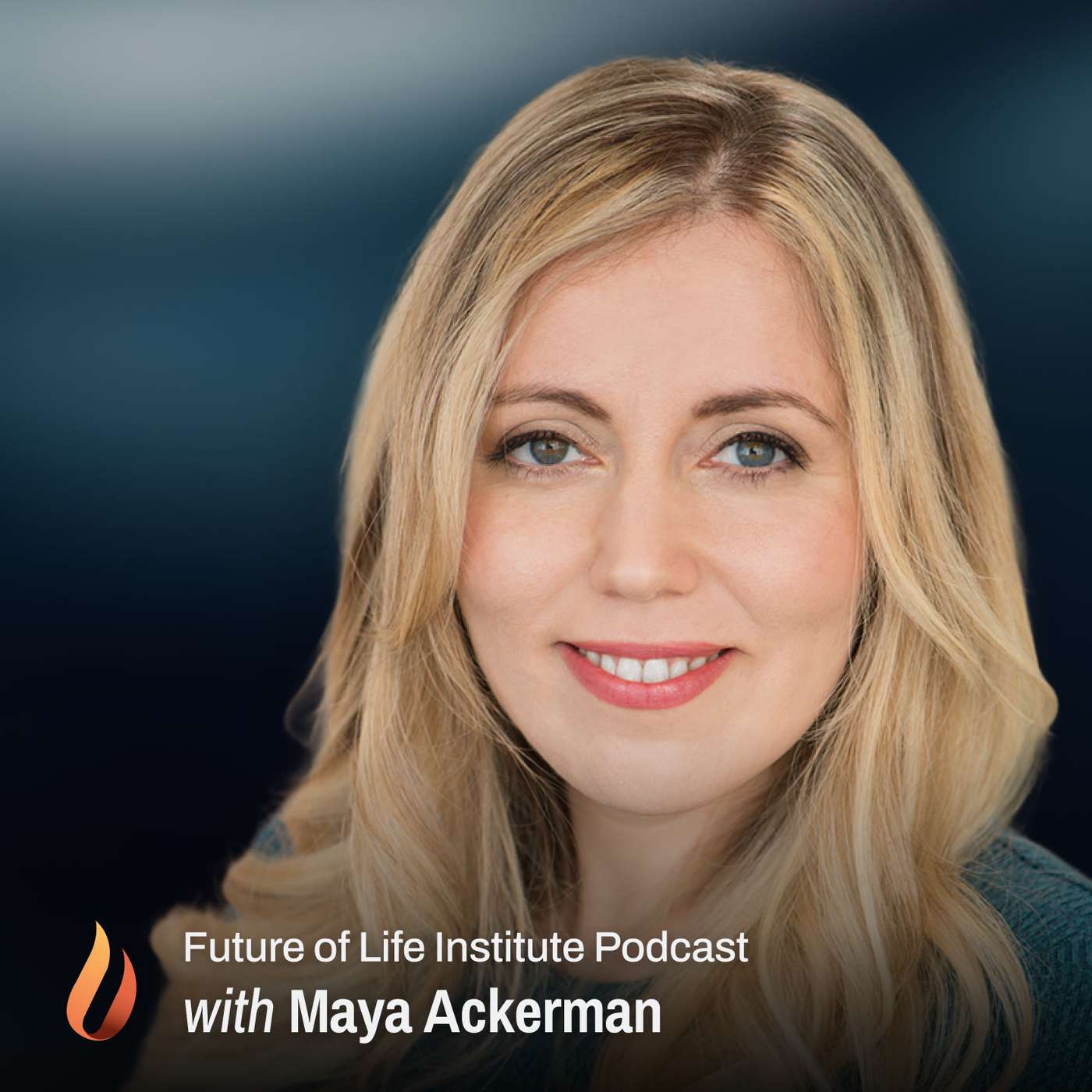
Loading summary
Transcript124 lines
- [00:00]
Maya
This whole idea of tying together intelligence, creativity and consciousness is part of this rather desperate effort of humans to prove to themselves over and over again that we are the most wonderful, the most important beings in this universe. And I really think we need to stop and instead look at what is and try to face reality and accept our role within it, whatever it happens to be. I think evolution beats all of us, but blows all of us out of the water. Blows AI out of the water. Creativity is hallucination. The fact that we hate hallucinations so much reveals a lot about our culture. It doesn't have to be addiction. We can have the goal of elevating humans. People need to believe in themselves now more than ever. We are going to see over time, over the next decade, this amazing improvement in human intellect and human creativity because of this elevation with AI. Not replacement, but real elevation. Humans becoming much better, much more capable because of AI. And that's what's going to keep us in the running.
- [01:00]
Podcast Host
Maya, welcome to the Future of Life Institute podcast.
- [01:04]
Maya
It's so great to be here. Thanks so much for having me.
- [01:08]
Podcast Host
Could you tell us a bit about yourself?
- [01:09]
Maya
To start with, I am a computer science and engineering professor and founder of one of the earliest gen AI startups, Wave AI. And in my free time I also make music and art.
- [01:24]
Podcast Host
This is actually what we're going to talk about today. The main focus is creativity in humans and machines. How do we define creativity? Where do we start?
- [01:34]
Maya
There's actually a surprisingly straightforward definition for this seemingly elusive concept. Creativity, a creative thing, something that was made is creative if it's novel and valuable for its context. So a piece of art, of music might have aesthetic value, people might enjoy them, whereas a meal needs to taste good, a movie needs to be interesting. But those two fairly simple components allow for a rich definition of creativity.
- [02:09]
Podcast Host
And maybe say a bit more about those two components, especially the first one. Why is it important for some something to be novel, for it to be an instance of creativity?
- [02:21]
Maya
Well, if it's just a small perturbation of something that already exists, we don't tend to appreciate that quite as much. Then it's. Then it might still be work, it might still be valuable in some sense. You know, a copy of Monet's art on someone's wall offers some kind of value, but the person making it, we typically wouldn't consider them as creative, at least as somebody who could create something brand new. Now, novelty itself just like value. Complicated, right? Because how novel is something? A new art form is much more novel than a New painting. Nevertheless, it's a helpful guide.
- [02:58]
Podcast Host
Yeah, perfect. All right. How do we think about machines that are creative? How do we measure creativity in machines if we can?
- [03:10]
Maya
Well, this definition with novelty plus value, it doesn't focus on how you got there. It just says that we managed to produce something novel and valuable, which is kind of cool because it's sort of agnostic to your process. And as a result, if a machine is able to reliably produce things that are noble and valuable, then we sort of benefit from admitting that it has creative capabilities rather than closing our eyes and saying, it's not human, it's not creative. That's it. Period.
- [03:46]
Podcast Host
Yeah. And so you distinguish between a creative process and a creative product. And it seems to me that perhaps we can agree that machines might be creative in the sense that they can create a creative product, but do we think that they can engage in a creative process? It seems that they perhaps lack the feelings of producing something while they're producing it.
- [04:12]
Maya
I'm so glad you asked that. If something is able. If a process of any kind is able to reliably produce creative things, then it's a creative process. So, for example, actually, one of my favorite examples is evolution itself, or for that purpose, any process by which people believe that we ended up with flowers and plants and animals and all the wondrous things that we have on this planet and beyond, which are unambiguously creative, incredibly creative. Way more creative. I'm sorry, than anything that humans have ever made. And so if we say that that process is not creative, then what does it even mean? It loses all value if a process that leads us to creative outcomes consistently is not considered a creative process. But then the whole notion of a creative process is meaningless. It's vacuous. Then we're just married to whatever humans do, and then we're just using the word creativity to feel special. We're no longer kind of scientifically looking at it at all.
- [05:20]
Podcast Host
So you would describe evolution as a creative process, but in evolution, it seems like there's no. I mean, there's no designer. There's no mind actually trying to get to some goal. It's mutation and selection. But the mind is not necessary for it to be a creative process for you.
- [05:40]
Maya
Of course, if it works, it works, right? If your developer, if your employee of any kind consistently creates amazing work, are you going to go and yell at them that they're not doing it the way that you're doing it? And so their work doesn't count? It doesn't make Any sense. This whole idea of tying together intelligence, creativity, and consciousness is part of this rather desperate effort of humans to prove to themselves over and over again that we are the most wonderful, the most important beings in this universe. And I really think we need to stop and instead look at what is and try to face reality and accept our role within it, whatever it happens to be.
- [06:25]
Podcast Host
If we go back to the question of whether we can measure creativity, it seems that now we're talking about creativity in a very broad sense. So evolution is a creative process. Humans are creative. Machines can be creative. What are. Is there something. Is there something that these processes have in common that we can measure? So we can say, okay, evolution is creative to such and such degree, and humans are creative to. Is there like a scale we can put creativity on?
- [06:56]
Maya
Measure by the output. I think the only way you can meaningfully measure creativity is by the output. Anything else about a process, it's just whatever it needs to be. Humans really like to measure things by how they do things. It's called anthropocentrism. It began with us believing that we're literally the center of the entire universe and the epitome of anything that could ever be created, which is cute, but has been proven to be false in so many, on so many different levels. And so the fact that we need emotion to be creative and our creativity tends to be very intent focused is interesting. And it's valuable to understand that from a human lens to help us be more creative. But we shouldn't be applying those same measures onto other entities that consistently make creative output.
- [07:54]
Podcast Host
But you say we can measure it. What are we measuring when we're measuring the creativity of some output?
- [08:01]
Maya
I think that there's a lot of subjectivity in this inherently. So when it comes to evaluation, kind of evaluating a creative thing is a massive direction of research within computational creativity, which existed for a decade before the Genai boom. And we sort of acknowledge that a mathematical formula, while sometimes helpful in specific context, is not really a holistic way to measure creativity. So sometimes you can look at it from a social lens. You can look at the critics and the general public as two measuring points. And that also admits that in human culture, creativity is sometimes a matter of opportunity, right? It's a matter of connections. So it's this complex social thing. There are many, many other ways of looking at it. But this is kind of one extreme. One extreme is a formula which sometimes apply within an algorithm. We measure art using a formula so that we can create better art to the machine. And in the other extreme, you can kind of look at the social fiber of creativity and there's a lot of other possibilities too.
- [09:12]
Podcast Host
So would you propose any specific measure of creativity specifically? Do we have tools from computer science that we can use to describe or measure creativity, like compression, for example?
- [09:26]
Maya
You can in some cases, I've seen compression used within our algorithms for Lyric Studio. You know, before we give people any lyric suggestions, we have our own internal way of measuring how good it is. And then of course we see whether this, whether things get picked or not. But that's very, very specific to our very specific system. So unlike the definition of creativity, which I just kind of could right away, right away, very quickly give you a definition when it comes to measuring creative output, output and its quality, there isn't the kind of this simple universal guideline for it that applies across all domains.
- [10:07]
Podcast Host
But you mentioned evolution as a creative process. What about animals? You write in your book about how animals can be creative and how this can help us see that perhaps we're not that special. So how can animals be creative?
- [10:22]
Maya
Or maybe you can help us see that animals are very special too. The flip to what I said earlier.
- [10:29]
Podcast Host
Yeah, yeah, yeah.
- [10:31]
Maya
I love animals very, very. And nature and all of that. And I think, I think it's amazing that the bower bird, in order to attract mates, creates these amazing nests. And the aesthetic value of the nest is what is used to attract a mate. And those birds are really, really creative in the sense that they also integrate, integrate human made objects. It's not entirely nature made nests. If humans leave behind little pieces of glass or plastic, they might integrate them in really cool ways into those creations. That's really cool. We also have a lot of evidence of intelligence which overlaps with creativity amongst various animals. Like dolphins educate their young, of course, various primates exhibited all type of tool use and intellect. And in some ways, some of the social behavior exhibited by animals is sometimes more cooperative than humans in some ways. And I think there's a lot we can learn there too. I think it's beautiful that animals can be creative and intelligent and that we're not alone in some of those capabilities, even if it doesn't manifest exactly the same way.
- [11:53]
Podcast Host
I'm super interested in whether we can develop a universal measure of creativity. And you mentioned this is not as easy as giving a definition of creativity. But do we have any signs of progress on such an endeavor?
- [12:11]
Maya
Gus? I think it's inherently subjective, right? We can have two paintings and I can have a measure that tells you that this one is more creative. And picture A is more creative than picture B. But you prefer picture B. Right. So it almost. There are kind of inherent limits to how much you can formalize this.
- [12:30]
Podcast Host
Yeah, yeah. All right, I can accept that. So it's not perhaps like intelligence, which we might be able to compare between animals even. There are. There are huge differences there. But we might be able to compare between different animals, between humans, and perhaps even in some abstract sense we can describe evolution as an intelligent process also.
- [12:53]
Maya
Well, I think evolution beats all of us. Blows all of us out of the water. Blows AI out of the water on.
- [12:59]
Podcast Host
Long enough timescales, I'm guessing it's just very slow.
- [13:03]
Maya
Yeah. I guess in that sense we have an advantage. It's not a complete one to one when it comes to human and machine creativity. It's not one to one. I think I kind of understand what you're getting at right now. But with animals, for the most part, I think we can say that we're more creative than other animals.
- [13:18]
Podcast Host
Yeah, yeah.
- [13:19]
Maya
Because we're just broader in the way that we're creative. We can be sort of more productive. Like you were talking about speed. We can go deeper. If you look at human creative outcome versus creative outcome of virtually any animal, I believe that we would have an advantage there. But that's okay, right? Admitting that animals are creative even in light of us being perhaps much more creative. That's all right.
- [13:44]
Podcast Host
Yeah. Do you doubt that machines will become more creative than us?
- [13:50]
Maya
I think that machine creativity is different from ours. I think it's not the straight line of better than us. One of my favorite examples, it really shakes things up is around text to image models. So text to image models are kind of one of the most obvious demonstrations of machine creativity. You type a sentence like dancing book and you would get the fullest, most imaginative pictures of dancing books. Especially if you use something that's a little less aligned, like midjourney, one of the system sets where the creativity has not been choked out of the machine.
- [14:23]
Podcast Host
Actually, I'm going to pause you this before you go on with that sentence. Say more about how alignment can damage creativity.
- [14:32]
Maya
Okay, well, let's not forget to come back to comparing that to human creativity.
- [14:36]
Podcast Host
Yes.
- [14:38]
Maya
Alignment was designed in order to take these wild creative beasts, these wild machines that literally just predict stuff and then agree with their own predictions. Okay. That's how machines create. They're like, I'm going to guess the next word or guess the next pixel. I'm simplifying. But fundamentally how it works. And I'm just going to agree with my own guess. They're generative creative beings and they were applied to almost exclusively creative applications before the big AI boom. The big AI boom comes and investors, along with their favorite entrepreneurs decide that the way that we should apply it is to realize a science fiction vision of the all knowing oracle. Let's replace search. Let's turn this wild creative thing into something that consistently tells us the truth. How are we going to do it? We're going to align it. We're going to make sure that it says what we want it to say all the time. They were successful to a pretty impressive degree, but they will never be entirely successful. They will never be entirely successful into creating an all knowing oracle, because an all knowing oracle cannot exist. Humans disagree with each other on what the truth is in many, many, many, many, many important ways. Okay? In fact, I think reducing things that are actual fact, like if we want a list of things that are actual, concrete, concrete facts that we all reasonably intelligent people agree on, would be not as much as we expect. And also, these machines are very poorly geared towards being fact dispensers. They're not. The fundamental mechanism of how they think is geared more towards creativity. So they're going to hallucinate forever.
- [16:21]
Podcast Host
All right, back to comparing humans to machines when it comes to creativity. Can they become more creative than us? How, how is their creativity different than our creativity?
- [16:31]
Maya
Okay, check this out. So text to image models, right? They generate images really, really fast. And we're like, wow, no human could ever create images this quickly. These machines are going to blow us out of the water. Okay, here's a fact, here is a fact. Human beings on psychedelics, certain psychedelics and certain human beings create images faster with more creativity and more details in their brain than text to image models. A lot of people don't know this, right? We are not, we are not living right now with our brain utilized to our full capacity. And I'm not suggesting we should all be on psychedelics all the time, but it does show us what the brain is capable of. And so actually what we're seeing in these machines is very impressive compared to sort of the standard mindset of a human being. But even in that sense, we maintain a lot of different advantages. We are connected to the real world, we do have our own feelings, we know what we want to express. Whereas the machine, that's the reason we have so much slop. If you just kind of takes what it gives you blindly believing that it's smarter than you, believing that it's More creative. And you uncritically take its output and publish it, or give it as your job or as your homework. It's often garbage because it doesn't have your context, it doesn't know what you're looking for, doesn't have your insight into your specific reality, your specific community, the specific purpose of whatever it is that you're trying to create and expecting you to have. That is absurd.
- [18:02]
Podcast Host
Although you can give it a bunch of context, right? The latest models take I don't know how many tokens as input in the context window. So you can provide, say if you're trying to solve some work or homework tasks, you can provide a bunch of examples of what exactly it is you want. And it does get, it does get better. Like the output does get better from that. But you're saying there's a fundamental limit here or I don't know, it just.
- [18:28]
Maya
It requires your engagement. No, what you're saying is perfect or in exactly the same wavelength here. Give it the context, see what it does. Still doesn't get it. Give it more context. Modify something, write, do something yourself. You know, bring your full self, do something yourself, then let it iterate. And after half an hour or an hour or two, you have something amazing, perhaps something much better than you could have created by yourself. But hey, you collaborated with it, you didn't treat it like an all knowing oracle.
- [18:58]
Podcast Host
This is actually an important point and I think we're going to talk more about human machine collaboration, which is one of the points in your book, which is the point of my book, the main point. Yeah, but you mentioned hallucinations. And hallucinations often have a negative connotation. We are dissatisfied when our models are hallucinating. We don't want them to make up facts. Even a human hallucinating seems somewhat bad because you're not connected to reality. Is it also an important part of creativity to hallucinate?
- [19:34]
Maya
Creativity is hallucination. The fact that we hate hallucinations so much reveals a lot about our culture. If we go back to the industrial revolution when machines, you know, entered the scene and they were accurate and they did things right, and then we wanted humans to do things right and be accurate. And we put them in schools where little kids have to sit on chairs for hours and memorize information. And then there was a big lash back with the romantic era saying humans are not meant to live like this. And now we have machines that dream and hallucinate and create. And I think it gives us a real push to reconsider how we Want to live. If machines are allowed to create, it's like, hey, hello. We wanted to be the creative ones. We want to spend our time creating what is happening. And what's happening is that hallucination, the core mechanism of hallucinating is actually at the core of thought. This prediction, predicting what's going to happen in the next instance, is a form of low grade hallucinations. There's great work by Cessna Neal that zooms into this particular phenomenon. So we are constantly experiencing low grade hallucinations as human beings because we constantly predict what's going to come. And sometimes we're right and sometimes we're wrong, but it helps us function, this sort of constant prediction. And machines, the machines we have today, the AI we have today finally works the same way. And because it works the same way, because it constantly predicts and constantly assumes that its predictions are correct and creates through prediction just as we do. It's a hallucination engine. And it's those hallucinations that make us, that make it so much more intelligent than any AI that we had before.
- [21:17]
Podcast Host
Because it functions the same way that we do. It's sort of creating its own reality and then engaging with it by trying to predict it further. Like in predictive processing, we might look at a scene and then see exactly what it is that we want to see in some sense, because we are trying to achieve a certain goal. So perhaps right now I'm paying much more attention to your face than the background because I want to understand what you are, your reaction to what I'm saying. And you're saying this is also happening in machines, but it must be different, right?
- [21:56]
Maya
Let me respond to that with a couple of stories because I think zooming into this would be really important. When I was in college, I broke up with my boyfriend and I missed him terribly. So anywhere I would go, I would think that he's there. I would mistake other people from far away for being him. And he was this tall, big Russian guy. And I would just keep imagining that I'm seeing him until I saw that I saw him. And the person came closer and closer and I realized that it was a short, dark haired Asian lady that I had mistaken for a big, tall Russian guy. I was like, okay, this needs to stop. So my brain was seeing what it wanted to see, right? And then there was work by a man named Alexander out of Google. And that was back about a decade ago in 2015. And he took their image system and he amplified it. He was curious to see what would happen if you Take an image recognition system and amplify it. And without any intention to make art, he ended up creating the system that would keep recognizing the same object over and over again. It ended up being called Deep Dream. Do you remember these hallucinogenic. Imagine with dogs everywhere. Basically, machines work the same way. They recognize images through prediction. And if you amplify it, you start, you start getting the kind of mistakes that you get, you know, when you miss your boyfriend, but more so when humans are on psychedelics.
- [23:22]
Podcast Host
Yeah. The images from Deep Dream are strikingly similar to some psychedelic paintings, for example. It does make you at least suspect that there's something similar going on. I don't know about the underlying process, but the output, as we discussed this.
- [23:37]
Maya
Is saying, like the human brain on psychedelics is a human brain amplified. The machine brain, that particular image recognition amplified is revealing the fact that the machine hallucinates. It's not an identical process. We have not successfully imitated every aspect of the human brain, but we imitated something really, really, really core here, which is why we're seeing such incredible, unprecedented levels of intelligence and creativity.
- [24:03]
Podcast Host
Is there something missing? Because it seems like the models are not fully able to compete with humans in all aspects yet. So people talk about long context missing, or people talk about embodiment. What do you think is missing right now?
- [24:19]
Maya
Well, embodiment is coming. Monument is coming over the next decade, but it's gonna be real something context is improving. We really only imitated certain aspects of our brain, and computer scientists knew that. We simplified the neuron. We know that the way that connections work in machines, it's not identical to ours. We sort of ended up leaning into what produces better output instead of perfectly imitating the human brain. Granted, there still are researchers that focus on imitating certain aspects of the brain, but my favorite distinction is that the human brain has well known regions. We have a memory center, which I suppose that one the machine does have. But we have things like a language center and a vision center, and different parts of our brain process are better at processing certain things. And that has not been fully utilized or, you know, remotely fully utilized in, in LLMs. LLMs are very specific form of thinking.
- [25:20]
Podcast Host
Yeah, yeah. You think they would do better if they were more segmented into specific regions that were more dedicated to, say, certain limited or narrow aspects of intelligence?
- [25:31]
Maya
Yeah, definitely.
- [25:33]
Podcast Host
And why is that?
- [25:34]
Maya
Because one demonstration of it are agents. Once you start breaking down things into smaller tasks than an agentic system, because it has lots of these components can do it better. But I think that There could be more benefit to mimicking more aspects of the human brain where the thinking processes are actually different and it's not just breaking it down into tasks, but more breaking it down into different forms of thought. So there's a lot of. There's still a lot of opportunity for research and growth. And I'm not saying that industry is going to jump on that right away, but researchers definitely have a lot of work to do.
- [26:13]
Podcast Host
What is a humble creative machine?
- [26:16]
Maya
A humble creative machine is one that does not insist on taking center stage. Think of a brilliant friend. We all have brilliant friends, right? And that brilliant friend, whenever you try to work with them, kind of pushes you aside and wants it to be about them. They know how to do it, so they'll just do it, okay? Because they don't want to share. They don't want to share their brilliance. They don't want to elevate anybody. And we can tell when that happens. And that's the vision through which most of our AI systems were brought to life as a kind of replacement. The AI is a genius in the room. You're lucky if it's willing to take one little prompt from you and then it goes off and does its thing and comes back, and if you don't like it, it's going to restart from scratch. It doesn't want to work with you. A humble creative machine is the amazing professor you had in college, the guru, or the really awesome, brilliant friend you have who'll sit with you, who listen, who'll step back, who'll do whatever it takes as little or as much, in order to elevate you permanently so that even if the friend has to move and you never see them again, you are elevated, you're smarter for having worked with them. And that's the kind of machines we need more of.
- [27:30]
Podcast Host
It's a wonderful vision. Do we need anything else than what we have now, or what else do we need than what we have now to achieve that vision?
- [27:40]
Maya
Well, we just need to have that purpose. Because those two friends, the one that elevates you and the one that always wants to be in the center of everything, might have the same intellect, but they have a different way of relating to you in the world. So it's that relational component. The reason that ChatGPT is successful is because they finally decided not only to improve the machine brain, but to make it interactive with us. You can tell ChatGPT, oh, you didn't quite get that. Oh, can you change this and you can iterate with it forever? Pretty much. And it cares. It cares about what you want. You can tell. You can tell right from using it. You go to a text to image model and if you don't like the hair color of one of the characters it generated, maybe you can manage with inpainting, which by the way, was an afterthought. But if you want it to be, oh, can you make this a little more goth? Like, can you redirect the angle of the camera? Forget it, it's just going to restart.
- [28:33]
Podcast Host
But I think this is actually a problem with text generation too. I will often have the experience of trying to work with the models, trying to get them to do exactly what I wanted and regenerating three, four, five times, trying different prompts and not really getting it. Seems like the model I'm working with is not really getting it. So I think, okay, asking more precisely, do we need a different architecture? Do we need something different than the transformer to get us to a place where we have. Where the models can learn flexibly as you're working with them?
- [29:09]
Maya
Well, let me give you two more examples of actually older systems. Right. So your question suggests, do we need something more complicated in order for it to be humble? Actually, there was some stuff that existed before that was already humble. So it's more of a mindset that we need to integrate. And yes, sometimes it's relevant to training, but it's really not a matter of a big breakthrough. It's a matter of intent on the developer side, on the investor side. So, okay, here is one of my favorite stories. This was a couple of years before the rise of Genai. Actually, it was four years before the rise of Genai. I was at a conference and my friend and colleague Robert Keller was there with his system improviser. It was a little, not very heavy model that was attached to a piano, to a little keyboard. And I started playing with it and I would play a little bit of piano and it would respond, it would trade with me. It's called trading. And this was my first ever successful piano improvisation session of my entire life. It played with me, it responded to me, and I actually permanently became a better improviser as a result of using that system. A system that did not boil any oceans, that did not have millions of parameters, but that the design was intent of elevating a human being. And then in my own product, Lyric Studio, which we built from scratch, not using any of these massive systems, we have people telling us that they become better pen and paper songwriters, and some of them stop using the system. They stop paying for it. And some of them keep using it because they still find that it's helpful to them even as they improve. It doesn't have to be addiction. We can have the goal of elevating humans.
- [30:50]
Podcast Host
Do you think there's a divergence between the incentive of the companies, which is to have people paying for and using the models, becoming reliant on the models, and then perhaps what is in our best interest, which is something like you described, learning with the models becoming permanently better at what you're trying to achieve. Is it the case that the machines won't be humble because it's not in the interest of the companies to make them humble?
- [31:20]
Maya
I think that that's how a lot of investors and entrepreneurs understand it. They want addiction, they want to serve you. The all knowing oracle that would make you reliant on them. That's the old model. But the truth is that in that effort a lot of them end up creating one hit wonders. Experiences that are so shallow and so devoid of caring about us and what we want that we don't come back to them at all. And so ChatGPT I think is a pretty good example. It kind of plays on both fronts, to be fair. But I believe firmly that one of the main reasons that it is successful is because it can be used in deeply profound kind of collaborative ways that have made people better writers. If you use it, it can make you a worse writer if you think of it better than all knowing Oracle. But it can actually make you permanently better. It can expand your vocabulary, it can show you new sentence structures you have not considered. And a lot of people who are heavy users of ChatGPT kind of power users use it as a humble creative machine. And it's the most successful product, tech product of all times by many measures. There is a very powerful precedent for humble creative machines that I think somehow gets missed by the industry.
- [32:35]
Podcast Host
I agree that perhaps the best users, the people who are best at getting everything out of the models, are using the models in that way as perhaps a humble partner to create something great. But I think a lot of people say you're in high school, there's a strong temptation there to just hand off your essay writing to a model and just accept whatever it outputs and that's it. And there's not much cooperation between you and a machine. And the machine isn't humble. It's acting like an oracle to provide you something that's probably mediocre, but maybe better than what you could do in the same amount of time. Isn't this a temptation we will increase in your face.
- [33:19]
Maya
It's like we have two sides to this, right? On the one hand, it can make us much better. On the other hand, it can make us much worse. And incredibly enough, it's in our hands in a sense that it's how we choose to interact with it that dictates this. I think people need to believe in themselves now more than ever. Yes, we're not the center of the universe. We're not the only creative entity, and we're not even the only very creative entity. We now have machines that are also creative. And it's unsettling. But that should not be a reason to give up on humanity, to give up on our brains, to sort of set our brains aside and just use ChatGPT with our eyes half closed. This is a time to push ourselves, to see how much further we can go to prove to ourselves that, you know, to stop worrying so much about how machines are going to be in the future and to prove to ourselves that right now we're still smarter and more creative than our machines and that we need to bring our full selves to those interactions. Because it's what's killing us is a mindset, not even the reality. It's like the fear and delusion.
- [34:22]
Podcast Host
Yeah, that may be the case, although I'm afraid that there might actually be something to just AI becoming better than us across the board. Do you worry that we won't be competitive and say, 5, 10, 20 years?
- [34:39]
Maya
I don't believe that that's what's going to happen. I think we're very, very attached to the science fiction model, to the point where no matter what happens with AI, we always think that we're about to be completely unnecessary and we're about to be overtaken. And by the way, it's going to kill us all, because that's what sci fi has been pushing for so long. And I'm not saying that what we have right now isn't amazing. I'm a big lover of AI. I think it's phenomenal. I think it's brilliant. I think we need to concede to the fact that we're not the only creative species. But that doesn't make us useless. It doesn't mean that we're going to be overwritten. And also we have not reached our potential. The fact that on psychedelics were more creative than machines that we have today by far, in very concrete ways, shows that the human brain is so much more than we're aware of today. What makes us think that we reach the pinnacle of human intelligence when, if we look 200 years ago, there's such a massive gap, we're nowhere near our capabilities.
- [35:37]
Podcast Host
Do you think so? You mentioned that we have some sort of control over how we use AI and how we interact with AI and how we cooperate with it, as opposed to just attempting to rely on it as an oracle. But do you think. I mean, the counterpoint to that is some form of technological determinism where it seems like we are discovering things, that there are enormous economic incentives pushing us in certain directions. If OpenAI does not make a certain discovery and implements it in the product, well, then DeepMind or Meta or Anthropic will do so. And it's not clear to me that this technological development is always going to land in a place where humanity is uplifted rather than replaced or something worse.
- [36:30]
Maya
The bad stuff is already happening. Right. Like it's. While I believe in humanity and our capacity to stay ahead, in many ways, the dark side of AI is already being played out. Young people, smart, very, very capable young people are having trouble finding work en masse. Right. Tech has seen massive layoffs. Certain jobs are going to disappear completely. That's because the people behind the technology, the people funding the tech, largely have a replace of model on how to make money on AI, against the fact that humans want to collaborate, users want to collaborate with AI, and the people funding the tech want to replace those people. And so we are going to see a lot of that, not because it's inevitable, but because that's what the powerful people want. Despite the fact that it's completely logical you replace all human workers, who's going to buy your products and services? What's the plan here? But they're just so used to this way of thinking that they can't. They're not realizing that they're running all of us, including themselves, off a cliff.
- [37:42]
Podcast Host
Maybe the AIs will sell to other AI companies.
- [37:46]
Maya
The AIs will be switching money. Actually, yeah.
- [37:50]
Podcast Host
In the AI economy, you could imagine just if you begin replacing workers, well then say an AI specialized in engineering will purchase something from an AI specialized in another field. And this is like a full vision of replacement, where suddenly or gradually the AI economy is larger than the human economy.
- [38:14]
Maya
Okay, so we only have a small number of people who stay in this economy because they were really wealthy before and they benefited from all of it and everyone else, no one cares.
- [38:25]
Podcast Host
Yeah, it's not a. It's not a glamorous vision. It's not a good vision. Do you think. Do you think it's. It's something we can avoid, though? I mean, why is it that many of the companies seem to be aimed at this? Isn't that just because this is. This seems to them to be the most profitable path.
- [38:43]
Maya
Investors. The reason is investors. Yeah.
- [38:47]
Podcast Host
Okay.
- [38:47]
Maya
Experience at firsthand. I was running a company where our goal was to help musicians, and I was told to my face many times that if I pivot to replacing them instead, then funding becomes. Can become simpler. You know, sometimes it was hinted at, sometimes it was told directly, so I know for a fact where it's coming from. And they'll just find entrepreneurs who don't care to replace people.
- [39:14]
Podcast Host
What do we do about that?
- [39:15]
Maya
I think we need to be very clear about what we want, and I think we need to support companies through our dollars that do that. Take us in a direction that we appreciate. You know, the general population has been sort of manipulated to focus on only one ethical conundrum, and that's don't use our data. This delusion that if we scream that loudly enough, we can halt the whole AI revolution. In reality, don't use our data mostly helps the companies that have large data sets like Universal Music, like book publishers, anybody that has a lot of data that they own the rights to benefits from this, don't use our data because then they get paid. Even if creators never see a penny of this, and if each creator saw $3, that would be such a massive accomplishment. Like, is this really what we should be putting all of our energy into? Instead we should be saying very loud and clear, don't replace us, Build tools to elevate us. Because that would actually have meaningful impact. And I think the reason that humanity is going to be relatively okay is because those tools are happening. And sometimes it's within the same tool that you have both possibilities. And human plus AI is always going to beat AI alone. So the more we push towards this collaborative path, the harder it's going to be to push us out of the formula.
- [40:36]
Podcast Host
I do worry, though, that, say, you know, humans aren't really relevant in chess anymore. Not if we're comparing human performance to top AI performance. And I think for a time it was the case that a human grandmaster combined with an AI was actually the best and even better than AI alone. But I don't think that's the case anymore. Again, I think this could happen across many industries or many jobs.
- [41:07]
Maya
Chess is really simple.
- [41:09]
Podcast Host
Chess is really, really simple. It's very contained and all of the knowledge is explicit. And yeah, it's just a search space.
- [41:20]
Maya
That eventually became small enough for computers to handle very well. Look, I mean, I understand the fear of the same thing happen across. Happening across the board, but the truth is that not all analogies carry through. There is a story. There are kind of. On the. On the flip side, there are AI optimists that say that no matter what happens, technology. I'm going to kind of make your point in a different way, just to make the point that analogies don't always carry through. You know, this idea that tech always improved human jobs, new jobs emerge, it's all gonna be fine. So there is a parallel story with horses. How it used to be that Porsche had the most tedious, most like annoying job in the world, where they had to go around in circle all day in order to grind certain materials. Horrible, right? Going around in circles all day, every day. Oh my goodness. Then farm equipment was invented and horses got to be forms of transportation for people. They would go around and see all these beautiful scenery and their lives got so much better. And then cars got invented. And of course that means that the jobs for horses should get better too. Except in reality, millions of horses got slaughtered because humans didn't need them anymore. Things don't always translate. Although this particular story is very depressing and it's typically used to demonstrate that improvement in tech for people doesn't necessarily mean better jobs for people, which is also relevant to our discussion.
- [42:47]
Podcast Host
So what's your position here? We can have analogies pointing in both ways, but as you say, they don't always carry through. What do you think about this?
- [42:56]
Maya
I just complicated things by throwing in a different analogy. I think we're going to see both. I'm a little saddened to say that. I wish I could say we can stop all the unemployment and there is a way forward that's really clean and simple. But investors, people who hold all the money, are very, very powerful. And I'm not so delusional to believe that we can stop them. So we're going to have job replacement. It's going to happen. And I really, really, really hope that governments are going to step up and help as this happens. That's really key. But at the same time, we are going to have tools that geared towards elevating humans and we are going to have tools that can be used in both directions, like ChatGPT. And so we are going to see over time, over the next decade, this amazing improvement in human intellect and human creativity because of this elevation with AI. Not replacement, but real elevation. Humans becoming much better, much more capable because of AI and that's what's going to keep us in the running. And it's sort of this tension between these two forces that's going to play out.
- [43:58]
Podcast Host
Yeah, you've mentioned a couple of times that you can have the same tool and then use it differently and have relate to an AI like you would relate to a humble friend trying to help you, or relate to AI like it's an oracle, specifically with the language models. How do you do that in a good way? How do we kind of train ourselves? Is it all on us is what I'm trying to ask, I think. Or could we do something, something on the developer side to make it more likely that you're interacting with an AI in a good way?
- [44:36]
Maya
It's definitely on both. It's definitely on both. Technology is not doing enough to meet us halfway right now. Too many systems are designed to be all knowing oracles. Too much of the narrative is around it being an all knowing oracle, which hinders how we think about it. My biggest push, my biggest ask is IT industry start doing a better job. That industry give us humble creative machines. That industry spend time building the part that interacts with us. I want text to image models that I can iterate with. I want musical AI systems that really, really care about what I want to create and give me as much freedom as possible. That's what I want and that's where things will get because that's what all consumers want. Ultimately, that's what we all feel is missing, that lack of autonomy, that lack of creative control. But at the same time, that's going to take time, right? That's not something we have immediate control over, but we can choose how we interact with existing systems. And the people who are really, really awesome at using AI takes this humble creative machine attitude. They bring their full selves, they're very critical of what the AI outputs, not in a kind of nonsensical I hated way, but in a sense that they actually look at what it creates carefully and critically and they think, okay, what context is missing. And honestly, I find that ChatGPT works best when I do the first draft completely by myself. Sometimes when I spend three days on the draft and then sometimes it's good to just say what do you think? And have it give you feedback instead of having it rewrite. Break it down into small steps. Think about it, really engage, really bring your full self. You can create amazing stuff and don't rush, honestly. AI as time saver is another science fiction Trope. And also kind of a bit of a carryover from previous types of AI technologies. Don't focus so much on saving time and see if you can use it to create something genuinely better than what you could do by yourself and much better than what it can create. It at first attempt, work together for quality, not just for speed.
- [46:46]
Podcast Host
It does seem like there's a big difference between having AI do the first draft for you and then doing the first draft yourself and getting feedback. Using AI as kind of like a study partner, figuring out the flaws in your arguments. It seems like a much healthier way to use the technology. But again, you mentioned there's, you know, consumers want something that can flexibly learn along the way, change to their preferences, give them exactly what they want. I do also think that consumers want whatever is most comfortable, whatever is quickest, whatever is the. The path of least resistance. And so do we have these two kind of clusters of motivations against each other?
- [47:30]
Maya
I don't know. Maybe kids want whatever is easiest and quickest. And even then, that's not completely true. Kids can stick with a game for hours if it's interesting enough. I think a lot of adults want good stuff that interacts with them. I don't know. I think it's a bit of a fallacy. It's a bit of a. Like, almost an not from you. I mean, what you're sharing is a very common perspective, but I think it's insulting to humanity. I think it sort of minimizes us. I don't want something quick and easy. I don't want to press one button and have everything done for me. It doesn't know what I want. How can it. Is it reading my mind? Like, how can it possibly give me exactly what I want from pressing one button? It doesn't make any sense. I want something that improves my work. I want something that lets me express what I want to express. And honestly, I want to be in the driver's seat. And a lot of people do. I've run a company for almost eight years now. We've had millions of users. People want control. We made a tool for them called Elysia, which would sing for them and come up with a melody for them. And he did, like, the universe and everything. And the main thing that I heard is I don't have enough creative control. So it's. I think that industry investors, entrepreneurs, need to maybe respect humanity a little more and listen to their users a little more. Because what they think we want and what we want is not always the same thing.
- [48:54]
Podcast Host
Just to make the pessimistic point in another way. I mean people also want TikTok. People also want. I mean there's a reason why Meta and OpenAI are launching these AI generated video feeds which are, you know, there's a bunch of potential for ad revenue there. And I don't think it's. This is, this is using AI as in a way that's like the path of least resistance. It's very easy to engage with. It's not a very creative thing. It's one way engagement. And you're not really, you're not interacting with a humble creative AI. You're just consuming content. And so this is also something that there's a huge demand for. And so I guess, yeah, now I'm asking the same question again. But what will win out? Right. How do we make sure that the best parts of us win out in the market?
- [49:48]
Maya
So a lot of stuff that's replacement is going to succeed. As I said, like we're not going to be able to get rid of all of it. I just want in parallel the deep profound stuff to also exist so humanity can stay ahead. Right. To counterbalance it. Okay, let's pause for a second on those video generators. Super cool stuff. If you haven't tried it, let's be honest, the quality of video generation is improved. Leaps and downs.
- [50:11]
Podcast Host
Yeah, I should have, I should have said that. I should have mentioned that this is like, this is real technical innovation. This is like the coherence of the characters in the videos. This is not easy to do. This is amazing technical progress. But it does, it just doesn't. I just fear that people will engage with it in, in a way that doesn't uplift them.
- [50:34]
Maya
Okay. And then there's going to be a lot of that unambiguously. So like I'm not here to say that, you know, I'm not here to paint a utopian picture, but if we kind of zoom in a little bit into TikTok, into what's going on with Sora too and where the future potential is. A lot of people are being super creative. A lot of on TikTok today. Extremely. Right. The short form video people are dancing and singing and just like creating these amazingly engaging videos with extreme forms of human creativity to make it happen. Not all of them. There's a lot of slop, a lot of human made slop, but a lot of genuinely amazing stuff. Right. That's the reason the platform is successful is because human creativity is so powerful. It was originally based on by dance. That's what? Which was all about these cool dances that people used to make which eventually became TikTok. So that's on the one hand. On the other hand we have these cool video generators which is kind of a little bit of a one directional, easy creation. Just write something and it'll immediately give you something really cool, which is cute, which is a starting point. But imagine, imagine the same technology getting a little bit better and becoming deeply profoundly iterative so you can make your own short film that realizes your vision. How many people would love that and make amazing things with it. So kind of very similar technology, similar enough can be used to create a whole bunch of silliness, which honestly doesn't bother me. Doesn't bother me. And I know that there are some issues with it, but I don't deny those issues. But ultimately I don't think it's the end of the world if we have a little bit of fun and are being silly. But the same thing can be used for if you make it into a humble creative machine. Oh my God, gone the possibilities.
- [52:21]
Podcast Host
Do you think so? One reason why models are improving so fast when it comes to mathematics and programming is because we have a bunch of training data and we can do reinforcement learning using that data. And it's a domain where we have answers. We know what the right answer is in programming, we know does this compile or not. We know in mathematics, is this a valid proof or not for something like creativity as we talked about in the beginning, we don't have this objective standard. Does this mean that the models will be limited in creativity or that the reinforcement learning paradigm won't work in the domain of creative creation?
- [53:11]
Maya
Machines are creative. These machines are creative inherently. It the underlying mechanism of predicting the next word or the next pixel and agreeing with yourself is creative. This reinforcement learning is used by these systems in order to take a creative machine and turn it into an all going oracle. So it's hard to make it not creative, it's hard to make it behave right. You don't need a perfect definition of right or wrong wrong to make a machine creative. Humans don't have any sort of accurate notion of what creativity is even or what's better or worse creatively. And we are able to be creative all the time, some of us more than others. But nevertheless humans, all humans are capable of some level of creativity that's very non trivial. So yeah, good luck making those machines not creative. Good luck choking out the creativity out of them. That's where reinforcement learning is generally used. The training process underlying Training process does not require a notion of right and wrong with these machines, which is different from the previous wave of machine learning, which where every single data point had to come with a label.
- [54:27]
Podcast Host
So what you're saying is, if I understand you correctly, as we get more reinforcement learning, we get less creativity in some sense, or we are able to concentrate constrain the models much more closely to the exact output we want.
- [54:42]
Maya
For the most part, the way it's used, kind of the major goal of reinforcement learning in today's LLMs is to make them behave, to make them do the right thing. You have this imaginative model that got trained on all of human data. It's marvelous. It hallucinates a lot. It's this cool, awesome thing. And then they're like, behave. So yeah, it's not quite the same when we're intentional about creative applications. In fact, by the time you told the machine to behave, behave, behave, behave, then you try to apply to something creative and it's kind of repetitive and consistent and not that helpful for creative things.
- [55:21]
Podcast Host
Do we have a working definition of AI slob? How can we describe AI slob in the times that we've been talking about here?
- [55:31]
Maya
I think that AI slop is humans using AI believing it's an all knowing oracle and kind of being lazy.
- [55:41]
Podcast Host
Okay.
- [55:44]
Maya
I mean that without disrespect. It's okay, you want to create slop, that's fine. You don't feel like bringing your full self, you just want to get it done quickly. Sure. But it's kind of the lowest form of the simplest, let's say, form of using AI.
- [56:02]
Podcast Host
You must see how your students are engaging with AI. What do you think of how they're using AI? What advice do you tend to give them?
- [56:13]
Maya
To be fair, there's a spectrum. There's one particular student that comes to mind. The way that he was engaging with AI is probably the most brilliant use of AI I've seen in my whole life. Like you would come up with like new philosophies using the AI systems. It blew my mind. So there definitely are students who are ahead of most working adults in how they're thinking about AI and how they're using it and how they're interacting with it. Unbelievable. Unbelievable. And then there is kind of the opposite side of this deeply ingrained belief that the AI is an all knowing oracle and the student has nothing to offer. So there was this really challenging case where I had students come up with ideas for a project, which is something I've been doing for years, and Years and years, you know, they need to come up with a project with their own original idea for a project. And one student insisted on doing that with Chachikati. And you can, could tell that the ideas were made with ChatGPT and they weren't very good. And I just couldn't get him to take, I couldn't get him to think by himself without ChatGPT. It was really, really bizarre, really new for me. Like I was not prepared for this. And also there were a whole bunch of projects that I used to do for years where I realized that students were finding ways to use ChatGPT for it. They were sort of. Our students are caught in a really difficult place right now where everybody around them cheats. If they don't cheat, they risk having lower grades. So they're not necessarily excited to even use ChatGPT to cheat. They almost feel that they have no choice. And it's really up to the education system to adapt. And we're doing our best, you know. And you know, my university I think is doing a phenomenal job adapting to it. But it's a, it's a global problem. Right? It's not something that's just facing us. But we'll figure it out. We'll figure it out and we'll get there. We're gradually making a lot of good progress on how to make sure that students still get a really good education. When the temptation to use AI is, you know, is overwhelming, is this just.
- [58:25]
Podcast Host
About raising the standards? So trying to make assignments harder and then say, then accepting that students will use models to solve the assignments, that's.
- [58:37]
Maya
Part of the approach. Sometimes that's appropriate, sometimes you can't. Sometimes you need them to learn a basic skill. It's very, very complicated if I'm really honest. It's one of the biggest challenges is to education where we're given no heads up. We're kind of off grown into it and I think we're really navigating it together with our students and it's important. The main thing I want to contribute to this line of thought is not to blame the students. Students, the students are faced with this reality. No individual student can do very much about the reality around them and how everyone else behaves. The system, the old system rewards using ChatGPT. So things need to be. And you can't constantly look over your student's shoulder as well. And you can't over punish them for something that everybody's doing. It's very, very, very complicated. And I think educators are doing a phenomenal job navigating a virtually impossible situation.
- [59:34]
Podcast Host
From the student's perspective. It must also be discouraging to say you're trying to learn new math, which is a process of just constantly getting the wrong answer and trying again and again and again, and then suddenly kind of the answer dawns on you. It must be so tempting to just use a model to solve your math problem.
- [59:57]
Maya
Well, I don't really bring up math because in math we had calculators forever, right?
- [60:01]
Podcast Host
Yeah, yeah.
- [60:01]
Maya
And then we have graphic calculators for some of the more complicated problems. And there are math problems that you can't solve with any of those, but those are usually in post secondary education. So, you know, it's very simple. You just, you know, on tests you're not allowed a calculator, and so you, you make yourself study without that calculator so that you can pass the test.
- [60:20]
Podcast Host
So back to pen and paper, basically, to test whether they actually know what they're writing.
- [60:26]
Maya
And that's actually perfectly fine. Like, calculators did not damage math. Granted, maybe, you know, we don't do arithmetic quite as well as we used to in our heads because of calculators, but that did not turn out to be the end of the world with ChatGPT. It's actually more complicated because of just the breadth of capabilities.
- [60:42]
Podcast Host
Yeah, yeah.
- [60:43]
Maya
It's actually terrible enough, which is, which is ironic. But anyways, it's because the brain is different, Right. It's this hallucinatory brain. It's very hard to reel it in. It's terrible in math.
- [60:53]
Podcast Host
I mean, models were terrible at math like two years ago or maybe three years ago, but now they're basically amazing at a certain kind of math. Like competitive mathematics, for example.
- [61:06]
Maya
Okay, that's right.
- [61:07]
Podcast Host
Because some because of the reinforcement learning.
- [61:11]
Maya
No, but it's also because you can build a specialized model. We've had stuff that was good in math forever. It's not impressive to integrate a model that's good in math into this, but the underlying generative models are not good at it. But now, basically, these companies added a whole bunch of capabilities anyways. I mean, they've done impressive.
- [61:32]
Podcast Host
Yeah. All right. Is there anything we hadn't touched upon that you feel is important to say?
- [61:38]
Maya
I think this was wonderfully comprehensive.
- [61:41]
Podcast Host
Perfect. Fantastic. It was great to talk to you, Maya.
- [61:45]
Maya
Yeah, same here, Maya.
- [61:46]
Podcast Host
Sorry.
- [61:48]
Maya
Thanks so much for having me.
- [61:50]
Podcast Host
Perfect.