← Generative Now | AI Builders on Creating the Future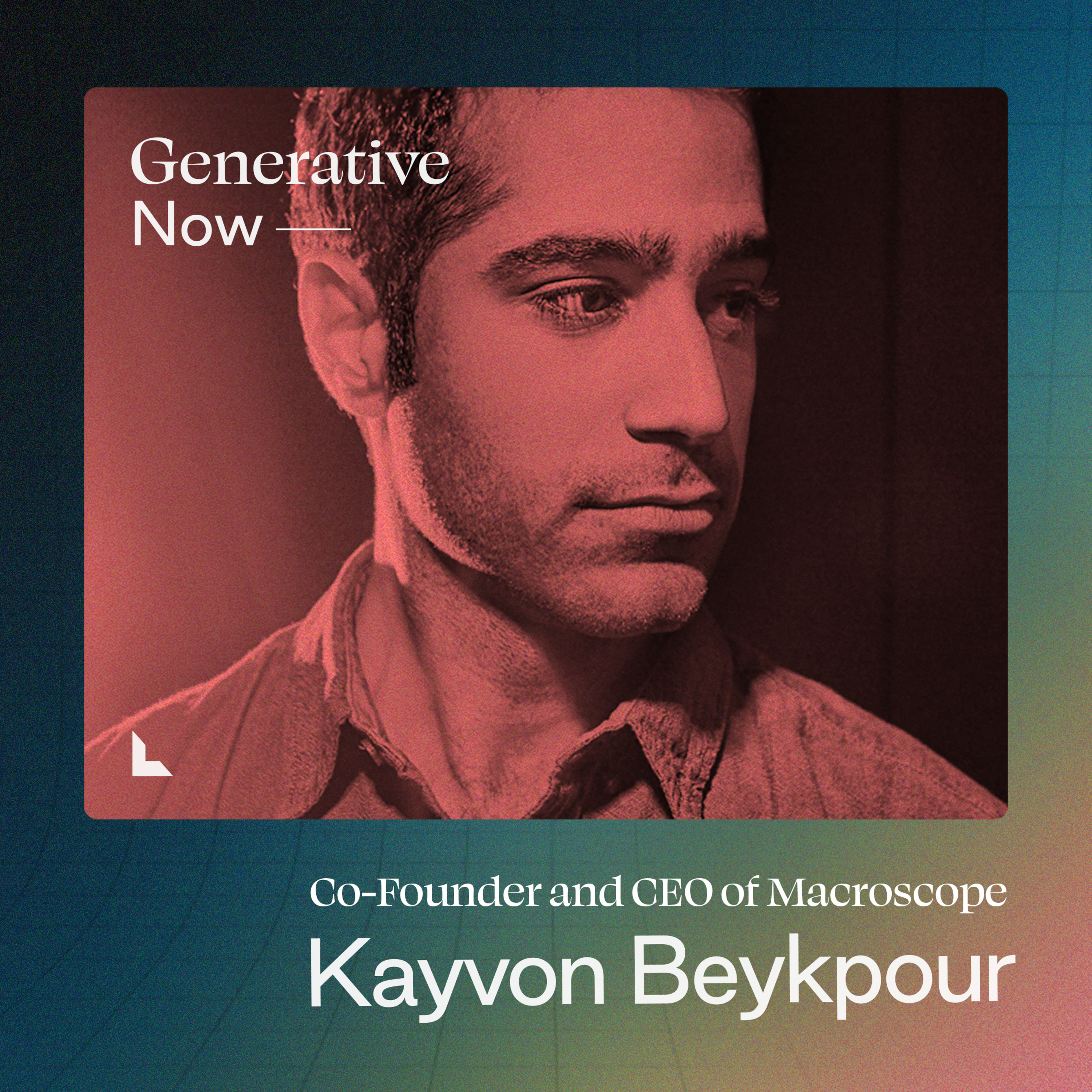
Generative Now | AI Builders on Creating the Future
From Periscope to Macroscope: Kayvon Beykpour’s Vision for AI-Powered Development
01:02:51
Loading summary
Transcript272 lines
- [00:00]
A
Foreign.
- [00:06]
B
Hey everyone, and welcome to Generative. Now I am Michael Magnano. I am a partner at Lightspeed. And today on the show, I have the one and only Kevon Bakepour, co founder and CEO of Macroscope, which launches today. Kayvon, of course, is also the former co founder and CEO of Periscope, which they went on to sell to Twitter where he became the GM of consumer products. We had an awesome conversation today about Macroscope, about Periscope, about Twitter, and lots of things that I'm really excited for you to check out. So listen to this conversation with Kayvon Baker. Hey, Kayvon.
- [00:41]
A
Hey, Mike.
- [00:42]
B
How you doing?
- [00:42]
A
Good, man, how are you?
- [00:43]
B
Good. Thanks for doing this. Thanks for having me. Yeah, very much. I've been looking forward to this. Today is obviously a really big day for you for the company you're building rather than me say what it is. Why don't you share with me and the audience everything that's going on today with this new company you just announced?
- [01:00]
A
For sure. Yeah. Today we're finally excited to unveil to the world a company that we've been sort of quietly building in the shadows. And we're announcing a product called Macroscope. And Macroscope we think of as an understanding engine for companies. It helps leaders get clarity and it helps engineers save time. And really, I think to get into what the product is all about, I think it's sort of helpful to start with the problem that we're focused on solving. I think our experience building software companies over the last 15 years sort of emphasized for us that understanding what's happening at a software company is just really hard and painstaking. And by that I mean understanding like what everyone's working on, how the product is changing, what progress we're making on our priorities, is a very important. Like there isn't a single leader or CEO or head of engineering or head of product that doesn't constantly ask those questions. And B, the sort of state of the art manner in which companies even today solve this problem is just insane. It's meetings, spreadsheets, ticketing systems, emails. It's a bunch of manual, archaic, non sophisticated processes that are ultimately trying to solve one fundamental problem, which is like, what the fuck is happening? Yeah. And we sort of have lived this pain very viscerally having worked at really large companies like Twitter, where very famously it was hard to understand what do we get done this week? And so our thesis with Macroscope is we want to solve this problem with technology, with state of the art LLMs. And the way we do that is, by building Macroscope, which fundamentally uses the code base as the source of truth. So if you're a customer and you want to understand what's happening, you set up Macroscope, we connect to your code base. We also connect to other systems you might use, like Linear or Jira, and we make sense of it all. We use the code base to fundamentally tell a story around how the code base is changing and how the product is evolving and also what everyone is working on so that we can answer all those questions for leaders around how things are changing and what's being worked on and what's not being worked on, while at the same time saving engineers a bunch of time. Because we're automating a lot of the paper cuts that take them a little bit of time 50 times a day. So things like know, automatically writing their PR descriptions, automatically writing their commit summaries, doing automated AI code review to help them, you know, find bugs and fix them faster. These are things that are tremendously important to engineers. Also very important to engineers is not being interrupted, which, you know, if you're a CEO or head of product asking a status question, as happens very often, ultimately that gets answered by an engineer taking time out of their day to go look at some code they shipped, figure out how they answer the question, and then play a game of telephone with some PM who tells an exec, who tells another exec.
- [03:47]
B
I was definitely guilty of that when I was CEO.
- [03:49]
A
We all were. All of that is what we're hoping to solve. I think, sort of stepping back, software development is already changing, right? Like AI has already completely upended how code gets written. And I think over time, as AI agents become more and more responsible for the vast majority of the code that's being deployed at any given company, this problem of understanding what's happening only gets worse. Like, you need this air traffic control system that helps you understand what's happening. And so whether it's Macroscope or not, we think that every company is going to have a system like this, a sort of intelligence layer that helps them get visibility around what's happening. And that's what we're trying to build.
- [04:32]
B
Yeah, it's really, really cool. And you know, I've obviously had a chance to think about this for listeners, for viewers, Lightspeed's leading your Series A. And so, yeah, I've thought a lot about the product. And I think what's really interesting about what you just said is if you imagine this future where there's more and more agentic workers inside of an Organization, AI that are actually committing code or actually designing pixels. Maybe there could be hundreds of these things, maybe there could be thousands, maybe there could be millions. I have no idea. And that's probably going to be really hard to. To manage. Is that kind of how you think about it?
- [05:07]
A
For sure. I sort of think of it from two different directions. One, just the orchestration aspect of that workforce is really difficult. And even sort of pretend like this AI transformation hasn't happened. This is already a difficult problem. Like when we were at Twitter, the consumer team, which was the area that I was overseeing, you know, there are 1200 engineers. It's already extremely hard to understand what 1200 human engineers are doing.
- [05:29]
B
Yeah.
- [05:30]
A
Not to mention to sort of ensure we're leveraging those resources in the right way. And so absent all the AI advancements that we're now, we have the luxury of now being surrounded with. This is already an extremely hard problem. In a world where you have a human engineering team, plus this sort of unbounded agentic software resource layer. Yeah, it becomes very hard to orchestrate and sort of understand ultimately humans are accountable for the product. Like, however much AI you're using, there are human beings that are still accountable for the things that are being shipped. And so it behooves you as a team, as a leader, to understand what's happening. Yeah, that's sort of one angle that, you know, I think Macroscope is quite helpful. The other angle is that if you are going to deploy AI agents to sort of make your, you know, write more of your code, make your product better, my thesis would be, and I think sort of how we're thinking about Macroscope is the system that's going to be best at augmenting your product and developing your code is going to be the system that understands the most context about how your code base works, how your product works. So if you imagine the actual models become more commoditized, all these models are competing to be the best at writing code. That's going to happen. That's one layer. And then the other layer is just the context engineering that goes into all the operations that people are using these models with. And I think the underrated thing that we haven't seen as much innovation around recently is like, what context can this product or this model bring about the product itself and about more sort of holistically how this code base works. You've seen more of the code base context in a lot of these agentic coding tools, but there hasn't been as much like, okay, what is the journey that this product has gone through, what is the essence of this product? What customer problems is this product trying to solve? And my thesis would be the more this intelligence layer, this orchestration layer, understands about that history, about that chronology, about that essence of a product, the better it's going to be at, you know, helping understand what we should build into the product and how we should build it to align with the customer problems we're solving. So I think that's an A layer to this feature that we're super excited about, that I think is underrated.
- [07:46]
B
Yeah. So I think everyone for a couple of years now has thought so much about how AI will give ICs individual contributors leverage. Right. And clearly, you know, Macroscope is also going to do that through the code review side. But one thing we haven't seen or heard, or at least I haven't thought much about, is how it's actually going to give leverage to or potentially eventually replace kind of the manager side. And there seems to be an element of that with Macroscope where, yeah, this thing is sort of like you said, air traffic control for all the agents, initially humans, eventually agents. I mean, is there a world in which we finally get to get rid of the annoying middle management layer that everyone despises?
- [08:32]
A
I'm extremely bearish on middle management, always have been. I think what's happening now sort of, I don't know what the right phrase is, whether it seals the deal or just shines a light on how inefficient and senseless those roles, or at least the things that those roles usually spend their time doing are silly in today's world. I'm less a subscriber to the belief that like, you know, leadership is dead, like AI is going to replace CEOs. I think that what we are fundamentally trying to build is an empowering tool for leaders. Right. Like, you know, one of the memes everyone always talks about these days is, you know, going founder mode. And it's like incredibly rewarding and exhilarating and powerful to sort of operate in founder mode. But it's also painstaking and exhausting and like taxing because like to walk the factory floor, so to speak, as a founder is time consuming and like you're raw dogging it the old fashioned way. Right. And I think, I sort of think of Macroscope or at least the leadership aspects of what we've built with Macroscope is it lets you founder mode and peace, like you can way more efficiently understand the ground truth of what's happening and be, well, more Way more informed around, like which part of the factory floor do you actually want to walk? You know, and you can come into that factory floor, walk about with like a bunch of questions already answered in your mind because you've interrogated the source of truth, which is the code base. And so I think that's going to be actually incredibly empowering for any leader that already has the instinct of wanting to go, you know, tackle issues that are plaguing the organization or fix things that are broken that only they can uniquely solve super efficiently. And I think it's also very empowering for the CEO who's maybe less technically fluent. You know, we see this a few of the customers that we work with today, you know, their CEOs want to fix their organization or make their organization work more efficiently, but they don't have the technical fluency to feel comfortable interrogating the code base or opening GitHub, looking at a diff and being, you know, asking the tough questions around how engineering work is progressing. But I think a tool like this can really empower you in the same way that ChatGPT can empower you to become way more fluent in some thing, whether it's a legal contract you're debating or whatever else. We sort of think of this as like an AI agent that helps you understand your product and your code base.
- [10:46]
B
Right.
- [10:46]
A
And so I think that's, that's all that all makes me bullish on like tools that empower leaders to be better leaders.
- [10:52]
B
Yeah.
- [10:53]
A
But yeah, middle management is cooked.
- [10:55]
B
Founder mode in peace. I like that. Speaking of founder mode, that you are a three time founder, this is your third company you founded.
- [11:03]
A
This is my third company.
- [11:04]
B
Yeah. So you have a lot of experience and we talked a little bit about Twitter and how you mentioned you had led large teams at Twitter. I feel like to fully understand Macroscope, I know we jumped right into it because I want to get right to the news. Like we have to go back a little bit and talk a little bit more about the experiences that led you here. So yeah, tell us a little bit about maybe those founding experiences you've had because I think that's, I think they offer really, really good context and history for this product launch.
- [11:32]
A
Yeah. So first company was your sort of prototypical scrappy startup in that it was, you know, my co founder Joe and I, who also I co founded Macroscope with. You know, we literally started it as college kids. Joe is on the east coast at Northeaster, I was at Stanford and there was a bunch happening in the development ecosystem. You know, Facebook had released the, their sort of app marketplace. And then eventually, you know, Apple had released the App Store. And so there's just these incredible canvases for building stuff that people could use. And we, our vision was no more grandiose than just like we wanted to build cool things for people.
- [12:09]
B
Yeah.
- [12:09]
A
So we started building Facebook apps. We ended up then building iPhone apps. And our idea was since we were in college as a student, you had to do all these things to survive, register for classes and search the campus map and figure out what your professor's contact information is. And all the systems that students use to access this stuff is ancient and archaic and terrible. PeopleSoft and other horrible ERP systems. And so our idea was, why don't we just build a really beautiful mobile app using the iPhone SDK and put it on the app store. And so we were able to collaborate with Stanford University to do this. We built the official Stanford app that was like exactly what you would expect, a really nice mobile app for a university to be. And along the way we sort of the entrepreneurial brain in us realized, wait a second, like every university should have one of these. So we turned it into essentially a SaaS platform that we could sell to universities. So you would buy a subscription to our product, we would do all the work to integrate with your systems and, and deploy you an iPhone app, an Android app, a BlackBerry app. At the time that became our business. And so we were literally like juniors in college.
- [13:15]
B
Wow.
- [13:16]
A
Joe ended up dropping out. I didn't because my parents would have killed me. We convinced all of our friends who were our college mates to join us.
- [13:23]
B
Oh, wow.
- [13:24]
A
And so we had like a six person team and you know, we were working with a few universities and that's when we were sort of discovered by Blackboard, which was a. These sort of like 800 pound gorilla in the tech space. They were a public company at the time and you know, that just. It all happened very fast. They literally cold called us on our landline in our office.
- [13:44]
B
Wow.
- [13:45]
A
Which like, we only got spam calls from telemarketers. So I remember.
- [13:48]
B
Can't even imagine that happening now.
- [13:50]
A
Yeah, I would. We played Nose goes for who's going to deal with the Telemarketer? And we picked up and it was the CEO of Blackboard cold calling us, which is still a very bold move. He's now an investor in a new company.
- [13:59]
B
Oh, wow.
- [14:00]
A
Yeah. So that was our first founding story. And you know, since eventually, obviously we joined Blackboard after they acquired us and we learned a lot from that. Just the contrast of, like, scrappy startup integration. Yeah. A dealing with the corp dev process of, like, integrating into that company in that way. I think we learned a lot of lessons that made us smarter and wiser when we were going through the process with Twitter a few years later. But then, more importantly, just getting exposed to how a big company like Blackboard rank. We just learned a lot.
- [14:30]
B
How big was the company? I know you said they were. They were public, but, like, how many employees or.
- [14:34]
A
Blackboard was probably 3,000 people at the time total.
- [14:37]
B
And you were 6 when you got acquired? That scaled up?
- [14:40]
A
Yeah, Our team became Blackboard Mobile. Like, we were the mobile division of Blackboard, and we grew that from six to about 120 people.
- [14:47]
B
Okay.
- [14:48]
A
Inclusive. We had a dedicated sales team.
- [14:50]
B
And you, like, you just graduated from Stanford?
- [14:52]
A
I hadn't graduated.
- [14:52]
B
Oh, you hadn't graduated at the time of the acquisition?
- [14:54]
A
Oh, yeah, we were. This was between junior and senior year. Got acquired.
- [14:58]
B
So, like, now you're running this huge team, and obviously you don't have any management experience. You haven't even finished college.
- [15:04]
A
No. Yeah.
- [15:05]
B
Okay.
- [15:05]
A
Well, actually, the reason I can always remember how old I was when this happened is because when Michael, the CEO, took us out to make us the offer, I had to use my fake ID to get into the bar.
- [15:15]
B
Oh, my God.
- [15:16]
A
So I definitely wasn't 21. I think I was 20.
- [15:18]
B
That's crazy. Yeah. Good job. Wow.
- [15:20]
A
And honestly, I think not having, in that experience, not having the management experience kind of served us well.
- [15:26]
B
Yeah.
- [15:27]
A
Um, because what we needed to do was shake things up and do things differently. Like, Blackboard was trying to sort of rejuvenate itself or rebrand itself as building tools kind of for students. You know, it was this. You know, it didn't have the best reputation, let's say, in terms of having students like their software. And here we came as a sort of, like, this is for us, by us. And that vibe, I think, ended up being very. It was so authentic. Like, we literally were students feeling the tools we wanted to use. And so I think that really helped. And everything else was just learning on the job. I'd never managed a sales team before. That was really fun, honestly, like, learning how to. How to navigate that. But, yeah, it was. It was pretty wild.
- [16:13]
B
So first founding experience at a very young age. Super successful. Amazing. And then you had another one, obviously, right after that with Periscope. Tell us a little bit about that journey. Give us, like, the abridged version of that story. I know it's Been told many times.
- [16:28]
A
The abridged version was very similar to Blackboard, very similar to now Macroscope. You know, our kind of philosophy around product development is. Is not particularly fancy. We. It's actually quite selfish. Like, we just want to build things that we want to use.
- [16:45]
B
Yeah.
- [16:46]
A
That's why we started istanford. That's why we started Periscope. That's why we started Macroscope. All for very different kind of reasons. But fundamentally, the Periscope one was, at the time, the iPhone had obviously flourished into this device that billions of people used. It became not just a smartphone, but became the best camera you could have in your pocket. And at the time, you know, my co founder and I, Joe, were doing a lot of traveling.
- [17:13]
B
This is like 2014.
- [17:15]
A
This was 2012, 2013. He had left Blackboard a little bit before me. I left Blackboard eventually. We just were traveling the world, you know, and the abridged version is I had this trip that was going to happen to Turkey. I was going to go to Istanbul, but there was a lot of civil unrest in Istanbul, protests on the street. And, you know, I kept watching cnn, kept getting texts from my parents being like, there's a lot of violence. You can't go. And I remember having this conversation with Joe being like, I wish I could just get a, like, true sort of live version of what's happening right now so I could get a sense for whether it's like, actually, like, what is the street that my Airbnb is on look like? Right. And we sort of. We started talking about this metaphor of teleportation, like, why can't I, like, rent someone's eyes and ears somewhere in the world to see what's happening was, like, the very selfish, like, question that. That came to my mind. And obviously, like, we weren't smart enough to build an actual teleportation device. Although that would be really awesome.
- [18:12]
B
That'd be awesome.
- [18:13]
A
But that sort of seeded this idea of, like, well, everyone's got a camera in their pocket. What if we could build this marketplace for.
- [18:19]
B
Oh, interesting. It was a marketplace initially.
- [18:21]
A
The first prototype of what became Periscope. It wasn't called Periscope at the time, was a marketplace for photo sharing.
- [18:28]
B
Show me this corner.
- [18:29]
A
It was like, let me drop a pin on the Tokyo fish market. Show me how long the line is for the sushi shop or drop a pin where my Airbnb is. You know, in fact, like, one of our first prototypes was we hired a bunch of walking tour guides. So it was like, I'm going to drop a pin in Central park and ask someone to give me a walking tour. That was like our way of trying to activate on this question, this, like, teleportation question. We built that product.
- [18:54]
B
It was called the Marketplace and everything.
- [18:56]
A
Yeah. The product was called Bounty.
- [18:59]
B
Okay.
- [18:59]
A
Because you could put a bounty on a place.
- [19:00]
B
Bounty on a place. Yeah.
- [19:01]
A
And we had this feature called Offers where I could put up an offer for a walking tour. I would pay 50 bucks an hour and I would pay per minute or whatever. And, you know, we built it, we prototyped it, and it just, it suffered from a lot of problems. One, like, photos were not particularly expressive. Right. Like, it was a very static rendition of what was happening. And two, the Marketplace thing, really, you have this liquidity problem of like, well, how do you ensure you have enough supply to fulfill these requests? And who's going to ask for a tour of the Tokyo fish market if they don't know if it's going to happen in time and if it's just photos? And so we changed two things. One, we tried live video instead of static photos. And two, we were like, let's just make it really easy to press a button and go live and just. Let's defer.
- [19:46]
B
Yeah. Make it more about the supply than the demand.
- [19:49]
A
Yeah. And that was the journey. It started with the same question of, like, what's the closest way to get to this teleportation concept? For no other reason than we thought it would be cool. Like, no, it's not like any. There's no customer demand for this that we could tell. In fact, every live streaming app we'd seen before, it was, like, not particularly successful. Every person we talked to, whether it was investors or friends, would say things like, this seems like a bad idea. You should pivot. But we just, we had to try it. It was as simple as that. And it still took a bunch of iterations. Like, the first few versions just didn't feel right. We still felt compelled to move forward, but it wasn't until we got the latency down on the streaming. On the streaming, such that the viewers could actually influence the broadcast. Mike could say, what's through that door? And two seconds later I would go through the door. Which for you as a viewer would be mind blowing. Like, at the time you being able to impact this experience, that wasn't a FaceTime. It was a broadcast with many people in. It was unlike any other live broadcast you'd experience. And likewise for the broadcaster, it was exhilarating because I had a fan base that Was like skewing the experience. Right. I sort of felt like I was part acting, part having a conversation and that when we did that and when we added the hearts, I was just.
- [21:12]
B
Going to ask about the hearts. I don't think I've ever asked you the story of the hearts because it was a really. It was a really innovative feedback mechanism. At the time, there was obviously liking content on the Internet, but never, like infinite hearts. I remember the first time I saw that, I was like, oh, man, that is so smart. Give us the story of that. I know it's like not super relevant to the overall story, but.
- [21:33]
A
So two things that happened.
- [21:35]
B
Yeah.
- [21:35]
A
One, we had a brilliant designer by the name of Tyler Hansen, who works for another lightspeed company, Particle. He's just, you know, one of the best designers I've ever had the good fortune of working with. And we just banged our head on the wall on this interaction. You know, at first it was a single heart, like we might have tried a thumbs up at some point. And it just felt so lame. It felt so unappealing and just not useful for anyone. Not the broadcaster, not the viewer. And Tyler, being the brilliant magician that he is, just kept banging his head on different ways of making this better. And one of those ways was making it infinite. But the first version was like the whole experience still wasn't very immersive, right? Video was half the screen and the chat was half the screen. So it felt like this very clinical.
- [22:20]
B
Yeah, user experience.
- [22:22]
A
But he made it so that the hearts could be infinite. And then he did the second part, which I think ended up being critical, which was we made the video full screen, we had the chat overlay. So now you're like, whoa, this is an immersive, fully portrait experience. Because at the same, at that time, totally new. Yeah, all video was like landscape. It was like anathema to have portrait, portrait video, let alone live video. But the combination of having the immersive live video, the comments overlaid and the hearts be infinite, and then the final touch, which was just pure Tyler magic of having them flutter and fly.
- [22:56]
B
Yeah, they would float up.
- [22:57]
A
I remember he spent like, you know, a week building this algorithm for how they would flutter. And man, the first time we tried that, it just clicked. We knew. I mean, we had like seven beta users at the time and we were just like, this is going to be something. That's it. We just needed that prototype to feel that this was different.
- [23:17]
B
Yeah, it was incredible. I remember the first time I saw it, same thing, I was like, I've never seen anything like this. It's magical. I actually have an interesting Periscope story. But before we get to it, tell us about the launch mixed with the acquisition. Because you guys got acquired before you launched, so nobody even knew about it, right?
- [23:35]
A
Nobody. Very few people knew about it. I think we had maybe 30ish beta users when Twitter reached out to us. And they reached out to us only because One of those 30 users happened to work in Corp dev at Twitter. Yeah, this amazing friend, Jessica Verrilli, who's now one of our investors, Macroscope. At the time she was running corp dev at Twitter. We'd gone to school together. So she somehow got the beta. I can't remember exactly how she got the beta. She reached out to us immediately and was like, hey, this is really cool. Thanks for adding me to the beta. I remember adding her B. Like, we'd love to introduce you to some. Some people at Twitter. Yeah, we were kind of genuinely played a little bit of hard to get because we were like, ah, we've been through this before. Like, we're not interested in having that conversation. But, like, who did you have in mind? She was like, I want to introduce you to Jack and Dick. Okay. We're not going to say no to that meeting.
- [24:25]
B
Yeah, of course.
- [24:26]
A
And then it all happened very fast. Like, they were. To their credit, Twitter has always been very good at acquiring companies. Not as great at the follow through, but they were very good at just being aggressive. And that first meeting, I think within like, four minutes of meeting Dick at the Twitter office, he handed us a term sheet.
- [24:43]
B
Oh, my. That fast. You had never met him before.
- [24:46]
A
And within four minutes, literally, it was like, hey, nice to meet you. Periscope's awesome. Read this.
- [24:51]
B
I've never heard anything like that.
- [24:53]
A
Yeah, it's. It was bold. And we were like, we kind of expected that there was going to maybe be an offer, but not. Not like that. The best part is we, like, on the spot, very politely said, thank you, but no thank you. And he literally was like, wait right here. And they. They left and came back 20 minutes later with another term sheet.
- [25:10]
B
Right. So then you launched, like, shortly right after this acquisition.
- [25:13]
A
We closed the acquisition in January.
- [25:16]
B
Okay.
- [25:17]
A
We ended up launching in March. We were probably on track to launch in April, but we accelerated our launch because Meerkat, which was a competing live stream app, ended up launching a couple weeks before, you know, our intended launch date, or maybe like a month before our intended launch date. And so. And it was taking off, but there.
- [25:38]
B
Were rumors of Periscope coming. I remember there were all these rumblings, oh, there's another app coming. Periscope. It's better than Meerkat. Like, wait, wait, wait till you see it.
- [25:46]
A
Yeah. I think the rumors. That rumor mill started because while we were getting ready for our launch, we were aggressively onboarding more people into the game, including lots of celebrities. And we were a part of Twitter at that time, too, so, you know, it was unavoidable that they were going to be. Especially, like, a lot of the early adopter crowd with Meerkat were investors and celebrities.
- [26:09]
B
People are talking.
- [26:09]
A
Yeah, people are talking.
- [26:10]
B
Hyping it up. Yeah.
- [26:11]
A
And we just. We had been working so hard to build this product. We did not want some other app to achieve escape velocity before we had a chance to have Periscope out there. And so we, like, that was a pivot. Not a pivot, but a. Like an evasive maneuver. That was super risky for us because we knew even if Periscope was not going to be a successful product, it was going to achieve very fast scale, just given that it was being backed by Twitter. And so we didn't want the service to topple, but we ended up pulling it off. Like, I'm so proud of what the team was able to do in that time, because when we launched, I think we had our first million users within, like, four days.
- [26:47]
B
Wow.
- [26:48]
A
Which at the time was like, in today's, like, ChatGPT growth craziness. Like, that's not unprecedented. But at the time, that was, like, an insane amount of growth for a consumer app and for infrastructure that was, like, pretty untested. And for live video, of all things. It's not like, you know, these aren't static photos that you can put on a cdn. Like, there's a lot of, like, sophisticated infrastructure that we had not tested at that scale. And so, yeah, that was. It was a crazy first.
- [27:14]
B
It was crazy.
- [27:15]
A
I don't think we slept for the first, like, six months.
- [27:17]
B
I remember right out of the gate the day at launch, I'll never forget it. I was working for a company called Aviary. Actually, I think we had sold to Adobe by then, but we were in our office in the East Village, and I remember it launched, and I think within a few hours of it launching, maybe not even there was a building in the Lower east side that exploded. And I pull out Periscope. I had never used it before and literally just tapped the button. It was the first time I had ever gone live. I just pointed it out the window towards this explosion And. And it instantly went viral. There were tens of thousands of people watching within seconds, and the hearts were fluttering. And it was this crazy moment where it really, like, for me, it, like, really lived up to this promise that you could tap a button and you could have thousands of people watching instantly. So that was, like, really fascinating for me. But, you know, I think this format of live video and live audio, which I later thought much about when I was at Spotify, I became convinced that this format is flawed. And I know you've talked a little bit about, like, the downfall of Periscope, and you also obviously dabbled in things like spaces, which I know was actually a big success for Twitter. Talk to us about Periscope, like, why maybe it didn't work long term, why live video didn't work long term. And really, like, how you feel about this format as a strategy.
- [28:33]
A
Yeah. So a few thoughts on this one. I would say there's one fatal flaw that we made.
- [28:38]
B
Yeah.
- [28:39]
A
And then there's a few other reasons as well. I think the fatal flaw that we made is, you know, I mentioned to you that the origin story was all around teleportation.
- [28:45]
B
Teleportation.
- [28:45]
A
Seeing what was happening. And I think that's always spiritually the thing that motivated us. And still to this day, like, my romanticized vision for Periscope is still is teleportation. The mistake we made is that what we. We didn't realize that the vast majority of people who were using the product were not motivated by that. They were just trying to talk to people.
- [29:07]
B
On the demand side or the supply side.
- [29:09]
A
On the supply side.
- [29:10]
B
Okay.
- [29:10]
A
The motivation of the broadcasters, which is essential. Right. They are the supply.
- [29:14]
B
Yeah. To go out and collect videos of the world.
- [29:17]
A
And their goal is not unlike other social media platforms. Like, they either want to be famous.
- [29:23]
B
Yeah.
- [29:23]
A
Or they just want to talk to people. Right. They're just bored and they want to have conversations.
- [29:27]
B
And you can't really be famous easily with this. Right. Like, my experience was totally random luck. I happen to be in a place at a time.
- [29:35]
A
I think you. I mean, you can, though it's. It's not unlike Twitter. Like, people become Twitter famous people, Instagram famous.
- [29:41]
B
Okay.
- [29:42]
A
Just for doing some shtick that resonates with them and they become popular.
- [29:46]
B
Right.
- [29:46]
A
For that shtick.
- [29:47]
B
Right. Could become like a talk show or something.
- [29:49]
A
Yeah.
- [29:49]
B
Yeah.
- [29:50]
A
Okay.
- [29:50]
B
Man on the street type thing.
- [29:52]
A
Totally. And I think those core needs, like, just having conversations because you're bored or making money or becoming famous. We lost our eye on those balls and Instead, I think for too long kept focusing on the teleportation thing where that wasn't the pull from the community. So that was the fatal flaw that we made. I think the other dynamic that happened here is one, and I believe this personally, maybe I'm too jaded, but I don't think that short form live video can exist as the sole medium within a social network.
- [30:33]
B
I agree.
- [30:33]
A
It's too difficult to make the synchronicity work and have critical mass and durable retention without including some asynchronous networking features. And this is why Live in the context of IG Instagram and live in the context of TikTok or live in the context of Facebook became so effective. One, they had much larger distribution because you had these scaled social networks, and B, the network that formed could retain their relationships outside of the asynchronous content. Yeah, outside of the bounds of a live video. And I think Periscope, it took us too long to add those features and our competitors were more quickly able to add our features into their larger platforms. Combine that with the fact that all the thesis around us integrating with Twitter took way too long for reasons that are annoying, but had to do with like Twitter's priorities and our ability to actually make the integration come to life. And so we just got out. Competed is the short answer. And you know, to our competitors credit, as frustrating as it was to see this, like, you know, Zuck woke up one day and decided we're going to make it a code red. Like 300 engineers, boom, go, go build Facebook Live. And we did not have that kind of priority at Twitter.
- [31:45]
B
But you could argue Facebook Live suffered, you know, the same fate as Periscope did in terms of the format considerations you just mentioned, like synchronous content on the Internet, short form, it's a math problem. Like, the beauty of the Internet is it's on demand. You know, most of the content on the Internet, you can view it anytime you want, you can consume it anytime you want, but with Live, you can't. Right. Like, you have to have a critical mass of people who are ready to consume that thing the moment it's happening.
- [32:10]
A
Yeah.
- [32:10]
B
And so, yeah, I also believe the format is kind of flawed, which, which is kind of interesting because. And it's kind of interesting you feel that way too, because few years later I, I heard a, I heard another rumor, I don't know if this is true, that Twitter tried to buy Clubhouse, another live synchronous format platform. So what's the thinking there? Well, first of All. Is that true? And then if it is, what's the thinking there in that the Periscope format was flawed, but then you all try to do it again?
- [32:39]
A
Well, what we felt was flawed was a dedicated live platform.
- [32:46]
B
Okay.
- [32:46]
A
By the time all this started happening with, you know, Clubhouse taking off, we had. It became clear in our minds that Live should be a feature within Twitter.
- [32:56]
B
Okay. To connect to the asynchronous content. You've got a timeline of asynchronous content.
- [33:01]
A
And just, you know, as I mentioned, like the, the thing that we realized, like the vast majority of reason people were using Periscope was to have conversations. And guess what's another conversation platform? Twitter.
- [33:11]
B
Yeah, right.
- [33:11]
A
It's just Twitter, you know, and we can have this conversation later. But Twitter, I think, had taken its eye off the ball on giving people more ways to have conversations. Right. Like it's this incredibly powerful, iconic scaled platform that only let people talk in 140 character tweets.
- [33:28]
B
Right.
- [33:28]
A
And so at the time, you know, I was then sort of leading the product strategy at Twitter and one of our theses, one of the things I felt very strongly about was we need to give people more ways to have conversations. And Live is just one piece of that. Right. You need to be able to do long form writing. You need to be able to not just broadcast tweets. You need to be able to have like civil conversations in the replies. Because. Because conversations aren't just like one way doors. Right. And so there's so many feature ideas we had and product strategy ideas we had around activating on this goal of like, let people have more kinds of conversations on Twitter. One of them was audio.
- [34:01]
B
Yeah.
- [34:02]
A
You know, so at the time, you know, we had our own effort to build audio conversations into Twitter.
- [34:07]
B
Can I just pause you real quick?
- [34:09]
A
Yeah.
- [34:09]
B
So just like, I just want to say. So everyone's caught up. Obviously Periscope got acquired, it launched Fast forward. You're leading huge team at Twitter at this moment, right? Like you're leading a team of, I don't know, thousands of engineers.
- [34:23]
A
After my Periscope chapter, I had two, two chapters at Twitter. One was head of product, head of consumer. Product, where I was not leading the engineering team, I was just leading the product.
- [34:34]
B
Right. And then GM of consumer, and then.
- [34:36]
A
I was GM of consumer, which included the product and engineering and design teams.
- [34:41]
B
So at this point you're.
- [34:42]
A
At this point, I was just leaving product.
- [34:43]
B
Okay, got it.
- [34:44]
A
Another sidebar for later. But Twitter's org structure was very strange. And one of my Lessons learned from how to not fuck up a big company is like org structure stuff. And so this was like a particularly challenging for me personally, part of Twitter, where I had the responsibility of the consumer product strategy and all of our metrics, but was only empowered with the product management team. But anyway, in that capacity, we were super excited about audio and we were building something ourselves what would later become Spaces, but we had not launched it yet. And yeah, Clubhouse was taking off and our thesis, our interest for either building or buying something was always to integrate it. Maybe a separate app could exist as a complementary thing, but our goal was, no, we want to make Twitter the product better. And, you know, I think, you know, we did talk to the Clubhouse team at multiple points about trying to convince them to come on board, and that didn't work out.
- [35:44]
B
Why not?
- [35:46]
A
I mean, the first time we were too late and didn't offer enough. And the second time, what they wanted was not something we could give.
- [35:55]
B
And I'm glad the offer, yeah, was not big enough.
- [35:59]
A
I mean, I thought it was big enough, but they didn't. And they also were able to raise an pretty insane fundraising round. And they, you know, they. They chose whatever they chose their path.
- [36:09]
B
Got it so classic, like, you know, founder goes to either raise or sell and, you know, they explore all options at the same time, whether it's selling or raising. And they picked the raise path.
- [36:21]
A
Yeah, as one. As one should, obviously. You know, I think every person has their own takeaway from this. My takeaway was I'm really glad we did what we did, which is we had an internal team that was so passionate and excited about audio that, like, deeply understood what Twitter was and how audio should exist within the context of Twitter. And a lot of this team was the Periscope team. And we used the Periscope infrastructure, which made it super efficient for us because it's all the same stuff. It's just like, take the video out, it's still, you know, it's live streaming. And so we were able to build Twitter Spaces and launch it and have really great impact. It's probably the feature I'm most proud of having shipped at Twitter. The speed at which we did it, like, that project really operated like a startup within Twitter, and it jolted Twitter to think that things were possible in a way that no one assumed was possible before. Just like the speed at which we launched that. And so I'm really proud of not just like the product, but like, how that shifted the culture of the company. It was really healthy for us to go through that.
- [37:31]
B
So on this strategy, you know, we just talked about how you didn't believe synchronous content could work if there wasn't an opportunity to then immerse the users in asynchronous content. Right. This is, this is like merging live into Twitter, where you have all this other content. Then why go out and spend all of this money on this platform Clubhouse, which at the time just was a synchronous platform. Why not just do the build path?
- [37:54]
A
I mean, there's trade offs, right. In theory, when you buy something, it's the same reason why Twitter decided to buy Periscope rather than build it themselves. They're bringing in talent, bringing in people who care deeply about a problem, who can sort of bring that founder je ne sais quoi of like, I'm going to will this thing. Yeah.
- [38:15]
B
And the user base. Bring them over and people who've like.
- [38:18]
A
Thought about the problem deeply and. Yeah, the user base as well.
- [38:22]
B
Yeah.
- [38:22]
A
And, you know, so those are the reasons to do something. And then there's lots of reasons not to do something. It's hard to generalize these things. Right. It was a, there was a time in that debate where it was like a kind of up in the air, like it could have been a good idea to acquire. And then eventually it became like very clear that it's just not like it would be foolish to do anything other than leverage the start that we have to go build, build it ourselves. So that, and that's why we did that.
- [38:48]
B
Okay, so now let's talk a little bit about Twitter and your role there, especially managing such a large team. You know, I think Twitter, I hope this doesn't offend you. I think famously got a lot of shit on the Internet for many years about not shipping fast enough, not, you know, not getting enough stuff out the door. And as you've spoken about Macroscope, you highlight how you and your co founders experience the challenges and the pain of communication and collaboration in a really, really large organization. Is that connected at all to the feedback like many had about Twitter over the years?
- [39:28]
A
I think in part, for sure.
- [39:30]
B
Okay.
- [39:30]
A
It's not the only reason. To understand the Twitter dysfunction requires a PhD dissertation.
- [39:36]
B
Okay.
- [39:36]
A
But we can go, we can go through the high levels. One is it was just a really large company. Like, like any large company, there's inefficiency that, that part of it is very connected to Macroscope. And we can go into detail there. There were some other things that were uniquely sort of Twittery, which was like, there was just A stated strategy for years, which was, and I quote, refine the core. Like, the strategy was, oh, wow, let's not take big swings.
- [40:00]
B
That's fascinating.
- [40:01]
A
And this is right around the time that we joined, you know, Periscope joined. We were a separate startup. We weren't really involved in Twitter land. We were kind of like a little frustrated from the sidelines because we were trying to get the attention of Twitter folks to help integrate live, and we sort of couldn't get the time of day because at the time, the company's strategy was like, no, no, no, we're not taking big swings. We are just, like, gonna turn the knobs on the home timeline to make recommendations better. Like, that is what we're going to do. And we're not going to go ship other random features that are, like, riskier and more speculative. Which is ironic, by the way, because they, like, bought a whole company. So, like, if you're, you know. Yeah, why would you do that and not do the integration part?
- [40:40]
B
That's fascinating. Is that. Is that known that that was the strategy? Is that publicly known?
- [40:44]
A
This was very explicit.
- [40:46]
B
Yeah.
- [40:47]
A
I think I've talked about this in previous interviews as well. But yeah, I mean, this was a huge mismatch in selfishly what we wanted. But also, you know, and by the way, this is nuanced. There's pros and cons to this, Right. The cons were Twitter had a reputation, rightfully so, for not having meaningfully changed the product or innovated. That is a deserved reputation for over many years. The upside was that focus actually brought the company back to growth because at the time the consumer product stopped growing, DAU stopped growing. It was that refinement of the timeline, literally that one product strategy focused that got Twitter back to like, double digit, year over year DAU growth.
- [41:27]
B
What do you mean? Like, what did you do?
- [41:28]
A
Going from a reverse chronological timeline to a rank timeline.
- [41:31]
B
Got it.
- [41:32]
A
That, like, literally no single feature at Twitter has been responsible for more dau growth than that.
- [41:37]
B
I guess it makes a lot of sense.
- [41:38]
A
And then B, turning the knobs on that timeline, which, by the way, is still like, what the XAI team is doing is just like constantly refining the timeline.
- [41:46]
B
I see tweets from Nikita all the.
- [41:47]
A
Time talking about the time Rick Rubin, me.
- [41:49]
B
Yeah, we got to get him on.
- [41:50]
A
Yeah, I mean, that's real. Like at that scale, with hundreds of millions of DAUs, like, making better recommendations drives dau growth.
- [41:58]
B
Yeah.
- [41:58]
A
And so Twitter was onto something with that focus, I think that they didn't personally I didn't agree with the portfolio balance of like having that be 100% of your focus and having 0% on like building new features that can get people to use the product in new ways that are true to its essence. I would have shifted that portfolio a little bit. But as much as I was throwing stones from the sidelines, it ended up being very impactful for the business. Now fast forward a couple years to when I became the head of product. The first thing that I did and felt very strongly about was shifting that portfolio balance. We still had an enormous amount of resources focused on improving the home timeline. We were not ignorant to the fact that that is extremely compounding valuable growth to the product and improved user experience. But we started doing a bunch of things that we felt were good long term bets. Things that turned into community notes, super follows Twitter blue, paying out creators spaces, letting people talk to fine grained communities of their interest. All this stuff started as bets. Some of them didn't work. By the way. Fleets we tried. Fleets was like the Instagram stories. Oh yeah, stories.
- [43:15]
B
Yeah.
- [43:16]
A
But we just like you shipped a lot.
- [43:17]
B
I remember when you got elevated into that role, the pace just from the outside was instant.
- [43:22]
A
We were like, literally like this. Like I. One of the things that I tried kind of going the exact opposite side of the spectrum model are like we had a product strategy which was like, what are all the sacred cows that like everyone thought we couldn't do? Let's go do those things. Yeah, like just like make a list of the sacred cows and let's come up with compelling product ideas that like solve customer problems. So that I think that process of cultural transformation was really important. I felt very strongly about and was frankly the hardest chapter in my career because it was not building stuff, it's influencing change and politicking when you kind of don't have complete authority. I was just leading the product team. We had to sort of influence the engineering team to come along, influence the design team to come along, which is not. It was just challenging to do. But that chapter of my time at Twitter really exposed me to a lot of the like inefficiencies of working at big companies and a lot of what influenced like how we think of Macroscope. I'll give you one simple example. When you're the head of product of a, you know, company that has 3,000 engineers and a product that has hundreds of millions of dau, like literally one of the most annoying but important parts of my job is just understanding what the fuck people were working on. Like 3,000 engineers, what are they doing?
- [44:39]
B
What are they doing?
- [44:39]
A
You ask the engineering leaders, they don't even know. They have to go ask their engineering managers, who then go ask their engineering managers, who then go ask another layer of engineering managers, who then go ask ICs who then just tell them what they want to hear. So you get this game of telephone where by the time some clarity gets shared to an executive who's asking the question, it's been so whittled down, the sort of problem that was being solved has probably been lost in translation. And you're getting a lot of sugar coated, like, well, here's what we're working on. And like, you know, 40% of our team is working on like keeping the lights on. What the fuck does that mean? You know? And like how much of that is just like projects you want to work on versus actually keeping the servers running. So but this is important when, like, if you're trying to build new features, you need engineers to work on those features. And if the team is saying those engineers are busy working on other important things, it brings about these questions of like, no, no, no, but like, what are you actually working on? Like, let me make, let me assess whether that's important or not. And so this game, this process happens at every company.
- [45:39]
B
Totally, yeah.
- [45:40]
A
It's just at smaller companies that are startups, the CEO, the CTO just knows they can sit around the table with their team and they know what's happening. But at bigger companies, whether you're 30 engineers or a hundred engineers, or especially thousands of engineers, you have processes in place to solve these problems. And that's where like even the most sophisticated AI companies that like, we all would know their names, they are using spreadsheets to track, like they might be using Linear for their backlog or some planning stuff, but like they are using spreadsheets to understand what their portfolio allocation is, which is insane. And it's all grounded in this like self reported information. And so that part of our experience and lots of other things like, you know, to sort of get to the bottom of like project status, we would have meetings. And those meetings at Twitter were enormous. It was like 60 person meetings, which is like shameful to even say out loud. But like we had to sit down with the tech leads and the PMs to be like, what, what did we work on? What progress did we make?
- [46:40]
B
So did you have the idea for Macroscope while you were at Twitter? Or this is, this is only sort of in hindsight where you're like, there's Gotta be a way to solve this with AI.
- [46:48]
A
Well, we asked the, like, there's gotta be a better way question many times, but I cannot claim to have thought of this idea because prior to LLMs, like, you just couldn't. There was no better way that we could think of to solve this problem.
- [47:02]
B
Yeah.
- [47:03]
A
And the thing that made this different is that the source code has always been the source of truth for all this stuff. Right. Like, for a software development company, if you build software, the source of truth for what has happened is the code period. Prior to LLMs, it just wasn't really feasible to use that source of truth. Like, what are you going to open the commit hash?
- [47:23]
B
You're not going to do it for.
- [47:24]
A
Every commit to a repo as large as Twitter's Monorepo with 3,000? Like, no way. Like, not even the. The most experienced engineer at the company couldn't do that. It's just, like, infeasible. LLMs changed that. And so this problem was percolating. I had been retired from Twitter for a year, comfortably playing tennis, still annoyed by the shit that we had to go through to get things done. And so it did start sort of formulating in our brains. Like, wait a second, this annoying thing that we lived with. There's got to be a better way now with LLMs. And there's been so much energy and effort and capital thrown at AI coding, but no one to your question earlier, no one had really solved the sort of management or put solutions in place. The pain felt by the management layer, or the pain felt by engineers solving questions for the management layer. And so that's where we really started thinking, wait, maybe there's something here. And even still, we had to do a lot of building to kind of figure out what this wanted to be when it grew up. But that turned into macroscope.
- [48:32]
B
You mentioned you had been retired from Twitter for a year. You were famously or infamously fired by Parag, which, at least from the outside, and I didn't know you that well then, was a shock to me. I know it was a shock to many others. Do you think you were fired as a condition of the acquisition? Like, did Elon's team ask Parag to, like, you know, reduce the staff or something?
- [48:56]
A
No. In fact, the very first time I met Elon, which was seven months after, you know, basically, like, the day he closed the deal, was the first time I talked to Elon and his first question to me was like, why did Parag fire you?
- [49:10]
B
Really?
- [49:10]
A
Yeah. He didn't.
- [49:11]
B
And you were like, I Don't know.
- [49:12]
A
Yeah, I said, I don't know. You'd have to ask him.
- [49:14]
B
Yeah. That meeting with Elon was documented in the Elon Musk biography by Walter Isaacson.
- [49:20]
A
I remember reading that. So this was a phone call with you, but then a couple days later met him in person for the Walter.
- [49:27]
B
Yeah, it was really interesting. I was reading. Yeah, I was reading that book. I was like, oh, my God. Kayvon and Scott Belsky are now in this story. Yeah, tell us about that meeting.
- [49:35]
A
Yeah, that was a wild 48 hours. My understanding of what happened here is as it became clear that Elon was going to do this deal even prior to him closing, he ended up asking a lot of his contacts and his network to get him up to speed on all the things at Twitter. Who are the great people? What are the projects I should go look into? What are the things I should cut? And so he started putting feelers out into his network. One of those people introduced him to Scott Belsky, and then Scott introduced him to me because I had just been there and spent a lot of time there and had lots of strong opinions about all those things, like, who are the great people? What are the projects? And so it was in that context that Elon and I talked on the phone. I think we talked maybe the day he closed the deal on the phone. Just had a FaceTime audio. And that was the conversation where he.
- [50:34]
B
Was like, why did Prague.
- [50:35]
A
He. Nice to meet you. My first question is, what happened there? And I was like, I thought you would know. You should ask Prague. We had a. A fun, you know, fun but quick, you know, 30 minute conversation where I, I told him, like, if I was in your shoes, here are all the things I would go learn about. Here are all the people I would talk to. Like, again, biased, but like, don't let these people quit. These people are your stars. Yeah, these projects are super interesting. And then, you know, he. He suggested we. We chat in person. He's like, can you come in tomorrow? And I was like, sure, why not?
- [51:06]
B
And you went with Scott?
- [51:08]
A
Scott and I went to the office, which was super weird because the mood was grim.
- [51:15]
B
This is like when people were sleeping on the floors and stuff.
- [51:17]
A
No, this was before. This was before that. Elon and his people were like, very publicly to the company assembling lists to fire people. And everyone knew that. And it was like, it was unclear. The execs hadn't been fired yet. I think that happened either that day or the next day. And so everyone was just like, what's Happening here? What's Elon doing? What are these lists for? Am I going to have a job? It was super weird, understandably. And so it was in that craziness that I strolled into the Twitter elevator and people, obviously a lot of people recognized me because I'd been there.
- [51:56]
B
What's Kayvon doing here?
- [51:57]
A
Yeah, so there's that whole thing.
- [51:58]
B
Do you think he was thinking about making you CEO?
- [52:01]
A
Oh, my God, no, not at that. At that time, he probably didn't remember the conversation he had with me 24 hours prior. I think he was very much in the mode of, like, trying to save the company. Right. He had acquired the thing, the market had gone to shit. His financing structure was creative, let's just say. And so for whatever reasons, he was very focused on saving costs. And that was his primary motivation. His secondary motivation was more on the product side. Understand, like, what are the opportunities here? What are the people here? And so I think it was as simple as that. Like, oh, here's, here's. Here are two people who might have insight on, like, what I should focus on. And he was, to his credit, very, like, open to learning and absorbing, you know, like a sponge information. So that was it. That was like.
- [52:45]
B
But I heard he asked you to come work there the next day or.
- [52:48]
A
So at the end. So we had like an hour and a half plus brainstorm where it was like all over the place. It was like, we talked about products that we thought were cool, we talked about teams. He. He shared all of his wild ideas for what he wanted to turn the product into and was sort of getting our thoughts on that. We were in like the largest conference room at the Twitter offices. And, like, in one corner was me, Scott Elon. I think that just us. And then at the opposite end of the, like, seemingly a hundred yards away was a guy who looked like Walter Isaacson. I did not know was Walter Isaacson until after this meeting. Walter came up to me and was like, here's my business card. I might have follow up questions for you. And I was like, great. Didn't realize this was on the radio.
- [53:28]
B
Not trying to be in a book.
- [53:29]
A
Yeah. And then, and then his EA was also. Elon's EA was, was. Was there as well. At the end of that conversation, Elon was like, you seem like you love the product still and you have decent ideas, like, do you want to, like, come work here? And my question to him was like, what would my job be?
- [53:49]
B
Yeah.
- [53:50]
A
And I'll never forget his response. He was like, but you can come hang out and can swipe right if you like it and swipe left if you don't, which I still think is an amazing line. And my response to him was like, listen, I have so much respect. I literally have purchased every single product you've ever made, except for a SpaceX rocket. I just don't know if I just left this place. I was here for eight years. Kind of enjoying being a dad. I want to start a company again. I have to think about it. Let me get back to you.
- [54:20]
B
Yeah.
- [54:22]
A
And that was the last time we talked.
- [54:24]
B
Fascinating. Macroscope wasn't the first thing you guys tried to build. There was another product before Macroscope which I never tried. I don't know a ton about it, but it was a consumer thing, which in my mind made a lot of sense for you and your co founders because you guys come from the consumer world. What was that and how did it lead to Macroscope?
- [54:45]
A
When we started the company, we had a few ideas that we were sort of marinating on.
- [54:50]
B
Yeah.
- [54:50]
A
And the first that we built was very different to Macroscope. It was another idea that was sort of like in our heads for a long time that we felt like was maybe finally possible with LLMs. And it was essentially a personal assistant app. It was sort of imagine an executive assistant meets a to do list. Right. What if we could give every consumer access to the superpowers of an ea, but in a form factor that looked like a to do list and without the cost of like hiring an ea.
- [55:20]
B
Sure.
- [55:20]
A
And so it's sort of like it was a to do list that wrote itself and executed itself. Right. We would infer tasks from your email, from your calendar. We would also let you write tasks. And rather than it just sitting in your to do list, we would try and do the tasks for you. We would like. We actually hire like a team of EAs.
- [55:36]
B
Oh, there were people doing these tasks.
- [55:38]
A
It was a mixture of sort of an LLM in the loop.
- [55:41]
B
Yeah.
- [55:42]
A
And yeah, we had humans. If your task was like, cancel the doctor's appointment.
- [55:46]
B
Yeah, I can't do that.
- [55:48]
A
Yeah, I can't do that. And our insight, which is still the thing that I think we got the most right about that idea was like, no one gives a shit how much of it is AI versus what you care about is having your task solved. And so we obfuscated all that from the customer to you. It looked like a to do list with an agent. Like, it literally just like ChatGPT tells you its thinking steps, like, we would tell you our thinking steps. It's just one of those steps was cool. We've queued this up for an agent to go to do for you and then we would follow up. And it was sort of ambiguous to you whether it was a LLM responding or a human responding. Some of those steps were human steps. That's what we were trying to build. And you know, long story short, in terms of why it didn't work and why we pivoted, the customer we were solving for just did not have a big enough pain point to use this frequently enough for this to be like a repeatable habit.
- [56:38]
B
Yeah.
- [56:39]
A
And no less one that you would pay, you know, substantial money for. And more importantly, like, we just weren't feeling it. Like, we, we've, we've been building stuff for long enough to know that if we weren't feeling it, yeah, it's, it's toast. Like we have to be working on something that, that we're super passionate about.
- [56:55]
B
And was Macroscope something you guys were building in the background? Like, were you, had you created a tool to help understand this code base or was it a completely distinct separate.
- [57:05]
A
It was just the other idea. It was the other idea that we had that when we started building the first consumer product, the models still weren't, I think, good enough to do what we are doing with them now. And so, you know, we had thought about this and in our own playing with these LLMs, we were like, ah, it's just not gonna, we're not liking the quality that we see just sort of tinkering with this stuff. For the use case that we had in mind, like, if you're an executive trying to grok what's happening with like your company, if you get LLM gibberish back, you're just never going to trust something again. The bar is so low, which is very different by the way. For if you're, you know, if you're in cursor and you're, you're in some ID and you're, you're, you're, you're doing tab tab to autocomplete. Like in that it's so human in the loop. Your tolerance for errors I think is a little bit higher because you're still driving, you're in control, you're not fully delegating. This is obviously different now with all the agentic tools, but the models are way better now. But for our use case, it's like trust is so imperative that the like gibberish bar is very, very low. And so it just didn't pass the smell test at that time, but a lot in that, you know, first seven months that we were tinkering with the first consumer product, a lot changed with the models.
- [58:21]
B
Totally.
- [58:22]
A
It was like literally the difference between cursor didn't exist. And then it did exist.
- [58:25]
B
Yeah.
- [58:25]
A
And all these, you know, GPT, I think four came out. So anyway, a lot changed and the combination of. Now we had sort of reminded ourselves what it was like to, like, be building software with a team. It wasn't a substantial team, but we had a large enough team that a lot of these problems sort of represented themselves to us of, like, what's everyone working on? And like, what did we get done this week? And so all the stars kind of aligned in a way that made that idea come back to the forefront and we started prototyping it and it started feeling good. Like, oh, wow, there's something here. Like, we can write technical summaries about code changes that we felt the AI could write better than we ever could.
- [59:03]
B
Wow.
- [59:04]
A
And that's still the thing that we hear from our customers today that makes us know we're on the right path.
- [59:08]
B
This isn't something a human could do.
- [59:10]
A
Really competent engineers who are like senior experts in their code base will say, wow. Getting an engineer to say wow about, like a summary.
- [59:17]
B
Yeah.
- [59:18]
A
Is, you know, I think is a good signal.
- [59:21]
B
Yeah. So, yeah, product is launching now. I, of course, think it's going to be a huge success. Assuming it is. Like, how does this evolve over the next 12 months? Like we said at the beginning of the conversation that we expect more and more agents within organizations. So I imagine that'll have an impact on the product. But, like, how else do you imagine this product in this space evolving over the next 12, 24 months?
- [59:44]
A
I think there's a couple sort of dimensions that we're really excited about. One is like, fundamentally Macroscope has built this perception layer that tries to understand what's happening at your company. And primarily today, we use the code base as that, as the sort of core tenant of that perception layer. And we've got a bunch of techniques that we've built that leverage the AST of the programming language to really build a graph of the code base and do all this magic to sort of set up the LLM to be successful. But it's using the code base as that source of truth. I think one of the sort of dimensions you can expect us to innovate on is using additional sources of data to understand what's happening. Oh, interesting. The code base is one your issue management System is one. Figma is obviously extremely important to the extent that you're building a sort of customer facing product that has pixels to it rather than just like an API, let's say Figma is a really important source. Being able to actually run your code and visualize it not just through the mockups, but like how the code actually looks when it's rendered is another aspect. There's many other data sources that matter to you. For example, you might want to understand what the impact is of certain features you've launched. The impact of your work is not in the code base, it's not even in a Google Doc. It's probably in your experimentation system like LaunchDarkly or STATSIG. So there are many systems. There's a patchwork of tools that companies use in their product development stack and you can expect Macroscope over time to integrate with more and more of these, which I think will improve the perception layer and will improve the sorts of insights that you can get about what's happening. So that's one layer and then the other layer that I think is further out. But it's part of our aspiration is we're not just trying to storytell what's happening, we're trying to help you build your product.
- [61:28]
B
Yeah.
- [61:29]
A
Today we focus more on helping you understand what's happening. But we have some ideas that we're really excited about in terms of actually being on the development path for you to not just understand, but orchestrate the future evolution of your product. And our thesis is that the system that can best do that is also the system that has the best understanding of what your product is, where it's come from and how it comes.
- [61:51]
B
All the context.
- [61:52]
A
All the context. We're starting with humble beginnings and there's a lot that, as we've learned from our customers so far, what we have today is valuable in and of itself and we don't want to take our eye off of making that great. But there's a lot more we can do moving forward.
- [62:07]
B
Awesome. Well, I'm personally really excited to see how people use it starting today. And I guess where can people get it?
- [62:15]
A
You can go to macroscope.com and learn a lot about the product and you can actually sign up to use the product as well.
- [62:22]
B
Cool. Awesome. Well, thank you so much, Kevin.
- [62:24]
A
Thanks, Mike.
- [62:27]
B
Thank you for listening to Generative. Now if you liked this episode, please please rate and review the show and of course subscribe. It really does help. And if you want to learn more, follow Lightspeed at lightspeedvp on X, YouTube or LinkedIn. Generative now is produced by Lightspeed in partnership with Pod People. I am Michael McNano and we will be back next week. See you, man.