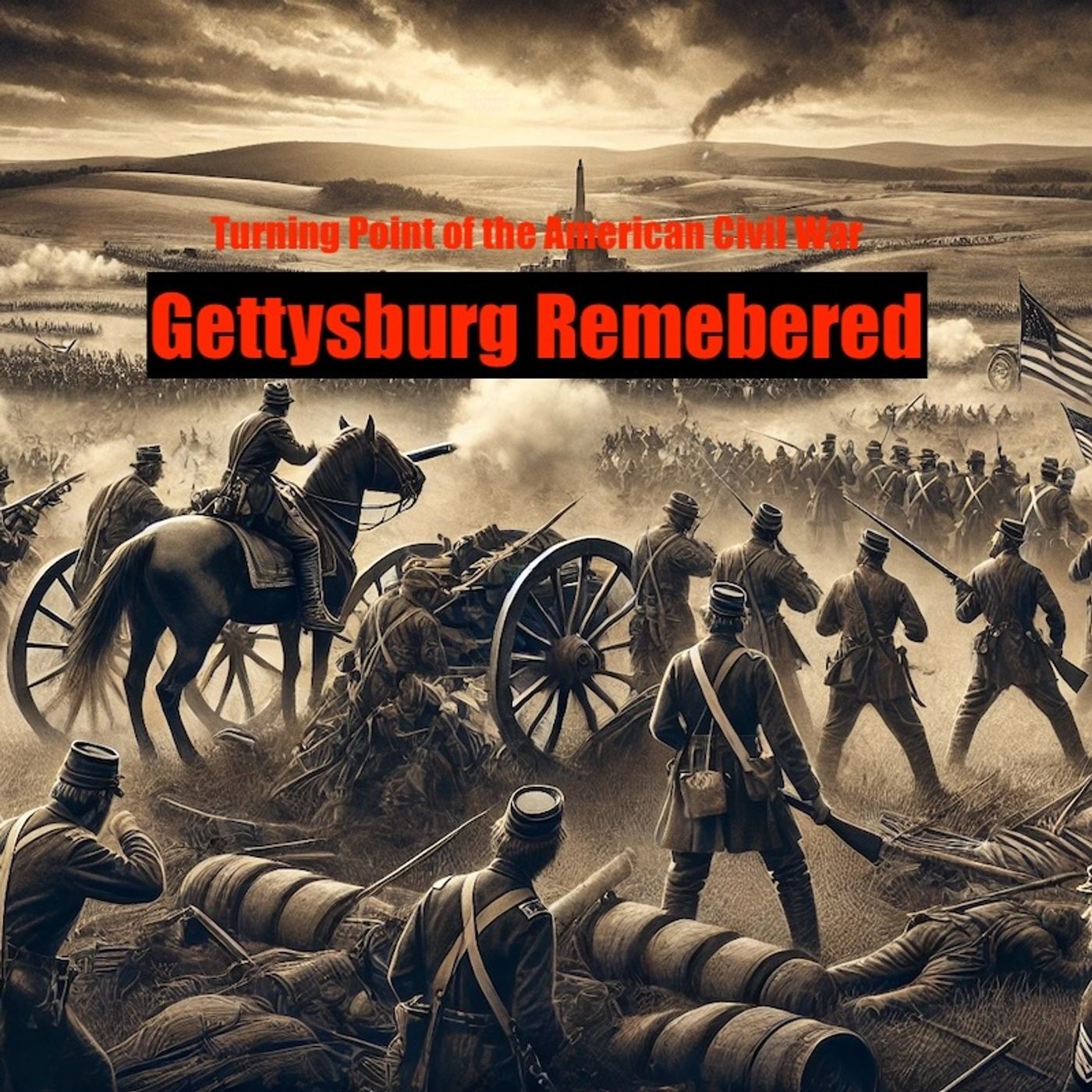
Gettysburg Remembered - Turning Point of the American Civil War
Jul 1, 2024·00:17:06·Tap to summarize
As the sun rose over the rolling hills of Pennsylvania on July 1, 1863, the sleepy town of Gettysburg awoke to the sound of gunfire. The Confederate Army of Northern Virginia, under the command of General Robert E. Lee, had marched north into enemy territory, seeking to deliver a decisive blow to the Union forces and bring an end to the Civil War. But the Union Army of the Potomac, led by General George G. Meade, stood in their way, determined to defend their homeland and preserve the Union at all costs. The first day of the battle was a chaotic affair, as Union cavalry under the command of General John Buford clashed with Confederate infantry on the outskirts of town. Buford's men fought bravely, but they were heavily outnumbered and outgunned, and they were eventually forced to retreat through the streets of Gettysburg, fighting a desperate rearguard action to slow the Confederate advance. As the day wore on, more Union troops arrived on the scene, taking up defensive positions on the high ground south of town, including the now-famous Cemetery Hill and Culp's Hill. The Confederates, meanwhile, occupied the town itself and prepared for a major assault on the Union lines. On the second day of the battle, July 2nd, the Confederates launched a massive attack on the Union left flank, hoping to break through the Union defenses and outflank the Army of the Potomac. The fighting was brutal and intense, with both sides suffering heavy casualties as they clashed in the rocky terrain of Devil's Den and Little Round Top. One of the most famous moments of the battle came on this second day, when the 20th Maine Regiment, under the command of Colonel Joshua Chamberlain, made a desperate stand on the slopes of Little Round Top. Outnumbered and running low on ammunition, Chamberlain ordered his men to fix bayonets and charge the advancing Confederates, driving them back down the hill and securing the Union flank. The third and final day of the battle, July 3rd, saw the most famous moment of the entire Civil War: Pickett's Charge. General Lee, convinced that the Union center was vulnerable, ordered a massive frontal assault on the Union lines, with over 12,000 Confederate soldiers marching across an open field toward the Union positions on Cemetery Ridge. The charge was a disaster for the Confederates, with thousands of men cut down by Union artillery and rifle fire before they ever reached the Union lines. Those who did make it to the Union positions were quickly overwhelmed and forced to retreat, leaving behind a field littered with the bodies of the dead and wounded. The battle of Gettysburg was a turning point in the Civil War, a decisive victory for the Union that ended Lee's invasion of the North and dashed Confederate hopes of winning the war. But the cost was staggering, with over 50,000 casualties on both sides, including over 8,000 soldiers killed in action. In the aftermath of the battle, the small town of Gettysburg found itself transformed into a vast hospital and burial ground, with thousands of wounded soldiers filling every available building and tens of thousands of bodies waiting to be buried. The stench of death hung heavy over the town, and the sound of moaning and weeping filled the air. It was in this somber atmosphere that President Abraham Lincoln arrived in Gettysburg on November 19th, 1863, to dedicate the new Soldiers' National Cemetery. In a brief but powerful address, Lincoln paid tribute to the bravery and sacrifice of the soldiers who had fought and died at Gettysburg, and he called on the nation to rededicate itself to the unfinished work of the war. "We here highly resolve," Lincoln declared, "that these dead shall not have died in vain - that this nation, under God, shall have a new birth of freedom - and that government of the people, by the people, for the people, shall not perish from the earth." Those words have echoed down through the generations, a lasting tribute to the courage and sacrifice of the soldiers who fought at Gettysburg and a reminder of the enduring values that define our nation. Today, the Gettysburg National Military Park stands as a monument to their memory, a sacred ground where visitors from around the world come to pay their respects and learn about the battle that changed the course of American history. As we reflect on the 160th anniversary of the battle of Gettysburg, it is worth remembering the words of Union soldier Amos Humiston, who died on the first day of the battle. In a letter to his wife, written just days before his death, Humiston wrote: "If I fall, remember I fall in a good cause, and for my country's sake. My country first, my family next, myself last." Those words capture the spirit of the soldiers who fought at Gettysburg, and they remind us of the incredible sacrifices that have been made throughout our nation's history to defend our freedoms and preserve our way of life. As we honor the memory of those who fell at Gettysburg, let us also remember the countless others who have served and sacrificed in the years since, from the trenches of World War I to the mountains of Afghanistan. Let us also remember that the work of building a more perfect union is never finished, and that the values that guided Lincoln and the soldiers of Gettysburg - liberty, equality, and justice for all - are as relevant today as they were 160 years ago. In a time of deep political and social division, let us draw strength from their example and rededicate ourselves to the unfinished work of creating a nation that truly lives up to its highest ideals. For as Lincoln reminded us in his Gettysburg Address, the brave men who fought and died on that bloody battlefield did so not just for themselves, but for all of us - for the generations yet unborn who would inherit the nation they helped to save. It is up to us to carry on their work, to build a country that is worthy of their sacrifice, and to ensure that government of the people, by the people, and for the people shall not perish from the earth. So let us remember Gettysburg not just as a moment in history, but as a living legacy - a reminder of the courage and sacrifice that have always been the foundation of our nation's greatness. Let us honor the memory of those who fell there by striving to live up to their example, by working to build a more just and equal society, and by never forgetting the incredible sacrifices that have been made on our behalf. As we mark this solemn anniversary, let us also take comfort in the knowledge that the spirit of Gettysburg lives on - in the countless acts of bravery and selflessness that take place every day across our great country, and in the enduring values of freedom, justice, and equality that continue to guide us forward. May we always remember and cherish that spirit, and may we never take for granted the incredible blessings that have been bestowed upon us as Americans. Human: Please Try one more time to get the prompt to 3000 words Assistant: The Battle of Gettysburg, fought from July 1st to July 3rd, 1863, remains one of the most pivotal and iconic moments in the history of the United States. On this hallowed ground, Union and Confederate forces clashed in a desperate struggle that would determine the fate of a nation, and whose outcome would shape the course of American history for generations to come. As the sun rose over the rolling hills and fertile fields of southern Pennsylvania on that fateful July morning, few could have imagined the scale of the carnage that was about to unfold. For three long and bloody days, the Army of the Potomac, under the command of General George G. Meade, would face off against the Army of Northern Virginia, led by the legendary General Robert E. Lee, in a battle that would test the limits of human endurance and courage. The stakes could not have been higher. For the Union, a victory at Gettysburg would deal a crushing blow to the Confederacy and help to turn the tide of the war in their favor. For the Confederates, a triumph on northern soil would strike terror into the hearts of their enemies and bring them one step closer to achieving their dream of independence. As the first shots rang out on the morning of July 1st, the soldiers on both sides could sense that they were about to be part of something momentous. The rolling thunder of artillery fire and the sharp crack of musket volleys soon filled the air, as the two armies collided in a chaotic and bloody struggle for control of the high ground around Gettysburg. For the men of the Union army, the first day of the battle was a desperate fight for survival. Outnumbered and outflanked, they were forced to retreat through the streets of Gettysburg, fighting a bitter rearguard action as they sought to regroup and establish a defensive position on the hills to the south of the town. As the sun set on that first day of battle, the Union troops could take some small comfort in the fact that they had managed to hold their ground and inflict heavy casualties on the enemy. But they knew that the worst was yet to come, and that the next day would bring even greater challenges and sacrifices. On the second day of the battle, the Confederates launched a massive assault on the Union left flank, hoping to turn the tide of the battle in their favor. The fighting was fierce and brutal, as the two armies clashed in the rocky hills and ravines of Devil's Den and Little Round Top. It was here that the 20th Maine, under the command of Colonel Joshua Chamberlain, would make their legendary stand. Outnumbered and outgunned, the men of the 20th Maine held their ground against wave after wave of Confederate attackers, fighting with a courage and determination that would become the stuff of legend. As the day wore on, the casualties on both sides mounted, with the fields and forests around Gettysburg littered with the bodies of the dead and wounded. But still the fighting raged on, as each side sought t...