← Gom Jabbar: A Dune Podcast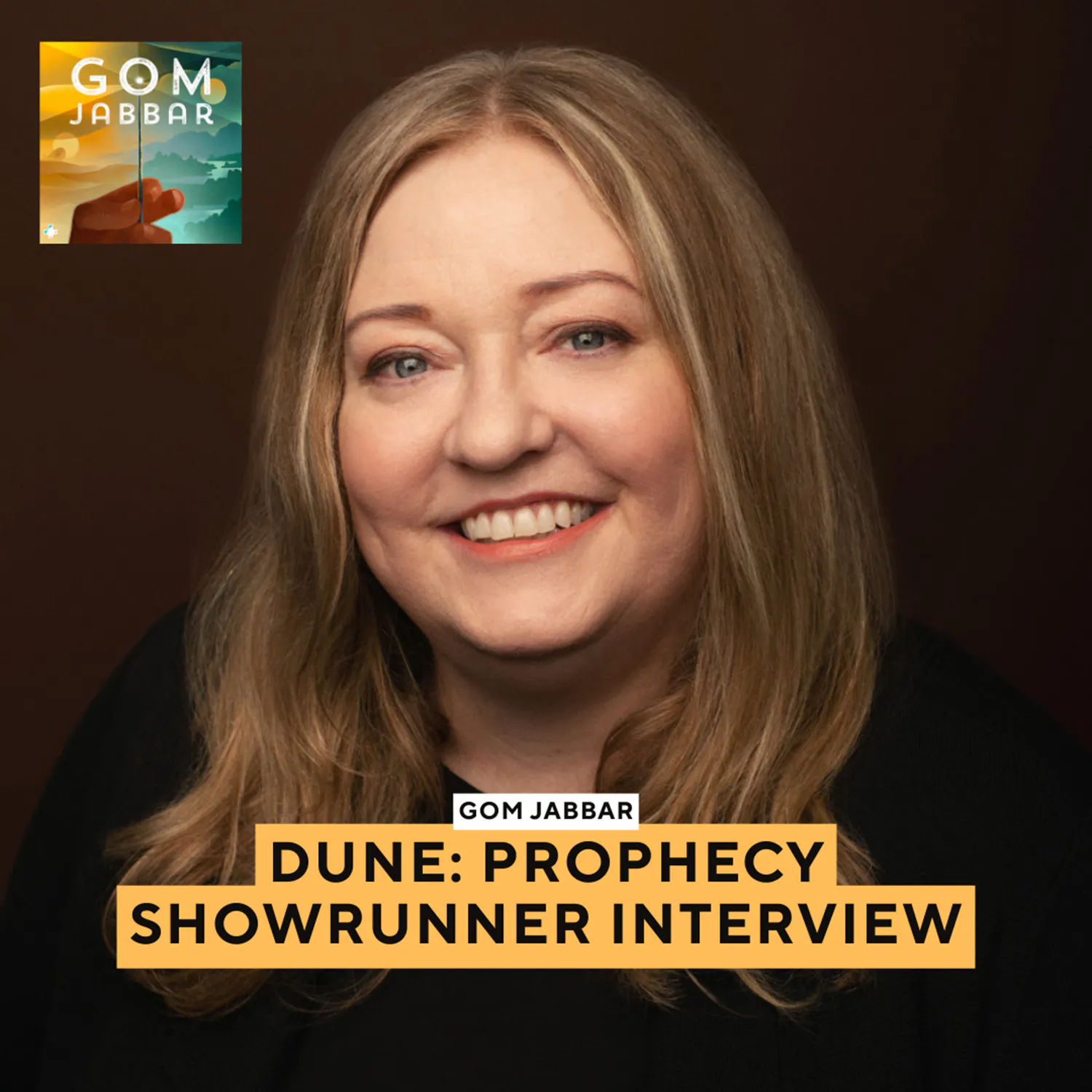
Loading summary
Transcript249 lines
- [00:00]
Leo
Today on the show, we're talking about Dune Prophecy with Allison Schapker and Jordan Goldberg.
- [00:25]
Abu
Welcome to Gom Jabbar. Your guide to the iconic world of Dune will be exploring the themes, philosophies and characters found in the sandy depths of this vast universe, from Frank Herbert's groundbreaking novels to the adaptations on film and tv. My name's Abu.
- [00:40]
Leo
My name is Leo.
- [00:41]
Abu
And folks, yeah. Boy, do we have an episode for you today.
- [00:44]
Leo
My goodness, I am.
- [00:46]
Abu
We just got done with this interview, like, mere minutes ago, and I am electric. You know, I am just shaking with excitement. I can't wait for folks to hear it. We had the absolutely incredible opportunity and honor to sit down with Dune Prophecy showrunner and EP Allyson Schapker and EP Jordan Goldberg. What a great chat. I think the immediate takeaway I got from our chat, I don't want to reveal too much. People are about to listen to it. But I walked away feeling like these are Dune fans. They love Dune as much as I do and they want to do their best and knock this show out of the park. And that, to me, is all I'm asking from any adaptation.
- [01:31]
Leo
Yeah. Even only having seen what we've seen of the show so far, that was already something I was feeling. But the conversation really cemented it for me is like, they care. They want to get this right. They're handling their piece of the Dune legacy with care, as much care as they can muster. Now, you're going to hear that conversation we had with them. But before we get into that, we do need to get through our housekeeping. So for our spoiler warning, today, we talked about things that have happened in the first two episodes of Dune Prophecy. So if you haven't yet watched the first two episodes of Dune Prophecy, first of all, what are you doing? Go watch it.
- [02:10]
Abu
Go.
- [02:10]
Leo
It's worth watching. Go watch it. It's great. And we also, I think there's some light spoilers here and there for Sisterhood of Dune as well. So that's the Brian Herbert, Kevin J. Anderson book. So if you haven't seen those two episodes or if you haven't read that book, you've been warned.
- [02:27]
Abu
And of course, a huge shout out to our Kwisatz Haderach level patrons at the top of the show here. Rob Silver, Daniel Dion, Jonathan Lambert, and C.R. sprule. Folks, interviews like this, and I like, truly mean this, interviews like this do not happen without your support, without the foundation of support we get from our patrons. That allows us to keep putting in the incredible amount of hours into this show. That is what leads to doors opening and opportunities to talk to showrunners, to talk to YouTubers like Quinn, to work with incredible people and have access to those conversations. So truly, from the bottom of our hearts, we thank you to our Kwisatz Haddock level patrons and we also thank all of our patrons who support us.
- [03:14]
Leo
And of course, if you are currently not in a place to become a patron, if maybe a monthly subscription, maybe you've got subscription fatigue. Quick reminder, we also did set up a way to make one time tipping a thing so you can buy us a spice coffee, you can pay for a couple spice beers, whatever you want. That link is in the show notes as well.
- [03:36]
Abu
That's right. Okay, so the game plan for today's episode is very simple, folks. Yeah, the game plan for today's episode is very simple. We sat down with Alison Schapker and Jorian Goldberg to talk about Dune Prophecy and ask them everything from production questions to the deep cut Dune lore questions. Okay, we asked about the spice cocaine and we got an answer. So you're going to hear all of that after a short break. So stick around and we hope you enjoy it. We'll be back in a minute with Alison Shapkar and Jordan Goldberg. Hey folks, Abu and Leo here from the Gom Jabbar Podcast here to tell you about another Dune podcast that we think you're gonna love.
- [04:19]
Leo
It's called the Official Dune Prophecy Podcast. It's from the fine folks at hbo. And of course the HBO original series is going to be focusing on that shadowy sisterhood that of course becomes everyone's favorite Bene Gesserit.
- [04:35]
Abu
On the companion podcast, hosts Greta Johnson and Ahmed Ali Akbar are going to guide you through every episode of of the HBO Original Series and unpack each episode with guests from the show including cast and crew.
- [04:49]
Leo
So if you're listening to our podcast Gom Jabbar, you're probably already a huge Dune fan. We think you'll enjoy the series and their companion podcast. It's a fresh take on an incredible universe and we're all gonna go places we've never seen before.
- [05:05]
Abu
That's right. And if you're a podcast listener, you know the drill. Listen to the official Dune Prophecy podcast wherever you get your podcasts. And don't forget to stream new episodes of the HBO original series Dune Prophecy exclusively on max.
- [05:18]
Allison Schapker
This episode is brought to you by Google Gemini. With the Gemini app, you can talk live and have a real time conversation with an AI assistant. It's great for all kinds of things. Like if you want to practice for an upcoming interview, ask for advice on things to do in a new city, or brainstorm creative ideas. And by the way, this script was actually read by Gemini. Download the Gemini app for iOS and Android today. Must be 18 to use Gemini live.
- [05:45]
Abu
So, Allison, Jordan, what a pleasure to have you both on the show. What an honor to get to talk to you about Dune prophecy and just about Dune in general to geek out with both of you. First question is a very easy one. And Allison, let's start with you and then we'll hop to. Jordan, can you tell us your Dune origin story? When did Dune first come into your life? And do you remember what you felt then? And can you tell us a little bit about how your relationship with Dune has then evolved ever since?
- [06:14]
Jordan Goldberg
Yes.
- [06:14]
Hi.
- [06:14]
Thank you so much for having us. I have a very strong sense memory of reading Dune as a teenager, like to the point where it's almost like a, you know, like they said, like the Proustian kind of like, I can remember being in my attic. Like, I had an attic room with very weird wallpaper. I remember being the bed and like the whole book cover. And that's not true of every book you read, you know, so it was really like that kind of. I felt so transported as a young person and I didn't read it with any context. I mean, I just picked it up and, you know, and I think I had a sense that there was something classic about it. But then I just sort of fell in and had the most amazing read and, you know, had my kind of mind blown. And then from that point on, I just was like a Dune fan. And I would keep an eye out for, like, anything Dune that would come along. And, you know, so obviously I saw the David lynch movie. I got incredibly obsessed with the Khodorovsky Dune documentary for a time like that. There was a year where, like, if you knew me, even vaguely at the holidays, like you were getting Jodorowsky's Dune on dvd, like for the Christmas, incredible. But, you know, various adaptations. But obviously then Denis films came along and kind of just, I think, reignited so many people's love of Dune and kind of to rediscover it all over again in that way on the big screen was thrilling. And then I was just working away in my genre focused writing career when I heard that they were making this television series. And, you know, I didn't even really think, like, it was just for me. I was like, yes, the chance to participate in something Dune Related was such a privilege and such a dream like I didn't even know I had, you know, because it felt so. You would just never imagine that life would present itself with that kind of an opportunity. So Jordan and I are thrilled. It's been an amazing ride, kind of diving in. So that's my. I'm just a lifelong Dune fan, I guess.
- [08:33]
Abu
Yeah. And that much is very obvious from the interviews we've read and the sort of other shows and interviews we've listened to in preparation for our conversation with you today. That was like the number one thing we were like. I think Allison is kind of obsessed.
- [08:49]
Jordan Goldberg
Yeah, I like it.
- [08:53]
Abu
Jordan, what about you? Where did Dune fit into your life? You know, Dune?
- [08:57]
Jordan Goldberg
You know, I. I guess my first kind of interaction with it was with the lynch film. I was, you know, probably seven or eight when it came out. And, you know, when I. I lived out in Maryland, we. When cable TV came in and like, they. They would play the same movies over and over again. And that was like one of the few movies they played over and over again. And. And I just, you know, I. I don't know if I was able to kind of grasp all the concepts the visuals are, you know, they kind of. They kind of burn into your mind. So I had this kind of appreciation for this world of imagination. I didn't really kind of grasp onto what the story was. But then as I got older, I was exposed to Dune again through the computer game Dune 2. And playing that game and the real time strategy of it, it just sucked you in. It was like the most immersive experience. And I felt like I learned a lot about the world because I believe, you know, Harkonnen and Atreides are all on the. On the. There was another family, I guess, in that game as well, mining the spice in there. So you learn about the worms, Oros? Yeah, something like that. It was such a. It was such a massive, like, you know, rule based kind of game that kind of taught you a little bit about the world. So then I was like, I gotta try to read this book. Cracked it open, went through it once again. Not much of a critical reader, but, like, kind of got blown away by this idea that you could have a hero that kind of has a very kind of curvy hero's journeys path. You know what I mean?
- [10:34]
Leo
Yeah.
- [10:35]
Jordan Goldberg
And at the end, what is he? A hero? And then, you know, as I got older again, I remember reading it with a more critical eye. Well, I guess with more of an academic sense of like, you know, knowing who Frank Herbert was a little bit more and what the themes were. And I found that, you know, his life and what he brought to the novel, I think was kind of fascinating and just kind of was blown away about, you know, what the messages were in that film and what was he was trying to get across and, you know. Yeah, and a lot of that I think I take into this show. You know, I mean, we kind of follow our own story.
- [11:07]
Leo
I mean, it's not going to surprise anyone to know that. We also love how deep and layered the Dune universe is. It's. It can be addictive because you're just. There's always layers to peel. I also quickly googled it. It's Ordos. House Ordos.
- [11:19]
Jordan Goldberg
Oh, nice.
- [11:20]
Leo
I was going to be losing my mind for the entire interview if I didn't look that up.
- [11:25]
Jordan Goldberg
Well, we should actually try to put that into the show, Allison. We should just try to Honor of the game.
- [11:32]
Leo
It's the number one buyer of whale based products from the Duke of House, Harkonnen. Baron Harkonnen.
- [11:40]
Jordan Goldberg
Exactly.
- [11:40]
There you go.
- [11:41]
Leo
Well, that's excellent to hear. And talking about the show a little bit. It's out. It's out now. People are seeing episodes. By the time this episode comes out.
- [11:49]
Abu
Congratulations.
- [11:50]
Leo
Congratulations.
- [11:51]
Jordan Goldberg
Thank you.
- [11:51]
Leo
It's out. People are seeing it.
- [11:53]
Jordan Goldberg
I know so far.
- [11:54]
Leo
I know only right now, as we're talking, one episode is out. How has the reaction been? How are y'all feeling?
- [11:59]
Jordan Goldberg
I mean, overall, I would say, like, we're excited. I mean, it's been. I mean, it's always an intense experience to work on something and, you know, pour so much creative energy and so much of ourselves into it. I mean, so, you know, to send it out for me is like, ugh. Like, you know, it's both inevitable. It has to happen, and then you feel like everybody's gonna come at, you know, it's been interesting. I mean, I hope people are really enjoying it. I mean, you know, it seems like we certainly have a contingent of people who are, and that's thrilling to us. You know, in some ways, I can't look at the Internet that much because, you know, I'm trying to preserve creative sanity. But yeah, I mean, all I can say is like, we made it with, you know, so much love and respect for the material that we were trying to bring to life. And people really went hard, you know, like, to try and try and reach a television standard, you know, that would be exciting for people. And I don't know that I imagine being like so directly one on one compared to the movies, you know, as a sense of like, you know, because at the same time that's probably inevitable as well. So, you know, just trying to stay positive and like, hope. Hope the show finds itself. Because, look, we have. We're obviously massively invested in it and, you know, have more story we'd like to tell. So we hope people are enjoying it.
- [13:39]
Leo
Yeah, totally.
- [13:40]
Abu
Yeah. And you know what, block and mute whoever you need to on the Internet, Right?
- [13:45]
Jordan Goldberg
Always.
- [13:46]
Leo
That's called self care in 2024.
- [13:52]
Abu
Well, Alison, we want to get into some of our questions about the show. In particular, we had one of our listeners, Luna, who absolutely loves some of your other projects that you've worked on. Luna in particular called out Alias and Fringe as two properties that she's obsessed with. She actually wanted to know what the experience was like for you working with a more pre established source material. Right. You've worked on shows that are original stories. What was it like to now work within a sandbox that did have edges?
- [14:27]
Jordan Goldberg
Yes, I love that. I mean, I think that's a really interesting creative challenge, especially in a world like this where you feel like it's the world's most excellent science fiction sandbox. You feel like, okay, we're inheriting a lot of really rich themes and characters and world building. And I think that the way we tried to structure our series was we used the Sisterhood of Dune and the Schools trilogy that Brian Herbert and Kevin Anderson wrote as the seminal texts. And they definitely gave rise to the show. And very much we knew we wanted to tell an origin story of the Bene Gesserit. And also the fact that the Harkonnen sisters. You had two Harkonnen sisters and Valya Harkonnen as the second Mother Superior. You know, personally, I thought was a really fascinating opportunity to look at a family that was going to, you know, become so extreme and villainous in the future. Sort of where they started and why they. Why they met this moment and who was Valya and were there seeds of that in her, but also what were her goals? And, you know, just sort of create a bit of a origin story for that family as well. And we use the books as our guide and we just. I really like this structure we have of trying to tell both a coming of age story of young Valya and how she inherited the sisterhood. And that puts us a little more squarely in the timeline of the books. And so we tether ourselves in that way to the source material, but we also created a part of our story in conjunction with the Herbert estate that outside, that's a little after the books end. So we're also getting to build some lore as well. And I think hopefully we'll make for a satisfying television experience and just the way we can tell one woman's story over time. And as you know, Dune is so nothing if not plans over time. So we wanted to build that into the show as well.
- [16:32]
Abu
I mean, how exciting is it that you get to add sand to the sandbox?
- [16:35]
Jordan Goldberg
I mean, it's really, it's so exciting and so humbling, but so exciting. I mean, very thrilling to have a little bit of the sculpting to be what serves our story, but very much in keeping with this world and these characters.
- [16:53]
Leo
I've also already heard from people. It's so cool to take someone like Baron Harkonnen and Feyd Rautha Harkonnen, who people now have seen in the movie theater, to then focus on Harkonnens and show a different side to the Harkonnen Atreides feudal. It is. I think it's a brilliant choice. And I've already heard other, like just kind of normies or like casual maybe newcomers to the Dune universe being like, whoa, Harkonnens. Like, aren't they the bad guys? And now they're the main character. That's so cool. I think that's really, it's excellent. And it's been fun to read the Sisterhood of Dune and some of those seminal text works, but also just to see the show. It's so cool.
- [17:28]
Jordan Goldberg
Oh, that's so nice. I love that people are saying that. Yeah. I mean, well. Cause, like, it's fun to think about, like, how the Harkonnens came to be. For sure.
- [17:40]
I mean, it was, it was that when, when Allison called me about Dune, I'd have to say, like the thing that really. Because I, I, you know, Dune, you know, it's a, it's a heavy lift to do anything with it because it's so, you know, it's a sandbox, but it's a, it's a fucking three football field sandbox. Yeah, it's huge. You know what I mean? And it's, I mean, there's a lot of sand that goes in that box and you know, you gotta get sure that the sand is right or people are gonna yell at you. You know what I mean? So. And even though, even though the television show is like a long form medium, so you're able to kind of get more out of it than a movie does. And that's why, you know, you know, hats off to Denis, like, he. He really nailed that story in the movies. I just feel like he got the great essence of it. He had made the. The right choices to kind of tell that story. You know, now that we're. We're on a tv, in a way, it's sort of like, you know, you can be paralyzed by how much stuff that you gotta feel like you gotta, you know, pay honor to in that story. But the thing that got me is that when Allison was telling me about it, when the idea that a Harkonnen was sort of at the center of the Saw and more of an antihero role really was fascinating to me because I think anti heroes play extremely well, particularly on places like hbo. They have a history with great antiheroes and stuff like that. And I think it is a lot of fun to be had with a story like that.
- [19:08]
Leo
Yeah.
- [19:09]
Abu
I'm curious. Cause, like, going into a TV show, to your point, Jordan, like, you have some more room to play with than you would in maybe like a 90 minute, 2 hour, 2 and a half hour movie. But Dune is so large that you still need to pick and choose.
- [19:22]
Leo
Yeah.
- [19:22]
Abu
So I'm curious how you honed in on this is the story. This is the message we're trying to tell across one season of television. You know, how do you hone in what. What I suppose kittens do you drown. You know, the things you wish you could squeeze in but just can't tell in a successful.
- [19:38]
Leo
Is that a saying?
- [19:39]
Abu
Serious? That is a saying, yeah.
- [19:42]
Leo
What?
- [19:42]
Abu
Drowning your kittens is like a. Oh, my God.
- [19:44]
Jordan Goldberg
And I'm not gonna let my daughter listen to this podcast. She'll be like, kittens.
- [19:50]
Abu
No kittens were harmed in the production of this show.
- [19:53]
Jordan Goldberg
Well, we knew. I mean, you knew that the, the cool thing about the show for me, other than value Harkonnen, but it was also sort of the, you know, foundational story of. Of the Benny Jesser. Right. So you, you know, you want to. You want to kind of, you know, for lack of a better phrase, pull back the veil on that and, and show you the. In inner workings of the Order, how they recruit, train, how they operate in the shadows, what it takes. I thought that was a lot of fun. But ultimately, when you're kind of breaking these stories, you have to just think about, like, who. Who your. Who your central character is. And it's Valya. And then, you know, and obviously Tula plays a massive part in that and then the kind of the central incident of this, you know, reckoning that is about to come upon the Sisterhood and the Imperium at large allows it to be tied into the Imperial family. And what happens on Seleucus Secondis, it was. You know, it's an interesting. Once you have that structure, it allows you then to kind of investigate all sides of that thing. But you gotta always kinda think, you know, these are my main players in these stories and we're gonna be following them. And then, of course, when you meet your villain, you then become. You get. Follow that person as well.
- [21:04]
Yeah. And I would just add to that, without wanting to be too spoilery, is like, we had a through line in terms of wanting to tell a story of, like, how Valya Harkonnen became the second Mother Superior, you know, where did she come from? Why was she chosen? What did she offer? And see her kind of grow into her power on the one hand, and then on the other hand, to tell a story of a crisis that comes where her power is tested. And we know that the Bene Gesserit is called the Bene Gesserit and this is called the Sisterhood. And so clearly her institution was challenged. Like, what led to that kind of reimagining of who they were. And that's basically the terrain of our series in success would be to understand that through this woman's life story. And so we knew in season one, we wanted to see both how she consolidated her position as Mother Superior, but also in the present time period, to be telling a story of how that will be drastically tested. So there's a bit of a rise and a bit of a challenge, I guess.
- [22:14]
Leo
Oh, that's. That's excellent.
- [22:15]
Abu
And I think by episode two, particularly the end of episode two, that through line is clear.
- [22:20]
Jordan Goldberg
You know, you're like, we have a collision here.
- [22:23]
Leo
Even on a microcosm. The fact that she is the one that invented the voice.
- [22:27]
Jordan Goldberg
Yeah.
- [22:28]
Leo
This seemingly fail safe thing that she can fall back on and then to see it fail and to be like, what do I do with that? Excellent, excellent moment.
- [22:36]
Abu
So what an electric scene.
- [22:38]
Jordan Goldberg
I mean, Emily Watson, first of all, is such a gift to be playing Evalia and to be so unbelievably nuanced as an actor. And then Travis Fimmel, I feel like it's so incredible. I mean, I could rave about our cast, but, yeah, like, it was. It's really fun to watch these heavy hitters kind of come and play together as actors. Yeah, that was thrilling to me, too. To see a full.
- [23:03]
Leo
I took notes during the second episode. A full, like, maybe fifth of my notes were just excellent line deliveries from people. Just like superb choices that they're making. That, like goosebumps, you know, like that.
- [23:15]
Jordan Goldberg
Yeah, they're amazing.
- [23:16]
Leo
It's so good. Now, zooming out a little bit. Frank's like, narrative arcs, of course, moral ambiguity. You've got anti heroes, you've got all of these themes alive and well. But also Frank was someone who was writing as a means of warning people about these charismatic leaders. You know, be careful of who you're following. And. And I'm sure he'd have a lot to say about, like, populism today, ecology. Right. And becoming, of course, too reliant on technology. Those are very relevant to his time. Our listener, Daniel. And of course we too wonder, are there any contemporary questions or topics or kind of maybe big challenges that you're. That you're kind of channeling or exploring through this series and maybe through Valya's story?
- [24:02]
Jordan Goldberg
Yeah, I mean, well, those are three big ones. I mean, definitely. I think, first of all, I just think it's amazing how Dune continues to be so prescient in terms of speaking to the themes. You can't get over it. And it keeps, you know, you keep turning whatever, living through history and then, you know, it speaks to the moment in a new way. And I do think it's an intro. It's an amazing time to understand that, like, for example, artificial intelligence is coming and there's not going to be any stopping it, and it's going to upend for better and worse. And I'm sure, like any tool, it's going to be something we all, not all, but those of us who make use of it will be trying to define. But it's happening so fast and it's happening so rapidly, and it's sort of ahead of people's learning curve a lot. And I think it's interesting to be having that happen in daily life and then be in this creative space where you're in the aftermath of thinking machines and people are really trying to sort of rebuild and out of the rubble, asking themselves in a totally different way, like, what makes us human? And I think that question, as much as what is the role of technology and where do we want to outsource? You know, where. What does it mean to outsource parts of our thinking and parts of our humanity? And we've done it before. It's not that I think this is a wholly new thing, but I do think those Kinds of questions that Dune is asking are really, I just think, give you an interesting leverage point on today because.
- [25:36]
Leo
For sure.
- [25:36]
Jordan Goldberg
Yeah, I think it's something always worthy of considering sort of what makes us human and how do we want to hold on to? What do we want to hold on to? Or what are we gaining or losing by interfacing with machines? So that's one. But politically, I mean, Dune's endless cautionary tales of politics and what does it mean? What stories are we telling? Who's telling those stories about our leaders, about institutions? What do we put our faith in? When is it good to sort of question, when are we only seeing the tip of the iceberg and then actually, like, what is in the iceberg? I mean, I think the Bene Gesserit. Yeah. They go very deep.
- [26:21]
Yeah. There was a couple of key lines for me. It was like, you know, power doesn't corrupt, it attracts the corruptible. I think was very relevant to what we were trying to do. He had a line that says that, you know, at some point, a man must recognize the myth that he's in. And I think that kind of speaks to what Alison is talking about, the stories I tell, the thing that really gets me. And I think it's probably one of his final messages as he runs through his books. Our composer Volker Bertleman, did that movie Conclave. That's out there. I don't know if you guys seen that, but there's a great moment in Conclave where the Ralph Fiennes character is giving a sermon. And it's about certainty is the kind of destruction of faith. You know what I mean? And Herbert has been, you know, he said a couple times about, you know, the universe is too complicated to get a full grasp on. Their uncertainty will always be there. But people are so terrified of that that they will do anything they can to make it certain. And so I think a lot of these schools and these people in Dune are always engaging in, you know, controlling the future because it's a way to kind of secure themselves against the tides of uncertainty. And. And I think the anecdote for the Herbert is, you know, I think he was a decentralist because I think that's where the book goes, you know, with scattering and all that stuff like that.
- [27:52]
Leo
Yeah.
- [27:53]
Jordan Goldberg
So those. They're me. They're relevant to me in looking at what we're doing with our story.
- [27:57]
Leo
Yeah.
- [27:58]
Abu
And certainly the warnings of, like, gripping, trying to grip the future too tightly that Frank repeated many times throughout the books. Right.
- [28:05]
Jordan Goldberg
Yeah.
- [28:06]
Abu
His advice to embrace Chaos to leap into the unknown. All of those, those big themes.
- [28:12]
Jordan Goldberg
Yeah.
- [28:13]
Abu
Have always resonated with me too, from the books.
- [28:15]
Jordan Goldberg
Yeah. I think, I think he saw in his. I think he saw in his years of working for the government that institutions that were created to call certain, you know, solve certain problems.
- [28:24]
Abu
Yeah.
- [28:24]
Jordan Goldberg
Their existence beyond this solving of that problem ended up creating the same or more problems. You know what I mean? And it's an interesting dynamic.
- [28:35]
Abu
Yeah. And to create a show that's centered in his time in the Dune universe where many schools are popping up to quote, unquote, solve problems.
- [28:43]
Jordan Goldberg
Yeah. It's really, I think, you know, what does he say? It's a time of great imagination and great rebuilding, but it's also like a really dangerous time and you still have a lot of anti technology fervor out there and fear. And that's another theme I think related to today. Like how are people's Jordan, like you're talking about like sort of either existentials uncertainty or feeling like they're social forces they don't understand or that experience of larger uncertainties being present and the fears that arise and then how is that something that can be wielded or shaped or used?
- [29:22]
Leo
Yeah, we see that with Havoco Corino being very quick to say let's control what information gets out because it will become a circus of fear if these rumors start to fly and stuff.
- [29:32]
Abu
So.
- [29:32]
Leo
Absolutely. I see that in some of the character choices. That's great. Also very relevant to today.
- [29:37]
Jordan Goldberg
Yeah. But the AI thing I think is massive, as Allison said, it's massively one of the backdrops of the story. And Allison and I worked on a show that had a lot of AI in it and showed you that how the relationship between AI and humans work. And then I think with this one, it's interesting too because it's like obviously there's Brian and there's a Frank Herbert version on you know, the kind of the machine wars and all that stuff like that.
- [30:06]
Abu
Yeah.
- [30:07]
Jordan Goldberg
But I do think at some point it bump. It is a conflict between man versus machine or AI. But it's also, at some point, you know, AI influences people. It does become. There is ideological divides on people who actually believe that, yeah, we need machines to live our life and there are people who believe, like no, we don't. And that is also explored in our show. Like, you know what I mean? That's how we bridge this gap, you know what I mean? Because I don't think those things are mutually exclusive, you know.
- [30:34]
Leo
No. Yeah.
- [30:35]
Abu
Well, something we've Always struggled with, like Leo and I have personally struggled with on this podcast. I'm sure you and the creative team talked a lot about on the show, and that's trying to balance newcomers to the series, especially with the flood of Denis Villeneuve newcomers who maybe have only seen those movies versus the we affectionately on the show call them our Dune daddies. The, like, dads who loved sci fi 40 years ago and have been obsessed with Frank Herbert ever since. Yeah. Trying to bridge the gap and tell a story that is powerful and meaningful for both of them. How did you and the creative team try and tackle that with this show?
- [31:18]
Jordan Goldberg
Yes, we did. I mean, that was a very conscious thing. I love the doodads thing. I mean, you know, we have some writers on staff whose dads read them dunes, you know, so it's like Spice Daddy's. It really is an intergenerational, you know, or it can be meaningful in families in that way. I mean, I think that's so cool. That was very conscious. I mean, that was something we talked about. It's something HBO was conscious of. It's something that we were conscious of. Like, how do we tell a story that doesn't dumb down Dune that allows, like, the lore to exist in complexity and, like, nuance and. And if you are, like you said, a longtime Dune fan, that you would be able to find things or enjoy things and maybe explain things to the person sitting next to you, that there was enough layers there that there were things just for you. But at the same time, could we also tell a story that if you did happen to be even, let's say you didn't even see the movies, could you start here?
- [32:15]
Abu
Who are those people?
- [32:15]
Jordan Goldberg
Oh, my God. I know. I don't know who those people are, but like that. No, no, no. But just like, really wanting to tell a story that, you know, if you just were coming with these characters at this time, could this be a point of entry into the universe? And I think it can. I think any story, obviously, 10,000 years as a buffer to the main Herbert books and the films allows, you know, you don't have to feel like you're constantly butting up against, or everyone's gonna know the outcome of your story.
- [32:46]
Leo
And.
- [32:46]
Jordan Goldberg
And we all know how it ended. Cause, like, you know, we're early enough that, you know, we have room to surprise people, I think. But we wanted to be, look, handhold where we needed to, to kind of open the world. But it was a balancing act. I mean, it's a tightrope, and we hope that on the whole, it allows for both kinds of enjoyment.
- [33:11]
Leo
Yeah.
- [33:12]
Jordan Goldberg
I mean, I'm fortunate enough to be married to someone that just has, like. Does. My wife. Izzy does not like any of the things. So, you know, when I. One of my. One of my litmus tests. Yeah. One of my litmus tests for this whole thing is like, what do you think about this? Like, you know what I mean? And I, you know, and I could just say, like, she. It was, you know, I think it was unbiased because, like, she's, you know, told me the truth many of times before, immediately got into what was going on there because I think the sisterhood is an unbelievable, you know, gateway into the story, if you're the uninitiated. You know what I mean? It's a fascinating thing, but it's also sort of like we're following the deep state in space. You know, these. These are spies. You know, they're. They're kind of. They're getting up to, you know, the. The games in the shadows and kinds of stuff. It's just. It's. It's. There's enough genre conventions in there to kind of make it really kind of. And we, you know, when we get into those moments where, like, you know, you're gonna see the agony at some point. You know what I mean? Like, you know, where do you. How do you marry that to a genre convention? And obviously, horror feels like the perfect one to do it, and you kind of make it. You make it that moment, and I think that's really exciting.
- [34:23]
Abu
Yeah.
- [34:23]
Jordan Goldberg
You know, you know, when we brought in the world and give you a different glimpse, you know, you know, that with the. With the hover cars and suspense or prisons and what people are doing recreationally with, you know, in that life, I don't, you know, that those kind of things, you know, just to kind of give you a sense of, like, you know, where the world is outside the, you know, the kind of. The major, you know, playing field of the story.
- [34:46]
Abu
And actually, by the time this interview comes out, episode two will be out. And I just want to say, yes, just bravo. Like spice, agony. Leo and I cannot stop talking about that.
- [34:55]
Leo
It was incredible.
- [34:56]
Abu
Like, I was giddy watching that. And yesterday we recorded, like, an instant reactions thing. And I said on that recording, like, to me, this is the definitive vision of the agony. Like, this is what it should look like. Like, this is what it is. Like, what an incredible interpretation. So really hats off to you and the team.
- [35:15]
Jordan Goldberg
Oh, well, thank you. You know, to see that, that's so exciting. I mean, that sequence, I mean, I cannot explain the amount of time and development, like, put into that and I bet. Sure.
- [35:27]
Leo
Yeah.
- [35:27]
Jordan Goldberg
I just. Yeah. I would love to give a sort of shout out to our VisFX team because Michael Enriquez, our Visifex supervisor, Taryn's our producer.
- [35:36]
Michael Enriquez and Taren Pratt.
- [35:38]
Yeah, yeah, yeah. I mean, they. That's not easy to find. Like, how do you make it feel visceral and scary and new and like you haven't seen it. And. Yeah, that was. They. They really went to town on that. It was very exciting.
- [35:55]
And Chloe Lee, the woman who plays Lila, is gonna blow you away. You got some stuff coming up that's gonna be great.
- [36:01]
Abu
Oh, really? Oh, gosh.
- [36:02]
Leo
Oh, exciting. I'll say. From a Lore standpoint, I can understand a sister who, through the agony, was very nearly taken by abomination. I could see her coming out of that and be like, abomination is the number one threat for our sisterhood forever. And I can understand how that would be the beginning of the trauma. I was like, this is too scary. I didn't sign up for a horror movie. This is terrifying.
- [36:25]
Abu
Yeah.
- [36:26]
Leo
So much fun.
- [36:28]
Jordan Goldberg
Oh, Leo, I can't tell you how great.
- [36:30]
That's awesome here. Yeah, it makes me feel good.
- [36:36]
Leo
We are loving the show. Very quick question. We were gonna save this for the end, but I wanna ask it now. Cause you mentioned the recreational activities in this universe that you've shown us. Jordan or Alison. What are they snorting?
- [36:48]
Abu
What are they snorting?
- [36:49]
Jordan Goldberg
What are they snorting? They're snorting. All right. So, yes, they're not snorting straight up spice.
- [36:55]
I think this was Abu's favorite scene, right?
- [36:57]
Yeah, I know. Abu loved it. And I just wanna say. Yeah, no, I am in Der Club.
- [37:04]
Leo
In Der Club.
- [37:05]
Jordan Goldberg
It's synthetics. I think of it as an Adderall. Like, I clearly don't know what the Adderall goes with, but, like in real life, but, you know, some kind of a drug cocktail where, like, the spice is sort of maybe doing some mind bending enhancing or is helping you be alert through your drug trip or, you know, but it is not straight up spice. It's married to other spices.
- [37:29]
Leo
So there is spice in the, like.
- [37:31]
Jordan Goldberg
Spice in my mind. There's a little bit of spice in.
- [37:33]
Abu
That spice laced with a bit of.
- [37:34]
Jordan Goldberg
Spice with a whole bunch of other synthetic drugs.
- [37:38]
Spice is nice, man. The spice is nice.
- [37:43]
Leo
I mean, Star wars and Dune agree.
- [37:44]
Abu
Look, Frank Herbert never shied away from drugs in his story. So there's No, I realized I was.
- [37:49]
Jordan Goldberg
Like, first of all, I've never had. I wish I had. Like, I, I. But, like, I'm like, don't they. What do they do?
- [37:55]
Leo
Do they all believe you? Yeah.
- [37:56]
Jordan Goldberg
Is it an espresso martini? You know, like that principle of I want to be alert and I also want to be really high? Like, I. I feel like that's sort of the vibe I imagine the clubgoers were enjoying.
- [38:11]
Leo
That's so funny.
- [38:11]
Abu
Well, actually, since we're geeking out about Lore, we did have a serious question for you too, that we're dying to know. Obviously, this podcast is so much about Dune lore. We dive into every nook and cranny of it that we can sink our teeth into. And we're curious. As this show was coming together, what were some of the guardrails that you were working with? Were there any must haves that your creative partners said had to be in the show in terms of lore or how much you could bend the lore, or did you just have total free rein and flexibility to take the show wherever you wanted? What comes to mind for me is George Lucas always had a rule that lightsabers always have to be certain colors until he eventually broke that rule.
- [38:57]
Jordan Goldberg
Yeah, yeah. There's a mythology team at Legendary, because we work with. Legendary is our partner along with hbo, they're keeping an eye on the franchise aspect of it and the canon aspect of it that they want to endure. So. And they're all triangulating the Herbert estate, and there's just, like, a lot of people with eyes on the world. And I think people do want to build it out in a way that it can all exist, you know, without, you know, running smack into each other as logical impasses, you know, occasionally, yeah, they would say, like, well, this is not happening in this time period, but you. But you could do it like this. Like, you know, if we wrote ourselves into a canonical issue, which didn't happen very often because I think we're fairly familiar, but, like. But they would tell us. They would tell us. And so I felt good. Like, I felt like when the scripts went through, like, the vetting process at hbo, at Legendary, at the Herbert, like, by the time everybody signed off on it, I felt like, you know, it had. It had been, you know, QC'd on that front, you know, to make sure. Which is good.
- [40:09]
Yeah, they were very helpful. I think they were also. They were slightly helpful, too, some of the world building. I mean, I remember reading, you know, they would review the scripts and stuff, and they would have their. Their personal opinions on certain things and helping us kind of, kind of stay within the realms of what was possible. Things like the Suspenser Prison. I think there was an idea about that. I think it was cool. And yeah, you know, it's. You know, it was very helpful when we needed to kind of, how can we make this more interesting with some more world building that kind of adheres to the canon. And as you'll see as the show goes on, you know, the canon becomes very important, you know what I mean? Not to reveal much, but, you know, it does. It becomes a thing, you know what I mean?
- [40:49]
And they were so supportive. I just felt like everybody, all the executives were very much wanted to help us tell our story, which is great, as opposed to also tell the story they want to tell.
- [41:00]
Leo
It was sort of.
- [41:01]
Jordan Goldberg
So if there was a sort of canon issue, I just remember the Herbert estate and Legendary and HBO being like, almost like problem solving with us, sort of.
- [41:11]
Leo
Oh, cool. That's so good to hear. Kind of along those lines, like, there are some really cool factions in the Dune universe, and naturally, we don't want to get too much into spoiler territory, but we kind of. As a quick question, are we going to see. I know that right now, at the time of the Sisterhood being founded, also Gilbertus is founding the Mentat School. Are we going to see Mintats in the series? Are we going to see Venport and his Navigators or other great Houses Ordos? Is House Ordos going to make a surprise appearance?
- [41:43]
Jordan Goldberg
I'm not dedicating the whole second season to House Ordos.
- [41:46]
Leo
The last two episodes. It's all about a House Ordos.
- [41:49]
Jordan Goldberg
Exactly. So much.
- [41:51]
Leo
Or are these things that maybe you're saving for hopefully future seasons, future storytelling? What can you say?
- [41:58]
Jordan Goldberg
Well, well, yes, we can say that the schools are all rising and they are all looking to both fill the voids, various voids left by the outlawing of thinking machine technology, about trying to protect the future in their own ways, they're competitive. So we focus a lot in season one with nods to the other schools, but very much on sort of getting to know the Sisterhood as it stands. But I talk about somebody who doesn't like living in a time of uncertainty. It's like me right now waiting to see, like, are we going to get to tell future stories? But yes, we would love to. As we're thinking about where we want to go from here, I would say things like the Mentats are. Yes, absolutely. We want to get into.
- [42:51]
Yeah, And I would say that we're going to. When these things enter the picture, are promised to you guys and all the fans out there is that we're gonna make it count. It's gonna be cool. You know what I mean?
- [43:02]
So, yeah, yeah, we want to do it justice. And look, I mean, it's funny. I thought we were doing well at kind of keeping the lore from overtaking, you know what I mean? Like, and keeping, like, the story very followable. And then the lore is there, and then it's funny. Some people are like, there's so much lore. It's just endless doom.
- [43:20]
Lord.
- [43:21]
You're like, really? And then I. Other people are like, it's not Dune. So it's just. It's interesting, like, that balance to try and find. But, yeah, if we have more Runway to tell story, I would say, like, yeah, you're gonna get to know the young Imperium. And all those touch points in the books are absolutely things that we are going to be reaching for as making part of our world on screen as well.
- [43:46]
Abu
I hope we get there. I hope we see it.
- [43:48]
Leo
I can't help but think about the wider audience, their confusion around Mentats from Villeneuve's films. Cause Villeneuve naturally, had also focus his narrative, and there was a lot of questions about, like, okay, Thufir, what did he do with his eyes? Ew. Stop that. You know, and I think, like, getting so fingers crossed, we're rooting for you 100%. More dune is good Dune, as we always say.
- [44:09]
Jordan Goldberg
That's how I feel. Well, thank you. That's why I love your podcast. I do think more Dune is good Dune, you know? Like, it's my opinion.
- [44:17]
Abu
Yeah. What a time to be a Dune fan, you know?
- [44:19]
Jordan Goldberg
I know.
- [44:20]
Abu
What a time.
- [44:21]
Jordan Goldberg
And it is such a huge universe.
- [44:23]
Leo
Yeah, it is.
- [44:24]
Abu
Well, speaking of the future and looking ahead, perhaps even beyond prophecy, which, I don't know, may be tough for you right now, but we're curious. I mean, Dune has endless stories to tell, both things that have been written about, but also things in between the pages and in between the lines that are only referenced, that are ripe for exploration. Allison Jordan. I'd love to get answers from both of you. What other Dune stories, if you were handed a blank check, would you love to tell?
- [44:53]
Jordan Goldberg
Oh, it's so interesting. Well, it's a question. Do you go backwards? Do you go forwards? You know, because there's, like, great story on, like, both sides of where Dune prophecy is located. Like, you know, the Butlerian Jihad, the great Machine wars. As we're calling them. I mean, I don't know that I have one that I would be dying. I'm so in love with our time period in our schools right now. Like, I'm exactly where I want to be. I don't know. Jordan, do you have a specific.
- [45:19]
Yeah. You know, from the book. I was really intrigued by the smuggler characters. That Gurney kind of. I just think that that's a whole. It kind of leans a little bit towards a little bit of the Star wars stuff. But I do think, politically, it's an interesting, you know, Arrakis to me. You know, there's a Casablanca vibe to it. You know what I mean? Like, your enemy could be your friend the next day and all this other kind of stuff. And I think that what's going on on the planet with those type of characters is that Gurney ends up hanging out with, you know, is fun. So that would be an interesting war, too. The Sword Masters are another group because they get up to.
- [46:04]
Abu
They're.
- [46:05]
Jordan Goldberg
They're pretty. They're pretty. They're pretty amazing. And their lineage is very interesting, I think. You know what I mean? So those would be cool shows.
- [46:11]
Leo
I. Oh, my God. You just made me so happy. I'm, like, such an. A obnoxious fan of the Tuek family and the smugglers that are. They are the coolest because they're, like, living in the cracks between these giant powerhouses, but they're still a piece of the economy, and they're like, yeah, it's so cool. Oh, my days, man.
- [46:30]
Jordan Goldberg
I agree. I mean, I mean, there's nothing better than, like, the world building in Dune. I mean, like, in terms of sort of, like you said, like, the economy getting all that nuance and all those players.
- [46:42]
Abu
Another quick question just off the top of your head. Don't think about this too hard. Favorite Dune character across any of the properties, the one that resonates with you the most.
- [46:50]
Jordan Goldberg
Oh, wow.
- [46:50]
Abu
Doesn't have to be from prophecy. You know, it doesn't have to be. It can be.
- [46:53]
Jordan Goldberg
Yeah, yeah, yeah. Oh, man. Well, I think when I first read it, like, I was. I feel like it's so obvious that I was, like, kind of Paul identified, you know, as a reader at first, and then that was such a trippy thing. But, no, I would say right now I'm loving. Valya would be my favorite character at the moment.
- [47:12]
What about you, Jordan Baron Harkonnen from the Dune book? Because he's an interesting villain to me, because he's got a lot of these aspirations to be so dastardly and mean. But he's also a constant complainer. There's a lot of bureaucratic, logistical things that he has that he's undergoing. And I feel like. Like, you know, it's just like this. Like, every kind of strong man gets themselves in the situation where it's like, I can control the situation and then realize, like, you know, all the moving parts involved in that and just like the, you know, the bemoaning of it all. And he's trying to activate his nephew and his nephew's a while and like, you know, he's. He's got joint problems for being so out of shape. And it's just like the whole. There's a very. There's a really.
- [47:56]
Leo
Like.
- [47:57]
Jordan Goldberg
Every time I read it, it was like, oh, this guy. I get this guy. He's like. He's, you know, he's. His anger comes from many places. You know what I mean? I feel like him sometimes in the morning when I'm, you know, you know, getting my kids up, ready for school. So I, you know, I get it. You know what I mean? You know, so. So he's kind of my favorite. Yeah.
- [48:16]
Abu
That's amazing. Great pick.
- [48:17]
Leo
I will also say that, like, the more we talked about it, the more I'm like, oh, yeah, he's playing the Imperial Game by the rules. He's the one following the rule book of killing, lying, stabbing, murdering, all that. That. And then he gets upturned by some sassy kid from that. Like, what is happening? I. Yeah, I found myself a lot more sympathetic with him the more time I spent thinking about it.
- [48:37]
Jordan Goldberg
Yeah, the older you get.
- [48:39]
I mean, the beauty of it, it's amazing and it's. I, you know, I can't speak for 10,000 years, but, you know, grudges do get passed down totally to families. I mean. I mean, that thing does exist. I mean, like, there's a. There's grudges that are just, like, genetic in a certain way. And the idea that we get to kind of flip the card and say. And you'll learn more about this in the next episode, you know. You know, with Abular Harkin, who we kind of mentioned in the. In the. Kind of. In the. In the prologue of episode one, you know, the Harkonnens are not, you know, the situation is not what they. You know, what you think it is. You know what I mean? But the fact that that kind of situation has tipped the cards so that the Baron is. Who he is later down is. Is, you know, it's Interesting. It's. It's interesting how that can create such villainy. Great pick.
- [49:29]
Abu
Well, we're at Time, and you all have been so gracious with giving us this much time already. Just as a closing thought then, is there anything that we haven't asked either of you or any message that you want to sort of send to our listeners, other Dune fans out there, people who are just discovering the show? Any final closing thoughts?
- [49:51]
Jordan Goldberg
Well, I definitely just want to reiterate. We really want you to come check out the show and hope that you give it a chance to develop. It is a dense world, but it's also, to me, such a rich world. And we try to build in a lot of just fun and surprises and pay off so that it's a ride worth taking. I would just invite people to enjoy.
- [50:17]
I would say that we made this show with a lot of love and joy and respect for the world in which it's set in. I've worked with Allyson before. I think that she is an incredible showrunner. I think she was the right person for this job because she has a tremendous amount of respect for the canon. And so I think that for those of you who are the initiator, who love the thing, I think you'll see that appreciation for it in the show because it's in the DNA of what we're trying. Trying to do with the story. And for those of you who aren't, I think it's an incredible introduction into this universe and I hope we'll get excited about reading more Dune.
- [50:58]
Abu
Yep. This could be somebody's Dune to the video game. Their entry point.
- [51:02]
Jordan Goldberg
Exactly.
- [51:03]
There you go. This could be your gateway.
- [51:05]
Oh, it's a total pleasure.
- [51:06]
Abu
Yeah. Thank you so much for joining us. It's been an absolute blast.
- [51:09]
Leo
Thank you.
- [51:09]
Jordan Goldberg
Oh, thank you. Like I said, we're such fans of the podcast and regular listeners. Listener. So it's been a real, real privilege being here.
- [51:18]
Leo
So much pressure.
- [51:19]
Abu
I'm gonna be super self conscious in every episode going forward. Yeah.
- [51:24]
Jordan Goldberg
That's awesome. Thank you.
- [51:26]
Leo
Of course. Well, there you have it. My God. Yeah. So it's Adderall. It's been Adderall all along.
- [51:38]
Abu
Spice laced Adderall.
- [51:40]
Leo
Spice laced. Adderall all.
- [51:41]
Abu
Yeah, I'm okay with that. I'm willing to accept that. I'm.
- [51:43]
Leo
I'll try it. I mean. Yeah, yeah, same. What?
- [51:47]
Abu
I love it.
- [51:48]
Leo
Yeah.
- [51:49]
Abu
What a great conversation, Leo. I had an absolute blast.
- [51:51]
Leo
Yeah.
- [51:52]
Abu
I think, honestly, the most humbling and flattering and kind of confounding part of that is that Allison and Jordan both joined the call and immediately were like, we're huge fans. Yeah, I can't believe we're getting to talk to you, Boo. And Leo. And I was like, like, do we have this backwards? We're supposed to say that to you. We're supposed to be like, oh, my gosh, we can't believe we get to talk to you.
- [52:16]
Leo
You know where I'm at with all of that? I think they were being sarcastic. I'm just going to tell myself they didn't mean any of it.
- [52:24]
Abu
Denial, maybe.
- [52:24]
Leo
Deny everything. I don't have a podcast. What are you talking about, Gam? Jamar Never met her.
- [52:30]
Abu
Oh, my gosh. It was incredibly flattering. I mean, it didn't make it into the interview because we didn't hit record in time, but before we started rolling, they were saying wild stuff that I'm still having a hard time believing. They were like, oh, we've listened to your show for years. And in fact, some folks in the writers room of Dune Prophecy listen to your show. That's wow. And we've learned so much from your podcast about Dune. And that, to me, is.
- [52:59]
Leo
That's surreal.
- [53:02]
Abu
That feels pretty surreal. But they were so lovely, you know, and that was the energy of the whole interview, as everyone just heard. I think they were very direct and honest with all of their answers. And again, it just. It's very clear that they're huge fans of this property in this universe, and they respect it so much.
- [53:19]
Leo
Yeah.
- [53:20]
Abu
And that. That, to me, means a lot.
- [53:22]
Leo
That's what I was going to say. Like, I think any interpretive work of art, any huge collaboration with hundreds, if not thousands of people working like, you can walk away from a work of art and be like, that's not my favorite work of art. But at the end of the day, if the artist is there and the artist loves and cares about the process and loves and cares about the things that we love and care about, that means so much. And I think it goes a long way for me as a fan of the show so far. Also to extend more goodwill toward, like, if something I don't agree with happens, it's like, okay, yeah, totally fine. Because. Because it wasn't done out of, like, fuck this franchise. We don't care about this. It's just. That's just how art is. So I really enjoyed the conversation. I think it's so fun to hear how much they care about it. The fact that they, like, offered to talk again at some point, I, again, pinching myself, I Would love to talk. Especially because I think once the full show is out to talk about what's in the show, what's not in the show, things like that.
- [54:26]
Abu
Yeah. Then the mittens are off, you know, then we can talk about anything and everything.
- [54:29]
Leo
These damn mittens are finally off. Trying to get these mittens off for years.
- [54:34]
Abu
Yeah. What a great interview. I think one of my all time faves that we've done over the four years of doing this podcast that this is one I'm going to remember for the rest of my life. What a good one. I hope our listeners enjoyed it and got a ton out of that. As much as we got out of that it and it was great. It really helps shape the show for me and I can't wait to keep watching. Right. Jordan teased some things to come in episode three that we're wondering about and we still have a whole season of TV left to go and hopefully more seasons in the future.
- [55:07]
Leo
Yeah. And as we kind of wrap up this episode and we'll remind you of how to support the show as well, I would say we got a lot of our questions, as you can tell from an interview from listeners we prompted people on in the Discord. So if we chat with Allison and Jordan again, that's a good reminder that pay attention to the Discord. If you haven't joined the Discord already, join it. I know it's a little hard sometimes if you don't have Discord already. It's kind of a pain to install. But we, we did grab some questions from there. That was awesome. I really appreciated having effectively like a research team for us to suggest best places to bring the conversation. So very grateful to everyone who contributed via Discord. And that is sort of the pivot into saying if you want to support us, if you want to join the Discord, if you want to be a part of these conversations moving forward. The best way to do that is to become a patron is to support us on Patreon. You said this at the beginning, Abu, but like, we can't have these conversations with people without putting a ton of time into making Gom Jabbar as good as it is. And doing that takes time and time is not free any longer as we battle the marching clock toward the void at the end of every man's life. Yeah, exactly. Anyway, death. So become a patron. That's my pitch for the Fremen name level of our patron, Patreon. We also have Dune themed swag, I guess. I mean, if you just want to bedazzle Yourself on the way toward the grave.
- [56:45]
Abu
Look, if we're all gonna die, you might as well die in some Gom Jabbar gear. Am I right?
- [56:49]
Leo
Get a pint glass. Why not? The weirdest, most morbid outro. Yeah.
- [56:57]
Jordan Goldberg
I love it.
- [56:58]
Leo
I love it.
- [56:59]
Abu
Okay, well, also, another quick reminder. We love to hear from you again. So many of our questions for Allison and Jordan came from our Discord conversations with all of you. Email us. Gomjabarpodcastmail.com is a great way to keep in touch. Becoming a patron and joining Discord is another way to get more involved. Talk to us all the time about doing stuff. We love it. We love interacting with our listeners. We love that we have this wonderful community around, a franchise that we all love so much. So reach out. Say hello. Send us cute pictures of your pets. Tell us how much you fear death. I guess I'm trying to keep.
- [57:36]
Leo
Do you have a plot? Yeah.
- [57:37]
Abu
There we go. There we go.
- [57:38]
Leo
I wasn't thinking.
- [57:39]
Abu
Where would you want. Which Dune planet would you want your ashes spread on?
- [57:43]
Leo
Oh, that's a good question.
- [57:44]
Abu
Abu.rightmail.com.
- [57:48]
Leo
Wait, no. Abu, what's your answer to that? My ashes mixed with some lube on Kamat. Just get me in the action. I might be out of the. Out of the. Out of the fight, but tap me back in coach.
- [58:03]
Jordan Goldberg
Yeah.
- [58:04]
Abu
Put me back in sex until I die. And after.
- [58:08]
Leo
And after. Yeah.
- [58:11]
Jordan Goldberg
What about you?
- [58:12]
Abu
Where. Where are we spreading your ashes in the Dune universe?
- [58:14]
Leo
You know what? Old Tara. No, that's dumb.
- [58:18]
Abu
Oh, okay, wait. That was kind of poetic for a second.
- [58:20]
Leo
I was gonna say backtracked. I. It's a strong poetic stance, but I don't think it's true. I don't know. Wallach nine. I think. I think among the apple orchards and Wallach nine. Nine.
- [58:32]
Jordan Goldberg
Beautiful.
- [58:33]
Leo
That's kind of. That'll make a lot more sense to people once we've talked about Chapter House. But, like, there's something really beautiful about the apple orchards on.
- [58:41]
Abu
Yeah.
- [58:42]
Leo
Or on Chapter House. Sorry. Dune. Chapter House. Yeah. Yeah.
- [58:45]
Abu
Yeah. Okay. Well, there are your very morbid reminders, folks. Thank you so much for joining us on this episode. Thank you to Allison and Jordan and the folks at HBO who coordinated all of this.
- [58:54]
Leo
Yeah.
- [58:54]
Abu
What an absolute blast. And we. We were very honored to have this opportunity.
- [59:05]
Leo
Well, friends, there is no real ending. It's just the place where you stop the recording. But this podcast is always one step beyond logic. So help spread the word of Muadib and leave us a review on Apple podcasts and Spotify. And be sure to check out the other shows on the Lore Party podcast network on loreparty.com you can also follow us on Twitter and Instagram at lorparty. You can also watch video versions of select episodes on the Lore Party YouTube channel. Thank you so much for listening. And remember, whoever controls the podcast controls the universe. We'll see you on the Golden Path.