← Good For You with Whitney Cummings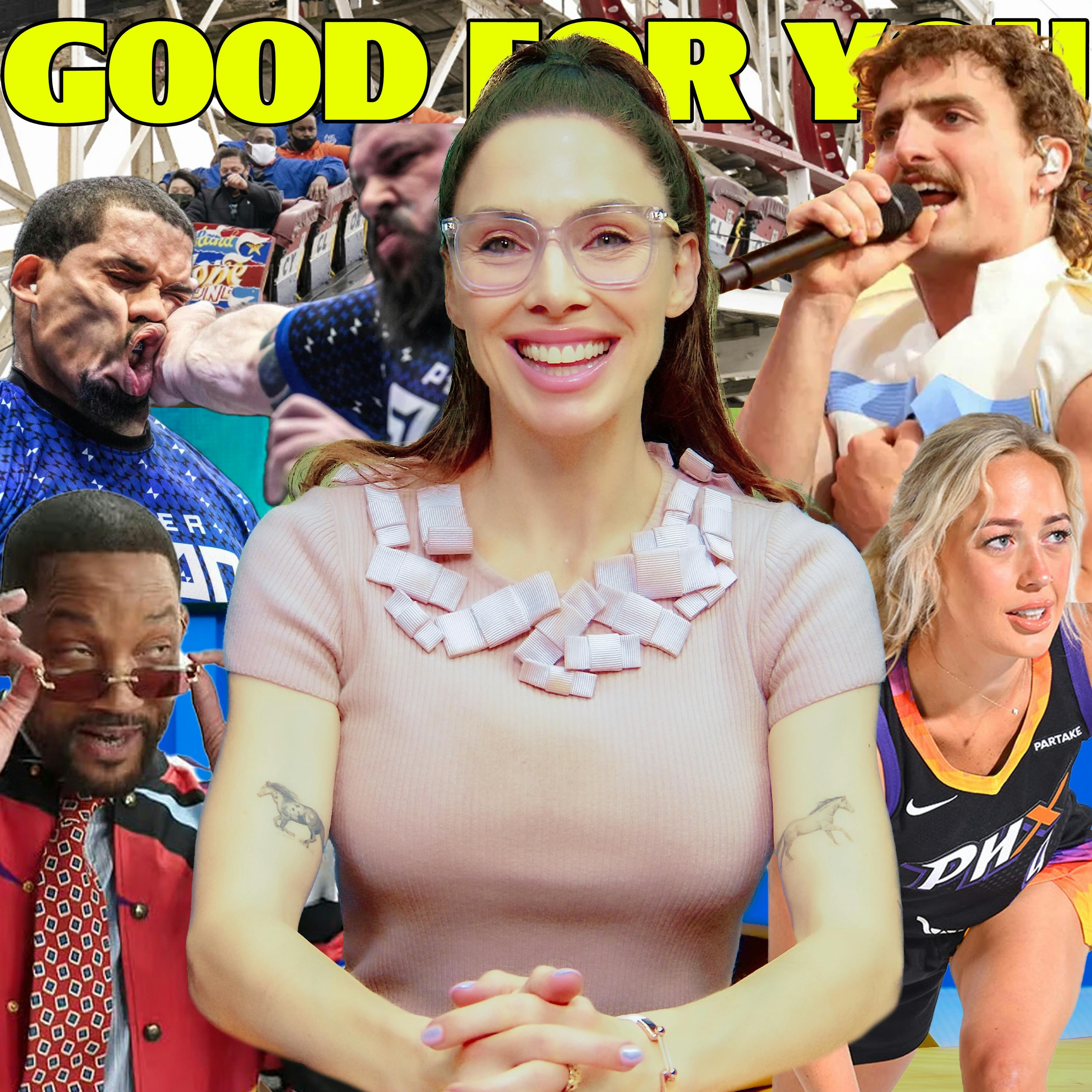
Good For You with Whitney Cummings
Good News, Good Apologies, WW3 and Roller Coasters, Emotional and Otherwise | Good For You EP295
00:47:34
Loading summary
Transcript136 lines
- [00:00]
A
Are we at war? Are we not at war? Like, what am I allowed to say on YouTube?
- [00:03]
B
The way things go in that part of the world, this will probably be cleared up in no time.
- [00:07]
A
You know how much men hate fighting.
- [00:08]
B
You know, the trend that I've noticed is that everyone that's getting all trigger happy with the big war machines, they all happen to be towards the end of their natural life. It's as though they've been repressing this forever. And right before they know they're going to die, they're like, I gotta drop bombs on people.
- [00:28]
A
When people talk about, do we need age limits for judges and age limits and stuff like that, usually you think of it in terms of like, well, this person's out of touch or this person is a. We don't think about it in terms of like, this person has like nothing to lose in six months to live. The biggest mistake that all of these dudes made with nuclear warheads, I believe is saying there's a button. You know, like there's a button. I now have a son. He is a year and a half. If I have learned anything, it is that men love buttons. They love buttons. They need to press the button. If you tell them not to press the button, they're going to get to that. But like, press. There's something about pressing a button that has to. If I see a button and someone's like, don't press that, I'm like, I will never think about that button again. They should have called it something totally different. They should have called it the nuclear G spot. Maybe that would keep them away from it. People are like, I can't believe America did this. You can't. This is what's different than me and most people that are so outrage, like, I believe there will always be war. I thought it was weird that there wasn't a war.
- [01:23]
B
This whole, like, since there's been seven people, there's been more.
- [01:26]
A
People think history's over and that it's not still happening. Like, we think that because our social media feeds are all like inspirational quotes that the bad guys just read our social media and we're like, what am I? What am I doing? What am I? They don't read your Instagram Marilyn Monroe quotes. Like, the leaders of the Middle east, they're not, they're not watching Brene Brown TED Talks. The more self help books that come out, the crazier people have become. Social media addiction now is disguised as using social media to watch clips about addiction. And then I send it to people I'm like, you want to do this drug? Like, it's psycho. Maybe when you grow up in a home that has a lot of fighting, like, nothing surprises you about fighting like the people that are like, we're at war. I'm like, did your parents, like, read to you together and go back and forth with baby mommy shark and daddy shark? Like you had ever. The whole cast was there. Like, I don't like what. What went on in your childhood. That countries fighting is shocking. We fight. That's our thing, right? All mammals fight. There's now a show called Slap Fight.
- [02:25]
B
That's the best one anybody can play.
- [02:28]
A
Teenage boys push over cows when they're asleep. Have you ever watched a hockey game? The guys are ice skating and then they just start fighting. You're like, you were just gliding across the ice. Guys fight with strangers in bars on their birthday. We are violent people, right? And anyone who is elected an official is mentally so corrupted and such an egomaniac by nature. How could they not go to war? It's like winning the presidency is the equivalent of taking every blue chew, all of them. At that point, if you're the president, women weren't enough for you. Being a senator wasn't enough. The local mayor, like, you have to be the president. That's not enough. Now what? Maybe my brain doesn't go to outrage around this because, you know, it's like, if you're dating a musician, don't be surprised he uses all your favorite nail polish. You know what I'm saying? I feel like a lot of people that are outraged about this don't know anyone in the military. So my friends in the military, it's kind of. It's kind of wild, their reaction when I ask them about it. So non military friends will be like, this is disgusting. This is despicable. And this is a humanitarian. And then when I text my friends in the military and I'm like, hey, what's going on with this thing? They're like, let's meet in person. I can't say it over text. And I'm like, wait, hold on. What? Like what? They're like, let's meet in person. I'll explain everything. I'm like, just send me a voice memo. They're like, I can't. So I'm like, not that I know the answer. Like, I'm meeting with a friend of mine who's in the military on Sunday. I'll try to get like all the tea. Cause I said, I was like, can you come on the podcast and Explain. And he was like, of course not, you idiot. I feel like maybe the government's best move is making us think that they're all complete, like morons that can't, like, read. They've gotten us to go like, these idiots in office. I missed the desk again. Unbelievable. So everything I say, just take with a grain of salt because twice now I've missed the desk with my own elbow. So if you get mad at me in the comments for using my platform irresponsibly, just know I can't even find my own physical platform with my elbow. So we just go like, the government's stupid and no one knows what they're doing. But there's probably, like, people in there. They're like, yeah, we want them to believe that. Right? The government is Jessica Simpson, and you cannot change my mind. She got famous making everyone think she's an idiot and she doesn't know the difference between chicken and fish. She's got a billion dollars, $1 billion.
- [04:48]
B
She's like, well, how'd that happen?
- [04:50]
A
You know what I'm saying? Like, went on. Ellen pretended to be dumb, leaned into it. Meanwhile, I believe the government should tell us everything. But just remember, sometimes when they do that, there is chaos. We're like, they need to tell us everything that's going on at all times. If they told you some stuff about the other countries that maybe we have beef with, then you would fight the people who immigrated here to leave that country at the Macaroni Grill. So hate crimes in America go up when you're told the truth about other countries behavior. They're like, no, we came here because we hate them too.
- [05:26]
B
Yeah. You know, we're just as powerless to verify that they're telling the truth when something leaks as when we think we're being lied to.
- [05:32]
A
The only thing crazier than being mad about a potential war is is the people that are mad about the people protesting the potential. This is like my. This is such an outrage, Rat King. This is like when trolls get trolled. When we're like, these trolls are such jerks. I'm like, you're trolling a troll? Like, how? How did we get here? I want out of this funhouse matrix nightmare. I think if you're truly patriotic, you will support protests even if they're ridiculous. Here's why I believe the point of protests and is so that the goofballs who are protesting who throw soup on paintings or whatever. The idea is this gets filmed. It's not for us. It's for other countries. So that other countries think that most of us hate war. You know what I mean? These protests are good PR for other countries. So they don't think we're all sociopaths. You know, like, anti war protests in America are good. Then other countries go see, they don't want war. Look at that. It's mostly good guys who don't agree with their president. You know, look at these guys. Look at them. Look at these men. They've got man buns and crocheted hats. They're. They're protesting the anti Armenian genocide out of nowhere. Let's. You know what? Let's just get the embassy over here. Let's not. They seem like good people with a bad leader. Does that make sense? Like, they're like, look at those young people. We can't bomb them. They're saying that they're saying no to war in Iran. We can't kill them. They may move here. They love us. They can't find us on a map. Right? Little do they know that the same protesters think that their Iranian Uber driver is kidnapping them. It's good. It's good for young people to protest war. It throws other countries off the trail. Here's my question. People are like, why? I can't believe this is happening. Why wouldn't it happen? This is what's funny. Because when I go, how could there be a war? There's the Internet. We thought that the Internet was gonna get us all on the same page or something, right? Like, the thing that's designed to boost posts based on conflict was gonna reduce conflict. In what world isn't Also the economy's collapsing. Isn't war, like, the only job left at this point? I mean, people don't even get married anymore. That was the one place that there was money. Thank God for cancer, or else we'd have no economy at all. Senior assaults are up. People are beating up old people. I mean, this is. Honestly, I blame social media for. This is one thing I do really blame social media for. Because people are like, social media gives the unrealistic body standard. That's always happened. Kate. I grew up literally idolizing Kate Moss, whose thighs didn't touch. She looked like the COVID of National Geographic. She looks like the Vietnam photo of the girl running from the napalm. Like, that was my body image paragon. So the thing that does bother you about social media is the way that they, like, you know, all these, like, memes and stuff that are like, Gen Z can't buy a house. But anyone who's 80 years old bought a house for like two bits and now they have $3 million. That's like a big sort of like zeitgeist thing on Instagram. Everyone's mad at old people for having owned property. Am I just in that algorithm? Is that real?
- [08:45]
B
They're living longer. That's the main thing.
- [08:47]
A
Yeah, how about this? Get in her will be a cool grandkid.
- [08:53]
B
Go watch TV with them.
- [08:54]
A
Go watch Roots, which they think is a comedy. Okay. Just go watch John Wayne. Cause over there it's not canceled. Being bad at old people is so crazy. Like yeah, an old person used the wrong term. I'd hope so. I'd hope that the seven year old man in your life doesn't watch Euphoria. I'm glad he doesn't know the cool terms that that would mean he hangs out with kids. We talk about racism and sexism and homophobia. We don't talk about ageism. And that really grinds my gears, you guys. That's a bee in my bonnet. As someone who Talks like an 85 year old man, I am offended by this. A lot of cancel culture was that it was like it's sex worker now. Okay, well when he was 20, I'm pretty sure it was subhuman. Trollop. Most old people I run into are actually on their best behavior. Okay, like why are you mad at someone who can hardly see you? He can't see see you as someone who I think might still be liberal, I think but pushes back on liberal people being hypocrites, which is why people are like when he's red pilled. No, like you criticize your own football team, right? Like you'll watch your own football team and be like, oh, that was a stupid play. Like I'm an Eagles fan but Michael Vick, I was like, bye. No, not doing this. Yeah, I am. My brand is self cannibalizing. My brand is to criticize the thing I love the most.
- [10:27]
B
You're like, who's with me? Yeah, you're next.
- [10:29]
A
I don't think that it helps anyone to just like pretend the side you're on or the team you root for or the person you're with is endlessly flawless. It's also not possible. But the point is liberals whole thing is we need to help the vulnerable, protect people, universal healthcare for all. Love it, great. But if you're 70, you're dumb and shouldn't exist and should die because you don't talk exactly like me. Old people are fun, dude. I like instead of focusing on that and a Bunch of conflicts that I may or may not understand. You know, I've been watching all these videos about Iran and the revolution and women, and on one hand, it's like, you know, they don't have any rights, and on the other hand, they're the most educated. I think, like 65 to 70% of all women are in a college. Graduates and PhDs are women over there. I don't know which is its own form of imprisonment. What am I saying? I'm like, women are oppressed over there, but they also have the most PhDs. I'm like, wait, that's the same thing. Having to study a bunch of science and medicine that's going to be obsolete in two years. That's actual prison. What am I saying? I like to focus on things I can control, and that is things that are going wrong here in America. Okay, let's focus on the real dangers that we need to deal with, which is that, did you know roller coasters are just flying off their tracks?
- [11:47]
B
That's the infrastructure we need to be fixing.
- [11:49]
A
I'm telling you, first of all, imagine being a person that needs to go on a roller coaster in 2025. Even the roller coasters are like, what are you doing? I just shut myself down. It's 2025. It seemed like enough of a roller coaster. I figured maybe you didn't need me. So I was like, I was on a break. My wheels aren't even on you guys. We're not even. Do you. Roller coaster injuries are up and no one's talking about this. People are like, and then we're going to war. I'm like, but roller coasters? Is there anything more dystopian than roller coasters in 2025? I feel like everyone is so focused on millionaire mindset and building their own dream that they're not tightening the screw when they do maintenance on the Tornado Fury. Because a lot of people that do maintenance and important jobs, we might be inspiring them too much.
- [12:36]
B
What podcast was the mechanic listening to while tightening these bolts?
- [12:40]
A
Like, walk away from that stupid corporate job and build your. Can you first tighten the screw for. Like, can you just clock out before you listen to Jay Shetty? Can you just clock out before Chris Williamson, please? Like, all social media now is like, don't work for someone else because you're building their dream build. Yeah, no. Well, right now you're not building their dream. You're operating a roller coaster. Okay, maybe stop drinking the WD40 for a TikTok challenge because you're building your brand Put on the screws that hold the roller coaster together. Then you can go focus on your dream. Okay. If your job is roller coaster operator, turns out you can't work from home. There's some jobs you have to go to work. Okay. A lot of things are just starting to collapse in our country. Like a month ago, a bridge collapsed in Mississippi. Second one this year. I don't like this. Cause I feel like there might be like a senioritis, a senioritis vibe of like, what is it called when accidents happen within five minutes of home? That is that like, that's the odds. Just when you're relaxed and you're kind of coasting or whatever. Because I feel like we're in this place where everyone's going like, well, the robots are just going to take over anyway. It's like, not yet. Not yet. The ones that the guy that's building them seems needs to go to Betty Ford for a couple of weeks. Allegedly, the robots have not replaced construction workers yet. We can't keep saying robots are going to do it because they've. Not yet. We're not. We're still driving cars over bridges for now, even the self driving cars and the waymos. We're in the backseat. We're in the car with them. The Key Bridge in Baltimore collapsed. This was a little while ago, but I just like got into this like wormhole. John Hopkins University team studying the risks found that both bridges were vulnerable. The Key Bridge would have been among the top 10 most at risk bridges in the country. Do you know about this? Do you know that there is a list of the top. I'm going on tour in the fall and I'm going to drive to some venues from some other venues. The National Transportation Safety Board, which maybe Elon Musk deleted them, I don't know, has identified 68 bridges across 19 states that require immediate risk assessments. Burning bridges is my literal vocation. It is my brand. And even I think this is crazy. I just. I feel like there's so much we can't control and everyone's so scared of so many things. Can we maybe just like throw some gorilla glue on the turnpikes? I don't want to be the person in 30 years who's explaining to my son, how did papa die? Oh, son, it was in 2025. The Ukraine war. No, son, it wasn't that. Was he in the Iranian embassy? No, no, no, sweetheart. A mass shooting. Nope. He drove to work. Huge mistake.
- [15:23]
B
He crossed a bridge on his way to Six Flags and died on the Green Goblin roller coaster.
- [15:29]
A
The Green Goblin. He died on the pirate ship. He was a pirate. No, no, no, no. It was the one that swings back and forth where everyone loses all their change. What I'm saying is, Iran, listen to me. I'm negotiating for us. There's no need to retaliate. You don't need to explode us because we're already imploding. If you want to destroy our country, just do nothing. Okay? We ignore updating our bridges. We'll take it from here. I know you guys love just hearing me ramble on. Come in person and see me actually do jokes that I. Instead of just frantically scrambling for a take about politics, which I half understand and I'm not completely sure are even real, come see me in Ridgefield doing what I actually do for a living. September 5th, I'm gonna be in Ridgefield, Connecticut, two shows. Then Huntington on the 6th. I'm going to Vancouver on September 12th, and then Richmond come out. I just posted a photo. I found my first boyfriend from Roanoke, Virginia. It's this doxing and we're sitting on a hammock together and I said, if you're David, my first boyfriend come to the shows. Is that doxxing?
- [16:40]
B
You gotta recreate the.
- [16:41]
A
I know, I. Oh, we gotta recreate the photo. He's wearing a Bartman shirt, but like in a cape. Dude. See you September 19th in Richmond and then September 20th in Norfolk. Squarespace. We made it. Look how far we've come, my baby. Everyone who needs a website knows how to build a website. That's kind of the whole point of Squarespace. Squarespace is an all in one platform where you can build a website, sell products, offer services, share content, or grow your brand without knowing how to code. Code for what? For who? Squarespace's blueprint tools creates customized layout based on your answers to a few quick questions. It's like you're dating a website, which we're all kind of doing anyway. Then you can use the drag and drop editor to fine tune it. It's designed to be simple, even if you've never built a site before. You can sell digital or physical products, manage subscriptions, post content, book appointments, launch email complaint complaints. That's not what's written in the copy digital suggestion. That's just my subconscious. Also, that's a good idea. Squarespace. I'll give it to you for free. You can launch email campaigns. Woo. I just jumped to complaints because when I get an email campaign, I want to. It's all in one place. There is also built in SEO tools, Google it analytics and social integrations to help you grow. Go to squarespace.com whitney for a free trial. Chris Cole. Please go to this. And stop with the getting websites on Craigslist or whatever you're doing for your stuff.
- [18:08]
B
Wiring telephone poles.
- [18:09]
A
Dude, you can't just write on the back of a Bed, Bath and Beyond coupon your new website. It's not going to work. Squarespace Use Code Whitney to get 10% off your first purchase of a website or domain. Squarespace.com Whitney Code Whitney. This show is sponsored by BetterHelp. BetterHelp is an online therapy platform that connects users with a licensed therapist. You can meet someone by video phone or message and you can switch therapists at any time. There's 35,000 therapists on the platform. Even more than that, frankly. And more than 5 million people have used the service. Where are they? How come they're not in my Whole Foods parking lot or grocery store parking lot? How come they're not in my comment sections but they're out there? I guess because if you're one of the 5,000 people who have used BetterHelp, you're not going into the comment section.
- [18:49]
B
They've learned to avoid you.
- [18:50]
A
They've learned. No, they have avoidant attachment disorder. Oh, that's what I'm great.
- [18:55]
B
They really love you.
- [18:55]
A
They love me too much. It's overwhelming to them.
- [18:57]
B
They need you to explain that to them.
- [18:59]
A
That's it. Therapy that fits your schedule from wherever you are. Listeners get 10% off their first month@betterhelp.com Whitney that's betterhelp.com Whitney. This episode is sponsored by BetterHelp. Thanks. Honestly, if you want to go to war against America right now, you don't even need to invade us. Just post dangerous TikTok challenges. Get them trending. That's all you need to do. We'll take care of the rest. Thousands of people a week will perish jumping off lighthouses while setting their farts on fire. Okay, sorry. That's dark. That's dark, that's dark. And I'm wearing a picture sweater. So let's like, let's just. You know what? I felt like with all that was going on in the last couple episodes that this could be a good week to bring back our segment. Good news. I think we can all use a little bit of good news right about now. So let's get into it. Will Smith is back in the studio. Don't panic. Don't panic. You don't have to wait another minute for him to rap in the streets. About doing ayahuasca. Also. It's a Deutsche song. Like, it's. It's. He has like a verse on anxiety, which is her song. So I guess he's trying to, like, work with her to try to, like, be liked again or something. I like this. I'm inspired. It is inspiring to know that it is possible to just completely disassociate through life and move on as if you did not publicly embarrass yourself. Just keep going. This is it now there's shame is over. It's canceled. And Will Smith. I'm expected to believe that Will Smith has anxiety. I am expected to feel bad. Good for him because I do. I do. It worked because I was like, oh, buddy. Like, it worked. You think you have anxiety? Grow up. So do billionaires. They have way worse problems than you because they have to stay married to bald women that they don't even really seem to want to be with because if they divorce them, they'll be millionaires, not billionaires. You think you have it bad and all that debt. I was in an Al Anon meeting once and like, Aca Al Anon, where you have dysfunctional relationships with family members or whatever. And this woman came in once. I already knew she was. Do we have a newer for spirit animal? That's not so cringe Hero. She's my hero. She came in pink, neon pink Crocs with, like, Disney like, characters on them. Like, you know, like a bun, like here forehead bun. Like unicorn bun. And she came in, she's like, okay, so I made a lot of progress today. You know, my sister, you know, screamed at me and tried to cut me out of the will and we got in a physical fight and, like, I just left and I went home and I didn't go by her house. I didn't, you know, knock over her mailbox or whatever it was. I didn't do anything phys. I did no physical damage to her home. But I just went to pornhub and put in her email. So she went to sites to make.
- [21:57]
B
Signed her up.
- [21:58]
A
Yes. I went to partybarn.com and I put her email in and said I would like to receive offers. And then, like, she just went to a bunch of websites and put her sister's email in.
- [22:07]
B
She's speaking at a timeshare conference next week.
- [22:10]
A
Yeah, she's just like. I just signed her up for the DNC and the RNC said that she would get emails every couple hours. And I was like, I love you. It made me laugh so hard. Anyway, More great news. The JD Vance leaked audio where he's saying, elon Musk, he's doing my job. He's embarrassing us. That audio. He's making us look bad. He's making me look bad. Looks like it's fake. Great news, because I got the benefit of thinking it was real. All the schadenfreude. And then I got the benefit of the relief of it being fake. Don't underestimate this whole new drug that we're going to get from AI where you think something's real and then you're relieved that it's fake. That's the roller coaster I'm on. So it's like this. This amazing new feeling that I didn't even know existed. I guess it's like a haunted house when you're like, oh, it's just a. You know, like, that's what you're getting now. So the good news is that the news now is just a haunted house. Great news. This is. We sign up to. We wait in line to go see them. We have a holiday about it. We get to do Halloween every day. I don't feel like I've been hoodwinked by AI. I get to go like, oh, my God, this is so crazy. And then I get to like, whoo. It's not the apocalypse that I thought it was, you know? So, good news. There's a new drug on the market, and we're all gonna be forced to take it. Some more great news. I have a crush, you guys. I have a crush. Now, we all know I'm gay, right? I would. Look, I don't. I've dated. I dated a girl, but I live in Los Angeles, and the men are so effeminate at this point that I actually think dating a woman is, like, the straightest thing you can do. But I have a girl crush. Her name is Sophie Cunningham. Do you know Sophie Cunningham, Pat?
- [24:07]
B
I'm gonna look her up.
- [24:08]
A
Pat doesn't watch the WNBA talk. Oh, no.
- [24:11]
B
I don't know who this is.
- [24:13]
A
She is Caitlin Clark's bodyguard now, because basically the WNBA refuses to protect Caitlin Clark. And she gets hit and she gets knocked out and all these, like, cheap shots, stuff like that. The refs don't do anything. They don't do anything. Sophie Cunningham, who's also the same team, she's basically, like, now Caitlin Clark's henchmen. So someone, like, flagrantly fouls Caitlin Clark. She's a total class act about it. And then later, Sophie Cunningham had just had it. She just had it. And I love it. She is everything I want in life. And by the way, she knew she was going to get fined. She knew she was going to get in trouble for it. She was fined 400 by the WNBA for a flagrant too foul on J.C. sheldon. I hope J.C. wasn't hurt. I'm not trying to condone violence, allegedly. I just. This is my type of person. And it is so rare that on social media I see my type of person. I don't condone violence. I think I Can we write that on the screen or something. But this is just. This is what I needed. I needed to see. It was such a relief to see someone just go, no, no, not in a comment section, not with no receipts, not with any of that. Like Caitlin Clark. She gets pushed and pushed and pushed it. I love it when a girl can't defend herself and then a girl's girl comes through. That's my kink. Kay. I love this moment because to me, it is the physical manifestation of when at least sane women retaliate. They've let so much slide, right? And we gotta stop letting stuff slide only because this is what it gets to. I love this so much because I am her and she is me. And for everyone that thinks, like, Whitney's too much or like, why are you yelling? It's because I grew up in alcoholic home and no one could ever hear me and I had to shout. I need. I'm working on it, but. But by the time I get to the podcast and talk about something, I've bit my tongue for too long. Do you know what I'm saying? Like, Sophie cutting him. Like, you go, like, well, that was dramatic. It's like, no, she's been restraining herself for so long. Like, this is every woman who's ever dated Jared Leto who's now on TikTok. Just like, yo, guys, how come no one cares? Why doesn't no one care? Jared Leto? Like, is it cause he wore dressed as a cat at the Met Ball? Like, something about Jared Leto? Like, no one seems to really care. This is. This is me when I post about a giraffe. Like, know that Whitney's posting about rescuing giraffes. She's crazy. Just know that for six months, I've not said anything Dan Bilzerian. By the time I got in a fight with and blocked proudly by Dan Bilzerian. I mean, honestly, whatever happens with my career at this point, I don't really care. I've made it. I've been blocked by Dan Bilzerian. Like, I am the person I want to be. Uh, I am so, so proud of the woman I've become. Know that I let things slide when he was, like, abusing bears at parties. Like, I let a lot slide by the time I posted. It's just. Here's what's amazing about this story, is that no one's mad at her, from what I can tell. And I was like, here we go. Like, everyone's gonna go through her old tweets and they're gonna find her Halloween costume from when she was 18 and had just seen Miss Saigon and read Memories of a Geisha and really just loved the geisha outfit. Oh, no, that was me. But it didn't happen. She didn't. Nothing happened there. This was like a cancel proof move. So when people are like, why did I get canceled? It's like, because what you did didn't have integrity. Like, you were cheating in some way. I just. Am I sick that I think this is integrity? This is. This is what trolls don't get. If you're going to troll, all you have to do is defend someone else. When you attack someone else, do something with integrity and have the motive. Be with integrity or let us know you're capable of it, and then we'll go along with it. We'll go along with your, like, shady move. So, like, next time you want to be like, you know, Hutta. Hutta from Lizzie. Love Island. Right, Love Island. I've been. I've been watching clips of Hudda from Love island obsessively. I like to watch things in pieces because I don't like being blindsided. So I'm consuming all of the clips of Hudda on TikTok, and then I will watch the entire show. Thank you. It is called Asperger. So next time you want to be like, hud is a psychopath, just also defend someone else. And you're good. Be like, I feel like we were a little too rough on Lindsay Lohan back then. She was very young, and Hud is a psychopath. Just do it like that. That wasn't so hard. Like, but I just. I love that no one's mad at Sophie. Like, her jerseys, like, sold out right away. Like, when you push back and it's justified, no one's mad. As a society, we're fine with you defending yourself or getting in a tiff as long as it's physical and as long as you are a beautiful blonde. My biggest mistake is I was not blonde at the time that I defended Lana Del Rey and Joey Diaz and Sabrina Carpenter. I realize that now.
- [29:12]
B
All of those elbows were illegal too.
- [29:15]
A
I do think this is a turning point in culture where we now will pivot back to defending ourselves physically. And I like it. Morgan and Morgan. This is a paid advertisement for Morgan and Morgan. But don't worry, I'm not getting paid that much and the money will go to tchotchkes on Etsy, Etsy, Etsky. Etsy needs to make a ski section after an accident. Insurance companies often delay, deny or underpay claims. The longer they keep that money, the more they make from it. Morgan and Morgan is usually going after the insurance companies dorks, not the people involved. But in court, insurers try to make it look like they're the ones paying. They're not. Their goal is to protect their bottom line. In one Pennsylvania case, the insurance company offered 500,000. Morgan and Morgan helped secure 29 million. Wait for one accident. Can someone please rear end me or Sorry, that was for OnlyFans. In another Florida case, they offered absolutely nothing. The final verdict was 20 million. Morgan and Morgan is America's largest injury law firm. If you've been injured, you can Visit for the people.com Whitney or dial pound law. That's £529. Again, that's for the people.com Whitney or pound law Attorney Advertisement Results may vary. Not a guarantee of outcome. Visit for the people.com for full disclaimer. This segment is sponsored by Ground News. Ground News is a website and app that shows how news stories are reported across the political spectrum. You can see which outlets are covering which topics and how they're framing it, what their political bias is. So there's a bias bar that shows how attention to a story is split between the left center and right leaning sources. There's also blind spot. A blind spot feed, it's called that highlights stories that are being ignored by one side entirely. This is wild, isn't it? Kind of just like where's this been all this time?
- [30:58]
B
It's been people yelling at you that you're reading the wrong thing.
- [31:02]
A
That's right. That's right. I love the idea. Whoever invented this, I love this person who was just like, I'm not going to Thanksgiving this year until there's something called the Ground News app. For example, if the outlet frame frames a story as a whistleblower and another calls it an insubordination. Whoa, Ground News. I need this for my relationship. Ground News lays those versions side by side so you can compare them. Go to groundnews.com Whitney that's ground G R O U N D news. Whitney, you'll get 40% off the vantage plan. So we can block people online. We also, we forgot you can block people in real life. Also, like, we. I feel like we kind of need to go back to that. And when it's for the right reasons, no one's mad at you. So if someone's mad at you about something you said, no one buys that it was for the right reasons. We like this because it was a girl defending her friend. We condone that. Okay, I defended Sabrina Carpenter because she is my friend. Just ask me. Do not ask her.
- [31:58]
B
I'll tell you.
- [32:00]
A
She'll be like, but anyway, I don't know. I got so much hate for defending Sabrina Carpenter. And I shouldn't have said it. I shouldn't have typed it. I shouldn't have talked about it on a podcast. I should have just shoved a hoe. And I didn't. And I will change the way I approach this moving forward. More good news. For the first time in my lifetime, I saw a good apology on social media from someone who acted like a silly goose online. And I think that deserves some positive reinforcement. This girl went to a Pilates class. She came out, like, crashed out, saying, no woman over £200 should be in a Pilates class. We know that yoga and Pilates people are all hanging by a thread. Like, literally in Pilates, you're hanging by a reformer machine. Like, they don't even pretend to be grounded people. I've never had more drama and more toxic nonsense or nastiness directed at me than by people who do yoga and Pilates. I love yoga. I've never tried Pilates. I don't. I'm not big on, like, paying money to get on a medieval torture machine. I don't like bells and whistles. I like to go for a dog so I can have construction workers whistle at me so I can get some self esteem. I do it the old fashioned way. The most brutal people that I know are yoga heads. I'm just saying, the most inflexible people I know spend most of their day stretching, but that's beside the point. They can do the splits, but if you ask them if they can meet you halfway between your house and their house, they're like, well, let's just reschedule. You're like, cool, I'm just gonna drive an hour anyway. Not a surprise to me that someone in a Pilates class was rude about the teacher, Whatever. But you know what? She slipped. She said it on her socials. You know, Pilates is all about controlling yourself. And your body doesn't teach you to control your hands the second you get out of Pilates class. Clearly. You know, they say never go to the grocery store when you're hungry. Never get on TikTok when you're sweaty. I'm telling you, I liked her apology. It made me like her. She, like, owned it. She didn't blame it on someone else. She wasn't like, well, my trauma. Like, she just, I don't think. Right. She was just like, yeah, that was gross. That was not pretty. I'm sorry, I need to go to therapy. Like, it was like, great. Cause here's the. Can we normalize actually accepting the apologies we demand from people? I've seen people apologize for things that were kind of, like, borderline shady. And then the apology made me be like, you're guilty. Or that. Wait, hold on. You're a problem. Like, sometimes apologies actually are worse.
- [34:26]
B
They reveal.
- [34:27]
A
That's it. So I like this. We should just, like, study this apology. This is the way to do it in an apology. You can't blame someone else. That's like 101. You have got to be accountable for your behavior.
- [34:39]
B
I'm so sorry that you were upset.
- [34:40]
A
Yeah. They're gonna be like, you know, I wouldn't have done it if she didn't criticize me and fat shame me first. It's just when I went in, the energy was just kind of, like, negative against me. I don't know. I think she's jealous of me. Like, no. We're going to see a lot more of these mistakes now that we are just live streaming our thoughts at all times and moving forward on this positivity train. Choo choo. Because there's just too much negativity out there. Hot take. I'm going to say it with a straight face. And I'm not going to laugh. I'm looking at you directly. Hmm. I, I, I have to close my eyes. Oh, no. I like Benson Boone. I said it. Why not?
- [35:22]
B
Is that what this is? This outfit's all about today?
- [35:24]
A
Yes. Do you want to borrow my shirt? Why? Why? Half of my TikTok is like, benson Boone sucks. Here's why. I hate Benson Boone. Why? Why can't people be cringy? Why not? People are like, well, he's not authentic. Yeah, he is. He is authentically a pick me dork. Why is that bad? Do you think that all the people you do like who are famous aren't desperate for attention.
- [35:53]
B
Like a rooster?
- [35:54]
A
It's catchy. I like it.
- [35:58]
B
It's like when you're making a smoothie.
- [36:00]
A
And you go, people act like being cringe is a choice. He sounds like a blender. That's what you say. Benson Boone. Coming to love the sound of blenders. Benson Boone on Twitter, you.
- [36:14]
B
Hey, do you get a smoothie after your Pilates class? You're gonna love Benson Boone.
- [36:18]
A
You're one of the few people that doesn't cover their ears when a siren goes by. You're gonna love Benson Boone. I'm just saying, cringe. People say, like, I just feel like there's certain things that are on and off limits to make fun of people about and things that are not within people's control to change. We've decided we can't. Their appearance, their height, stuff like that. People cannot control whether or not they are cringe. No one wakes up and is like, I'm gonna be a. I'm gonna be a loser today.
- [36:44]
B
They're informed.
- [36:45]
A
Yeah. No one's like, I'm gonna be a dork. I'm gonna dress fugly and embarrass myself. Everyone thinks they're cool. You know what I'm saying? Like, the person being like, benson Boone's not cool. Like, but you're talking about how Benson cool is. Benson Boone isn't cool, though. Why?
- [37:05]
B
What's dorkier than what you're doing?
- [37:07]
A
What's dorkier than being like, he's a dork. Like, you think you're the dork police. Like, the only cool version of this is being like, Donald Glover, who's like, they're like, benson Boone. He's like, who? That's the only cool person. That's the only way to be cool, period. Like, he's doing his thing. Like, the people who hate Benson Boone are the same people who post like, be yourself. Everyone else is taken, don't live for the approval of others, have the courage to unapologetically be you. And then they're like, I hate Benson Boone. He took my advice. Like, what an idiot.
- [37:42]
B
Look at him going for it.
- [37:44]
A
Yeah. Like, what is it? What is it? Pat explained to me why people are so mad at Benson Boone, and I think I get it.
- [37:50]
B
I heard it on the radio or somewhere. Where I didn't radio. Where I didn't.
- [37:53]
A
The radio. AM or fm.
- [37:55]
B
I think it was AM radio. Yeah. At the. At a diner.
- [37:58]
A
Yeah, yeah, yeah. Okay.
- [37:59]
B
As you do.
- [38:00]
A
And this podcast is.
- [38:02]
B
I heard his voice, and I was like, oh, that's like a big, powerful, loud voice. And it's not Like a hip hop voice, which is almost all the new stuff that's being pushed on everyone. I was like, oh, there's. There's a new rock and roll singer out there.
- [38:14]
A
It's a new Sean Tous in town. Cool. Cool.
- [38:18]
B
I. I was like. And then, and then I was. It was brought to my attention the video for that song where he's like, out in the country and it kind of looks like a truck commercial.
- [38:28]
A
So the first song. He's out in the country.
- [38:30]
B
He's got a hipster stash. He's got a, you know, he's got the jeans and the leather.
- [38:34]
A
Already not cool, so. Already not cool.
- [38:36]
B
I think there's a pickup truck in the video.
- [38:37]
A
Okay.
- [38:38]
B
Very, very currently cool, which is this.
- [38:43]
A
Country mainstream Brooklyn maga.
- [38:46]
B
Main mainstream country with the Brooklyn hipster sort of fused together. It was like very perfect timing.
- [38:52]
A
Okay.
- [38:53]
B
Then he becomes incredibly famous.
- [38:55]
A
Williamsburg, Wyoming, there.
- [38:57]
B
Yeah. Yeah. Great shopping.
- [38:59]
A
Okay.
- [38:59]
B
And then the next thing that I saw of him on the Internet was.
- [39:05]
A
After that got big.
- [39:06]
B
After that got crazy huge. The next thing that. That came up on my screen regarding him was he was roller skating around all oiled up with denim jean shorts and sparkling rollerblades. And I. I said, the range.
- [39:22]
A
The fact that you haven't had me do this exact thing on the podcast means you are a saboteur. That sounds like a good idea to me. Are we jealous? What's.
- [39:30]
B
What is it like, anyone who jumped on board right away?
- [39:34]
A
Yeah.
- [39:35]
B
I think being in. Being oiled up with jean shorts and sparkling rollerblades, you've just alienated a bunch of your audience. That's like. That's our.
- [39:45]
A
Yeah.
- [39:45]
B
Hipster country dream guy.
- [39:47]
A
Yeah. Yeah. But can I ask you a question, though? I. I'm with you. I'm with. Yeah. Like, he's got.
- [39:51]
B
He's doing too much.
- [39:53]
A
Signed and got a stylist and got like art director. But here's the thing. And go like, oh, he's like a plant. Or he's been. What's the word? Like commodified or commercialized to be mainstream. But in every. Most Sorry countries. That's not like China's like, we don't do gay. Middle east is like, we don't do that. No, no. It's not about.
- [40:11]
B
It's not about gay and straight. Oh, in.
- [40:14]
A
In gay baiting.
- [40:15]
B
In. No. Well, in. I'm sure.
- [40:18]
A
Sorry. We have to decide who's into naked on roller skates. We don't know who's into it.
- [40:23]
B
I don't know. It's A mystery. I'm. I'm testing it out this weekend. Styles that are too broadly separated, happening within the same album cycle. While your first release has you going from someone who auditioned on a TV show to, like, you're the big main act at the Grammys.
- [40:42]
A
Yeah.
- [40:43]
B
Is hard to keep up with as a fan. And because it's moving and changing so quickly, most people that are actually, like, music fans, that's, like, their biggest personality.
- [40:54]
A
Some people don't have a personality, though. What? So we're gonna bully people that don't have personalities?
- [40:58]
B
Some people don't even care about me.
- [40:59]
A
Because also, by the way, that. Shouldn't we be pro imposter syndrome? Shouldn't we root for people with imposter?
- [41:04]
B
Well, just being on American Idol, you've signed away.
- [41:07]
A
At least he was on American Idol.
- [41:09]
B
At least. The first part of your career belongs to the companies that own American Idol, by the way.
- [41:14]
A
Love that. I have a really strong opinion, and I'm like, so who is he? Please. What annoys me about it is that it gets me. It gets me. I feel like he's got a great voice, he's got a mental operator, and when I'm alone, it's my favorite song. And when I'm around everyone else, I'm like, lame. I think maybe it's because I'm a comedian. I believe that music that makes you laugh and feel ridiculous. I enjoy that. Thunder. I think it's funny. Thunder sale while nation members sale. I'm like, do I like this for real or do I just think it's funny?
- [41:46]
B
Well, that's hilarious. That is genuinely hilarious.
- [41:49]
A
I love something. You can just be like, pl. Who's the person of all the villains in the world right now and all of the Dr. Oz, whatever people are like, you know, who needs to get out of here right now is the guy in the glitter jumpsuit who is losing a sperm a second in his outfits trying to dazzle. He. He. I feel like he's like, for China. I. When I see people like that, I'm like, oh, good. He's like, china. He's for China. Fine. Fine. Look, we had Sugar Ray. He's like, should the Sugar Ray of 2025 or what? What is he like, the. The 311? When I hear someone say, like, about a really famous comedian, like, oh, he's not funny. Like, he's funny, or she is funny to their fans, but what you're really saying is, like, their fans are stupid if they think that's funny. You know what I mean? Yeah, it's funny. Subjective, like, to this, I guess maybe me, I'm pulling a, you know, Sophie Cunningham here going like, hey, the people who, like, what's his name? Benson Boone, maybe they just need a bop because they work in the Amazon warehouse and they have to poop in a jar in between deliveries. Comedy is for people who want to escape their circumstances or not have their own inner monologue run the show at all. They want to laugh. They want to. Right. And people that don't like comedy, your lives are probably just so good that you don't need to laugh. I'm happy for you, but it's not for you if you're actually, like, in a dark spot. You want just like. Like, I don't want to have to, like, think about, like, I don't want to be like, eric Clapton saw you. I don't want to hear Eric Clapton singing about his son jumping out of a window. Like, when people do. I'm like, is your life so easy that you can just picture this and dance and sing along?
- [43:40]
B
Well, when I heard that song, immediately I thought about Halloween and scaring trick or treaters when they reach for the bowl.
- [43:47]
A
Please stay. That's such a funny thing to put as you're. Like, when someone's leaving your house.
- [43:55]
B
Yeah.
- [43:55]
A
When someone's like. Like, the welcome map goes. Please stay. I think I'm also projecting because I feel like I was kind of pushed by the industry onto the public when I was in my 20s and would wear, like, T shirts with sparkles. And, like, I was trying really hard.
- [44:12]
B
Yeah.
- [44:12]
A
You know, to, like, be entertaining. Like, I wasn't cool at all. And no one's cool in your 20s. You're like, you know, I just. It doesn't every artist that starts young kind of start like this. Like, Ariana Grande has to be like, oh, God, please don't.
- [44:27]
B
Like, you saw him in those sparkles, and you were like, go easy on him.
- [44:30]
A
Guys, guys, I know every time I defend someone, it's really me defending myself. Always, always, always. Not that uncool, which is literally, don't ride elephants is because I rode elephants 11 years ago in Thailand. Only one. I was, like, jumping from elephant element one time. As soon as I got on, I was like, this feels wrong. This is wrong. And I looked down and I saw chains on their feet. And they told me it was a sanctuary. It wasn't a sanctuary. They sold elephant skeet, skeet to zoo. Like, I was like, so now I say, don't ride elephants at the end of every episode because of. It's all just. You point one finger at others and you point three at yourself. Huh?
- [45:04]
B
Yeah, big guy, too.
- [45:07]
A
Whenever I defend people, it's so funny because, like, the Lana Del Rey thing, like, I defended her publicly. I got so much, like, Winnie's, you know, publicly defending her because she's a woman who, you know, is getting canceled, and she's getting canceled, and she sucks and Winnie sucks and all this stuff. And then I felt, like, so bonded to, you know, I did my, like, like, Sophie Cunningham thing with her, like, on my, like, blog at the time, and then I ran into Lana Del Rey, and I was like, hey. Like, hey, like, it's me. And she was like, do you want a photo? I was like, the key is defend the indefensible. I guess I'm always just looking for something to argue with people about that's not politics. And I just. This is the takeaway. There's other things to argue about. Okay. Doesn't have to be our president. Doesn't have to be politics. It can be Benson Boone. You're welcome. Don't ride elephants. That's not. Oh, God. Can we even do that? Oh, God. How do you. Wait, I'm stuck. How do I put it down? Go. How do I put it down the back?
- [46:14]
B
Just keep the hand. Keep the elbow bent as much as you can.
- [46:18]
A
Oh, no, I did a salute. I can't get out of it without pulling into lawmakers.
- [46:23]
B
Comb your hair back.
- [46:23]
A
Okay? I have to.
- [46:25]
B
There you go. Keep that elbow bent.
- [46:28]
A
Oh, God. That could have gone real Reddit meme real fast.
- [46:32]
B
Yeah.
- [46:32]
A
Oh, God. That was a close call. I'm gonna say bye like this from now on. Sal.
- [46:56]
B
Sat.