← Good For You with Whitney Cummings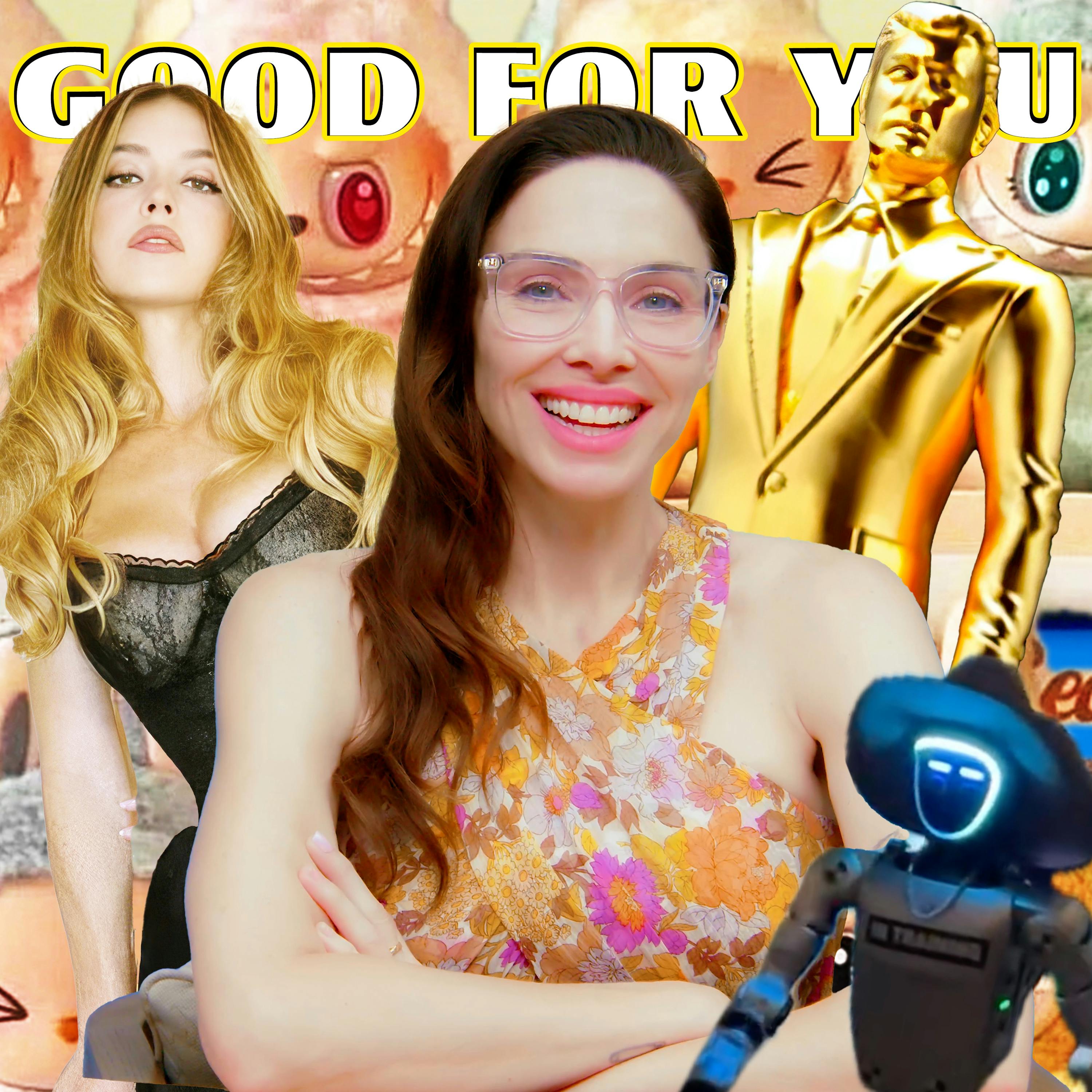
Good For You with Whitney Cummings
The Sky Is Falling, Robots Are Rising, and My Labubu Smells Like Trump
00:50:40
Loading summary
Transcript103 lines
- [00:00]
A
Comedy. You need it. It's medicine. How about this? Stop going to the doctor. Delete WebMD from your search bar, your top favorites. What's that called? Why can I never get that Marks? Bookmarks. I just am sick and tired of computers trying to pretend they're books. MacBook. It, like, tricks you into thinking there's something like brain building about it.
- [00:26]
B
M. And it's not just a fishing lure.
- [00:29]
A
It's the opposite of a book. Whatever. Like, whatever effect a book has on your brain. It's like, literally, it's like how pharma is meant to sound like farm. So you think it's, like, natural.
- [00:39]
B
Pat, I looked into that. That's not. That's not accurate at all.
- [00:44]
A
Oh, it's a co. Oh, Pat's over here on.
- [00:46]
B
Feels like a coincidence now.
- [00:48]
A
Okay, give. Where. Where did you look into it? Pharmaceuticals.com.
- [00:51]
B
I think the word farm came after pharmaceuticals. Pharmacy. Pharmaceuticals, yeah.
- [00:58]
A
What does pharma mean then?
- [01:00]
B
I mean, I can give you the origins from.
- [01:03]
A
Okay, from what?
- [01:04]
B
Trusted sources on the Internet.
- [01:06]
A
Let's go, Pat, please. Oh, I'll. I'll cancel everything I was going to talk about today to get to the bottom of this. Pat, if you want to get in some etymology. Yeah, let's go.
- [01:17]
B
It originates from the Greek word for pharmacon, which initially referred to a drug, poison, or charm.
- [01:24]
A
Hold on. This is even better. That, like, they just admit their poison.
- [01:29]
B
Yeah. I feel like we leveled up this theory that you have.
- [01:32]
A
Okay. Okay. This is one of the very few times that me being wrong has made me more right. Okay. Because the whole point of going like, oh, pharma. They made it sound like farm because they're selling poison, but they're trying to trick you into thinking it's natural. They just said we're poison. Always hiding in plain sight. It's like, you know, the other day I was with. I say this like, it's like, I'm my son. The other day I was with my son. It happens every day. And we were going down the street. He's obsessed with the mailman. That's all he cares about. And I was like, mailman. And he, like, looked at me like, mailman. Because he knows mail and he knows man. And he's. He almost looked at me. Maybe I'm projecting. Like, isn't that redundant? And then you're like, why is it called mailman? Why is it called male? Like, now that I'm having to teach a kid words, I'm like, that spelling. Yeah. That cast a spell. That's what words are used for? Whatever. Male. It's called male. They were like, what do we call this? Well, women can't read. Nor should they. It goes to the guy in the house. Let's just call it guy stuff.
- [02:46]
B
Ladies, you can go back to sleep.
- [02:47]
A
Yeah, you can go. Just give birth. If you die. Fine, fine, fine.
- [02:50]
B
No mail for you.
- [02:51]
A
Just male. It's just called man stuff. That's like, documents involves words, logistics, correspondence, planning.
- [03:02]
B
Yeah, don't busy your little head about the mail.
- [03:05]
A
Wild. I love stuff like that. That's, like, right in front of you, and you're just like.
- [03:10]
B
Originates from Middle English, meaning a traveling bag or sack for personal belongings. So that it is a sack, to be fair.
- [03:19]
A
Yeah. Little male sperm.
- [03:21]
B
Can I have you scoot 4 inches to your right? Perfect. You nailed it.
- [03:28]
A
Better.
- [03:29]
B
Yeah. One hop. It only took one hop.
- [03:30]
A
That's what. That's what women are good for science. Scooting.
- [03:32]
B
Just scooching your boots.
- [03:33]
A
I. I might not. I might not be able to understand any of these big words or big concepts, but I can scoot my tush. Okay, y', all, I'm gonna be scooting my tush to Ridgefield, Connecticut, two shows on September 5th, and then Huntington, New York, on the 6th. I must say, my new hour is very funny. I'm, like, so into my new hour. I've done six specials. Fine. I've toured, you know, for 18 years. But there's times where you're like, I know this is funny, but I'm kind of, like, ready to tape it and be done with it, you know? And I am so excited about this new hour. It's just. I don't. I don't know. It's. I. That's. The whole point is you're supposed to get funnier and funnier, but it cracks me up still. Also, a lot of comedians don't get funnier and funnier because you see, like, big comedians. And stopping making the hahas is because they're, like, fine, private, and they're. And they're out of touch. I'm more in touch than ever, you guys. I'm sober. I'm in airports with a child. I'm more in touch. I'm going to grocery stores with a toddler. I have to talk to everybody, and I have some thoughts about Yalls personalities. Vancouver, Canada. I'll be there on the 12th. Richmond, Virginia. I'll be there on the 19th of September. And then Norfolk, Virginia, on the 20th. All right, let's get to it. The court has made its decision about Diddy. I think the takeaway is that he's a good person and he was wronged and I apologize. He's frankly a role model and a martyr. A martyr for millionaires with sadistic kinks. And everywhere this is a victory for sociopaths not seen since the Winklevoss twins lost to Mark Zuckerberg. I think we're at a place where we feel compassion for sociopaths. I don't know what's going on. Or maybe it's just that if you're implicated in the killing of Tupac and you don't want to be the juror who spends the rest of their life not being able to start your car without being like, I feel like the jury and the judge were just like, we have kids, dude. We don't. He's gonna die soon anyway. It's fine. We don't have to put him away forever. He's gonna slip on some baby oil and crack his skull any day. Let's just let gravity do its job. I mean, look, we've seen this before. Epstein had a full on charge in 2009. He pleaded guilty for soliciting prostitution from a minor and then just like went free and had an office at Harvard. So, like, this is America, okay? It's not just freedom for good, it's freedom for everyone. You know, you can make the argument that these, these sick psychopaths are heroes because they're creating adversity for a generation that is way too entitled. If Diddy doesn't buy Epstein island, I will honestly lose respect for him at this point. This could also be strategic. Pat and I were talking about this earlier. Like, what if they're like, we're going to set you free. You have a year to transfer the VHS tapes to QuickTime and get us the video on Bill Gates. Allegedly. And then we, you know, if you can get us some tapes on. Why do we still say tapes? As soon as Malibu was on fire, I knew Diddy was going to go free. That's what I knew. I was like, all the evidence is gone. Malibu caught on fire. And then the Hamptons, remember? And then Palm beach, which is not weird at all. You had a theory that it was like blackmail, which, by the way, Pat, just so you know, if you guys like. Pat doesn't talk enough, he will say the most genius sort of theory about what really happened, and then he'll send me the cut and it will be all removed from the episode. So he's about to say something genius, but is like, I have daughters. I'm not getting involved.
- [07:22]
B
Blackmail is probably the most powerful form of influence around the world.
- [07:27]
A
The only. What else do you have? I'm going to kill you. Kill me, then what?
- [07:31]
B
I think Diddy and Epstein both played similar roles, gathering material that could be used against anybody who is somebody or could be somebody that is important enough to blackmail.
- [07:41]
A
So do you think that Epstein went free because they needed him to go out and get more blackmail?
- [07:49]
B
I think he literally had blackmail on whoever was charging him that day, and that influenced getting prosecution to drop whatever they were doing.
- [07:58]
A
Also, the only way the FBI and the CIA, the only reason they know anything is because they employ the people that do that. Like Frank Abagnale, the guy that was Catch Me if you can was based on. He pretended to be a pilot. He had all these fake identities and stuff. There was that Leonardo DiCaprio movie about it. And you're like, oh, my God, this. What jail is this guy in? And like, no, the FBI hired him to help them do their job. They were like, you can go to prison or you can come work for us. Like, yeah, that's a tough choice. So I feel like criminals like this, they ultimately have to end up working to catch other criminals. Is that it?
- [08:34]
B
The fact that he had cameras everywhere recording everybody, doing everything that has to mean something to someone else.
- [08:42]
A
What is with you guys? What is with you? Can you just be famous and marry a beautiful woman and then get divorced if you want? And the marriage, honestly, I've never thought I'd say this, but I feel like Larry King did it right. Just married a woman a year and go on with your day. This just feels like so much work. I don't know how much courts even matter that much. Anyway, court of public opinion, I feel like on some level has, like, eclipsed courts. Like Kevin Spacey, I guess, was. Was he ruled innocent, but two of his accusers are ghosts now. So town square come through, baby. And it also is tricky because, like, judges are human beings that have kids in fears and they don't want to have to put nine, you know, barbed wire fences around their house. Like, this story blew my mind. So you know me and that my cause is set the elephants free. I can't take it. It draw. I don't know what in my epigenetic imprinting or ancestral. I don't know what. By the way, elephants being in zoos are the only way that they can stay afloat. If they lose elephants, they basically end up shutting down. So elephants in the LA Zoo, it was like a nightmare. It was a tiny enclosure, whatever. So Cher, all these people went down to try to get Billy the Elephant freed. All this evidence of how Billy was getting abused, this, that, the other. And the judge just went, my kids love going to see Billy the Elephant. And you're like, huh? Like, oh, you can't do the right thing because your kid will have a tantrum. I don't know why that's so mind blowing to me, and I don't know why I'm making the case somehow for AI judges, but let's just move on because it's getting sticky. People seem very upset about Diddy going free, but nothing is as upsetting to me as just finding out that Trump has a new cologne that just came out. Can I have, like, a week off?
- [10:38]
B
They let Diddy loose. They let the Trump scent loose the same week. Connect the dots.
- [10:46]
A
Oh, God, you just ruined my weekend. Now I'm gonna spend the whole weekend trying to figure out the connection between these two things. Like, the President of the United States is promoting his. Can I just call it a perfume, please? I just. Look, we have to pick one. Shame on me for being outraged or upset or nettled by this in the slightest. We either idolize hustler culture or we don't. We don't. We can't have every other Instagram post being about hustling and millionaire mindset and then being annoyed when someone does it. I have to tell this to myself over and over again so I don't completely lose my mind to hawk to a perfume while being the president. It's honestly not something I have a take for. It happened. Trump broke me. Although I am frankly shocked he didn't do it sooner. That's the only. Which is how gone we are. Maybe he didn't launch this sooner because if he had, Elon would have snorted at all. I mean, I don't know. I have a. It's not a take take, but it's just. This is my theory. I've always thought Trump does whatever Vladimir Putin does. Like, I think he's obsessed with Vladimir Putin. Now, I looked up Vladimir Putin cologne being like, this is just a hunch. Sure enough, Vladimir Putin has a cologne. Reading this verbatim, it hit the shelves of some of Moscow's most upscale department stores. It's called Leaders Number One, which is so funny to me. You dork, you are number one because you've poisoned everyone who challenges you. This is probably how Putin turns people into ghosts. It's like a perfect plan. You voted against my bill, and like no hard feelings. I believe in bipartisan system. Here is my cologne. Then a week later, you find out that person's friend just died of cardiac arrest. And you're like, do I call him out for re gifting? If you want to know what's about to happen in tv, movies, Hollywood, look at what South Korea does. Like, we always just kind of copy what they do a little bit later, right? And to know what Trump is going to do next, just watch what Russia did 20 years ago, right? And that, I feel like, is what Trump is about to do. He's in love with Putin. That is my theory. News, for example, like, when I talk to my Russian movers, which I make up things to move just to hang out with them, I'm completely obsessed. Because when I talk to them, like, they are so entertained by how naive we are in America about, like, the new. We're like, the news is fake. They're like, why would you put truth in the news? And everyone would know things and you couldn't get away. Like, what do you. Like, they have no naivete about, like, powerful people are corrupt and they use the news to manipulate. And then when I'll be like, so, does Putin have, like, doubles? They're like, of course he does. You'd have to have doubles. How? Like, it's crazy to them that any leader of any country doesn't have doubles. So Biden doesn't have clones. Are you guys insane? Like, what if he gets sick? You're going to look weak to the rest of the world. We're like, oh, no. We just peddle out guys that can't speak. We just peddle them out. We just. Mitch McConnell, we just let him go into a K hole. On tv, on the news, in their mind, they're like, well, your leader is going to look weak. And we're like, yeah, that's our thing. I guess it's kind of a power move to have had a president that just, like, couldn't finish a sentence and would walk off a plan podium and just, like, not know where to go, because maybe that sends a message of, like, oh, the deep state is so deep, you don't even know who's running things. Like, you had a meeting with Biden, dork. Like, that's not who runs our country. Like, maybe there's a power move and all that. I don't know. Maybe that's like some Machiavellian type of thing. My theory is that everyone in power who has everything, money, fame, whatever, everything they do at this point, because they already have money. They already have fame. Right. That they're doing it all despite some. Someone, a frenemy, an enemy. The person they think is their competition, Whoever, like, reminds them of their dad or their mom, whatever it is, the person they've decided is their, you know, nemesis. My theory is that everyone does things at someone else. So Trump does things at Putin, period, right? 50 Cent has so much money and makes time. Makes time to succeed at Diddy. He didn't have to do Vegas residency. He doesn't have to do anything. He makes time to succeed at Diddy. Troll Diddy, which I support. 50, let me know if you ever need anything. I will write you jokes. I will edit your videos. I volunteer as tribute. So when people are that successful, the only real pleasure they can get, they have everyone's approval. It wasn't enough. They have the money. It wasn't enough. Is to make sure that their competition isn't enjoying their success. They're like, I have it all. But, like, that person also has it all, and I just have to make sure they can't enjoy it. They just are like, oh, I just need to make someone jealous. Like, who is Sydney Sweeney trying to make jealous right now? Every outfit choice is like, who's this at? Is it your high school bully? You didn't get prom queen? Like, who?
- [15:29]
B
Is that a good red carpet question? Instead of, who are you wearing? It's who are you wearing this at?
- [15:34]
A
Yeah, yeah, yeah. Toledo. Where is the person you want to hurt? Just so we can make sure they see this, we can get this to the Kansas City Register if you need to get this at your high school basketball coach. If you thought going to space was weird, get ready for what we're about to see Katy Perry do to at Orlando Bloom. They're getting divorced. So Orlando Bloom just went to Bezos's wedding at Katy Perry, right? Then Katy Perry wore a jacket with no shirt or bra underneath. At Fashion Week, which Fashion Week, I think is about clothes and how clothes look. Math isn't mathing on that. Fine. Who is Trump doing his cologne at? Who's it at? Arnold Schwarzenegger had a clone, and he was probably doing it at Sylvester Stallone. Listen to me.
- [16:20]
B
Sylvester Cologne.
- [16:22]
A
Oh, God.
- [16:24]
B
That's what he named it, right?
- [16:25]
A
Oh, God. Is that real Sylvester Stallone Name his cologne Sylvester Cologne. Did he have a cologne? No, he doesn't have one. Pat, you need to become an advisor to celebrity.
- [16:35]
B
Trademark pending, pending. Sylvester Cologne.
- [16:39]
A
Sylvester Cologne. I make. If you don't make it, I. I will ruin our business. Relationship over this. I don't care. Everything feels more expensive right now. We could have just started there, except. Credit building with Kickoff. This episode is sponsored by Kickoff. Kickoff gives you a credit line that is designed for building credit, not for spending. It reports to all three. This I really needed in my 20s. I really needed this in my 20s. I'm so glad it exists. No one tells you that to build credit you can't pay off your credit cards completely. You have to maintain some of the balance. No one told me that. And in my 20s, I had just. I had so much debt that I was like, oh, I'm just gonna do a debit card. I'm just gonna. So that I don't spend money I don't have. And then my credit got worse. You have to build anyway. This is nothing funny about this. Just saying. I like this company. Improve your credit mix, reduce credit utilization. All key factors in improving your credit over time. Their most popular plan is just $5 a month. That is so worth it. No interest. No. Is this for the social credit score or for credit? Credit? Which credit? Which credit are we on these days? Kickoff users with credit under $600 saw an average increase of 84 points in their first year. And I need you to understand that within the next eight or 10 months, your credit score will be public and posted on your dating app without even your perm. It will be the bio you chose and then your credit score. We are that close to all of your private information being public, so figure it out. You can start building your credit for as little as $1. Your first month setup takes minutes from your phone. Autopay is included and you can cancel it at any time. Kind of like actors. Kickoff has over 1 million users and hundreds and thousands of positive reviews. It's. It's the number one credit builder in the app store. Start building your credit today@getkickoff.com Whitney that's get G E T K I K O F.com Whitney must sign up via KickOff.com Whitney replies to new KickOff customers first month subject to approval offer subject to change average first year credit impact of plus 84 points based on users starting under 600 between January 23rd and January 2024 who paid on time and had no new delinquencies. Late payments may negatively affect your credit. This is a paid advertisement for Morgan and Morgan. But I don't need to get paid to say this, okay? Because you know what really grinds my gears? Injustice. It's my. I was gonna say kink, but I do know that Morgan and Morgan once did not appreciate that they were on the Angela White episode. So I'm just gonna keep it pg, but thank you, Morgan and Morgan, because Morgan and Morgan fights back. They're usually going after big insurance companies, not the individual at faults. We've all been. We've all made mistakes. In court, though. Insurers, they try to make juries think the payout is coming from a regular person. It's not. No, no. It's coming from an insurance company. A scam. One client in Pennsylvania was offered 500,000. Morgan and Morgan helped secure 29 million. Another case in Florida. The offer was zero. The final result was 20 million. There's a reason Morgan and Morgan is America's largest injury law firm. If you've been injured, Visit for the people.com Whitney or dial pound law. That's pound 529 again for the people.com Whitney or pound law. Morgan and Morgan, I am begging you to open an emotional injury firm as well. Attorney ever. By the way, I just missed my hands. I was like, I'm going to make a joke and then I miss my fingers. So. Attorney advertisement. Results may vary. Not a guarantee of outcome. Visit for the people.com for full disclaimer. Do not make your decision based solely on this ad. Services may be performed by others. No representation is made without your legal rights. Every case is different. Look, most of what I do, it's at, like, one MySpace troll from, like, 15 years ago. There's a couple people in my head where, like, when you're, like, getting dressed or getting writing jokes, you're like, they think that's funny. You can use it in a positive way. Because when I post something, I'm like, if Chris Rock sees this, is he going to be like, you know what I mean? There's. That's good. It's like, healthy keeping your standards high. Trump has. I feel like he did it just for this. He. It had a cologne come out just because he had a video of Joe Biden smiling at him and, like, hugging him. Right. And he's using that as the ad. The level of hilarity is unmatched in doing that. So president has a cologne, still doesn't have a dog. I do believe this is the natural evolution of someone who has all the money in the world but no animals. This is what it does to your brain. Like, if a dog isn't a man's best friend, it's going to be a little bottle of cologne shaped like you who smells like you. Like, he's Just making, like, ultimately just dolls of himself. Also, like, the pee tape, it might be at something in the past. So there's things that I do at me having blue hair where I'm like, I just have to undo having blue. Like, I got to stack Google, like, the first couple pages. Like, I'll be like, should I go to this, like, a charity event? That's like a fake scam so rich people, like, don't have to pay taxes. And I'm like, yeah, I need some photos to push down some of the pandemic photos. So it's also maybe just to push down the pee tape stuff. I don't know. But you know that I don't. I'm gonna bring it up.
- [21:43]
B
I think it's unfortunate that it's equally as distracting as a potential nuclear war in the Middle east for the new cycle. Having a cologne drop.
- [21:52]
A
Yeah. You think the bombs dropped hard? There's a lot. I know. I should be talking about the robots in Austin. Pat, you sent this to me. Robots are out in Austin. It's near 6th street, right? This is. This thing has the best motor skills I've seen on that street. It's showing off of all the drunk maniacs who live there. I don't think this robot is, like, that impressive. I think everyone else is just, like, doggy crab walking from bar to bar. It's very hard to tell. Listen to me. Girls aren't scared of robots. This is the first time men have ever had something above them on the food chain that could maybe snap. We're used to. We've got you. I look at that street, Men are like, look at that robot. It's so scary. I'm like, look at all those men. They're in groups. Why are they in a group? I'm not scared of robots. Robots have the potential to defend us from drunk guys, you know? And look. And also, allow me to remind you, just as everyone is getting very dramatic about the robots, this is the least crazy thing going on in the world right now. Don't get distracted. People are collecting labubus, and I am one of them. I'm coming out. I got one off ebay, and it's a blind box, so I don't even know what color it is. First of all, I'm a doll guy. Now it happened. People feel so little control in their lives, and they're being run by their inner child. It's such a 100% batting average at this point that we feel the need to collect dolls. Things that are just constantly smiling and smiling at us. You don't collect soft cutie pie dolls as an adult because things are going in the right direction mentally. Listen, we're talking robots and dolls. The future is clear. And the clearest part is that we are not in this future, okay? We will replace humans with robots. Which, by the way, I don't think robots are going to kill us. I don't. I think we're going to die of heart disease because we spent so much time worrying about what the robots would do. The anxiety we have about robots will be so much worse for us than the actual robots who are just kind of trying to help us cook and clean. And we're like, whatever tries to kill me. The robots are like, you're the one that could just like, unplug me if you want. Your phone is at 11%. I'm not going to work that much longer. Like, you're the one who can just press off on the app in your phone. Like, honestly, as soon as WI fi is down, I'm going to stop working. Also, it's not that hard to take down a person who can't cook or clean themselves. If you have a robot cook for you, you are going to starve to death anyway. Like, I don't. Like, why do you need help? Maybe don't give the robot sharp knives and you maybe won't be scared. I don't know. Also, you're the one that can't cook or clean. You don't get to be scared of robots that help you. It seems like you'd rather die than cook for yourself. I am talking to Silicon Valley men. The robots are like, you think I'm going to kill you. Without me, you would starve to death and have flesh eating bacteria slowly kill you because you don't clean yourself. People are so scared of robots. Like, robots can find cancer faster than humans. Everyone's like, it's the apocalypse. My mom might survive breast cancer. No furry dolls that adults collect and hang on their keychain. Normal trending on TikTok. As long as the doll serves no purpose except to repel social interaction, we're fine with it. The robots are bad for humanity. But adults buying little fake friends? Fine. Nothing to see here. We literally look back on Beanie Baby people like, they're nuts. And then we're like, I will suck your dick for a lobo. I mean, as humans. Like, this is our thing though. I'm obsessed with this. It's called Tulip Mania Syndrome. There's a book called Tulip mania about in 1630, there was a tulip bubble frenzy. The Dutch lost their mind. It was like crypto or baseball cards or Pokemon cards or whatever. It was the first recorded financial bubble. I. Only thing I will talk about more than Shirley Temple is this. I'm obsessed. We've done it with all kinds of things. Dolls, collectibles, Gypsy Rose. The. The root of it, I think, is a gambling addiction. Like, the idea of, like, I need the. Because they didn't even know the color of the tulips. They were, like, killing each other in the streets because they all wanted to get these tulips, so. Or it's a hoarding thing, which, frankly, is a healthy, normal thing to do. My therapist is incorrect about that, and she should lose her license for telling me otherwise. So I guess I'm truly only going to be afraid of robots if they start collecting Labobos. That's when you know there's a problem. Okay, I'm only going to be scared of robots if they start doing the things humans actually do. Like, most humans don't kill people, right? Only the makers of robots replace people till they just go so broke that they die of stress and lack of healthcare. Which, by the way, I love that we're just now using the word replace instead of kill, because that's kind of what you're doing. But just watch that. I just want to make the point that I will be scared of robots when they drink half of a drink and just leave it out for the ants to get. Chris Cole, I am talking to you. I will be scared of robots when they finish a carton of milk and put it back in the fridge. I'll be scared of robots when they have trash in the side of their door of the car. Instead of grabbing it on the way out, they just let it accumulate and just push it down with their hand, thinking eventually it'll just vaporize into the air. That's when I'll be afraid of robots. I'll be afraid of robots when they cut down birds houses to make bird houses. I'll be afraid of robots when. When they spend two days in an airport to get two days of a quote, relaxing vacation, when they're okay with checking into a Hotel at 4pm that's when I will be afraid. I'll be afraid of robots when they start putting metal dog tags on a dog's collar that hangs down and jingles because dogs have super hearing and it obviously stresses them out, literally. Imagine having two alarm bells around your neck and your owner being like, listen to me, respect Me, the dog's like, I can't. You made my necklace a never ending trolley from hell. I'll be afraid of the robots when they start smoking cigarettes or vaping or zinning, getting energy from nicotine instead of just sleeping. I'll be scared when the robots text a woman, I miss you at 2am out of nowhere and then are engaged two months later. I will be terrified of the robots when they start taking photos in the club like this with their chin up for just no reason. I'll be scared of robots when they start holding up liquor bottles to the camera at the club like, we know you're an alcoholic. We got it. You don't need to hold up the Ciroc SOK is probably back. I'll be afraid of robots when they start dressing like Native Americans at music festivals. I'll be afraid of robots when they're like, you know what we should do? Scuba dive. Let's break into someone else's home where we can't breathe. Let's climb rocks for fun. That's when I'm going to be afraid of robots when they start falling off cliffs, taking selfies when they die doing TikTok challenges, jumping off boats. That's when I will be scared of robots. I will not be scared of robots until they start collecting labubus that come in a quote, mystery box where you don't even know what color you're getting. This mystery box thing, what is this? Is this is the new thing where you don't want to know what you're buying. You want to be surprised whether you get what you ordered or not. Is this the only way for us to feel alive anymore? To pay for something and be like, I may not get the thing that I want? If you want to feel that, just order from postmates, okay? You will never get what you ordered. The fact that a mystery box is so successful is proof that all of life, it truly is just adult peekaboo. Now that I have a kid, it's just all, we're just like, peekaboo. Peekaboo. That's all we want. We want someone to go like peekaboo. We never stop playing peekaboo. It's like, it's like love is blind but with collectibles or something. Like, honestly, to me, life is a mystery box. So I get it. I guess I get it. Mine just happens to be with. I look at people as a mystery box. I'm like, who are you going to be? Who are you pretending to be? And who are you actually? And Are you hiding in plain sight? So I guess I do that with reality a little bit. So I get the root of what makes it satisfying or why it's, like, addicting. Here's my problem with the mystery box. I know this is like, me just being like, Joy. How much are these companies saving on doing a mystery box? They have convinced us that the mystery box is cute and fun. Meanwhile, they save so much money not making the box for the blue and the green.
- [30:02]
B
They just make one and then they also announce which one is rare. And then they don't necessarily need to make it rare. They can send it to a ton of people. So everybody is talking about the good luck that they had.
- [30:15]
A
Oh, it's Charlie and the Chocolate Factory. I'm on the edge of my seat with where we're going humanity wise. My only concern is our ability to just normalize information that is supposed to explain an insane phenomenon. And we're like, that tracks. It doesn't track. Nothing tracks. And I'm just. I'm always going to be the squeaky wheel. I don't care if you think I'm crazy. I don't care if you think I've lost my mind. But, oh, as soon as I saw this, I was like, I knew this is. I know this is going to be some nonsense when this. The shrapnel from a meteor. There's a video of a fireball coming out of the sky. And I was like, I. When I see something like that, I'm like, don't, don't, don't. Just forget about it. Pretend it didn't happen. But I have the inability to be in denial. I'm not doing this.
- [31:04]
B
Is the crash site on one of your tour stops? You should go check it out.
- [31:09]
A
Pat, Stop having good ideas. They have ruled. What is it deduced? Concluded that the fiery thing that came out of the sky and fell is. It's called space junk. And everyone's like, nice. What? They showed a picture of the hole in a woman's ceiling, but they didn't show the thing that fell through the ceiling. That's just what on ebay, can I buy, like, what? Also, they showed a hole. Listen, in Georgia, this woman was like, here's the hole that. Where's the thing? Where's the space junk? Where is the thing? It made. Okay. And when you see it coming out of the sky, it's a huge ball of fire, but then like a little tiny hole. Does no one even try to make sense anyway? Like, do they just. They're like, that's fine. Everyone's on drugs. Like, ah. Everyone's on edibles or, you know, oxy or whatever. I don't. Is this the opioid crisis? You're not even gonna sell it? You're not even gonna. Space shrapnel. Space detritus. Space junk. Junk. We're at the point where if you have any dignity as a person or have the self respect to be, like, that doesn't really add up. That's weird. Could I see more information? They're like, you're a conspiracy theorist. It's like, okay, here's what I've learned about conspiracy theory. Accusing of people I believe that I witnessed. Because after the CNN thing, conspiracy theory people think I'm their leader. And I. They come up to me in airports and Trader Joe's. People will just be like, hey, Whitney, you know, I saw you on cnn. You know, pandas are fake. Like, okay. I don't know. They spray paint polar bears. I'm like, I don't know. So heard it all. Whatever. Avril Lavigne's not real. She has. Britney Spears is some. A puppet. I don't know. So. So here's the thing. I believe that conspiracy people come from something in their past where their entire reality was, like, capsized, right? I think there's some people who can believe that two things can be true at once. Right? My dad loves me, but also cheats on my mom or something like that, right? Like, I saw so much of that dichotomy as a child. Like when someone is like, conspiracy theories are trash, whatever. And you're like, oh, cool, cool. Like, I'm so happy for you that your dad didn't have a secret family. But some of us got, like, huge information that completely blew our minds that was like, I mean, earth shattering, right? Flat. Earth shattering for some of you.
- [33:35]
B
Earth flattening.
- [33:36]
A
Earth flattening. That's exactly it. So I believe I. And you know, growing up, like, I grew up half Virginia, half Washington, D.C. like, seeing politicians, seeing kind of like, you know, oh, these are just human beings who, like, suck at parking and like, go to restaurants and, like, yell at the waiter for not getting their oysters on time or whatever. Like, it's just. It's not that crazy to me that there would be a big, long con lie, you know, to hoodwink another country. Like, that's not crazy to me. Am I making any sense? Ted Bundy, his sister was his mom. He always thought his sister was his sister and then found out later his sister's his Mom. I'm not saying that's why he felt the need to just, you know, if.
- [34:17]
B
You have, like, an everything you know is wrong event in your teenage years, you're very likely to assume that whatever's being presented to you.
- [34:27]
A
Yeah.
- [34:27]
B
Has either a mirrored version of it.
- [34:29]
A
That's right.
- [34:30]
B
Or is. Is masking something else.
- [34:32]
A
Conspiracy theory people, I think, also are afraid of maybe being embarrassed. That's a little bit of why I'll, like, listen when you tell me. Because I'm like, I don't want to look like the idiot who bought the lie, you know, because when you grow up with a chaotic family where you, like, never had your school lunch, you never had the, you know, check to go on the field trip, it's like, embarrassment was such a big part of my childhood that I'm kind of like, I'll listen to it just so I have in my back pocket, you know? So I'm not embarrassed. I'm not like, the idiot who went along with it or whatever. But if you are open to ulterior explanations for things. If, like, you know, accepted the moon thing. I know this comes up every episode, but if we didn't go. You can't say that. If we fake the footage and did go. Right. I don't care. Russia can't know that guys like you realize what we're doing here. I'm not saying that's a good thing. I'm just saying when, like, nukes are involved, there's the. Russia can't know that we don't have any of the stuff we say we have. You can't tell everyone, like, where Area 51 is. Every Joe Rogan fan would try to hunt the aliens. We can't tell anyone where the aliens are. If they're here. We can't. Mr. Beast would dig them up and make candy bars out of them.
- [35:41]
B
Do you remember that campaign for everyone to raid Area 51?
- [35:46]
A
Yes.
- [35:47]
B
They're like, let's go see them aliens.
- [35:49]
A
They said, we'll shoot you.
- [35:50]
B
They were like. Just so we're clear, if a group of people try to hop the fence of a military base, you're gonna get killed.
- [35:59]
A
Died doing what I loved, by the way. It's not for everyone. It's just for the fringe. People who really need to get their numbers up on Instagram or who really need a cool photo for plenty of fish. If space junk is a real news headline and we're just going to move on, it either means we don't know what it is. So let's just Say space junk or. We can't tell you and we're going to minimize it because. I don't know. You tell me. Is space junk always on fire?
- [36:33]
B
Do you want me to. I know about this stuff a little bit.
- [36:36]
A
Why not cut me off sooner?
- [36:38]
B
Because I like watching you go. You're fun.
- [36:41]
A
I'm just saying, why would it. Why wouldn't the wind of it falling put the fire out?
- [36:47]
B
Well, if anything's traveling around, orbiting the Earth in low Earth orbit, it's going, like thousands of miles per hour.
- [36:57]
A
Sure.
- [36:58]
B
And it's. It has no resistance because it's in outer space. So there's no air particles slowing it down or rubbing against it when it's moving that quickly, I thought there's no.
- [37:07]
A
Gravity and everything moves slow.
- [37:09]
B
No, it goes faster. It was very fast. Like the. Anything that's orbiting Earth is going around multiple times a day. So they see sunrise and sunset all, like, for their day. Many in a day.
- [37:24]
A
Okay.
- [37:24]
B
And then when it enters the atmosphere, it starts rubbing against all of the particles in the air. And that friction sets most things on fire.
- [37:33]
A
What if it was raining? What if it rained and it went through the rain? I would like to look up the weather when the space junk would still be burning. I just think it's weird that it was on fire.
- [37:46]
B
Anything that's orbiting that without.
- [37:49]
A
So but once it comes down into our atmosphere. How about this then? Why does anything ever go into space? Why have we allowed anything to go into space if when it fell, it would be on fire?
- [37:58]
B
Well, they're supposed to stay up there forever.
- [38:01]
A
Yeah, but they don't.
- [38:02]
B
That's right.
- [38:03]
A
So why do we still let things that would catch on fire?
- [38:05]
B
We've gone from, like, a few things orbiting the planet to there's tens of thousands of things orbiting the planet, but.
- [38:12]
A
We can't get WI fi to work.
- [38:13]
B
They're renting out orbit height, like real estate around the planet.
- [38:20]
A
Who owns space? So who's renting out real estate in space?
- [38:24]
B
So you get your own height of orbit when you launch satellites. So like, Elon Musk is doing Starlink. All of his Starlink satellites are given the height that they have to orbit so they don't bump into other things.
- [38:36]
A
Well, who's. What other things from other countries that have other elevations. Is this like the food pyramid from 30 years ago? Whose graphic is this?
- [38:45]
B
Thousands of satellites orbiting the planet.
- [38:48]
A
Sure.
- [38:49]
B
They're going to bump into each other.
- [38:53]
A
I'm with you.
- [38:54]
B
It's like a blanket.
- [38:55]
A
I believe you. I just. My problem with what you're saying is there's no way to debunk it. But I think you're right.
- [39:04]
B
You can get a telescope and find one and watch it go.
- [39:11]
A
That's expensive. Why are telescopes so expensive? Yeah.
- [39:16]
B
That's the real.
- [39:17]
A
Huh? Big telescope in collusion. I just. I don't. It does. I don't know. Something in my gut's like, ah, it's fishy, man. Chachi. Pt. Where the truth actually is said that the mystery drones that were in New Jersey, which caused public concern, prompted numerous reports were largely determined to be a combination of authorized drone activity, misidentified aircraft. We're all dumb and crazy. And routine aerial objects. No one seems to. I've never heard that those three words together. The drones were primarily flown by hobbyists. So it was a couple of scalawack. Some scoundrels and law enforcement. We haven't heard from one police officer who said they flew. That was me. Sorry. That was me. We were. We didn't catch the guy. But sorry for the distraction. And some sightings were actually planes and helicopters or even stars mistaken for drones. This is. This is. This is the explanation that. First of all, hobbyists. Okay. Okay. And no. We're collecting dolls. That's our only hobby now. Let's don't be ridiculous. Planes and helicopters that we always see during that time, they just look completely different and went vertical instead of horizontal just for that week. I just. You know, space junk. And the drones. It's just. How stupid do they think we are? I don't even think anymore, honestly, that they think we're stupid. Actually, I gave this some thought. If they thought we were stupid, they wouldn't have to try so hard to try to confuse and exhaust us is my guess. Right? They know we're busy. They know we have lives. You know, that we've saved so much time with Amazon and all these online things that we're busier than ever. And I mean, we've literally saved six hours a week of running errands and we're just, like, slammed. I think that they know we're busy and they know that, you know, we don't have time to put pieces together all day. You know, they know that, you know, we'll eventually have to move on to another weird distraction that they throw out, you know, And I know this. I've seen it, okay? When my R. Kelly joke from the joke special I did was trending on Black Twitter, I did the same thing. I was like, okay, just. This will pass. I need something else. To happen. They'll. They'll move on. They'll move on. Like, ah, just fingers crossed. Matt Damon went as Al Roker for Halloween before he was famous. And as soon as the new story comes out, that's where the dopamine is, and everyone's going to move on. They know how dopamine in the brain works, right? But by they move on, I mean them, not me. I don't move on. That's my brand, okay? Every time something doesn't add up in my brain, it's a window that stays open, like, on your phone, you know? And then you have too many windows open. And that's part of why I get distracted on tangents, because someone will be like, oh, look, a helicopter. And I'll be like, oh, wait, yeah. Remember when they said the drones could be just regular helicopters? That was weird. And now I need to, like, go get on Reddit for three hours. You know, I don't care what the truth is. I just want to know the truth so I can figure out how to proceed. You know? Like, they can say the space junk was a missile from Iran, and, like, we diffused it, we got it, it's fine. I'm like, cool, great. That's awesome. Which, by the way, imagine if that was the case, and, like, the military guys that did it are like, can you at least. Like, we said the sickest thing ever, and you're just gonna say, it's like, space. You're all a junk. Like, I mean, who knows? Who knows? I just. If they said, like, we're at war, that was a missile, we defused it, move on. I'd be like, cool, I can relax. We're at war. Fine, Great. We're going to get, like, a good Tom Hanks movie out of it. But again, when you grow up in an alcoholic home, you're hypervigilant, you know? And I'm like, I can't close this window on this lie, okay? Or else, like, I have no way of getting to school tomorrow. I need to go ask the neighbor for a ride. So are you telling the truth or not? Like, you see your mom drinking, and you're like, I know how this ends, okay? She's going to sleep in tomorrow, all right? I gotta figure out a way to get to school tomorrow. I got. Am I walking to school? I can delude myself into thinking, you know, some things, like, you know, having horse tattoos on my biceps, that's not gonna harm me professionally. I can delude myself into that. Like, oh, it's just gonna, like, Weed out people that are judgmental. So I don't work with judgmental people. Fine. I can delude myself into thinking that I can just be a female comedian and think, you know, anyone on YouTube is gonna like me. I can. I can tell myself that story, but you can't tell me that story. You know, I'm not sure the difference here, but I am taking a swing at being self aware. How's it going? I can delude myself into thinking that I could just have blue hair and people be like, oh, yeah, we should hire her. Like, fine. In retrospect, I can see when I've deluded myself, but if someone else tries to delude me, that's, like, super fishy. So space junk isn't going to fly. Okay? That's all I'm going to say. When did she see it? Why was she so ready to film this thing? And she also said there was a loud bang. Why was there a bang? When things fall out of the sky, do they just bang? Why would it bang? I'm sure it's true. I'm sure it's true. But I'm also sure that Donald Trump is. Is truly like, gold medal troll. Like, gold medal. And the best way to humiliate and destroy his now nemesis, former bestie Elon Musk, would be to have something drop out of the sky and go, these, what are they called? Star Spy things that they are dropping from the sky and it's dangerous and we're going to pull his funding is to embarrass him. Because if you can't, that's the only thing he can do to Elon, right? Is embarrass him saying his spaceship doesn't work. That's like saying to a man, you need Cialis. Saying a man's spaceship doesn't work is the most humiliating, flaccid dong joke of all time. If Donald Trump is like, hey, your spaceships have erectile dysfunction. We can no longer let you shoot them into the sky. Like, that's where I see this going. Okay. I am sure this will get pettier and pettier and everything we see in the news until Trump is done being president will all be at Elon Musk or at Putin, like the cologne. But now it's at Elon Musk. I think everyone's so worried about robots. I think Trump will make them illegal just because Elon makes them. I believe a video will come out of one of Elon's, you know, robots choking a kitten, something, something. Okay, imagine. Imagine the robot apocalypse being completely shut down because the inventor of the robots hurt the president's feelings. I believe that that will happen. Like. Anyway, I'm not dropping the space junk. I'm not doing it. You think I'm going to drop space junk? I'm still trying to locate the graves of Shirley Temple's parents so I can go take a piss on them. I will cancel a tour date to go on there. The fireball from space was space junk. That's literally what my toddler would have called it. Not even unidentified falling object. At least put some effort into it. I'm still working on getting NDAs from. From people who worked for Britney Spears. The ones that jam the sedatives down her throat. Allegedly. But also, by the way, not allegedly. Ple. Jamie Lynn, whatever your name is. The dad. Please sue me. It would honestly be my dream to be in court with that man. I'm still processing the fact that Nicholas Cage is related to Francis Ford Coppola. Like, I don't. I talk fast, but I process slow Lyme disease. I have a lot of questions. Diddy's wife, Kim Porter. Okay, okay. Every time I Google cause of death, it's different. When I googled it yesterday, it was labar pneumonia. Okay. Changes every time I Google it. I don't know. No one thought it was weird that Diddy was married to a woman his age. Number one telltale sign that something is very fishy. No billionaire marries a woman his age. It's like when Epstein was with Ghislaine. I was like, this is. Something's off. I was like, why? Because he's with a brunette. Why would a billionaire could have anyone be with Janet from Three's Company? Just you guys. You gotta listen. I just. I. You know, this is just the weekly reminder that everything's fine. Nothing to see here. I hope everyone's having a great summer. Especially now that we just found out that sunscreens are toxic. They say, like 90% of sunscreens are just chock full of chemicals. So your options are either to burn or to get cancer. Has. I mean, the summer has never been particularly fun for me, but that just added a level of stress to a vacation that nobody needed. Like, why right when people are. Could you have waited to release all this information till October when people are done with their vacations? Like, so people, like, put on sunscreen. Do I not put on sunscreen? Well, the great news is the hotel won't let you check in till 4, so there's no time to go to the pool the first day you're there anyway. I will never drop that. I will never drop that. Everyone, I hope you're having a great summer. And I hope you find a sunscreen that doesn't give your child, you know, brain cancer. As always, don't ride elephants. Love you. Mean it. Bye, Sa.