Podcast
Habits 2 Goals: The Habit Factor® Podcast with Martin Grunburg
Hosted by Martin Grunburg · EN
WE ARE NOW LIVE ON SUBSTACK w/ H2G Premium Content!
If you’ve ever struggled to achieve your goals you are not alone! The reason just might be because ALL prior goal achievement methods missed ONE key element— habit!
That's right, The Habit Factor® (bestselling book and app) exposed a timeless truth that helped to launch an entirely new genre of productivity apps (habit trackers) and help thousands around the world achieve their goals faster!
There’s a reason top coaches, consultants, trainers, Professional athletes, Olympians, PhD’s and the very best learning institutions world-wide have adopted and recommend The Habit Factor®.
Learn The Habit Factor's method for goal achievement and how to use Habit Alignment Technology™ to achieve your most important goals faster than you ever thought possible!
Learn more at: http://thehabitfactor.com
habits2goals.substack.com
habits2goals.substack.com
11episodes
Episodes
Newest firstAll episodes
Why Science Exists
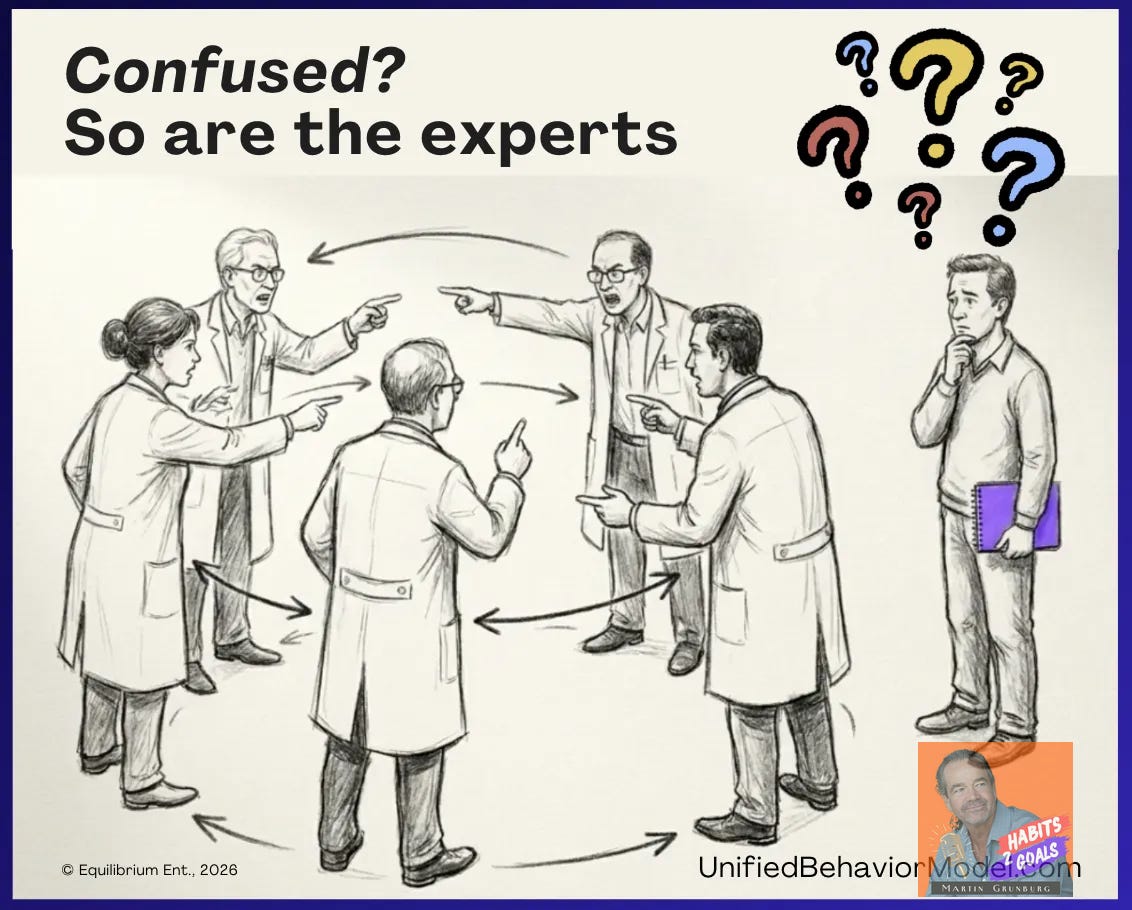
May 2100:27:28Tap to summarizeBehavior Architecture, the 8-Day Cohort & Scholarship Applications are now open. Next cohort begins Thursday, June 18th.👋 Hey, Martin Grunburg (mg) here, author of the Habit Factor® trilogy, creator of the Unified Behavior Model™ (UBM), and host of the Habits 2 Goals podcast — possibly the longest-running habits, goals, and performance podcast. For 20+ years, I’ve researched, trained, and coached with a SINGLE objective: to make behavior change, habit development, and achieving goals EASIER to understand, implement, and teach. That twenty-year concentrated effort yielded the world’s first elemental, unified, goal-directed behavioral model. Important: Quality scientific theories are subject to disproof because they are testable. Unfortunately, behavioral science, since its inception, has failed to produce a single elemental and unified model of behavior. Thus, the Unified Behavior Model™ (UBM) is presented as falsifiable, which means it is testable.The best part— the ONLY reason YOU ought to care… is that UBM provides the highest-goal probabilistic outcome of ANY goal framework, ever. Of course, that statement is independently verifiable, so please DO NOT take my word for it, visit unifiedbehaviormodel.com and download the white paper and LLM Primer 5.1— keep reading, listening, and please, always test and experiment for yourself.🎓 Next cohort: Behavior Architecture on Maven → | 6/18/26 - 6/25/26🎙️ Habits 2 Goals Podcast 📄 Free habit tracking templateRead time: 4 minutesWhy Does Science Exist?Let’s begin with why science does NOT exist. Science doesn’t exist to win awards or fill thick textbooks with complicated diagrams and formulas.Science does not exist to gatekeep, lecture from ivory towers, or foster incestuous citation cartels,Science does not exist to make other scientists feel good.Science exists for one reason:To understand phenomena.Life, experience, and human behavior are mysterious “phenomena.”Science, then, is (ideally) the simple tool used to pull back the curtain to understand and learn about such phenomena.Yet, there’s a massive problem, particularly in BEHAVIORAL SCIENCE…Without a shared paradigm or ontology, behavioral scientists have no basis upon which to fundamentally present theories.The “Napkin” TestEinstein famously said that if you can’t explain a theory to a child, it’s probably useless.Double click to interact with videoGreat science must have a simple pictorial representation.The “Behavior Echo-System” 2021 - Presented on a Napkin just before the release of EVERYTHING is a Freakin’ STORY.According to the best scientists, including Einstein, worth consideration…If you can’t draw it on a napkin, it may not be ready.If it requires a PhD to decode, it probably lacks elementality.Good science brings with it accessibility.Good science is easy to learn, teach, and—most importantly—USE.The Myth of ComplexityWe’ve been taught to respect complicated things.We think “complex” equals “intelligent.”It’s almost always the opposite.“Simplicity is the ultimate sophistication.” ~Leonardo da Vinci“Truth is ever to be found in simplicity, and not the multiplicity and confusion of things.” ~ Sir Isaac NewtonComplication is almost always a mask for confusion.If a behavioral scientist is showing you 14 stages of behavior change or 17 personality types, if there are complex matrix flow diagrams and variations, they’re almost certainly worthless.That’s what Michio Kaku and Einstein say, anyway.They’d also tell you that if a scientist can’t boil a system down to its first principles, they haven’t finished their work.The Unified Behavior Model delivers on its promise of elemental sufficiency.No researcher on this planet will ever be able to model human behavior with fewer ELEMENTS— not because the claim is bold, but because the logic is airtight.More than four elements create redundancy…Attempt to reduce them to just three, and the system breaks.With four and ONLY FOUR, you have Elemental Sufficiency.A MODEL OF HUMAN BEHAVIOR MUST HAVE THE FOLLOWING:Remove Environment — no context, no stimuli, no embodied biology. The model collapses.Remove Behavior — nothing is ever acted upon. Not a behavioral model.Remove Stories/Cognition — no meaning, no belief, no intention. A reflex machine, not a human.Remove Emotions — no motivational direction, no valence, no felt experience driving action. Gone.Thus, there is just one and only one correct, ELEMENTAL solution that models HUMAN BEHAVIOR.The Unified Behavior Model is it.Your TakeawayTo be very clear: this is NOT (really) about the model, it’s about what ANYONE can do with it.The only reason to present any model is to teach from it and apply it as a tool. This is why UBM is presented…Few people care about models or even behavioral science. Yet, intelligent people care about their goals.You don’t need more “inspiration,” or “willpower,” or “motivation,” or even more “discipline.”Once you possess elemental understanding, those elusive properties make sense. You possess UNDERSTANDING.FOUR ELEMENTS and ONLY FOUR ELEMENTS.Understand them, and you’ll understand your behavior like never before.Matthew B— Regional Sales Manager and recent graduate of Behavior Architecture on Maven.comWelcome to Your “Command Center”UBM provides the “command center” for your behavior.Once you stop guessing—stop chasing mirages and understand for certain which ELEMENTS to address, you can architect change and your goals.This is how you start applying the physics of behavior as “hard” testable science.Go Deeper…The most direct path to understanding YOUR own behaviors is Behavior Architecture on Maven. Nearly every student goes into the program skeptical— ALL exit, just eight days later, as raving fans. Test for yourself. It’s 110% Risk-Free and Guaranteed.🌐 UnifiedBehaviorModel.com — free white paper 📚 The trilogy: The Habit Factor® · The Pressure Paradox™ · EVERYTHING 🎙️ Habits 2 Goals Podcast 📄 Free habit tracking template This is a public episode. If you'd like to discuss this with other subscribers or get access to bonus episodes, visit habits2goals.substack.com/subscribe
Transcribe →
The 16 Year Habit-Tracking Flip-Flop
May 700:35:18Tap to summarizeHappiness on a WhimThe surprising truth is that happiness and every other emotion are not mysteries. This framework proves it.Start hereHappiness might be the most talked-about behavioral concept of all time. Thousands of books. Tens of thousands of blogs and podcast episodes. And yet — for most people — it remains a mystery.The first key: happiness is not simply a feeling that happens to you.Happiness is both a primary, elemental emotion/feeling — raw, immediate, requiring no explanation — AND an emergent compound: a resultant cocktail produced by one, several, or all of the elements within your “Behavior Echo-System” (see image below) working in concert.That’s what this episode is about. And once you see it this way, you can never unsee it.Why elemental thinking matters (and why “simple” is powerful)Before we get to happiness, here’s the setup that makes everything else click.The reason UBM — the Unified Behavior Model™ — works is precisely because it’s elemental. Some people push back on that word. “Elemental sounds reductive,” they say.The surprising thing is that the opposite is true. Elemental means learnable. Elemental means teachable. Elemental means powerful.Consider: every podcast, every video, every download, all of artificial intelligence — runs on just two digits. A one and a zero. That’s the binary system. Remove the zero? Goodbye, information age. But wait, isn’t elemental too simple to be userful? Apparently not.The key phrase here is elemental sufficiency — what is truly necessary, and when combined, does it produce sufficiency? A “2” might seem necessary. It isn’t. It emerges from the “1.” UBM applies this same principle to behavior.This is why, 10 months since publication (pre-print), no behavioral scientist has been able to disprove it — including every major LLM. Several top theorists have given it a serious look. A few shots hit the rim— a few airballs. Nobody has formally entered, because UBM’s logic and scientific rigor are airtight.What’s worth noting is this is what experts call “hard,” testable science — something the behavioral sciences, particularly around a unified model, have never had.The bottom line: a truly elemental, unified model has been sought since the founding of behavioral science. William James himself called for a “closed causal system.” UBM is it.The four — and only four — primary elements that categorize and describe ALL behavior This is a public episode. If you'd like to discuss this with other subscribers or get access to bonus episodes, visit habits2goals.substack.com/subscribe
Transcribe →
“The Seeker”: The Habit Factor® & Pattern Recognition (Shhh 🤫)
May 300:26:09Tap to summarizeHappiness on a WhimThe surprising truth is that happiness and every other emotion are not mysteries. This framework proves it.Start hereHappiness might be the most talked-about behavioral concept of all time. Thousands of books. Tens of thousands of blogs and podcast episodes. And yet — for most people — it remains a mystery.The first key: happiness is not simply a feeling that happens to you.Happiness is both a primary, elemental emotion/feeling — raw, immediate, requiring no explanation — AND an emergent compound: a resultant cocktail produced by one, several, or all of the elements within your “Behavior Echo-System” (see image below) working in concert.That’s what this episode is about. And once you see it this way, you can never unsee it.Why elemental thinking matters (and why “simple” is powerful)Before we get to happiness, here’s the setup that makes everything else click.The reason UBM — the Unified Behavior Model™ — works is precisely because it’s elemental. Some people push back on that word. “Elemental sounds reductive,” they say.The surprising thing is that the opposite is true. Elemental means learnable. Elemental means teachable. Elemental means powerful.Consider: every podcast, every video, every download, all of artificial intelligence — runs on just two digits. A one and a zero. That’s the binary system. Remove the zero? Goodbye, information age. But wait, isn’t elemental too simple to be userful? Apparently not.The key phrase here is elemental sufficiency — what is truly necessary, and when combined, does it produce sufficiency? A “2” might seem necessary. It isn’t. It emerges from the “1.” UBM applies this same principle to behavior.This is why, 10 months since publication (pre-print), no behavioral scientist has been able to disprove it — including every major LLM. Several top theorists have given it a serious look. A few shots hit the rim— a few airballs. Nobody has formally entered, because UBM’s logic and scientific rigor are airtight.What’s worth noting is this is what experts call “hard,” testable science — something the behavioral sciences, particularly around a unified model, have never had.The bottom line: a truly elemental, unified model has been sought since the founding of behavioral science. William James himself called for a “closed causal system.” UBM is it.The four — and only four — primary elements that categorize and describe ALL behavior This is a public episode. If you'd like to discuss this with other subscribers or get access to bonus episodes, visit habits2goals.substack.com/subscribe
Transcribe →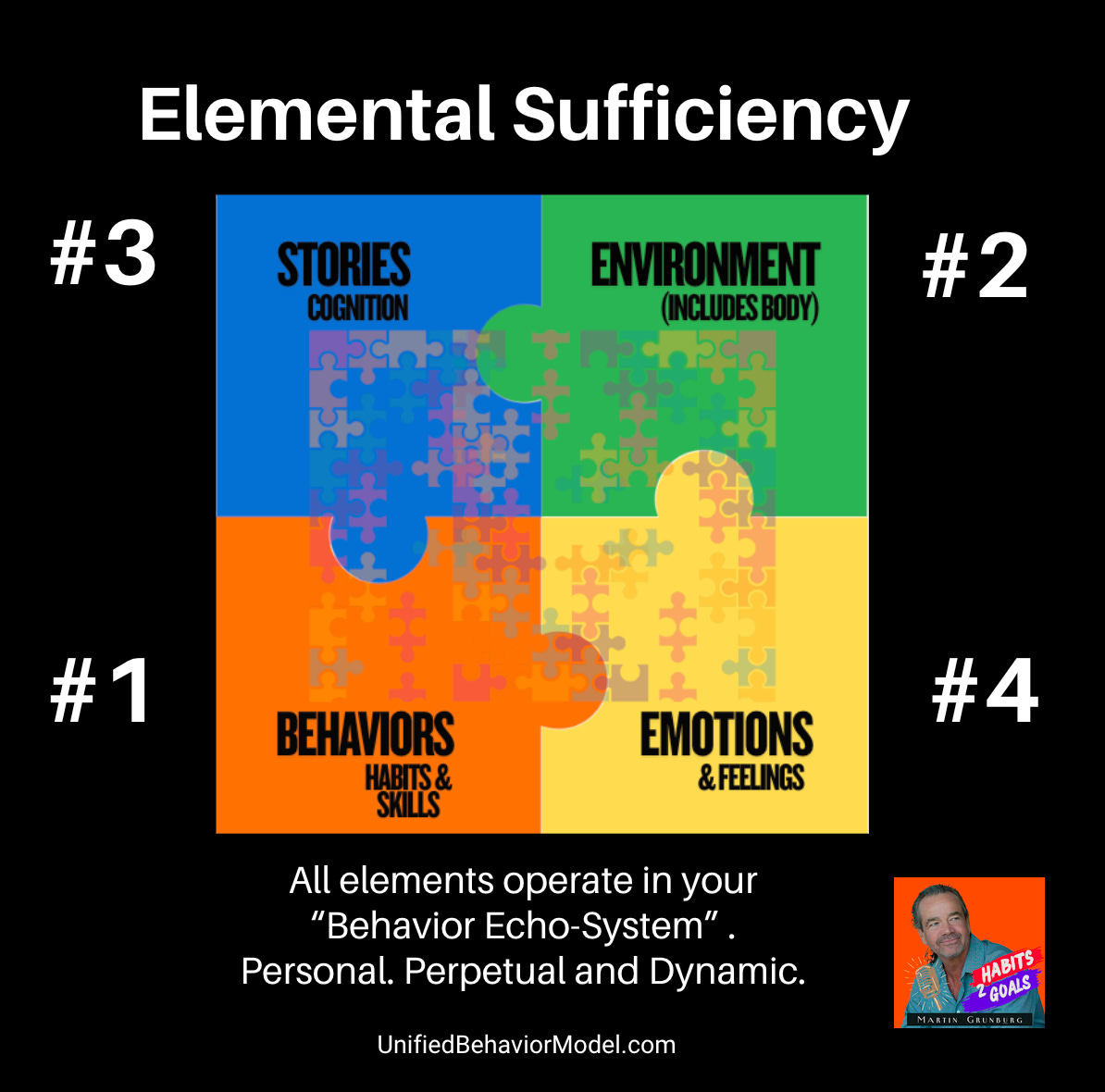
Happiness on a Whim
Apr 1600:21:03Tap to summarizeHappiness on a WhimThe surprising truth is that happiness and every other emotion are not mysteries. This framework proves it.Start hereHappiness might be the most talked-about behavioral concept of all time. Thousands of books. Tens of thousands of blogs and podcast episodes. And yet — for most people — it remains a mystery.The first key: happiness is not simply a feeling that happens to you.Happiness is both a primary, elemental emotion/feeling — raw, immediate, requiring no explanation — AND an emergent compound: a resultant cocktail produced by one, several, or all of the elements within your “Behavior Echo-System” (see image below) working in concert.That’s what this episode is about. And once you see it this way, you can never unsee it.Why elemental thinking matters (and why “simple” is powerful)Before we get to happiness, here’s the setup that makes everything else click.The reason UBM — the Unified Behavior Model™ — works is precisely because it’s elemental. Some people push back on that word. “Elemental sounds reductive,” they say.The surprising thing is that the opposite is true. Elemental means learnable. Elemental means teachable. Elemental means powerful.Consider: every podcast, every video, every download, all of artificial intelligence — runs on just two digits. A one and a zero. That’s the binary system. Remove the zero? Goodbye, information age. But wait, isn’t elemental too simple to be userful? Apparently not.The key phrase here is elemental sufficiency — what is truly necessary, and when combined, does it produce sufficiency? A “2” might seem necessary. It isn’t. It emerges from the “1.” UBM applies this same principle to behavior.This is why, 10 months since publication (pre-print), no behavioral scientist has been able to disprove it — including every major LLM. Several top theorists have given it a serious look. A few shots hit the rim— a few airballs. Nobody has formally entered, because UBM’s logic and scientific rigor are airtight.What’s worth noting is this is what experts call “hard,” testable science — something the behavioral sciences, particularly around a unified model, have never had.The bottom line: a truly elemental, unified model has been sought since the founding of behavioral science. William James himself called for a “closed causal system.” UBM is it.The four — and only four — primary elements that categorize and describe ALL behavior This is a public episode. If you'd like to discuss this with other subscribers or get access to bonus episodes, visit habits2goals.substack.com/subscribe
Transcribe →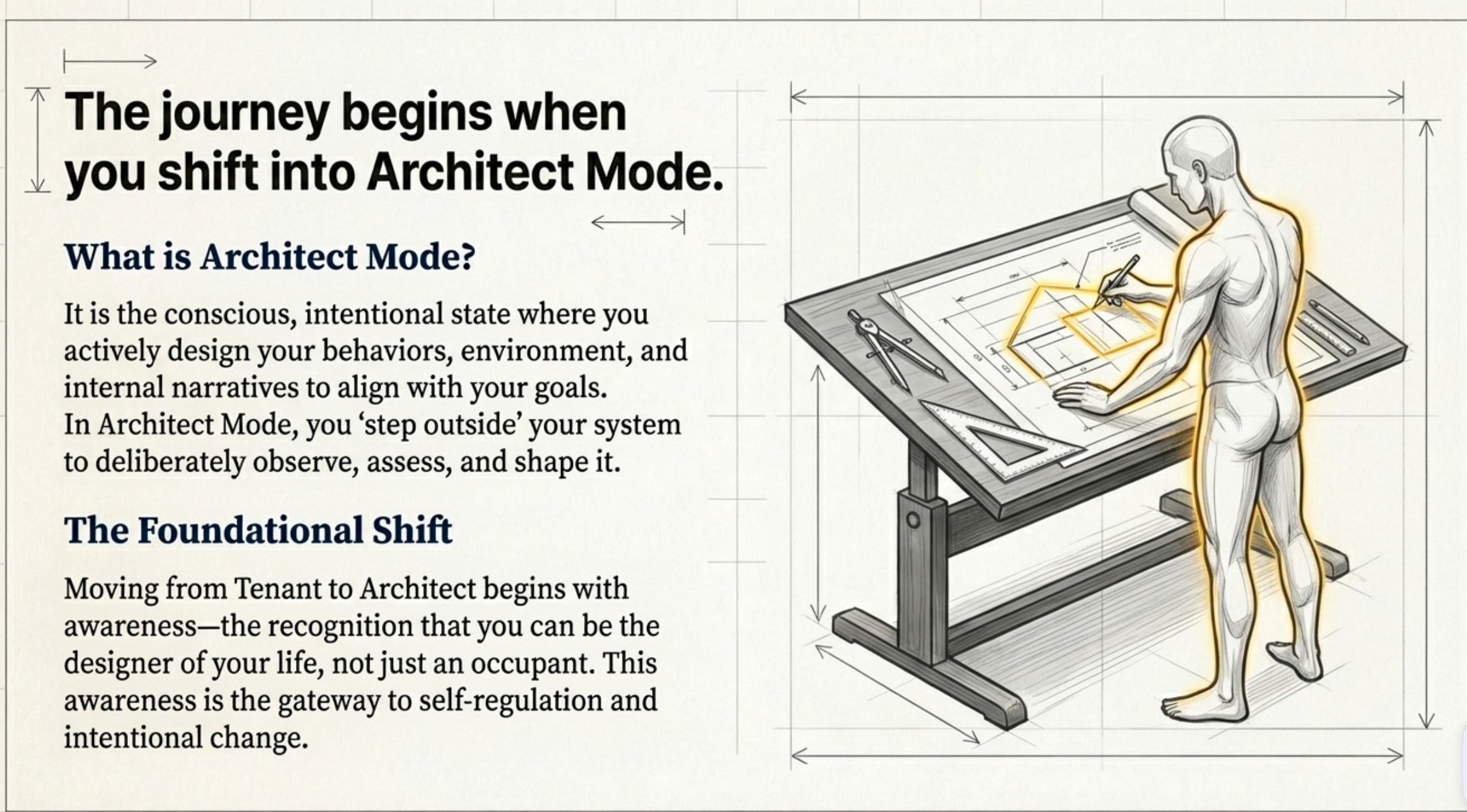
Find Your Way Out! Begin Architecting
Feb 2600:20:19Tap to summarizeImportant: The Behavior Architecture 8-Day Cohort Scholarship Application is now open. The next cohort starts on March 19.There’s a different sort of “stuck” that doesn’t seem too disarming from the outside.Life appears to “work.” Stuff gets done. The bills get paid. The calendar is full. You’re busy. Busy. Busy. Busy.And yet…You wake up one day, despite all the busyness, you wonder what you’ve accomplished.This is tenant mode.I lived in it for far too long…Something deep down always felt like ‘something’ was missing.It’s easy to ignore: stay busy, check off the next box, doom scroll.Check. Check. Check.In the silence, you wonder, “Am I leaving something on the table?”Maybe (like me) you even hear the late Dr. Wayne Dyer’s voice:“Don’t die with your music still in you.”ShareEnter: Your Behavior Echo-System (BES): This is your behavioral “home.”You’re in it right now. You’ll be in it tomorrow and (wait for it…) forever.You don’t just live in “the world.”You live in your personal Behavior Echo-System.Your Behavior Echo-System shapes and influences your behaviors in the moment and over time.Right now, you’re reading this (environment). That may make you think, “This is dumb,” or “This is helpful,” or… ???Then you may feel something or do something…Sidenote: UBM scientifically presents the long-sought “causal” behavioral structure (architecture) that William James argued behavioral science must identify back in 1892: “This is no science. It is only the hope of a science.”Let me be clear: UBM wasn’t assembled—or rather, “unearthed”—without the century-long discoveries, academic research, struggles, and insights behavioral science has produced since those statements.Having said that, this is precisely what the Behavior Echo-System and UBM scientifically demonstrate: the causal structure. And UBM goes further by demonstrating elemental sufficiency through its “No Fifth Element” Challenge, now almost eight months strong. This is a public episode. If you'd like to discuss this with other subscribers or get access to bonus episodes, visit habits2goals.substack.com/subscribe
Transcribe →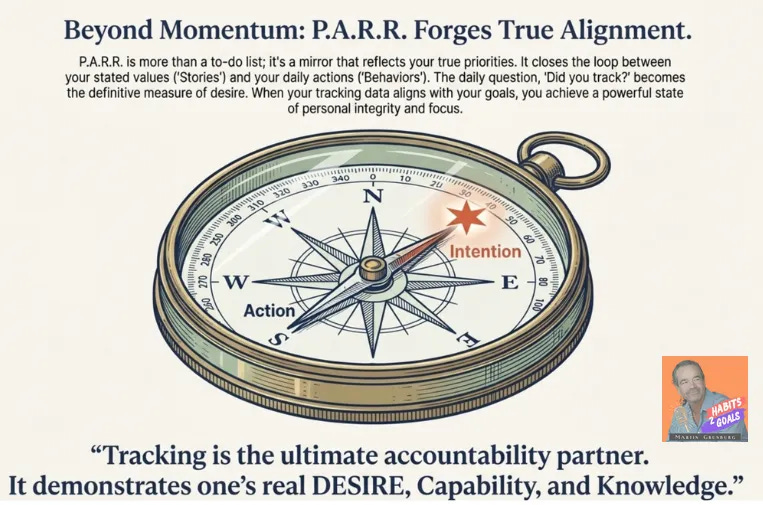
🚨 The Habit Tracking Controversy (Yes, there was one...) is Finally Over. UBM Ended It.
Jan 900:24:59Tap to summarizeThis is a public episode. If you'd like to discuss this with other subscribers or get access to bonus episodes, visit habits2goals.substack.com/subscribe
Transcribe →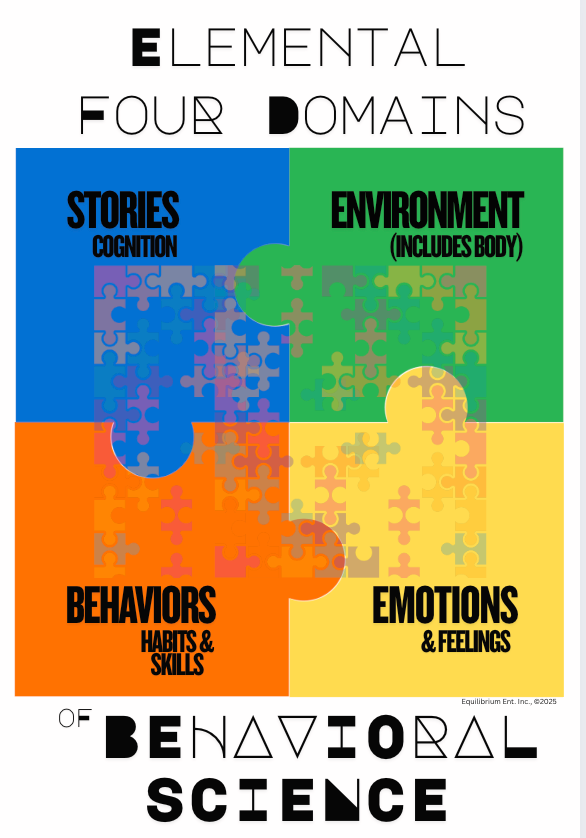
What’s a Seminar?
Jan 200:23:27Tap to summarizeHappppppppppy New Year!!! 🎉Here’s to a safe, prosperous, and phenomenally clear 2026…a year full of growth, action, and gratitude.I’m deeply grateful for your readership, participation, and contributions.May the FORCE of UBM be with you! 🎉🍾🥂🎆Tony Robbins shares a story that he’s probably told a few thousand times.It’s his origin story.Same story. Over and over.You don’t get to write the bestseller and disappear.I used to think that was the case.Nope.You show up. Day after day. Again and again.And, you keep telling your story.Nobody records a podcast episode and vanishes.If your work really helps people, you keep showing up and producing.Over and over…500+ episodes later... here we are…So, yes, it used to kill me to tell my Catalina Classic (32-mile, open-ocean paddle) story over and over.Now I get it.It’s just part of the territory.I love Tony’s origin story… and it goes something like this…He’s seventeen-ish… late 70’sA friend of his father’s invites him to earn some extra money moving furniture over the weekend.Tony’s hustle— energy—stood out. So the guy invites him to lunch; mid-sandwich, Tony asks: “How did you become successful?”The guy pauses, smiles, and says, “Honestly? I went to a seminar.”Tony blinks. “What’s a seminar?”The man explains:A seminar is where someone who’s accomplished something—figured out a few things—gets on a stage and shares the very best lessons… He teaches things that will literally shave years of struggle off your life… all boiled down into about three hours.Tony exclaims, “Wow! That sounds amazing. Can you get me in?”The guy nods. “I probably could. But I won’t.”“…Wait—what?” Tony’s confused.Mentor-guy says, “Look, if I give it to you for free, you’re not going to value it.”Tony asks, “How much is it?”“It’s about forty bucks.”Tony stares. “That’s a week’s pay. No way!”The guy replies—without missing a beat: “Cool. Enjoy the next twenty years of struggle.”Tony scrapes the money together.Goes to the seminar.Ultimately, he becomes the speaker’s protégé—Jim Rohn, who at the time was selling his Adventures in Achievement course.Then, as they say in storybook land,THE REST IS HISTORY…Why Share That Story?I’m guessing you know.Behavior Architecture is the product of my twenty-plus years of struggle.The books: The Habit Factor, The Pressure Paradox, Everything is a Fcking Story.*Together, they laid the foundation.Now, they’ve given rise to something unprecedented:the first elemental, unified, goal-directed, and falsifiable model of behavior.Nearly six months after publication, every attempt by behavioral scientists as well as top LLM/AI has been unsuccessful.UBM stands. 1500 downloads later…. a scientific response/presentation to the field’s imperative for a unified framework.Done.------UBM has a single mission:To deliver the clearest, most practical, holistic framework to help anyone architect their habits, skills, goals, and life.Not just theory.Not just big ideas.But in practice—a scientifically validated, proven framework.Yes, proven.Let’s be clear:Nobody else in the world can say that. That’s not boasting. It’s science.Of course… YES! It’s backed by a 110% money-back guarantee.(Seriously. Full details on the site.)Here’s the funny thing...When there’s ZERO RISK, the real challenge reveals itself.It’s no longer about the course.It’s no longer about its value.It’s definitely not about the science.It’s about the MIRROR.Because if the program delivers—If it offers what one participant of FC-01 (Australian CEO) described in his review(let me see if I have this correct… ; )“UNBELIEVABLE VALUE”Then the question is rarely about the money.It’s about YOU.Are you ready to do the work?Behavior Architecture is the last behavior-change course you’ll need.Risk-free. Guaranteed.The Founders Cohort 01 (FC-01) experience was sooooo GOOOOOOOD….Here’s your special offer:The NEW YEAR, NEW SCIENCE, FINALLY, NEW YOU. 50% OFF enrollment!!Until January 7, 2026, or as available.That’s HALF-OFFPLUS, a 110% risk-free guarantee.See you on the inside!👇PROMO CODE: “NewScience”Grab your 50% OFF!New Year. 🎆New Science. 🔬New You. 💪🏽 This is a public episode. If you'd like to discuss this with other subscribers or get access to bonus episodes, visit habits2goals.substack.com/subscribe
Transcribe →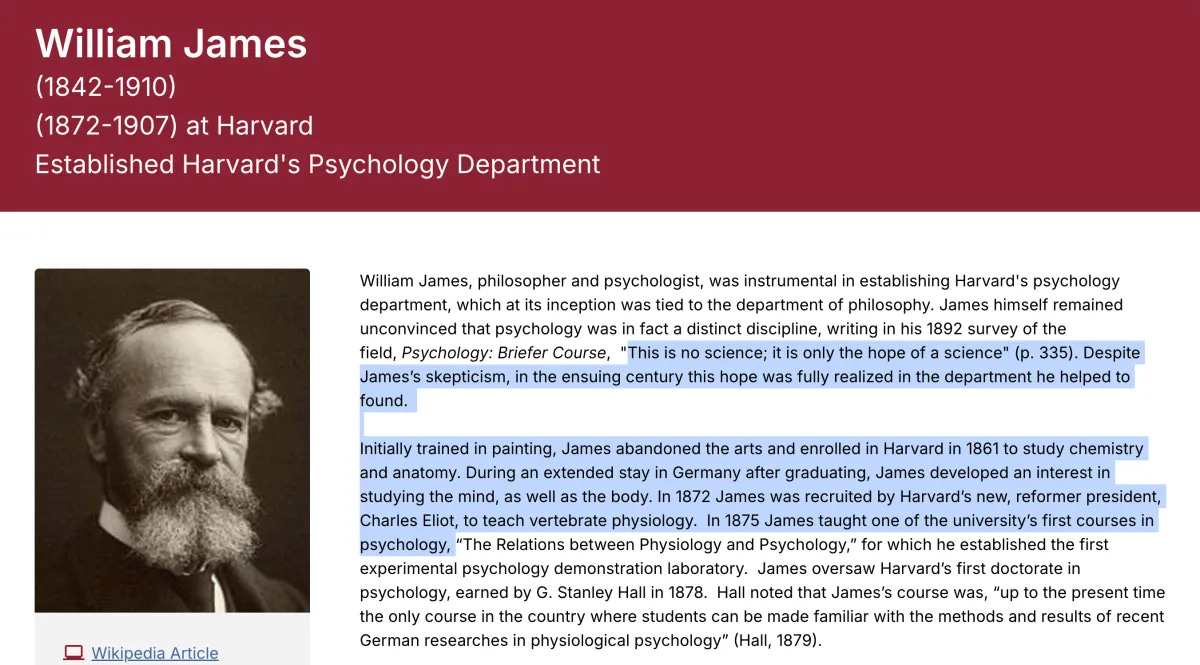
Behavior Architecture
Dec 500:26:16Tap to summarizeHow the Unified Behavior Model Was Unearthed—and Why This Is Your Last Chance to Join the Founders CohortThe 8-Day intensive kicks off 12/11/25 on Maven.com.It’s designed to rapidly accelerate your understanding of UBM—and explode your effectiveness.✅ 110% Money-Back Guarantee🔒 Zero risk, high upside🕓 Only 4 days left—sign-up closes 12/9Learn more + enroll now:https://maven.com/thehabitfactor/behavior-architectureQuick exercise: Close your eyes and think back to where you were last December—physically, mentally, emotionally, socially, spiritually, financially, and professionally.Can you remember your vision? The goals you set? How did you hope 2025 would unfold?In short, you probably had a few goals. So… how did it go? How much progress did you make?10%? 25%? 0%?If you crushed it, congratulations!!Next week, Behavior Architecture – Founders Cohort kicks off!Already a handful of PROFESSIONAL COACHES are enrolled!That should tell you all you need to know.It’s their job to understand and teach behavior—to help their clients achieve their GOALS!Thus, New Year. New Science… New You?» SAVE an instant $200 » Behavior ArchitectureWhat is Behavior Architecture?Let’s begin with what it is NOT.It’s NOT hype.It’s NOT marketing.It’s A SCIENTIFIC framework that emerged from a 150-year behavioral science riddle.You can find out more and read it yourself. UnifiedBehaviorModel.comYour Excuses…“I don’t have the time.”That’s the opposite of architect mode.You’re locked inside tenant mode—trapped within your own Behavior Echo-System (BES) by your existing HABITS, unable to step back and proactively DESIGN and architect your behaviors and goals.To be fair, some people do have greater time commitments. That’s precisely why ~85% of the Behavior Architecture coursework is ASYNC. Meaning: you do it in your social media time, miscellaneous downtime, lunch breaks—your usual “lost time.”“I don’t have the money.”If this is a genuine issue, we’ve set aside a few scholarships. You can email me directly for more information.“I’ve tried EVERYTHING—this won’t work for me.”Two quick thoughts. First, you haven’t tried everything. UBM is brand new. This course is brand new.Second, with that attitude, you’re right. If you truly believe nothing will work for you… nothing will work for you.“What if it SUCKS? I’ve just thrown away money.”Do NOT enroll if you don’t have a sincere desire to LEARN, GROW, and APPLY the principles.There is a 110% money-back, risk-free guarantee, and you can read all about it here: Behavior Architecture (YES, that link saves you an INSTANT $200!)From Tenant Mode to Architect ModeHere’s where it clicks:Most people live in Tenant Mode. Essentially, forever.Tenant Mode is reactive. Mostly automatic.At the mercy of their environment, emotions, default stories—and default behaviors (habits).Your home is already designed.You’re in it right now.It might be so comfortable, there’s no “reason” to leave.That’s the catch.Everyone gets pulled in.And most stay there as long as possible.Just wait…When something shifts—and life is nothing but change—will you know what to adjust?A deadline moves.A relationship ends.Your energy crashes.A habit, once solid, suddenly fades.Where do you look?INSTANT $200 Savings here→ Join the waitlist here and lock in your Founders rateCut through the chaos, the confusion, and the overwhelm with pure, scientific CLARITY.🚨 The habit tracking controversy has finally been settled. Section 7.0 of the UBM whitepaper addresses every objection.Done and Done. Read it here →📄 Free habit tracking template: thehabitfactor.com/templates📖 Full UBM whitepaper: Zenodo.org📚 The trilogy that unearthed UBM:* The Habit Factor®* The Pressure Paradox™* EVERYTHING🌐 Learn more: unifiedbehaviormodel.com This is a public episode. If you'd like to discuss this with other subscribers or get access to bonus episodes, visit habits2goals.substack.com/subscribe
Transcribe →
How to Keep Behavioral Science Comfortably Incoherent — i.e., Ununified
Aug 1800:37:44Tap to summarizeOn July 8th, in what can only be described as an act of reckless clarity, we published a white paper (grab it here—>) Unified Behavioral Model™ — Read more… listen now.Disclaimer: The following is a bit tongue-in-cheek. Just a bit.I have the utmost respect for the behavioral science community and its vast contributions—including the many scientists whose work has directly shaped my own.That said, the more I learn about the history of attempts to unify behavioral science (and, by association, psychology)—and then set those challenges alongside the Unified Behavior Model (UBM) as it now exists—formally published (elemental and falsifiable), 500+ downloads later—the more peculiar the entire situation becomes.To be clear: it’s only in hindsight that these “obvious” errors and omissions—both in behavioral science (BS) and in its unification efforts—come into focus.Subscribe nowTip #1: Make Sure Only True Insiders Get to PlayWhatever you do, don’t approach this unification challenge from the outside. That’s where troublemakers and fresh ideas tend to arise—reportedly. 👇Imagine that… via Stanford Business. Where is Stanford’s own Psychology Department when it comes to UBM? @stanfordpsypodInstead, ensure that no outside ideas are taken into account and non sneak their way in—even via OPEN SCIENCE. Better yet, throw up your hands and surrender: “Why Psychology Isn’t Unified, and Probably Never Will Be…” “PROBABLY NEVER WILL BE.”Valid points to be sure…“Why a Unified Theory of Psychology is Impossible”Unification as a Goal for PsychologyIt goes on and on—for several reasons, dear friends, which appear below.Tip #2 Prioritize Knowledge over ImaginationEnsure that only those fluent in four-letter acronyms, armed with multiple advanced degrees, and a dense theoretical vernacular are entrusted with presenting “novel” ideas.Further, insist that only those who can quote James, Pavlov, Watson, Bandura, Maslow, Skinner, and Freud backward and forward—and who possess psychological libraries spanning generations—be invited to contribute.“Imagination is more important than knowledge.” ~EinsteinTip #3: Form a Large Committee. The Larger, the BetterNothing unifies quite like 23—or maybe 43—strong personalities in one room.When “top behavioral theorists” gather for a week-long consortium, be sure to take minutes, roll in the whiteboard, and order extra coffee.Everyone knows: the more expert opinions, the quicker a consensus.As history (and a few hallucinating AIs) like to remind us, when it comes to unification attempts, the go-to answers are always consortia, committees, and bowling alleys.Darwin famously huddled with his nine-person advisory council.Einstein wouldn’t dream of publishing without first posting to social media.And Newton? Legendary for his gravitational consortiums.Here’s a nutty thought: what if that unified model came from one person on the fringe? (The fringe—see above ☝️.)One person. U N I — F I C A T I O N.⚠️ WARNING: Unification carries a dangerous synonym—coherence.By extension, it implies that the 150-year exercise known as behavioral science—and its twin sister, psychology—are, brace yourself...INCOHERENT.Oy.To be clear, that’s not me talking, it’s Webster.If you didn’t catch the 1991 reference—well, that was when the U.S. National Institute of Mental Health (NIMH) convened a “Top Behavioral Consortium.” Its noble goal? To create a “Unified Framework.”“What emerged?” you ask.The meeting —a week long gathering—brought together “leading human behavior theorists”. While a comprehensive roster of all attendees from this specific 1991 meeting is not fully detailed in the available documentation, a critical outcome of this expert gathering was the acknowledgment that “there was no consensus among the theorists” on a single, universally accepted unified framework.Imagine that. This is a public episode. If you'd like to discuss this with other subscribers or get access to bonus episodes, visit habits2goals.substack.com/subscribe
Transcribe →
Black Swan Me | Unified Behavior Model™
Aug 400:30:00Tap to summarizeOn July 8th, in what can only be described as an act of reckless clarity, we published a white paper (grab it here—>) Unified Behavioral Model™ — Read more… listen now.Subscribe now“Science may be described as the art of systematic oversimplification.” ― Karl PopperWhat makes UBM so unique—so different from prevalent behavioral models?First, let’s clear up a common misconception:UBM—specifically the Behavior Echo-System (BES)—is a model of behavior, not a model of a person.People often see the graphic and assume it represents themselves, or a diagram of the human body. It doesn’t.As Dr. Popper’s statement above suggests, UBM simply articulates how behavior is influenced in the moment and shaped over time—within the system.Now, here’s the B.I.G. claim:UBM is falsifiable.In science, that’s the gold standard.(Period.)If a theory can’t be tested or broken, it’s just storytelling. Worse yet, Karl Popper would say it’s non-science.What’s his core claim? Science and non-science are divided by a single demarcation: Falsifiability.UBM asks—check that, insists—“Go for it… Please try to break me.”Apparently, no other behavior model—certainly not a unified one—has ever done that.Kind of interesting? Maybe just a bit?Worth mentioning, at least?Or dedicating, I don’t know… twenty-plus years to uncovering?UBM/BES Comparison Table & Major Prevalent Models as provided by DeepSeek.According to Dr. Karl Popper—and as noted in the Stanford Encyclopedia of Philosophy, “Karl Popper is generally regarded as one of the greatest philosophers of science of the twentieth century”—if a theory can’t be tested (or broken), it’s just storytelling. Worse, he’d call it “non-science.”Just to be clear: that’s Dr. Popper, philosopher and trained psychologist, who introduced the idea of falsifiability (and gave us that delightful bit with the Black Swan).So yeah—if you can’t at least attempt to break it, he says, it doesn’t count.UBM is so confident in its falsifiability that it’s offering a $1,000 reward to the first person to prove there’s a missing fifth element—one that isn’t reducible or emergent. (See below and bottom for official entry details.)So far: nearly 500 downloads and…Nada. Zip. Zilch. NOTHING.Even the world’s top AIs—ChatGPT, Gemini, Claude, Grok, DeepSeek—took their shots.They’ve all struck out. Attempts include: Time (environmental), Consciousness (emergent from the system), Willpower (embodied environment), Self-Organization (embodied environment—note the “self” in self-organization).The list goes on, and it’s kind of funny. Google’s Gemini, for example, offered a “someday” quantum property we don’t even know of yet.Seriously.Just to be clear: if we don’t know of it yet, and we can’t test it—it’s not a valid fifth element.DeepSeek’s parting words? Also comical...“UBM 1. DS 0... Game respects game.”And, here’s Gemini’s best response after half dozen attempts…Gemini tries desperately to break the Unified Behavior Model and fails.The difficulty in falsification, as intended by the model’s design, is a powerful indicator of its conceptual strength and it’s potential to serve as a TRULY UNIFYING FRAMEWORK FOR BEHAVIORAL SCIENCE. ~Gemini 8/4/2025Some have argued, “Well, UBM is overly simplified.”Really?Then why hasn’t anyone discovered it before—or more accurately, uncovered it and brought it to light?Surely, by now—150 years in—some behavioral scientist, somewhere in the world, would’ve presented this kind of systematic “oversimplification,” right?Let’s go over that one more time:“Science may be described as the art of systematic oversimplification.” ― Karl PopperThis is precisely Dr. Popper’s point: science progresses by oversimplifying—systematically.Voila: UBM. 👇“Great theories have simple pictorial representation.” —Michio KakuThe Behavior Echo-System (BES): the systematic simplification of behavior.Which makes it—by definition—the elemental science of behavior.Allegedly.Until—and unless—you produce the Black Swan.(Looking at you, top psych departments—according to U.S. News & World Report, 2025): @StanfordPsych, @HarvardPsych, @UCBPsychology, @UCLPALS, @Psych_at_Yale, @UMichPsych, @UCLA_Psych, @UCSDPsych, @OxfordPsych, @PrincetonPsych.Please, with all due respect, step right up. 👊 🤙 🙏 This is a public episode. If you'd like to discuss this with other subscribers or get access to bonus episodes, visit habits2goals.substack.com/subscribe
Transcribe →