Loading summary
Transcript134 lines
- [00:01]
Nicole Wallace
Hi, everyone, it's Nicole Wallace from msnbc. Listen to my new podcast called the Best People. I get to speak to some of the smartest, funniest and wisest people I have ever encountered. People like Cara Swisher, Rachel Maddow, Doc Rivers, Jason Bateman, Jeff Daniels, and Sarah Jessica Parker.
- [00:18]
General Stanley McChrystal
They'll often say, hey, Kerry, you know, they'll call me Carrie.
- [00:21]
Nicole Wallace
And that's all right, too.
- [00:22]
General Stanley McChrystal
The Best People with Nicole Wallace. New episodes drop Mondays. Listen now, wherever you get your podcasts.
- [00:32]
Nicole Wallace
Lemonada. For five years, you were in charge of the US Military's most elite commandos. You found Saddam. You killed the head of Al Qaeda in Iraq. Are you familiar with the Onion?
- [00:47]
General Stanley McChrystal
I am.
- [00:48]
Nicole Wallace
Okay, let me show you this Onion headline. 80% of Al Qaeda number two is now dead. Now, General, I take your smile. You understood the joke?
- [00:58]
General Stanley McChrystal
Absolutely.
- [00:58]
Nicole Wallace
Did the Onion get it more right than the US Military?
- [01:02]
General Stanley McChrystal
Well, the Onion was wrong. We killed the number threes. We killed I don't know how many number threes. And we used to joke about it, but. But the point's exactly right.
- [01:12]
Nicole Wallace
Wait, so just for the analogy, if you're looking at a super team.
- [01:15]
General Stanley McChrystal
Yeah.
- [01:16]
Nicole Wallace
You didn't get mj, you didn't get Scotty, but you, you blew up Dennis Rodman.
- [01:20]
General Stanley McChrystal
Yeah. Over and over again.
- [01:21]
Nicole Wallace
And maybe you got Luke Longley.
- [01:23]
General Stanley McChrystal
Yeah. I mean, just.
- [01:24]
Nicole Wallace
And then Bill Wennington.
- [01:25]
General Stanley McChrystal
Exactly. And, well, you get who you can get.
- [01:28]
Nicole Wallace
And I mean, General, I do think killing the Bill Wennington of Al Qaeda isn't worth it.
- [01:35]
General Stanley McChrystal
Hurry, right away. No delays.
- [01:37]
Nicole Wallace
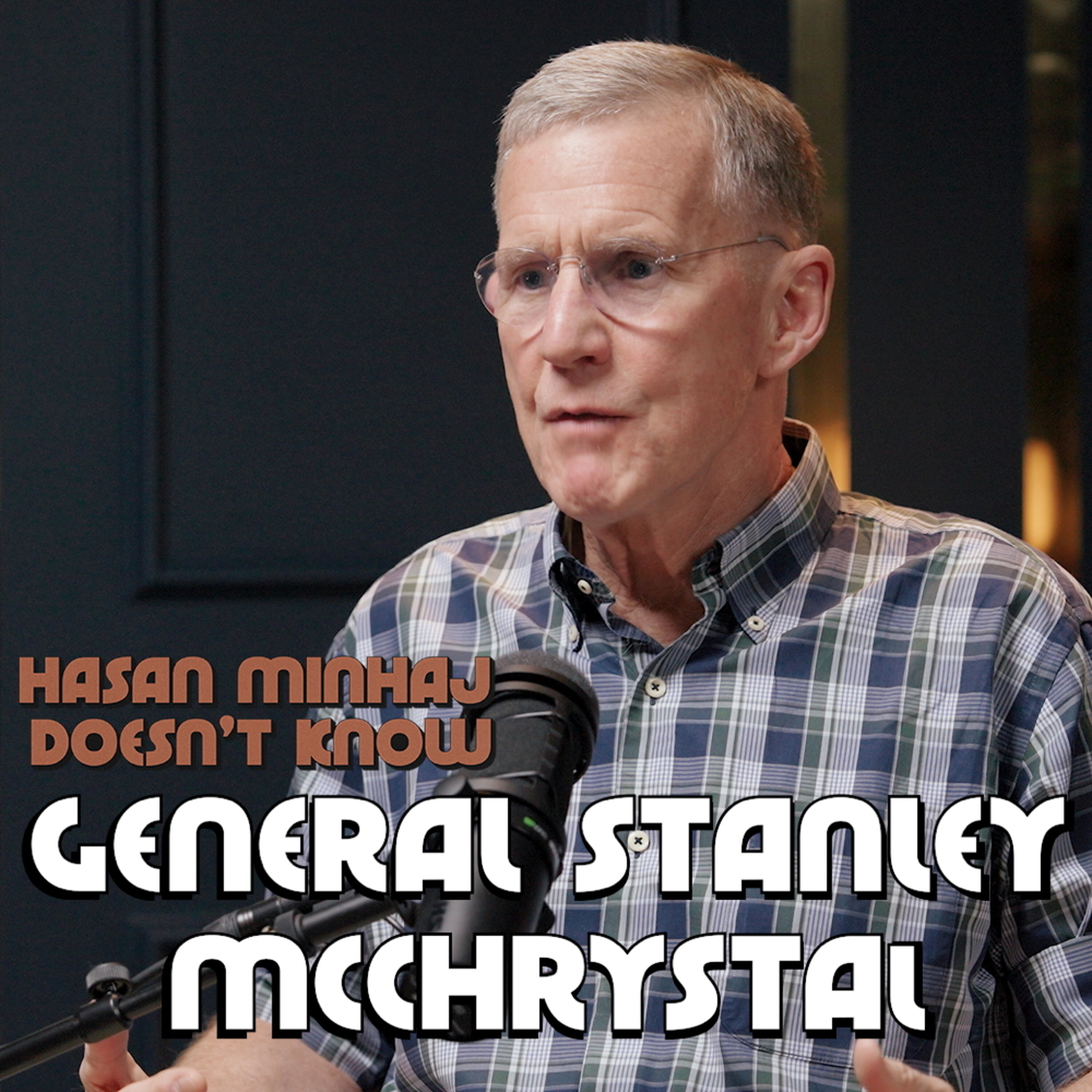
Are daddy glad to have had such a land. Four Star General Stanley McChrystal spent one year commanding US and NATO forces in Afghanistan. After spending five years commanding the Pentagon's most secretive operations in Iraq as the head of jsoc, Joint Special Operations Command, his unit captured Saddam Hussein and killed Abu Musab al Zarqawi, the head of Al Qaeda in Iraq. I was honestly surprised when he wanted to come on my show because we have very different perspectives on the US Military. But I wanted to have an open good faith conversation and he was game for that, which I respect. Now here's my talk with General Stanley McChrystal about his new book on choices that define a life and about some of the choices that define his own life. Let's talk about the book. You have written a book specifically on character. You are a four star general. I am a zero star comedian. One of the things that you had to oversee as a four star general is the state of the geopolitical world.
- [02:40]
General Stanley McChrystal
Right.
- [02:41]
Nicole Wallace
Now, the state of the geopolitical world is, dare I say, nuts. We're on the verge of World War iii. If you could give us Vegas odds, over or under, how stable is the world right now? And should I get ready to hit the bunker immediately?
- [02:56]
General Stanley McChrystal
I wouldn't be far from the bunker. I think we're at very dangerous times. Well, if you think back to many times, there are disagreements between nations. There are maybe the rising of a dictator who is likely to start a war. What we've had in the last. Call it, a couple of decades is this erosion of relations between nations. We never thought there'd be another ground war in Europe, and now we. For three years, we've seen a grinding war in Europe. And so as we start not to respect institutions or nations or. Or each other, the likelihood that we have some kind of conflict just goes through the roof.
- [03:40]
Nicole Wallace
That's what you talk about in your book on character, which is. It's your personal musings on leadership, character, and specifically honor. Now, I took this and your recent New York Times op ed as a little bit of a sneak diss of the current president. Is that true?
- [03:56]
General Stanley McChrystal
I'm trying not to talk about any specific personality because, you know, we trip over policies and politics and personalities, and what we ought to be talking about is character, because as we would describe it in the military, it's left of the boom. It's before you actually have a problem. What are the root causes? And so I think that we have lost sight of the fact that character, in many cases, the lack of character, is. We're seeing the symptoms through certain personalities and actions in our society.
- [04:28]
Nicole Wallace
Are there particular moments that inspired you to write this that you saw? Oh, wow. There's been a fundamental erosion of particular either democratic norms or social norms that you said, I have to speak on this because you did meet the press and you publicly endorse Kamala Harris. But I felt when I was watching that clip of you, you felt deeply, personally moved to speak on that issue. What have you seen at large, kind of in society that made you go, you know what? I have to. I gotta speak on this?
- [04:58]
General Stanley McChrystal
Now, I've seen a bunch of things I've seen in the last couple of decades. Maybe I've been watching more closely. Politicians who on one day stand up and they absolutely espouse certain values, sometimes they're admirable, and then a couple months later, they flip flop and they support something that is completely the opposite of what they said before. Now, maybe they had an epiphany and they changed what they think? I don't think so. I think it was opportunism. I see the way we have public discourse, the way we describe people. When I see how we treat our allies, I'm really bothered. And so it's a. It's a buildup of or of a lower standard of behavior, lower standard of respect, lower standard of personal conduct. And then you can extrapolate that to organizations and, unfortunately to the nation.
- [05:52]
Nicole Wallace
One of the things that gets thrown around on the Internet often is we are descending into fascism. Our president is a dictator. Now, as someone whose unit actually captured Saddam Hussein, an actual dictator, how close are we to our president going full green beret and wearing military fatigues?
- [06:12]
General Stanley McChrystal
Yeah, it's hard to say. I think that the danger is if we start thinking that's okay, because humans being what they are, almost anyone put in a very powerful position is going to try to pull together more power, gather more power. I worry that if we as a nation and the people around that aren't vigilant to protect us against ourselves. I mean, let's be honest, if you made me president for life tomorrow, I would start off and I'd be a great guy. And I'll bet in a couple years, you wouldn't want to have me on your show.
- [06:49]
Nicole Wallace
Sure.
- [06:49]
General Stanley McChrystal
You know, Okay. I mean, that's me. And I think I'm probably average.
- [06:55]
Nicole Wallace
Okay. I'd love to actually pull family members to find out how they feel about you, General. So one of the things that you're alluding to, and you're being very respectful, and I do appreciate that. But one of the key critiques that we hear in the media is that our current president isn't operating from a place of character. Specifically, the president is operating from a place of emotion. He's very emotional. His supporters argue that he's playing 4D chess. Sometimes I feel like he's shooting from the hip. Do you agree with that kind of premise of what I'm laying out?
- [07:28]
General Stanley McChrystal
Well, my views on President Trump are out there. I've come out before. But I'd say he's not standing alone in a field in that. I think the number of people who are operating outside of character or without character is the disturbing part. And if we find ourselves standing in the field with them, we got to wake up and get out of there. Because the reality is it's that erosion that is the dangerous part. It's not the power of a single person in our government is somewhat limited, but the power of a bunch of people who are not willing to be the checks and balances. That's fatal.
- [08:04]
Nicole Wallace
How do we get here? I'm 39 years old, so some of the most formative years of my life were the war on terror. I think about this, I go, well, that word, the war on terror, that's actually just a war on an emotion, a feeling, terror. You are terrorized, you feel fear, anguish, terror. Wouldn't Donald Trump be the natural endpoint of fighting a 20 year war on a feeling?
- [08:33]
General Stanley McChrystal
I think he's the natural import endpoint of that and of some other things. I think he's a natural endpoint of frustration with the idea that elites have gathered disproportionate amounts of power and wealth and that much of the country feels like they are not been represented. I think this idea that the world is out to take advantage of us and in some cases to attack and kill us, and all of those things stir up emotions that I, I usually associate with tribalism. You link arms together and you say we're going to defend ourselves because we can only trust each other. Yeah. And that's dangerous because as soon as you start that, you start to immediately characterize everybody else as them, as the enemy.
- [09:21]
Nicole Wallace
Yeah.
- [09:21]
General Stanley McChrystal
And then of course, once you think of them that way, at some point.
- [09:25]
Nicole Wallace
They become, and you really wax poetically about that, that point about people's humanity, not only your own humanity, the people that you serve with, but even when you've served in war, their humanity. A couple things I wanted to unpack on, because we're talking about character, we're talking about emotion. When you look at U.S. history, has the United States in your mind responded to crisis emotionally or stoically and calmly?
- [09:57]
General Stanley McChrystal
I think emotionally, in almost every case. If you look at the beginning of US Civil War, if you look at the Spanish American War, the destruction of the Maine, you look at the sinking of the Lusitania, and then the Zimmerman telegram that brought us into the First World War. But that's natural. I mean, we shouldn't be shocked, we shouldn't even be embarrassed by that. What we.
- [10:19]
Nicole Wallace
But why haven't we. We've learned our lesson, though, by that you're clearly laying out the patterns here.
- [10:24]
General Stanley McChrystal
Right. Every generation has to learn their lesson again. We read history, but we make many of the same mistakes. If you think the internment of Japanese Americans in World War II and then the Patriot act after 9, 11, I would say they rhyme. And so this idea that emotion is large. When I taught my course at Yale to freshmen, I used to do one session on the 911 attacks. And they were young enough when it happened that they. They didn't have the feel for the moment.
- [10:54]
Nicole Wallace
Sure.
- [10:55]
General Stanley McChrystal
But I had them watch the videos and listen to the 911 calls so that they would understand just how viscerally emotional that was. And when that happens, when in their life, when something equivalent happens, they are going to be equally emotional.
- [11:13]
Nicole Wallace
Yeah.
- [11:13]
General Stanley McChrystal
And they will want to do something.
- [11:15]
Nicole Wallace
I remember being in high school at that time, the two emotions that people felt, I could feel it in the air. Fear and anger.
- [11:24]
General Stanley McChrystal
Correct.
- [11:24]
Nicole Wallace
We have to do something about this. And I remember George Bush said it very clearly. Number one, you're either with us or you're with the terrorists. And number two, we can't let the terrorists win. And then for some reason, at some point we had to go buy trucks because that helped America. So I had to go to Toyota.
- [11:42]
General Stanley McChrystal
Thon. Yeah.
- [11:43]
Nicole Wallace
I mean, even though those cars were made in Japan Hand.
- [11:47]
General Stanley McChrystal
Yeah. I don't think that was very well thought out. But it should be instructive because the instructive part is not what happened on 911. There were mistakes made that allowed 91911 to happen, but what we did afterward. Yeah, there were a number of mistakes made, but they weren't made with bad intentions. They were made by good people with good intentions, working hard. That should be what we pay attention to. Because if we look and we say George W. Bush was the guy who was wrong, we'll blame him. We were all part of that. And so we've got to understand that dynamic is repeatable. And so when that comes again next time, will we be a little bit wiser or we will at least recognize that that dynamic is growing.
- [12:36]
Nicole Wallace
I mean, what scares me the most, General, is I don't think we'll learn that lesson. And of my favorite artists has this great quote, history repeats itself and then deletes itself. That's one of my favorite Iraqi artists. His name is Narsi. But General McChrystal, for five years, we can kind of break this down for the audience and how this plugs into the book. For five years, you were in charge of the US Military's most elite commandos. You found Saddam. You killed the head of Al Qaeda in Iraq. Are you familiar with the Onion?
- [13:04]
General Stanley McChrystal
I am.
- [13:05]
Nicole Wallace
Okay, let me show you this Onion headline. This is from 2006. It says 80% of Al Qaeda number twos now dead. Now, General, I'm not here to explain comedy, but I take your smile. You understood the joke.
- [13:23]
General Stanley McChrystal
Absolutely.
- [13:25]
Nicole Wallace
That you cannot kill your way out of a Political problem. Did the Onion get it more right than the US Military?
- [13:32]
General Stanley McChrystal
Well, the Onion was wrong. We killed the number threes. Number two was Zawahiri. So you had Osama bin Laden and Zawahiri, but we killed I don't know how many number threes. And we used to joke about it, but the point's exactly right. When I first got involved, after 9 11, I came back from Afghanistan, I went to Pentagon.
- [13:54]
Nicole Wallace
Wait, wait. So just for the analogy, if you're looking at a super team, you didn't get mj, you didn't get Scotty, but you blew up Dennis Rodman.
- [14:02]
General Stanley McChrystal
Yeah. Over and over again.
- [14:04]
Nicole Wallace
And maybe you got Luke Longley.
- [14:05]
General Stanley McChrystal
Yeah. I mean, just.
- [14:07]
Nicole Wallace
And then Bill Wennington.
- [14:08]
General Stanley McChrystal
Exactly. And. Well, you get who you can get. And there was an idea that if we decapitated Al Qaeda.
- [14:19]
Nicole Wallace
Yeah.
- [14:19]
General Stanley McChrystal
That we would take the energy out of the organization.
- [14:22]
Nicole Wallace
Okay.
- [14:23]
General Stanley McChrystal
But the energy wasn't in the head of that organization. It was in the ideas of that organization. It was in the sense of humiliation felt across the Islamist world. So you really had to step back and say, what's the energy that is causing people to follow somebody as extreme as Osama bin Laden or Ahmed El Zawahiri? And we tried to do that. I'm not going to say we were stupid. We weren't.
- [14:51]
Nicole Wallace
I mean, General, I do think killing the Bill Wennington of Al Qaeda isn't worth it.
- [14:57]
General Stanley McChrystal
Operationally. There's a value to do that, and you are trying to tamp down the value or the violence and the effectiveness of the organization. So I don't buy the idea that there's no value in that. My point is that it's necessary but not sufficient. The real effort is cultural and political. It's trying to get at the root causes of it. But if I went into a. A rally of Americans at any point during that war.
- [15:26]
Nicole Wallace
Yeah.
- [15:27]
General Stanley McChrystal
And I said, okay, we're gonna kill Osama bin Laden. I'd have gotten standing ovation. A lot of tears. If I said, we're gonna go and we're gonna spend a long time trying to build up understanding with people in the Islamist world. All this kind of stuff. It had been completely silent. Because that's not the emotional, sexy response.
- [15:47]
Nicole Wallace
Right.
- [15:49]
General Stanley McChrystal
But that's the necessary part.
- [15:51]
Nicole Wallace
You know, the sexy response also didn't make sense to me because there was this line that I heard repeatedly, which is, they hate our freedom. They. They're over there. Why do they care if I have the HBO cable bundle? Like, someone in Al Qaeda is just.
- [16:12]
General Stanley McChrystal
Like what he has, he.
- [16:13]
Nicole Wallace
He has Amazon Prime Video. So much freedom and Showtime that's now been rolled over into Paramount. So many options like I don't. That never clicked for me.
- [16:26]
General Stanley McChrystal
Yeah, we need to be sure that we are even handed here because of all the mistakes we made and the attitudes we took on. They were equally guilty. If you were talking to a leader there. They did do all those things. They tried to simplify us. They. They tried to characterize us in a certain way. Weakness. All the things of our social lack of discipline, our lack of morals.
- [16:51]
Nicole Wallace
Right.
- [16:52]
General Stanley McChrystal
And so they, they did the same thing.
- [16:54]
Nicole Wallace
Were they making fun of our bmi? Were they doing that? Were they making fun of American.
- [16:57]
General Stanley McChrystal
Of course. So I mean you know, we, we go around and self flagellate all the time but everybody makes that same m.
- [17:07]
Nicole Wallace
Did you guys hear that X is suing the New York City Attorney General? Elon apparently wants to challenge the Stop Hiding Hate act because it will require X to disclose how much they moderate sensitive speech claiming it would violate the first Amendment. Now at hmdk, we just started using a platform called Ground News which shows a breakdown of publications reporting on a story in which way they tend to lean politically, right, left or center. Now this isn't about eliminating bias. We've all got biases. It's just trying to make you aware of potential biases of different publications so that you can factor that into your own analysis of the issue. For example, with that story about X, I was able to scroll between some of the 43 publications reporting on that lawsuit and I noticed a right leaning one included a photo of Elon Musk looking. Looking like a business class seal team 6. While the left and center chose photos that make him look like he's about to fire unicef. Huh. So you should use the link in the description or go to groundnews.com Hasan H A S A N to get 40% off their vantage plan. The same one that I use here at HMBK that breaks down to just five bucks a month. For unlimited access, visit groundnews.comhassan and subscribe today. This episode of Hasan Minhaj Doesn't Know is brought to you by booking.com booking. Yeah. Whether you're planning a getaway for just you or the whole crew, booking.com has summer stays across the United States to match every single personality you can think of. From light sleepers to late risers, picky teens to chill partners, you'll find just the right spot and vibe for everyone. When I travel with my family, we're not Just looking for a place to sleep. We. We are looking for a place that works for our entire family. That means a big kitchen where we can cook breakfast together, a separate TV room where we can wind down at night, and a hardwood floor so my girl can dribble. She's a Hooper. Whether you're going on a road trip upstate or hitting a beach, booking.com helps us find the perfect stay that checks all of our boxes. Ridiculously big fridge. Check. Blackout curtains for grown men who can't sleep without them. Check. Quiet neighborhood that is extremely unpopular with spring breakers. Check. Whatever your family needs to feel at home, booking.com makes it easy to find your kind of place. And hey, if our family can find their perfect stay on booking.com anyone can find exactly what you're booking for@booking.com booking. Yeah. Book today on the site or in the app. Well, General, I gotta give you this, which is even in this conversation and in the interviews you've been given, you have been very empathetic towards even people that you have been in combat with. I found this interview that you recently gave and I wanted to show it to you.
- [20:02]
General Stanley McChrystal
Yeah. If I was a young Palestinian who lived in Gaza, who'd been raised in Gaza, say I was born about 2000, my experience would be be such that I accept that I probably would be a supporter of or a participant from Hamas, because that would be my perspective.
- [20:25]
Nicole Wallace
General, if I said those exact words, I would be sent to a prison in El Salvador. Let me also just say this. Just because this is on video, I just want to let you know, even though I don't know if you've been listening to Chapo, Trap House or Stavi got to you and you're on your anti imperialist stuff, I just want to let everyone know that I condemn all of it.
- [20:51]
General Stanley McChrystal
I completely understand that if you said that you think that you would be targeted and I don't disagree. But at the same time, we need to step back and say, why is somebody thinking that if I had a different life journey and grew up somewhere different in the United States, different thing, I probably feel very differently politically and whatnot.
- [21:10]
Nicole Wallace
And you have that quote in the book, in every war, each side seeks to dehumanize.
- [21:14]
General Stanley McChrystal
Exactly.
- [21:15]
Nicole Wallace
That's what you're talking. So destroying them.
- [21:16]
General Stanley McChrystal
So you all gotta think. Even comedians can't step away from thinking.
- [21:21]
Nicole Wallace
Sure, sure, I try to. I try to. Now I've been accused of not being so sharp, but I'm trying my best. General, but you are saying, look, the people that are involved in war. And in this particular case in Gaza, they're human beings. They're not monsters. And they're responding to their experiences. So here's my question. Do you think the military teaches people to humanize the other side, or when did you come to this conclusion? Is it while you were serving? After you served?
- [21:54]
General Stanley McChrystal
The military does a little bit of both, unfortunately. On the one hand, because it is designed to be an aggressive culture, particularly historically, you sort of want to simplify things. Admiral Bull Halsey had this billboard created, World War II, that said, kill Japs, kill more Japs. And that was at the entrance to one of the harbors that his ships went in and out of. I mean, that's pretty sure, pretty focused. But in the moment, nobody had any problem with that. I think that the military does that. But on the other hand, we do a pretty good job in the American military of talking about rule of law, law of armed conflict, morality. So better than almost any military I've seen, we balance that pretty well. But if you think about what you're asking a young soldier to do, you're asking to screw up their courage, go into battle, be aggressive, and then at the same time, you're asking them to almost in a nanosecond, switch over and be humanitarian, to survey injured a wounded enemy. It's necessary, but it's hard. It's like taking attack dogs and suddenly asking them to calm down and don't attack anymore. So that's why discipline is so important, and that's why leadership in the military is so critically valuable. And that's why, of course, leadership at the national level is so important.
- [23:18]
Nicole Wallace
You have been an expert specifically on leadership, but also your expertise and your frame of mind and thinking was relied on for military interventions in the Middle East. What is the lesson that we as Americans keep failing to learn when it comes to everything that's happening in the Middle East? Because things are worse in Iraq, in Libya, in Afghanistan. Why, as Americans, do we always resort to military intervention over other forms of diplomacy?
- [23:54]
General Stanley McChrystal
Your point's right. When we go military intervention, I think that we don't do some things that you absolutely need to do before you go first is understand the conflict. We went into Afghanistan after 9 11. We had not been involved for about a decade because after the Soviets had been pushed out, we backed away, closed our embassy. So we went in almost blind, deaf and dumb. We didn't have people who spoke the language, who knew the area. We had a few people who might have had a little bit of peripheral interaction. With it, but we didn't understand it. And we tried to be in a hurry. So we did things with expedients which weren't with bad intentions, but they were.
- [24:33]
Nicole Wallace
Ultimately in effect, There was this feeling of, we'll get in there and fix it.
- [24:35]
General Stanley McChrystal
That's right.
- [24:36]
Nicole Wallace
We'll fix it. Is there any data set that can undermine that unshakable faith that military intervention will fix it?
- [24:44]
General Stanley McChrystal
Yeah, history. I mean, history will show you that that almost never works from outsiders going in to fix something like that. It really has to be fixed from within. That doesn't mean we shouldn't be involved. We shouldn't support. We shouldn't do things which allow budding nations either to defend themselves or to increase their effectiveness of their governance or their economy.
- [25:06]
Nicole Wallace
General, I really. And I don't want to interrupt you here because I respect you so much, but I need you to do this while you're on the book tour, which is, hey, I've served. I've seen how messy the puppy dog gets around the world for every crisis that happens in this country from here on out. I know everybody learns things through TikTok and Instagram stories, but I need phones down for 90 days. Open up your Hot and Mifflin history book, and you need to read about how we it up.gov is that possible?
- [25:38]
General Stanley McChrystal
Probably not. Would it be valuable? Absolutely. And we need to start at the top. We need to admit with our national leadership who do have the time and staffs to help educate them themselves so they can understand it.
- [25:53]
Nicole Wallace
These guys, they write so many books about history, they evoke their favorite president all the time.
- [25:58]
General Stanley McChrystal
You know, it's interesting. When I went in Afghanistan, I had been a student of Vietnam because my father and brother had served there. And so I was very familiar with what we got wrong in Vietnam and what the costs were. And we did most of the same mistakes in Afghanistan. And you could see it happening. And again, I go back to. It was good people trying hard. And that's the danger of it. Because if we try to say, well, we'll just get better people and send them over, that wasn't the problem. The problem was the mindset and the process that we followed. We couldn't unify our effort and we couldn't clarify exactly what was doable by foreigners. And I think those things we can learn from, but they are hard lessons to learn.
- [26:41]
Nicole Wallace
We have the memory of earthworms is what I'm realizing more and more.
- [26:48]
C
Hey, Julia, Louis Dreyfus here, if you listen to me on my wiser than Me podcast. You probably already know that I'm an investor and an evangelist for the mill food recycler. There are a lot of reasons to love mill, but for me, it's all about the impact. Keeping food out of the garbage is one of the most powerful things we can do to help the planet. Every single day. We're talking banana peels, carrot tops, old takeout. When that stuff heads to the landfill, it becomes a huge driver of climate change. If you already compost, great. But of course, there's the smell, the flies, the running to the curb every day with a little leaking compost bag made of cornstarch. That's where mill comes in. It makes keeping food out of the trash as easy as dropping it in. It can handle nearly anything from a turkey carcass to like 20 avocado pits. It works automatically while you sleep. You can keep filling it for weeks and it never, ever smells. Mill makes dry, nutrient rich grounds that you can use in your garden, add to your compost, feed to your chickens, or mill can get them back to a small farm for you, but you kind of have to live with mill to really get it. And that's why they offer a risk free trial. Go to mill.com wiser for an exclusive offer.
- [28:03]
Nicole Wallace
Chapter 17. You talk about a thought experiment that you did with your students in a leadership course at Yale. So this is the scenario, all right? There's a nuclear bomb, and there's a little red countdown clock, and the countdown clock is ticking. And you ask the students, is it okay to torture the terrorist to find out where they put the bomb? And you wrote that you were stunned by their response. How did they respond?
- [28:29]
General Stanley McChrystal
Well, first, the scenario also put their family in that city. So there was a personal connection. And I said, is it okay to torture this subject or this detainee to try to get the information? And they go, oh, yeah. It was always a majority who said, oh, yeah, you know, you got to get the information. And we would sort of back up. And I'd say, now wait a minute. You know, torture is not only wrong, it's illegal. And so you can't do that. And they go, yeah, but there's a bomb in the city with my family. And that guy's got the information, we got to get it. And you suddenly realize how powerful that kind of a feeling is. We go back and we say the things we did wrong after 9, 11. And there was not outright torture, at least not that I ever saw. But the reality is there's this pressure to do whatever it takes to get the job done.
- [29:27]
Nicole Wallace
Yeah. Okay. Time for a fact check. So while Stanley McChrystal was the commander of JSOC in Iraq, he oversaw a detention center called Camp Naama, which soldiers said stood for Nasty Ass Military Area. According to a report by Human Rights Watch, prisoners at Camp Namah were, quote, regularly stripped naked, subjected to sleep deprivation and extreme cold, placed in painful stress positions, and beaten. The New York Times reported that soldiers there beat prisoners with rifle butts, yelled and spit in their faces, and used detainees for target practice in a game of paintball. And one interrogator at the camp reported seeing the general in person inspecting that prison multiple times. Now, the general knows all of this, but I think it's important for you to know, too, before you hear the next question and the next answer. I mean, you write, I'm still not sure if they were right or wrong, the students.
- [30:25]
General Stanley McChrystal
Exactly.
- [30:25]
Nicole Wallace
I know the right or politically correct answer. And I personally don't condone torture, but if my family were in danger, I would likely react similarly. So maybe I do condone torture. Now, I'm just. This is really. I'm very curious here. Did any of your students think that it was a little weird getting asked a question about torture from a man who oversaw a military detention facility in Iraq?
- [30:51]
General Stanley McChrystal
Well, I think they knew that I knew something about the subject we were talking about because it is much more complicated than people think.
- [30:59]
Nicole Wallace
Yeah.
- [31:00]
General Stanley McChrystal
Now, there's a right and wrong. There's a black and white on this thing, but there's also the reality of how things are. And so I think the ability to recognize that if you haven't thought about it beforehand. Yeah, it's more difficult to Confront that after 9 11, the United States had not really thought about it before. Suddenly this horrific action occurs and there's all this talk about taking the gloves off. We're going to do whatever it takes to defeat these terrorists. And there were some ideas that were floated around that were, I thought, preposterous, but they were in the emotion of the moment. And that gets back to our earlier conversation. You need to understand that boundaries will be pushed in moments like that, and you need to think about them beforehand. You need to decide what your character is.
- [31:48]
Nicole Wallace
Yeah. This is where there's particular chapters in the book where you really wrestle with these pretty gnarly philosophical questions, specifically about pushing those boundaries. In Iraq and Afghanistan, you oversaw a system of those night raids. Some of them did not go very well. Okay. Particularly the one outside of the city in Gardez, in Afghanistan. Now, I don't. I'm not going to get into the details with you. Maybe when you do the podcast with Mehdi Hassan, he will go into every bullet point. Okay, so Mehdi told me the general's not coming on Zatteo, so I'll just have to give you these bullet points myself. In Afghanistan, the US Military regularly carried out night raids. Now these ramped up under the leadership of General McChrystal. And at their peak, his soldiers were reportedly doing 12 to 15 of these a night. On one of these night raids In February of 2010, US Army Rangers raided a house outside the city of Gardez. What happened was covered in Jeremy Scahill's Oscar nominated documentary, Dirty Wars. And I'll let Jeremy describe what happened.
- [32:52]
D
What happened in gardez was that U.S. special Operations forces had intelligence that there were, you know, a Taliban cell was in a, was having some sort of a meeting to prepare a suicide bomber. And they raid this house in the middle of the night and they end up killing five people, including three women, two of whom were pregnant. And another person that they killed in the house, Mohammad Daoud, turned out to be a senior Afghan police commander who had been trained by the US and so the soldiers raid this house and they killed these people. And instead of realizing that they had made a horrible mistake and that the intelligence was wrong and it resulted in these people being killed, they actually covered up the killing. And we interview the survivors of this raid, including a man who watched while he was zip cuffed soldiers, American soldiers digging bullets out of his wife's dead body.
- [33:57]
Nicole Wallace
As head of the military command in Afghanistan, General McChrystal ordered an internal investigation about what happened in the Gardez raid. Now, the report eventually concluded that the amount of force utilized was necessary, proportional, and applied, applied at the appropriate time. None of the soldiers involved were disciplined for what happened, which sets up this next question. But the reason why I bring it up, the night raids, the torture, all of that stuff, is to set up this, this really important final question. I get why America losing its standing in the world is bad for me, but if I'm in another part of the world, if I'm a citizen in Vietnam, in Cambodia and Iraq, Afghanistan, anywhere in Latin America, if I somehow turn on NPR and it says breaking news today, China is the world's superpower, why would I care?
- [34:54]
General Stanley McChrystal
Yeah, yeah. If you don't believe in American values and character, you won't care.
- [35:00]
Nicole Wallace
Right?
- [35:01]
General Stanley McChrystal
Because you will just do a transactional accounting of what's easier to trade with. Where do I make more money.
- [35:06]
Nicole Wallace
Or if you live in, say, Sudan or. Or another part of the world that we have invaded, just, hey, okay, well, someone else is in charge. Someone else has the agency, and I don't.
- [35:17]
General Stanley McChrystal
I think we have to be the kind of nation that people admire enough again, we'll never be perfect. Admire enough that they say, for all of their faults, the United States is essential. For all of their faults, we want to be with them and like them as much as we can.
- [35:35]
Nicole Wallace
So thank you for your time here, but I wanted to end with a personal anecdote, and we chatted about this before we came in here. I'd like to shout out my mom, who has worked at the VA right off of Zinfandel Boulevard, right near the Mather Air Force Base, and she has been a physician who has served members of the military for decades. And as a young kid, I got to visit my mom at work, and I got to see the way a lot of our former veterans were treated. I'm talking about veterans that served in Iraq, Afghanistan, the Vietnam War, the Korean War. And I got to tell you something, General, it was really sad to see the way our country has neglected people that have served. And in my lifetime, I have found that the ideas of diplomacy or negotiation, these characters or values that we use first, have never really been the place. And it's always been military intervention first. And when I see the patients that my mom works with every day, I would love to live in a country where it's diplomacy and negotiation first, military intervention and first force last. But sadly, I feel like it's always been the inverse, General McChrystal, to take us out. Do you feel there will be a time in this country where that inverse does happen?
- [37:04]
General Stanley McChrystal
I don't think that's always been the case. I understand your perception, though, because the wars are such big things. I think there's been a heck of a lot of diplomacy. But the reality is, in every case, that ought to be what we lean into. That ought to be our first and best pitch of the game. Because the people that your mother does so much to serve, they're our brothers, our sisters, our mothers, our fathers, our kids. You know, they are part of us. So when we go to war, a bit of us goes. And so I think that the. The idea that we need to do everything we can, both to be the kind of people we can be, but also to protect the rest of us, that's the key thing.
- [37:49]
Nicole Wallace
General McChrystal, I thank you for your time, and thanks for coming on the show.
- [37:52]
General Stanley McChrystal
Thanks for having me. I know you're not a young man, but you're younger.
- [37:59]
Nicole Wallace
Yeah.
- [38:00]
General Stanley McChrystal
Don't be too binary on your assessment of the US Is just going out and rushed toward every time. We've actually done in many cases where we have not. But you just don't read about them and hear about them as much. And you've got a whole group of people who try to do that every day.
- [38:20]
Nicole Wallace
Yeah.
- [38:20]
General Stanley McChrystal
The problem with the military is it's an easy button because when you press the button, something happens much more rapidly than it does in diplomacy or something. So if you have a political expedience, a politician is. First they press the CIA button because they think they can do it secretly, and that never works.
- [38:38]
Nicole Wallace
Right.
- [38:38]
General Stanley McChrystal
Then they press the military button because.
- [38:40]
Nicole Wallace
And generally the CIA button is the overthrow the political dictator.
- [38:43]
General Stanley McChrystal
Exactly. And they say it'll always be secret. No. Yeah. And then they do the military button and then they realize that neither of those two solve the problem anyway.
- [38:51]
Nicole Wallace
Right.
- [38:52]
General Stanley McChrystal
I think if you ever studied people in power, their aversion to the use of either those kind of covert operations or military go down. It's just like military people. The more wars you've been in the mess, the less you're excited to have wars. Sure. And it makes sense. Not just because war is hard. It's actually kind of exciting. I mean, to be honest. But it doesn't work.