Podcast
Healthcare Matters
Hosted by Global Healthy Living Foundation · EN
Welcome to Healthcare Matters! In this podcast, we talk about 'matters' in healthcare and why it matters to you!
Our host Ben Blanc will speak with our talented Chief Science Officer Robert Popovian. And together, we will take on some pretty complex topics and distil them, so everyone can understand what is happening in the world of healthcare.
The show is brought to you by the Global Healthy Living Foundation.
www.ghlf.org
15episodes
Episodes
Newest firstAll episodes
S6, Ep 6- The Cost of Savings: How Drug Price Reform May Hurt Patients
May 16, 202500:17:56Tap to summarizeIn this episode of Healthcare Matters, Dr. Robert Popovian and Ben Blanc dive into a recent paper published in the Journal of Health Economics and Outcomes Research that explores the unintended consequences of drug price-setting under the Inflation Reduction Act. Using real-world modeling focused on Eliquis and Xarelto—two widely used anticoagulants—Dr. Popovian discusses how Pharmacy Benefit Managers (PBMs) may shift costs onto patients in response to federal pricing reforms, potentially increasing the risk of treatment abandonment, hospitalization, and death. Tune in as our hosts break down how pricing policy, rebates, and transparency intersect—and why policymakers must act now to protect patient access. Among the highlights in this episode: 00:45: Ben introduces the topic of the episode: how new drug pricing rules that aim to lower costs could unintentionally increase out-of-pocket expenses and reduce access for patients 01:12: Robert discusses GHLF’s recent paper, which he co-authored and that was published in the Journal of Health Economics and Outcomes Research, on the potential risks of the IRA’s Maximum Fair Price (MFP) policy To access he full paper, visit: https://jheor.org/article/125251-could-the-inflation-reduction-act-maximum-fair-price-hurt-patients 02:16: Robert explains how the MFP allows the federal government to set prices for high-spend Medicare drugs and how this disrupts the current rebate model used by PBMs 03:38: Robert describes how PBMs and insurers may respond to lower drug prices by shifting medications to higher formulary tiers or increasing patient cost-sharing to make up for lost rebate revenue 05:10: Ben transitions to the study’s real-world modeling and asks why Eliquis and Xarelto were chosen as the focus 05:42: Robert explains that these two anticoagulants were selected because they are widely used among older adults and come with serious risks if treatment is abandoned 06:55: Ben highlights the human cost of non-adherence and prompts Robert to detail the real-world health outcomes if patients stop taking these drugs 07:23: Robert cites published data showing that increased out-of-pocket costs lead to medication abandonment—and in the case of Eliquis and Xarelto, that can mean higher risks of stroke, heart attack, and death 09:16: Ben asks about transparency in drug pricing and how the current system makes it difficult to understand what patients actually pay 09:38: Robert explains how PBMs deliberately obscure drug pricing, rebates, and patient costs, calling it a “black box” that benefits from secrecy and ultimately harms patients 12:07: Robert calls on Centers for Medicare and Medicaid Services (CMS) to monitor both formulary coverage and out-of-pocket costs for MFP drugs, ensuring that price controls don’t backfire by limiting access or shifting costs to patients 13:20: Robert references a real-time tracking tool from the Pioneer Institute that supports the findings of his study and shows actual increases in out-of-pocket costs for MFP drugs You can access the Pioneer Institute’s tool here: https://pioneerinstitute.org/the-inflation-reduction-act-ira-overview/ 14:59: Robert reinforces that the IRA’s price-setting goals are noble—but without oversight of PBM behavior, patients could be harmed by unintended policy consequences Contact Our Hosts Dr. Robert Popovian, Chief Science Policy Officer at GHLF: rpopovian@ghlf.org Ben Blanc, Director, Digital Production and Engagement at GHLF: bblanc@ghlf.org A podcast series produced by Ben Blanc. We want to hear what you think. Send your comments, or a video or audio clip of yourself, to podcasts@ghlf.org Listen to all episodes of Healthcare Matters on our website or on your favorite podcast channel.See omnystudio.com/listener for privacy information.
Transcribe →
S6, Ep 5- Immunization at a Crossroads: Experts Weigh In from the World Vaccine Congress
Apr 25, 202500:28:16Tap to summarizeIn this special live episode of Healthcare Matters, Dr. Robert Popovian and Ben Blanc bring you insightful conversations from the 2025 World Vaccine Congress in Washington, DC. Joined by leading experts—including Richard Hughes, Abby Bownas, Rekha Lakshmanan, and Tommy Acciani—they explore the current landscape of adult immunization policy, funding threats to vaccine infrastructure, misinformation challenges, and what’s next for vaccine innovation. From coalition-building and provider reimbursement to legal barriers and access equity, this episode unpacks the complex, cross-sector challenges and solutions shaping the future of adult vaccines in the U.S. Among the highlights in this episode: 02:00: Ben provides an overview of the World Vaccine Congress and its cross-sector focus on vaccine equity, innovation, and public health policy 04:00: Abby Bownas shares that one of the most urgent needs in adult vaccination policy is restoring and protecting funding for immunization infrastructure, from doses to education to data 05:30: Abby highlights how cross-sector partnerships between public health and healthcare systems are key to maintaining vaccine access, especially amid funding cuts 06:50: Robert reflects on Abby’s interview, emphasizing the rising hesitation around adult immunization and the importance of education and legislative engagement 08:00: Tommy Acciani shares that successful policy innovation must come from collaboration—not silos—and that events like the Congress create space to unite stakeholders 09:00: Tommy identifies major remaining barriers to adult vaccination, including outdated policies, lack of provider reimbursement, and under-supported patient-provider conversations 11:15: Tommy flags the coming end of the CDC’s Bridge Access Program as a major funding threat, particularly to local clinics and federally qualified health centers 12:40: Tommy reflects on hearing vaccine pioneer Dr. Stanley Plotkin speak, underscoring how vaccines remain one of the most impactful public health interventions of our time 14:00: Rekha Lakshmanan explains that many state-level vaccine policy fights now center on efforts to weaken school immunization requirements and increase opt-outs 16:10: Rekha shares that coalitions play a critical role in fighting misinformation by serving as trusted, community-embedded messengers—not government entities 17:00: Rekha argues that the U.S. lacks a national culture of adult immunization and calls for normalizing vaccine conversations across all age groups 18:00: Rekha ends on a hopeful note, saying the passion and collaboration on display at the Congress reaffirm the strength of the vaccine ecosystem 19:00: Robert emphasizes Rekha’s unique experience at the intersection of pharma, policy, and grassroots coalitions in Texas—the epicenter of a measles outbreak 20:00: Richard Hughes says this year’s Congress feels different, with more concern about regulatory uncertainty and federal political interference in vaccine policy 21:00: Richard shares that his legal background allows him to spotlight access, reimbursement, and constitutional issues that affect vaccine policy at all levels 22:10: Richard explains that questions are mounting about the legal boundaries of what the administration can and cannot do around mandates, access, and injury compensation 23:10: Richard expresses deep concern over misinformation and disinformation coming from high levels of government, calling it one of the greatest current threats to public health 25:00: Ben turns the spotlight on Robert, who shares key findings from his presentation on adult immunization research 26:00: Robert highlights that pharmacies—not physician offices—are the most accessible vaccination sites for adults, especially in low-income communities 27:00: Robert calls out two major policy barriers: risk-based recommendations and Shared Clinical Decision Making (SCDM), both of which limit access in pharmacy settings 28:30: Robert also shares that GHLF research found a 26% cost premium when patients receive vaccines in physician offices vs. pharmacies, showing why pharmacy access is also a cost issue 29:30: Robert recaps a panel he moderated about provider support in underserved communities, where key themes were vaccine hesitancy and reimbursement issues 30:00: In closing, Robert says the one word that sums up the energy at this year’s Congress is “optimism”—with the private sector showing renewed commitment to driving progress in adult vaccine access Contact Our Hosts Dr. Robert Popovian, Chief Science Policy Officer at GHLF: rpopovian@ghlf.org Ben Blanc, Director, Digital Production and Engagement at GHLF: bblanc@ghlf.org A podcast series produced by Ben Blanc. We want to hear what you think. Send your comments, or a video or audio clip of yourself, to podcasts@ghlf.org Listen to all episodes of Healthcare Matters on our website or on your favorite podcast channel.See omnystudio.com/listener for privacy information.
Transcribe →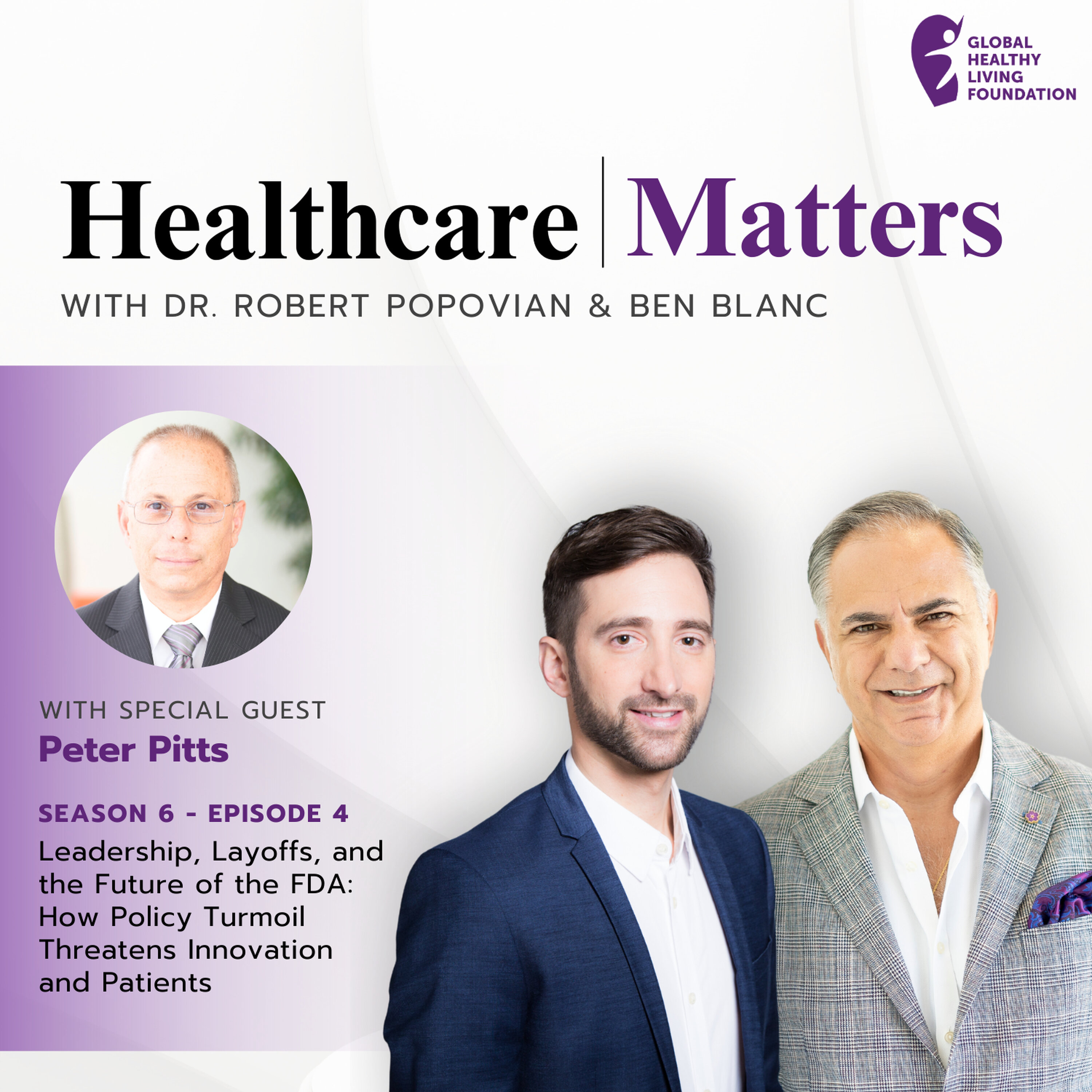
S6, Ep 4- Leadership, Layoffs, and the Future of the FDA: How Policy Turmoil Threatens Innovation and Patients
Apr 11, 202500:26:40Tap to summarizeIn this episode of Healthcare Matters, hosts Dr. Robert Popovian and Ben Blanc are joined by Peter Pitts, former FDA Associate Commissioner and President of the Center for Medicine in the Public Interest. Together, they unpack the sweeping personnel cuts at HHS, ongoing instability at the FDA, and how it all may threaten the future of drug innovation in the U.S. With delays in leadership appointments, policy misalignment across agencies, and increased uncertainty from pricing reforms like the Inflation Reduction Act, pharmaceutical companies may hit pause—and patients may pay the price. Tune in for a timely discussion on how chaos in science policy reverberates through clinical innovation and patient access. Among the highlights in this episode: 03:09: Peter Pitts shares his FDA background and warns against viewing staff consolidation through a purely numerical lens—emphasizing the nuance of function and legal responsibility 04:07: Peter breaks down FDA’s structure, clarifying that the majority of its 18,000 staff are non-political, career public health officials—not industry influenced 06:33: Peter explains that gutting senior leadership slows down innovation and drug approvals, as regulatory coordination is weakened 07:42: Peter details ongoing leadership instability across FDA’s key centers (drugs, biologics, devices), and notes the loss of progressive voices like Dr. Peter Marks and Dr. Patrizia Cavazzoni 08:32: Dr. Popovian adds that short- and long-term uncertainty in biopharma is significant, especially in oncology—a therapeutic area critical to innovation and patient survival 09:53: Peter warns that chaos and unpredictability undercut investor confidence, which could delay development in oncology, gene therapy, and rare diseases 11:10: Dr. Popovian reinforces that cancer care is now chronic care, and disruptions in FDA operations could rob patients of critical time and treatment options 11:42: Peter highlights misalignment between FDA and CMS, especially when CMS questions the validity of FDA-approved data—jeopardizing reimbursement 12:43: Dr. Popovian and Peter urge alignment between FDA and CDC guidance, citing conflicting vaccine messaging as a source of confusion for patients and providers 13:37: Peter underscores the need for improved communication and coordination between public health agencies to rebuild trust 15:06: Dr. Popovian raises concerns that instability and underappreciation will deter top scientists from public service roles at agencies like the FDA 17:21: Dr. Popovian explains that pharmaceutical companies are delaying R&D and trial investments due to regulatory uncertainty 18:35: Peter adds that companies may also pause research into new uses for existing drugs—despite their public health value—due to unclear FDA pathways 19:21: Dr. Popovian discusses how the Inflation Reduction Act (IRA) further complicates investment decisions, creating a “perfect storm” with FDA uncertainty 23:19: Ben emphasizes that policy uncertainty delays hope for patients awaiting new treatments—and that public accountability is more important than ever 24:03: Dr. Popovian shares some final thoughts Contact Our Hosts Dr. Robert Popovian, Chief Science Policy Officer at GHLF: rpopovian@ghlf.org Ben Blanc, Director, Digital Production and Engagement at GHLF: bblanc@ghlf.org A podcast series produced by Ben Blanc. We want to hear what you think. Send your comments, or a video or audio clip of yourself, to podcasts@ghlf.org Listen to all episodes of Healthcare Matters on our website or on your favorite podcast channel.See omnystudio.com/listener for privacy information.
Transcribe →
S6, Ep 3- From Good Intentions to Missed Injections: How Complex Vaccine Guidelines May Be Slowing Adult Immunization
Mar 28, 202500:23:23Tap to summarizeAre well-intentioned vaccine policies making access harder instead of easier? In this episode of Healthcare Matters, hosts Dr. Robert Popovian and Ben Blanc unpack a new report from the Global Healthy Living Foundation (GHLF) on how Shared Clinical Decision Making (SCDM) and risk-based recommendations may unintentionally reduce adult vaccination rates—particularly in underserved communities. From real-world data showing a 10 percent drop in pneumococcal vaccine uptake to sharp disparities in meningitis coverage, the findings are hard to ignore. Tune in as we explore how these policies may create confusion, widen health inequities, and hinder access—and what can be done to fix it. Among the highlights in this episode: 03:00: Dr. Popovian explains what Shared Clinical Decision Making (SCDM) is and the role of Advisory Committee on Immunization Practices (ACIP), noting the challenges of expecting time-strapped physicians to hold complex conversations with patients 06:00: Dr. Popovian expresses concern that SCDM can lead to decreased immunization rates due to misaligned expectations and informational imbalance 07:15: Dr. Popovian cites a 10 percent drop in pneumococcal vaccine uptake after its recommendation changed from “routine” to SCDM, and notes a striking difference in coverage between the quadrivalent meningococcal vaccine (60.8%) and MenB (11.9%) meningitis vaccines, the latter being subject to SCDM 10:03: Dr. Popovian explains that pharmacists and clinic-based providers often lack access to patients’ full medical records—making risk-based decisions difficult in practice 13:47: Dr. Popovian explains that patients in underserved areas often rely on pharmacies or federally qualified health clinics, where continuity of care is lacking and risk assessments are harder to verify—exacerbating health inequities 15:59: Dr. Popovian predicts the administration will double down on SCDM and patient-led decisions—likely leading to lower vaccination rates and reduced herd immunity 17:58: Dr. Popovian warns that some states (like Louisiana) are banning public health messaging about vaccines, making the role of advocacy organizations even more critical in providing accurate information 19:00: Ben emphasizes the importance of education, outreach, and advocacy to bridge the gap between policy and real-world vaccination practices 19:00: Dr. Popovian calls for aligning ACIP recommendations with FDA labels and tracking the public health consequences of recent policy changes 20:02: Dr. Popovian shares some final thoughts For more information about “Enhancing Adult Vaccine Uptake: Challenges in Shared Clinical Decision Making and Risk-Based Recommendations,” and to access the full report, visit: https://ghlf.org/issues/vaccines/enhancing_adult_vaccine_uptake/ Contact Our Hosts Dr. Robert Popovian, Chief Science Policy Officer at GHLF: rpopovian@ghlf.org Ben Blanc, Director, Digital Production and Engagement at GHLF: bblanc@ghlf.org A podcast series produced by Ben Blanc. We want to hear what you think. Send your comments, or a video or audio clip of yourself, to podcasts@ghlf.org Listen to all episodes of Healthcare Matters on our website or on your favorite podcast channel.See omnystudio.com/listener for privacy information.
Transcribe →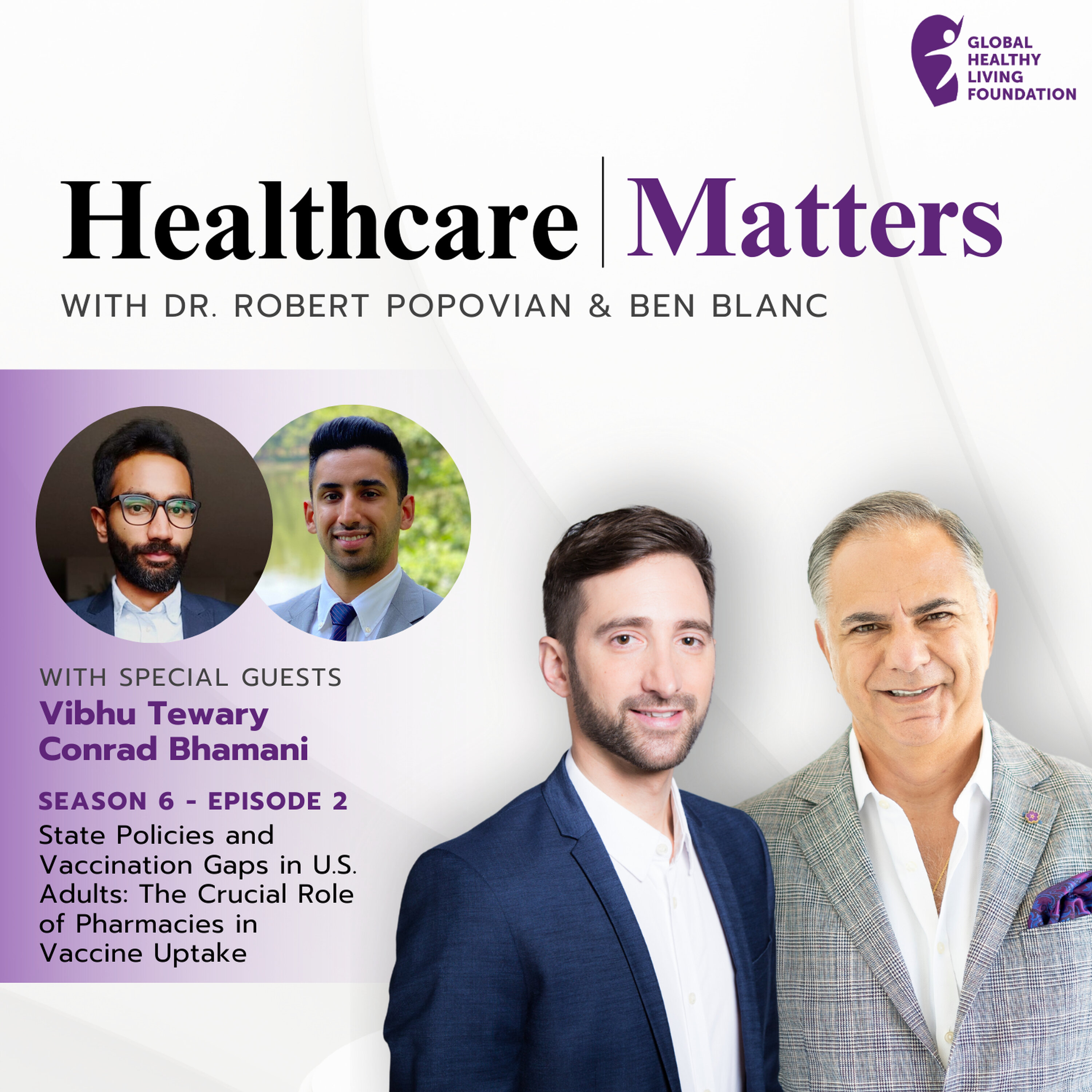
S6, Ep 2- State Policies and Vaccination Gaps in U.S. Adults: The Crucial Role of Pharmacies in Vaccine Uptake
Mar 7, 202500:19:27Tap to summarizeDid you know that millions of adults may have missed crucial vaccines due to restrictive state policies on pharmacist vaccination authority? In this episode of Healthcare Matters, hosts Dr. Robert Popovian and Ben Blanc sit down with Vibhu Tewary and Conrad Bhamani from the IQVIA Institute for Human Data Science to discuss new research conducted by the IQVIA Institute and GHLF on how these restrictions impact vaccination rates. They break down key findings from the report, revealing that states with tighter regulations see significantly lower vaccine uptake — by as much as 14% for RSV vaccines. Tune in as they explore real-world consequences for underserved communities, why pharmacists are essential to public health, and what policy changes could help expand vaccine access. Among the highlights in this episode: 01:17: Ben introduces the key topic of the episode: how state restrictions on pharmacists’ vaccination authority may be preventing millions of adults from accessing crucial vaccines 02:56: Dr. Popovian explains that pharmacists are the most accessible health care professionals, particularly in underserved communities, and cites data showing that many patients prefer to receive vaccines at pharmacies 05:27: Conrad highlights key statistics from the report, including that states requiring a physician’s prescription for RSV vaccines see a 14% lower vaccination rate, while states requiring a physician protocol see a 9% lower rate 07:41: Vibhu explains how pharmacy access is critical for people in low-income and minority communities, who often face additional barriers to seeing a physician during regular office hours 09:56: Dr. Popovian outlines policy recommendations, including eliminating physician prescription requirements and protocol restrictions, to make vaccinations more accessible 12:39: Dr. Popovian emphasizes the importance of collaboration between pharmacists and physicians and urges pharmacists to advocate for policy changes 14:10: Vibhu discusses how states that grant pharmacists independent vaccination authority tend to have higher immunization rates and how data should drive policy decisions 16:14: Dr. Popovian shares some final thoughts Contact Our Hosts Dr. Robert Popovian, Chief Science Policy Officer at GHLF: rpopovian@ghlf.org Ben Blanc, Director, Digital Production and Engagement at GHLF: bblanc@ghlf.org A podcast series produced by Ben Blanc. We want to hear what you think. Send your comments, or a video or audio clip of yourself, to podcasts@ghlf.org Listen to all episodes of Healthcare Matters on our website or on your favorite podcast channel.See omnystudio.com/listener for privacy information.
Transcribe →