← The Preamble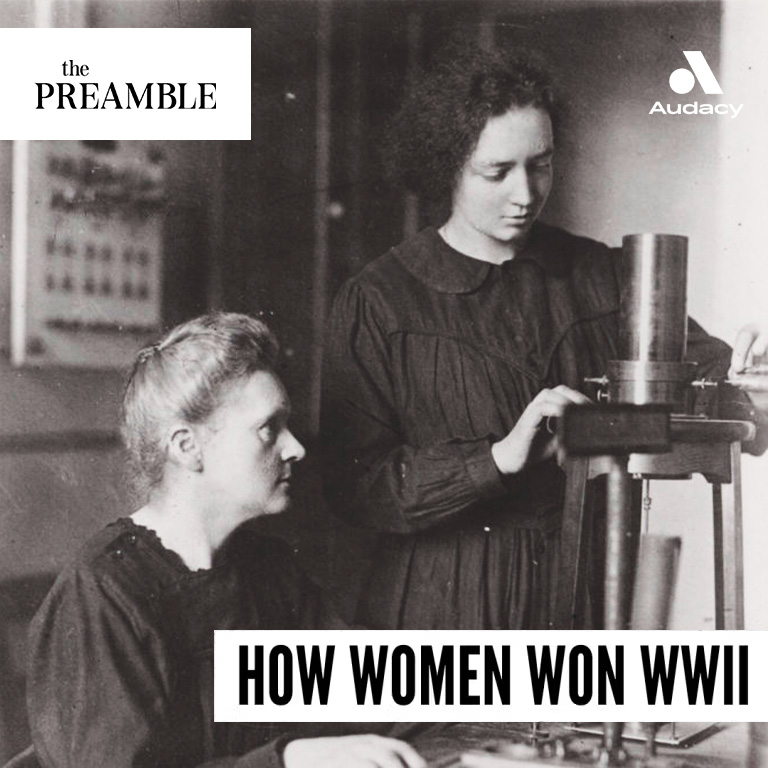
The Preamble
How Women Won WWII: By the Glow of Radium
00:34:08
Let's talk about how the United States successfully produced and detonated the first atomic bomb. That success happened through a combination of random events and intricately planned schemes that fed into the speeding train that was atomic technology.
Loading summary
Transcript23 lines
- [00:00]
Sharon McMahon
Running a business is hard enough. Why make it harder with dozens of disconnected apps? If your software is causing more stress than success, it's time to switch to Odoo. Odoo is an all in one business platform that handles CRM, accounting, inventory, E
- [00:16]
Narrator (History Podcast Host)
Com, HR and more.
- [00:18]
Sharon McMahon
Everything is fully integrated so you don't
- [00:20]
Narrator (History Podcast Host)
have to waste time switching between apps or juggling multiple logins.
- [00:24]
Sharon McMahon
It's one seamless system designed to make your workday easier, more productive and less stressful. And it's not just conven convenient, it's smart business. Odoo replaces multiple expensive platforms, helping you save money while still giving you all the tools you need to run your company efficiently. Plus, it's designed to grow with your business. From startups to established enterprises, Odoo is easy to use, customizable and built to streamline every process so you can spend less time on software headaches and more time on strategy, customers and growth. Thousands of businesses have already made the switch. Why not you try Odoo for free
- [01:02]
Masterclass Advertiser
today@odoo.com that's O-O-O.com with Squarespace you can
- [01:08]
Squarespace Advertiser
do more than just build a website. You can build a business. Squarespace helps restaurants and hotels showcase signature offerings and experiences. And with Squarespace, consultants and photographers can create invoices to collect well earned payments. You can even send email newsletters to keep in touch with your loyal customers. Done. So grow your business@squarespace.com get started with offer code. Make it real for 10% off your website or domain.
- [01:40]
Narrator (History Podcast Host)
Hello friends. Welcome. So delighted to have you with me today for the fourth episode in our documentary series, How Women won World War II. Well, it was the United States that ultimately produced and detonated the first atomic bomb. The technology came from various players and programs across Europe. France, Austria, Germany, Norway and Great Britain all had scientists and governments who played a role in the success of the Manhattan Project. That success happened through a combination of seemingly random events and intricately planned schemes that fed into the speeding train that was atomic technology. The US pops up along those tracks. But the spark that would lead to the bomb began across the Atlantic. And in a way, there were women at the heart of it all.
- [02:43]
Sharon McMahon
I'm Sharon McMahon and this is the Preamble Podcast.
- [02:47]
Narrator (History Podcast Host)
Lets begin with a name that you likely know from your earliest years in school. At the dawn of the 20th century, Marie Curie and her husband Pierre discovered and isolated the chemical element of radium. Their lab in France. Their work opened up a whole new world of scientific possibilities. Marie became the first woman to win Nobel prizes in physics and chemistry. And by the time the roaring twenties danced in on jazz music. The Polish born Marie, who had once been shunned in France for being a foreigner, was immensely popular with the public. Radium, with its radioactive green glow, was all the rage. And it was used in a number of everyday products like tonics for your health, toothpaste to whiten your teeth. And it was put in in chocolate. Chocolate and it was added to chicken feed. You also might be familiar with the radium girls, the young women who worked in factories painting watch faces with radium. It was in part through their terrible suffering that we discovered just how devastating radiation poisoning can be. But none the wiser. In 1920, everyone wanted to talk with the woman who discovered radium. Magazines and newspapers around the world were desperate to gain an interview with Marie, but she declined all of them. A few years earlier, the Parisian press had ousted a messy love affair Marie Curie had with a married physicist. Like messy, messy. When the scandal broke, the physicist challenged newspaper publishers to no less than five duels. And his wife wrote threatening letters to Marie. Needless to say, Marie was not interested in going anywhere near the press. Enter an American woman also named Marie Marie Mattingly Maloney, who, like Marie Curie, defied the domestic limitations placed on women and excelled in a career dominated by men. Marie Maloney, who went by the name Missy, was a highly respected journalist in the United States, having made her mark with the Washington Post and Denver Post as a teenager before rising to the top as an editor of several popular national magazines. At 18, she had become one of the very first female journalists to hold Senate press credentials. That is still unusual. I don't, I'm not aware of any 18 year olds that hold congressional press credentials today. Missy was ambitious and she was absolutely determined to land the coveted interview with Marie Curie. In 1920, Curie relented to give an interview to the tenacious Missy Maloney, not because she was ready to step into the limelight, but because the United States had something that Marie had needed and France couldn't give her more radium. Pierre Curie died in a streetcar accident in 1906, just a few short years after the couple was recognized for their work with radium. Marie continued the work they began together and upheld their agreed upon scientific ideals. The curious believed that their research should not be used for individual profit, but instead be accessible to the scientific community for the good of all. They didn't register any patents on their work. And as the demand for radium grew, so did its Price. Marie could no longer afford to work with the element she had discovered. Curie got right to the point when the interview began and let Missy Maloney know that if she had one wish, it would be to get a gram of radium from an American uranium mine. Missy supported Marie Curie's goal to continue her research, but knew that obtaining the needed radium would come at a high cost. So Meloni used her position as a journalist to launch the Marie Curie Radium Fund and promoted it to American women who would be interested in supporting Curie's research. She rallied readers to the cause by writing Life is passing and the great Curie getting older and the world is losing. God alone knows what great secret. Missy then gathered groups of housewives to fundraise in their neighborhoods, collecting money from households, a dollar or two from women's grocery funds, pocket change from school children. A huge amount of donations poured in from around the country. And a year later they had raised the needed $100,000, which is over a million dollars today, to buy Marie Curie a gram of radium. Missy convinced Curie to make her first overseas trip to the United States and formally receive the radium from President Warren Harding. Americans flocked to see Marie as she, she and her two daughters, Ev and Irene, embarked on a whirlwind tour of the United States. Marie shook hands with Girl Scout troops, waved to women while brass bands played jaunty tunes. And when the seven week tour ended in Washington D.C. president Harding handed Marie Curie a tiny gold key. She used it to unlock a small lead lined cabinet containing not her gram of radium, which was actually locked safely away in a separate location. But Marie played along for the press, pretending to find radium nestled inside the 130 pound lead box. That single gram of radium waiting for Marie in an American government lab would play an important role in the establishment of the Manhattan Project. In 1920, around the same time that Marie Curie was receiving her new supply of radium in America, a young Hungarian scientist named Leo Szilard immigrated to Berlin to continue his university education. He was enrolled in engineering, but was drawn to the lectures given by a physics professor named Albert Einstein. Perhaps you have heard of him. Leo kept sneaking into the back of Einstein's classes and even though he wasn't registered for the physics program, Einstein allowed him to stay and learn. Imagine just sneaking into the back of Einstein's classes. That seems ridiculous today. Leo was very awkward and kind of the clumsy type, but he also knew an opportunity when he saw it. And so when he realized that he lived in the same neighborhood as Einstein, he asked the famous professor if they could walk home together. Einstein said yes. And as the pair walked, a camaraderie began. A decade later, in the early 1930s, Leo worked as a professor at the University of Berlin. But when Hitler was elected Chancellor in 1933, he feared for his intellectual and personal safety. Not only was he Jewish, but he had watched several of his fellow colleagues be forced into work to further the Nazis own scientific goals. He left Germany, and not a day too soon, literally. Leo Szilard slipped out of the country the day before German troops begin to ban Jewish residents from leaving. One day more, and his fate and role in history could have looked very different. Leo moved to Great Britain, where he eventually came into contact with some of the most brilliant scientific minds who were on the verge of an enormous scientific breakthrough. Scientists across free Europe contemplated the newest physics discovery that the atom is made up of both protons and neutrons, and contained within that was an untapped resource of unlimited energy. But accessing that energy by splitting open an atom seemed like an impossible task. Physicists agreed that it was worth theorizing, but almost impossible to achieve. The Atomic Heritage foundation explains it like this. The power of the atom is in the nucleus to release it. And to release it, you would somehow have to break the strong bonds holding it together. As tiny as an atom is, the nucleus is even tinier. Imagine a pea sitting in the middle of a racetrack. This is how small the nucleus is compared to the atom. It seems crazy to think that it would be possible to hit that pea with enough power to break the strongest forces in the universe. There was a new physicist power couple in France who believed that it was possible to split an atom. Marie and Pierre Curie's oldest daughter Irene had grown into a brilliant physicist physicist in her own right and married a scientist named Frederick Jolio Curie. And remember that gram of radium that Marie was gifted by the people of the United States? In the early 1920s, her laboratory team at the Radium Institute still had some left. And Ren and Frederick used it to experiment with their theory that splitting an atom could be done. But in 1933, when the Joliot Curies presented their ideas at a scientific conference, they were dismissed. We're not talking about, you know, polite disbelief of like, oh, yeah, we'll see. No, no, we're talking about pretty heavy dissent from the audience. The couple's methodology was loudly rejected by an important Austrian scientist named Lise Meitner. Leo Szilard agreed with Irene and Frederic Joliot Curie's theories. He was convinced an atom could be split and believed that one element could be hit with another one to start a nuclear chain reaction. But while the Joliot Curies were focused on how their breakthrough could change the field of medical technology, Leo Szilard became obsessed with making sure that Nazi Germany was not the one to figure out how to put this scientific theory to use in a different destructive way. By building a bomb in Britain. The immigrant Leo didn't have regular access to a lab or sponsorship, otherwise known as money. His ideas fell on deaf ears in the scientific community. So Leo did something clever to make it harder for Hitler and Nazi Germany to obtain and research the controversial scientific theory. He filed a patent. As a next step, Leo connected with a research physicist at Oxford who was a friend and scientific advisor to Winston Churchill. Through this connection, Leo Szilard had his patent certified as a military secret. In late 1938, an Italian physicist named Enrico Fermi discovered that a nuclear transformation could happen in almost any element. And he began working to split uranium. These European scientists, many supported financially by governments opposed to the Nazi regime, were racing the clock. Once they figured out the process on how to obtain an atomic chain reaction, they realized that Germany's scientists had been keeping up with them. Queen Carvania stood haloed by the morning sun. An army hung on her every word.
- [16:01]
Carvana Advertiser
My champions, I have sold my chariot on Carvana. Twas a lovely suv, an inexplicably queen. They're even coming to the castle to collect it. Tonight we feast. An offer you can feast on. Sell your car today on Carvana. Pickup fees may apply.
- [16:23]
Sally Helm
Sometimes it feels like the news is full of things that have never happened before. And that is not exactly true. In fact, it may have happened this very week, hundreds or thousands of years ago. I'm Sally Helm, host of the podcast History this Week from the History Channel. Trade embargoes. Thomas Jefferson tried them.
- [16:40]
Narrator (History Podcast Host)
Rent too high.
- [16:41]
Sally Helm
We've been arguing about that for a while. Each episode is proof the past isn't that far away. Listen to History this Week. Available now on Apple, Spotify, or wherever you get your podcasts.
- [16:53]
IXL Advertiser
Summer break is here. I want my kids to have fun, but I also want them to keep their skills sharp between vacations and sports. I need something that fits our busy schedule without adding stress. That's why we use ixl. IXL is an award winning online platform that helps kids truly understand what they're learning. Whether they're building math confidence, strengthening reading and writing skills or reviewing science concepts from Pre K through 12th grade. IXL offers personalized, interactive learning that adapts to each child's level and pace. It's proven to improve grades, and one subscription covers every child in the home, saving us time and money. It's trusted nationwide and in fact, IXL is used in 96 of the top 100 school districts in the U.S. make an impact on your child's learning. Get IXL now and listeners can get an exclusive 20% off IXL membership when they sign up today at ixlearning.com audio Visit ixllearning.com audio to get the most effective learning program out there at the best price.
- [18:01]
Narrator (History Podcast Host)
In 1939, the German government formed a commission called the Uranium Club with the goal to research emerging, emerging nuclear technologies for the production of nuclear weapons. This was Nazi Germany's version of the Manhattan Project. By the following spring, members of the German Uranium Club traveled to Norway to purchase a very specific substance. Heavy water. And when I first learned about this, I was like, heavy water. That's what we call it, Heavy water. Yes, that is what it is called. Heavy water, which looks and feels just like regular water is processed to contain extra neutrons. It was a substance that could act as a moderator when controlling the chain reaction of atoms. And the biggest source of heavy water was a hydroelectric plant deep in the mountains of Norway. Like literally about plant built into a mountainside. The Norwegian electrochemists at this plant were smart. You don't get to be an electrochemist without learning some basic skills of deduction. And they knew the Germans sniffing around the plant were up to something. And that something was probably not good. They tactfully postpone the sale of their stock of heavy water to the Germans. Instead, they connected with the Joliot Curie lab in France and made arrangements to have 408 pounds of heavy water transferred to Paris for safekeeping. An elaborate plan was hatched with spy schemes that would make James Bond look like an amateur. The Germans were tipped off about the plan and made an attempt to sabotage it. But the French intelligence service was one step ahead. Instead of traveling by plane over the city of Oslo, where the Germans were attempting to intercept it, the heavy water traveled by railroad through Scotland before landing safely in a vault in France. By the time the heavy water had made it to Paris, two scientists had left Europe for the United States to teach at Columbia University. They were Enrico Fermi, who had been working to split uranium, and our friend Leo Szilard, who continued to fear that Germany would beat the rest of the world in creating atomic weapons. Leo felt that the United States was woefully behind and he enlisted an old friend to convince President Roosevelt to ramp up the country's nuclear research. And that friend was Albert Einstein. It was Leo who helped Einstein draft his letter to fdr. And that letter would set off the chain reaction that led to the creation of the Manhattan Project. Leo Szilard and Albert Einstein weren't the only ones who were catching the eyes of world leaders in the early 1940s. I have to pause here and tell you what Missy Maloney had been up to since she helped Marie Curie purchase radium from the United States 20 years earlier. Marie and Missy continued their friendship until Marie Curie died in 1934. They were a duo that did not always make sense. Marie was very quiet and serious and often in poor health, which we now know was due to her decades long exposure to radiation. Missy, on the other hand, was a vibrant, spirited soul. She was a people person and dang, she met a lot of people. During the 1930s. She interviewed Benito Mussolini on four separate occasions and her obituary recounted the time that she was supposed to interview Adolf Hitler. Hitler broke his appointment with her and when the emissary tried to reschedule, Missy told them that she was no longer interested. She declined to interview Hitler. And that is the very definition of a power move. Missy rose and rake to become the editor of one of the biggest publications in the United States, the Sunday magazine that was put out by the New York Herald Tribune. For all of her clout, she never failed to make time for Marie Curie and her daughters. She convinced New York's mayor to name a Bronx street after Marie and even mentored Marie's youngest daughter, Ev. Unlike the rest of her scientifically minded family, the youngest Curie's passion was was writing. In fact, Ev wrote the biography Madame Curie after her mother died and it became an instant international bestseller. During the war, Ev devoted herself to the Allied effort as both a war correspondent and a volunteer in the French 1st Armored Division. Missy Maloney was also great friends with Eleanor Roosevelt, and the two women visited each other as often as they could. When missy died in 191943 after a struggle with pneumonia, Eleanor Roosevelt wrote of her. If I am sometimes weary and think that perhaps there is no use in fighting for things in which I believe against overwhelming opposition, the thought of what she would say will keep me from being a slacker. She believed that women had an important part to play in the future. She not only helped such women as Marie Curie, who were great women, but she helped many little people like myself to feel that we had a contribution and an obligation to try to grow. In 1942, as the Manhattan Project started running in earnest, a group of scientists, including Enrico Fermi and Leo Szilard, were sent by Director Leslie Grobes to a newly formed lab at the University of Chicago. And remember, the Manhattan Project started in Manhattan, but quickly expanded to larger sites and more intricate labs across the country. There were science labs in Manhattan, Chicago in Berkeley, California, and larger production facilities were erected in Oak Ridge, Tennessee, Los Alamos, New Mexico and Hanford, Washington. General Groves and Leo Szilard did not get along by the way they butted heads on protocols all the time. But Leo needed General Groves to allow him to continue working on the project that he'd spent over a decade obsessing over. And General Groves needed Leo's patent to be able to continue with specific projects in their nuclear research. Leo was a shrewd man. He did not want to turn his patent over to the US Military. He didn't believe that the technology should be out of the control of scientists. And Leo wasn't the only one concerned with the US Military retaining complete control of the atomic plans. Back in Britain, a coalition had formed their own Manhattan Project called the British Tube Alloys. Initially, the British had been ahead of everyone else in their atomic work and they'd already done top secret research to discover just how much enriched uranium you'd need to build up for a new nuclear explosion. Britain had zero interest in the Tube Alloys project being under the control of the United States military. So for the first few years of their work, the programs remained friendly but separate endeavors until 1941, when Mark Olifando, an Australian physicist working in Britain, visited the United States to check up on their atomic program to see what could be shared or gained. He realized that the American project had already dwarfed the British research. And with the clock ticking to beat the Germans in the bomb race, the projects needed to join forces. In August of 1943, Winston Churchill and President Roosevelt signed the Quebec Agreement, which brought together military and scientific cooperation between the United States, Great Britain and Canada. Through the Quebec Agreement, the Manhattan Project expanded exponentially. The German born British physicist Rudolph P. Ales led a team to develop gaseous diffusion technology in New York, Chicago and eventually at Los Alamos. The Australian Mark Oliphant led a mission at the Berkeley Radiation Laboratory that assisted with the electromagnetic separation process. And the British James Chadwick headed the British Commission at the Los Alamos Laboratory. Leading a team of multinational scientists, including Klaus Fuchs, who also worked at Oak Ridge, Tennessee, and would later be revealed as one of the biggest Soviet spies within the Manhattan Project. The British and United States Atomic Partnership dissolved after the war was over with the 1946 McMahon act, which, in case you were wondering, I have no relation to. But during those few years of collaboration, the Manhattan Project was able to do exactly what it set out to do.
- [27:43]
Sharon McMahon
Today's episode is brought to you by ALMA Therapy has made a real difference in so many people's lives. But getting started isn't always, always simple. People have told me they don't know where to look and they felt unsure about how to find someone they would actually connect with. And then there's the whole insurance piece, which can make things even more confusing. That's why ALMA exists. ALMA helps people quickly find affordable in network therapy that actually works. They've built a diverse network of over 26,000 therapists and you can browse their directory freely with no account required. You can filter by everything from insurance to specialty to background, so you can find the right fit faster. Clients with insurance pay $20 on average, and 98% of Alma therapists accept insurance. Plus their free cost estimator shows you exactly what you'll pay upfront. Most people find their match on the first try, and 95% connect with a therapist within a week. In fact, 83% of clients believe their current therapist is the right fit. Get started now@helloalma.com preamble.helloalma.com P R E A M B L E Lately I
- [28:56]
Masterclass Advertiser
felt completely overwhelmed by digital distractions, constantly losing hours of my day to mindless scrolling. But I found a fix after watching Cal Newport's session on the Masterclass platform. He teaches a brilliant technique to rebuild your focus by treating attention as a finite precious resource. It completely changed how I approach my work. What's amazing is that Masterclass puts you
- [29:19]
Sharon McMahon
in the room with the world's best
- [29:20]
Masterclass Advertiser
instructors across over 200 classes. Their bite sized lessons fit any schedule featuring an audio mode perfect for your commute or workout. And it actually works too. Over 80% of members apply what they learn to their real lives and there's zero risk. With a 30 day money back guarantee. Masterclass keeps adding new classes, so there's never been a better time to get in. Right now, as a listener of this show, you get at least 50 off any annual membership@masterclass.com Sharon that's 15 15% off@masterclass.com Sharon head to masterclass.com Sharon to see the latest offer it's the middle of summer, which means long days, sticky nights, and a lot of us are tossing and turning. More than ever, here's the piece of the puzzle most people overlook. The summer heat quietly depletes your body's magnesium. And magnesium is exactly what your system relies on to promote relaxation, support a balanced stress response and pave the way for more restful sleep. That's why Magnesium Breakthrough by Bioptimizers is a permanent fixture on my nightstand. Now what sets it apart is that it delivers multiple bioavailable forms of magnesium in a single serving rather than the basic single types found in standard supplements, helping to ease muscle tension and support overall wellness. Here's what you get when you go to bioptimizers.com Sharon and use code Sharon 15% off your entire order. A free travel size bottle of of Mass Times Bioptimizer's best selling digestive enzyme added to your order automatically when you use our exclusive code. That's a 20 product free on top of your discount. This is a limited time offer and while supplies last, you cannot get this on Amazon. You can't get it in stores. This offer exists in one place. My link with my code. That's it. Bioptimizers Breakthrough Science results you can feel by optimizers.com Sharon Code Sharon
- [31:17]
Sally Helm
Many of
- [31:17]
Narrator (History Podcast Host)
the male scientists who emigrated to the United States to work on the Manhattan Project didn't come alone. They brought their wives and families with them. The Italian physicist Enrico Fermi brought with him his wife Laura and their two small children. When he came in 1938, Laura wasn't technically technically a lab scientist, but she was a science writer. She was born in Rome to a Jewish family and she spent a few years studying natural science at the University of Rome before she met Enrico at a soccer game. Enrico was a physics professor and when the Couple married in 1928, Laura discontinued her studies and settled in at home to have children, yes, but also to write her first science book. Laura co wrote the book the Alchemy of Our Times with another woman, the wife of Enrico's physics partner. I mean picture this. Two young Italian mothers with babies on their hips collaborating over science notes. They took their husband's work and explained it for the people outside of the science field. I cannot stress enough how difficult it is to turn complicated scientific concepts into something digestible for those of us who who couldn't give a definition of a neutron if our life depended on it. But this was Laura's talent. She spent her entire lifetime breaking down complex science and making it accessible for a general audience. Unfortunately for the Fermis, Italy had grown increasingly hostile toward Jews. Even those who, like Laura, weren't practicing. Mussolini's government allied with Nazi Germany and embraced fascism. Laura, Enrico and their two children left for the United States. Life was not all sunshine and rainbows from there, even though Enrico began working at Columbia University and then on the Manhattan Project in Chicago's Met Lab. The Italian Fermis were enemy aliens in America. They faced security scrutiny and travel limitations. And Laura wasn't allowed to know what her husband was doing at the Metlous. In fact, she didn't even know that her husband had overseen the world's first successful nuclear chain reaction until after the war was over. It took seven years, but in 1944, Laura, Enrico and their children were naturalized as Americans. They moved to the top secret site Y in Los Alamos, New Mexico, as scientists rushed to finish building the atomic bomb. Because Enrico was a top scientist on the project, the family was offered comfortable housing. But Laura and Enrico diplomatically opted out of it. Three years in on the project and employees tended to grumble when they saw new people get special treatment. So Laura settled her children into bare bones living quarters just like any other working class Manhattan Project family. Wives were encouraged to join the work effort. And so, still in the dark, Laura worked in the Los Alamos Health Group lab taking blood counts. She didn't know why she was taking them at the time, but we know now that her job was crucial in the effort to monitor for radiation poisoning. And Laura Fermi was one of many, many, many women who impacted the Manhattan Project both in ways that are documented and in small ways that might seem inconsequential but allowed the project to move forward. Women like Floyd Agnes Lee, whose job it was to monitor the blood of Enrico Fermi, even though she didn't know who he was. Because of the top secret nature of the project, women like, like Floyd didn't even know the first names of their patients. Floy knew Enrico Fermi as a number only, even though they saw each other socially outside of the lab where he had his blood drawn. In fact, Floyd Lee and Enrico Fermi often played tennis together and Floy usually beat Enrico. It wasn't until the project was made public that Floy learned the identity of her patient. And then she went on to get her PhD and to work at the Jet Propulsion Lab. And then we have women like Lily Hornig, who had a master's degree in chemistry from Harvard, whose husband was recruited to work on the Manhattan Project. When the Hornigs were offered a move to Los Alamos, Lily asked how she might be of help. And the recruiter told her there will most definitely be a place for anyone with a master's in chemistry from Harvard. After making the journey to New Mexico, Lily went to the personnel office for her assignment. And they asked her, how fast can you type? And Lily was like, not, I cannot. I cannot type. And the personnel office told her, well, we're gonna have to do a lot of background research on you. We're gonna have to contact every country your family ever lived in, which was a lot because Hornick's family had fled the Nazis in Europe. And the personnel office said, we'll get back to you in a few months. What the person working in the personnel office didn't know was that Lily Hornig already had a background check done. And she was quickly given a job where working with plutonium and the solubility of various plutonium salts. She then moved on to another team where they worked on designing shock fronts that could protect devices from implosion. It was while working on that team that Lily Hornick became acquainted with the name you may have heard before, David Greenglass. David Greenglass was part of the Soviet spy ring that ultimately became brought down Julius and Ethel Rosenberg. Julius Rosenberg didn't work on the Manhattan Project directly, but he was a low level recruiter for the spy ring. He and his wife Ethel were both executed for their role in espionage. And the person who gave them up, David Greenglass, who was Ethel Rosenberg's brother. In Laura Fermi's last book, Illustrious Immigrants, she writes about the large number of Europe's most intelligent and best trained men and women who immediately became visible to middle class America as neighbors, teachers and colleagues. They were, she continued, men and women who came to America fully made, so to speak, with their PhDs and diplomacy diplomas from art academies or music conservatories in their pockets, and who continued to engage in intellectual pursuits in this country before, during and after World War II, the brilliance of women, and of course men, many of whom were immigrants and refugees, helped transform the United States into a global superpower. And before we wrap for today, I have one more loose end to tie up. Back in Europe, after the French smuggled heavy water out of the Norway plants, Germany was furious. The Nazis invaded Norway in April of 1940, and after taking the city of Oslo, they seized control over the heavy water plant and forced its workers to continue production and shipment into Germany. In February of 1943, an Allied mission called Operation Gunnerside that included both Great Britain and the United States successfully destroyed the Nazi controlled plant and cut off Germany's access to heavy water production. It was a mission that devastated the German atomic bomb project. British and American men, who reportedly spoke perfect Norwegian, dressed themselves in British military uniforms, armed with revolvers and entered the front door of the factory. They told workers to go up to the seventh floor where no harm would befall them. And then they went to the machinery of the heavy water factory, placed explosive devices in precisely the right locations, pulled the pins and let the fuse. The vital machinery was destroyed and with it much of the Nazis hope of using heavy water technology to accelerate their own atomic bomb program. No doubt that during Operation Gunnerside and thousands of other covert Allied missions like it throughout World War II, coded language, ciphers and game theory were all used to increase the likelihood of success. In our next episode, we will meet the women who were first recruited for naval war jobs to do behind the scenes tasks like cooking and mending, but who became indispensable players in the art of code breaking and mission strategizing. I'll see you next time. This show is written and researched by Heather Jackson, Sharon McMahon, Valerie Hoback and Amy Watkin, edited and mixed by our audio producer, Jenny Snyder, and is hosted by me, Sharon McMahon. We'll see you again soon.
- [41:20]
Autotrader Advertiser
Look around. Every car you see is probably on autotrader. New cars, used cars, electric cars. As for flying cars, well, we're ready when they are. If you see a car you like, find it on autotrader. That's our kind of thing. Autotrader.