← The Preamble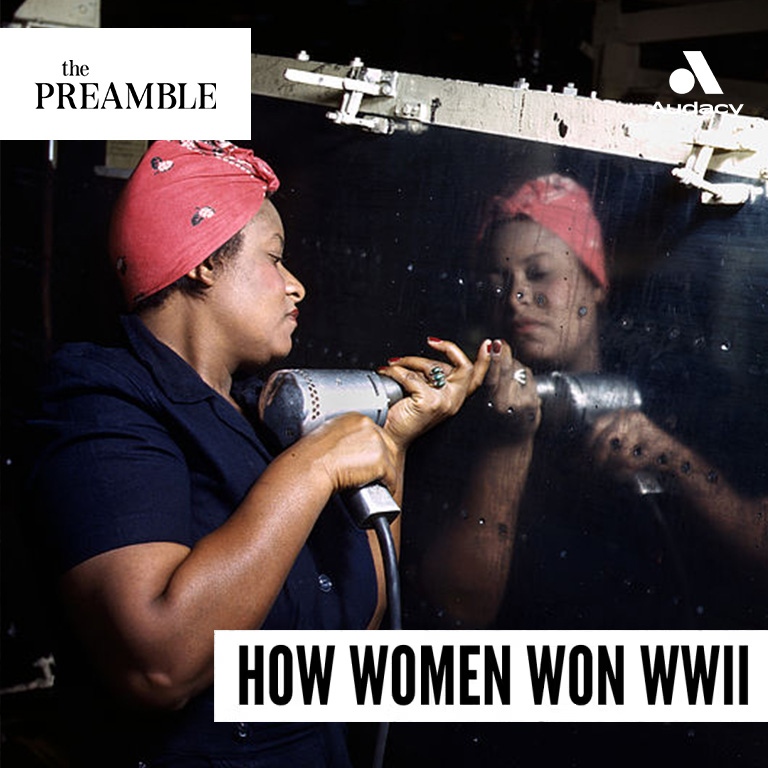
The Preamble
How Women Won WWII: Rosie the Riveter Was Just the Beginning
00:31:50
Explore the incredibly varied and complex roles women stepped into during World War II. No, they weren’t GIs. They didn’t land at the beach on Normandy on D-Day, or face military combat, but without a doubt, the roles they performed shaped the way the war was both fought and won.
Loading summary
Transcript22 lines
- [00:00]
Sharon McMahon
Today's episode is brought to you by. ALMA Therapy has made a real difference in so many people's lives. But getting started isn't always simple. People have told me they don't know where to look and they felt unsure about how to find someone they would actually connect with. And then there's the whole insurance piece, which can make things even more confusing. That's why ALMA exists. ALMA helps people quickly find affordable in network therapy that actually works. They've built a diverse network of over 26,000 therapists, and you can browse their directory freely with no account required. You can filter by everything from insurance to specialty to background, so you can find the right fit faster. Clients with insurance pay $20 on average, and 98% of Alma therapists accept insurance. Plus their free cost estimator shows you exactly what you'll pay upfront. Most people find their match on the first try, and 95% connect with a therapist within a week. In fact, 83% of clients believe their current therapist is the right fit. Get started now@helloalma.com preamble. That's helloalma.com P R E A M B L E so many people have been there. Staring at the ceiling at 3 o' clock in the morning, heart pounding while your mind races. I learned that during perimenopause and menopause, shifting hormones are actually draining the magnesium your nervous system needs to function. And that is why so many people are adding magnesium breakthrough by Bioptimizers to their routines. Unlike most brands, they've spent 20 years and conducted over 15,000 lab tests to get this PhD formulated complex exactly right. It includes seven different forms of magnesium, which is why practitioners recommend it so highly. It hits everything from stress and recovery to that deep, deep restorative sleep we're all craving. If you're ready to finally sleep great and feel like yourself Again, head to bioptimizers.com Sharon and use my exclusive code Sharon to get 15% off any order. You'll get great discounts, free gifts, and the peace of mind of never running out. And Bioptimizers backs it with a 365 day, no questions asked money back guarantee, a full year, zero risk. Because at the end of the day, Bioptimizer's mission is to empower everyone to live a stronger, longer, better, better life. And this is one of the best tools to actually do that. Again, that's 15 off@bioptimizers.com Sharon when you use my code Sharon make this the year you finally get your sleep, your energy and yourself back.
- [02:42]
Narrator / Historian
Hey, friends, welcome. Welcome to our new series, How Women won World War II. Over the next few weeks, we're going to explore the incredibly varied and complex roles women stepped into during our last World War. No, of course they were not GIs. We're not claiming that they were the tank drivers who beat back Hitler's army. They didn't land on the beach at Normandy. But without a doubt, the roles they performed shaped the way the war was both fought and won. While our tendency is to connect women's work during World War II with the image of Rosie the Riveter, women weren't only tackling manufacturing jobs at home while the men were drafted into the military. Women, both in the US and in Allied Europe filled key positions that resulted in the Allies winning the war. Those positions, many of them, were top Secret.
- [03:54]
Sharon McMahon
I'm Sharon McMahon and this is the Preamble Podcast.
- [03:59]
Narrator / Historian
In early 1943, a catchy new tune rang out over the nation's airwaves. The song was written by two popular American composers, Red Evans and John Jacob Loeb, after they wrote read a newspaper article about a 19 year old woman named Rosalind Palmer. Rosalind worked as a riveter on Corsair fighter planes and was known for her speed and reliability. On the assembly line, she was also known for her gumption. She vocally advocated that the women make a fair wage while they worked. Inspired by Rosalind, the songwriting duo composed a song that they dedicated to the women who stepped in to do war work in the wake of America's declaration of war with Germany and Japan. The song was called Rosie the Riveter and you can hear just how catchy it was when it was recorded by the four vagabonds.
- [05:00]
Singer / Performer
All the day long where the rain or shine She's a part of the assembly line she's making history working for victory Rosie the Riveter keeps a sharp lookout for sabotage Sitting up there on the fuselage that little frail can do more.
- [05:20]
Narrator / Historian
The tune became a hit, an anthem even, that bolstered the confidence, pride and spirit of working women throughout the nation. Although conveniently, the part about fair wages got left out. Newspapers around the country ran stories about Rosalind, this real Rosie the Riveter who had inspired the song, and an August 1943 profile on her in the Buffalo News described her as the aspirational archetype of young working women. Rosalind is a prominent New York debutante, the newspaper said, a graduate of the fashionable Ethel Walker School and works the night shift. She's taken a room in a New York hotel where she washes and irons all her clothes and supports herself entirely, buying war bonds with a surplus. And although Rosalind was known to her family and friends by the nickname Roz, it was Rosie that became the de facto nickname given to the American female war worker. But this was just the beginning of the iconic Rosie the Riveter propaganda. The War Production board, which in 1942 had been granted supreme authority over the production of wartime materials, knew a gem when they saw it. They jumped at the chance to promote this assembly line. Working Rosie as a national symbol meant to inspire patriotic action in American women.
- [06:54]
Singer / Performer
Rosie, Rosie. Rosie the riveter.
- [07:02]
Narrator / Historian
So what exactly is a riveter? It's not necessarily a job most of us are familiar with. Sybil Lewis, a black woman who was a wartime riveter for Lockheed Aircraft in Los Angeles, describes the work she did in the 1940s. She said the women worked in pairs. I was the riveter and this big, strong white girl from a cotton farm in Arkansas worked as the bucker. The riveter used a gun to shoot rivets through the metal and fasten it together. The bucker used a bucking bar on the other side of the metal to smooth out the rivets. Bucking was harder than shooting rivets. It required more muscle. Riveting required more skill. Both World War I and World War II are what we call total wars, which meant that fighting them required governments to use as much of their nation's population as they could to defeat their enemies. America and its allies weren't just sending troops to the front lines. They were also engaging millions of civilians to provide resources and infrastructure to keep the economy stable. And the war effort supported, women specifically were encouraged to work outside the home. The conscription of men meant there was a shortage of available workers at a time when the demand for labor was rising. Domestic and defense industries filled their vacancies the only way they could, by employing a class of women who traditionally married and did domestic work. But to employ these women, they first had to reassure them that it was both patriotic and womanly to take on male dominated trade jobs. It's important to note that they were looking to target a very specific race and class of women. Because women have always worked outside the home when it meant they could help make ends meet for their families. They just did work less visibly and for less pay. Nearly 16 million American women were already working outside the home. They were working low paying jobs and had really only recently re entered the workforce. As the country rebounded from the Great Depression, the task of the War Production Board was twofold. One, they had to convince white middle class housewives to join the workforce. And two, they had to convince women who were already working to move into roles that had previously been off limits to them. In the 1940s, the Saturday evening Post was one of the most popular publications in the nation. About 4 million copies made their way into American homes each week. So in the Post's 1943 Memorial Day issue featured a new cover made by their most iconic illustrator, Norman Rockwell. You can bet the whole country saw it. Capitalizing on the popularity of the Rosie the Riveter song, Norman Rockwell's Post cover brought her to life on the page. Rockwell's Rosie was the first widespread illustrated image of what a wood working war woman looked like. And his interpretation wasn't necessarily what the public was expecting. She was confident. She was large and brawny. She was streaked with dirt. She was strong. She was somehow masculine and feminine at the same time. The image conveyed just how powerful and important a Rosie could be. Set against the patriotic backdrop of the red, white and blue American flag, this popular image of Rosie communicates the full story about who she was and what she stands for. On her head, she wears eye goggles and a face shield which signals that she's ready for any type of job. Laying in her lap is her oversized riveting gun. And she wears denim overalls, the type of working uniform that was thought of as menswear but provides more coverage and durability than dresses. Pinned on Rosie's overalls are the symbols of her patriotic assistance, a victory pin, her blood donor status, and the security badge from her job. In the pocket of her overalls is a handkerchief and a face compact. Her nails are polished, her cheeks have blush on them, her curly red hair is neatly styled, and there's no mistaking that she has lipstick on. She may have stepped in to do men's work, but her womanhood was still intact. She wears loafers over thick, long socks because the US had not yet manufactured work boots or steel toed shoes. Shoes for women. The first pairs came off the assembly line In July of 1943, after it was clear that safe shoes were a necessity for women who worked on dangerous plant floors. Below her loafers sits Adolf Hitler's 1925 manifesto, Mein Kampf, As a symbol of Rosie's mission, this bold new woman is crushing the enemy. In 1943, Norman Rockwell's Rosie became the poster girl for the working war women. But it's not the image we Think of when we picture Rosie the Riveter. Is it to us? To the modern audience, Rosie has evolved into a powerful symbol of feminine strength. And the version of Rosie that we know, the one that's sold on magnets and T shirts and mugs. And literally every product available on Redbubble.com is different from Rockwell's we know. Rosie is a woman wearing a yellow polka dot bandana with her arm in a bicep curl. She's standing against a yellow background with the slogan We Can do it splashed over her head. This particular image was made by an artist by the name of J. Howard Miller in collaboration with an advertising agency. But it was never meant to become a feminist symbol for the ages. In fact, when it was released in 1943, it was nothing more than one in a series of 42 motivational posters that were hung on the walls of the Westinghouse factories. The We Can do it poster stayed up for only two weeks before it was replaced with a new poster. Afterward, it disappeared into the depths of the national archives for nearly 40 years. Interestingly, the Westinghouse Corporation was a manufacturing company that specialized in a lot of domestic products that didn't lend themselves well to the war effort, like their plant in Mansfield, Ohio, which before the war employed only 100 or so men who worked on an assembly line making household appliances like irons, waffle makers, refrigerators, water heaters, that sort of thing. During the war, however, plants like the Mansfield Westinghouse quickly switched gears. A manager's report from the Small Appliance Division explained how the first product we made for the war effort started shortly after the bombing of Pearl Harbor. An emergency order was placed by the Army Air Corps in Singapore. There were British bombers and they had used all, all of their British bombs, but they had plenty of American bombs that did not fit in the British planes. A design was quickly made as an adapter to fit the bombs. Westinghouse Mansfield got the contract to manufacture these bomb bands. It was women who stepped in at Westinghouse and at plants across the country. The posters created by J. Howard Miller included, including the We Can do it poster, were meant to bolster workers morale and productivity. It was never intended to inspire women to join the workforce. The women who saw it were already working. They were already filling in on assembly lines and creating over 85,000 bomb bands a week.
- [15:37]
Sharon McMahon
This episode of the Preamble is brought to you by Alloy Health. Midlife aging comes with some unwelcome changes, including brutal hot flashes ruining your days and your sleep. Too many women suffer in silence for years because finding real solutions is exhausting. Alloy changes that. It's an online health platform that matches you with a menopause specialized doctor without you ever leaving your couch. You just fill out a quick intake form and your doctor handles the rest, creating a safe personalized prescription plan to tackle those vasomotor symptoms like night sweats and hot flashes. You get a three month supply delivered to your door and unlimited messaging with your prescribing physician with aloe anytime. Join the 95% of women who try Alloy and saw relief in the first two weeks. Head to myalloy.com and use the code Sharon and tell them all about your symptoms and you'll get a fully customized treatment plan and unlimited messaging with your doctor. Plus, you'll get 20 off your first order today. Head to my a l l o y.com and use code Sharon to get 20 off your first order yo it's
- [16:43]
Jey Uso and Jimmy Uso
Jey Uso from WWE and I'm Jimmy Uso. Chumba Casino and WWE are hyped for the biggest event of the summer SummerSlam. I know I can't wait. There's nothing better to do while we're waiting than playing Chumba Casino. Sign up today and you could win a VIP experience with Chumba Casino and WWE for SummerSlam. So what are you waiting for? Play Chumba Casino and enter for your chance to win. Let's chomble purchase necessary bgw group void
- [17:10]
Narrator / Historian
we're prohibited by law. CTS and C's 21+ sponsored by Chumba Casino Like Rosalind Palmer and the Rosie the River Song, both Norman Rockwell and J. Howard Miller based their images of Rosie off of real women. Rockwell's model was Mary Louise Doyle, who was a wartime telephone operator, not a riveter. Rockwell painted his Rosie as larger than the sitting Mary's slender figure. It was an act that he apologized for. In a letter he sent to Mary 25 years later, he told her, I did have to make you into sort of a giant. The identity of the Rosie from the We Can do it poster didn't emerge until the early 1980s, when the image was printed in a Washington Post magazine article about the National Archives collection of wartime posters. Geraldine Hoff Doyle worked in a military machine plant during World War II, and with the re emergence of wartime images in the 1980s and 90s, she realized that a photo of herself from 1941 looked a lot like the We Can Do It Rosie. In the photograph, she's leaning over a large piece of machinery wearing a blue jumpsuit and a polka dotted bandana. She believed until her death that she was the inspiration for J. Howard Miller's poster. But after her death, a historian named Jim Kimball discovered the real story behind the poster. The woman in that photo that Geraldine Doyle mistakenly identified as herself was actually a different woman. That woman was Naomi Parker Fraley, a former waitress who worked at a naval air base in California during the war. Her picture was distributed nationwide as part of a workforce promotion, and J. Howard Miller used it as his inspiration for the poster he created for Westinghouse. Naomi was none the wiser until decades later when she saw her photo printed in a feature about Rosie the Riveter, and the woman in the picture was identified as Geraldine Hoffman Doyle. Jim Kimball made contact with Naomi and said in a 2016 interview that she had been robbed of her part of history. He added that it's like the train has left the station and you're standing there and there's nothing you can do because you're 95 and no one listens to your story. Naomi, sitting next to Jim added, I couldn't believe it because it was me in the photo. But there was somebody else's name in the caption. Gerald Dean. I didn't want fame or fortune, but I did want my own identity. The Westinghouse poster of Naomi had something that the Rockwell painting did not a softer, more feminine look. The Rosie on the Saturday Evening Post cover may have been wearing makeup, but she was covered in oil and dirt. The woman in Miller's poster for the factory was tough, but she was also poised and pretty, with long lashes and plump lips. And. And though that particular image wasn't used as propaganda, many others like it were. And they utilized the same polished feminine aesthetic because these two varying depictions were meant to reach two very different audiences. Just a few months after the bombing of Pearl harbor, the U.S. office of War Information launched their large campaign to increase the number of women in the workforce. Those who were already working were needed to fill positions of greater responsibility, and Rockwell's Rosie spoke directly to them. They had the tenacity and experience to move into grittier jobs. But the other group of women, though ones who were married, middle class and had never worked outside the home, they needed a little more convincing. Millions of them would eventually enter the workforce during the war years, but they were skeptical at first and wary of the changes they'd have to make if they went to work. Women were afraid that they wouldn't have adequate training, and so detailed demonstrations of the extensive help they would receive were filmed by Media production companies hired by government departments like the the Office of War Information. Naomi's original photo was part of the department's promotional materials that outlined how newspapers, magazines and motion pictures should brand war efforts to appeal to women. And it wasn't just riveters and factory workers that were needed. The efforts to recruit women into the workforce regularly highlighted over 25050 unique jobs that they could do for pay through the Women's Army Corps, or wac. The WAC was the women's branch of the United States army that was created in May of 1942. The Women's Army Corps was originally established as an auxiliary corps, meaning they had no military status and could not be governed by military rules and regulations. Regulations that changed in July of 1943 when President Roosevelt signed legislation that officially made it part of the United States Army. The WAC was established for the purpose of making available to the national defense the knowledge, skill and special training of women of the nation. And here is a short clip from the 1944 documentary film it's your war too that was shown to recruit women into whack.
- [23:06]
Jey Uso and Jimmy Uso
What the devil's a woman want to
- [23:08]
Actors in WWII recruitment film
be a soldier for? Just a waste of time. This is a man's war. What sort of jobs could they do?
- [23:17]
Narrator / Historian
What sort of jobs can we do? Take a look, Mr. X Ray Technique Inspectors of army meat teachers schooling our soldiers. WACs are classification experts, assignment interviewers.
- [23:33]
Actors in WWII recruitment film
So this is a man's war, is it? WACs are at work on every sort of army vehicle, doing every sort of motor transport job. Testing walkie talkies, testing radio tubes. Those are just a few of the jobs they do. There are 239 more. Hey, you two armchair generals on the porch. Here's something more for you to think about. Listen. General Eisenhower said, In many jobs, WACs do the work of two men. The army needs and can use all it can get. And listen to the women of the United Nations. They too have some ideas on the subject. The English with their calm courage. The stalwart women of heroic Russia. The Canadian and Austrians Australian women. The women of China with their undying fortitude. And tens of thousands of American wax. What are their ideas on the subject? Listen.
- [24:28]
Sharon McMahon
We shall live up to the legends
- [24:30]
Narrator / Historian
of our fighting men. If you noticed in the clip, you could hear the narrator talking about working women in other countries like Canada, China, Australia and Britain. So let's take a few moments to talk about the home front war effort in other countries. What was the average woman doing to help the war effort? Was there A British version of Rosie the Riveter. Just like in the US as men in allied countries went off to war, women stepped in to fill their empty positions, tackling all sorts of jobs that kept civilians life running smoothly. Jobs like driving buses and fire engines, operating elevators and clerking at grocery stores. And yes, some of these countries had their own Rosie the Riveter to encourage women to get wartime jobs in factories. In Canada, even before Rosie the Riveter made her claim to American fame, a woman named Veronica Foster was known as Ronnie D. Bren Gunn Girl. She was a national icon and the Canadian government used her likeness to inspire over a million Canadian women to take up jobs in munitions and weapons factories. The most famous photo of Veronica was taken while Ronnie Foster relaxed next to an assembled Bren gun. She holds a lit cigarette in her hand and the smoke she's exhaling curls up past her dark hair tied in handkerchief. And even though the photo is much grittier than the American photos of Rosies, you can instantly see the similarities between Ronnie and Rosie. In Britain, a number of positive propaganda posters for women promoted messages such as Women of Britain come into the factories and up house wives and Adam and join the Women's Land Army. Food comes first. When the men left for combat, the Women's Land army recruited workers so that Britain could produce a large scale of food to supply their country, territories and military population. The women who worked these jobs became known as Land girls and over 80,000 of them managed to produce 70% of Britain's food during the war. This is significant not just because it was women who were doing the work, but also because Britain had previously relied heavily on imports to feed its citizens. Up to two thirds of their food sources were shipped in from other countries. The Axis powers knew this and began to cut off their supply chain in the late 1930s. The work done by Land Girls kept British citizens from starving. Another million or so working class British women worked in munitions factories during the Second World War, making shells, bullets and other types of ammunition. They were called munitionettes and the work was often well paid. But it involved long hours, sometimes up to seven days a week. And it was dangerous too. Those who handled sulfur in munitions factories were nicknamed Canary Girls because their skin and hair turned yellow from contact with the chemical. A former Canary Girl, Gwen Thomas from Liverpool, described the hazards of the job. There was no training. You were put into what they called small shops where they made different sizes of shells and landmines and different things like that. You were just told what you had to do. Filling them with tnt. It was quite heavy work actually, because they used to have a big cement mixer full of hot sulfur and the smell was terrible and you had to just go with that, a watering can and take it up. There was a chap to help fill your big can and you'd have to carry that to where you were working and then fill the shelves from that. I slipped on the floor with one of these big cans and I was covered in tnt. My eyes were concealed and everything up my nose. It was everywhere. I had quite a job getting it off my eyelashes. And of course my face then was red and scarred with the hot tnt. You know, they put me on the bed for an hour and then it was straight back to work after that. But it wasn't just the working class and housewives who worked for the cause.
- [29:14]
Sharon McMahon
It's easy for a sense of style to get lost somewhere between work, family and the daily grind leading to a closet full of clothes, but nothing that feels right. Whether it's for a professional event, a vacation or just a quick grocery run, everyone deserves to wear outfits that feel like them. Dailylook is the number one highest rated premium personal styling service for women, designed to help you rediscover your style with the help of a professional. Unlike other services, you get a real personal stylist, the same one every time, who curates a box of up to 12 premium pieces based on your body shape and lifestyle. You simply try them on at home, keep what works and return the rest. Shipping is free both ways and you can receive a box every 30, 60 or 90 days. Elevate your style by signing up@dailylook.com today. Take your style quiz at DailyLook and get 50% off your first styling fee with the code Sharon. That's DailyLook.com code Sharon running a business is hard enough. Why make it harder with dozens of disconnected apps? If your software is causing more stress than success, it's time to switch to Odoo. Odoo is an all in one business platform that handles CRM, accounting, inventory, E, Com, HR and more. Everything is fully integrated so you don't have to waste time switching between apps
- [30:32]
Narrator / Historian
or juggling multiple logins.
- [30:34]
Sharon McMahon
It's one seamless system designed to make your workday easier, more productive and less stressful. And it's not just convenient, it's smart business. Odoo replaces multiple expensive platforms, helping you save money while still giving you all the tools you need to run your company efficiently. Plus, it's designed to grow with your business from startups to established enterprises. Odoo is easy to use, customizable and built to streamline every process so you can spend less time on softw headaches and more time on strategy, customers and growth. Thousands of businesses have already made the switch. Why not you try Odoo for free today@odoo.com that's O-O-O.com finding a gift that someone will actually use and appreciate can be so tough, especially when you're shopping for a busy student, an educator, or a professional who is constantly juggling a million things at once instead of another novelty item that just sits on a shelf. I love giving things that genuinely make life a little easier, which is why I have to recommend Notability. It's an all in one note taking and learning app designed to help people capture ideas, stay organized and make way more use of their notes. It makes such a thoughtful, practical gift for anyone in your life who needs a better way to manage information and stay on top of a hectic schedule. What's amazing about Notability is how versatile it is. You can take notes by hand, type and annotate PDFs all in one place. It even lets you record and transcribe audio so you never miss an important detail from a lecture or a meeting. Plus it has AI powered study tools that can turn notes into quizzes and flashcards. Give a gift they'll actually use with notability. Go to notability.com gift and use code PREAMBLE25 at checkout to get 25% off
- [32:20]
Narrator / Historian
the start of the war, the then Princesses Margaret and Elizabeth were evacuated from Buckingham palace in London to the countryside windsor Castle about 20 miles away. Elizabeth was 13 when the war began, and it was the backdrop to her teenage years. When she turned 18 in 1944, Elizabeth joined the Auxiliary Territorial Service, or ATS, which was the women's branch of the British Army. Similar to the WAC in America, the princess most definitely enjoyed special privileges like commuting to and from the comfy Windsor Castle instead of sleeping in a camp bunk. But she was not automatically given a special rank. She started out as a second subaltern, which is the British equivalent of a junior officer, and began learning the craft of auto maintenance. It's not the first skill set we equate with royalty, but Elizabeth and the whole royal family capitalized on her work. It was an ideal way to show off the family's likability and encourage women to join the Auxiliary Territorial Service. When the war ended on May 8, 1945, Princess Elizabeth also used her army role to celebrate in the streets undetected. In London, Elizabeth and Margaret cheered in the streets with the best of them. In 1985, the princess turned Queen said, I remember we were terrified of being recognized, so I pulled my uniform cap well down over my eyes. There were lines of unknown people linking arms and walking down Whitehall. And all of us were swept along by the tides of happiness and relief. For the first few years, only single women between the ages of 20 and 30 were asked to contribute to the war effort in Britain. But by 1943, almost 90% of single women and 80% of married women were working in factories on the land or like Queen Elizabeth, in the armed forces. A small percentage of those women, both in the United States and in other allied countries, worked for the war effort in secret and classified jobs. Back In August of 1939, Albert Einstein typed a two page letter to President Franklin Delano Roosevelt. In his letter was a warning. He wrote, in the course of these last four months it has been made probable that it may be possible to set up a nuclear chain reaction in a that way large mass of uranium by which vast amounts of power and large quantities of new radium like elements would be generated. This new phenomenon would also lead to the construction of bombs. The work of a number of American and European scientists was coming to light. The creation of atomic bombs was not just a possibility, but a probability. Einstein continued his letter by telling Roosevelt that Nazi Germany had learned how to split a uranium atom and was accelerating their nuclear programming. He encouraged the US to do the same. By October of 1941, which if you notice, was before the bombing of Pearl harbor and before the United States declared war on Germany and Japan. FDR gave the go ahead for the development of an atomic weapon. But the following summer, the top secret Manhattan Project, which would carry out the development of nuclear weapons, was established under the direction of Major General Leslie R. Groves. Groves and the scant few others with clearance began recruiting the best and the brightest scientists from around the U.S. canada and allied Europe. At first, the project, like its namesake, was headquartered in Manhattan. But soon its size and scope meant that they needed to branch out and secret labs were created around the country. Beginning in 1943, 422 women from the Women's Army Corps were assigned to the Corps of Engineers to work on the Manhattan Project. Because the details of the project were classified, any women who were interested in positions on it were told only that they would be doing a hard job, that they would never receive publicity, and they would live at rough and isolated stations away from their families. They were given only instructions specific to their tasks. Most of them were completely in the dark about what the Manhattan Project's nuclear goals actually were. At a time when women were discouraged from pursuing advanced degrees and careers, women who stepped up and said yes to the Manhattan Project worked in almost every role as pipefitters, inspectors, machine operators, typists and nurses, as doctors, physicists, chemists and engineers. And they did it all behind closed doors. Afterward, Director Groves addressed the wac, saying, little is known of the significance of the contribution to the Manhattan Project by hundreds of members of the Women's Army Corps. Since you received no headline acclaim, no one outside the project will ever know how much depended upon you. Coming up this season, we're going to dive into the intricate ways in which women helped turn the tide of World War II. They did it through science and game theory, through espionage and everyday sacrifices. They labored hard and smart, and they used every available resource to influence the war effort. And together, we'll learn their stories and share their secrets. I'll see you next time. This show is written and researched by Heather Jackson, Sharon McMahon, Valerie Hoback and Amy Watkin, edited and mixed by our audio producer, Jenny Snyder, and it's hosted by me, Sharon McMahon. We'll see you again soon.
- [39:10]
International Animal Rescue Announcer
This is the sound of captivity. This is the sound of rescue. And this is the sound of freedom. Give Armenia's captive bears a second chance by supporting International Animal Rescue. Call 508-826-1083 or search the Great Bear Rescue to learn more.