← The Preamble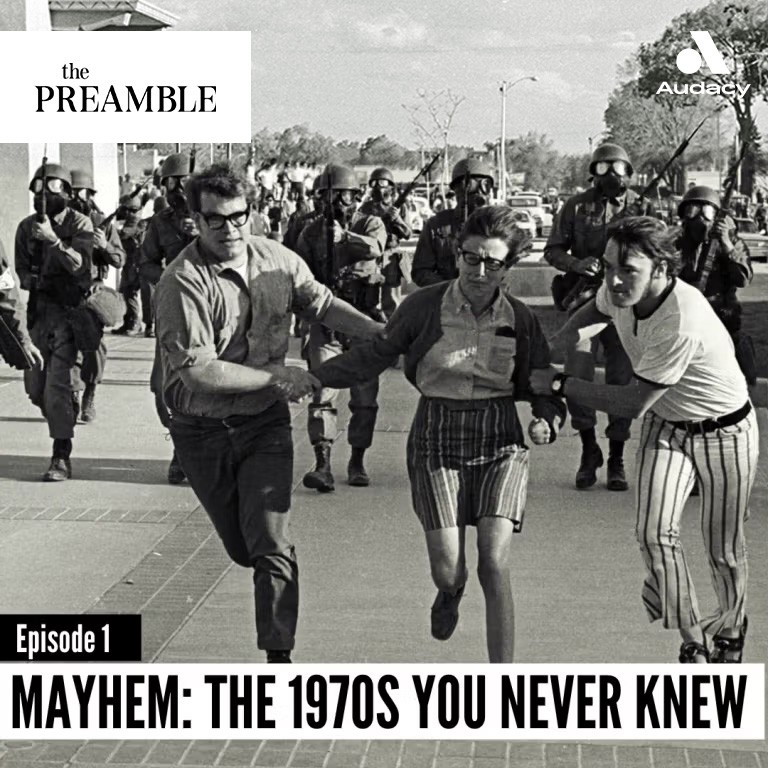
The Preamble
Mayhem: The 1970s You Never Knew, Episode 1
00:44:36
Over the next few weeks, we’ll take a journey through the Decade of Defiance, with all its scandals and secrets. As the decade devolved, Apollo 13 flew high above Earth with the hope of landing safely on the surface of the moon.
Loading summary
Transcript55 lines
- [00:00]
Sharon McMahon
Busy schedules don't have to make getting dressed stressful. Dailylook is the number one highest rated premium personal styling service for women. Each customer gets a dedicated stylist, real
- [00:12]
Narrator / Host (likely Sharon McMahon or co-host)
human expertise, not an algorithm who curates
- [00:15]
Sharon McMahon
up to 12 premium pieces per box based on body shape preferences and lifestyle. The same stylist works with each box for a consistent personalized experience. Clothes are delivered right to the door. You try on the items at home. You keep what works. You return the rest with free shipping both ways.
- [00:33]
Narrator / Host (likely Sharon McMahon or co-host)
This saves time while ensuring every outfit
- [00:35]
Sharon McMahon
is stylish and polished. Boxes can be scheduled every 30, 60 or 90 days. Elevate your style by signing up@dailylook.com today. Take your style quiz@dailylook.com and get 50% off your first styling fee with the code Sharon. That's dailylook.com code Sharon.
- [00:55]
Mission Control / NASA Communications
We lost O2 tank two pressure.
- [00:59]
President Nixon
Okay, Houston, we've had a problem here.
- [01:01]
Narrator / Host (likely Sharon McMahon or co-host)
Mrs. Houston, say again please.
- [01:04]
President Nixon
Here's the way that about
- [01:07]
Narrator / Host (likely Sharon McMahon or co-host)
hello friends. Welcome welcome to our new series where we are set to explore a bit more than shag carpet, smiley face pins and bell bottoms. We're going to look at what was happening politically and socially in this decade that brought so many advancements, setbacks and controversies. Writer Tom Wolf called the seventies the Middle Me Decade to point out the turn American society was taking from the more communal, countercultural nature of the 60s to the individualism of the 70s. The baby boom was over and Gen X, the last generation to experience childhood without the Internet, was born. Historians sometimes refer to the 1970s as the pivot change. If I toss out a few examples like Watergate, Vietnam, Atari, Roe v. Wade, Kent State, Star wars, and the kidnapping of Patty Hearst. It's easy to see how what happened in the 1970s is still impacting us today. So stay tuned as we take you through all of that and more, with some fun facts sprinkled throughout. So let's peace out and dive in. I'm Sharon McMahon and this is the Preamble Podcast.
- [02:34]
Apollo 13 Launch / Mission Audio
10, 9 ignition sequence start. 6, 5, 4, 3, 2, 101970 was
- [02:47]
Narrator / Host (likely Sharon McMahon or co-host)
something of a heyday for astronauts. On April 11, 1970, the Apollo 13 mission carried the seventh crew to fly as part of the expansive Apollo space program, which actually got off to a heartbreaking start in 1967 when Apollo 1's launch rehearsal ended in a devastating fire that killed all three astronauts inside. Apollo 11 would help redeem the program in 1969 by bringing Neil Armstrong all the way to the moon, and Apollo 13 intended to continue that legacy, Apollo 13's commander Jim Lovell, remembers the purpose of their mission well.
- [03:33]
Jim Lovell
Apollo 13 was going to be the third lunar mission. We were going to go to a place called Fra Marl. This is going to be sort of a mountainous type or more of a hilly type facility than the previous two flights. And because they thought that the material there was different than the material that had been brought back on 11 and 12.
- [03:57]
Narrator / Host (likely Sharon McMahon or co-host)
NASA wanted not only the military's best pilots, they also wanted the best equipment in the world, even down to the astronauts wristwatches. NASA asked a number of watch manufacturers to submit watches that they thought could withstand the rigors of space flight. Only Hamilton, Rolex, Omega and Longines participated. Hamilton, for some reason, submitted a pocket watch. And since these astronauts were headed to space and not a dusty 19th century saloon, NASA said no thanks. The remaining three watches were put through 11 different tests involving extreme temperature changes, vibration testing at almost nine times the force of gravity, and resting in a vacuum chamber for more than 90 minutes. The Omega Speedmaster Professional, now called the Speedmaster Moonwatch Professional, survived it all and is still the only watch NASA certified for extravehicular space activity. You can buy one today for the low, low price of $7,000. This may not seem important, but the specialized shatterproof crystal on the watch meant that astronauts were protected from flying shards of debris should something hit their watch during the flight. Astronauts also needed extremely accurate and durable watches to be used as a backup for timing equipment on space missions in case of an accident like the one on the Apollo 13 mission. On April 11, 1970, at the perhaps ominous military time of 13:13, Apollo 13's first stage of liftoff went like the clockwork on their Omega watches. Commander Jim Lovell, lunar module pilot Fred Haise, and command module pilot Jack Swigert were heading to the moon. Just minutes after the launch, the center engine cut out. But NASA engineers figured the ship would still make the correct orbit even without the fifth engine. After that, mission control in Houston thought they had probably gotten past the major glitch of this mission. According to NASA's records, during the first two days the crew ran into a couple of months minor surprises. But generally, Apollo 13 was looking like the smoothest flight of the program at 46 hours 43 minutes. Joe Kerwin, the capsule communicator on duty, said, the spacecraft is in real good shape as far as we're concerned. We're bored to tears down here. It was the last time anyone would mention boredom for a long time. Remember when I said that Apollo 13 launched at 1313. With that deliberate launch time, it seems like someone should have guessed that something significant would happen to Apollo 13. On April 13, the crew aboard Apollo 13 was finishing up a TV broadcast, not realizing that none of the major TV networks in the United States decided to pick up the broadcast from space. That's right. No one outside of NASA and the crew's families were watching. The first moon landing had happened less than a year prior. With a second four months later. The war in Vietnam was still raging. Anti war protesters were marching all over the country. And many Americans were no longer supportive of NASA's space race. I was able to speak with Apollo 13 astronaut Fred Haise. He is nearly 90 now, and he remembers everything about his journey.
- [08:02]
Fred Haise
The explosion caused a large bang that echoed through the spacecraft. Both spacecraft are metal, metal holes that impact. I guess it'd be kind of like if you're in a big tin can, you think of it and somebody hits it with a sledgehammer. That kind of a one big bang. The other unusual thing going on was a small 100 pound thrust attitude rockets. Motors that normally hold your attitude or you can change your attitude. Some of them were firing from the command module, service module, actually trying to hold attitude. And Jack had already reported to Houston. You know, Houston would have had a problem there. You know, it wasn't apparent what really had happened. But we had a lot, about seven, I think, caution, warning lights on. And they were. That was confusing because they were in different systems. That's not like modern things today. Airplanes are your automobile for that interest. Or things are all hooked through some little chip computer. And the one thing that was clear fairly quickly was looking at the instrument gauges. Tank 2 had two of its needles and the gauges at the bottom. And they were separate sensors. And normally you never have two sensors fail simultaneously. So I was pretty sure we had lost tank two. And then I just had a sick feeling in my stomach. I knew that constituted an abort. We would not even go into lunar orbit. I wasn't sure what we were going to do, but I knew we'd failed the mission. We weren't going to land on the moon.
- [09:40]
Narrator / Host (likely Sharon McMahon or co-host)
The crew reported a large bang just as the computers went haywire. But in the confusion, what they were saying didn't make sense. Pilot Fred Hayes had been regularly setting off the cabin release valve, which was harmless, but made a bang that scared his crewmates enough to make him chuckle. Initially, everyone believed the noise they heard was haze. Commander Jim Lovell recalls the event clearly, even 50 years later.
- [10:09]
Jim Lovell
I Heard just a big sharp bang. And the spacecraft rocked back and forth. And then I looked up at Fred Haise to see if he knew what caused the problem. And then as I got into the command module, I looked at Jack Swickert. His eyes were as white as saucers. He didn't know what the problem was. But the first indications that something was wrong was the fact I noticed that one of our fuel cells was inoperative. And then as I started to glance around at various things, I saw that in our indicators of the liquid oxygen, one tank was empty, and one tank had the fuel oxygen going down. And so I knew that something was desperately wrong.
- [10:53]
Narrator / Host (likely Sharon McMahon or co-host)
Mission Control in Houston thought it was an electrical glitch, a problem that could be worked through. But at the rate that the oxygen fuel cell was disappearing, the ship out of power in hours, which meant they were also losing water. And the spaceship's propulsion system looks familiar.
- [11:11]
Mission Control / NASA Communications
Looking out the hatch that we are venting something. We are venting something out into the. Into space.
- [11:19]
Narrator / Host (likely Sharon McMahon or co-host)
Roger, we copy your venting.
- [11:21]
Mission Control / NASA Communications
It's a gas of some sort.
- [11:22]
Narrator / Host (likely Sharon McMahon or co-host)
What Jim Lovell saw venting out into space was the liquid oxygen they needed to keep the command module running. There were only 15 minutes of power left in the command module, so Mission Control told the crew to power it down and get to the lunar module. The command and service module is the main body of the spacecraft, while the lunar module is an attached vehicle designed only to descend to the moon's surface. And sure, it seems convenient that they had a second vehicle attached to their main spacecraft. But the lunar module was designed and equipped with only for 45 hours of use by two men on the moon. Now it would have to support three men for as long as it took to get them all headed back towards Earth. A moon landing was no longer a possibility.
- [12:18]
Sharon McMahon
This episode is sponsored by BetterHelp. Financial stress is something that affects so many of us, often quietly. It's not just about the money in the bank. It can show up as anxiety, sleepless nights, and tension in relationships.
- [12:31]
Narrator / Host (likely Sharon McMahon or co-host)
I know all of us have likely
- [12:33]
Sharon McMahon
had times where we felt completely overwhelmed trying to figure out our bills and future plans. And it's easy to feel like you're
- [12:40]
Narrator / Host (likely Sharon McMahon or co-host)
carrying it all alone.
- [12:42]
Sharon McMahon
That's where therapy can help. It's not about giving financial advice. It's about helping you manage the stress, anxiety, or shame that comes with money worries. Therapy can give you tools to cope, help you feel less alone, and give you space to process your feelings better. Help makes it simple. Their therapists are fully licensed in the US and follow a strict code of conduct. You fill out a short questionnaire and they match you with a therapist based on your needs and preferences. And if the match isn't right, you can switch anytime. With over 30,000 therapists and more than 6 million people served worldwide, BetterHelp is the largest online therapy platform and live sessions have an average rating of 4.9 out of 5 from over 1.7 million million client reviews.
- [13:23]
Narrator / Host (likely Sharon McMahon or co-host)
When life feels overwhelming, therapy can help
- [13:26]
Sharon McMahon
Sign up and get 10% off@betterhelp.com Sharon that's betterhelp.com Sharon Understanding power requires more
- [13:36]
Peter Hamby
than headlines I'm Peter Hamby, host of the Powers that Be, a podcast from Puck examining politics, economics and media. To provide context, analysis and clarity without sensationalism, we ask how power operates, who benefits, and what's at stake. If you want to move beyond breaking news to deeper understanding, join us on the Powers that Be new episodes every weekday. Follow the Powers that Be Wherever you get your podcasts, you know that one
- [14:03]
Sharon McMahon
skill you keep saying you want to get better at? For me, it was negotiating more confidently at work. So I went to Masterclass and found a class taught by Chris Voss, the former FBI negotiator and the single most useful takeaway. The way he teaches tactical empathy. It has changed the way I approach every conversation. I now do it without thinking and it actually works. What's great is that Masterclass fits into real life lessons are short. You can listen on your phone during a commute or even download them for offline access. There are over 200 classes across 13 categories Business, Cooking, wellness, creativity and more, all taught by the best instructors in the world. Three out of four members feel inspired every time they watch, and 83% actually apply what they learn. Whether you want to design your dream home with Joanna Gaines, develop habits with James Clear, or sharpen your storytelling with Michael Lewis, there's something here for you. And every new membership comes with a 30 day money back guarantee, so there's no risk. Masterclass keeps adding new classes, so there's never been a better time to get in. Right now, as a listener of this show, you can get at least 15% off any annual membership@masterclass.com Sharon that's 15% off@masterclass.com head to masterclass.com Sharon to see the latest offer.
- [15:22]
Narrator / Host (likely Sharon McMahon or co-host)
The Apollo 13 astronauts had very limited battery and electrical power, very limited water to keep them hydrated, rapidly decreasing cabin temperatures, and no extra space for moving around or sleeping. Back in Houston's mission Control lead flight Director Gene Krantz was no stranger to to adversity. Kranz earned an aeronautical engineering degree and flew fighter planes before leaving the Air Force to become a test flight engineer. He was the flight director for 17 NASA missions during his career, and he'd already dealt with Apollo 13's struggles before it even left the ground. It was partially Kranz's call to remove astronaut Ken Mattingly from the crew of Apollo 13 only three days before it was scheduled to launch. Mattingly was exposed to German measles and hadn't been vaccinated yet. They could not risk him getting sick during the mission, so he was replaced by Jack Swigert, who trained with the crew as a backup. If you've seen the film Apollo 13, you heard actor Ed Harris, who played Gene Kranz, speak the famous line, failure is not an option. But Gene Kranz never actually said exactly that. What Kranz actually said to the Flight control crew in 1970 was, when you leave this room, you must leave believing that this crew is coming home. Flight Control will never lose an American in space. You've got to believe your people have got to believe that crew is coming home. Now let's get going. Mission Control figured out a trajectory that would take the spacecraft around the moon and kind of slingshot it back to Earth before it ran out of electricity or water.
- [17:16]
Mission Control / NASA Communications
Here in Mission Control, we're looking now looking towards an alternate mission swinging around the moon and using the lunar module power systems. Because of the situation that has developed here this evening. This is Apollo Control, Houston.
- [17:32]
Narrator / Host (likely Sharon McMahon or co-host)
All of these decisions were made less than an hour after the initial explosion. Kranz signed off of his shift one hour and ten minutes after the explosion, writing later that it had been the longest hour of his life. But although Kranz was officially off the clock, he didn't go home. He and his team headed to a meeting room to continue their work. Now that they'd solved the immediate problems, they needed to devise a plan to keep their astronauts alive. Without expected amounts of power, water, or heat, all things needed to fuel both the men themselves and the spacecraft they piloted. Mission Control drew up a rest schedule for the crew in hopes the astronauts could stay functional. Though sleep was difficult to come by with most of the electrical systems turned off, which reduced temperatures inside the spacecraft to 38 degrees Fahrenheit. Soon, Houston learned that they needed to guide the Apollo 13 crew in building a device to remove the carbon dioxide that was filling their lunar module. And if that wasn't enough, Gene Kranz and others had to navigate several cigarette and coffee fueled press conferences as the American and indeed the international public was suddenly riveted by the troubles in space. No one had cared at liftoff, but now the whole world was watching. A few months before Apollo 13 left Earth, 14 year old Marianne Vecchio ran away from her sometimes turbulent home in Opelaca, Florida. Marianne and her five siblings would scatter when their parents fought and Marianne started getting in trouble for skipping school and smoking pot. Police had told her that if she skipped school one more time, she would be arrested. So she left Florida with nothing, not even shoes on her feet. Marianne hitchhiked her way around the country making friends and even getting a pair of sandals from someone, working odd jobs and having an adventure. She said that her travels weren't about defying her parents and she wasn't involved in any protesting against Vietnam. She said, I just wanted to be anywhere that wasn't Opelaka. Protesting on college campuses wasn't new in 1970. Students around the country had spoken against national and world events for decades by then, including protests against McCarthyism in the 1950s when professors at some universities were targeted as Communists. In the 50s, college students protested against nuclear proliferation. The fallout from atomic bombs dropped in Japan in 1945, combined with the dangers of the new Cold War with the Soviet Union, led many college students to speak against government and authority in new ways. Add to all of that the civil rights movement and leaders like Dr. Martin Luther King Jr. And Malcolm X sharing ideas about how to achieve goals of equality and justice, and it's easier to see how the Vietnam protests did not emerge fully formed. Out of nowhere. They were right in line with the student voices that had been raised for over a decade already. When Marianne arrived in Kent, Ohio in May, she headed to the Kent State campus and happened to walk alongside a 20 year old college student named Jeffrey Miller. And they struck up a conversation. Jeff was a drummer and a radio DJ who traveled around following Sly and the Family Stone. He'd just transferred to Kent State in January of 1970. Maybe they talked about Nixon's announcement just a few days earlier on April 30, 1970, when he said that the Vietnam War would expand into Cambodia.
- [21:49]
Apollo 13 Launch / Mission Audio
If when the chips are down, the world's most powerful nation, the United States of America, acts like a pitiful, helpless giant. The forces of totalitarianism and anarchy will threaten free nations and free institutions throughout the world. It is not our power, but our will and character that is being tested tonight. The question all Americans must ask and answer tonight is, does the richest and strongest nation in the history of the world have the character to meet a direct challenge by a group which rejects every effort to win a just peace, ignores our warning, tramples on solemn agreements, violates the neutrality of an unarmed people, and uses our prisoners as hostages?
- [22:43]
Narrator / Host (likely Sharon McMahon or co-host)
Critics and scholars have said that if Nixon had emphasized the operation's goals of faster troop withdrawal from Vietnam instead of noting its importance to keeping the US A world power, people may not have responded so passionately and poorly as it was though. On May 1, just hours after Nixon's announcement, almost 900 college campuses participated in the first, first nationwide student strike in the history of the United States. If you were a male college student in early 1970 and your grades were high enough to put you in the top half of your class, chances are you were granted a deferment from the draft. But many college students saw graduation looming in the near future, meaning that they would not just be free of homework, but they or their loved ones would be left wide open to the draft process. Things were even more tense for people from lower socioeconomic backgrounds as they had less opportunity to pay for college or gain the types of jobs that would earn deferments. Between 1954 and 1964, as the Korean War ended and the Vietnam war gained steam, 1.4 million American men were drafted. Peacetime drafts had been signed into law in 1940 by President Roosevelt as the U.S. anticipated joining World War II. So despite the fact that the conflict in Vietnam was never officially declared a war, 120,000 young men were pulled into service every year. College aged people in 1970 had lived nearly their entire lives with the threat of themselves or someone they loved being drafted into a conflict that was either just starting to happen or fully escalated in a faraway country. For reasons that many people disagreed with, the first lottery drawing for the draft since 1940 occurred in December 1969. Young men born between 1944 and 1950 watch TV or listen to the radio as blue plastic capsules, each containing a different day of the year, were drawn one by one. If the first date drawn happened to be your birthday, you would be in the first group called to serve. It's easy to imagine lots of American young men between 19 and 25, as well as all their loved ones walking around with sweaty hands, waiting for their numbers to be called. Add to all of that the knowledge that what was happening in Vietnam seemed very confusing to many Americans. Some felt that this was not America's fight and that the country should not be sacrificing American lives for a cause that so many Americans did not understand or support. October 15, 1969, had seen the moratorium to end the war in Vietnam, when over 2 million people across the country participated in marches, speeches and ceremonies. By that time, 39,000Americans had been killed in Vietnam. One month later, there was a second moratorium to end the war in Vietnam, attracting even bigger crowds across the country. Half a million people marched in Washington, D.C. alone. All of this tension had been building for so long that by April 1970, when Nixon announced what sounded like an escalation of the war, college students were poised to protest in record numbers. Many college students saw the choice as really that simple. Protest and risk arrestor beatings or watch the war continue and end up dead. On the morning of May 1, Nixon spoke to a group of civilian employees, employees at the Pentagon referring to student protesters as bums blowing up campuses, which was the strongest language he'd used publicly when talking about the issue. At noon, around 500 students at Kent State University gathered to protest after they'd buried a copy of the Constitution to symbolize their belief that it was dead. Thanks to Nixon, they conducted a peaceful rally. That evening, a fight broke out at a local bar between students and locals. Windows were broken in town and a few people were arrested. The mayor declared a state of emergency and mobilized the town's entire police force. The students were forced back toward the campus and things finally calmed down around 2:30am the mayor ordered a dusk to dawn curfew, but was still nervous. Sometime very late on the night of May 1, the mayor contacted the governor and asked that the National Guard be sent in to keep things calm. More than 1,000 Ohio National Guard troops were sent in and told that there could be machine guns brought in by outside militants. The governor compared the student protesters to the Brown Shirts of Nazi Germany and vowed to rid the community of the problem. On the evening of May 2, a fire started in the back of the ROTC building on the Kent State campus. No one has ever been able to verify how the fire started. Hundreds of students were drawn to the fire despite their curfew. When fire trucks arrived to try to put the fire out, some of the the students cut the hoses with knives, hampering the firefighters efforts. The ROTC building burned to the ground. It was fully engulfed just as the Ohio National Guard arrived on campus. As the building burned, around 1000 rounds of.22 caliber ammunition exploded within the burning building, adding to the mayhem. Using bayonets, rifle butts and tear gas, the National Guard cleared the students from the smoldering scene. Martial law was declared and another curfew imposed until classes were in session. While the students were stuck inside, they planned their next move. At noon on May 4, when between 1 and 2,000 students, students had gathered in a parking lot and grassy area on campus called the Commons, they found themselves facing a line of Ohio National Guardsmen. The National Guard ordered the demonstrators to leave. When the students refused and threw rocks at the Guardsmen, the National Guard used tear gas to try and disperse the crowd. Ellis Burns, a Kent State student, recalled these moments.
- [30:20]
Ellis Burns
It was at that point then that they started to lob some tear gas. I remember seeing some of the protesters, some of my, you know, my colleagues, if you will, some of the protesters starting to throw the tear gas back and forth. And Sophie. And then another National Guard picked up some tear gas canister, threw it back, and then another person threw it back.
- [30:38]
Narrator / Host (likely Sharon McMahon or co-host)
After several rounds of having their tear gas canisters thrown back at them, the Guardsmen drove the protesters over the hill behind the Commons. Carol Merman, a student protester at Kent State, was in the Prentiss hall parking lot. She remembers, so the Guard were in
- [30:58]
Carol Merman
a crouching position with their guns out to shoot, like you would think the Continental army was. I mean, they were literally in that kind of a position. It was a shock. I thought they would shoot tear gas, but they didn't.
- [31:09]
Mission Control / NASA Communications
And they.
- [31:09]
Carol Merman
The next thing I knew from where I was, and there weren't that many of us in the parking lot. The Guard was not surrounded at that point. There's pictures to show it. There was lots of lies about that. Now, that's not to deny that those people, those Guardsmen that were down there didn't feel surrounded, didn't feel threatened, weren't tired, weren't in all kinds of other circumstances. But the reality, the physical reality, was
- [31:30]
Narrator / Host (likely Sharon McMahon or co-host)
not that when a group of the Guardsmen got to the top of the hill behind the command, they spun around and opened fire. Some National Guard members discharged their weapons into the air or on the ground, but some opened fire on the protesters, firing between 61 and 67 shots in 13 seconds. So by about 12:30pm on May 4, only about 25 minutes after they first met, Marianne knelt on the ground with her hands in the air and anguish on her face as Jeffrey Miller lay dead in front of her. A student photographer had taken a picture of another student waving a black flag in the space between the students and the Guardsmen a moment before the shots were fired. Then he hit the ground like everyone else. Denny Benedict, a Kent State student, remembers the immediate aftermath now.
- [32:34]
Denny Benedict
So after the shooting, of course we didn't know there was live ammunition. We didn't, you know, we got up and it was going, man, that was unbelievable. There was smoke and then there was just like a quiet. And then you heard people scream and you know, people yell, we need a doctor, we need an ambulance. And we're going, you know, something's wrong. So we look around and you notice in a parking lot in the area, some of the kids weren't getting up. And it's just amazing, just life changing in an instant. Some people, their lives change when maybe they get married or the first time they see their kids. And mine changed the second I realized that people were shot.
- [33:19]
Narrator / Host (likely Sharon McMahon or co-host)
The smoke cleared and the photographer saw Jeffrey Miller's body in the parking lot with a girl kneeling beside it. He said, I knew the boy was dead, but I could tell she didn't know. Marianne remembers crying out, doesn't anyone see what just happened here? Why is no one helping him? As the soldiers approach, their guns at the ready, she recalls the asking them a question that countless others across the country would soon ask as well. Why? Why did you do this? And that photo that we all know, the one featured in magazines that would win 21 year old John Filo a Pulitzer Prize, captured the moment. Four students were killed that day. 19 year old Allison Kraus, 20 year old Sandy Scheuer, 19 year old William Schroeder and 20 year old Jeffrey Miller. Nine more students were injured, one of them permanently paralyzed. Some of the students killed or wounded were not involved in the protest. They were just walking a class. Kent State students were given two hours to pack their things and leave campus. The school was shut down for the rest of the spring semester. In the very early hours of Saturday, May 9, being unable to sleep, President Nixon decided to go to the Lincoln Memorial, which he knew was surrounded by over 100,000 anti war protesters. Nixon and a minimal security team arrived before sunrise to talk to some of the movement's leaders.
- [35:01]
President Nixon
As I tried to explain in the press conference, my goals will be a were the same as theirs. To stop the kill, to end the war, to bring peace. Our goal was not to get into Cambodia by what we were doing, but to get out of Vietnam. There seemed to be no they did not respond. I hope that their hatred of the war, which I could well understand, would not turn into a bitter hatred of our corps system, our country and everything that it stood for.
- [35:34]
Narrator / Host (likely Sharon McMahon or co-host)
But by mid May, students across the country were not only protesting the escalation of the Vietnam War, they were also protesting what had happened at Kent State and what had happened at Jackson State College in Mississippi. Just ten days after the fatal protests at Kent State, Jackson State, a historically black college, had the added layer that students knew that young black men were being sent to Vietnam. In disproportionate numbers, police opened fire on student protesters at Jackson State, firing 150 rounds in 30 seconds, killing law student Philip Gibbs and high school student James green and wounding 12 others. At both Kent State and Jackson State, authorities involved claimed that they were being fired upon by snipers before before opening fire. These claims were later debunked by investigating commissions. The surge of anti war protests after the Kent State and Jackson State shootings were larger than any that had come before. More than 4 million students attending hundreds of universities, colleges and high schools joined in a national student strike in May 1960. In 1970, 30 ROTC buildings burned or were bombed and there was violence between students and police at 26 schools. Vice President Spiro Agnew called the Ohio National Guard's actions an over response and President Nixon established the President's Commission on Campus Unrest, sometimes known as the Scranton Commission, to investigate the both the Jackson State and Kent state events. On October 16, a grand jury in Ohio decided that 25 students should be charged with deliberate criminal conduct in connection to the killings at Kent State. The grand jury was made up of local townspeople, no students or professors. In fact, no students were allowed to testify during the proceedings, only professors and National Guardsmen. A Gallup poll at the Time found that 58% of Americans blamed the Kent State students for their own deaths. Only 11% blamed the National Guard. None of the National Guardsmen were prosecuted because the grand jury decided that they fired their weapons in the honest and sincere belief and under circumstances which would have logically caused them to believe that they would suffer serious bodily injury had they not done so. Jeffrey Miller's father was shocked by the grand jury's decision. He said, holy mackerel. You mean you can get away with murder in this country? It's ridiculous. They can't exonerate the National Guard after students are maimed for life and killed. These kids are dead. They're gone. My life is worthless. I live in an empty house. The grand jury in Ohio stated that the university administration shouldered most of the responsibility for what happened on May 4th. They accused Kent State's administration of allowing an attitude of laxity, overindulgence and permissiveness between the faculty and the students. This conclusion was in contrast to the conclusion reached by the commission ordered by President Nixon. The Kent State investigation was released on October 4 and called the use of M1 machine guns against the students unjustifiable and inexcusable. But they also criticized the students actions as reckless and irresponsible. More than a year of investigations followed the Ohio grand jury's charges against the 25 students. Meanwhile, the 25 students who were charged joined almost three dozen faculty members from Kent State State in filing lawsuits claiming that the grand jury had violated their constitutional rights and gone beyond the scope permitted. In January of 1971, a U.S. district Court judge agreed that the rights of these faculty and students had indeed been violated and ordered that the Ohio grand jury report be destroyed. But that did not mean that all of the charges against the students would be dropped. The first of five trials began in November 1971 and ended with a defendant being found guilty of a minor charge. The next two trials ended with guilty pleas. And the last two defendants were acquitted and dismissed for lack of evidence. In early December, the prosecutor held a press conference to say that he was dropping the charges against the remaining 20 individuals. The official story was that their cases were dropped for a lack of evidence. In 1979, those injured at Kent State won a civil suit in which the Ohio National Guard was ordered to pay the injured parties a total of $675,000. That's just over $2.8 million. Miles above Earth in a freezing cold cabin. The lunar module that was meant to keep two men alive for around three days. Needed to keep three men alive for four days. They rationed everything they could, Knowing that they were still likely to run out of water. Hours before re entering the Earth's atmosphere. They cut down to 6 ounces of water water each per day, Surviving mostly on fruit juice and hot dogs. The dehydration that resulted set unfortunate records. The crew lost a total of 31.5 pounds, nearly 50% more than any other crew. Usually procedures take weeks, if not months to develop and test. In this situation, NASA had hours to stimulate the situation situation and test the procedures before relaying instructions up to Apollo 13. A measles free. Ken Mattingly came back to mission Control to run tests that would get the Apollo 13 crew home with their very limited power supply. In order to position the limping spacecraft for re entry into the Earth's atmosphere, the crew was forced to do a series of precisely timed engine burn maneuvers. These were planned to position the spacecraft so that it was in line with the Earth's gravitational pull and at the correct angle so that no one side of the craft would be facing the sun for too long. But because they had shut down most of the equipment inside the lunar module to preserve power, the only way to time these engine maneuvers was by using, you guessed it, their watches. On April 17, Apollo 13 began its procedures to re enter Earth's atmosphere. Part of that procedure involved disconnecting the lunar module from the command module. As the crew detached and watched it float away, they took photos of the damage and were left to wonder if the heat shield had also been destroyed. A damaged heat shield could mean that they would burn up upon re entry into the Earth's atmosphere. But they couldn't know for sure and they had no way to fix it. This three man crew had already been through several, several life threatening events in just a few days. And they now had to strap into their seats and watch out the window as they hurtled toward Earth, turning into a ball of fire that may or may not kill them. Getting these three men home, a goal that so many had lost sleep to achieve, might now be the very thing that took their lives. Flight controller Gene Krantz once said that a flight controller's job is never over until the crew is plucked from the water and on the Air Force carrier. But as soon as the parachutes opened and the capsule with the three living crew members inside dropped safely into the Pacific Ocean, he found himself weeping at his console. After 5 days, 22 hours, 54 minutes and 41 seconds of flight, traveling 622,268 miles, the Apollo 13 mission was finally over. Here again is lunar module pilot Fred Haise.
- [44:43]
Fred Haise
The thing I was really surprised at was how the mission had been accepted, frankly, at least in the back of my mind, I was worried that this failure, even recovering, was a loss of a mission and did not accomplish what we set out to do. And I frankly was worried that we might have something to do affecting to cancel the Apollo program. As it turned out, I was very happy to see was looked at for what it was, that it was a great challenge.
- [45:15]
Narrator / Host (likely Sharon McMahon or co-host)
At a press conference after the safe landing, Commander Jim Lovell was asked whether he would want to take another space flight. He got excited and thought he'd better jump at the chance for NASA to hear his enthusiasm so publicly. But then he saw a hand go up at the back of the crowd and give an emphatic thumbs down.
- [45:37]
Jim Lovell
Down.
- [45:38]
Narrator / Host (likely Sharon McMahon or co-host)
It was Jim's wife Marilyn, letting him know that his two space flights had been more than enough. So Jim answered the reporter's question with a polite no and said it was time to give some others a chance. None of the Apollo astronauts ever went back into space again. Of course, we don't have time to cover all of the fascinating things that happened in 1970, but we want to give you glimpses of the rest of the year. In August 1970, members of the American Indian Movement occupied an abandoned naval air station outside of Minneapolis to protest the station's presence on Treaty Land, as well as the lack of educational and housing opportunities for Native Americans in the Twin Cities area. In October of 1970, the Organized Crime Control act was signed into law. You may have noticed that recently the RICO Statute has been in the news quite a bit. RICO is part of the Organized Crime Control act and stands for Racketeer Influenced and corrupt organizations. RICO's purpose is to stop criminal organizations from using legitimate businesses as fronts for criminal activities. And did you know that Elvis showed up at the White House in December of 1970 not to perform. He literally went to the White House
- [47:07]
Sharon McMahon
gates and asked to see President Nixon.
- [47:10]
Narrator / Host (likely Sharon McMahon or co-host)
Elvis expressed admiration for the President and concern for the country's increasing drug culture. He suggested that he could help combat these things by being appointed a federal Agent at large. Nixon declined making that appointment and instead gave Elvis a commemorative badge. And that is it for 1970. Join us next time when we learn more about the year 1971 and a party in the desert that is truly, I kid you not, beyond your wildest imagination. I'll see you then.
- [47:55]
Apollo 13 Launch / Mission Audio
Foreign
- [47:59]
Sharon McMahon
the show is written and researched
- [48:01]
Narrator / Host (likely Sharon McMahon or co-host)
by Sharon McMahon, Amy Watkin, Mandy Reed, and Kari Anton. Our audio producer is Jenny Snyder and it is executive produced and hosted by me, Sharon McMahon. If you enjoyed today's episode, we would love for you to hit the subscribe button. Leave us a review or share this episode on your favorite social media platforms. All of those things help podcasters out so much. We'll see you again soon.