← The Preamble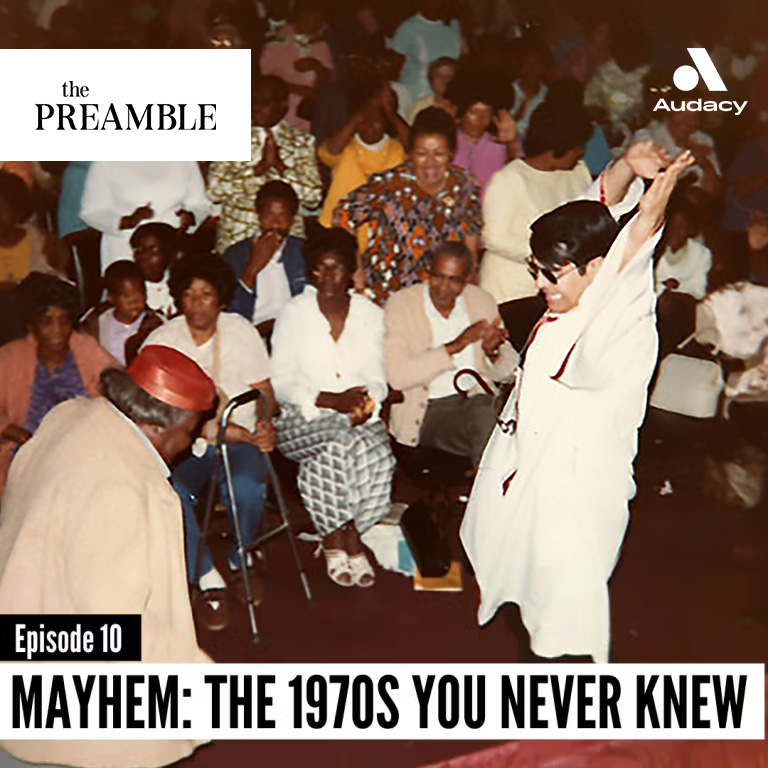
The Preamble
Mayhem: The 1970s You Never Knew, Episode 10
00:43:14
A religious leader with a raging drug addiction who led his following to a tragic end. A President with the hope of finding peace between Israel and Egypt. And a politician who was pivotal to the early LGBTQ+ rights movement, and lost his life in the process.
Loading summary
Transcript34 lines
- [00:00]
Angie Hicks
Hi, I'm Angie Hicks, co founder of angie. When you use Angie for your home projects, you know all your jobs will be done well. Roof repair done well. Kitchen sink install done well. Deck upgrades done well. Electrical upgrade done well. Angie's been connecting homeowners with skilled pros for nearly 30 years, so we know the difference between done and done well. Angie the one you trust to find the ones you trust. Find a pro for your project@angie.com there's
- [00:31]
Spectrum Business Advertiser
never been a better time to get outside and experience the benefits of nature, discover nearby trails and explore the outdoors with alltrails. Download the free app today and find your outside.
- [00:50]
Sharon McMahon
Hello friends, and welcome back to our series on the 1970s mayhem. If any year lives up to that name, it is 1978. And today we're going to explore three headline making stories about a religious leader, a presidential would be peacemaker, and a politician central to the early LGBTQ rights movement. All three of these men share two important elements, power and a commitment to bring their vision to fruition. But before we begin, I want to offer a quick content warning that we are covering events involving things like physical violence, drug use, death by suicide, and murder today, so you may want to listen on your own before allowing young children to hear this episode. I'm Sharon McMahon and this is the Preamble podcast. During the 1930s and 40s, in a small Indiana town whose main industry was coffin making, a young, unwanted and woefully neglected boy grew up in dire poverty. His father was disabled after having been harmed by mustard gas in World War I. His mother had no interest in children, including her own. So the boy, left to his own devices, engaged in some childhood play, you know, sneaking into the coffin manufacturer and daring other kids to climb into coffins to play dead. He held funerals for roadkill and insects and anything else he could find. The boy's name was Jim Jones, and his childhood was anything but typical. Often banished from his own home when his mother was working, Jim was a regular fixture around their neighborhood. He was a kid for whom other adults had pity, and other families regularly fed him. Jim was always careful to praise their cooking and thank them profusely for their meals, claiming it was the best he had ever eaten. Polite, yes, but also Jim quickly figured out, as do many people who grow up in unstable families, that certain behaviors help them get their needs met. If, say, little Jim raved about Mrs. Thompson's meatloaf, then maybe the next time she made it for her family, she might remember his appreciation and invite him for a Second meal. One neighbor sought to fill more than Jim's belly, and she took him with her to church. One service and Jim was hooked. He was promiscuous in his church attendance, going from one service to another, regardless of denomination. His life began to revolve around church attendance. He studied the preachers and the sway they held over their congregations. He grew intoxicated with the feeling of belonging, and he wanted that. He needed that. At one church, week after week, Jim stood and asked to be saved. It was not a one and done process for Jim, not even when other parishioners eyed him curiously. Faith, or the appearance of it, was attention. It was a way for him to become someone other than a poor boy born into a family who didn't want him. Being super religious helped him to become, in his mind, respectable. Jim leaned into this new identity hard. He wore his Sunday suit every day to school. He tried on the role of preacher, this time not presiding over the burial of deceased animals and insects. Apparently, even at a young age, he had a gift for using what he had learned at the feet of the town's preachers to try to create connections with others. For some people, their high school years were the best years of their lives. But for others, it was an ordeal to survive. That his classmates recalled Jim's preaching decades later suggests that Jim was either an odd duck or that his actions were not typical. Jim worked nights as a hospital orderly, beginning at age 16, and there he met a nurse several years older than him, Marceline Boswell. They married shortly after his high school graduation. Two years later he was 18 and she was like around 23. While that too was unusual for the time, serious, pious and still suit wearing, Jim won over Marcy's parents. Jim wanted to go to college and did for the next 11 years, off and on when he had the funds to do so. And he eventually graduated from Butler University in 1961. While he was working towards a degree, Jim also found a place for himself in in a pulpit near Indianapolis. Now, if you're not familiar with the Hoosier State, something important to know about this story is not that Indiana is the birthplace of Larry Bird or that they grow a lot of soybeans there. No, it's that Indiana was the seat of the KKK when it was reborn in the early part of the 20th century. Jim claimed that his early experiences as an outcast due to poverty made him more sympathetic to the plight of African Americans in Indiana. He was disgusted by rampant racism, and when he eventually began to pastor a church, he sought to make his congregation a welcoming one in which blacks and whites could worship together. This was rather shocking. At the time, most local churches were still segregated. In order to raise funds for the church, Jim, who was now 22, soldiers monkeys. Door to door. No Fuller brushes. No, no, no, no driving for Uber eats. He sold spider monkeys as pets, which he paid to import for the purpose of selling. Each one cost $29, which is like $332 today. Monkeys imagine someone arriving at your door with a literal selection of monkeys and asking if you would like to purchase one. It seems absolutely bizarre today. If anything screams 1950s, it is like door to door monkey sales. The monkeys continued to play a key role in the growth of the church. Jim would randomly award a monkey to a congregant who had brought in the highest number of new members. And Jim's leftist politics and work on behalf of the elderly, the poor, and people of color in Indiana begin to gain attention in the early 1960s. The Indianapolis Human Rights Commission named him director in 1961 because of his commitment to civil rights. This was not just a token award, by the way. Jim, along with his church, helped to desegregate many staples in Indianapolis. Movie theaters, hospitals, the police department, restaurants, and even the phone company. His church ran a restaurant, and they built homes for the elderly and the mentally ill. For the next two years, from 1961 to 1963, Jim worked as a missionary in Brazil. While he was there, he took a side trip to Guyana, which will be important in a minute. When he returned to Indiana, he reopened his church. Jim was not into liturgy. He considered the Bible a paper idol that distracted people from the true meaning of religion. He had no interest in preaching sermons because based on biblical teachings. Nor did he want to be mentored by more seasoned pastors. Looking back, this maybe should have been a giant flying red flag. Why would Jim not want oversight? Why wouldn't he want to study under more senior preachers who had had more life experience guiding their flocks? Such questions could be easily brushed aside as the impatience of a devout man ready to run his own church. Jim wanted autonomy. He craved connection, and he saw in his church a way forward. Jim scrapped prepared sermons and spoke to his congregation, asking them, what do you need? How are you surviving? From the very beginning, Jim sought to have a diverse church family. Many of his parishioners suffered because of racism, and Jim and Marceline helped them to brainstorm and solve their problems, whether it was related to unemployment or systemic racism, like utility companies taking their money but not fixing their service. Jim remembered the individuals and their plights. He asked after them. Sometimes he had visions of a turnaround in fortune, a new job, perhaps, or a better paying one that would help to support a new addition to their family. Members of his church believed in him. They loved him and wanted others to believe in and be helped by him. Some took to calling him dad. And it was here that we can see glimpses of Jim's ability to manipulate others for his own ends. Like itinerant preachers who practiced faith healings as they moved from town to town in the 19th century, Jim performed miracle cures on his flock. In one particularly gruesome approach, he took animal organs and held them up as a tumor that he had just cured somebody of. But the congregant was in on the trick. Jim was able to convince his parishioners to serve as plants, a key component of tent revival services. To persuade others of the preacher's abilities, those who conspired with Jim would go off stage and cough up these fake tumors, the grotesque globs of animal parts that Jim held up and was like, this was cancer. He was likely able to convince them that playing along wasn't lying per se, but rather as spreading the word, especially if there were newcomers in the audience. Coincidentally, Jim was being investigated for suspicious transactions in which his congregants had donated their real estate. But Jim Jones did not want anyone looking over his shoulder to see what he was doing to lead his flock. Nor did he want any questions about him potentially fleecing them out of their savings. So instead of, he got out of Dutch by convincing his congregation that they needed to move to a remote area in California in case of nuclear war. There, he told them they would be safe. The group lasted about six years in California before Jim began looking at opportunities to move outside of the United States.
- [11:16]
Pet Owner
Why have I asked my electrician I found on Angie.com to bury my pet hamster, Nibbles, in our yard for me? Because I was so moved by how carefully he buried my electrical wires, I knew I could trust him to bury my sweet Nibbles after his untimely end.
- [11:30]
Spectrum Business Advertiser
Huh?
- [11:30]
Pet Owner
Nibbles gone too soon. May he scurry in peace.
- [11:34]
Angie.com Advertiser
Hey, sorry about your pet, but I just wire stuff.
- [11:37]
Pet Owner
Nibbles would have loved you like a brother.
- [11:39]
Angie.com Advertiser
Connecting homeowners with skilled pros for over 30 years. Angie, the one you trust to find the ones you trust. Find pros for all your home projects@angie.com
- [11:47]
Spectrum Business Advertiser
As a woman entrepreneur, you know that every connection counts, whether it's with your customers, your team or your community. Spectrum Business is here to help you build those connections stronger and faster. Imagine running your business with fast reliable fiber powered Internet so you can stay connected to customers, employees and vendors without having to worry. We know flexibility matters. That's why select Spectrum Business packages come with a three year price guarantee so you can focus on running your business plus enjoy savings on Internet, phone, TV and mobile services. When you bundle all with a 30 day money back guarantee and no long term contracts with Spectrum Business you get more than just Internet. You get support with 100% US based customer service. Real people who understand small business ready 247 to help you stay up and running. Join millions of business owners like you across America who trust Spectrum Business for reliability, speed and support. Visit spectrum.combusiness today to get started. Restrictions apply. Services not available in all areas.
- [12:47]
Sharon McMahon
Lots could and did happen in six years. Jim's congregation grew, as did his name recognition as he got involved in local politics. With popularity and power, Jim probably felt like the little boy he used to be. Bouncing from house to house and church to church had finally won the lottery. He was beloved, he was important, and he was more superstar than outcast. But when you come from little, sometimes you fear going back and sometimes you'll do anything not to lose everything you've worked so hard to gain. Holding on to his status was imperative for Jim. He wanted security and he also wanted what he felt was due him. And this, my friends, is where we will exit the G rated portion of this episode. Jim had needs that he claimed his wife Marceline could not meet, and so he needed other romantic relationships to meet his needs. And all records indicate that members of his congregation were cooperative in participating. They considered it an honor to be chosen. But despite apparently giving consent, there definitely was a power differential that Jim exploited with both the women and the men that he had relationships with outside of his marriage. Can you imagine your preacher coming up to you and your spouse and saying, hey, hey, I'm gonna need your wife to be my special friend and we're not gonna be married, but I'm gonna treat her like she's my kid's stepmom. And don't worry, I'll just get you a replacement. I'll get you a younger, hotter wife. And then he introduces this woman to his kids as dad's special friend. I mean, that actually really did happen. That happened more than one time. During this time, Jim became increasingly reliant on on pills. Rumors spread that his behavior was erratic, likely due to amphetamine use, which Is why you often see him wearing sunglasses and photographs, and that he coerced his congregation to sell their real estate and donate the proceeds to the church. While in California, Jim became cozy with several politicians, including Harvey Milk, about whom we'll hear later, as his ability to compel thousands of people to show up and vote on shortened notice gave him clout. That sort of influence could absolutely change a vote. And politicians recognized that befriending Jim could help their careers because he could deliver voters to politicians. Jim Jones was appointed to the San Francisco Housing authority board in 1976, and Jim's lawyer, Timothy Stone, was hired by the district attorney's office. But with rising visibility in the outside community came quickly questions about Jim and the People's Temple, his church. One of his sons remarked later that Jim was obsessed with his own perception of other people's perceptions of him. So when a negative article about him was published in the New west magazine in 1977, Jim's already heightened, thanks in part to his drug use, sense of paranoia soared. It was time to leave. But there was one little problem. Jim didn't want anyone to mar the excellent press the People's Temple had received over the past six years. Due largely to his relationships with politicians and reporters, Jim wanted to leave the country on his own terms with his people and in such a way that did not invite further questions about who he was and what he did. Earlier I mentioned that during his missionary trip to Brazil, Jim visited Guyana. He thought it more might be a great new home for the People's Temple. He chose this English speaking South American country as a potential utopia for his congregation. And he leased 3,800 acres of remote land in the jungle from the government of Guyana. He moved his family and congregation there, and over the course of several years they built Jonestown, which they referred to as an agricultural mission. And as one does after moving to the remote jungle, Jim became a licensed jeweler. He was not expecting to find emeralds and rubies in the jungles of Guyana. No, as licensed jeweler, Jim could legally order cyanide, which was then used to clean gold. At least that's why Jim said he needed. Wasn't an easy move. The land they leased in the jungle, it was a jungle. It was not ready made for development with paved roads and whatnot, but it was away from prying eyes and Jim Jones was able to maintain complete authority over everyone. And he was able to stockpile vast quantities, quantities of cyanide. Did they have adequate food for all the congregants? Many of whom spent 12 hours a day clearing the jungle? No. Did they have adequate sanitation and clean water also? No. Did they have adequate and safe housing for the entire community, which was near a thousand people? No. The new People's Temple was, in fact, a commune with communal latrines, not equipped with adequate sanitation measures, with little cabins designed for four people, but instead were holding eight people, which led to the spread of diseases. And then began the practice suicides. A member, perhaps Marceline or the nurse or the doctor, maybe somebody else, would prepare and set out a huge vat of red flavor aid, a generic version of Kool Aid, and cups and syringes filled for the babies and children who could not drink from a cup. Everyone would be compelled to ingest the liquid over and over and over again. The practices worked to desensitize members to the idea of immediate death, because each time they practiced, everyone was fine. Repeating the practices so that they become routine indicates that Jim knew that revolutionary suicide, as he called it, was always an option he could exercise just in case. California congregants were offered a free trip to Guyana. But they were not told of the hardships they would have to endure or that leaving would prove to be nearly impossible. There was never a return ticket in the deal. Many of the people who chose to follow Jim into the jungle Were elderly black women. They were required to sign over their Social Security checks to the People's Temple and as payment for their upkeep, as they didn't have the physical strength to help clear the jungle and build the buildings that the group needed. The idealistic Jim we saw in the early days, the one who worked for civil rights and spoke of equality, Bore little resemblance to the man in control at the commune. Some, but not all, of this, can be attributed to his raging drug addiction. At Jonestown, Jim's narcissism and absolute control were unchecked. He confiscated medications and kept the drugs for himself, censored letters going out and coming into the compound, and proclaimed every man except for him a homosexual, and thus paving the way for him. Jim, to take their wives publicly. He broke up families and demanded they rat on each other's daily activities. He staged loyalty tests in which he required his followers to drink what he claimed was poison. He conducted White Nights, in which he locked everyone in a pavilion and railed against the horrors of the world. He swore that the KKK roamed the streets erecting gas chambers to kill minorities, and claimed that the government, media and other forces were out to get them. Armed guards patrolled the town at night to protect the inhabitants from the outside world and also to prevent members from escaping the compound. On multiple occasions, temple members sought help. One from the American Embassy in Guyana, who dismissed her claims out of hand as too preposterous. Jim's wife, Marceline, wrote to Jimmy Carter and other politicians about her husband's erratic behavior, beliefs and her fear that something absolutely horrific would happen. A former member even filed a lawsuit in California claiming that children's lives were at risk. But nothing happened. That is, until family members of those who had been pulled into this cult sought assistance from the United States State Department and reporters, who managed to convince Congressional Representative Leo Ryan of California that people, his constituents, were an imminent danger. Timothy Stone, who was the attorney I mentioned previously, and his wife compelled Representative Ryan to travel to Guyana to see if people needed help leaving. Although both Stones, Timothy and his wife had defected by this point, they left behind their six year old son, John Victor. Why, you might be asking yourself, why would you leave a young child in the hands of a man from whom you yourselves fled? In order to preserve the good name of the People's Temple and prevent those who left from speaking ill of him or the temple, Jim required that those individuals sign handwritten documents to which they confessed to multiple crimes. In the case of the Stones, Jim Jones had convinced them to sign an affidavit to John Victor's birth certificate naming him as the father of the boy. The Stones knew that trying to escape with this little boy would mean his death. In fact, Timothy stone said that Mr. Jones took any critical comment about the commune as a personal attack and said that anyone who left the church deserved to die. So they left John Victor behind in the care of another congregant with a child of her own. They immediately began court proceedings back on the US mainland, and Jim perceived these as betrayal and escalated threats against his community from the outside world. And while Jonestown was deliberately insulated from the outside world, Guyana was not the only global site embroiled in turmoil. War in the Middle east has been a top news story in the months during which this podcast was written and produced, and the history of the region is marked by conflict. For now, though, we're going to enter into that history with non military US involvement. In 1977, after three decades of conflict, including four wars that put the US on nuclear alert, President Jimmy Carter thought that he might be able to broker a peace agreement between Egypt and Israel. The leaders of the countries involved, Jimmy Carter, Prime Minister Menachem Begin of Israel and President Anwar Sadat of Egypt met at camp David, a 125 acre presidential retreat in the countryside of Maryland. As with presidents before him, Carter feared that Soviet involvement in Middle Eastern conflicts might result in another world war. Even more than that fear, though, was Carter's assessment that Sadat and Begin were, like him, deeply religious men and that this commonality just might allow for the three world world leaders to find common ground and ultimately peace. It was Rosalynn Carter's idea to hold peace talks at Camp David, and her husband valued her opinion. Both Sadat and Begin sought U. S support, and having them meet at Camp David on neutral territory seemed like a logical solution. The construction of Camp David was completed in 1938, and over the years it has had different names. Its official name is the Naval support facility Thermont, and the first president to use it, Franklin Roosevelt, called it Shangri La. Initially, it was used as a getaway for federal employees. That changed during World War II when both optics and security concerns about Roosevelt sailing on his yacht led to limiting the retreat's use to the president. President Eisenhower renamed the retreat after his grandson John David in 1953. Of its previous name, Eisenhower said Shangra Law was just a little fancy for a Kansas farm boy. Foreign dignitaries and leaders of state had been hosted at Camp David for decades. By the time the Carters thought it might be the best venue for peace talks between Israel and Egypt, the group's objective was to devise a framework for peace that would allow their people to to live in harmony in the same geographical area that had been the site of much bloodshed and strife. Despite a professed desire by all parties for peace, the negotiations were challenging. Initially, the men had set aside three days to hash out an agreement on three subjects. The Sinai Peninsula, the West bank and the Gaza Strip and Palestinian self governance. At issue were the security of the people who lived in the region and the land and to whom it belonged. Talks did not go smoothly, with both sides refusing to sit at the same table and threatening to leave. Carter installed each man in his own room and ran between the two, helping each of them to draft what they wanted and the concessions they were willing to make. When that continued to prove difficult, the US Contingent worked separately with the Israeli and Egyptian contingencies and left the finalizing of drafts to Sadat and Begin in an effort to keep everyone there and working toward a common goal over such an emotionally laden topic as their holy land and who had the right to live there. Tensions ran so high that Carter called a time out for a field trip to Gettysburg, the site of the main battle in the American Civil War. Three days turned into a week, which turned into nearly two. Thirteen days in, the men finally hammered out an agreement known as the Camp David Accords that would serve as a blueprint for future peace in the Middle east. It took them 23 drafts. The camp David Accords were formally and publicly signed in 1979, and the camp David Accords became the Egyptian Israeli Peace Treaty. The accords included a designation of Palestinian rule of the west bank and Gaza Strip as a path for Palestinian in statehood and full autonomy. And Israeli troops had to leave the west bank and any land they acquired during the 1967 Six Days War, which was what UN Resolution 242 required. Unfortunately, hammering out a resolution for peace did not mean that peace was easy or imminent or that compromise came without severe consequences. After Begin and Sadat returned to their countries, negotiations continued for well over a year year. Both men were in precarious positions regarding the concessions they made. Begin was defending his fledgling country, and as many of its inhabitants, including military leaders, were affected by or fought against the Nazis, they were determined not to compromise or lose anything else. Sadat's willingness to compromise was widely condemned in Egypt, and many Arab leaders considered him a traitor. Carter traveled abroad to visit each man and urged them to continue their work. And they did. The peace agreement led to both Begin and Sadat winning the Nobel peace Prize in 1978 for their efforts. However, the implementation of the peace agreement was another story. Sadat was so distressed that it did not go according to plan that he refused to travel to Oslo Oslo to accept his Nobel Peace Prize. So while it was groundbreaking valiant effort to construct a blueprint for peace in the Middle east, the Camp David Accords, for practical purposes, were not a complete success. While wars and conflicts are the past and the present in the Middle east, the peace treaty known as the Camp David Accords is supposed to still be in effect today. Though the recent Hamas Israeli war illustrates just how fragile such agreements can be and how parallel life in the region is. Smart people across the globe have spent their careers thinking about how to achieve lasting peace in the Middle east and how to honor the history, cultures, faiths and humanity of the people who inhabit such contested land. And still we do not have an answer that meets everyone's needs.
- [29:57]
Family Member
Why have I asked my h vac guy I found on Angie.com to change my grandpa's trachea tube? Because I was so amazed by how quickly he replaced our air ducts, I knew I could trust him to change Pop Pop's tube while I was on vacation.
- [30:09]
Sharon McMahon
Make it quick young man.
- [30:12]
Spectrum Business Advertiser
Aw.
- [30:13]
Family Member
See Pop Pop trusts you.
- [30:16]
Angie.com Advertiser
I think we should call a doctor. Connecting homeowners with skilled pros for over 30 years Angie the one you trust to find the ones you trust. Find pros for all your home projects@angie.com
- [30:27]
Spectrum Business Advertiser
as a woman entrepreneur, you know that every connection counts. Whether it's with your customers, your team or your community. Spectrum Business is here to help you build those connections stronger and faster. Imagine running your business with fast reliable fiber powered Internet so you can stay connected to customers, employees and vendors without having to worry. We know flexibility matters. That's why select Spectrum Business packages come with a three year price guarantee so you can focus on running your business plus enjoy savings on Internet, phone, TV and mobile services when you bundle all with a 30 day money back guarantee and no long term contracts with Spectrum Business you get more than just Internet. You get support with 100% US based customer service. Real people who understand small business. Ready 247 to help you stay up and running. Join millions of business owners like you across America who trust Spectrum Business for reliability, speed and support. Visit spectrum.combusiness today to get started. Restrictions apply. Services not available in all areas Furniture
- [31:27]
Bob's Discount Furniture Advertiser
shopping can be overwhelming. There are so many options and it's hard to know what's actually worth it. That's why I always turn to reviews to guide my decisions. If something has hundreds of five star reviews, I'm paying attention. And Bob's Discount Furniture has tons of highly rated pieces that make choosing a whole lot easier like their Elm Dining set which has over 700 five star reviews. And it's a gorgeous setup with a real marble table and comfortable Boba Pedic seating that instantly upgrades your dining space. And at 999 it's a super approachable way to get that high end look. Or check out Bob's Copper Radiance Queen Extra Firm Mattress. Over 400 five star reviews and recommended by Consumer Reports. It's designed with a copper infused cover and and high density Boba Pedic foam for support. Plus it comes with a 20 year warranty. And if you're looking for a sofa upgrade, the modular Bob Sectional is a customer favorite with over 1,000 five star reviews. It's got soft, durable upholstery storage, wireless charging and starts at just 250 per piece so you can customize it without overthinking it. For quality furniture and everyday low prices, shop at Bob's. It's where America shops for furniture.
- [32:58]
Sharon McMahon
On November 27, 1978 a disgruntled former San Francisco City Supervisor Dan White. Gunned down his colleague, Supervisor Harvey Milk. And Mayor George Moscone, in cold blood. Harvey Milk and Dan White each ran for the position of city supervisor three times before they were elected together. Dan was a conservative, and Harvey, though he had once shared Dan's beliefs in his younger years. Left conservatism and the closet behind. When he moved to San Francisco to live as an out gay man. This was a risky choice to take. But Milk wanted to live an authentic life. After serving in the Navy during the Korean War. He returned to his home state of New York and and worked on Wall Street. He eventually moved to California. And participated in protests against the Vietnam War. He opened a small camera shop in the heart of the gay community. And became well known in the neighborhood. When he discovered that he and other small business owners were taxed unfairly. He opted to do something more Than just complain about it to his friends. He ran for a position on the San Francisco Board of Supervisors. So he could speak up on behalf of those affected by the taxation. He didn't win, but he finished 10th out of 32 contenders. So he threw himself into continued community organization. And ran again in 1975, and again he lost. He tried for a third time in 1977. And this time he won. At his core, Milk was a gay rights activist. But he knew that his work had to appeal to a broader audience. So one of the first initiatives he worked on was about dog poop. Milk co sponsored a pooper scooper law. And was the lead on a bill banning discrimination based on sexual orientation. In housing, employment and public accommodations. And when a vote was taken on the discrimination measure, Dan White was the only dissent. Mayor Moscone signed it into law in March of 1978. It remains a fundamental piece of legislation in the history of gay rights. Harvey Milk then turned his attention to Proposition 6. Which sought to ban gay employees. Especially teachers and supporters of gay rights. From working in local schools. Milk campaigned hard against this discriminatory initiative. Dan White, however, felt that because he was so outnumbered on the vote. Against discrimination in housing, employment and public accommodations, he had to resign. He was a former cop and his role on the supervisors board was to represent conservatives. Especially conservative business owners. Except he didn't really want to. White regretted his decision to resign. And sought unsuccessfully to withdraw it. Mayor Moscone, however, refused after Milk told him that to allow White back. Would be perceived as anti gay. Dan White blamed Harvey Milk. Who, as the out gay politician. Seemed to be the face of his Failure. And who manipulated Moscone to oust him. And White couldn't seem to move on after he resigned. So on Sunday, November 26, a reporter called Dan White's residence. It was evening. When White answered, the reporter dropped the bombshell. I'm calling from the mayor's office. And I have insider information that you will not be reappointed. Care comment? Dan White did not. He sat up all night on the couch, staring at the TV and binge eating Twinkies, Trying not to wake his family, Ruminating on what this meant. The following morning, he packed his gun, carefully wrapped up in cloth, Brought extra bullets and went to city hall. Except metal detectors had recently been installed outside of city hall. White saw that he would not be allowed in the front door. And found a window that he could climb through. He found mayor Moscone and executed him. Firing multiple times into his body and head. And then he went in search of Harvey Milk. He asked to speak with him in his office. And there Dan White executed Milk just as he had done Moscone. You may have heard the name Dianne Feinstein at the time. She wasn't a senator from. From California, though she later became one. She actually recently died at the time of the writing of this podcast. Back in 1978, though she was the president of the board of supervisors. And the one who found mayor Moscone's and Harvey Milk's bodies. She announced the assassinations to the press.
- [37:37]
Spectrum Business Advertiser
Both mayor Moscone and supervisor Harvey Milk have been shot and killed.
- [37:45]
Sharon McMahon
This experience helped to catapult her political career. And she took as one of her causes, gun control. The morning of the murders, she had told reporters that she was quitting politics. After the assassinations, she took over Moscone's term. And went on to serve as mayor twice more. Before she tried to run for governor. But ultimately was elected to the u. S. Senate. In 1992, Dianne Feinstein wrote a federal assault weapons ban. Which president Clinton said signed into law in 1994. The assault weapons ban lapsed in 2004 and was never renewed. Dan White turned himself into the authorities. And he pleaded diminished capacity Due to his consumption of junk food. Have you heard of the twinkie defense? This is its origin story. One psychiatrist testified that, quote, if not for the aggravating fact of junk food, the homicides might. Might not have taken place. And the jury bought it. They found White guilty of manslaughter instead of first degree murder. Despite the fact that he went to city hall gun in hand, extra bullets in a handkerchief and after seeing the metal detectors, climbed in through a window, all in order to kill the men he blamed for the loss of his job. The public was outraged. Riots broke, broke out, police cars were overturned. Protesters and police fought. The violence was unchecked and scores were wounded, some for life. Eventually, California eliminated the diminished capacity defense. White was sentenced to five to seven years and he served five years before he was released and shortly thereafter took his own life. Harvey Milk was posthumously awarded the Presidential Medal of Freedom in 2009. By then, President Obama and California declared Milk's birthday May 22, Harvey Milk Day. When we left off at Jonestown in Guyana, Jim Jones felt betrayed by those who had left the commune and paranoid that officials in the US were investigating him and his community. Representative Leo Ryan from California, Laornia and his team, including a reporter and photographer, were able to Visit Jonestown on November 18, 1978, after pressure from the press caused Jim to cave and allow them onto his property. While they were there, a congregant slipped a reporter accompanying Representative Ryan a note stating that they would like to leave, but Jim wouldn't permit it. Leo Ryan confronted Jim Jones, who announced that anyone who wished to leave was free to do so. Two large families immediately started packing their belongings. One couple played tug of war with their child as one adult wanted to go and the other and wanted to stay. Jim allowed the visitors and defectors to drive out on the road to the air strip, although on their way out, a congregant rushed at Leo Ryan with a knife. Ryan escaped unharmed, though his shirt was bloodied by the man. Man accidentally slicing open his own hand. Representative Ryan had to make arrangements for a second plane as he feared for the lives of those who might not be able to leave with his team. Accounts of the timeline of what happened next differ. What we know is that Jim Jones ordered an ambush. A truck of men followed the people who were trying to leave to the airfield, where they opened fire. Leo Ryan and his team, including a reporter and cameraman from a news agency, were shot multiple times. While the defectors were shot and left to die, some played dead until the killers drove off. They huddled up together, trying to bandage wounds while they waited to see which would arrive first, help or death. Later that day, Jim Jones gathered everyone together. He knew what he was doing doing, and he turned on a tape recorder to preserve it. He began speaking. I have always loved you. And if we were to recreate the before scene in November 1978, it would look something like this. A vat full of cyanide laced flavor aid, a dipper, scores of cups and a multitude of syringes filled with a liquid concoction dutifully prepared for the littlest residents who either couldn't or quite possibly wouldn't drink the punch on their own volition. People might be praying and crying, scared children might squirm and sob in their parents arms. And there would be a man, their fearless leader, phoning his own children who were not on the compound and others who were in a different town that day, conveying the message to all of them. It's time. Jim Jones ordered parents to sedate their babies. The adults panic undid some of the desensitization of the earlier practice runs. Unfortunately, the sedation didn't have time to take effect, and parents and onlookers watched children die, while Jim proclaimed that it was painless. It was just bitter, that's all. Don't stop, he told them. This is our revolution. Drink. People are coming for us. They will kill our children. Hurry. Hurry. It took the children about five minutes to die. It took the adults about 20. After dosing their children, many parents willingly drank the poisoned liquid. Those who did not immediately comply were ordered to do so. And yes, this is the origin of the phrase drinking the Kool Aid. A total of 918 people died that day, though not all from cyanide poisoning. Some were stabbed, some were shot. On the day of the mass death, two of Jim's sons were away with the Jonestown basketball team at a tournament. Stefan remembers that their father ordered them to return and they refused. They were enjoying the freedom from being out from under their father's watchful eyes. Jim Jr. Reference called, speaking to his father on the phone. Jim told him, we're going to visit Mr. Frazier. And Jim Jr. Said, I was the director of communications on our security team, so I knew what that code meant. That code, we're going to visit Mr. Frazier meant revolutionary suicide. My first reaction was, there's got to be a different way. No, dad, we've got to do something different. And he goes, no, you need to be strong. You need to be our avenging angels. And little John Victor Stone, the one that Jim Jones claimed was his child, that Tim and her wife were trying to get back, was found dead. He was one of 300 children to die. Jim Jones was one of the last to die. On the death tape, Jim tells his followers that he is going to wait for them all to go first. Many of them call him dad. Notably, he was found with his head on a pillow and with what a medical examiner determined to be a self inflicted gunshot to the head. Jim Jones did not himself ingest the poison. His wife Marceline was found next to him and one of his special friends slash romantic liaisons was found dead in his room too. They both drank the poisoned beverage. One follower, a 76 year old woman who had slept the whole day survived, as did a man who played dead. The remains of the dead were collected and flown to Dover, Delaware where they were cremated. All but five were identified and claimed by their families. Guyana eventually allowed the jungle to reclaim Jonestown. Jim Jones's son Stefan said in an interview that it's also important to talk about the sickness of the people. However it happened, there's a sickness, you know, Jim Jones can't kill more than 900 people alone. I believe that madness can happen to anyone under the right circumstances. And what circumstances might those be? Are these the words of a haunted son looking for some sort of redemption for his father? Are they a warning to others to not buy into occult mentality? Or are they something else altogether? Jim Jones sought power and connection through his pulpit. His followers at the end, mostly black, those who defected were white, believed in the equality and civil rights he once preached. In all three of these stories, today we see men with distinct visions of the world. We see men who are the heads of different communities. And we see that utopias, peace talks and the ongoing struggle for equality sometimes fail. And in that failing, violence is often wrought upon the innocent. Well, those were three major events of 1978. Other things happened that year too. 1978 was a year of popes. Pope John Paul VI died. He was 80. He was replaced by Pope John Paul I, who served a mere 33 days before he died too. He was then replaced by Pope John Paul ii. The beginning of in vitro fertilization, or ivf, hit a milestone with the birth of Louise Brown in England. Although she was nicknamed the test tube baby, the gametes that eventually developed Louise were united in a petri dish, not a test tube. Her parents, who had suffered from nine years of infertility, were overjoyed. At the time we are writing and producing this episode, we learned the sad news that former first lady Rosalynn Carter had died. Her husband Jimmy is a main focus of our next episode, which is the first of a two part exploration, the end of the mayhem of the 1970s. I'll see you soon. The show is written and researched by Sharon McMahon, Amy Watkin, Mandy Reed and Kari Anton. Our audio producer is Jenny Snyder and it is executive produced and hosted by me. Sharon McMahon. If you enjoyed today's episode, we would love for you to hit the subscribe button. Leave us a review or share the this episode on your favorite social media platform. All of those things help podcasters out so much. We'll see you again soon.
- [48:28]
Autotrader Advertiser
Are you really buying a car online on Autotrader right now?
- [48:31]
Angie Hicks
Really?
- [48:32]
Autotrader Advertiser
At a playground?
- [48:33]
Sharon McMahon
Yeah, really. Look at these listings from dealers.
- [48:36]
Autotrader Advertiser
Wow, your search can really get that specific.
- [48:39]
Sharon McMahon
Really?
- [48:39]
Autotrader Advertiser
And you just put in your info and boom, car's in your budget.
- [48:42]
Family Member
Mom needs a second.
- [48:43]
Autotrader Advertiser
Honey, you can really have it delivered.
- [48:45]
Sharon McMahon
Really? Or I can pick it up at the dealership. One sec, sweetie.
- [48:49]
Family Member
Mommy's buying a car.
- [48:51]
Autotrader Advertiser
Mommy, I think your kid is walking up the slide.
- [48:54]
Sharon McMahon
Kyle. Again? Really? Autotrader? Buy your car online? Really?