← The Preamble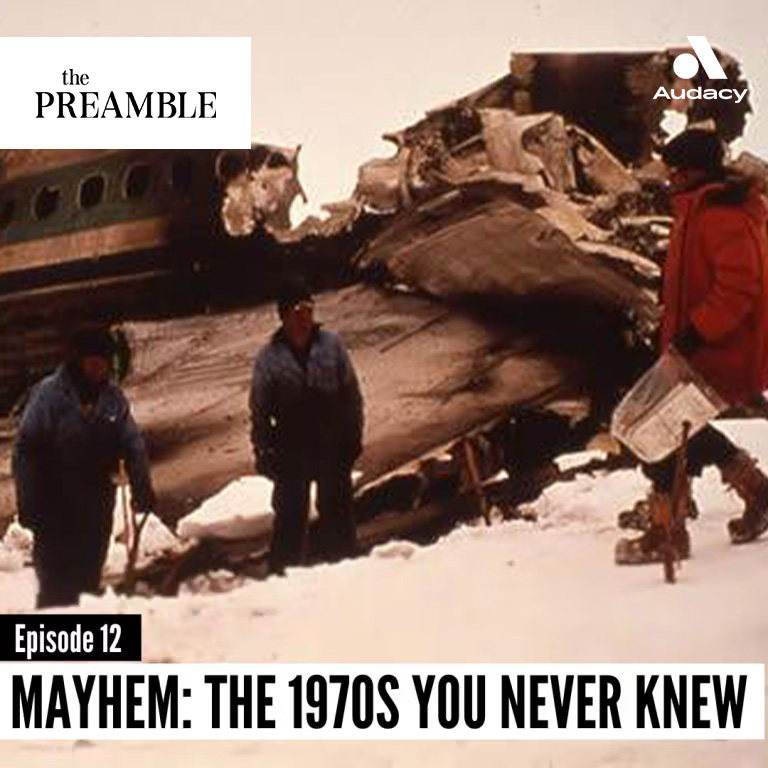
The Preamble
Mayhem: The 1970s You Never Knew, Episode 12
00:34:14
It was supposed to be a picturesque and luxurious sightseeing tour over Antarctica. One filled with wonder and awe, in a tour that had cultivated a reputation for giving passengers the “trip of a lifetime.”
Loading summary
Transcript35 lines
- [00:00]
Sharon McMahon
Hi there, it's Sharon. As a listener of the Preamble, you likely value thoughtful, nuanced discussions about politics, civic duty and our future. Which is why I highly recommend the Signal Award winning podcast no Small Endeavor. Hosted by my friend Lee C. Camp, no Small Endeavor explores what it means to live a good life through conversations about faith, culture, ideas and the habits that help people flourish. Each episode, host and award winning theologian Lee C. Camp sits down with courageous and impassioned people like Pulitzer finalist historian Garrett Graf and New York Times bestselling author Malcolm Gladwell about what it means to flourish in our day to day lives. Not sure where to start? Check out my conversation with Lee where we talk about the transformative power of education, the need for informed civic participation, and the hopeful possibilities that emerge when we approach politics not as partisan warriors but as compassionate, curious learners. Follow no Small Endeavor on Apple Podcasts, Spotify or wherever you're listening now.
- [00:57]
Sponsor/Advertiser Voice
Finding a gift that someone will actually use and appreciate can be so tough. Especially when you're shopping for a busy student, an educator, or a professional who is constantly juggling a million things at once instead of another novelty item that just sits on a shelf. I love giving things that genuinely make life a little easier, which is why I have to recommend Notability. It's an all in one note taking and learning app designed to help people capture ideas, stay organized and make way more use of their notes. It makes such a thoughtful, practical gift for anyone in your life who needs a better way to manage information and stay on top of a hectic schedule. What's amazing about Notability is how versatile it is. You can take not notes by hand, type and annotate PDFs all in one place. It even lets you record and transcribe audio so you never miss an important detail from a lecture or a meeting. Plus, it has AI powered study tools that can turn notes into quizzes and flashcards. Give a gift they'll actually use with notability, go to notability.com gift and use code PREAMBLE25 at checkout to get 25% off.
- [02:03]
Sharon McMahon
Welcome to our final episode of our series the 1970s you never knew. On November 28, 1979, 257 adventurous travelers anticipated a day of sightseeing and drinking champagne and then they were never heard from again. I'm Sharon McMahon and this is the Preamble Podcast. In 1977, Air New Zealand began offering sightseeing tours over Antarctica. These tours were marketed to people with money and wanderlust and might be considered an Aviation equivalent to a luxury cruise, which by the way, cruises boomed in popularity in the 1970s and were popularized by the 1975 TV show Love Boat. These tours helped New Zealand develop a reputation as a prime tourist destination. In all their years of operation, over 10,000 people went on what some former passengers called the trip of a lifetime. The flights included gourmet meal service, a complimentary bar in flight, entertainment and commentary from world famous naturalists. Air New Zealand purposely undersold the airplane so that passengers could get up and move about freely, being able to look out the windows on one side of the plane or the other. One tour flew near Mount Erebus, the southernmost active volcano on planet Earth. A five hour flight from Auckland, New Zealand. In addition to flying over an active volcano, many travelers were interested in seeing firsthand other types of natural phenomena. In the 1970s, volcanologists discovered the open lava lake inside Mount Erebus that they think dates back to the early 1900s. We've included a picture of it in our podcast show Notes if you want to see for yourself. Volcanoes emit gases through vents in the ground called fumaroles. When you have volcanoes and ice together, volcanic gases escape from the ground which cause the nearby ice to melt, turn into vapor and develop into tall towers called ice fumaroles. These huge sculpture like towers occur naturally near Mount Erebus. In order to even qualify to fly passengers to Antarctica, pilots had to undergo special training. Captain Jim Collins and First Officer Greg Casson began preparations for the 11 hour round trip flight to two weeks in advance, attending a mandatory flight qualification briefing for the route. The men were given logs and information from previous flights to study. It was imperative that they have the correct route as there were few, if any visual cues to keep them on track. From above, Antarctica was mostly snow, surrounded by water. The magnetic heading of the plane was absolutely essential on these sightseeing flights. Flights. The plane took off at 8am Winging its way to Antarctica with excited passengers eager to learn more about the Earth's least visited continent. Here's Captain Collins.
- [05:28]
Guest/Interviewee
Our captain is very keen to see a great deal more down here, as indeed all of us are, I'm sure. So our intention is now to go towards the southwest. Well, ladies and gentlemen, the aircraft now is just over 10,000ft and we're looking straight into Mount Erebus. You can see a great plume of smoke up there from the crater, a very active volcano.
- [05:52]
Sharon McMahon
The pilots, with over 19,000 flight hours between them, shuttled passengers away from Auckland, New Zealand and toward Christchurch, where they planned to refuel and change the crew along the way. Passengers with their cameras took photographs through the windows of the plane. The day was bright and clear, and there was no sense that this sightseeing tour would be any different than previous ones. As they circled closer to Mount Erebus, the pilots requested and were granted the usual permission to decrease their altitude to 2,000ft. Suddenly, shockingly, alarms started sounding. The five people in the cockpit must have had their hearts leap into their chest. What was going on? They were flying a safe distance above the ground. And then, before they even realized what was happening, every person on Flight 901 was dead. On the other side of the world, oblivious to the fate of Flight 901, Ronald Reagan was trying to unseat Jimmy Carter in his third quest to be elected president. You may know that prior to his political life, Reagan was a Hollywood actor. After the Japanese attack on Pearl harbor, though, he decided that he wanted to join the military. His connections in Hollywood helped to create a special role for him that would serve the war effort, but also keep him safe. You might be thinking that there's always been two Americas, one for regular folks and one for elite folks, rich folks, famous folks. And that might be one way to frame Reagan's service. Another might be that his on screen talents set him apart from others who rushed to their country's defense, and thus it made sense to capitalize on his skill set. However you want to look at it. The Warner Brothers studio persuaded the Army Air Corps that they needed a film unit and that Reagan was their man. The army agreed, and with the assistance of a former FBI agent, William Guthrie, the Army expedited Reagan's admittance into this unit, where he joined 1300 other men that Guthrie had selected. Reagan worked in the photographic unit, and his responsibilities included making instructional videos for different branches of the military, recording newsreels that were shown in movie theaters, and creating promotional materials for the Army Air Corps. He made 400 instructional videos, in fact, including those for the B52 bombers. As part of Reagan's job, he saw unedited documentary film material before it was reformatted for newsreels. Some of this material included the European front and the liberation of Nazi concentration camps. Reagan decided to steal some of the unedited film, and he later explained that he did so because he wanted evidence should people ever deny that the Holocaust happened. After his World War II service, Reagan went back to acting, but felt compelled to blend his political interests with his acting career during what we now call the Red Scare. The House on American Activities Committee, which operated from 1938 to 1975 was busy rooting out alleged communists in America in the 1950s, and Reagan wanted to be part of that effort. At the time, he was the president of the Screen Actors Guild and the House UN American Activities Committee was certain and convinced him and others that America had been infiltrated by communists, particularly in unions and guilds. As with the Lavender scare of the 1940s through the 60s, which was similar in that Americans were panicked about UN an invasion of a group of people in specific workforces. Mere allegations that someone was gay, like in the Lavender Scare, or a communist in the Red Scare, resulted in job terminations and blacklisting. Reagan was in favor of blacklisting and he used his position to inform on Hollywood writers, actors and directors accused of communist sympathies. Reagan's codename was T10, and he engaged in informing for the duration of his SAG presidency. Around this time, Reagan's politics shifted increasingly to the right. He was a Democrat and had even campaigned for President Harry Truman in 1948. Two years later, though, he rescinded his endorsement and began campaigning for Richard Nixon's run for California Senator Reagan endorsed President Eisenhower in 1952 and 1956 and made over 200 speeches for Nixon's unsuccessful presidential bid of 1960. In 1966, Reagan ran for governor of California and won, and two years later he tried running for president, but lost that bid and instead was re elected as a governor of California in 1970. He tried to run again for the presidency in 1976, and finally he was feeling more optimistic about his chances in the upcoming 1980 election. Seven Republican candidates participated in the 1980 Republican primary, but Reagan's top competitor was George H.W. bush, who had worked in politics, namely as the head of the CIA for years and was thus widely known. Reagan's initial campaign strategy was to let his name as an actor and his charisma do the work for him. He chose not to debate his competitors, and he considered his lead in the polls wide enough to exempt him from that sort of public engagement. But George H.W. he was coming on strong in the race. So Reagan decided to change strategy. Reagan challenged H.W. to a debate in New Hampshire, which was initially sponsored by a local newspaper. Turns out, though, that that violated FEC campaign guidelines. A debate sponsored by a newspaper could not just be between a couple of candidates. So Reagan offered to foot the bill and pay for the debate himself instead of having it sponsored by the newspaper. But the newspaper was still in charge of moderating the debate, and they clearly wanted to highlight the top two candidates, Reagan and Bush. They had prominent places on the stage, while the other candidates were kind of like off to the side, which Reagan didn't think was fair. Reagan demanded that everyone be allowed to give an opening statement, and the moderators balked. They had a format that they wanted to follow and that was not it. And then this exchange happened.
- [13:00]
Guest/Interviewee
If we may have the first question. You asked me if you could make an announcement first, and I asked your permission to make an announcement with the sound man. Please turn Mr. Reagan's mic off. Is this on? Mr. Green? You turn on my. You address for me, if you would. I am paying for this microphone.
- [13:29]
Sharon McMahon
The media had a field day with the clip of Reagan's frustrated outburst and frequently replayed it. This one line helped to clinch the victory of Reagan as the Republican candidate for the 1980 election and his running mate none other than his more Moderate competitor, George H.W. bush. The race was now a contest between President Carter and the Republican nominee, Ronald Reagan. But the ongoing Iranian hostage crisis weighed heavily on Carter's mind. He didn't want to lose focus on it and spend time debating Ronald Reagan, but it became increasingly clear that he had no choice. While Reagan had been in full campaign mode for months and he had decades of practice performing for crowds and cameras on him from his time as an actor, Carter had none of that. Carter had promised during his election campaign against Ford that he would never tell a lie. And after the Watergate fiasco, the country found his honesty and plain spokenness refreshing. But it wasn't enough. This time, Reagan was full of humorous charm. While Carter addressed each issue the nation faced and how he would continue to work to solve those problems, People thought he seemed like a professor lecturing about material only he cared about. Reagan's end of the debate question went to the American public. He looked into the camera and said, would you say that you are better off now than you were four years ago? That sealed the election. Incumbent President Jimmy Carter lost badly. Ronald Reagan had a different plan to address the hostage situation. He wanted the hostages released, of course, but he wanted it to happen while he was president so that he and not Carter would get the credit. The Americans being held hostage in the Iranian embassy weren't the only victims of disaster. In 1979, Flight 901 never came back to Christchurch, New Zealand, as scheduled, and they were not answering any attempts to contact them.
- [15:48]
Sponsor/Advertiser Voice
It's easy for a sense of style to get lost somewhere between work, family and the daily grind leading to a closet full of clothes, but nothing that feels right. Whether it's for a professional event, a vacation, or just a quick grocery run, everyone deserves to wear outfits that feel like like them. Daily look is the number one highest rated premium personal styling service for women, designed to help you rediscover your style with the help of a professional. Unlike other services, you get a real personal stylist, the same one every time, who curates a box of up to 12 premium pieces based on your body shape and lifestyle. You simply try them on at home, keep what works and return the rest. Shipping is free both ways, and you can receive a box every 30, 60, or 90 days. Elevate your style by signing up@dailylook.com today. Take your style quiz@dailylook.com and get 50% off your first styling fee with the code Sharon. That's Daily Look.com code Sharon so many people have been there staring at the ceiling at 3 o' clock in the morning, heart pounding while your mind races. I learned that during perimenopause and menopause, shifting hormones are actually draining the magnesium your nervous system needs to function. And that is why so many people are adding Magnesium Breakthrough by Bioptimizers to their routines. Unlike most brands, they've spent 20 years and conducted over 15,000 lab tests to get this PhD formulated complex exactly right. It includes seven different forms of magnesium, which is why practitioners recommend it so highly. It hits everything from stress and recovery to that deep restorative sleep we're all craving. If you're ready to finally sleep great and feel like yourself Again, head to bioptimizers.com Sharon and use my exclusive code Sharon to get 15% off any order. You'll get great discounts, free gifts, and the peace of mind of never running out. And Bioptimizers backs it with a 365 day, no questions asked, money back, guarantee, a full year, zero risk. Because at the end of the day, Bioptimizer's mission is to empower everyone to live a stronger, longer, better, better life. And this is one of the best tools to actually do that again, that's 15% off@bioptimizers.com Sharon when you use my code Sharon, make this the year you finally get your sleep, your energy and yourself back.
- [18:12]
Sharon McMahon
Hours ticked on. Rescue aircraft was marshaled to try to locate the plane. Family members congregated at the airport waiting for news. There were really only a handful of places a large plane could make an emergency landing, and Flight 901 was nowhere to be found. Eventually, the family Members were told that the plane had most certainly run out of fuel. At this point, search and rescue aircraft continued their work, and at midnight, Flight 901 was spotted. Piles of wreckage littered the side of Mount Erebus. News of the tragedy broke the following morning. Flight 901 had crashed, and the 237 passengers and 20 crew members on board were killed instantly. Calls immediately went out to police stations for volunteers to help with recovery efforts for what they named Operation Overdue. Crash investigators arrived on scene on November 30, but they were pinned in their tents for a week due to terrible weather conditions. The cold helped to preserve the remains, the film inside the travelers cameras and the flight recorder. The hull of the plane itself lay in the snow like a crumpled soda can. When the weather finally broke, the investigators were able to meet their primary objective, locate and send for analysis the plane's data recorders, also known as the black boxes. That same day, the first crew of disaster victim identification DVI team members were flown near the crash site, where they jumped out of a helicopter and trekked their way to the debris field. Team members said that it was like jumping into the great white abyss. But there was another obstacle. Nature. Specifically birds. Birds that are a lot like the seagulls you might be picturing, except they live in Antarctica, and these birds were not afraid of people. And they were bound and determined to feast on the remains of the people who. Who died when rescuers tried to zip remains inside body bags. Not even that kept the birds at bay. And as a way to thwart them, the DVI teams temporarily buried remains in the snow and ice. The recovery operation was both difficult and harrowing. By December 10, the teams had completed the site investigation and they recovered 114 substantially intact bodies and 133 bags of human remains, along with countless personal belongings. In New Zealand, Chief Inspector Jim Morgan led a team that undertook the grim task of victim identification. They worked tirelessly, and by December 21st they had completed postmortems on all recovered bodies, managing to identify 213 of the 257 victims, an identification rate of nearly 83%, which was considered high compared to other air crashes. In the shadow of the pristine white wilderness of Antarctica, where the silence is as thick as the ice, the crash of Air New Zealand Flight 901 on Mount Erebus reverberated through the corridors of power far beyond the icy continent. This is not just the story of a tragedy. It's a narrative woven with secrecy, a battle for truth and the relentless pursuit of justice in the face of overwhelming odds. At first, the narrative spun by officials was, tragically, pilot error, a misjudgment in the harshest of landscapes, leading to the deaths of 257 souls. But as the families of the lost grieved, they stumbled upon inconsistencies and half truths that painted a much more complex and sinister picture. It wasn't just a story of a flight crew led astray, but of maps redrawn, coordinates changed, and a company and government scrambling in the aftermath to direct the blame away from themselves. Just as Peter Mann stepped into this tale as the head of the Royal Commission of Inquiry, his investigation would peel back the layers of secrecy to reveal what he infamously described as an orchestrated litany of lies by Air New Zealand. Yet the cost of truth was high and man himself became a casualty in the battle, his career ending in resignation and his findings contested and challenged by the airline and the government. In the silence of the Antarctic expanse, the stage was set for a tragedy that would haunt New Zealand for decades. Flight 901 embarked on a sightseeing journey that promised breathtaking views. But as it descended into the white embrace of Antarctica, a series of fatalities, human errors and a phenomenon known as sector whiteout conspired against it. What was not immediately known was that the flight's coordinates had been altered without the knowledge of the flight crew. This crucial detail, a seemingly innocuous change in the flight path entered into the plane's navigation system, would draw the aircraft not so much safely over the ice as intended, but directly towards the looming face of Mount Erebus. As the DC10 descended into McMurdo Sound, the pilots found themselves in the grip of a polar mirage. The clear sky whiteout conditions created an illusion, a deceivingly uniform whiteness where the sky blended with the snow covered landscape, masking the horizon and cloaking the perilous slopes of Erebus, as if they were an extension of the snow on the ground. In this disorienting visual trap, the mountain revealed itself only when it was far too late for the pilots to react. Captain Jim Collins and his crew, seasoned but unprepared for such a treacherous optical illusion, believed that they were flying over flat terrain. As they peered out into the vast white, the ground proximity warning system blared its alarms. But in the calm before the storm, there was no panic, only a routine call for go round power. The navigational coordinates had been changed by the airline's navigation section. They believed they were making a minor adjustment to the flight's long standing destination point. But due to a typing error made 14 months earlier, the coordinates shifted 27 nautical miles east. This change directed the flight path over Mount Erebus instead of over Sea I as the crew had been briefed. Unfortunately, the flight crew was not informed of this change. And on the morning of the flight they received the adjusted flight plan and entered the new coordinates into the onboard computer, leading to the tragic crash. Just as Mann found that Air New Zealand was directly involved in a conspiracy to whitewash the inquiry and their lies were designed to cover up evidence and mislead investigators, they did not want the public to know that the disaster had in fact been the fault of their own employees. Man's evidence of this conspiracy was based in part on untrue statements given about the sightseeing trip's routes. Flying directly over Mount Arabis, both the captain and first officers homes being burglarized, but only work papers stolen because that is not how burglaries normally work. And a shredding spree which airline executives embarked on immediately following the accident. Justice Mann was convinced that these actions pointed to Air New Zealand. Knowing that the typo in the flight route was the primary cause of the crash, man ordered Air New Zealand to pay the legal cost of the estates of the passengers, the New Zealand Airlines Pilot association, and the legal cost of the estates of the pilot and co pilot. On top of that, he ordered the company to pay $150,000, which is like $634,000 today, for the government's legal fees. Air New Zealand appealed the decision and they were successful. The Court of Appeals ruled that man had violated natural justice because those he accused of wrongdoing didn't have an opportunity to defend themselves prior to him releasing the report. They also found that man had overstepped his authority by saying that the airline had orchestrated a litany of lies and that it was not in his lane to order restitution costs against the airline. It wasn't until 2019, on the 40th anniversary of the crash, that the government of New Zealand offered an official apology. In her statement, the Prime Minister read some information from the Royal Privy Council appeal that was never publicized, she said. In particular, the Privy Council said, and I quote, the Royal Commission report convincingly clears Captain Collins and First Officer Cassen of any suggestion that negligence on their part had in any way contributed to the disaster. That is unchallenged, she said. Those findings stood then and they stand now. The pilots were not responsible for this tragedy and I stand here today to state that again. But these were not the findings accepted by the government of the day. The government did not table the report in parliament. Nearly 20 years went by before the report was finally tabled. That was wrong. It caused trauma on top of grief and persecution on top of pain. History that Doesn't Suck is a legit, hard hitting American history podcast told through entertaining stories. As we approach America's 250th anniversary, now might be the time to go back and learn how we got here. With more than 200 episodes, you can binge your way decade by decades, defining event to defining event from the founding into the 20th century. Join me Professor Greg Jackson for History that Doesn't Suck An Odyssey Podcast available on Apple Podcasts, Spotify or wherever you get your podcasts.
- [29:35]
Sponsor/Advertiser Voice
This episode of the Preamble is brought
- [29:37]
Sharon McMahon
to you by Alloy Health.
- [29:39]
Sponsor/Advertiser Voice
Midlife aging comes with some unwelcome changes, including brutal hot flashes ruining your days and your sleep. Too many women suffer in silence for years because finding real solutions is exhausting. Alloy changes that it's an online health platform that matches you with a menopause specialized doctor without you ever leaving your couch.
- [30:01]
Sharon McMahon
You just fill out a quick intake form and your doctor handles the rest,
- [30:05]
Sponsor/Advertiser Voice
creating a safe, personalized prescription plan to tackle those vasomotor symptoms like night sweats and hot flashes. You get a three month supply delivered to your door and unlimited messaging with your prescribing physician with Alloy anytime. Join the 95% of women who try Alloy and saw relief in the first two weeks. Head to myalloid.com and use the code
- [30:25]
Sharon McMahon
Sharon and tell them all about your
- [30:26]
Sponsor/Advertiser Voice
symptoms and you'll get a fully customized treatment plan and unlimited messaging with your doctor. Plus, you'll get $20 off your first order today. Head to my a l l o y.com and use code Sharon to get $20 off your first order.
- [30:40]
Sharon McMahon
Running a business is hard enough. Why make it harder with the dozens of disconnected apps? If your software is causing more stress
- [30:48]
Sponsor/Advertiser Voice
than success, it's time to switch to Odoo. Odoo is an all in one business
- [30:53]
Sharon McMahon
platform that handles CRM, accounting, inventory, E, Com, HR and more. Everything is fully integrated so you don't have to waste time switching between apps or juggling multiple logins.
- [31:05]
Sponsor/Advertiser Voice
It's one seamless system designed to make your workday easier, more productive and less stressful. And it's not just convenient, it's smart business. Odoo replaces multiple expensive platforms, helping you
- [31:17]
Sharon McMahon
save money while still giving you all
- [31:19]
Sponsor/Advertiser Voice
the tools you need to run your company efficiently. Plus, it's designed to grow with your business. From startups to established enterprises, Odoo is easy to use, customizable and built to
- [31:30]
Sharon McMahon
streamline every process so you can spend less time on software headaches and more time on strategy, customers and growth.
- [31:38]
Sponsor/Advertiser Voice
Thousands of businesses have already made the switch. Why not you try Odoo for free today@odoo.com that's o d o o.com back
- [31:48]
Sharon McMahon
in the tumultuous political world of the United States and Iran, far away from the silent ice of Antarctica and the misty mountains of New Zealand, Ronald Reagan won the presidency. But still the hostages had not been released from Tehran. The Carter's last Christmas in the White House had all the trappings of Christmas decor an elaborate gingerbread house created by the White House chef and an indoor tree bedecked in the Victorian theme Rosalynn Carter had chosen. Tree branches were laden with lace and ribbons, dolls and jesters, clowns and fabric, flowers and more. The Carter's daughter, Amy, had a matching dress, but inside, the mood was not full of holiday cheer. The previous Christmas, in 1979, President Carter and Amy Carter set out to light the outdoor Christmas tree and only the star and the blue lights on the state trees along the pathway to Peace Walkway. Carter explained that the tree would remain dark until the hostages were released. Released except for the star, it remained unlit for the rest of 1979. President Carter said Amy had lit 50 trees, one for each American hostage. We will turn on the rest of the lights when they come home, President Carter asked everyone to pray for their safe return. In 1980, President Carter decided to illuminate the outdoor Christmas tree for 417 seconds, symbolizing the total number of days the American hostages were detained far from home. In his remarks to the crowd, President Carter said, the hostage families asked me to do this year the same thing we did last year, and this is just to light the Star of Hope and to hold the other lights unlit until the hostages come home. And they also asked me to ask all Americans to continue to pray for the lives and safety of our hostages and for their return to freedom. Recent evidence suggests that Reagan's campaign worked to delay the release of the hostages until after he took office on January 20, 1981, so that his first act as president would be announcing the hostages departure from Iranian airspace, which he did at a luncheon following his inauguration some 30 minutes ago.
- [34:24]
Guest/Interviewee
The planes bearing our prisoners left Iranian
- [34:29]
Sharon McMahon
airspace at the time, though, and in the following decades, reporters and others tried to piece together just how. A few minutes into Reagan's inaugural address, the plane carrying hostages who had been held for well over a year in Iran, was able to depart. Ben Barnes was the youngest speaker of the Texas House of Representatives and the former Lieutenant governor of Texas. In multiple interviews with the New York Times, Barnes made some grim confessions. His motivation, as he explained it, is that Both he, age 85, and former President Carter, who in 2023 entered hospice care, celebrated his 99th birthday and lost his wife, are nearing the ends of their lives. Barnes said that history needs to know that this happened. I think it's so significant and I guess knowing that the end is near for President Carter put it on my mind more and more and more. I just feel like we've got to get it down some way. I just want history to reflect that. Carter got a little bit of a bad deal about the hostages. He didn't have a fighting chance with those hostages still in the embassy in Iran. The American public watched on a split screen the inauguration of President Reagan. And on the left side of the screen was a camera trained on hostages boarding a plane while Reagan giving his speech filled the right half of the screen. A few minutes after Reagan's speech began, the plane carrying the hostages left Iran. George Will, who you might recognize as a leading conservative journalist and political commentator, participated in the live TV news coverage of Reagan's inauguration. His comments on ABC that morning revealed that the idea that it would take Reagan to set the country straight and save the hostages was embraced by Reagan supporters. Here is George Will's exchange with news anchor Frank Reynolds and George Will, the
- [36:27]
Guest/Interviewee
syndicated columnist and Pulitzer Prize winner and I must say, a card carrying conservative who has longed for this day for some time. George, you must be very, very pleased. Well, it is pleasing and I think it's particularly pleasing to have this hostage crisis come as a kind of punctuation to the, to the ending presidency and clearing the plate for the new presidency. And in a way, perhaps, Ronald Reagan is unusually blessed in the sense that most men have to wait a while for their first achievement. An argument can be made that he's had his first achievement with presidential power before he got presidential power. That it was the anticipation of his somewhat sterner position, as revealed in his description of the Iranians as barbarians, that may have helped break the logjam here and bring the hostages home.
- [37:12]
Sharon McMahon
The day after he left office, the Carters flew to West Germany to meet the hostages who were receiving medical attention at V spot in Air Force Base. As we've seen throughout this series, the 1970s were one crisis after another inflation, stagflation, Vietnam, skyrocketing oil and gas prices, cults, kidnappings, assassinations and political upheaval. And 1979 in particular was a year full of crises and headline grabbing events. And here are some of the other things that happened Margaret Thatcher became the first democratically elected woman prime minister in Britain. Both she and Reagan were in favor of the free market and cutting social service programs to reduce big government. On the TV front, both Nickelodeon and ESPN debuted to lasting success. This might blow your mind if you've always gotten your music from Internet downloads, but we didn't always have the ability to take our music with us. At least not until 1979. Sony released the Walkman, a large cassette tape player with a headphone jack but no speaker. They were incredibly popular and Sony sold over 200 million Walkman. Pope John Paul II visited the Carter White House, the first such visit. President Carter greeted the Pope in Polish and the two met privately for an hour before a reception on the south lawn at which 6,000 guests greeted both men. President Carter offered the words as human beings, each acting for justice in the present and striving together for a common future of peace and love, let us not wait so long for ourselves and for you to meet again. Welcome to our country, new friend over the course of this series about the 1970s, an often overlooked decade, we've explored man made disasters like Watergate and Jonestown. We've learned all about the rise in pop culture that led to cinematic marvels, the start of the gaming culture, and we've seen examples of humans who served themselves and their aspirations while others attempted to help the world. We've heard about Fleetwood Mac and the development of personal computers, 11 pound keyboards and the significance of fancy watches on the wrists of astronauts. We learned about the tragic origin stories of space, the Twinkie defense, and the adage don't drink the Kool Aid. We delved into the history of the Vietnam War and what seemed to be a never ending revolving door of presidents and vice presidents. With our coverage of Roe v. Wade, massive inflation, and a presidential candidate who relied on his high polling and charisma to carry him into the White House. We see reverse reverberations that some of the major headlines from more than 40 years ago are remarkably similar to those we see today. Thanks for joining me on this exploration of the mayhem of the 1970s. I hope you enjoyed it. What do you think? Should we do other decades? Let us know and I'll see you next time. The show is written and researched by Sharon McMahon, Amy Watkin, Mandy Reed, and Kari Anton. Our audio producer is Jenny Snyder and it is executive produced and hosted by me, Sharon McMahon. If you enjoyed today's episode, we would love for you to hit the subscribe button. Leave us a review or share this episode on your favorite social media platform. All of those things help podcasters out so much. We'll see you again soon.
- [41:19]
Sponsor/Advertiser Voice
This is the sound of captivity.
- [41:24]
Sharon McMahon
This is the sound of rescue.
- [41:28]
Sponsor/Advertiser Voice
And this is the sound of freedom.
- [41:31]
Sharon McMahon
Give Armenia's captive bears a second chance
- [41:35]
Sponsor/Advertiser Voice
by supporting International Animal Rescue. Call 582-6-1083 or search the Great Bear
- [41:44]
Sharon McMahon
Rescue to learn more.