← The Preamble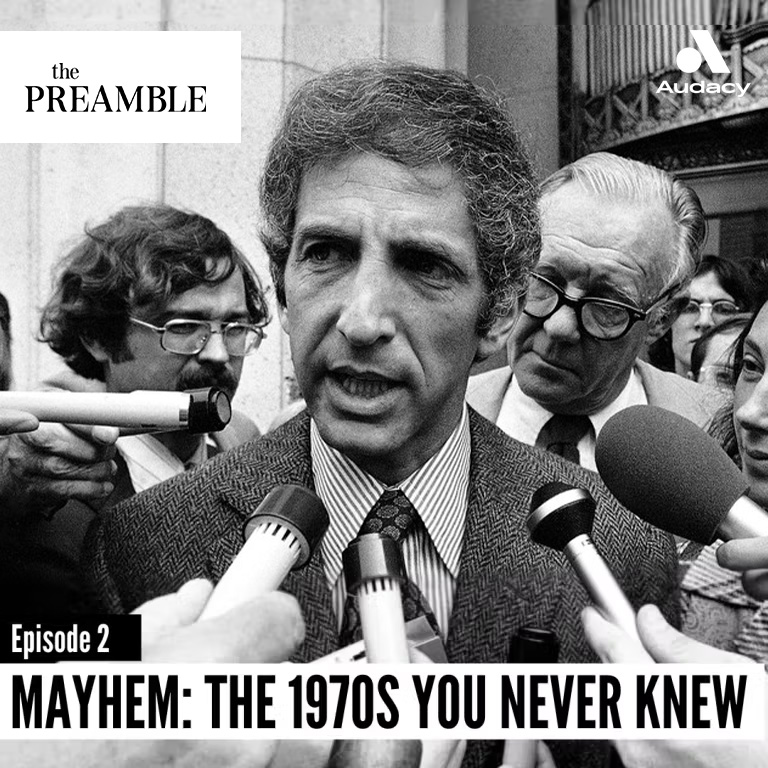
The Preamble
Mayhem: The 1970s You Never Knew, Episode 2
00:41:22
Secret Police, CIA operatives, The Pentagon Papers, and The Most Dangerous Man in America. There was a time in the not-so-distant past, when the nightly news changed the game in how Americans felt about the war in Vietnam, the first “television war.”
Loading summary
Transcript75 lines
- [00:00]
Sharon McMahon
Busy schedules don't have to make Getting dressed stressful DailyLook is the number one highest rated premium personal styling service for women. Each customer gets a dedicated stylist, real
- [00:12]
Narrator/Co-host
human expertise, not an algorithm who curates
- [00:15]
Sharon McMahon
up to 12 premium pieces per box based on body shape preferences and lifestyle. The same stylist works with each box for a consistent personalized experience.
- [00:25]
Narrator/Co-host
Clothes are delivered right to the door.
- [00:27]
Sharon McMahon
You try on the items at home.
- [00:29]
Narrator/Co-host
You keep what works.
- [00:30]
Sharon McMahon
You return the rest with free shipping both ways.
- [00:33]
Narrator/Co-host
This saves time while ensuring every outfit is stylish and polished.
- [00:37]
Sharon McMahon
Boxes can be scheduled every 30, 60 or 90 days. Elevate your style by signing up@dailylook.com today. Take your style quiz@dailylook.com and get 50% off your first styling fee with the code Sharon. That's dailylook.com code Sharon running a business is hard enough. Why make it harder with dozens of disconnected apps?
- [00:58]
Narrator/Co-host
If your software is causing more stress
- [01:00]
Sharon McMahon
than success, it's time to switch to Odoo. Odoo is an all in one business platform that handles CRM, accounting, inventory, E Com, HR and more. Everything is fully integrated so you don't have to waste time switching between apps
- [01:15]
Narrator/Co-host
or juggling multiple logins.
- [01:17]
Sharon McMahon
It's one seamless system designed to make your workday easier, more productive and less stressful. And it's not just convenient, it's smart business. Odoo replaces multiple expensive platforms, helping you SA money while still giving you all the tools you need to run your company efficiently. Plus, it's designed to grow with your business. From startups to established enterprises. Odoo is easy to use, customizable and built to streamline every process so you can spend less time on software headaches and more time on strategy, customers and growth. Thousands of businesses have already made the switch. Why not you try Odoo for free today@odoo.com that's o d o o.com foreign.
- [02:04]
Narrator/Co-host
Welcome welcome to episode two of our new documentary series about the 1970s. Today we are revisiting 1971 and it was definitely one for the records. From astronauts to a billion dollar feast, the passage of the 26th Amendment to the Pentagon Papers. 1971 ushered in political and cultural shifts that still reverberate today. And stay tuned until the end of the episode where I have some facts that didn't make it in to today's story. Let's dive in.
- [02:44]
Sharon McMahon
I'm Sharon McMahon and this is the Preamble Podcast.
- [02:52]
Narrator/Co-host
The year was 1970 and Shah Mohammad Reza Pahlavi of Iran had an idea. An idea to throw a lavish three day, no expense spared celebration of the 2,500th anniversary of the Persian Empire in the desert with no infrastructure and scorpions and serpents everywhere. He started by rounding up all of the undesirables which were the creepy crawly animals he had poisoned, along with students, activists and dissidents he imprisoned. He closed the borders and shuttered all schools and universities. He created the image of Iran. He wanted to project a perfect image, one of lavish wealth, no poverty and definitely no human rights violations. He wanted to connect his leadership with that of Cyrus the Great, the first ruler of the Persian Empire. And for those who may have missed it in history class, the Persian Empire lasted roughly from 539 BCE until it was conquered by Alexander the Great in 334 BCE. It encompassed modern day Egypt, Iran, Turkey and sections of Pakistan and Afghanistan. The Shah was all about reform. Reform that some considered progressive and others blasphemous. His goal was to aggressively modernize, even westernize Iran with freedoms for women's dress in education, urbanization and redistribution of landowners and clerics wealth. Such wide scale change so quickly led to a great sense of unease among some people in what was already a politically turbulent time. The Shah came to power in 1953 following Operation Ajax. Two years earlier the Prime Minister had nationalized Iran's oil supply, stripping foreign countries like Great Britain from profiting off the claims they had to Iranian petroleum. The Shah was paid $1 million to head a coup orchestrated by the CIA and British intelligence that overthrew the Prime Minister and installed him as Iran's supreme leader. The thinking was that the Shah would have policies that benefited the west, unlike the policies enacted by the Prime Minister before him. And listen, I am telling you all of this for a good reason. It is going to be important later in the series. In order to create the impression of a flourishing country due to his leadership, the Shah had to create an oasis in the middle of a literal desert. He chose Persepolis as the site of his festivities as it was the original capital city founded under king Darius in 518 BCE. It's near modern day Shiraz and it's important archaeologically and it's protected as a UNESCO World Heritage site. So in October 1971, the transformation of a desert into an ostentatious destination involved importing thousands of trees, plants and European songbirds, most of which perished in the desert heat. The shop built a golf course, an airport and two hotels and arranged for 250 bulletproof Mercedes Benz limousines to shuttle guests to and from the airport. And the elaborate tent city he had erected, constructed in the shape of a star with a fountain at the end and five points radiating from it, symbolizing the five continents from which he invited world leaders and heads of state. The amenities for guests were unlike anything the world had seen. Designed by Maison Jensen and flown in from Paris, each tent was covered in traditional Persian cloth and included air conditioning, special telecommunications systems that linked each leader to their home countries. Two bedrooms and bathrooms, a sitting room, a kitchen and two servants available around the clock. This was not camping. It was not even glamping. All of this though, was in a custom designed tent. In total, the tent city occupied over 160 acres of land. But that wasn't all. There was also a banquet tent where the feast was held and there were other tents that connected to it. And those tents had things like pastry and entree kitchens. There was also a secret gambling room and a tent for the ladies that housed four makeup stylists and 16 prefabricated hair salons staffed by Parisian, not Persian, Parisian hairstylists. The food was prepared by the staff of Maxims in Paris, which was then considered the best restaurant in the world. Maxims closed for a full two weeks in order to prepare for this party. In addition to flying out the restaurant's entire staff, the Shah also had flown in daily blocks of ice said to be the size of garages. Enough to keep 4,500 bottles of champagne cool, along with thousands of pounds of meat, caviar and booze. In total, the three day event required over 18 tons of food and drink. The menu of delicacies included quail eggs, stuffed peacocks, the country's national symbol, complete with restored tail feathers. Although guests really just ate the quails surrounding them. We included a photo of this in our show notes, by the way. Lambs, figs with cream, cognac, coffee and more. It was served on a seamless hand sewn tablecloth that took 150 artisans well over half a year to complete atop a 187 foot table, so that all 60 heads of state could see each other for a celebration of the Persian Empire. Its original remarkable that almost all of the elements were outsourced from European artisans, particularly from France. From the handcrafted plates to the food to the landscaping, the attendees were royalty and leaders from around the globe. It's actually easier to name the people who didn't attend than those who did. Noticeably, Queen Elizabeth not there. She was not interested in bowing down to the King of Kings, which is the title the Shaw gave himself hope. Paul v6 declined, likely for the same reason President Nixon wanted to go, but security concerns kept him back in the United States. So he said the vice President, Spiro Agnew, and the vice president's wife, Judy. There ended up being a bunch of controversy about Judy spending too much money on her outfits. And also absent was most of the Iranian government. The procession of guests from 60 countries greeting the Shah was televised in America and hosted by Barbara Walters. In a primetime special, newspapers from all over the world sent reporters and the Shah, ever interested in preserving history, hired Orson Wellesley to narrate a documentary of the festivities. With so many dignitaries in one place, security was, as you can imagine, a top concern. The Shah deployed 65,000 soldiers and secret police to protect the tent city and ensure that nobody got in who wasn't supposed to be there. On Only the restaurant staff was allowed in the banquet hall prior to the feast as a means of preventing mass poisoning. A fireworks display following the feast, however, frightened surprise guests into thinking that they were under attack. But no. But no. It was just the Shah being extra
- [12:09]
Sharon McMahon
the Second Day of Festivities I've only
- [12:13]
Narrator/Co-host
told you about the fear first day the second day of festivities, October 14, 1971, featured a celebration of Persian culture. About 17,000 soldiers reenacted Major historical moments, complete with camels and replicas of centuries old musical instruments recreated on the Shah's orders. Life size replicas of boats were put on wheels because again, it's the desert and historically accurate down to the tiniest detail, costumes brought Persian history alive. This all sounds like a sight to behold. And it was. But the ramifications of the party of the century created a history of their own. If your routine only works when you have extra time, it's probably not going to work. That's why Merit beauty has become such
- [13:13]
Sharon McMahon
a staple for me. I've been using it daily because it
- [13:15]
Narrator/Co-host
actually fits into real life.
- [13:16]
Sharon McMahon
Merit is a minimalist beauty brand that makes elevated makeup and skincare designed to help you look put together in minutes. The minimalist seriously streamlines everything. It replaces both foundation and concealer so
- [13:27]
Narrator/Co-host
I'm not layering product after product.
- [13:30]
Sharon McMahon
It gives quick, natural coverage and blends in seconds. Then I tap on the flesh balm
- [13:35]
Narrator/Co-host
for a healthy glow. No brushes, no fuss. On days when I skip makeup entirely,
- [13:39]
Sharon McMahon
the Great Skin Serum hydrates and plumps so my skin still looks polished.
- [13:44]
Narrator/Co-host
Everything is clean, vegan, crueltyfree and made with skin Care forward ingredients that leave your skin looking better even after you wash it off. Right now, Merit Beauty is offering our
- [13:54]
Sharon McMahon
listeners their signature makeup bag with your first order at meritbeauty.com that's me r I t beauty.com to get your free signature makeup bag with your first order.
- [14:04]
Lloyd Lockridge
Merit beauty.com hi, my name is Lloyd Lockridge and I'm the host of a new podcast from Odyssey called Family Lore. In this podcast, I'm going to have people on to tell unusual and sometimes far fetched stories about their families.
- [14:17]
Narrator/Co-host
I've heard my whole life that she invented the margarita and then we're going
- [14:21]
Lloyd Lockridge
to investigate those stories and find out how much of it is true. He gets a patent one month before the Wright Brothers. Oh my God. Please follow and listen to Family Lore, an Odyssey podcast available now on Apple Podcasts, Spotify or wherever you get your shows.
- [14:36]
Sharon McMahon
You know that one skill you keep saying you want to get better at? For me, it was negotiating more confidently at work. So I went to Masterclass and found a class taught by Chris Voss, the former FBI negotiator and the single most useful takeaway. The way he teaches tactical empathy. It has changed the way I approach every conversation. I now do it without thinking and it actually works. What's great is that Masterclass fits into real life. Lessons are short. You can listen on your phone during a commute or even download them for offline access. There are over 200 classes across 13 categories. Business, Cooking, wellness, creativity, and more, all taught by the best instructors in the world. Three out of four members feel inspired every time they watch and 83% actually apply what they learn. Whether you want to design your dream home with Joanna Gaines, develop habits with James Clear, or sharpen your storytelling with Michael Lewis, there's something here for you. And every new membership comes with a 30 day money back guarantee, so there's no risk. Masterclass keeps adding new classes, so there's never been a better time to get in. Right now, as a listener of this
- [15:39]
Narrator/Co-host
show, you can get at least 15%
- [15:41]
Sharon McMahon
off any annual membership@masterclass.com Sharon that's 15% off@masterclass.com Sharon head to masterclass.com Sharon to see the latest offer.
- [15:55]
Narrator/Co-host
Back in the United States, while President Nixon was trying to work out if he could attend the party to beat all parties, 30s, a man named Jennings Randolph kept on trying and trying and trying. Jennings Randolph was a Democrat from West Virginia, and what he believed passionately in was lowering the voting age in the United States from 21 to 18. Congress didn't appear hip to the idea Immediately because it took him nine tries before he succeeded. 9. Prior to President Nixon signing into law the 26th Amendment on July 5, 1971, both states and the federal government had their own rules about young adults voting. Georgia was the first in the nation to lower the voting age to 18 back in 1943. But throughout the 1940s, Jim Crow laws restored restricted the rights of black Americans. The drafting of 18 year old men during World War II was a catalyst for increased rights. And the slogan old enough to fight, old enough to vote appeared on buttons and advertisements across the nation. President Eisenhower was a former general who spent most of his life in the military, and he voiced support for a constitutional amendment to change the voting age in his 1954 State of the Union speech when he said, for years our citizens between the ages of 18 and 21 have in times of peril been summoned to fight for America. They should participate in the political process that produces this fateful summons. But nothing happened in the 1960s. Disenfranchised youth who wanted to use the power of the ballot to affect change were dismayed that it was not an available avenue, especially as it became clear that the United States would soon involve itself in Vietnam. So the slogan old enough to fight, old enough to vote gained traction again. In April of 1970, Congress voted to lower the voting age. But a few months later, in December, the Supreme Court ruled that Congress didn't have the authority to do that. So with an eye on the upcoming presidential election, Congress wrote and passed a constitutional amendment lowering the voting age to 18. And it took three quarters of the states only four months to ratify it, making it the fastest ratification of an amendment to date in history. Perhaps the biggest story in American politics began with a brilliant man whose conscience about the morality of what was happening in Vietnam and subsequent actions earned him the label the most dangerous man in America. Daniel Ellsberg was academically gifted from a young age, and he remembered everything he read. As a child. He went on a Detroit radio show and recited the entire Gettysburg Address from memory. He studied economics at Harvard and graduated in 1952, after which he, with a scholarship in hand, traveled abroad to study at Cambridge for a year before returning home to enlist in the Marines. There he climbed the ladder from platoon leader to rifle company commander. Daniel Ellsberg served during the Suez Canal crisis and returned to Harvard for graduate studies in economics. And he then took a job at the RAND Corporation, a California based think tank used by the Defense department. As he did in the military, Daniel worked his his way up and Onto several important assignments. He became quite an expert on matters of war, and he worked directly with the secretary of defense on multiple projects. Daniel wrote reports for secretary of defense mcnamara about conditions on the ground in cambodia, Laos, and vietnam. Information he gleaned by traveling to and living in Vietnam for two years, where he befriended the locals. When he returned to the United States in 1967, Secretary McNamara directed Daniel ellsberg to collaborate in the writing of a report. Daniel, along with 35 other employees of RAND and academics, historians, defense analysts, and military personnel, wrote U.S. decision Making in Vienna, Vietnam, 1945-1968, which was also known as the mcnamara study and was eventually dubbed the Pentagon papers. A Gallup poll in 1971 asked Americans if they approved of the way Nixon was handling the Vietnam War. 41% did. Yeah, that was one poll, but it reflected the country's political turmoil. The Vietnam war was the first television war, and people's ability to access information through the nightly news Brought light to its horrors. By 1966, 93% of American homes had TV. By the way, the average age of American casualties in Vietnam was 22. Journalists reported from on site, and often the news was not good. Yet many Americans wanted to roust out communism and spread democracy. The cost, though, was immeasurably high. And the pressure on Nixon to wind down what became known as an unwinnable war was immense. So Daniel decided to release information to the press. And this was not just a like, hey, you know what? The president said one thing and did another. No, no. It was the very foundation of what we have been told about how imperative our involvement and how noble the sacrifice we're making. It's all a lie. And if you've already forgotten the title of the report, Let me contextualize it for you. It covered our involvement in southeast Asia from the end of World War II until 1968. Ellsberg didn't believe that this was just one lie. It was decades of them. Mountains of lies. Initially, the report was a classified document labeled as secret, which indicated that the contents might be embarrassing politically if they were publicized. Daniel knew that what he saw firsthand on the ground did not reflect the information that had been told to the American public. So Daniel and his former colleague at Rand Anthony russo, decided to work together to reveal to the world what was really happening in the White house. By releasing the Pentagon Papers, a 7,000 page report, the Pentagon papers revealed how the White House, going back four presidential administrations, had not given americans the full truth of what was happening in Vietnam. It Dated back to president truman who told people there was a connection between the soviets and the vietnamese, Even though he knew there wasn't. President eisenhower believed in the domino theory which argued that if vietnam became a communist country, the rest of southeast asia and beyond would follow. And so they backed an anti communist south vietnamese leader, diem. Diem turned out to be terrible, as was predicted, and almost a decade later, he was president kennedy's problem. Guided by secretary of defense McNamara, the u. S. Backed a couple coup that killed DM although the administration said no, we definitely didn't have anything to do with that. Shortly thereafter, kennedy himself was assassinated, and this entire mess landed in president johnson's lap. Johnson sought congressional approval to fight in vietnam without officially declaring war. The administration pushed congress, congress to pass the gulf of tonkin resolution which allowed for, quote, the determination of the president as commander in chief to take all necessary measures to repel any armed attack
- [24:58]
Sharon McMahon
against the forces of the united states
- [25:00]
Narrator/Co-host
and to prevent further aggression. Months after Johnson won the 1964 election, he sent troops to vietnam but didn't declare war. Instead, the 20,000 troops were called military support forces and the entire vietnam war was technically a police action by 1967. Two years later, Secretary of defense mcnamara wrote to the president that the war was unwinnable and the continued deployment of troops and bombs would not change it. Johnson, however, wouldn't hear of it and authorized sending a total of 550,000 troops. And then he forced mcnamara to resign. Nixon won the 1968 election after promising to end the war. Yet his invasion of cambodia expanded it, and it ended up being the catalyst for daniel ellsberg's decision to go public. Daniel's conscience demanded that he do something about what he called evidence of a quarter century of aggression, Broken treaties, deceptions, stolen elections, lies, and murder. Daniel said in 2021, I'd been lied to. The country had been lied to. The congress had been lied to as to what the situation in vietnam actually was. However decent they may have been in other contexts, these smart men, generally as smart as any men we have today, Managed to lie to the public every day of the war and in bad faith actually pursue a war that they saw had very little likelihood of helping anyone but leading just to an escalating stalemate, which is what actually happened for the next 15 years or so from 1961-75. As you might imagine, in the days before the Internet, getting 7,000 pages out to the public was a daunting undertaking. Copying one page at a time, it took ellsberg Months to complete this task. Beginning on October 1, 1969, Daniel started sneaking out every night as many pages as he could fit in his briefcase and taking them to an advertising agency owned by the girlfriend of a friend because she had a copy machine there. They made copies, often with the assistance of Daniel's three kids. One copied, one collated, and the third child cut off the top secret that was stamped on the copied pages. One night, the cops showed up because of a misset alarm, and the ellsberg family pretended they were just, you know, making copies of some homework. Daniel recalled, the first time I was at the xerox machine, I looked up at the glass door. There's knocking on it and two police outside. I thought, wow, these guys are good. How did they get onto this? But I remember covering the top secret pages with the magazine, and I closed this xerox cover where I was copying the these things and opened the doors and said, what can I do for you? But there were a few seconds of thinking, well, this is over. The reason my children were there was that I expected to be in prison very shortly. I'd hoped to get the papers out quickly, and I wanted them to know that their father was doing something in a businesslike way, a calm, sober way that I thought had to be done. And I did let my older son, who was at the time 13, know in particular that it might, in fact, would probably result in my going to prison. On March 2, 1971, Daniel met with Neil sheehan, a reporter for the New york times. Daniel was frank. What he was doing was illegal, but he believed, believed it was imperative that the public know the truth about vietnam. Once the newspaper's legal department cleared it, Sheehan and another reporter were put up in a hotel suite and directed to write their story. Their first article on the Pentagon papers was published on June 13, 1971. Now, Nixon, we know, secretly recorded his phone calls in the white house. And in the one I'm about to play for you, we'll hear his response when he first learns of the leak of the Pentagon papers. He's talking here to general Alexander haig.
- [29:46]
Richard Nixon
Nothing else of interest in the world.
- [29:48]
Alexander Haig
Very significant, this new York times expose of the most highly classified documents of the war.
- [29:56]
Richard Nixon
Oh, that I see. I didn't read the story. But you mean that that was leaked out of the Pentagon, sir.
- [30:04]
Alexander Haig
The whole study that was done for mcnamara and then carried on after mcnamara left by Clifford and the peaceniks over there. This is a devastating security breach of the greatest magnitude of anything I've Seen.
- [30:20]
Richard Nixon
Well, what's being done about it then? I mean, I didn't. Did we know this was coming out?
- [30:25]
Alexander Haig
No, we did not, sir.
- [30:26]
Richard Nixon
Yeah.
- [30:27]
Alexander Haig
There are just a few copies of this.
- [30:30]
Richard Nixon
What about the volume report? But what about the. Let me ask you this though. What about the. What about Laird? What's he going to do about it Is. Well, I know I just start right at the top and fire some people. I mean, whoever. Whatever department it came out of, I'd fire the top guy.
- [30:45]
Alexander Haig
Yes, sir. Well, I'm sure it came from defense and I'm sure it was stolen at the time of the turnover of the administration.
- [30:53]
Richard Nixon
Oh, it's two years old.
- [30:54]
Alexander Haig
I'm sure it is. And they've been holding it for a juicy time and I think they've thrown it out to affect Hatfield McGovern. That's my own estimate. But it's something that. It's a mixed bag. It's a tough attack on Kennedy. It shows that the genesis of the war really occurred during 61.
- [31:13]
Richard Nixon
That's Clifford. I see.
- [31:15]
Alexander Haig
And it's brutal on President Johnson. They're going to end up been a massive gut fight in the Democratic party on this thing.
- [31:22]
Richard Nixon
Are they?
- [31:24]
Alexander Haig
There's some very.
- [31:25]
Richard Nixon
But also massive. Against the war.
- [31:27]
Alexander Haig
Against the war.
- [31:29]
Richard Nixon
But it's a Pentagon study. Huh.
- [31:32]
Narrator/Co-host
Initially, Nixon was delighted that President Johnson came out looking really bad in these Pentagon Papers. As the story unfolded in the headlines and front pages of newspapers and led stories on nightly news programs, Nixon became increasingly paranoid that someone might reveal the first act of his presidency. The secret bombing of Cambodia in 1968. And he wanted to distance himself from the public outrage. He also wanted to deter other would be whistleblowers by showing them that revealing the nation's military and political secrets would not end well for the them. So Nixon used the judicial branch to attempt to stop the publication of the Pentagon papers. His administration filed an injunction and won. The New York Times was prohibited from further publication of the material. So Daniel Ellsberg got the Washington Post to publish the next section. This pattern continued with injunctions and then new news outlets stepping up to publish the classified information. In all, 17 major newspapers across the country published files. Nixon was determined to see that the thieves who published classified information were first silenced and second punished. And he asked the Supreme Court to weigh in. The Supreme Court was tasked with with deciding whether lower court's injunctions against the publication should stand or if it violated the men's first amendment rights. What Nixon condemned as an act of espionage turned into a major victory for the press and free speech. This was Nixon's response.
- [33:22]
Richard Nixon
I just say that we've got to keep our eye on the main ball. The main balls, Ellsberg. We got to get this son of a. And. And, you know, I was talking to somebody over here yesterday. I mean, one of our. The PR types, and they're saying, well, maybe we ought to drop the case that the Supreme Court doesn't sustain and so forth. And I said, hell, no. I mean, you can't do that. You can't be in a position of having. As I said this morning, we can't be in a position of ever allowing. Just because some guy's going to be a martyr, of allowing a fellow to get away with this kind of wholesale thievery or otherwise. It's going to happen all over the government.
- [34:02]
Narrator/Co-host
For the next six months, President Nixon and Attorney General Mitchell tried to get Ellsberg and Russo put in jail. Nixon ordered the FBI to tap their phones. And on September 3rd, a group of men called the plumbers working for Nixon and about whom we will learn more in a future episode, burglarized the office of. Of Daniel Ellsberg's psychiatrist in order to find a confession or other information that they could use to discredit him. The public was largely against Vietnam by this point, and Ellsberg's revelations led to more widespread disapproval of Nixon and his administration. Nixon authorized CIA operatives to go after Ellsberg. As Ellsberg recounted in a 2017 interview, he said, well, Bernard Baker, a CIA asset, said that his mission was to break both of my legs, but I don't think that would have shut me up totally in the hospital bed. I think they probably wanted something to happen to my jaw, but they were going to attack me in the course of a rally that I was speaking at on the steps of the capitol on the May 3, 1972. And they brought 12 of these CIA assets, mostly Bay of Pigs veterans, who were shown my picture and said I was to be incapacitated totally. And when their prosecutor told me this later, I said, well, what does that mean? Kill me? He said the words were to incapacitate you totally. But you have to understand, these guys would never use the word kill. They use a. A lot of euphemisms for assassination. So let's pause here for a moment. Here we have a sitting US President so infuriated and threatened by a whistleblower that he ordered the CIA to silence him. Nixon's response over the leaked documents reveal a man who was desperate for control and power. The Bulk of the Pentagon Papers uncovered events that happened before Nixon even took office. So why this reaction? The leak happened under Nixon's watch, and he considered it an attack on both the nation and his presidency. Fearing a loss of standing at both the personal and national level, Nixon marshaled all available avenues to fight off his enemies. The public's response to the release of the classified information was mixed. The editor of the Washington Post, Ben Bradley, kept two file folders of letters he received. One was named Public Reaction Positive and the other Public Reaction negative. The positive letters included praise for daring to publish the truth. The file of positive feedback holds 40 letters, not quite as many as the negative file. And the gist of them can be summed up by this excerpt. Thank you for standing up and being counted. When so many people in power positions seem to pass the buck and compromise themselves, perhaps there's more hope for this country than I realized. I rejoice in your courage and real patriotism. Negative comments included concern for the deployed troops, the risk of national security, and the idea that publishing secrets was unpatriotic. One person wrote, I think both you and the Times are as subversive as you can get. It's a national tragedy and a national scandal. Legal battles over the Pentagon Papers continued well into 1972, with questions about the ownership of the papers prior to their publication. Ellsberg and Russo were headed to trial in July, three hours before the jury trial was set to begin. On July 27, a three judge panel issued a stay and ordered the prosecution to turn over all the documents and they had hidden from the defense. Ellsberg and Russo were charged with theft, conspiracy and violating the Espionage act. However, by May 1973, the judge declared a mistrial. And the conduct of the government has placed the case in such a posture that it precludes the fair, dispassionate resolution of these issues by a jury. Basically, the government's illegal phone wiretapping was considered gross misconduct and the case was dismissed. Reflecting back on his actions, Daniel told the New York Times that the Pentagon Papers didn't shorten the war by a day, but the criminal actions that the White House took against me led to the absolutely unforeseeable downfall of a president which made the war endable. He said that in the end things couldn't have worked out better. By this point, Nixon had other major concerns. What his plumbers might reveal under oath in Senate hearings, Watergate and what his vice president was up to and whether or not he might be be criminally indicted. I mean, his vice president might be criminally indicted. The whole Nixon administration had legal issues
- [39:36]
Sharon McMahon
Today's episode is brought to you by alma. The biggest challenge in therapy isn't just showing up, it's finding the right therapist in the first place. Many people deal with uncertainty around fit insurance and cost, and that's where ALMA can help. ALMA is dedicated to simplifying access to high quality, affordable mental health care. They offer a nationwide directory of over 20,000 diverse therapists that you can browse without creating an account. Alma's filters make it easy to find therapists who take your insurance and match your preferences, whether that's therapeutic style, identity or specific needs. With 99% of therapists accepting insurance, people who use ALMA to find in network care save an average of 80% on session costs, and their free insurance cost estimator lets you know exactly what you'll pay upfront. A year from today, who do you want to be? The right therapist can help you get there. A year from today isn't that far away. Get started now@helloalma.com preamble that's helloalma.com P R E A M B L E
- [40:39]
hi there, it's Sharon.
- [40:40]
Narrator/Co-host
As a listener of the Preamble, you
- [40:42]
Sharon McMahon
likely value thoughtful, nuanced discussions about politics,
- [40:46]
Narrator/Co-host
civic duty and our future.
- [40:48]
Sharon McMahon
Which is why I highly recommend the Signal Award winning podcast no Small Endeavor. Hosted by my friend Lee C. Camp, no Small Endeavor explores what it means to live a good life through conversations about faith, culture, ideas and the habits
- [41:01]
Narrator/Co-host
that help people flourish.
- [41:03]
Sharon McMahon
Each episode, host and award winning theologian Lee C. Camp sits down with courageous and impassioned people like Pulitzer finalist historian Garrett Graf and New York Times bestselling
- [41:12]
Narrator/Co-host
author Malcolm Gladwell about what it means
- [41:15]
Sharon McMahon
to flourish in our day to day lives.
- [41:16]
Narrator/Co-host
Not sure where to start?
- [41:18]
Sharon McMahon
Check out my conversation with Lee where we talk about about the transformative power of education, the need for informed civic participation, and the hopeful possibilities that emerge when we approach politics not as partisan warriors, but as compassionate, curious learners. Follow no Small Endeavor on Apple Podcasts, Spotify or wherever you're listening now. You ever find yourself lying awake at night tossing and turning and then wake up more exhausted than when you went to bed? I know that has definitely happened to me. And for me it wasn't just stress. My body was navigating hormonal changes that might come with age and when your sleep is off, everything else suffers. That is why I started taking Magnesium Breakthrough by Bio Optimizers. I feel more settled at bedtime, my mind is calmer and I wake up without that groggy feeling. What I love is that it's not just one type of magnesium, it's a blend of seven different forms that are designed to support relaxation and overall sleep quality. People cannot stop talking about the benefits Deeper sleep, feeling calmer, better workout recovery, even improved digestion. My challenge to you? Try it. Track your sleep. Notice how you feel. Bioptimizers even backs it with a 365 day, no questions asked money back guarantee. I've worked magnesium Breakthrough into my nightly routine and it's made a difference in my overall energy and mood. If you're ready to feel more rested, head to buyoptimizers.com Sharon and use my exclusive code Sharon to get 15% off any order. And when you subscribe, you'll get great discounts, free gifts, and the peace of mind of never running out again again. That's 15% off any order@buyoptimizers.com Sharon make 2026 the year you finally start sleeping great again.
- [43:11]
Narrator/Co-host
While things weren't looking too great for Vice President Agnew, his political future wasn't the only one that took a nosedive after the party in Iran. Most guests left after the final scheduled day of the festivities on October 16, 1971, though a few decided to extend their stay. By the time all of the people were cleared out, the frame of the tent city, stripped of its glorious Persian coverings, lay in the desert like bones bleached by the sun for decades. They truly were a haunting spectacle, and made even more so by the fallout. After the details of the gluttonous gathering were made public, the organizers of the event told the international press that they would donate the luxury tents. But instead, like the trash littering the ground after an outdoor festival, these ghostly monuments became a tribute to a decades old over the top celebration. At the time, a representative claimed that the entire affair cost a mere $16 million, which is like $125 million today. But other calculations were far higher. An outside source put it at $165 million in 1971, or roughly $1.2 billion today. For a party, y'.
- [44:41]
Richard Nixon
All.
- [44:41]
Narrator/Co-host
A party that lasted two and a half days. While Iran was suffering a drought, the Shah was pumping hundreds of thousands of gallons of water into the desert. A newspaper reporter covering the event described the Shah and his wife as they greeted their guests. They said the Shah was in full military uniform, his chest covered with medals. The Empress wore a green and white silk ball gown. Although it was only 11 o' clock in the morning and long white gloves. Some of the emeralds in her chest 10 pound crown were the size of golf balls and her diamonds were only slightly smaller. The entire affair just reeked of excess and self aggrandizement that ignored the very real needs of Iranian citizens. Conservative Muslims were outraged by the mass consumption of alcohol and gambling. The citizens who struggled in impoverished conditions were likely shocked by the sheer quantity and quality of food and insulted that the Shah provided it for outsiders, but not his own people. But by the Shah's account, his party was a tremendous success. Time magazine called it the greatest gathering of the century. The story was published internationally and photos depicting the glamorous Empress and her ostentatious gems created a lot of publicity for Iran. But publicity does not always equate respect and as we will explore in future episodes in this series, Vice President Agnew faced widespread allegations of political corruption, including taking bribes while in office, as well as federal tax evasion. And guess what? The Shah also does not have a happy ending. If you've heard the saying, if they'll cheat with you, they'll cheat on you. If we put that in a political context, the Shah came to power by participating in a coup and that is exactly how he was taken out. Does the name Ayatollah Khomeini ring any bells? Stick around because it's a complicated, fascinating story we will address in a future episode. And at the top of the podcast I promised you some additional facts about 1971 and here they are. In 1971, Disney World opened its doors. I know we have a lot of listeners who are Disney fans and if you haven't heard heard my episode on Walt Disney.
- [47:30]
Sharon McMahon
Give it a listen.
- [47:31]
Narrator/Co-host
It is episode 18 called Florida Forever with Danielle Koch. I linked it in the podcast notes. Also, that year the first probable cases of HIV or AIDS occurred and this would lead to a decimation of the gay male population in the 1980s. In 1970, Billy Graham introduced President Nixon and Johnny Cash, which led to an interesting relationship. The Nixons invited the Cash's to sing at the White House that year. And then in 1971, Johnny Cash visited Nixon at the White House to discuss prison reform in the Oval Office. Johnny Cash was in favor of course, and he wanted President Nixon and others to get on board too. And Cash and Nixon started up a correspondence that included Cash directing his label to send his latest album to the President with a request for his thoughts. Chances are good you have seen the original Willy Wonka and the Chocolate Factory starring Gene Wilder, which hit the big screens in June of 1971, and for all of you coffee drinkers, the first Starbucks opened its doors in Seattle. Join me again next time for a break in in an office building that changed the course of history. I'll see you again soon. The show is written and researched by Sharon McMahon, Amy Watkin, Mandy Reed, and Kari Anton. Our audiobook producer is Jenny Snider and it is executive produced and hosted by me, Sharon McMahon. If you enjoyed today's episode, we would love for you to hit the subscribe button. Leave us a review or share this episode on your favorite social media platform. All of those things help podcasters out so much. We'll see you again soon.