← The Preamble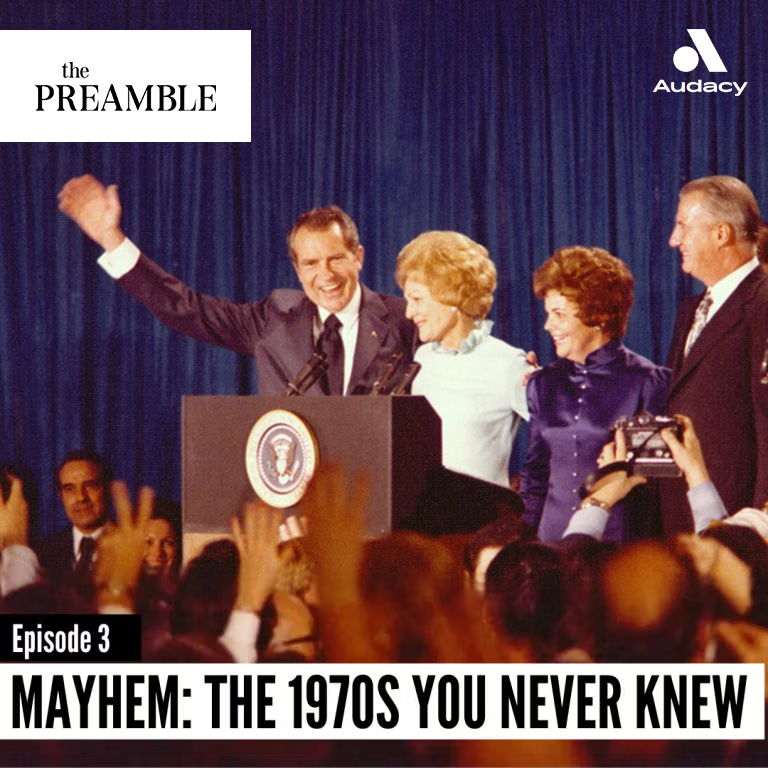
The Preamble
Mayhem: The 1970s You Never Knew, Episode 3
00:31:52
“The week that changed the world.” Was it a chance encounter at the World Tennis Championship in 1971, “Panda diplomacy” between the U.S. and Communist China, or a break-in at the Democratic National Headquarters by a team of 5 burglars, that drastically altered the trajectory of world history?
Loading summary
Transcript235 lines
- [00:00]
Sharon McMahon
As the season shifts into summer, so do the demands on your wardrobe weddings, graduations, vacations and a calendar full of events. Finding fresh, stylish outfits for every occasion can take time most people don't have. Dailylook offers a more efficient way to stay on top of seasonal style. Dailylook is the number one highest rated premium personal styling service for women. It's designed to simplify the process of getting dressed while delivering elevated on trend pieces. With daily look, you're matched with a dedicated personal stylist. Real stylists, not an algorithm who select clothing based on your body shape preferences and lifestyle. You'll also continue working with the same stylist, ensuring a more tailored experience over time. Each box includes up to 12 premium pieces delivered straight to your door. Try everything on at home. Keep what works and return the rest. Shipping is free both ways. Flexible delivery options allow you to receive a box every 30, 60, or 90 days. Elevate your style by signing up@dailylook.com today. Take your style quiz@dailylook.com and get 50% off your first styling fee with the code Sharon. That's dailylook.com code Sharon. Today's episode is brought to you by Alma. I feel like one of the biggest misconceptions about therapy is that once you decide to go, the hard part is over. But honestly, finding the right therapist can be a challenge in itself. I have definitely run into that either
- [01:19]
Narrator/Host (likely Sharon McMahon or a main narrator)
not knowing where to start or not
- [01:21]
Sharon McMahon
being sure if someone would really understand, or even just figuring out what was covered by insurance. That is where ALMA comes in. ALMA is on a mission to simplify access to high quality, affordable mental health care. They've built a network of over 26,000 therapists across the country, and you can browse their directory without making an account. And since May is Mental Health Awareness Month, it's a great reminder that support should feel within reach. Clients with insurance pay $20 on average, and 98% of Alma therapists accept insurance. You can also use their free insurance cost estimator to know exactly what you'll pay before booking. Most people find their match on the first try and 95% connect with a therapist within one week. Over 80% of people report feeling better within six months, and more than a million people have already found care through Alma. Get started now@helloalma.com Preamble that's helloalma.com Preamble.
- [02:22]
Narrator/Host (likely Sharon McMahon or a main narrator)
Hello friends, and welcome back to our Docu series about the 1990s 70s. If you've been listening to our previous episodes. You know we've already been on a wild ride through government deceit, an unbelievable party in Iran, student protests and travels through space. Well, buckle up because there is so much more to come. Today we're going to talk about 1972 when President Nixon visited Communist China. Title 9 was established, Nixon was re elected and an eagle eyed security guard
- [03:01]
Narrator/Reporter (possibly a co-host or guest narrator)
spotted a little piece of masking tape in a building you may have heard of called Watergate. I'm Sharon McMahon and this is the Preamble podcast.
- [03:15]
Narrator/Host (likely Sharon McMahon or a main narrator)
According to Eugenio Martinez, one of the Watergate burglars, the mission felt doomed from the beginning. Martinez had signed divorce paperwork that same day, going directly from the courthouse to
- [03:27]
Narrator/Reporter (possibly a co-host or guest narrator)
the airport to get to Washington D.C.
- [03:31]
Narrator/Host (likely Sharon McMahon or a main narrator)
not only that, but the car that
- [03:33]
Narrator/Reporter (possibly a co-host or guest narrator)
picked up the five man team heading
- [03:36]
Narrator/Host (likely Sharon McMahon or a main narrator)
to the Watergate office building reminded him of a hearse.
- [03:41]
Narrator/Reporter (possibly a co-host or guest narrator)
Martinez felt a deep sense of foreboding but continued with the mission.
- [03:49]
Narrator/Host (likely Sharon McMahon or a main narrator)
Inside the DNC offices they turned off their walkie talkies, cutting off communication with
- [03:54]
Narrator/Reporter (possibly a co-host or guest narrator)
anyone outside the building. They rifled through files and documents, photographing as many as possible, but soon heard the sounds of people moving up and down hallways and stairs. They told themselves it was just guards and employees doing regular nightly checks, but in fact it was the police that
- [04:18]
Narrator/Host (likely Sharon McMahon or a main narrator)
security guard Frank Wills had called after
- [04:21]
Narrator/Reporter (possibly a co-host or guest narrator)
he found the tape on the door lock. Officers entering the 6th floor DNC offices knew even in the darkness that they had closed in on their suspects because of the missing ceiling tiles and the paperwork and files strewn everywhere.
- [04:41]
Narrator/Host (likely Sharon McMahon or a main narrator)
John Barrett, one of the police officers
- [04:43]
Narrator/Reporter (possibly a co-host or guest narrator)
on the scene, remembered walking through through the pitch black DNC offices with guns drawn when he crouched down to check the area thoroughly and saw movement out of the corner of his eye only about 2 inches from his face, Barrett
- [05:02]
Narrator/Host (likely Sharon McMahon or a main narrator)
said in a 2022 interview. I screamed something to the effect of
- [05:06]
Narrator/Reporter (possibly a co-host or guest narrator)
get out of there, get your hands up.
- [05:09]
Narrator/Host (likely Sharon McMahon or a main narrator)
Sergeant Paul Leeper jumped on top of
- [05:11]
Narrator/Reporter (possibly a co-host or guest narrator)
the desk and found more, more men there.
- [05:15]
Narrator/Host (likely Sharon McMahon or a main narrator)
The five burglars were hiding behind cubicles
- [05:17]
Narrator/Reporter (possibly a co-host or guest narrator)
and file cabinets, but now they were
- [05:20]
Narrator/Host (likely Sharon McMahon or a main narrator)
trapped, Martinez said in a 1974 interview. Then there was running and men shouting come out with your hands up or we'll shoot.
- [05:30]
Narrator/Reporter (possibly a co-host or guest narrator)
All five men were arrested.
- [05:32]
Narrator/Host (likely Sharon McMahon or a main narrator)
Some of them were carrying equipment like
- [05:34]
Narrator/Reporter (possibly a co-host or guest narrator)
bugs for phones and other listening devices for rooms.
- [05:38]
Narrator/Host (likely Sharon McMahon or a main narrator)
They were also wearing surgical gloves and carrying long range walkie talkies, a shortwave radio capable of listening to police calls, 40 rolls of unexposed film, two 35 millimeter cameras with multiple lenses, three pen sized tear gas guns, and $2,300 in uncirculated and sequential $100 bills.
- [06:03]
Narrator/Reporter (possibly a co-host or guest narrator)
Just a teeny bit suspicious, the five men sat in jail after giving fake
- [06:09]
Narrator/Host (likely Sharon McMahon or a main narrator)
names and refusing to talk to anyone or call lawyers.
- [06:13]
Narrator/Reporter (possibly a co-host or guest narrator)
No one had posted bail.
- [06:16]
Narrator/Host (likely Sharon McMahon or a main narrator)
The first newspaper article about the break in, written by longtime reporter Alfred E. Lewis, appeared pretty unobtrusively at the bottom
- [06:24]
Narrator/Reporter (possibly a co-host or guest narrator)
of page one in the Washington Post on June 18, 1972. But it would soon become the biggest
- [06:33]
Narrator/Host (likely Sharon McMahon or a main narrator)
news in presidential history.
- [06:35]
Narrator/Reporter (possibly a co-host or guest narrator)
As the five men headed to trial,
- [06:40]
Narrator/Host (likely Sharon McMahon or a main narrator)
29 year old Bob Woodward, a reporter for the Washington Post, was not enthusiastic about going to the courthouse to cover another burglary until his editor told him where the break in happened, as well
- [06:54]
Narrator/Reporter (possibly a co-host or guest narrator)
as details about the five men arrested, the cash and the fake names.
- [07:02]
Narrator/Host (likely Sharon McMahon or a main narrator)
The judge presiding over the case asked
- [07:04]
Narrator/Reporter (possibly a co-host or guest narrator)
the five men about their occupations. One finally spoke up and claimed that
- [07:08]
Narrator/Host (likely Sharon McMahon or a main narrator)
they were employed as anti communists, and all the others nodded.
- [07:14]
Narrator/Reporter (possibly a co-host or guest narrator)
But that wasn't good enough. The judge called one of them, who
- [07:17]
Narrator/Host (likely Sharon McMahon or a main narrator)
we now know was James McCord, to step forward and asked if he was employed. McCord replied that he was a security
- [07:26]
Narrator/Reporter (possibly a co-host or guest narrator)
consultant recently retired from a government department. The reporter, Bob Woodward, moved to the
- [07:35]
Narrator/Host (likely Sharon McMahon or a main narrator)
front row of the courtroom so he
- [07:37]
Narrator/Reporter (possibly a co-host or guest narrator)
could hear every word.
- [07:39]
Narrator/Host (likely Sharon McMahon or a main narrator)
Where in the government?
- [07:40]
Narrator/Reporter (possibly a co-host or guest narrator)
The judge asked, clearly losing patience with the men's vague answers.
- [07:47]
Narrator/Host (likely Sharon McMahon or a main narrator)
CIA, McCord whispered, causing the judge to recoil back into his chair.
- [07:53]
Narrator/Reporter (possibly a co-host or guest narrator)
Woodward's story ran on the front page of the Washington Post the next day and began with this paragraph. Five men, one of whom said he
- [08:03]
Narrator/Host (likely Sharon McMahon or a main narrator)
is a former employee of the Central Intelligence Agency, were arrested at 2:30am yesterday
- [08:09]
Narrator/Reporter (possibly a co-host or guest narrator)
in what authorities describe as an elaborate plot to bug the offices of the Democratic National Committee. Here the Watergate scandal began.
- [08:23]
Bio Optimizers Advertiser/Spokesperson
You ever find yourself lying awake at
- [08:25]
Narrator/Host (likely Sharon McMahon or a main narrator)
night, tossing and turning, and then wake
- [08:29]
Bio Optimizers Advertiser/Spokesperson
up more exhausted than when you went to bed? I know that has definitely happened to me. And for me it wasn't just stress. My body was navigating hormonal changes that might come with age. And when your sleep is off, everything else suffers. That is why I started taking Magnesium Breakthrough by Bio Optimizers. I feel more settled at bedtime. My mind is calmer and I wake
- [08:53]
Narrator/Host (likely Sharon McMahon or a main narrator)
up without that groggy feel. Feeling. What I love is that it's not
- [08:56]
Bio Optimizers Advertiser/Spokesperson
just one type of magnesium. It's a blend of seven different forms that are designed to support relaxation and overall sleep quality. People cannot stop talking about the benefits. Deeper sleep, feeling calmer, better workout recovery, even improved digestion.
- [09:11]
Narrator/Host (likely Sharon McMahon or a main narrator)
My challenge to you?
- [09:13]
Bio Optimizers Advertiser/Spokesperson
Try it.
- [09:14]
Narrator/Reporter (possibly a co-host or guest narrator)
Track your sleep.
- [09:15]
Narrator/Host (likely Sharon McMahon or a main narrator)
Notice how you feel.
- [09:16]
Bio Optimizers Advertiser/Spokesperson
Bioptimizers even backs it with a 365 day, no questions asked Model Money Back guarantee. I've worked Magnesium Breakthrough into my nightly routine and it's made a difference in my overall energy and mood.
- [09:28]
Narrator/Host (likely Sharon McMahon or a main narrator)
If you're ready to feel more rested,
- [09:30]
Bio Optimizers Advertiser/Spokesperson
head to bioptimizers.com Sharon and use my exclusive code Sharon to get 15% off any order. And when you subscribe, you'll get great discounts, free gifts, and the peace of mind of never running out again again. That's 15% off any order at bioptimizers.com/sharon make 2026 the year you finally start sleeping.
- [09:52]
Sharon McMahon
Great again.
- [09:54]
Peter Hamby
Understanding power requires more than Headlines I'm Peter Hamby, host of the Powers that Be, a podcast from Puck examining politics, economics and media. To provide context, analysis and clarity without sensationalism, we ask how power operates, who benefits, and what's at stake. If you want to move beyond breaking news to deeper understanding, join us on the Powers that Be new episodes every weekday. Follow the Powers that Be wherever you
- [10:20]
AllTrails Advertiser/Spokesperson
get your podcasts, there's never been a better time to get outside and experience the benefits of nature, discover nearby trails and explore the outdoors. With all trails, download the free app today and find your outside
- [10:38]
Narrator/Host (likely Sharon McMahon or a main narrator)
President Richard Nixon's July 15, 1971 announcement that he'd accepted an invitation to go to China and meet with the leader of the People's Republic of China shocked most Americans. Nixon had, after all, been very publicly anti Communist for years. As a member of Congress in the 1940s and 50s, he had served on the House on American Activities Committee and been part of investigations and eventual prosecutions of suspected communist spies like Alger Hiss. During Nixon's time in Congress, Communist leader Mao Zedong announced the creation of the
- [11:21]
Narrator/Reporter (possibly a co-host or guest narrator)
People's Republic of China after the Chinese Revolution of 1949.
- [11:27]
Narrator/Host (likely Sharon McMahon or a main narrator)
This ended the Chinese civil war that had been fought on and off since the 1920s. But it also led to the United States breaking diplomatic ties after declaring that
- [11:38]
Narrator/Reporter (possibly a co-host or guest narrator)
China had fallen to communism.
- [11:42]
Narrator/Host (likely Sharon McMahon or a main narrator)
In other words, by 1972 there'd been no diplomatic relationship between the United States and China in about 23 years, and Nixon seemed like a very unlikely person to build that bridge. Nevertheless, Nixon would become the first US President to visit China, the world's largest communist country, while in office. Now you might be wondering what led President Nixon to suddenly announce a trip to China. It turns out that the straw that broke the camel's back was not a strong arming politician or new economic sanctions.
- [12:24]
Narrator/Reporter (possibly a co-host or guest narrator)
It was table tennis.
- [12:28]
Narrator/Host (likely Sharon McMahon or a main narrator)
In January 1971, Nixon received a message from Mao Zedong because the countries did not have diplomatic relations. Chairman Mao sent the message via Romania saying that Nixon was welcome to visit Peking, the capital of China, which is
- [12:46]
Narrator/Reporter (possibly a co-host or guest narrator)
now known as Beijing. Apparently wanting to come off as super casual, Nixon put a note on Mao's message saying we should not appear too eager to respond.
- [13:01]
Narrator/Host (likely Sharon McMahon or a main narrator)
All of this is the governmental equivalent of passing notes in high school or snapping each other or whatever it is
- [13:09]
Narrator/Reporter (possibly a co-host or guest narrator)
the teenagers are doing today.
- [13:11]
Narrator/Host (likely Sharon McMahon or a main narrator)
You have a friend ask for you
- [13:13]
Narrator/Reporter (possibly a co-host or guest narrator)
so that you save face.
- [13:15]
Narrator/Host (likely Sharon McMahon or a main narrator)
If the other person isn't interested, then the person being asked has to wait
- [13:21]
Narrator/Reporter (possibly a co-host or guest narrator)
a while to respond so that they can seem all nonchalant about it, basically leaving them unread, even if they're really excited.
- [13:31]
Narrator/Host (likely Sharon McMahon or a main narrator)
But look, it worked, right? Nixon's closest national security advisor, Henry Kissinger,
- [13:37]
Narrator/Reporter (possibly a co-host or guest narrator)
began speaking to Peking in January 1971. But they weren't yet discussing a presidential visit.
- [13:46]
Narrator/Host (likely Sharon McMahon or a main narrator)
In April 1971, the World Table Tennis
- [13:50]
Narrator/Reporter (possibly a co-host or guest narrator)
Championships took place place in Japan, and you might know table tennis as ping pong.
- [13:59]
Narrator/Host (likely Sharon McMahon or a main narrator)
At one point, American player Glenn Cowan boarded the Chinese team's bus. Whether by accident or not was never clear, and one of the Chinese players took the opportunity to talk to him and they were photographed shaking hands. Chairman Mao was delighted and called the
- [14:17]
Narrator/Reporter (possibly a co-host or guest narrator)
player a good diplomat, but wasn't quite
- [14:19]
Narrator/Host (likely Sharon McMahon or a main narrator)
ready to invite the American team to China. Mao regularly took sleeping pills before dinner and had a standing order with his staff that they should disregard anything he said.
- [14:31]
Narrator/Reporter (possibly a co-host or guest narrator)
After taking his sleeping pills that night, as his staff was helping him to bed, Mao cracked his eyes open and insistently mumbled instructions to invite the American team to China.
- [14:46]
Narrator/Host (likely Sharon McMahon or a main narrator)
At first, his staff didn't do anything because of his standing order, but after
- [14:50]
Narrator/Reporter (possibly a co-host or guest narrator)
Mao's insistence that they make the invitation quickly, they complied.
- [14:55]
Narrator/Host (likely Sharon McMahon or a main narrator)
The table tennis visits really broke the ice and made it easier for Kissinger to plan a presidential visit. Nixon and Kissinger decided that it would be better for the balance of power against the Soviet Union if the United States could somehow re establish diplomatic relations with China. Nixon also clearly understood how positive and monumental a presidential trip to China would be preceding the 1972 election. Nixon's official announcement of the trip aired
- [15:30]
Narrator/Reporter (possibly a co-host or guest narrator)
on television in both countries in July 1971.
- [15:36]
Zootopia Character/Advertiser
The meeting between the leaders of China and the United States is to seek the normalization of relations between the two countries and also to exchange views on questions of concern to the two sides.
- [15:52]
Narrator/Host (likely Sharon McMahon or a main narrator)
And so, after months and months of mostly secret negotiations between the two countries, President Nixon and First Lady Pat Nixon finally visited China in February 1972 to
- [16:05]
Narrator/Reporter (possibly a co-host or guest narrator)
experience what would soon be called the weak. That changed the world.
- [16:10]
Narrator/Host (likely Sharon McMahon or a main narrator)
The official meeting between Nixon and Chairman
- [16:13]
Sharon McMahon
Mao lasted a little over an hour
- [16:15]
Narrator/Host (likely Sharon McMahon or a main narrator)
and has been described by historians as lively, focusing mainly on what they called philosophical questions, with the men exchanging a famous handshake afterwards. It was Chinese Premier Xuan Lai who spent most of the trip with Nixon and worked with him on details of an agreement called the Shanghai Communique, in which they formally agreed to normalize relations between their two countries, develop trade, lessen the chances of what they called international military conflict, and avoid seeking hegemony or
- [16:53]
Narrator/Reporter (possibly a co-host or guest narrator)
power and dominance in the Asia Pacific region.
- [16:57]
Narrator/Host (likely Sharon McMahon or a main narrator)
Another result of this trip was that the People's Republic of China, the prc, gained a place in the United Nations General assembly and as one of the five permanent members of the UN Security Council. The rest of the visit was well documented, with the President and First lady traveling to the Great Wall, the tombs of the Ming Dynasty, the formerly Forbidden
- [17:20]
Narrator/Reporter (possibly a co-host or guest narrator)
City, and Tiananmen Square.
- [17:22]
Narrator/Host (likely Sharon McMahon or a main narrator)
It was this very visit to China that started something now known as panda
- [17:29]
Narrator/Reporter (possibly a co-host or guest narrator)
diplomacy between the US And China.
- [17:32]
Narrator/Host (likely Sharon McMahon or a main narrator)
Premier Xu heard First Lady Pat Nixon express her fascination with China's national symbol, the giant panda. She was taken with how playful they were and how gentle they seemed to be for their size. And Premier Xu was not going to miss this opportunity for continued diplomacy.
- [17:52]
Narrator/Reporter (possibly a co-host or guest narrator)
So he offered to send the United
- [17:54]
Narrator/Host (likely Sharon McMahon or a main narrator)
States a pair of pandas. And that is how the Smithsonian National Zoo in Washington, D.C. received its first
- [18:03]
Narrator/Reporter (possibly a co-host or guest narrator)
pair of giant pandas, named Ling Ling and Sing Sing.
- [18:08]
Narrator/Host (likely Sharon McMahon or a main narrator)
First Lady Pat Nixon was there to welcome the pandas.
- [18:13]
Pat Nixon
On behalf of the people of the United States, I am pleased to be here and accept the precious gift of the panda pandas and also these other mementos from the government of the People's Republic of China. I'm so glad that this delegation could come here to the United States and enjoy some of our hospitality, just as we enjoyed that in their country. And I do appreciate them taking such good care of the pandas on the long trip and after they arrived here at their new home.
- [18:55]
Narrator/Host (likely Sharon McMahon or a main narrator)
Panda diplomacy essentially means that the National Zoo pays a fee somewhere around 500,000 to a million dollars a year per panda to China. And American zookeepers and scientists get to learn about the raising and keep keeping of giant pandas. And in exchange, China uses the giant pandas to soften its authoritarian reputation and
- [19:19]
Narrator/Reporter (possibly a co-host or guest narrator)
draw attention away from its human rights abuses.
- [19:25]
Narrator/Host (likely Sharon McMahon or a main narrator)
Since Ling Ling and Sing Sing died without any surviving offspring, China gave the
- [19:30]
Narrator/Reporter (possibly a co-host or guest narrator)
National Zoo a second pair of pandas in 2000, this time on something like Elise.
- [19:37]
Narrator/Host (likely Sharon McMahon or a main narrator)
The second pair of giant pandas Meishang
- [19:39]
Narrator/Reporter (possibly a co-host or guest narrator)
and Tiantian have been at the national
- [19:41]
Narrator/Host (likely Sharon McMahon or a main narrator)
zoo for 23 years and now they, along with their three year old Xiao Qiji, are scheduled to go back to
- [19:49]
Narrator/Reporter (possibly a co-host or guest narrator)
China in December of 2023.
- [19:54]
Narrator/Host (likely Sharon McMahon or a main narrator)
In 1972, Mariah Burton Nelson was unconcerned with politically motivated break ins in Washington D.C. she was a 16 year old high school student asked to try out for her Phoenix High school boys basketball team because there was no girls basketball team. The 6 foot 2 Mariah soon started at Stanford University and joined the women's basketball team.
- [20:17]
Narrator/Reporter (possibly a co-host or guest narrator)
Though calling it an official team is
- [20:20]
Narrator/Host (likely Sharon McMahon or a main narrator)
a stretch when you consider that they were coached by an unpaid graduate student, had to purchase their own T shirts and high tops that passed for uniforms and and did all of their own physical training and therapy like taping ankles. Yet there was Mariah breaking the rebound record and going on to play professionally in what was then called the Women's Basketball League, quickly learning, as she says in this quote, that the reality was quite a contrast to the dream. Many of us were not ultimately paid to play. As the league developed financial troubles, many, many of us, myself included, received checks that bounced. Many of the coaches were sexist, insisting that we wear makeup or attend John Robert Powers Charm School. One coach insisted on calling us girls when we asked to be called women.
- [21:15]
Narrator/Reporter (possibly a co-host or guest narrator)
Most had never coached women before and
- [21:17]
Narrator/Host (likely Sharon McMahon or a main narrator)
compared us unfavorably to the men and
- [21:20]
Narrator/Reporter (possibly a co-host or guest narrator)
boys that they coached.
- [21:21]
Narrator/Host (likely Sharon McMahon or a main narrator)
There was a lack of respect for
- [21:24]
Narrator/Reporter (possibly a co-host or guest narrator)
us as athletes that we found demeaning.
- [21:29]
Narrator/Host (likely Sharon McMahon or a main narrator)
Basketball was invented in 1891 by James Naismith. The first women's intercollegiate basketball team. In fact, the first intercollegiate women's game in any sport was played in 1896 between Stanford and the University of California, Berkeley. And at that time, Stanford didn't even
- [21:48]
Narrator/Reporter (possibly a co-host or guest narrator)
have a men's team.
- [21:50]
Narrator/Host (likely Sharon McMahon or a main narrator)
But roles quickly reversed and men's sports began to dominate. In 1906, the National College Athletics association, or the NCAA, was founded in order to regulate the rules in men's college football. Before long, they became the regulatory body over all college athletics. NCAA regulations did not require institutions to offer women's athletics, meaning that there were no funds set aside for women's sports, scholarships or facilities or supplies, etc. Before someone says that this happened because men's sports garner more attention and thus more money for the colleges, or because men are naturally more athletic.
- [22:35]
Narrator/Reporter (possibly a co-host or guest narrator)
Consider the history.
- [22:37]
Narrator/Host (likely Sharon McMahon or a main narrator)
People at the turn of the 20th century still believed that humans had a limited amount of of energy. And historians note that women were not encouraged to exert themselves, probably because they needed their energy to clean their houses and cook meals and run after children. Some experts preach that sports would make women unattractive to men and make their children weaker and harm their reproductive ability. Nevertheless, female PE teachers, coaches and hopeful athletes pushed forward. In 1970, there were approximately 30,000 women competing in NCAA sports, compared to about 170,000 men. And the vast majority of those women had to pay their own way, just like Mariah's 1972 Stanford team.
- [23:31]
Narrator/Reporter (possibly a co-host or guest narrator)
In 1967, President Lyndon Johnson had signed
- [23:35]
Narrator/Host (likely Sharon McMahon or a main narrator)
Executive Order 11375, which said that any educational institution that received federal funding or participated in federal contracts could not discriminate on the basis of sex. Around this same time, Brooklyn native Bernice
- [23:50]
Narrator/Reporter (possibly a co-host or guest narrator)
Resnick Sandler had a Ph.D. in psychology
- [23:53]
Narrator/Host (likely Sharon McMahon or a main narrator)
and was working as a lecturer at
- [23:55]
Narrator/Reporter (possibly a co-host or guest narrator)
the University of Maryland.
- [23:57]
Narrator/Host (likely Sharon McMahon or a main narrator)
As full time teaching positions became available, she was given a myriad of experience excuses for why she was not promoted,
- [24:05]
Narrator/Reporter (possibly a co-host or guest narrator)
including women always stay home when their
- [24:08]
Narrator/Host (likely Sharon McMahon or a main narrator)
children are sick or you're just a
- [24:11]
Narrator/Reporter (possibly a co-host or guest narrator)
housewife who went back to school.
- [24:13]
Narrator/Host (likely Sharon McMahon or a main narrator)
And the time worn chestnut of you
- [24:17]
Narrator/Reporter (possibly a co-host or guest narrator)
come on too strong for a woman.
- [24:22]
Narrator/Host (likely Sharon McMahon or a main narrator)
Bernice and her husband realized that she was being discriminated against. So she joined the Women's Equity Action league. And in 1970 they filed one of the farthest reaching class action lawsuits in U.S. history at that point against all colleges and universities in the country. The gender discrimination was rampant. Cornell School of Veterinary Medicine only admitted two women per year, no matter how many applied. Most faculty, departments and universities across the country had no female staff at at all and enforced policies against giving scholarships to married women. The 1971 House Report on Higher Education revealed that 21,000 women students were turned down for college entrance in the state of Virginia. While not one male student was rejected, Dr. Sandler's lawsuit led to compliance investigations of several colleges and universities, starting with Harvard. In 1970, federal government offices began issuing
- [25:31]
Narrator/Reporter (possibly a co-host or guest narrator)
guidelines against sex discrimination.
- [25:35]
Narrator/Host (likely Sharon McMahon or a main narrator)
While all of that was going on, Dr. Sandler met Representative Patsy Mink from Hawaii, the first woman of color and
- [25:42]
Narrator/Reporter (possibly a co-host or guest narrator)
the first Asian American woman to serve in Congress. And together they began working on what would become Title 9.
- [25:51]
Narrator/Host (likely Sharon McMahon or a main narrator)
Title IX was part of the larger 1972 Education act, an omnibus bill containing 10 subsets or titles. The 1972 Education act did many things like giving $2 billion to desegregate school districts and 19 billion to colleges and universities for the first time offering programs so that students who couldn't afford college could receive federal aid to help pay for it, and taking federal fund away from colleges and universities that discriminated against
- [26:23]
Narrator/Reporter (possibly a co-host or guest narrator)
women in their Admissions policies.
- [26:27]
Narrator/Host (likely Sharon McMahon or a main narrator)
President Nixon signed the final version of the Education act and thus Title IX
- [26:32]
Narrator/Reporter (possibly a co-host or guest narrator)
Into Law on June 23, 1972.
- [26:39]
Narrator/Host (likely Sharon McMahon or a main narrator)
Title IX covers gender discrimination in a number of areas. As we can see from its wording, it says, no person in the United
- [26:47]
Narrator/Reporter (possibly a co-host or guest narrator)
States shall, on the basis of sex,
- [26:49]
Narrator/Host (likely Sharon McMahon or a main narrator)
be excluded from participation in, be denied the benefits of, or be subjected to discrimination under any education program or activity
- [26:59]
Narrator/Reporter (possibly a co-host or guest narrator)
receiving federal financial assistance.
- [27:03]
Narrator/Host (likely Sharon McMahon or a main narrator)
But it's best known for its effect on college athletics. When asked if she considered herself a pioneer in women's sports, sports, Mariah Burton Nelson said, yes, we all are. Pioneers are people who go where others have not gone before. They don't usually get rich or famous, and they often suffer numerous hardships and
- [27:27]
Narrator/Reporter (possibly a co-host or guest narrator)
indignities, but they open doors for future generations.
- [27:33]
Narrator/Host (likely Sharon McMahon or a main narrator)
After Representative Patsy Mink died in 2002, title was officially renamed the Patsy Takamoto
- [27:40]
Narrator/Reporter (possibly a co-host or guest narrator)
Mink Equal Opportunity in Education Act.
- [27:45]
Progressive Insurance Advertiser/Spokesperson
This episode is brought to you by Progressive Insurance. Do you ever think about switching insurance companies to see if you could save some cash? Progressive makes it easy. Just drop in some details about yourself and see if you're eligible to save money. When you bundle your home and auto policies. The process only takes minutes and it could mean hundreds more in your pocket. Visit progressive.com after this episode to see if you could save Progressive Casualty Insurance Company and affiliates. Potential savings will vary. Not available in all states.
- [28:12]
Zootopia Character/Advertiser
Zootopia 2 has come home to Disney. Let's go get ready for a new case.
- [28:17]
We're gonna crack this case and prove we're the greatest partners of all time.
- [28:20]
Narrator/Reporter (possibly a co-host or guest narrator)
New friends, you are Gary Desnake.
- [28:23]
Zootopia Character/Advertiser
And your last name?
- [28:25]
Pat Nixon
Desnake.
- [28:26]
Zootopia Character/Advertiser
Dream Team and new habitats.
- [28:29]
Narrator/Reporter (possibly a co-host or guest narrator)
Zootopia has a secret reptile population.
- [28:32]
Zootopia Character/Advertiser
You can watch the record breaking phenomenon at home.
- [28:35]
Narrator/Reporter (possibly a co-host or guest narrator)
You're clearly working at Zootopia 2.
- [28:38]
Zootopia Character/Advertiser
Now available on Disney Plus. Rated PG.
- [28:43]
Narrator/Reporter (possibly a co-host or guest narrator)
And it's time we return to Richard Nixon and Watergate.
- [28:48]
Narrator/Host (likely Sharon McMahon or a main narrator)
At the end of 1972, the president was running for re election against a candidate. There's a good chance you don't remember George McGovern. Clinching the Democratic nomination was hardly a foregone conclusion for McGovern. People felt sure it would go to someone like Ted Kennedy or Hubert Humphrey. McGovern's platform included ending the war in Vietnam and implementing a basic minimum income
- [29:14]
Narrator/Reporter (possibly a co-host or guest narrator)
to help the nation's poor.
- [29:17]
Narrator/Host (likely Sharon McMahon or a main narrator)
Almost everyone who met McGovern declared him to be one of the most decent men they'd ever known. Even the Pope was so impressed with the work that McGovern was doing with the Kennedy administration. That he told him, when you meet
- [29:30]
Narrator/Reporter (possibly a co-host or guest narrator)
your maker and he asks you, did you feed the poor? You can say, I did. McGovern's initial choice of running mate was Ted Kennedy.
- [29:43]
Narrator/Host (likely Sharon McMahon or a main narrator)
After much back and forth over the phones during the convention, Kennedy told his
- [29:47]
Narrator/Reporter (possibly a co-host or guest narrator)
friend he was, sorry, but no, thank you.
- [29:50]
Narrator/Host (likely Sharon McMahon or a main narrator)
Noting personal responsibilities to his own family and those of his assassinated brothers John
- [29:56]
Narrator/Reporter (possibly a co-host or guest narrator)
and Bobby, Kennedy suggested Tom Eagleton, a
- [30:01]
Narrator/Host (likely Sharon McMahon or a main narrator)
senator from Missouri who gladly joined McGovern's ticket.
- [30:05]
Narrator/Reporter (possibly a co-host or guest narrator)
But Eagleton had secrets of his own.
- [30:09]
Narrator/Host (likely Sharon McMahon or a main narrator)
The McGovern campaign learned that Eagleton had
- [30:11]
Narrator/Reporter (possibly a co-host or guest narrator)
received inpatient care for depression depression several times. And his treatment had included electroshock therapy and antipsychotic medications. Everyone was telling McGovern to change his mind.
- [30:26]
Narrator/Host (likely Sharon McMahon or a main narrator)
Instead, McGovern released a statement saying that he was, quote, 1,000% for Tom Eagleton and he had no intention of dropping
- [30:34]
Narrator/Reporter (possibly a co-host or guest narrator)
him from the ticket.
- [30:37]
Narrator/Host (likely Sharon McMahon or a main narrator)
On the campaign trail, McGovern was battling an incumbent president enjoying a booming economy
- [30:44]
Narrator/Reporter (possibly a co-host or guest narrator)
and the predicted positive attention from the visit to China. Nixon's campaign rested confidently on the fact
- [30:51]
Narrator/Host (likely Sharon McMahon or a main narrator)
that he was already president, taking the
- [30:53]
Narrator/Reporter (possibly a co-host or guest narrator)
attitude that the current president was far
- [30:56]
Narrator/Host (likely Sharon McMahon or a main narrator)
too busy and important to be bothered
- [30:59]
Narrator/Reporter (possibly a co-host or guest narrator)
with partisan bickering between candidates. And it worked.
- [31:03]
Narrator/Host (likely Sharon McMahon or a main narrator)
By 1972, only seven incumbent presidents in history had lost reelection. And so, with those odds, plus a
- [31:11]
Narrator/Reporter (possibly a co-host or guest narrator)
campaign budget of $45 million, which was like $330 million today, the Nixon Agnew ticket looked unstoppable.
- [31:22]
Narrator/Host (likely Sharon McMahon or a main narrator)
The Republican campaign slogan, president Nixon now
- [31:26]
Narrator/Reporter (possibly a co-host or guest narrator)
more than ever was plastered on buttons
- [31:30]
Narrator/Host (likely Sharon McMahon or a main narrator)
and bumper stickers everywhere and seemed to be what people wanted.
- [31:33]
Narrator/Reporter (possibly a co-host or guest narrator)
Despite the news trickling out about the summer break in at DNC headquarters, McGovern was stymied by the lack of concern that most voters seemed to have about the recent break in at the Watergate building. Years later, one of McGovern's campaign managers said McGovern was holding up the Washington
- [31:54]
Narrator/Host (likely Sharon McMahon or a main narrator)
Post at rallies and saying, here is the newest story.
- [31:59]
Narrator/Reporter (possibly a co-host or guest narrator)
The country just didn't want to believe it. A poll just before the 1972 election
- [32:05]
Narrator/Host (likely Sharon McMahon or a main narrator)
showed that only 3% of likely voters thought that Watergate was important. Another poll showed that 48% of Americans
- [32:16]
Narrator/Reporter (possibly a co-host or guest narrator)
had never even heard of Watergate. Then, fewer than 14 days before the general election, Henry Kissinger announced that through ongoing negotiations, peace was at hand in Vietnam. This was not strictly true. Six weeks after the 1972 election, Nixon ordered the beginning of the Christmas bombing raids on Hanoi. But about 80% of the public believed Dr. Kissinger. It turned out that announcements like these
- [32:50]
Narrator/Host (likely Sharon McMahon or a main narrator)
designed to let voters believe that Nixon was close to Brokering peace in Vietnam was were aimed at young voters.
- [32:58]
Narrator/Reporter (possibly a co-host or guest narrator)
In particular, one of the reasons McGovern
- [33:01]
Narrator/Host (likely Sharon McMahon or a main narrator)
may have still believed that he could win was the 26th Amendment passed in
- [33:05]
Narrator/Reporter (possibly a co-host or guest narrator)
1971 that lowered the voting age from 21 to 18. McGovern's campaign hoped that the more than
- [33:13]
Narrator/Host (likely Sharon McMahon or a main narrator)
11 million new voters now eligible to
- [33:15]
Narrator/Reporter (possibly a co-host or guest narrator)
cast a ballot in 1972 would vote
- [33:19]
Narrator/Host (likely Sharon McMahon or a main narrator)
overwhelmingly for him, the Democrat.
- [33:22]
Narrator/Reporter (possibly a co-host or guest narrator)
But Nixon was paying more attention to the environment and pledging to end the draft, all with an eye on those young voters. Nixon's campaign hired a PR consultant to
- [33:33]
Narrator/Host (likely Sharon McMahon or a main narrator)
develop and direct a brand new Young Voters for the President organization.
- [33:38]
Narrator/Reporter (possibly a co-host or guest narrator)
And a September 1972 poll showed that
- [33:42]
Narrator/Host (likely Sharon McMahon or a main narrator)
57% of young voters found Nixon more sincere than McGovern.
- [33:49]
Narrator/Reporter (possibly a co-host or guest narrator)
Around November 1, McGovern's staff became concerned. Their fear was that McGovern might believe he could actually win when it was clearly going to be a landslide victory for Nixon. The Sunday night before the election, one
- [34:06]
Narrator/Host (likely Sharon McMahon or a main narrator)
staffer drew the short straw and had
- [34:08]
Narrator/Reporter (possibly a co-host or guest narrator)
to tell McGovern that according to all the polls, there was no way they were going to win. McGovern looked at him and said, bob, I know this, but for the next 48 hours, I just have to pretend. On election day, it was all over. By 7 o' clock Eastern, 49 states had voted for Nixon, and only Massachusetts and Washington, D.C. for McGovern, it was the largest margin for presidential victory in U.S. history to date. Nixon won 60.7% of the popular vote and 97% of the electoral votes. On election night in Washington, D.C. president Nixon publicly thanked his staff and his wife and children.
- [34:55]
Narrator/Host (likely Sharon McMahon or a main narrator)
He cracked some jokes for insiders about those guys at the papers. Missing a good party. But what else could possibly have been happening in 1972, you ask? Let's see. In October 1972, the International Computer Communication
- [35:15]
Narrator/Reporter (possibly a co-host or guest narrator)
Conference saw the first public demonstration of
- [35:18]
Narrator/Host (likely Sharon McMahon or a main narrator)
arpanet, or the Advanced Research Projects Agency
- [35:22]
Narrator/Reporter (possibly a co-host or guest narrator)
Network, one of the precursors of the Internet.
- [35:27]
Narrator/Host (likely Sharon McMahon or a main narrator)
Also in 1972, a new form of communication called electronic mail was first introduced. Reduced. Imagine how fast the news about Watergate would have traveled if email had been available then. Also in March 1972, the Equal Rights
- [35:44]
Narrator/Reporter (possibly a co-host or guest narrator)
Amendment, which was first proposed in 1923
- [35:48]
Narrator/Host (likely Sharon McMahon or a main narrator)
and would provide a constitutional guarantee of equal rights under the law for all people, regardless of sex, passed in Congress and was immediately ratified by 35 of the 38 states required to make it
- [36:00]
Narrator/Reporter (possibly a co-host or guest narrator)
part of the constitution.
- [36:03]
Narrator/Host (likely Sharon McMahon or a main narrator)
The 38th state finally ratified the amendment just a couple years later, in 2020. Many scholars say this means the era is now part of the Constitution, but the amendment has not been officially archived that way.
- [36:20]
Narrator/Reporter (possibly a co-host or guest narrator)
Maybe if Nixon had had email, he would have known that an accident would soon change someone's loyalty and that his campaign manager had the home phone numbers of two of the Washington Post's news reporters.
- [36:40]
Narrator/Host (likely Sharon McMahon or a main narrator)
And we'll cover all of that and
- [36:42]
Narrator/Reporter (possibly a co-host or guest narrator)
more in our next episode. I'll see you soon.
- [36:49]
Narrator/Host (likely Sharon McMahon or a main narrator)
The show is written and researched by Sharon McMahon, Amy Watkin, Mandy Reed and Kari Anton. Our audio producer is Jenny Snyder and it is executive produced and hosted by me, Sharon McMahon. If you enjoyed today's episode, we would love for you to hit the subscribe button. Leave us a review or share this episode on your favorite social media platform.
- [37:10]
Narrator/Reporter (possibly a co-host or guest narrator)
All of those things help podcasters out so much. We'll see you again soon.
- [37:19]
Zootopia Character/Advertiser
What would you do if your online store converted 36% more shoppers? You could take 36% more vacation.
- [37:25]
Another pina colada?
- [37:26]
Narrator/Reporter (possibly a co-host or guest narrator)
Yes, please.
- [37:27]
Zootopia Character/Advertiser
Open a new retail location with 36% more square feet.
- [37:31]
Narrator/Host (likely Sharon McMahon or a main narrator)
Fantastic.
- [37:32]
Zootopia Character/Advertiser
Hire 36% more help.
- [37:34]
Peter Hamby
You're hired and you're hired.
- [37:35]
Zootopia Character/Advertiser
Shopify has the world's best converting checkout up to 36% better than other e commerce platforms. What you do with those extra sales is up to you. Switch to Shopify today at Shopify. Com Setup and get a $1 trial. Shopify com Setup.