← The Preamble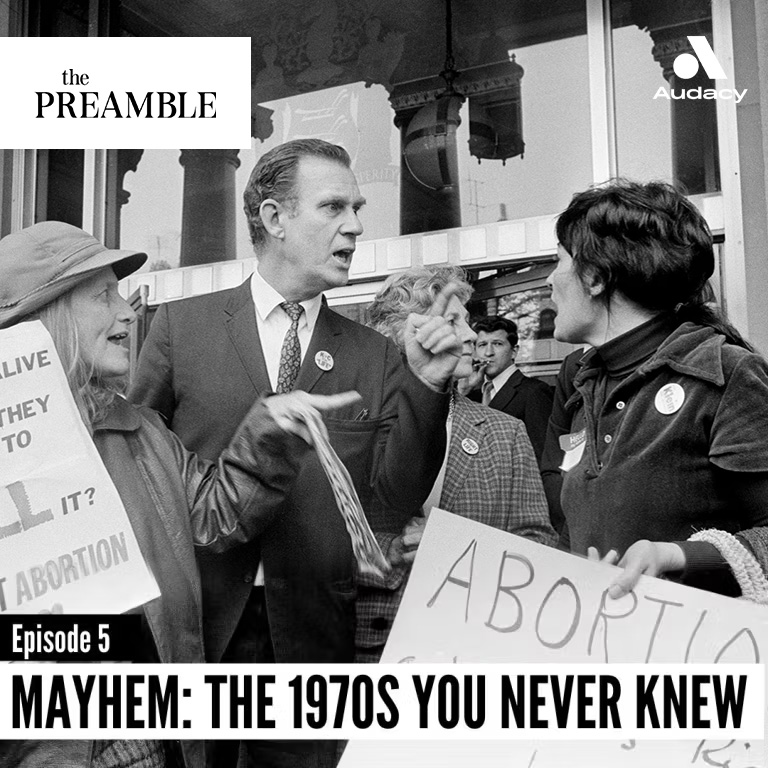
The Preamble
Mayhem: The 1970s You Never Knew, Episode 5
00:40:07
The right to privacy, a 22-year-old who went by the pseudonym “Jane Roe,” and one of the most famous court cases in United States history. We learn what happened leading up to Roe v. Wade, the fate of Norma McCorvey following the Supreme Court’s ruling, & how this piece of history echoes today.
Loading summary
Transcript27 lines
- [00:00]
Sharon McMahon
As the season shifts into summer, so
- [00:03]
Sponsor/Ad Voice
do the demands on your wardrobe. Weddings, graduations, vacations and a calendar full of events. Finding fresh, stylish outfits for every occasion
- [00:10]
Sharon McMahon
can take time most people don't have.
- [00:12]
Sponsor/Ad Voice
Dailylook offers a more efficient way to stay on top of seasonal style. Dailylook is the number one highest rated premium personal styling service for women. It's designed to simplify the process of getting dressed while delivering elevated on trend pieces. With daily look, you're matched with a dedicated personal stylist. Real stylists, not an algorithm who select clothing based on your body shape preferences and lifestyle. You'll also continue working with the same stylist, ensuring a more tailored experience over time. Each box includes up to 12 premium
- [00:43]
Sharon McMahon
pieces delivered straight to your door.
- [00:44]
Sponsor/Ad Voice
Try everything on at home. Keep what works and return the rest. Shipping is free both ways. Flexible delivery options allow you to receive a box every 30, 60, or 90 days. Elevate your style by signing up@dailylook.com today. Take your style quiz@dailylook.com and get 50% off your first styling fee with the code Sharon. That's dailylook.com code Sharon. Today's episode is brought to you by Alma. I feel like one of the biggest misconceptions about therapy is that once you decide to go, the hard part is over. But honestly, finding the right therapist can be a challenge in itself. I have definitely run into that either not knowing where to start or not being sure if someone would really understand, or even just figuring out what was covered by insurance. That is where ALMA comes in. ALMA is on a mission to simplify access to high quality, affordable mental health care. They've built a network of over 26,000 therapists across the country, and you can browse their directory without making an account. And since May is Mental Health Awareness Month, it's a great reminder that support should feel within reach. Clients with insurance pay $20 on average, and 98% of Alma therapists accept insurance. You can also use their free insurance cost estimator to know exactly what you'll pay before booking. Most people find their match on the first try and 95% connect with a therapist within one week. Over 80% of people report feeling better within six months, and more than a
- [02:07]
Sharon McMahon
million people have already found care through Alma.
- [02:10]
Sponsor/Ad Voice
Get started now@helloalma.com Preamble that's helloalma.com Preamble.
- [02:21]
Sharon McMahon
Hello friends. Welcome. Welcome to episode four five in our series about the 1970s mayhem. Norma Nelson's father left when she was nine years old. Her mother suffered from alcoholism and frequently abused Norma. Norma dropped out of school in ninth grade, ran away from home, and was eventually made a ward. She was sent to Catholic boarding school, where she was sexually assaulted by one of the nuns and then by a family member. She married Woody McCorvey, who beat her when he learned that she was pregnant. After giving birth, Norma surrendered custody of her baby to her mother and began abusing drugs and alcohol. Eventually, Norma became pregnant again and placed that baby for adoption, left her abusive husband, only to find herself pregnant for a third time at age 21. And this time she wanted an abortion. But before Norma could figure out what to do next, she met two ambitious women, gained a pseudonym, and became part of one of the most famous court cases in U.S. history, which, of course was decided in 1973. I'm Sharon McMahon and this is the Preamble Podcast. Abortion was largely considered a private issue in the United States until 1857, although some states, like Connecticut, made rules banning it after quickening or when the mother began to feel fetal movement. Medicinal remedies for pregnancy were advertised in newspapers, sometimes coded as quote unquote, relief for Ladies. A woman might buy a little tin of 20 pennyroyal pills for $2, which is about $72 today, either over the counter or through the mail. This kind of thing happened for decades, and of course, women and midwives were using herbs to try to control conception and abortion. For centuries before this, anti vice crusader, Anthony Comstock was determined to put a stop to these practices. If women were allowed to access birth control, they would have relationships outside of marriage, and Comstock's religious beliefs did not allow him to tolerate such things. Even while he was a Union soldier during the Civil War, Comstock would pour his daily whiskey ration, another vice in his mind, out onto the ground rather than drink it or share it. After the war, Comstock became a dry goods merchant, but spent much of his time lobbying Congress for stronger obscenity laws. The Comstock act of 1873 made it illegal to send obscene material through the mail. No one really ever defined obscene, but it definitely included writings or tools related to contraception and abortion. Ann Loman lived in New York city and in 1839 began calling herself Madame Restaurant Female Physician and Professor of Midwifery, and placing ads selling preventive powders for, quote, married ladies whose health forbids a too rapid increase of family. Madame Restell was arrested in 1847 for allegedly performing abortions and spent a year in prison on lesser charges. Restell and her Husband continued their lucrative business, but changed it to mail order instead of in person until the Comstock act of 1873. After the Comstock act was passed, Comstock himself was appointed Special Agent of the United States Post Office, allowing him access to people's mail so he could enforce the Comstock Act. In his case against Madame Restell, he pretended to be a customer so that he could bring her up on charges. She died by suicide before the trial began. In 1965, Supreme Court ruling Griswold v. Connecticut made it legal for married couples to obtain a prescription for contraceptive pills. This decision was based on the right to privacy, which will come up again later in this episode. Between 1967 and 1970, more than a dozen states, including Mississippi, Alabama and New Mexico, loosened their abortion laws. By 1973, legal abortions were possible under some circumstances in 17 states and completely legal in Hawaii. None of this information would have helped Norma Nelson McCorvey in Texas, though Texas law at the time said that if a woman terminated her own pregnancy, she was not guilty of any crime. But those supplying the means for an abortion were considered accomplices and could be prosecuted. Lawyers Linda Coffee and Sarah Weddington, both in their 20s, were nearly ready to file a lawsuit about Texas's abortion laws. But they needed a pregnant woman who would step forward as a plaintiff. Linda Coffey first became interested in women's legal rights around abortion in high school when her class had to watch a film warning about abortions. Sarah Weddington was compelled by the issue because she herself had an abortion the year before she was married. Sarah and her then future husband drove together to Mexico for the procedure in 1968. In February 1970, when Norma McCorvey met Weddington and Coffee at a pizza shop in Dallas, she was 22 years old. Pregnant for the third time and desperate, Norma agreed to be part of their class action lawsuit only after being reassured that it would cost her nothing and that her real name would not be made public. The lawsuit was filed on behalf of Norma, now known as Jane Row, and all other women who were or might become pregnant and want to consider all options. Jane Rowe's lawsuit was filed against the District Attorney of Dallas County, Henry Wade, because he was responsible for enforcing criminal laws, including anti abortion statutes. Henry Wade, by the way, had garnered some national attention in 1964 for prosecuting Jack Ruby, the man who shot Lee Harvey Oswald. And Lee Harvey Oswald was the man who shot jfk. And so it began. Jane Roe and Henry Wade each standing in for a much larger group. Attorneys Weddington And Coffey claimed that the Texas law was unconstitutional and that the Court needed to stop Wade from prosecuting doctors who performed abortions. On May 22, 1970, at the Federal courthouse in Dallas, Weddington and Coffey faced off against a couple of junior lawyers from the county prosecutor's office who argued that the unborn child's right to life outweighed the mother's right to Privacy. Meanwhile, Norma McCorvey, whose baby was due before the case was decided, carried to term this baby a girl, was adopted immediately after she was born. The unanimous lower court decision was released in June 1970, declaring the Texas state statute unconstitutional because it was vague and overbroad. No doubt coffee Weddington and McCorvey celebrated. It was a shallow victory, though, because Henry Wade continued to prosecute doctors who provided abortions and most judges would not intervene. So Weddington and Coffey asked themselves, how do you stop the Texas DA's office if they won't comply with a court decision? They submitted a petition to the U.S. supreme Court in the fall of 1970 and then waited over a year for it to be heard. But then, by December 1971, when the Supreme Court was scheduled to hear the case, Justices Hugo Black and John Harlan had both retired, leaving only seven justices on the bench. The remaining seven justices decided to move forward with hearing Roe v. Wade because they thought it would be an application of existing statutes. Arguments began on December 13, 1971, and it turned out to be more than those seven justices bargained for. Weddington presented the harmful effects of unwanted pregnancies on women's well being, lack of due process, the guarantee of privacy, and the guarantee of Privacy under the 14th Amendment as established in Griswold v. Connecticut. She also argued that one of the central tenets of the Constitution was to guarantee to an individual the right to determine the course of their own lives. Weddington then argued that doctors and patients had a constitutional right to make the best educated, private decisions together without fear of prosecution, and that Texas law removed physicians ability to provide the highest standard of medical care to their patients. Jay Floyd, the lawyer representing Texas, began his argument with a tasteless joke that fell flat. It's an old joke, Mr. Floyd told the Court. But when a man argues against two beautiful ladies like this, they are going to have the last word. No one in the courtroom laughed. Floyd claimed that under the 14th Amendment, fetuses are classified as people and should therefore be protected as such. He also argued that nowhere in the Griswold v. Connecticut decision did it mention abortion again. This is all happening in December 1971. But Supreme Court Justices William Rehnquist and Lewis Powell were appointed by Richard Nixon and joined the court on January 7, 1972. So just a few weeks after oral arguments, the Court got two new members. And of course the two new members had missed the oral arguments of Roe v. Wade. The Court felt that it could not, under these circumstances, vote on the full merits of the case. In May of 1972, Justice Blackmun announced that he would like both parties to return to the Court at a later date and re argue the case, this time in front of all nine Justices. Weddington and coffee and Wade's office agreed to return to the Supreme Court in the fall of 1972. And of course, what happens next would change the course of U.S. history.
- [13:38]
Sponsor/Ad Voice
You ever find yourself lying awake at night, tossing and turning and then wake up more exhausted than when you went to bed? I know that has definitely happened to me. And for me it wasn't just stress. My body was navigating hormonal changes that might come with age. And when your sleep is off, everything else suffers. And that is why I started taking Magnesium Breakthrough by Bioptimizers. I feel more settled at bedtime, my mind is calmer and I wake up without that groggy feeling. What I love is that it's not just one type of magnesium, it's a blend of seven different forms that are designed to support relaxation and overall sleep quality. People cannot stop talking about the benefits deeper sleep, feeling calmer, better workout recovery, even improved digestion. My challenge to you? Try it. Track your sleep, notice how you feel. Bioptimizers even backs it with a 365 day, no questions asked, money back guarantee. I've worked Magnesium Breakthrough into my nightly routine and it's made a difference in my overall energy and mood. If you're ready to feel more rested, head to bioptimizers.com Sharon and use my exclusive code Sharon to get 15% off any order. And when you subscribe, you'll get great discounts, free gifts, and the peace of mind of never running out again again. That's 15% off any order@bioptimizers.com Sharon make 2026 the year you finally start sleeping Great again.
- [15:09]
Peter Hamby
Understanding power requires more than headlines. I'm Peter Hamby, host of the Powers that Be, a podcast from PAC examining politics, economics and and media. To provide context, analysis and clarity without sensationalism, we ask how power operates, who benefits, and what's at stake. If you want to move beyond breaking news to deeper understanding, join us on the Powers that Be. New episodes every weekday. Follow the Powers that Be wherever you get your podcasts.
- [15:38]
DSW Advertiser
You know that thing where you get an amazing pair of shoes at a really great price and want to tell everyone about it?
- [15:44]
Sharon McMahon
Yeah.
- [15:45]
DSW Advertiser
So do we here at Designer Shoe Warehouse. We'll give you something to brag about, like the latest styles from brands you love, or the trends everyone's obsessing over, or shoes that make you feel like, well, you. So go ahead, show off a little. Buying shoes that get you at prices that get your budget. Head to your DSW store or dsw.com today DSW let us surprise you.
- [16:09]
Sponsor/Ad Voice
Before we get back to Roe v.
- [16:10]
Sharon McMahon
Wade, let's look into some of the other things that were going on in 1973.
- [16:16]
Sponsor/Ad Voice
Some of us may remember the days
- [16:18]
Sharon McMahon
before the pay at the pump option was available at most gas stations. And for those of you who do not remember, listen carefully, youngsters. Gather around. Because back then you had to pull up to the pump, get out of the car, and walk all the way inside the gas station to pay. I mean, it was the injustice. It was terrible. But believe it or not, things got even worse for car owners in 1973. During World War II, the United States had been the biggest oil producer in the world and for decades enjoyed low and steady gas prices. By 1946, there was a car on the road for about one out of every five Americans. In the 1950s, oil and petroleum product consumption around the world nearly quadrupled from the decades before. In the 1950s and 60s, the first interstate highways were built, Americans bought big cars, and the all American road trip on Route 66 became the ultimate vacation. Each state set its own speed limit, so drivers crossing state lines could quickly go from driving 40 miles an hour to driving 70 miles an hour. In 1953, gas in the US was 29 cents a gallon. Over the next two decades, gas prices increased only 10 cents to 39 cents a gallon in 1973. By then, there were vehicles on the road for three out of every five Americans. In 1973, the petroleum markets were controlled by seven dominant companies, often referred to as the Seven Sisters. These companies have changed names over the decades, but in the 1970s they were known as things like British Petroleum or BP, Gulf Oil, Royal Dutch Shell, Chevron, Exxon Mobil, and Texaco. The Seven Sisters worked together to control production and price in the oil market. They were especially dominant from the 1940s through the 1970s. Throughout the late 1950s, there were strikes, coups, and general unrest that disrupted the Oil industry in the Middle east region, not to mention the conflicts surrounding Israel's existence. Frustrated with the Seven Sisters stranglehold over the price and availability of oil, more and more countries tried to nationalize their oil holdings. Iran, for example, announced in 1951 that it planned to nationalize the oil company company owned by the British. The British government fought back and enlisted the United States in a plan to overthrow Iran's prime minister, leading to one of the first instances when the CIA was used to remove a government that was becoming hostile to Western powers and replace it with a leader that appeared to be friendlier. Countries like Iran, Iraq, Kuwait, Saudi Arabia and Venezuela felt cheated by Western companies controlling a product that originated in their country. They knew that they needed to join together in order to have any power against the seven sisters. So on September 10, 1960, Iran, Iraq, Kuwait, Saudi Arabia and Venezuela met together in Baghdad and created the Organization of Petroleum Exporting Countries, or opec, in order to gain sovereignty and ownership of their country's natural resources. Membership in OPEC grew to 13 countries by 1975 and before long they were producing half of the world's oil. It turns out that 13 countries is sometimes too many cooks in the kitchen jockeying for position and negotiating power which destabilized the oil market and created fertile ground for major problems. As far as the oil industry goes, the US was torn between two opposing countries. The United States needed Saudi Arabian oil to keep our refineries running and our cars on the road. Ideologically, however, the United States was committed to defending the right of Israel to exist. Israel had shocked the world by fending off the Egyptian forces during the Six Day War in 1967, expanding their boundaries and damaging Egypt's economy. Anwar Sadat, the President of Egypt, formed a coalition with Syria and chose the day to attack Israel carefully. October 6, 1973 was the first day of Yom Kippur, the Day of Atonement on the Jewish calendar and many of the Israeli soldiers were away from their posts in observance of the day. Henry Kissinger, the Secretary of State, got involved in the Yom Kippur war because the Soviets were an unofficial ally of Syria and Egypt and the United States didn't want the war to escalate through Soviet involvement. After a proposed ceasefire failed on October 9, the Soviets started to quietly resupply the Egyptians, Syrians and Iraqis who were fighting. Seeing that the other side was being restocked, the Israeli government appealed to Washington D.C. for help. On October 14, planes carrying American aid and arms began arriving in Israel. Henry Kissinger spent the next 10 days performing shuttle diplomacy as he traveled between the Middle east and Washington multiple times trying to broker a ceasefire between the opposing sides. He was able to secure a resolution through the un but that ended the fighting, but at a significant economic cost to the United States. In the statement announcing the embargo, OPEC said they would reduce production 5% every month until Israel evacuated the territories that had been annexed during the Six Day War. When that threat didn't work, a full embargo was imposed in December 1973. An embargo, by the way, is the ban of trade or the sale of certain goods. In 1973, the United States held only 6% of the world's population. But we were using one third of all of the oil produced in the world. And gas prices rose quickly from 39 cents a gallon to 53 cents a gallon. One big difference between the high gas prices we've seen in recent years and 1973 though, is that back then prices were high and the embargo meant supply was very limited. People were locking their gas tanks on their cars to prevent thieves from siphoning gas. The National Archives has a photograph of a man standing in front of a Buick Skylark with holding a gun next to a sign that says Gas dealers beware. We are loaded for bear. It was not unusual at the end of 1973 to see service stations with signs out front saying no gas. All of this was a very big problem. To have any hope of eliminating these problems, the Nixon administration knew that peace talks and oil negotiations had to happen simultaneously. The Yom Kippur War began and ended in October 1973. And the first Egyptian Israeli disengagement agreement was signed on January 18, 1974. There really never was a final peace deal, but the promise of an end to the conflict was enough to get the oil embargo lifted in March of 1974. And all of this, my friends, is why we now have a Strategic Petroleum Reserve, the largest emergency supply of crude oil in the world, stored underground along the Gulf of Mexico. The oil embargo is also the reason Nixon imposed the first national more fuel efficient speed limits of 55 miles an hour on interstate highways. The oil embargo ended, but in some ways we still feel its effects. And here's another interesting tidbit from 1973. Did you know that something happened that year that's connected to my personal nemesis, President Andrew Jackson? On December 28, 1832, John C. Calhoun, Vice President under Andrew Jackson, became the first vice President to ever resign from office, citing policy differences with Jackson as his reason for leaving. When Calhoun resigned, there was no plan in place to replace a vice president under those circumstances. So the US was without a vice president until March of 1833, when Secretary of State Martin Van Buren was sworn in. I mean, I guess it's a good thing that nothing bad happened to Andrew Jackson during that time. It's a real good thing. Throughout the centuries, though, the office of the Vice President was empty more than 20% of the time. Either a president died and the VP had to be elevated to being the President or the Vice President died or in the case of Calhoun, resigned and there was no way to replace them. It wasn't until 1967 that the 25th Amendment was ratified. The amendment says whenever there's a vacancy in the office of the Vice President, the President shall nominate a Vice President who shall take office upon confirmation by a majority vote of both houses of Congress. Turns out this amendment came in the nick of time because by 1973, another vice president was facing resignation, which had not happened since Calhoun. In the first week of August 1973, Vice President Spiro Agnew became the subject of a federal investigation with the potential to be charged with several dozen felonies. The Nixon Administration. Come on now. So much corruption. Agnew was accused of taking payments in exchange for civil project contracts that were handed out to various engineering and design firms in Maryland where he was formerly the Governor. Basically, a deal would be made between Agnew's people and someone at the engineering firm that needed work. If the firm made a substantial contribution to Agnew's campaign, they One, a contract to make $50,000 worth of improvements to the freeways and in turn, that engineering firm would kick back 5 to 10% of that $50,000 to Agnew. Agnew insisted he was innocent and asked if the President believed him. President Nixon paused and then told him he had complete confidence in him and that they would get through it together. Later that same day, Agnew received a visit from White House Chief of Staff Alexander Ha, who explained that President Nixon also felt that if Agnew were to face an indictment while still in office, his ability to fulfill his duties would be impaired, creating an unprecedented situation and that Agnew should keep the best interests of the country in mind. Spiro Agnew was incensed. Nixon seemed to be talking out of both sides of his mouth. On August 8, the investigation became public and Agnew gave a press conference to insist repeatedly that he had no nothing to hide. What Agnew would soon find out was that his former Commissioner of Roads, who had also briefly been on his vice presidential staff, Jerome Wolf, had kept very detailed records of every illicit payment. Wolf had multiple notebooks containing every payment. The name of the company involved, the project it was related to, and the date of the transaction. The notebooks were a prosecutorial gold mine, and they were also Wolf's get out of jail free card. These notebooks showed evidence that Agnew had received payment of $1,000 a week from state contractors while he was the Governor of Maryland. They also showed a total of $50,000 paid to Agnew in 1970 or 1971 after he had become Vice president. President Spiro Agnew hired his own lawyers rather than using the White House counsel who were busy trying to defend President Nixon against Watergate. Press speculation about the relationship between Nixon and Agnew ran rampant in the weeks between early August and mid September, maybe because Nixon had largely remained silent. Even when Nixon and Agnew finally met again on September 22, second, the press was not allowed to report on or discuss the meeting. Journalist Dan Rather got the following statement from an unnamed White House official. Mr. Agnew is convinced he's done nothing wrong. He does not want to quit, but has indicated he may be willing to do so if the President insists. And if he, Mr. Agnew can be assured that he will not face indictment or prosecution. Late 1973 was a uniquely bad time for Agnew to have to resign because Congress was deep into its investigation of Watergate and quickly losing trust in Richard Nixon, who was refusing to hand over the tapes Congress had requested. Senator Ted Kennedy voiced concerns. So long as the President himself is so clearly under the cloud of the possible disclosures on the tapes, grave questions exist as to the propriety of the President choosing his own successor. Meaning it wasn't entirely clear if Richard Nixon should be trusted to choose a new vice president. On September 28, after one day of grand jury hearings, Spiro Agnew filed a lawsuit to stop the hearings. He claimed that under the Constitution, a sitting Vice President could not be criminally prosecuted. The next day, he proclaimed his innocence again and said that he would not resign even if he was indicted. On October 5, the Justice Department released a 5,000-word document outlining the legal justification for indicting a sitting vice president. The one bright spot in the memo was the open offer from the Department of Justice to conduct impeachment proceedings instead of a criminal trial that would mean, of course, that Agnew would be out of office, but he wouldn't go to jail. The Department of Justice launched a full investigation into Agnew's financial history going back nearly a decade, and Agnew quietly began talking with them about the terms of a plea bargain. And on October 9, Agnew walked into the White House to meet with President Nixon and offer his resignation face to face. Agnew admitted that he was guilty of failing to report $29,500 of income while he was the governor of Maryland. That's like almost $200,000 in today's money. He agreed to plead no contest to felony tax evasion and resign. The next day, October 10, 1973, Agnew's one sentence resignation letter read, I hereby resign the office a Vice President of the United States, effective immediately. The judge sentenced Agnew to three years of probation and a $10,000 fine. Two days later, thanks to the relatively new 25th Amendment, House Minority Leader Gerald Ford was nominated by President Nixon to be the new Vice President. The nomination was approved without much drama, as the one worst thing Ford's political adversaries could say about him was that he wouldn't have any late night drinks with them unless it was a glass of milk
- [33:33]
Alltrails Advertiser
we all belong outside. We're drawn to nature. Whether it's the recorded sounds of the ocean we doze off to or the succulents that adorn our homes, nature makes all of our lives, well, better. Despite all this, we often go about our busy lives removed from it, but the outdoors is closer than we realize. With Alltrails. You can discover trails nearby and explore confidently with offline maps and on trail navigation. Download the free app today and make the most of your summer with Alltrails.
- [34:03]
Progressive Insurance Advertiser
This episode is brought to you by Progressive Insurance. Do you ever think about switching insurance companies to see if you could save some cash? Progressive makes it easy. Just drop in some details about yourself and see if you're eligible to save money when you bundle your home and auto policies. The process only takes minutes and it could mean hundreds more in your pocket. Visit progressive.com after this episode to see if you could save Progressive Casualty Insurance Company and affiliates. Potential savings will vary. Not available in all states.
- [34:30]
Sharon McMahon
Zootopia 2 has come home to Disney. Let's go get ready for a new case. We're gonna crack this case and prove
- [34:36]
DSW Advertiser
we're the greatest partners of all time.
- [34:38]
Sharon McMahon
New friends, you are gay Desnake and your last name? Desnake Dream Team New habitats Zootopia has
- [34:47]
DSW Advertiser
a SN secret reptile population.
- [34:50]
Sharon McMahon
You can watch the record breaking phenomenon at home. You're clearly working at Zootopia too.
- [34:56]
Peter Hamby
Now available on Disney plus rated PG.
- [35:01]
Sharon McMahon
Many thought that the May 2022 leak of Supreme Court Justice Alito's draft of the majority opinion in Dobbs v. Jackson was a once in a lifetime event. But no, it turns out there were two leaks regarding abortion cases before the Dobbs leak. Almost exactly 50 years before the Dobbs leak, Supreme Court Justice William O. Douglas wrote a memo to his colleagues in June 1972 saying that he was against delaying the hearing of Roe v. Wade during a presidential election year. The Washington Post obtained the memo and published the story. Despite Justice Douglas's now public argument, the hearing was delayed until October 11, 1972, when Sarah Weddington was able to re argue Jane Rose case in front of the Supreme Court, this time with all nine Justices. The Assistant Attorney General for the State of Texas this time around was Robert Flowers, who argued that because Jane Roe was no longer pregnant, the case should have been dismissed because it was moot. Weddington had already addressed this by reminding the Court that Roe was pregnant when she filed the suit and stating that, quote, it is not possible to pause pregnancy for the timing of the Court. In Texas, the women seeking abortion were not subject to prosecution like doctors were. But Weddington argued that women were appealing to the Supreme Court for the redress of harm that had been done to them by state interference that forced them to carry unwanted and unsafe pregnancies. These women, Weddington argued, suffered irreparable financial, medical, emotional and physical harm that no amount of money could ever compensate for. Robert Flowers once again argued on behalf of Texas that the case hinged on the argument about whether or not a fetus was a person. And he said that a fetus is indeed a person protected by the 14th amendment. If you're not aware, Supreme Court Justices often interrupt the attorneys as they're speaking to ask them questions, and the Justices challenged the attorneys with questions of who should decide what constitutes personhood. And they asked for examples of of instances when a fetus was granted the full rights of the 14th Amendment. Flowers replied that we can only go back to what the framers of the Constitution had in mind. Justices replied that the framers didn't write the 14th amendment. It was added later. Justice Marshall pointed out that there were no other laws on the books that specifically prohibited a surgery besides abortions. He asked why an abortion was the only operation a doctor could perform that would bring on prosecution. Flowers claimed that the reason was that it was the only surgery that could take a human life. And then Justice Marshall pointed out that brain surgery could also kill a person. On January 22, 1973, the Supreme Court released its decision. But it turned out that a second leak had occurred, and a story about the decision was published in Time magazine. Before the official release of the Supreme Court opinion, a clerk for Justice Lewis Powell had talked to a reporter from Time magazine, and they had agreed that the story would only be published after the Court's decision was officially announced. But the announcement of the Supreme Court's decision was delayed by a few hours after, and the magazine had already gone to print. Chief Justice Warren Berger was irate and established the famous 22nd rule, saying that any clerk caught talking to a reporter would be fired in under half a minute. When the decision finally did come out, it revealed that the Supreme Court was split seven to two and that the majority found that the Texas law banning abortion was unconstitutional. Justice Blackmun wrote the majority opinion. Justice Blackmun was uniquely positioned to understand medical intricacies, the Court believed, as he'd been the head of legal counsel for the Mayo Clinic earlier in his career, seeing firsthand some of the medical malpractice issues related to botched abortions and mistreated miscarriages. The decision for Justice Blackmun was also quite personal. His daughter got pregnant in college and had to drop out and marry her boyfriend, but shortly after suffered a miscarriage. As part of his opinion, Blackman explained how Jane Roe was explicitly harmed by the Texas law that banned her from ending her pregnancy. He pointed out that women have had abortions as far back as we have written medical history. Norma McCorvey didn't tell anyone that she'd been Jane Row until years after the case was over. She spent most of the 1980s as the voice of the pro choice movement, so it was a shock when in 1995, she announced that she was pro life. However, in a documentary filmed shortly before her death, McCorvey was brutally honest about her conversion in the 1990s. McCorvey said that she'd been lying. She said, I took anti abortion advocates money and they put me out in front of the camera and told me what to say, and that is what I would say. The documentary's director asked at one point if it was all an act, and McCorvey replied, yeah, I was good at it, too. In 2003, Sarah Weddington said, I thought that by this time, the 30th anniversary of Roe v. Wade, the controversy over abortion would have gradually faded away like the closing scenes of a movie, and we would go on to other issues. I was wrong. The immediate effects of the Roe v. Wade decision were about as split as the results of a 1973 Gallup poll showing 46% of the people supporting legalized abortion and 45% being against it. The Roe v. Wade decision was overshadowed in the news because former President Lyndon B. Johnson had died on the very same day the opinion was released. The White House's response to the Roe v. Wade decision was no comment, but the rest of America wasn't shy about responding. Hospitals around the country immediately began receiving calls from women asking, when can I get an abortion? Responses varied from place to place because the Supreme Court's decision said that women could now legally ask for abortions and doctors could not be kept from performing them. But it did not say that doctors were required to perform abortions. Boston Hospital for Women, the country's oldest hospital focusing on women's health, immediately changed its policy so doctors there could provide abortions. Other doctors and hospitals either stood morally against abortion or didn't have the tools and training to perform them, leaving some women to hunt around to find doctors to help them. And sometimes they traveled great distances right to life. Groups started planning to lobby for a constitutional amendment, while a group of Catholics in Virginia proposed the symbolic gesture of excommunicating Justice William Brennan, who supported the majority opinion and was the only Catholic on the Supreme Court. On the flip side, a shuttered abortion clinic in Detroit immediately opened, and Doctors there performed 20 abortions on their first day. Planned Parenthood and other health organizations pledged support for opening more clinics. Fifty years after the Roe v. Wade decision leaks out of the Supreme Court happened again. As I mentioned earlier, in May 2020 22, Justice Samuel Alito's draft majority opinion was leaked, revealing that the Supreme Court would likely reverse the 1973 Roe v. Wade decision. And the Supreme Court has still not been able to uncover the source of the leak. Abortion access now varies widely by state, and it is once again mostly illegal in Texas. Let's wrap up 1973 by talking about a few other things that were going on that year. On July 12, 1973, a fire broke out at the National Personnel record center in St. Louis, Missouri, and burned for 22 hours. Many St. Louis residents had to stay indoors to avoid the heavy smoke, and firefighters could not enter the building until 48 hours after the fire. Fire started. The flames destroyed 80% of army records for those discharged between 1912 and 1960, as well as 75% of Air Force records for personnel discharged between 1947 and 1964. The first cell phone call was made on April 3, 1973. Martin Cooper was head of communications at Motorola and he hefted a two and a half pound brick sized phone to his ear in order to demonstrate how it worked. President Nixon signed the Trans Alaska Pipeline Authorization act and Construction began in November 1973. Eventually, there would be an $8 billion, 48 inch pipe covering 800 miles in order to move oil from northern to southern Alaska. And finally how do you feel about spiders, my friends? If you don't care for them, perhaps you'd like to see them launched into space. Well, I'm here to tell you that's already been done. In 1973, a space station named Skylab was launched into space carrying a number of biology experiments. High school student Judy Miles had suggested learning whether spiders can spin webs in the weightless environment of space space. So two female cross spiders named Anita and Arabella made the journey. And guess what? Spiders can spin webs in weightlessness. And Stay tuned for the next episode in this series when Ford and Rockefeller take over the White House and Nixon has to find something else to do in the midst of of a global economic recession. I'll see you again soon. The show is written and researched by Sharon McMahon, Amy Watkin, Mandy Reid, and Kari Anton. Our audio producer is Jenny Snyder and it is executive produced and hosted by me, Sharon McMahon. If you enjoyed today's episode, we would love for you to hit the subscribe button. Leave us a review or share this episode on your favorite favorite social media platform. All of those things help podcasters out so much. We'll see you again soon.