← The Preamble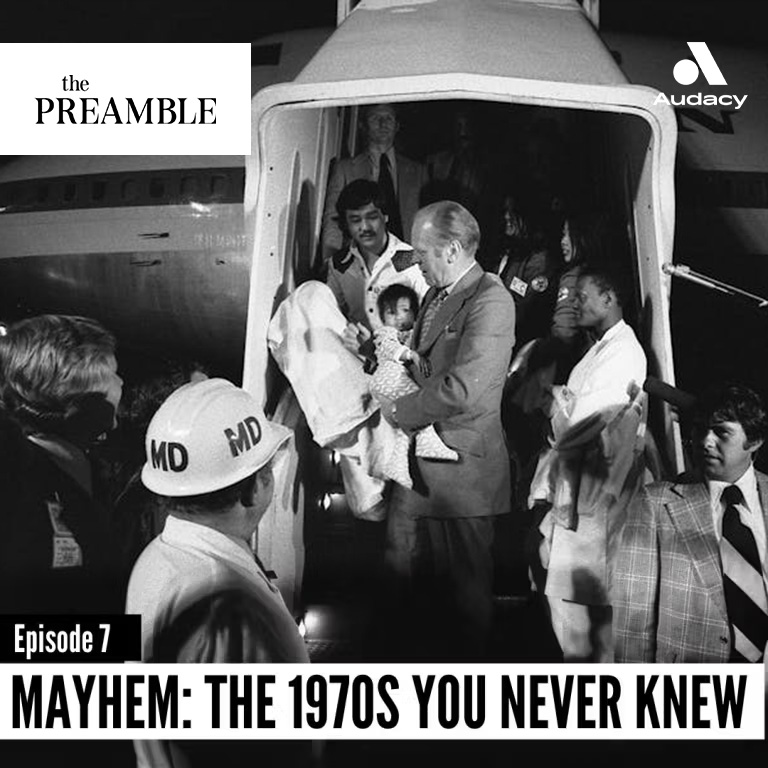
The Preamble
Mayhem: The 1970s You Never Knew, Episode 7
00:46:14
Draft dodging. When did the draft lottery begin for the war in Vietnam, and who among America’s youth was hit the hardest? It was an unwinnable war, and thousands of high school graduates and college students refused to comply. What sparked these explosive protests nationwide?
Loading summary
Transcript69 lines
- [00:00]
Sharon McMahon
As the season shifts into summer, so do the demands on your wardrobe. Weddings, graduations, vacations and a calendar full of events. Finding fresh, stylish outfits for every occasion
- [00:10]
Narrator/Reporter
can take time most people don't have.
- [00:12]
Sharon McMahon
Dailylook offers a more efficient way to stay on top of seasonal style. Dailylook is the number one highest rated premium personal styling service for women. It's designed to simplify the process of getting dressed while delivering elevated on trend pieces. With daily look, you're matched with a dedicated personal stylist. Real stylists, not an algorithm who select clothing based on your body shape preferences and lifestyle. You'll also continue working with the same stylist, ensuring a more tailored experience over time. Each box includes up to 12 premium pieces delivered straight to your door.
- [00:44]
Narrator/Reporter
Try everything on at home.
- [00:46]
Sharon McMahon
Keep what works and return the rest. Shipping is free both ways. Flexible delivery options allow you to receive a box every 30, 60 or 90 days. Elevate your style by signing up@dailylook.com today. Take your style style quiz@dailylook.com and get 50% off your first styling fee with the code Sharon. That's dailylook.com code Sharon. Today's episode is brought to you by Alma. I feel like one of the biggest misconceptions about therapy is that once you decide to go, the hard part is over. But honestly, finding the right therapist can be a challenge in itself. I have definitely run into that either
- [01:19]
Narrator/Reporter
not knowing where to start or not
- [01:21]
Sharon McMahon
being sure if someone would really understand, or even just figuring out what was covered by insurance. That is where ALMA comes in. ALMA is on a mission to simplify access to high quality, affordable mental health care. They've built a network of over 26,000 therapists across the country and you can browse their directory without making an account. And since May is Mental Health Awareness Month, it's a great reminder that support should feel within reach. Clients with insurance pay $20 on average and 98% of Alma therapists accept insurance. You can also use their free insurance cost estimator to know exactly what you'll pay before booking. Most people find their match on the first try and 95% connect with a therapist within one week. Over 80% of people report feeling better within six months, and more than a
- [02:07]
Narrator/Reporter
million people have already found care through Alma.
- [02:10]
Sharon McMahon
Get started now@helloalma.com Preamble that's helloalma.com Preamble.
- [02:21]
Narrator/Reporter
In October 1967, 24 year old Captain Rodney Arch Hastin, a US soldier from Alabama who'd been fighting in Vietnam for over a year. Wrote a letter home saying this. Mom and Dad, I appreciate all your letters. I appreciate your concern that some of the things you write about are trivial. But they aren't trivial to me. I'm eager to read anything about what you and the family are doing. You can't understand the importance that these trivial events take on here. It helps keep me civilized for a while. As I read your letter. I am a normal person. I'm not killing people or worried about being killed while I read your letters. I'm not carrying guns or grenades. Instead, I'm going ice skating with David or walking through a department store to exchange a lampshade. It's great to know your family is safe living in a secure country. A country made secure by thousands upon thousands of of men who have died for that country. Your son, Rod. One year later, on October 22, 1968, Rod Chastain was killed in action. I'm Sharon McMahon and this is the Preamble podcast. The Vietnam War started long before many of us realize we the last French troops left Vietnam on September 14, 1956. President Eisenhower was very concerned that the communist governments of Asia would spread. They called this the domino theory because they felt that if one country or government fell to the communists, it was very likely that surrounding countries would also fall, meaning that the US would have more enemies than just the initial country that turned communist. The Cold War and the Red Scare began in earnest in 1950s America and the propaganda was everywhere, from pamphlets to comics to film and television. Metaphors showing scary aliens as stand ins for communist infiltration came through in films like the Blob and Invasion of the Body Snatchers. TV shows like Leave it to Beaver and Father Knows Best focused on what felt virtuous about American society. The nuclear family, obedience and prosperity. Schools and textbooks were also enlisted to help convey to Americans that they were living in the best possible society and should reject all things communist. Lessons, particularly in history and English, became more focused on nationalism and patriotism. The words under God were added to the Pledge of allegiance in 1952, and young people were given handouts called things like how to Spot a Communist. Perhaps most famously, children in schools were regularly participating in duck and cover drills where they would practice hiding under their desks in case of Soviet nuclear attack. The Geneva Accords of 1954 divided Vietnam along the 17th parallel. North Vietnam was communist under Ho Chi Minh and South Vietnam was led by Nationalist dm. Part of the agreement was to hold elections that would, in theory, unify the country under one agreement within the following two years. But guess what? It never happened. China and the Soviet Union provided weapons and resources to North Vietnam, while the US Provided the same to South Vietnam. And the fighting began. The military advisors from the US entered South Vietnam in the 1950s. During 1959, guerrilla attacks on Saigon became more common. On July 8, two US military advisors were killed when their living quarters were attacked. After the incident, President Kennedy secretly sent the Special Forces with helicopters and estimates of 600 Green Berets to continue training the South Vietnamese. In 1962, President John F. Kennedy answered a question about how involved the United States was in the growing war between north and South Vietnam.
- [06:42]
President John F. Kennedy
There is a war going on in South Vietnam. I think last week There were over 500 killings, assassinations, bombings. The casualties are high. I said last week. A subterranean war, guerrilla war of increasing ferocity. The United States, since the end of the Geneva accord, setting up the South Vietnamese government as an independent government, has been assisting Vietnam economically to maintain its independence and viability and also has sent training groups out there which have been expanded in recent weeks as the attacks on the government and on the people of South Vietnam have increased. We are out there on training and on transportation and we are assisting in every way we properly can the people of South Vietnam who with the greatest courage and under danger are attempting to maintain their freedom.
- [07:36]
Narrator/Reporter
At the time of Kennedy's death in November 1963, there were over 16,000American troops in South Vietnam. The US had been helping South Vietnam with a $24 million modernization plan to build a network of roads and airstri strips all over the country. By the end of 1965, there were 184,000 U.S. troops in Vietnam. Just two years later, the number of American GIs in Vietnam had risen to almost 500,000. More than 9,000Americans were killed in action in 1967 alone. And the war was costing the American public more than $25 billion a year. Over the course of Johnson's presidency, he came to realize that winning in Vietnam would be extremely difficult, if not impossible. But American GIs and war protesters didn't care about Johnson's growing discomfort. He was blamed for sending American GIs overseas and into harm's way. Under Johnson, some of the most startling protests occurred as well. One example was Norman Moore Morrison, a Quaker pacifist from Baltimore who set himself on fire in front of the Pentagon to protest the war. While holding his 11 month old daughter, Emily. Onlookers convinced him to let go of the baby before he was engulfed in flames. Just before the 1968 election, Johnson had been in talks with the South Vietnamese to end the US's involvement in Vietnam. Johnson felt that since he was not running for reelection, he could be more flexible on terms and take more risks. But Nixon was running for election and knew that if Johnson brokered a peace deal before election day, it would rack up votes for Hubert Humphrey, Nixon's opponent, because Hubert Humphrey was a Democrat like Johnson. So Nixon used the wife of a US general, Chinese born Anna Chenault, to deliver a message to the South Vietnamese government saying that if they held out until after the election was over, they would get better terms, assuming Nixon was the one taking office in November 1968. Nixon won the presidential election partly on the promises of leaving Vietnam and ending the draft. But that was not the immediate plan. On December 1, 1969, the first draft lottery began. College students with high enough grades could receive deferments until graduation. But people who couldn't afford college got no such consideration. Around 80% of the 2.5 million enlisted servicemen in Vietnam had received only a high school education and came from impoverished or blue collar family backgrounds. College aged people and their loved ones were scared, angry. During the 1969-1970 school year, two and a half million students went on strike. Seven hundred colleges or universities were shut down for at least two weeks, and there were around 9,000 recorded protests and more than 80 acts of arson or bombings at schools around the country. Protesters in the United States knew that over in Vietnam there were Hundreds of American GIs in POW camps and thousands of young, young soldiers were fighting for their lives in battle. Hal Kushner, an Army flight surgeon, survived a helicopter crash with severe burns, a broken arm and collarbone, and missing teeth and eyeglasses. He watched two of his crew members die before he was captured by the Viet Cong and brought to a camp with 27 other POWs. Ten of those men died in Kushner's arms. Kushner recounted in a 2018 talk at the University of Arkansas that the prisoners went without shoes, clothes, mosquito nets or medicine. They survived on rice that had been stored for 15 years and contained rat feces, rocks and weevils, which we ate, said Kushner. Other soldiers were struggling with heat, rain, exhaustion and other elements that people in wars throughout history have faced with the addition of two drugs and controversial orders from superiors. Now, we're not going to pretend like drugs didn't exist before the 1960s and 70s and that soldiers haven't used and abused drugs throughout history. But Vietnam was different. According to historian Jeremy Kuzmarov Drugs played a role in Vietnam in part because we had the counterculture stateside, in part because of the ready supply of the drugs and in part because of the breakdown in morale in the army where a rebellion took root, marijuana was cheap and easy to get. Commanding officers often overlooked marijuana use among soldiers, at least until author John Steinbeck's son, John Steinbeck iv, a Vietnam soldier himself, wrote a piece for the washingtonian magazine in 1968 and detailing the widespread use of marijuana among soldiers. The negative response to this among the American public was so strong that the military had to start clamping down harder on marijuana use. But what was also easy to get in Vietnam and even harder to detect than marijuana, Heroin. A Pentagon study showed that in 1973, nearly 20% of Vietnam soldiers were regularly used heroin. Vietnam military personnel have largely claimed then and now that drug use was relatively mild and did not have negative effects on most of the soldiers or the war itself. Another aspect of Vietnam that seemed more widespread than previous wars was the disturbing nature of the orders that soldiers claimed to have been given. After returning from Vietnam. In 1970, future senator and Secretary of State John Kerry co founded Vietnam Veterans of America and became a spokesperson for the Vietnam Veterans against the War.
- [14:08]
John Kerry
There are all kinds of atrocities and I would have to say that yes, yes, I committed the same kind of atrocities as thousands of other soldiers have committed in that I took part in shootings in free fire zones. I conducted harassment and interdiction fire. I used.50 caliber machine guns which we were granted ordered to use, which were our only weapon against people. I took part in search and destroy missions, in the burning of villages. All of this is contrary to the laws of warfare. All of this is contrary to the Geneva Conference conventions. And all of this is ordered as a matter of written established policy by the government of the United States from the top down. And I believe that the men who designed these, the men who designed a free fire zone, the men who ordered us, the men who signed off
- [15:05]
President John F. Kennedy
the
- [15:06]
John Kerry
air raid strike areas, I think these men, by the letter of the law, the same letter of the law that tried Lieutenant Kelly, are war criminals.
- [15:16]
Sharon McMahon
Running a business is hard enough.
- [15:17]
Narrator/Reporter
Why make it harder with dozens of disconnected apps if your software is causing
- [15:22]
Sponsor/Advertiser Voice
more stress than success?
- [15:24]
Sharon McMahon
It's time to switch to Odoo.
- [15:26]
Sponsor/Advertiser Voice
Odoo is an all in one business
- [15:28]
Narrator/Reporter
platform that handles CRM, accounting, inventory, E, Com, HR and more. Everything is fully integrated so you don't have to waste time switching between apps or juggling multiple logins.
- [15:40]
Sponsor/Advertiser Voice
It's one seamless system designed to make
- [15:43]
Narrator/Reporter
your workday easier, more productive, and less stressful.
- [15:47]
Sponsor/Advertiser Voice
And it's not just convenient, it's smart business. Odoo replaces multiple expensive platforms, helping you
- [15:52]
Narrator/Reporter
save money while still giving you all the tools you need to run your company efficiently. Plus, it's designed to grow with your business.
- [15:59]
Sponsor/Advertiser Voice
From startups to established enterprises, Odoo is easy to use, customizable, and built to
- [16:05]
Narrator/Reporter
streamline every process so you can spend
- [16:08]
Sharon McMahon
less time on software headaches and more
- [16:10]
Narrator/Reporter
time on strategy, customers and growth.
- [16:13]
Sponsor/Advertiser Voice
Thousands of businesses have already made the switch.
- [16:15]
Narrator/Reporter
Why not you try Odoo for free
- [16:18]
Sponsor/Advertiser Voice
today@odoo.com that's o d o o.com what
- [16:22]
Narrator/Reporter
if everything you learn in history class was only half the story? I'm Dr. Haruni Bhatt, host of Hidden History. Every Monday I go where history gets mysterious vanished civilizations, doomsday prophecies, paranormal phenomena and events that science still can't fully explain. On Hidden History I treat these moments like open case files. Not myths, not superstition, just incomplete explanations waiting for a closer look. Listen to and follow Hidden History Available now, wherever you get your podcasts.
- [16:52]
Sponsor/Advertiser Voice
Ever feel like your nights just aren't really restful anymore? You finally get into bed but your mind keeps running through everything you didn't finish and suddenly it's way too late to feel good about tomorrow. I learned that as we go through hormonal shifts, our body's demand for key nutrients like magnesium can change and that can affect how supported we feel day to day. That's why I added Magnesium Breakthrough by Bioptimizers into my nightly routine. It's a blend of seven different forms of magnesium designed to support relaxation, better sleep quality and overall balance. For me, it's become a simple habit that helps me wind down and feel more steady the next morning. Try it for a month, pay attention to your routine and see how you feel. They also back it with a 365 day money back guarantee, so there's really no risk in trying. Here's what you get when you go to bioptimizers.com Sharon and use code Sharon 15% off your entire order. A free bottle of Mass Zymes Bioptimizer's best selling digestive enzyme added to your next order automatically when you use our exclusive code. That's $20 of product free on top of your discount. There's a limited time offer while supplies last and you cannot get this on Amazon, you can't get it in stores. This offer exists in one place.
- [18:15]
Sharon McMahon
My Link with my code. That's it.
- [18:17]
Sponsor/Advertiser Voice
So if you were already thinking about trying it, this is the sign. Go to buyoptimizers.com that's B I O P T I M I Z e r s bioptimizers.com Sharon and grab it before it's gone. Make 2026 the year you finally start sleeping.
- [18:35]
Sharon McMahon
Great again.
- [18:38]
Narrator/Reporter
One incident that has marked the Vietnam War in many ways is allegedly connected to both the drug use I've been describing and the disturbing orders like the ones John Kerry described. On March 16, 1968, part of the Army's 23rd Infantry Division, led by Captain Ernest Medina, arrived in the village of My Lai because they thought Viet Cong soldiers were being hid there. Soldiers and officers remember the orders given differently, but some say they were told to decimate the village, including women and children. I'll spare you most of the details, but suffice it to say that 70 to 80 villagers were lined up and shot. Soldiers fired randomly into the village, homes were burned and people running away were killed. Some historians have argued that the My Lai massacre happened because heroin use made soldiers aggressive and ir, adding that racism led some American soldiers to kill Vietnamese people more indiscriminately than we've seen in wars carried out in places with largely white populations. We may never know for sure which, if any, of these factors played a role in the My Lai massacre. What we do know is that the American soldiers were never fired upon. No one shot at them, probably because none of the villagers had guns. And some soldiers have since reported that they did not see anyone in My Lai who appeared to be part of the Viet Cong. Even without all of those details at their disposal, hearing some of these stories in the news and knowing a bit of what was happening in Vietnam caused a flood of young American men to make their way to Canada and apply for political asylum. Giant peace marches were organized all over the country. The largest was in 1967 in Washington, D.C. with an estimated 100,000 people. So why, under all of this pressure from hundreds of thousands of constituents and with Americans being killed every day for a war that didn't seem to have an end in sight, why didn't the United States leave Vietnam? Because they couldn't give up. Giving up would be weak, and the United States wanted to strengthen its new superpower status, not weaken it, there was still the threat of spreading Communism as well. So the protests continued, even in the halls of Washington, D.C. itself. In April 1971, John Kerry, wearing his decorated army green Vietnam War uniform, testified in front of the Senate Committee on Foreign Relations on behalf of the Vietnam Veterans against the War
- [21:20]
President John F. Kennedy
each day to
- [21:21]
John Kerry
facilitate the process by which the United States washes her hands of Vietnam. Someone has to give up his life so that the United States doesn't have to admit something that the entire world already knows, so that we can't say that we've made a mistake.
- [21:39]
Narrator/Reporter
The tenor of the nationwide demonstrations changed dramatically after 1970, when President Nixon announced that U.S. troops would be going into Cambodia and Laos. The incursion into Cambodia and Laos only lasted a few months, but nearly a thousand allied casualties caused Congress to pass the Cooper Church amendment banning any American troops from being deployed into ground operations in Laos or Cambodia. Nixon's workaround was to have the South Vietnamese attack the Ho Chi Minh trail from the ground with American bombers supporting them from the air. Nixon and Kissinger saw it as a test of the military fitness of the South Vietnamese. Nixon held a press conference responding to the student protests that emerged as a result of the incursion.
- [22:32]
President John F. Kennedy
They're trying to say that they want peace. They're trying to say that they want to stop the kill, killing. They're trying to say that they want to end the draft. They're trying to say that we ought to get out of Vietnam. I agree with everything that they're trying to accomplish.
- [22:53]
Narrator/Reporter
Student groups seemed unwilling to take President Nixon at his word that he had the same end goal that they did. The Weathermen took their inspiration from the revolutionaries of Latin America and China and began creating violent confrontations with the objective of, as they said, bringing the war home. Peaceful demonstrations didn't feel like enough anymore. They wanted to take things to the next level. At the end of 1969, the Weathermen organized what they called days of rage.
- [23:27]
Kathy Wilkerson
Days of Rage had already taken that turn towards we're going to fight you, and that the point of it was to show how tough we were and how militant we were.
- [23:39]
Narrator/Reporter
They went into high school and college classrooms, tying up the teachers and giving speeches. During the days of rage, the Weathermen also blew up a statue in Chicago commemorating police officers. The weekend was largely unsuccessful and sent the organization underground. They surfaced again on March 6, 1970, when three members making bombs in a New York City Greenwich Village townhouse accidentally set off an explosion. Kathy Wilkerson was in the house when the bomb went off.
- [24:15]
Kathy Wilkerson
At the moment that the explosion happened, I was ironing sheets right above where the floor above the basement. And there was just this huge blast. The room filled with smoke, the floor sank, and I was holding the iron And I thought, I don't want to put this down. It'll start a fire. And then I looked over 20ft next to me and saw that the entire basement was engulfed into flame.
- [24:50]
Narrator/Reporter
The building was on fire, its windows blown out, bricks littering the street. Two young women stumbled out of the rubble before the police and fire trucks arrived, one of them naked because she had been in the shower. Neighbors took them in and lent them some clothes. But in the confusion of the day, the two young women disappeared. Neighbor Dustin Hoffman can be seen in some of the pictures from that day racing up and down his stoop stairs trying to save some art pieces. And that was not actor Dustin Hoffman's only connection to anti Vietnam sentiments. His breakthrough role in the 1967 film the Graduate had led him to travel to college campuses and show the film with director Mike Nichols. Though the film was ultimately very popular, Nichols remembered being questioned by student anti war activists wherever they went. And he, he said in an interview that to make a movie for young people that was not about Vietnam actually affronted them. Nevertheless, it was only happenstance that brought the Weatherman to Dustin Hoffman's building. And it turned out that the Graduate was kind of about Vietnam after all. It's a film about a young man learning that older generations were not always looking out for him. The two young women who decided escape the townhouse explosion. Kathy Bowden and Kathy Wilkerson were scheduled to appear in a federal court in Chicago on March 16, along with a number of other people because of their participation in violent clashes with officers the year before. Neither women appeared in Court in 1970 or for years afterward. After the New York explosion, the group changed their name to the Weather Underground and continued with their campaign to, quote, protest the American condition through most of the 1970s. The bombs that leveled the townhouse in Greenwich Village had been intended for a dance that evening at an army base in New Jersey. They were planning, in fact, hoping for large numbers of collateral damage. At the time, their view was that no one on the base was innocent. They were all connected to what the Weather Underground called the military industrial complex. The Weather Underground was responsible for at least 10 other high profile bombings, including the National Guard building in Washington, D.C. bank of America headquarters, the NYPD headquarters, three courthouses, the Harvard center for International Studies, and the U.S. capitol Building. On May 19, 1972, on what would have been Ho Chi Minh's birthday if he hadn't died in 1969, the Weather Underground bombed a women's bathroom in the Pentagon on the fourth floor of The E Ring causing flooding that destroyed classified information. In his 2001 memoir, Fugitive Days, Weather Underground leader Bill Ayers describes the preparation and execution of the Pentagon attack. He said, we pulled together a special group that scouted the Pentagon and irregularly for months. When a new escalation in Vietnam became imminent, my associates Anna and Aaron and Zeke got a storage locker outside D.C. moved some explosives in, and then found a cheap apartment nearby and rented it by the week. Anna, her fingertips painted with clear nail polish to obscure the identifying marks of her naked hand and heavily tight, disguised in suit and blouse and briefcase, dark wig and thick glasses, began entering the Pentagon every morning with hundreds of other workers. She walked the halls, ate breakfast in the cafeteria, and left by 11am she was never challenged. I can do it, she said, finally pulling out her sketches and maps. Here. She pointed to an isolated hallway in the basement of the Air Force section. I've been here for four times, never seen another person. And there's a women's room halfway down right here. She made an X on the map. Anna was in the next day at 9am and was in the women's room and the stall by 9:10. She locked the door, hung up her jacket and pulled plastic gloves, a screwdriver and tape measure from her briefcase. The graded drain cover was gunky but easy to pop off once the screws were out and there was a comfortable 4 inch diameter that ran down over a foot. Anna replaced the drain cover, wiped the area down, and was back at the apartment by 10am At 11am Aaron pulled on plastic gloves and taped a statement about the impending attack beneath a tray in a phone booth across from the Washington Post offices. He then moved across town and at 11:30 called the Pentagon emergency number. In 25 minutes a bomb will explode in the Air Force section of the Pentagon, he said calmly. I'm calling from the Weather Underground and believe me, this is no prank. Clear the area. Get everyone out. You have 25 minutes. Vietnam will win. In 1969, Nixon announced the plan insiders had dubbed Vietnamization, which meant shifting the full responsibility of the war to the South Vietnamese so that U.S. troops could withdraw. By late 1970, Nixon could see that staying in Vietnam would sink his presidency if he did not bring American soldiers home. His initial idea was to bring all of them, at that point, around 300,000 soldiers home within 18 months. Kissinger cautioned Nixon against pulling all combat troops out by the end of 1971, as it would not leave the US a way to calm things down if the fighting heated up. Again. So they decided to commit to having combat troops out by the end of 1972. After the next election in April 1971, there were still 150,000American troops in Vietnam. One year later, there were around 50,000. By October of 1972, just a month before the US presidential election, the North Vietnamese had finally given up their offense posture, but not before taking new territory in South Vietnam. They were refusing to cut a deal with Kissinger, who nevertheless made the fateful, if exaggerated, announcement that, quote, peace was at hand. The US And Hanoi had technically been in peace talks for four years when both sides agreed to meet in Paris. But for almost four years, no progress was made. On January 27, 1973, American involvement in the Vietnam War officially ended as the Paris Peace accord was signed. U.S. national Security Advisor Henry Kissinger and the head of the Vietnamese Communist Party negotiated the final deal and won the 1973 Nobel Peace Prize for it. Just three months after the peace accord was signed, open fighting once again broke out in Vietnam. But in those first six months of 1973, when the peace accords were mostly holding together, almost 600Americans who had been POWs, including future senator John McCain, returned to the United States in Operation Homecoming. Remember how Kushner, the military flight surgeon who was taken prisoner after his helicopter crash, Kushner recalls finally coming home in March 1973 after almost six years in POW camps, including the infamous prison nicknamed the Hanoi Hilton.
- [33:07]
Hal Kushner
And they. Then they called our name. And I walked out in the sunlight, and the first thing I saw was a girl in a miniskirt. She was a reporter for one of the news organizations. I'd never seen a real live miniskirt. And the. There was a table with the Vietnamese and American authorities on one side, and there was a brigadier general, Air Force general in class A uniform. And he looked magnificent. And I looked at him, and he had breadth, he had thickness that we didn't have. And his hair was. He had on a garrison cap, and his hair was plump and moist. And our hair was like straw. You know, it was dry. And we were skinny. And I went out and I saluted, which was a courtesy that had been denied us for so many years. And he saluted me, and I shook hands with him, and he hugged me. He actually hugged me. And he said, welcome home, Major. We're glad to see you, Doctor. And the tears were streaming down his cheeks, and it was just a. A powerful woman.
- [34:29]
Narrator/Reporter
But of course, many Vietnam veterans faced much worse reunions back at home. Many veterans were spat on and called Baby killers. Some say their loved ones ignored their service altogether. And they never heard the words thank you for your service or even welcome home. Studies after Vietnam showed that at least 15% of veterans were suffering from PTSD. But some Americans claimed that PTSD wasn't real, just something invented by the government to garner support for the war. Soldiers whose fathers and uncles had returned from World War II to ticker tape parades, jubilant celebrations, and many honors were finding that America had turned away from them, scapegoating them for a war that it was hard for many to feel proud of, blaming them for their government's decisions. And things weren't going all that well at the White house either. On August 8, 1974, President Nixon resigned to avoid impeachment related to the Watergate scandal. And in January 1975, President Ford made it clear that there would not be any more military deployments to Vietnam. This announcement might have been met with some relief on the home front, but in Saigon, it did nothing but raise anxiety to new heights. Saigon is in the far southern part of Vietnam, with Cambodia's capital city Phnom Penh to the west and the South China Sea to the east. One of the most important things that the US And South Vietnam needed to maintain was the South Vietnamese capital city, Saigon. Losing Saigon to the Communists meant losing the Vietnam War. It meant that the entire country would be reunified under Communist rule, defeating the entire purpose for the war in the first place. The North Vietnamese army, the People's army, it was called, was marching south through the country, capturing cities like Da Nang along the way. Phnom Penh, the capital of what is now Cambodia, fell to the Communist Khmer Rouge. Cambodia's deputy prime minister wrote to the American. I cannot, alas, leave in such a cowardly fashion. I have only committed this mistake of believing in you, the Americans. A few days later, he was executed by the Khmer Rouge. American officials advised the ambassador to South Vietnam, Graham Martin, to start evacuating American personnel in early 1975 to make it easier for a later possible emergency evacuation to happen. Graham Martin said it would be bad for morale and believed that Saigon would not fall. So 6,500American officials remained in Saigon. CIA agents reported that nothing short of B52 bombings could stop the North Vietnamese from advancing into Saigon. On April 3, President Ford authorized Operation Babylift, which evacuated thousands of orphans, many of them fathered by American servicemen from the country. Children known to have or suspected of having white fathers were rumored to be in particular danger in Vietnam. One mother shared her fear that her child would be doused in gasoline and burned. Over several weeks, Operation Babylift carried children out of Vietnam. Transports landed in nearby countries to get aid to those most in need and then continued on to various places in the United States carrying children in airplane seats and babies in cardboard boxes lined with blankets. One plane crashed right after takeoff, killing 78 children and 50 adults. By the end of Operation Babylift, over 2,700 children were brought to the United States, while another 1300 were taken to Canada, Australia, and Europe. Several agencies worked to get the Vietnamese children adopted by families all over the world. All of this hasty activity, said to be in the best interests of the children, caused problems later when families, sometimes even parents, of those children, left Vietnam mom to find their children and try to get them back, only to learn that their children's names had been changed and they were hard to find or they had been legally adopted and it would be difficult for relatives to get them back.
- [39:15]
Sharon McMahon
This episode of the Preamble is brought to you by Alloy Health. Aging can be let's just say rough sleep gets disrupted, hot flashes show up out of nowhere, brain fog sneaks in, weight shifts and more. And while men menopause is universal, so many of us are still trying to push through it alone. Nearly half of women wait three plus years before seeking relief. What stands out about Alloy is how direct it is. It connects you with menopause specialized physicians who actually understand what's going on and create a treatment plan that fits you. Not a one size fits all approach. Here's how it works. You complete an online intake and verification, get matched with the prescribing physician with Alloy and receive a personalized plan. Once approved, your three month supply ships straight to your store with automatic refills. I know many people who use Alloy and absolutely love it. Join the 95% of women who tried Alloy and saw relief in the first two weeks. Head to myalloid.com and use the code Sharon and tell them all about your symptoms. And you'll get a fully customized treatment plan and unlimited messaging with your doctor. Plus you'll get $20 off your first order. Today. Head to my a l l o y.com and use code link Sharon to get $20 off your first order. Hi there, it's Sharon. As a listener of the Preamble, you likely value thoughtful, nuanced discussions about politics,
- [40:38]
Narrator/Reporter
civic duty and our future.
- [40:40]
Sharon McMahon
Which is why I highly recommend the Signal Award winning podcast no Small Endeavor. Hosted by my friend Lee C. Camp, no Small Endeavor explores what it means to live a good life through conversations about faith, culture, ideas and the habits
- [40:53]
Narrator/Reporter
that help people flourish. Each episode hosts an award winning theologian. Lee C. Camp sits down with courageous
- [41:00]
Sharon McMahon
and impassioned people like Pulitzer finalist historian Garrett Graff and New York Times bestselling
- [41:05]
Narrator/Reporter
author Malcolm Gladwell about what it means
- [41:07]
Sharon McMahon
to flourish in our day to day lives.
- [41:09]
Narrator/Reporter
Not sure where to start? Check out my conversation with Lee where we talk about the transformative power of education, the need for informed civic participation,
- [41:17]
Sponsor/Advertiser Voice
and the hopeful possibilities that emerge when
- [41:19]
Narrator/Reporter
we approach politics not as partisan warriors,
- [41:22]
Sharon McMahon
but as compassionate, curious learners. Follow no small endeavor on Apple Podcasts, Spotify or wherever you're listening now.
- [41:30]
DSW Advertiser
You know that thing where you get an amazing pair of shoes at a really great price and want to tell everyone about it?
- [41:36]
Narrator/Reporter
Yeah.
- [41:36]
DSW Advertiser
So do we. Here at Designer Shoe Warehouse. We'll give you something to brag about, like the latest styles from brands you love, or the trends everyone's obsessing over, or shoes that make you feel like, well, you. So go ahead, show off a little. Find shoes that get you the prices that get your budget. Head to your DSW store or dsw.com today DSW. Let us surprise you.
- [42:00]
Narrator/Reporter
The People's army continued to advance towards Saigon, and reports of beheadings, mass graves, and people simply vanishing traveled with them. People in Saigon had very little food and gas was so expensive that many could buy only one quart at a time. During the last week of April 1975, the People's army began closing in on Saigon. The President of South Vietnam resigned, appointing his vice president the new leader. In his resignation speech, he said, let me say that we need immediate, I say immediate shipment of arms and equipment to the South Vietnam battlefield. I would challenge the United States army to do better than the South Vietnamese army without B52s, he said. Most of his speech was reserved for criticism of the United States, such as his statement that the United States has not respected its promises. It is unfair, it is inhumane, it is not trustworthy, it is irresponsible. The troops that were left in the city of Saigon were soon overrun. North Vietnamese forces now controlled key bridges and roads blocking the food supply route as well as the path from Saigon to the sea. The roads from neighboring villages and cities were so crammed with refugees hoping to escape Communist rule that even military vehicles couldn't get through and had to return to Saigon. Refugees waited to get into Saigon but couldn't get past South Vietnamese troops that worried they were communists disguised as refugees. More importantly, people who were already in Saigon could not get out there was a rare blood red sunset the night that Saigon was completely surrounded by North Vietnamese forces. At 11am on April 29, Secretary of State Henry Kissinger gave American personnel their evacuation order. The secret code was the temperature in Saigon is 105 degrees and rising broadcast on American radio and followed by the song White Christmas performed by Tennessee Ernie Ford because the DJ couldn't find the Bing Crosby version. At that time there were an estimated 1 to 2000American civilians still living in Saigon. However, there were tens of thousands of Vietnamese soldiers and others who'd worked with the US military. All of their lives were now at risk. And there was only one way to get out. The helicopter airlifts out of Saigon began at 2pm on April 29, 1975. US Ambassador Martin initially refused to leave on the helicopter transports. He instructed the pilots to take Vietnamese people out to the aircraft carriers and sent his wife with them. She left her suitcase behind in order to make room for more Vietnamese people in the chopper. There are several famous photographs capturing the chaos of these hours. A line of people standing on rooftop stairs waiting to board a helicopter. Screaming mothers trying to ham their small children children over embassy fences to get them out of the country. During the evacuation, Ambassador Martin sent a telegram to National Security Advisor Brent Scowcroft asking perhaps you can tell me how to make some of these Americans abandon their half Vietnamese children. One pilot commented that normally they would cram about 44 seated troops into a Chinook helicopter. But during the during the fall of Saigon, one chinook helicopter carried 147 refugees in a single trip. 55 helicopters were flying back and forth from the embassy out to the USS Midway aircraft carrier, waiting for their turn to land and drop off the people they'd rescued. Many of these helicopters had no radio communication with air traffic control, so controllers on the carrier deck communicated only through hand signals and red and green flags. Being airlifted out on a Chinook was not the only way that people got out of Vietnam. That day, South Vietnamese Air Force Major Wang Lee knew he had to get his young family out of the country. He and his wife raced to the airstrip with their five children between the ages of 14 months and 6 years. He hotwired a tiny two seater Cessna airplane, crammed his family inside and took off towards the South China Sea. Figuring it would be safer over water than overland with the tank full of gas. He was happy to see the USS Midway, but he could also see there was not room for him to land on it. Captain Lawrence Chambers, the first African American aircraft Carrier captain commanded the USS Midway. That day, when they saw the little Cessna, Chambers admiral ordered him to tell the Cessna to ditch in the water. This was a common order. On that particular day, with 55 helicopters and one aircraft carrier, there simply wasn't room for everyone to land. As each helicopter ran low on fuel, the pilots were ordered to hover over the carrier deck to allow everyone but the pilots to disembark and then go out to open water. Jump free of the rotors as the chopper sank into the water, and then the pilot would swim to the nearest vessel. But the tiny plane couldn't hover over the carrier deck like a helicopter, and Chambers could see that there were several people inside. At one point, they flew the Cessna low over the carrier and dropped a note that he'd crammed into his pistol holster to weigh it down. The crew retrieved the note which said, can you move these helicopters to the other side? I can land on your Runway. I can fly one hour more. We have enough time. Please rescue me. Captain Chambers knew it was time to defy orders as there was no way the pilot and his wife and children could survive ditching the small plane out in the open water. His order to the crew was, get me a ready deck, which they knew meant pushing the helicopters into the sea. Chambers turned the ship to give the Cessna favorable headwinds for landing. While firefighters prepared on deck just in case another crews pushed three Hueys and one Chinook off the carrier. Five Huey pilots who'd been waiting to land took quick advantage of the situation and unloaded their passengers. Cruz then pushed those five Hueys overboard as well. Chambers knew that he could be court martialed for disobeying direct orders, not to mention destroying millions of dollars in military equipment. So he turned his head away so that he wouldn't be able to witness exactly how many choppers were destroyed or who pushed them. It seemed like everyone on that aircraft carrier held their breath as the Cessna safely landed. Crewmen jumped onto the plane immediately to weigh it down as they were afraid it would blow right off the deck before the family got out. Shouts and applause greeted the pilot, his wife and his five little children as they all got out safely. Captain Chambers was not court martialed. He was promoted. Over $10 million worth of helicopters were pushed into the water that day because they couldn't be flown home and they couldn't be left for the communists. Nobody was prosecuted for that loss. The ship's crew collected money to help the pilot and his family resettle, and all seven of them are now naturalized American citizens. At 7:53am on April 30, 1975, the evacuation of the American Embassy in Saigon was over, stopping only when the North Vietnamese tanks came rolling into the embassy's courtyards. 1373Americans and 5595 Vietnamese and other nationals were rescued by helicopter. Hundreds of thousands more would have to find other ways out. April 30, 1975, is called Many things, depending on your perspective. Western countries typically call it the Fall of Saigon, but in Vietnam, it's officially called the Day of Liberating the south for national reunification. Some call it Liberation Day, others National Day of Shame, or even just April 30. Between 1975 and 1995, more than 3 million people fled Laos, Cambodia and Vietnam. The first wave of 140,000 refugees arrived in the United States in 1975. And on April 30, the city once known as Saigon was renamed ho Chi Minh City. 58, 000Americans and somewhere close to 2 million Vietnamese soldiers and civilians died in the Vietnam War, which lasted far longer than most people realize. But of course, back in 1975, there were a few other things happening as well. Bill Gates and Paul Allen developed and sold a software program called Basic, the name Microsoft is used for the first time that year and year end sales totaled a whopping $16,005. The movie Jaws was released on June 20, 1975, terrifying audiences with a mechanical shark named Bruce and a boat that
- [52:14]
Sharon McMahon
was clearly way too small. Jaws was the second film that director
- [52:18]
Narrator/Reporter
Steven Spielberg and composer John Williams worked on together.
- [52:22]
Sharon McMahon
Spielberg has said that when Williams first
- [52:25]
Narrator/Reporter
played him the simple two note line that's at the heart of the Jaws theme song. He thought it was a joke at first, but film audiences were properly terrified by it. Before 1975, summers were called graveyard season for movies. But Jaws came through, and as the very first summer blockbuster, on July 31, 1975, union leader Jimmy Hoffa was reported missing. He was last seen the day before in a restaurant parking lot in Detroit. It's presumed that he was murdered and was even declared dead in 1982, but his remains have never been found. Hoffa's son, James Hoffa, took over his father's leadership role in the Teamsters until stepping down in 2022. And after writing about him in 33 novels, two plays and 51 short stories, Agatha Christie killed off her beloved detective, Hercule Poirot. And he became the only fictional character to ever receive a front page obituary in the New York Times. The obit ran on August 6, 1975 and never mentions that Poirot is fictional, referring to Agatha Christie as his historian and Hang on friends, for our next episode in this series, politics heat up as the Carter campaign rolls into 1976 and Patty Hearst, y', all. You have got to come back for Patty Hearst. I'll see you soon. The show is written and researched by Sharon McMahon, Amy Watkin, Mandy Reed and Kari Anton. Our audio producer is Jenny Snyder and it is executive produced and hosted by me, Sharon McMahon. If you enjoyed today's episode, we would love for you to hit the subscribe button. Leave us a review or share this episode on your favorite social media platform. All of those things help podcasters out so much. We'll see you again soon.
- [54:36]
Progressive Insurance Advertiser
This episode is brought to you by Progressive Insurance. Do you ever think about switching insurance companies to see if you could save some cash? Progressive makes it easy. Just drop in some details about yourself and see if you're eligible to save money when you bundle your home and auto policies. The process only takes minutes and it could mean hundreds more in your pocket. Visit progressive.com after this episode to see if you could save Progressive Casualty Insurance Company and affiliates. Potential savings will vary. Not available in all states.