← The Preamble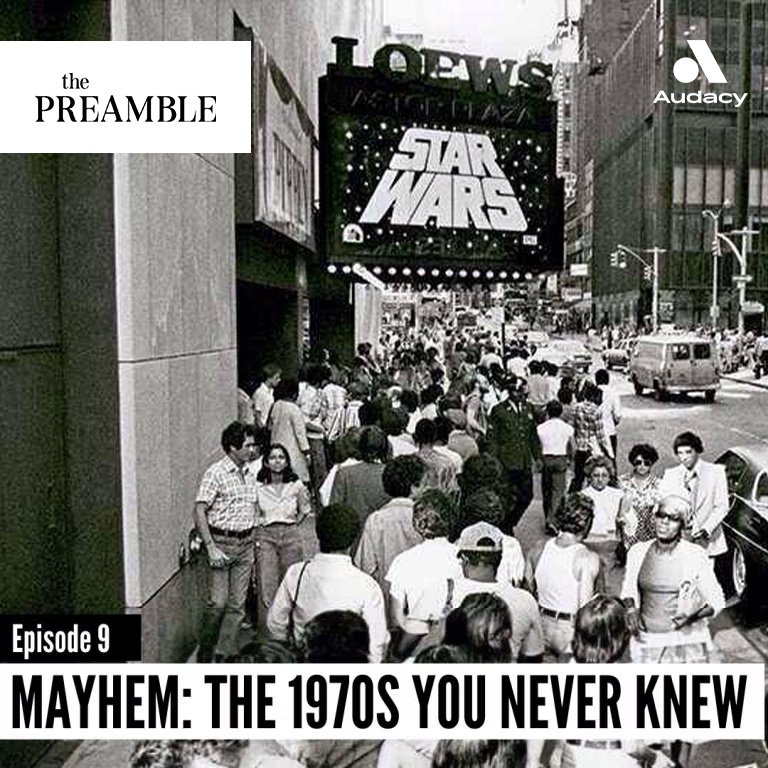
The Preamble
Mayhem: The 1970s You Never Knew, Episode 9
00:41:23
Did you know that Star Wars almost started a war in real life, over a sand crawler model? Would the film have been so wildly successful if someone else had been cast in the role of Han Solo, such as – let’s say – Christopher Walken?
Loading summary
Transcript63 lines
- [00:00]
Sharon McMahon
Running a business is hard enough. Why make it harder with dozens of disconnected apps? If your software is causing more stress than success, it's time to switch to Odoo Odoo is an all in one business platform that handles CRM, accounting, inventory,
- [00:16]
Narrator/Host
E Com, HR and more.
- [00:18]
Sharon McMahon
Everything is fully integrated so you don't have to waste time switching between apps
- [00:22]
Narrator/Host
or juggling multiple logins.
- [00:24]
Sharon McMahon
It's one seamless system designed to make your workday easier, more productive and less stressful. And it's not just conven convenient, it's smart business. Odoo replaces multiple expensive platforms, helping you save money while still giving you all the tools you need to run your company efficiently. Plus, it's designed to grow with your business. From startups to established enterprises, Odoo is easy to use, customizable, and built to streamline every process so you can spend less time on software headaches and more time on strategy, customers and growth. Thousands of businesses have already made the switch. Why not you try Odoo for free today at odoo. Com that's o d o o.com hi there, it's Sharon.
- [01:07]
Narrator/Host
As a listener of the preamble, you
- [01:09]
Sharon McMahon
likely value thoughtful, nuanced discussions about politics, civic duty and our future. Which is why I highly recommend the Signal Award winning podcast no Small Endeavor. Hosted by my friend Lee C. Camp,
- [01:21]
Narrator/Host
no Small Endeavor explores what it means
- [01:23]
Sharon McMahon
to live a good life through conversations about faith, culture, ideas, and the habits
- [01:28]
Narrator/Host
that help people flourish.
- [01:29]
Sharon McMahon
Each episode hosts an award winning theologian. Lee C. Sits down with courageous and impassioned people like Pulitzer finalist historian Garrett Graf and New York Times bestselling author
- [01:39]
Narrator/Host
Malcolm Gladwell about what it means to
- [01:41]
Sharon McMahon
flourish in our day to day lives. Not sure where to start? Check out my conversation with Lee where we talk about the transformative power of education, the need for informed civic participation, and the hopeful possibilities that emerge when we approach politics not as partisan warriors, but as compassionate, curious learners. Follow no Small Endeavor on Apple Podcasts, Spotify or wherever you're listening.
- [02:03]
Narrator/Host
Now. Imagine that it's 1977 and you're making a movie, so let me give you a list of supplies you're going to need. First, you'll definitely want some recordings of bears and walruses because obviously their vocalizations are similar to the sounds one of your characters makes. Next you're going to want to make a bunch of little models spaceships, but make them act more like fighter jets on screen. And side note, to do this you will need an entirely new type of camera, so definitely get started on that and finally, while you're out, grab an ice cream maker, some bubble wrap, maybe a dog toy. Just some random things that we can spray paint to make them look like futuristic devices or parts of costume. You know, like the usual stuff. Get started on those errands, please. You're about to make one of the biggest movies of all time. I'm Sharon McMahon, and this is the Preamble Podcast. George Lucas started imagining what he called his space opera way back in 1971, the same year that he founded his entertainment company, Lucasfilm. Though he was relatively new to moviemaking, Lucas had some big plans. While dreaming about his space opera, Lucas released another movie, and that one did really well. Maybe you've seen or heard of American Graffiti, starring Ron Howard, Richard Dreyfuss, Cindy Williams, and an unknown actor named Harrison Ford. Because American Graffiti was so successful, Lucas was offered several other film projects. But he was determined to work on his own ideas and turn back to his space opera. Universal Studios and United Artists passed on their chances to make this strange film. George Lucas was actually glad that these big studios turned him down, as he wanted more creative control over the film than they were likely to Grant. In 1973, three George Lucas met with Alan Ladd Jr. President of 20th Century Fox. Laddie, as he was known, was excited about Lucas's success with American Graffiti. George Lucas and Laddie negotiated a contract to make Star wars for $11 million. Around the same time, by the way, the movie Superman was being made for $55 million, and, and King Kong had a budget of $24 million. So $11 million was not enough to do what George Lucas envisioned. With this contract, George Lucas himself would earn $200,000 for making Star wars, not the $500,000 his agent thought he could demand. But Lucas also got the rights for the soundtrack, licensing, publishing, merchandising, and any sequels. Turns out that was what was most important to him. Lucas recalled. I was very careful to say, I don't want more money. I don't want anything financial, but I do want the right to make sequels. George Lucas created two branches within Lucasfilm in 1975, one called Sprocket Systems for sound and post production, and another called Industrial Light and Magic for visual effects. And so the making of Star A New Hope, the very first Star wars film ever made, but the one that's technically fourth in the film series began. This strange movie with a small budget was going to use special effects that had never been seen before. George Lucas hired illustrator and artist Ralph McQuarrie to create the first visual concepts of the landscape and characters in the film. McQuarrie's concepts set the tone of the entire first Star wars trilogy and helped 20th Century Fox executives to visualize what they were reading. Continuing to refine the script, George Lucas spent months consulting with renowned author and mythology professor Joseph Campbell about the archetype of the hero's quest. Campbell called Lucas one of his best students and is likely the reason that Star wars is still studied today for its use of archetypes like the hero, villain, mentor, and sidekick. George Lucas then went hunting for his three main characters, Luke starkiller Yes, that was his original name, Han Solo and
- [07:00]
Sharon McMahon
Leia Organa Running a business is hard Enough. Why make it harder with dozens of disconnected apps? If your software is causing more stress than success, it's time to switch to Odoo. Odoo is an all in one business platform that handles CRM, accounting, inventory, E. Com, HR and more. Everything is fully integrated so you don't have to waste time switching between apps
- [07:25]
Narrator/Host
or juggling multiple logins.
- [07:27]
Sharon McMahon
It's one seamless system designed to make your workday easier, more productive, and less stressful. And it's not just convenient, it's smart business. Odoo replaces multiple expensive platforms, helping you save money while still giving you all the tools you need to run your company efficiently. Plus, it's designed to grow with your business. From startups to established enterprises, Odoo is easy to use, customizable, and built to streamline every process so you can spend less time on software headaches and more time on strategy, customers and growth. Thousands of businesses have already made the switch. Why not you try Odoo for free today@odoo.com that's o d o o.com what
- [08:09]
Narrator/Host
if everything you learn in history class was only half the story? I'm Dr. Haruni Bhatt, host of Hidden History. Every Monday I go where history gets mysterious vanished civilizations, doomsday prophecies, paranormal phenomena and events that science still can't fully explain. On Hidden History I treat these moments like open case files. Not myths, not superstition, just incomplete explanations waiting for a closer look. Listen to and follow Hidden History available now, wherever you get your podcasts. Hi there, it's Sharon. As a listener of the Preamble, you
- [08:42]
Sharon McMahon
likely value thoughtful, nuanced discussions about politics,
- [08:46]
Narrator/Host
civic duty, and our future.
- [08:47]
Sharon McMahon
Which is why I highly recommend the Signal Award winning podcast no Small Endeavor. Hosted by my friend Lee C. Camp,
- [08:54]
Narrator/Host
no Small Endeavor explores what it means
- [08:56]
Sharon McMahon
to live a good life through conversations about faith, culture, ideas, and the habits
- [09:01]
Narrator/Host
that help people flourish.
- [09:02]
Sharon McMahon
Each episode, host and award winning theologian Lee C. Camp sits down with courageous and impassioned people like Pulitzer finalist historian Garrett Graf and New York Times bestselling
- [09:12]
Narrator/Host
author Malcolm Gladwell about what it means
- [09:14]
Sharon McMahon
to flourish in our day to day lives. Not sure where to start? Check out my conversation with Lee where we talk about the transformative power of education, the need for informed civic participants, and the hopeful possibilities that emerge when we approach politics not as partisan warriors, but as compassionate, curious learners. Follow no small endeavor on Apple podcasts, Spotify or wherever you're listening now.
- [09:38]
Narrator/Host
Initially, George Lucas did not want to cast Harrison Ford as Han Solo because he had so recently cast him in American Graffiti, and he wanted an unknown actor. He looked pretty seriously at casting Christopher Walken instead, but as he watched Ford feed lines to other actors auditioning, he knew that the semi sarcastic and world weary delivery of the lines was perfect for Han Solo. Look your Worshipfulness let's get one thing straight. I take orders from just one person.
- [10:10]
Commercial Voice
Me.
- [10:11]
Narrator/Host
Luke starkiller was renamed Skywalker, which seems a more fitting name for the fresh faced 20 year old Mark Hamill's easy sincerity. Very bad feeling about this. The role of Princess Leia required an actor with natural poise and confidence, someone who could pull off the attitude of someone unaccustomed to being questioned. 20 year old Carrie Fisher was Hollywood royalty, the daughter of legendary actors Debbie Reynolds and Eddie Fisher, but she was still virtually unknown, which was exactly what Lucas wanted. Help me Obi Wan Kenobi. You're my only hope. Add in Shakespearean actor Alec Guinness for the role of Obi Wan Kenobi, the wise sage who guides the hero on his quest, and Star wars was ready to start filming.
- [11:00]
Commercial Voice
These aren't the droids you're looking for.
- [11:03]
Narrator/Host
These aren't the droids we're looking for. The arid country of Tunisia would stand in for the desert planet of Tatooine when filming started in 1976. But there were several problems right off the bat. First, the Tunisian desert saw its speed. First significant rain in 50 years, cinematographer Gilbert Taylor later recalled. You couldn't really see where the land ended and the sky began. It was all a gray mess and the robots were just a blur. Robots were malfunctioning all over the place, collecting rocks, falling over and rusting. Eventually, several of the robots needed to be pulled through their scenes on ropes, attached to poles. Police and the film was rapidly slipping behind schedule. Another problem in Tunisia could have been significantly bigger. Star wars production involved partial construction of the enormous sand crawler machine used by Tatooine natives called jawas when traveling across the desert collecting scrap machinery. The partial sand crawler constructed in Tunisia, was 88ft long and. And resembled a very large military vehicle moving along large tracks inspired by NASA's rovers. It would be an understatement to say that in 1976, the relationship between Tunisia and Libya was tense. So maybe it wasn't a surprise when Libya's leader, Muammar Gaddafi, saw what appeared to be a huge military vehicle near the Tunisian border and threatened war, war if it wasn't removed. Production was quickly moved away from the border and eventually to Death Valley, California. George Lucas's wife, Marcia, a film editor, was integral to the making of Star Wars. Not only did she resolve a major plot hole by rewriting one of the final scenes in the movie so that Darth Vader actually killed Obi Wan Kenobi. By the way, I'm not apologizing for spoilers. This movie is 50 years old, okay? It's 50 years old. And this killing makes the force seem important and consequential. But she also kept production going when Lucas was hospitalized with hypertension and exhaustion from the stress of making the movie. At one point, 20th Century Fox told George Lucas to have the film done in a few weeks or they were pulling the plug. So Marsha edited scenes together to get the most bang for their buck. But pulling together the Tatooine scenes filmed in Tunisia with those filmed in California and editing the battle scenes between the rebels and the Death Star, editors even spliced together the famous cantina scene, which Lucas had also reshot, blending the two completely separate scenes together so that it appeared they were filmed at the same time. The sounds of the blasters or guns in the film were, as sound designer Ben Burt has said in interviews, discovered by accident. I was on a hike with my family. We passed underneath the guide wires of a radio tower. I bumped against it, and the wire made a twanging sound. And I said, oh, my gosh, that's a laser gun. And that wire on that particular radio tower became the basis for all the blasters. The sound effects crew hit the wires with a hammer or a wrench to create blaster sounds, while the famous sounds of the lightsabers were made using a broken TV and a film projector, recorded while a microphone was swung around to create the feeling of movement. And are you ready for this one? Darth Vader's breathing sounds were made by putting a microphone inside a scuba regulator. Ben Burtt Said the sounds of the real world world simply cannot be duplicated on a synthesizer. He was credited for humanizing the sound effects in the film, making them stand out among the cold electronic sounds of most sci fi films of the time. At Industrial Light and Magic, they were literally reinventing the camera, you know, as want us. They only changed everything about the ways that flying scenes could be shot using miniature models rather than full scale airplanes. And I don't have time here to explain all of the innovations of Star wars, but maybe it will suffice to say that they did not use cgi. Even the computers they were using were very primitive. One month before the Star wars premiere, George Lucas felt defeated. And like his movie was destined to fail. So in an effort to sort of rip off the band aid and prove himself right, he recruited a group of 17 to 25 year olds for a screening. Shockingly for George Lucas, the whole audience was on their feet cheering halfway through the movie. And at the end, they were on their feet again for a standing ovation. I mean, can you recall ever giving a movie a standing ovation? It just shows how revolutionary this movie was. Even after that, George Lucas wanted to avoid what he assumed would be negative reviews. So he went on vacation over opening weekend, which was Memorial day weekend of 1977. It turns out all he missed was the news that people were seeing the movie multiple times a day and celebrating it as the uplifting movie that America needed at the time. Star wars appeared in only 43 theaters that first weekend, but made over $1.5 million. But that was small potatoes compared to what was coming. Star wars stayed in theaters for a staggering 135 weeks and grossed over $775 million. And if you're wondering, the only movie to have stayed in theaters longer was the Sound of music. In 1978, Star wars won 14 Academy Awards, including best film editing, best sound, best original score, and best visual effects. Not only that, but Star wars has garnered some political focus as well. Film scholar Peter Lev called it a harbinger of the renowned renewed American conservatism of the Reagan presidency. The clean cut, well spoken, white youths of the film seem to come out of an idealized version of the 1950s, and the clear division between good and evil governments suggests the cold War. Scholars have argued that George Lucas used former president Richard Nixon as his model for the evil emperor in the movie. Even the language of Star wars came to be used in the US Government during Reagan's presidency. They named the Strategic Defense Initiative Star wars and referred to the Soviet Union as the evil empire. Reagan's March 1983 speech asking for support for his new defense budget contained the line, I've reached a decision which offers a new hope for our children in the 21st century. George Lucas sued several groups that campaigned for the Strategic Defense Initiative using the Star wars name, and he later claimed in the 1980s that additional star wars movies were meant to be critical of the Republican Party and in particular of Ronald Reagan. And remember that $200,000 that George Lucas took home as his salary for making Star Wars. Don't feel too bad for him and his tiny, tiny paycheck. Don't shed one little tear because he sold Lucasfilm and the entire Star wars franchise to Disney for $4 billion in 2012. Everything turned out just fine in the end for George Lucas. $4 billion. George Lucas once said that when he made Star wars, he was making a film for 10 year old boys, but the movie had much broader appeal than that. Many of those same folks who saw Star wars would also be thr thrilled to see a new album hit record stores later that year from a band, maybe you've heard of them, called Fleetwood Mac. When asked about the recording sessions when making what went on to be one of the biggest albums of all time, Rumors band member Christine McVie just replied, Drama. Drama. Even by 1977, the 10 year old band already had a bit of a revolving door of membership over the course of the band's history. To date, 18 different people have been part of Fleetwood Mac at one time or another. In 1977, when Rumors was recorded, the members were Christine McVie, John McPhee, Stevie Nicks, Lindsey Buckingham and Mick Fleetwood. And these five musicians recorded their album at the Record Plant in Sausalito, California, which at the time was a dark wood paneled building building with almost no windows, more or less designed to keep the people inside isolated while they worked. Under normal circumstances, this might have worked out great, but keeping these particular five people in dark rooms together did not make for normal circumstances. Two of the band's newest members, Stevie Nicks and Lindsey Buckingham, had been in a relationship for several years, but were in the process of splitting up, and founding members John and Christine McVie were in the process of divorcing. And not to be left out, Mick Fleetwood's marriage was also falling apart. In late 1977, the public learned that Stevie Nicks and Mick Fleetwood were having an affair. All of these relationship issues were no doubt complicated by the large amounts of cocaine used in the studio. At some point, one of the Sound engineers pranked the band by spilling a bag of cocaine, but in this case, it was actually powdered sugar all over the floor. The band members began to yell and panic, and the engineer said later that Mick Fleetwood looked like he was going to jump over the control panel and snatch the bag. Cocaine played such an integral role in the development of rumors that the band seriously considered things, thanking their dealer in the album's liner notes. Heavy drug use may have caused some of the manic behavior and destructiveness of the band members, particularly Lindsey Buckingham. While recording the song Never Going Back Again, Buckingham's guitar was restrung every 20 minutes, three times an hour. It was apparently driving the studio techs a bit crazy, understandably. And after all that trouble, the next day they listened to the recording and realized that Buckingham had played all of his guitar parts in the wrong key. And I think the takeaway here is that cocaine is not your friend, ladies and gentlemen, boys and girls, it's just not. But it turned out that by throwing all of their emotional trauma into these songs and working their way through their pain, the band created an album with emotional relatability and rawness that helped make Rumors the massive hit that it was, selling more than 45 million copies worldwide. The enormous popularity of Fleetwood Mac was hard on the band at times, though Stevie Nicks has since reflected that they had to choose between staying together as a band and staying together in romantic relationships, saying, I mean, I think it's why Lindsay and I and Chris and John broke up. The band got so big so fast that we were all just like blown away. And it was almost like, we can't do this, we can't. This is destroying our business. The business of Fleetwood Mac is being destroyed by these relationships, and none of us were willing to give up the band. And another type of bestseller was making entirely different news in 1977. Alex Haley's roots is a doorstopper of a book, coming in at around 800 pages long, but readers didn't seem intimidated by the book's length. The novel was published in 1976 and held the number one spot on the New York Times bestseller list for 22 weeks and stayed on the list for another 24 weeks after that. The book itself was clearly a huge success, but even before it was finished, Alex Haley had sold it to ABC for a miniseries, which helped make Roots a cultural phenomenon. An eight part miniseries of Roots was produced by ABC in 1977, and it was quite different from other sweeping period pieces of the 70s in that it pulled no punches, showing Pre Civil War Virginian plantation life. As realistically as it could, the series didn't gloss over the facts of family separation, forced sexual relationships, and absolutely brutal conditions. The casting choices were also fascinating for viewers. ABC chose their white cast members from beloved sitcoms like the dad from the Brady Bunch and Ed Asner from the Mary Tyler Moore show, and place them in roles that showed them inflicting the casual cruelty that was everyday life during slavery. In May of 1977, ABC devoted eight nights to the Roots miniseries. The premiere and the finale were two hours long, while the other six episodes were 90 minutes. Almost 30 million households had the program on for the eight nights that it aired. And this was appointment TV. There were no DVRs or VCRs in people's homes. So if you wanted to watch something, you checked your local newspaper or the TV Guide to find out when it was on. And then you planted yourself in front of the TV at that time or you missed it. There was no rewinding, There was no recording. You went to the bathroom only during the commercials, or you would have to make your family repeat everything you just missed verbatim. This is series showed the humanity of those who were enslaved and began to change the standard, deeply erroneous view that enslaved people had been quote unquote happy because they didn't know any better. The Roots miniseries was released more than a decade after the passage of the Civil Rights act and the Voting Rights Act. Had it been released before then, it might have been viewed by many Americans as inflammatory instead of informative, as it was in the mid to late 70s, educators and scholars around the country were examining the antebellum period of American history with fresh eyes, looking to explain a more honest and complete truth about our national history. By the time the Root series premiered, the book had sold over 500,000 copies. And the story around the book is as compelling as the story story within. Alex Haley claimed that it was a factual accounting of his own family's history, starting when his first known ancestor was brought to America as an enslaved person. Alex Haley made speeches and garnered publicity for his story for more than 10 years before Roots was published. An overwhelming number of black people in America can't trace their genealogies back very far. Far. Because enslavers were not keeping records of people's names and lineages or even who was on which ship sailing the Middle Passage, enslaved people were often forced to take on their enslavers names, making it even harder to trace their ancestry. But Halley claimed to have been able to trace his ancestry all the way back to a young man who was taken from Gambia and enslaved in America. He told the story of meeting Keba Kinte, a traditional Gambian storyteller, in 1967 and how Kinte wove for Haley his own family history. Farther back than seemed possible, Haley traveled around the US delivering over 100 lectures about this experience and his upcoming book. These talks inspired thousands, especially black Americans like the woman from York, New York, who wrote to him, you have made so many of us proud of not only you, but of ourselves and most certainly of our forefathers about whom we knew so little until you. Roots was finally published in August 1976 and quickly rose to number one on the new York Times bestseller list, in addition to winning a Pulitzer Prize. Confusingly, the book was classified as fiction but shelved in the non fiction sections of bookstores. By April 1977, though, several suspicions around the book had been raised. A copyright infringement lawsuit claimed that Roots was largely copied from a 1966 novel by Margaret Walker titled Jubilee. Another author named Harold Courlander sued, claiming that Roots contained what he called substantial similarities to his 1967 book The African. On top of that, British journalist Mark Ottaway wrote in the London Sunday Times that the man who provided Halley with the vital links to his African ancestors, Kunta Kinte, was a man of notorious unreliability who probably knew beforehand what Halley wanted to hear. Halley did acknowledge plagiarism of the African, claiming it must have happened by accident when one of his assistants provided him with handwritten research notes that did not properly attribute sources. The judge in this plagiarism case also ruled that any similarities between Roots and Margaret Walker's book Jubilee were insignificant. As for Mark Ottaway's claims, Haley insisted that what he had heard from this storyteller in Gambia was true and could be verified by talking to people in Gambia. Historian Henry Gates, who was a friend of Haley's, said, most of us feel it's highly unlikely that Alex found the village whence his ancestors sprang. Roots is a work of the imagination rather than strict historical scholarship. It was an important event because it captured everyone's imagination.
- [29:49]
Sharon McMahon
Running a business is hard enough. Why make it harder with dozens of disconnected apps? If your software is causing more stress than success, it's time to switch to Odoo. Odoo is an all in one business platform that handles CRM, accounting, inventory, E,
- [30:05]
Narrator/Host
Com, HR and more.
- [30:07]
Sharon McMahon
Everything is fully integrated so you don't have to waste time switching between apps
- [30:11]
Narrator/Host
or juggling multiple logins.
- [30:14]
Sharon McMahon
It's one seamless system designed to make your workday easier, more productive, and less stressful. And it's not just convenient, it's smart business. Odoo replaces multiple expensive platforms, helping you save money while still giving you all the tools you need to run your company efficiently. Plus, it's designed to grow with your business from startups to established enterprises. Odoo is easy to use, customizable, and built to streamline every process so you can spend less time on software headaches and more time on strategy, customers and growth. Thousands of businesses have already made the switch. Why not you try Odoo for free today@odoo.com that's O-O-O.com hi there, it's Sharon.
- [30:56]
Narrator/Host
As a listener of the Preamble, you
- [30:58]
Sharon McMahon
likely value thoughtful, nuanced discussions about politics,
- [31:02]
Narrator/Host
civic duty and our future.
- [31:03]
Sharon McMahon
Which is why I highly recommend the Signal Award winning podcast no Small Endeavor. Hosted by my friend Lee C. Camp,
- [31:10]
Narrator/Host
no Small Endeavor explores what it means
- [31:12]
Sharon McMahon
to live a good life through conversations about faith, culture, ideas and the habits
- [31:17]
Narrator/Host
that help people flourish.
- [31:18]
Sharon McMahon
Each episode hosts an award winning theologian. Lee C. Camp sits down with courageous and impassioned people like Pulitzer finalist historian Garrett Graf and New York Times bestselling
- [31:28]
Narrator/Host
author Malcolm Gladwell about what it means
- [31:30]
Sharon McMahon
to flourish in our day to day lives. Not sure where to start? Check out my conversation with Lee where we talk about the transformative power of education, the need for informed civic participation, and the hopeful possibilities that emerge when we approach politics not as partisan warriors, but as compassionate, curious learners. Follow no Small Endeavor on Apple Podcasts, Spotify, or wherever you're listening now.
- [31:55]
Commercial Voice
At dsw, we ask the important questions like what shoes are you going to wear? Whether you're prepping for wedding season, festival season, or just planning the ultimate vacay. The right shoes can make or break an rsvp. So own the moment. You've got big plans and we've got just the shoes. At the perfect price, of course. Get ready to get ready with Designer Shoe Warehouse. Head to your DSW store or dsw.com today and let us surprise you.
- [32:24]
Narrator/Host
Another writer would get the country's attention and capture imaginations in a different way. When Clarence Darrow mocked William Jennings Bryan in 1925 during the Scopes Monkey trial in Tennessee for what he called, quote, fool ideas that no intelligent Christian on earth believes, many Christian fundamentalists withdrew from politics altogether. That began to change with the rise of television in the mid 20th century during what some scholars have called a third great awakening evangelical pastors like Jerry Falwell and Pat Robertson use their large followings to gather influence. Although the leaders of this third Great Awakening were from different Christian denominations, they all believe that the moral fabric of the the country was frayed and about to tear. Enter Dr. James Dobson, who founded Focus on the Family in 1977 as a weekly radio show. It became so popular that it morphed into a daily call in advice show for Christians seeking counseling about everything from marital disagreements to addiction issues. Focus on the family and Dobson's 1970 best selling book Dare to Discipline reinforced the importance of the nuclear family with clear roles for men, women and children and also challenged mainstream parenting styles that he said went against the Bible. Dobson's book Dare to Discipline was a response to Dr. Benjamin Spock's book the Common Sense Book of Baby and Child care, published in 1946 and in its fourth edition with millions of copies, soldiers by 1977. Spock advocated for parents to pay attention to the individuality of their children rather than worrying about rigid timelines and rules. Spock also emphasized the importance of children's emotional needs. Dobson positioned himself as the one focusing on traditional family values and a return to morality because his ideas were the antidote to what he saw as the chaos and protest of the 1960s. The title dare to Discipline demonstrates this emphasis, which was on the spare the rod, spoil the child mentality. One writer said that Dare to Discipline launched Dobson's career as a political force. Some have called the book a practical, reassuring guide, while others said it promotes religiously motivated child abuse. Focus on the Family was not the first or the last group to center its teachings around traditional family values, but it was by far the largest, with the media empire claiming that heterosexual patriarchal family structures were ordained by God, that the Bible held a single interpretation of universal truth, and that these things were gravely threatened by homosexuality and feminism as well as permissive parenting. Focus on the Family developed a legal arm called the Alliance Defending Freedom, or adf, which lobbied state school boards to stop teaching evolution or to make it optional. Within a few years, Focus on the Family appeared in over 500 newspapers around the US and Canada and was broadcasting from 230 radio stations by the mid-1990s. The half hour radio program was as well, one historian notes, the largest syndicated program in the history of religious radio, and Focuses mailing list included 250 million households receiving enough mail to require it to get its very own zip code. James Dobson left Focus on the Family in 2010, saying that he wanted the organization to thrive beyond its original leader. CNN religion reporter Dan Gilgoff stated that the real reason was likely that Dobson wanted to become more political than the organization was allowing him to be. Dobson started another radio show called Dr. James Dobson's Family Talk that says it still has 500, 000 listeners every week. Jim Daly is the president and CEO of Focus on the family and took over hosting duties for the radio show, which they say has 6 million listeners per week. And as Dan Gilgoff predicted, James Dobson does write and speak to his listeners about politics quite often. But back in the 1970s, two young men were probably not focusing much on James dobson or on politics, since they were hard at work on a far different sort of breakthrough. On June 27, 1972, Nolan Bushnell and Ted dabney registered their game company, atari incorporated. They went with atari, a japanese word meaning to hit a target, because shockingly, the name they'd originally wanted, syzygy, was already taken. Do you remember pong? It was one of the first coin operated arcade Games, launched in 1972. The game is essentially table tennis with small white lines representing paddles that could hit the ball, which was another smaller white line back and forth. And that's it. That's the entire game. The first home console was actually introduced in 1975, but you had to buy the whole console for just one game. And it cost $100, which is like $570 today. How much Pong would you have to play to make it worth $570? On September 11, 1977, the Atari VCS, or Atari 2600 as it came to be called in the early 80s, revolutionized the gaming industry. This was a console that could bring atari arcade games into the home. And guess what? It could play more than one game. Several other companies actually beat atari to the punch, releasing systems shortly before atari's, but none had what atari could sell. For the really pretty darn high price of $189.95, which is like nearly a thousand thousand dollars today, you could get an atari console, two joysticks, two paddles, all of these, by the way, connected with wires, a connector to plug into the TV and play on that screen. And the game Combat, where two players could each control a tank, a biplane or a jet, and fire missiles at each other for 2 minutes and 16 seconds. There was even a metal switch on the console marked tv in game. If it was toggled to tv, you were watching tv. But when you wanted to play Atari, all you had to do was flip the switch. It Allowed you to leave the console plugged into your tv, which today seems like no big deal, but it really, really was at the time. These were the days when humans had to get up and walk all the way over to the TV in order to change the channel or adjust the volume. It didn't take much to make things feel luxurious. At the same time, Atari launched eight other games that came as cartridges. Oh, you're sick of shooting at another plane for 2 minutes and 16 seconds playing combat? No problem. Just buy another game cartridge and stick it in your Atari console. 15 million Atari 2600s sold by the end of 1982, which was also when they started packaging the console with the Pac man game. And sales doubled in another 10 years with 30 million consoles sold by 1992. Atari was known for keeping their secrets secret, which included giving credit to the people developing their games. Some of the developers got frustrated and found ways to sneak their names in. In the game called adventure, if you got the character into a secret room and walked in a special pattern, the designer's name, Warren robinette, would appear. It's one of the first known gaming easter eggs, But a tough way to get credit for your work. Four of atari's program engineers became so frustrated with a company making millions off of their creations without giving them credit or even much money that they quit and formed Activision in 1979. And what has Activision done, you ask? Oh, just a couple of tiny things called Call of duty and Candy crush. Not that any of us have ever wasted time on our phones playing Candy crush. Absolutely not. Unfortunately for Atari, their time at the top of the gaming market was short lived. In 1983, they invested $20 million into the game E.T. which was based on the movie, but it generally considered one of the worst video games ever created. Not only was the game unsuccessful, but the entire gaming market crashed, Leading Atari to famously bury unsold games in a landfill in new Mexico. Even so, Atari 2600 is now in the national toy hall of fame. And generations of people think fondly of the days when they had to remove Frogger, Space invaders or Donkey Kong games from their console to blow on them really hard and trying to get them to work correctly again. In 1976, a young man named Steve Jobs Was working for Atari when he was assigned to the development of the game that would become breakout. To make sure he got the design and formatting right, he got some help from a friend of his, Steve Wozniak. Jobs and Wozniak worked together again in 1977, developing what I will describe to you as a large typewriter. Like so big, it weighed 11 pounds. On top of the keyboard component sat a 9 inch black and white monitor, one of the old square ones that's deeper than it is wide. And next to the monitor was the floppy disk drive for all of your five and a quarter inch floppy disk storage needs. The Apple II also came with two game paddles and cassette inputs and outputs for additional storage. There was no way to connect a printer or a modem, but a cassette player could be connected to the computer and then to a teletype machine if you happen to have one of those handy. The monitor displayed only uppercase text, so you were always yelling whatever you wrote. And yet this machine that now seems so incredibly clunky started the boom of in home computing. The Apple II, introduced at the West Coast Computer Fair in 1977, was the first pro pre built packaged desktop that Apple computers marked as portable despite the 11 pound keyboard. Okay, it's not the whole computer that weighs 11 pounds. It's the keyboard that weighed 11 pounds. It also had available expansions for upgraded graphics, an external floppy drive, and extra memory. For just a fun comparison, consider that the processing speed of today's iPhone 14 is 3,000 times faster than the processing speed of an Apple II computer. The Apple II cost a whopping $1300 when it hit the market. That's like $6600 today. And that is the price for the version with less memory installed before you add the monitor and the disk drive. Apple sold about 6 million Apple II models between 1977 and 1993. Apple II and later the Mac computers were popular in schools, so a whole generation grew up learning geography from where in the world is Carmen Sandiego? Or got bummed out when they died of dysentery on the Oregon Trail. It feels safe to say that 1970s childhoods were a bit weird. Kids back then had pet rocks and chia pets and hung around in their yard smoking candy cigarettes. Probably after a healthy meal of bologna Wonder bread with tang to drink. When TV news writers and producers were looking for something warm and fuzzy to start their broadcasts to counter the cultural upheaval of the 1960s, here's what they came up with. It's 10pm do you know where your children are?
- [45:10]
Sharon McMahon
Yes.
- [45:10]
Narrator/Host
Warm. So warm and fuzzy. Apparently parents needed the reminder to look around for their children. It's like I said, 1970s childhoods were weird. But what else was going on in 1977? On July 13th of that year, a small substation in upstate New York was hit by lightning at about 9:30pm Causing a blackout in most of the New York City. People in New York City were already on edge because the serial killer known as Son of Sam was on the loose. Writer Jonathan Mahler remembers that in some areas of the city, people were literally throwing garbage cans through windows, sawing open padlocks, and using crowbars to pry open steep shutters. It took nearly 25 hours to restore electricity to the city. Scientist Spencer Silver and researcher Art Fry were Both working for 3M when they realized that putting the new adhesive that Silver had developed onto small pieces of paper allowed those pieces of paper to be stuck and unstuck, stuck and unstuck, without tearing or leaving residue. Their new office product, Press N Peel, received a so so reception in 1977, but by 1980 they rebranded it as Post It Notes and they started appearing everywhere. A study in the 1990s revealed that the average office professional saw about 11 different messages a day written on Post It Notes. If you happen to be friends with three future presidents in 1977, you would have attended a lot of weddings that year. On April 9, 1977, 30 year old Donald Trump married his first wife, Ivana. They later went on to divorce in 1990. In June of 1977, a man named Joseph Biden married Jill Jacobs, and In November of 1977, George W. Bush married Laura A. Welch. Several new terms were coined in 1977 too. This was the first year that people started using the terms text Message Gamer Hot 2nd gazillion, bad cholesterol, karaoke, shopaholic, and for the fashion conscious parachute pants. Tune in for our next episode where we'll talk about the 1978 peace talks, the assassination of the country's first gay politician who was out of the closet, and the sad truth behind the phrase drinking the Kool Aid. I'll see you then. The show is written and researched by Sharon McMahon, Amy Watkin, Mandy Reid and Kari Anton. Our audio producer is Jenny Snyder and it is executive produced and hosted by me, Sharon McMahon. If you enjoyed today's episode, we would love for you to hit the subscribe button. Leave us a review or share this episode on your favorite social media platform. All of those things help podcasters out so much. We'll see you again soon.
- [48:34]
Commercial Voice
Are you really buying a car online on Auto Trader right now?
- [48:37]
Narrator/Host
Really?
- [48:38]
Commercial Voice
At a playground?
- [48:39]
Narrator/Host
Yeah, really. Look at these listings from dealers.
- [48:41]
Commercial Voice
Wow, your search can really get that specific.
- [48:44]
Sharon McMahon
Really?
- [48:44]
Commercial Voice
And you just put in your info and boom. Cars in your budget.
- [48:48]
Narrator/Host
Mom needs a second.
- [48:49]
Commercial Voice
Honey, you can really have it delivered.
- [48:51]
Narrator/Host
Really? Or I can pick it up at the dealership. One sec, sweetie. Mommy's buying a car. Mommy, look.
- [48:57]
Commercial Voice
I think your kid is walking up the slide.
- [48:59]
Narrator/Host
Kyle again? Really? Auto trader? Buy your car online? Really?