← History 102 with WhatifAltHist's Rudyard Lynch and Austin Padgett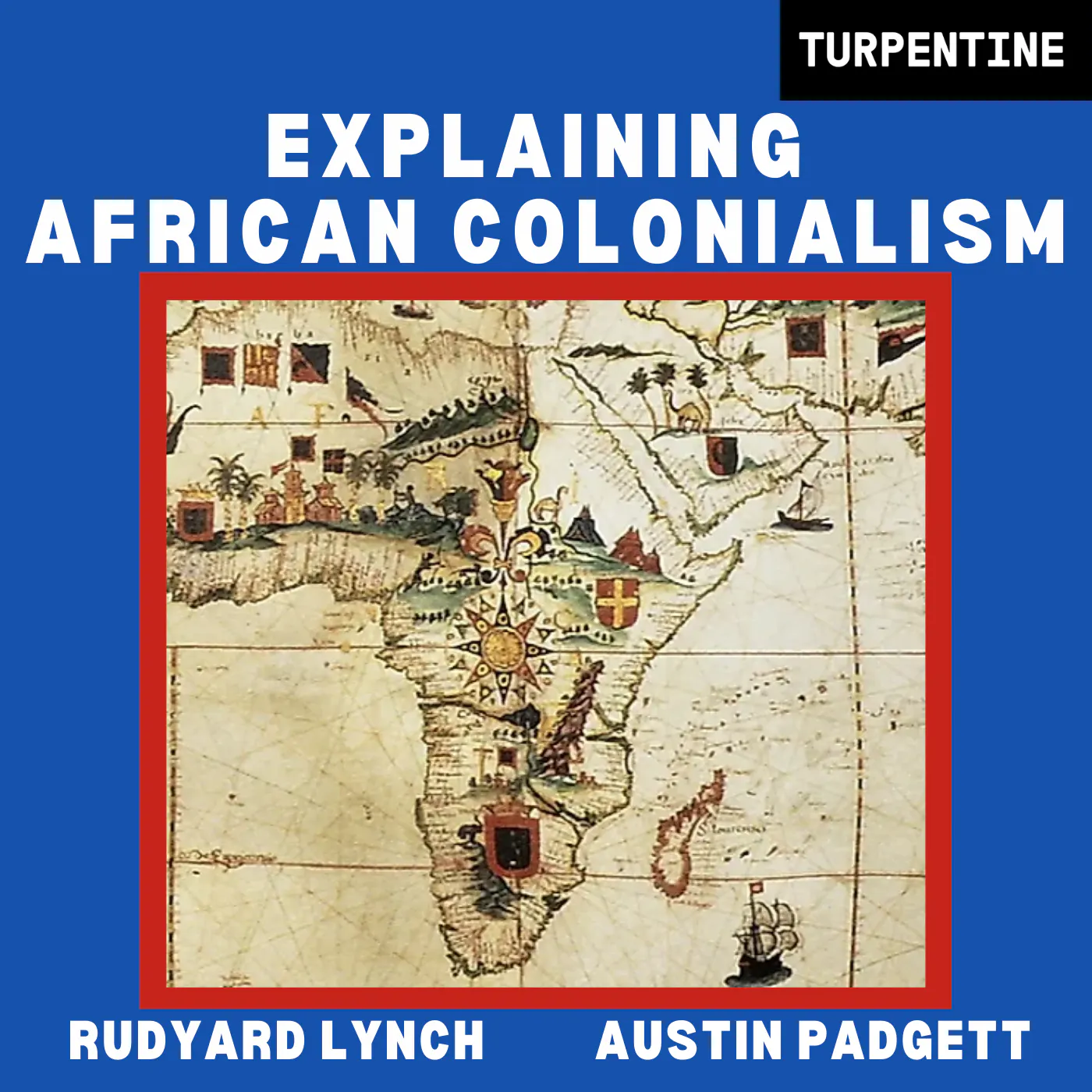
History 102 with WhatifAltHist's Rudyard Lynch and Austin Padgett
Explaining African Colonialism
01:36:54
Loading summary
Transcript107 lines
- [00:03]
Whatifalth
Welcome to History 102, where YouTube creator Whatifalth hist, Rudyard lynch and Austin Padgett dive into critical moments in history and tease out patterns to help us predict the future. Let's jump right in.
- [00:16]
Rudyard Lynch
Hi everybody. Super happy to have you folks here again for another episode of History 102. And this show will be about African colonialism. And I apologize for the audio. I am traveling in Mexico right now, and thus I don't have the microphones I have back home. But I don't think it's fundamentally that bad, the new microphone quality and. Hi, Austin, how are you?
- [00:41]
Austin Padgett
Hello. I'm fantastic.
- [00:44]
Rudyard Lynch
Amazing. And so this is one of the topics where the elephant is most in action. The elephant is a term from John Haidt's work where John Haidt is one of the most important scholars of our time period. I think he's actually going to have a long term historic impact because John Haidt studies human nature and his theories just shot the blank slate. He shot the blank slate. He shot the idea that humanity is perfectible, the noble savage. And so all honest sociological and political thought since 2010 is influenced by John Haidt. And you can test whether or not someone's honest in modern politics, whether or not they treat John Haidt's studies on human nature honestly. So the elephant is the force of rationalization because there's the rider and there's the elephant. And wisdom is the process of training your elephant. And certain parts of politics today are more elephant. They're more rider. The left is completely controlled by their elephant. The rider just passed out for the left. They openly say that whatever they rationalize, they're just rationalizing random subjective crap. But I find with African colonialism, there's just this horrific degree of just emotion the second you touch it. And I don't really get why, because if you're European or American, this is something that has very little downstream historic effects on you, where it's relatively unimportant to the West's historic trajectory. But it's due to the left making a strategic calculation in the mid 20th century in America that they should work with black people to get them more political power. And then this became a religious doctrine for the left where they're like, we must support the continent with the biggest amount of black people, even if they're not that close to our American black people. And so I find with Europeans, especially African colonialism, it's like you're touching. It's, it's, you're, you're touching so many Pain, sore points. That and my attitude here is like, I don't care. I'm just going to tell you the truth. Because the more you dance around it, the more people see weakness and they try to attack you.
- [02:58]
Austin Padgett
Right. A good example of that is even the Leopold narrative. It's a popular example of some of the most horrifying abuses of colonialism with the Belgian Leopold occupation of the Congo. But I had someone tell me the other day that apparently the rate of hands getting chopped off, which is seen as pretty emblematic of Leopold's terror, decreased drastically after Leopold took over because the Arab slave trade was no longer in charge.
- [03:29]
Rudyard Lynch
Interesting.
- [03:30]
Austin Padgett
So even, even stories like that can have hidden details.
- [03:34]
Rudyard Lynch
I'm glad you said that because I was actually going to bring up that story during this episode where I. This is how dedicated I am for this job. I read statistics that 8 million people died in Leopold's atrocities in the Congo. And I read other stats that the Congo's total population was 11 million at the time. And I was looking at that and I thought, that doesn't add up. It doesn't add up that Leopold's killed three quarters of the Congo's population. So. So I studied more and then I realized those numbers were completely falsified by a leftist academic.
- [04:14]
Austin Padgett
Interesting. And the way I heard it was he was basically trying to make the colony work and he was trying to be more European about it, and he was failing. So he eventually resorted back to a lot of the status quo practice, but not as aggressively.
- [04:33]
Rudyard Lynch
So I'm not going to defend Leopold because I think ostensibly he is a horrible person. Where you remove the leftist narrative, the stuff that remains true is so deeply horrifying. Where Leopold actually wasn't Belgian, he was an ethnic German that the Belgians brought in because they needed a monarch to stabilize their internal politics with the way 19th century Europe worked. And he didn't have that much power in Belgium. And then due to the Treaty of Berlin, which we'll get to, all of Europe wanted to avoid the Germans taking Central Africa because Germany had just unified and it was this great power. And so the European great powers agreed to give tiny Belgium, this area of Central Africa, the size of Western Europe, because the Congo is as big as the Congo. If there's a great website called the True Size of. And if you drop the Democratic Republic of Congo, it stretches from like San Antonio to North Dakota and from across the entire American Great Plains. And it's the size of all Western Europe combined. And it had about 10 million people at the Time. And Leopold got the region as his own private fief. The locals had no legal rights. And then he wanted to get very wealthy. His previous plan was to buy Taiwan. And there was this huge rubber craze in Europe due to the invention of the bicycle. And he wanted to get in on the rubber trade. And so he sort of just brutally destroying the local population where it was millions of deaths and the region didn't. Rubber takes a long time to form. And so we told the locals, if you don't get me rubber, I'm going to cut your hands off and kill you. And there just wasn't the rubber. So there was a lot of hands and hands and heads off. And this was really horrifying because the Europeans had all these myths of colonialism, that colonialism was about civilization. And Leopold hired his own bands of thugs to carry this out. And American and British journalists realized what was happening. It became a huge publicity scandal. And then the Belgian government took the Congo away from Leopold. And this is the part people forget that the Belgian Congo was considered the most humane colony in. In Africa after the loss of Leopold because the Belgians over did trying to be nice to the Congolese. And so they didn't have a lot of political freedom, but for material comfort and for the state giving out material goodies to the population. The Congo was seen as the most humane governance in Africa after Leopold. Leopold was by far the worst. He's. Yeah, he's. He was terrible.
- [07:22]
Austin Padgett
Yeah. I have a lot of thoughts on colonialism because from the leftist perspective, a lot of their criticisms are inaccurate and out of context with regards to slavery and other things. But it prevents us from ever really talking about colonialism on another dimension where it's like, where was it actually wrong? Where could we have had better relations with these countries and also benefited more ourselves with a different approach? And that we never get to that discussion.
- [07:53]
Rudyard Lynch
Which is why I wanted to start this video with like Popping the emotional pimple where I. I do not want to have this conversation about the emotional connotations of colonialism. So I will start with that and then leave it and I will just tell you the truth because I refuse to honor silly people. I only speak to a level. If you are a silly person, I do not want you to watch this podcast. I would only like to. I would only like you to watch this podcast if you are capable of rationality and objectivity. And so let me start it with this. Africa is truly huge. I'm sure all of you have seen the map of how you can Fit China, America, India, and all of Western Europe in Africa at the same time. And Africa is wider across from Senegal to Somalia than it is up. Down. We get the. The Mackinder. Not the Mackinder. It was the.
- [08:49]
Austin Padgett
There's.
- [08:50]
Rudyard Lynch
The Mercator projection really doesn't do Africa justice. Where the Sahara is as wide across as America least. And there are three general regions of Africa where Africa straddles the equator and it gets roughly equivalent distances away from the equator, with South Africa and North Africa existing roughly at the latitudes of Texas. So the coolest Africa gets is Texas. And the extremities of Africa are largely. Are largely healthy for white habitation. In the same way, I joke that there's. I joke that there's a line in Texas where Anglo American settlement just becomes impossible south of San Antonio. You just can't have Anglo American populations. And we both live in Texas and we've driven across that line together. And so I've made the joke as we cross it. But once you get closer to the equator, Africa's climate becomes really inhospitable. And the Africans have gone through an enormous genetic gradient to adapt to it. McNeil's book Plagues and Peoples, he makes a very interesting point that since humanity evolved in Africa, that the diseases in Africa evolved with humans. And thus, and thus, due to that, humans were stuck at artificially low population rates because the diseases were so vicious to us. And in the rest of the world, humans were able to break out of the ecological equilibrium we evolved in in Africa where in Europe or Asia or the Americas, humans weren't there long enough. Humans have been. Humans have left Africa less than 100,000 years ago, which is nothing geologically. And so those areas were capable of basically having much larger population densities than Africa was because they didn't have the disease issue. And diseases get worse in Africa the closer to the equator you get and the more. And the more wet the climate is. And a lot of these diseases are just. They're the most horrifying things ever. And I am going to purposely gross you out because these people had to live through this if they could live through it. You can afford to listen to it. Where these. Some of these diseases. Dengue fever, as an example, it's. Most of these diseases come from mosquitoes. And I want to also emphasize this. This is one of the things where you should be very collectively grateful to modernity. Modernity got rid of these horrifying demon illnesses for you. You don't have to face them anymore. We live in Texas Texas did not used to be Texas had a horrifying dengue and malaria. Dengue fever. Bug bites you after three days, you vomit out your entire intestines, you vomit out blood, you vomit out this horrifying, viscous yellow liquid. And then you die of dehydration and there's a 90% death rate. That's yellow fever. Dengue is somehow even worse. Dengue. I forget. Dengue is really horrible. Dengue, Malaria. Malaria. Almost everyone in the tropics caught malaria in the pre industrial world. And malaria keeps you sick for years. You have recurring lethargy from malaria, another disease that nearly kills you. And it gives you this horrifying sweet. It gives you this horrifying fever. So dengue, yellow Fever and the TZtz fly. The TZtz fly did the tease. What illness did the Tz Tz fly spread?
- [12:31]
Austin Padgett
That was like a nursery run.
- [12:32]
Rudyard Lynch
Yeah, I always thought that as a kid, my dad would tell me at the Tztz fly as a kid. And we had a running joke at the Tztz fly. He said, it's a fun word. It was. We'd say like tz TZ fly and we'd pretend to bite each other and then catch illness.
- [12:45]
Austin Padgett
When I was like, so you remember your sleeping net? When I was in Uganda, we had nets overall, the best beds. And you got to close those.
- [12:53]
Rudyard Lynch
So the Tztz flies spreads sleeping sickness. And sleeping sickness is. Oh yeah, you just fall asleep forever and die. So I don't think I grossed you out effectively enough. But I'm going to move on. I needed to be more dramatic about that. But I lack enough knowledge of horrifying diseases. And an example of how much this affected the region is that 60% of Tanzania was completely uninhabitable until a century ago. And lots of central Africa was completely uninhabitable. You had these huge regions of Africa hundreds of miles across where there was no human settlement due to the sleeping sickness and where there were these lions. And so when the British colonized Kenya, they ran into these huge oversized lions due to these horrifying diseases that the lions ran the land. And Africa didn't have horses basically until now, because horses all died of sleeping sickness. And until about a century ago, 90 plus percent, until the industrial revolution, 90 plus percent of humans lived in the great four civilizations. Europe, India, China and the Middle East. And Africa had incredibly low population density. Where Africa in the year 1900 had a third of Europe's population. Now Africa has a significantly higher population. And one of the downstream effects of colonialism and modern science was to see Africa's population balloon due to the breakthroughs in agriculture and these illnesses where now Africa has a significantly larger population than Europe. But you should see Africa in this time period as a very lightly populated place. There were only a handful of cities in Africa clustering in certain areas. And on top of that, we technically say Africa is part of the Old World, the Old World being the things we knew about before Columbus. But you should really see Africa alongside Australia as part of the New World, because they were only really dragged into the global system after the European age of exploration. At least a lot of Africa, and they were the first people, at least large parts of Africa. The first people they encountered were Europeans. And so much like the New World, they were forced to have this enormous change. Whereas they encountered the Europeans, they were immediately slammed by thousands of years of technological difference, which makes them in a lot of ways comparable to the Native Americans.
- [15:36]
Whatifalth
We'll get back to the conversation in a moment after a word from our sponsors. What does the future hold for business? Ask nine experts and you'll get 10 answers. It's a bull market. It's a bear market. Rates will rise or fall. Can someone invent a crystal ball? Until then, over 41,000 businesses have future proofed their business with NetSuite by Oracle, the number one cloud ERP bringing accounting, financial management, inventory, HR into one fluid platform with one unified business management suite, there's one source of truth G giving you the visibility and control you need to make quick decisions. With real time insights and forecasting, you're peering into the future with actionable data. When you're closing the books in days and not weeks, you're spending less time looking backwards and more time on what's next. If I had needed this product, it's what I'd use. Whether your company is earning millions or even hundreds of millions, NetSuite helps you respond to immediate challenges and sees your biggest opportunities. Speaking of opportunity, download the CFO's guide to AI and machine learning at netsuite.com Zen the guide is free to you at netsuite.com Zen netsuite.com Zen so it's a new year, 2025, and one of the recurring questions I've already been receiving is, should I start my own business? Can I do it all on my own? Now more than ever, my answer is a resounding yes. With tools like today's sponsor, Shopify, it's never been easier to start pursuing your dreams. Shopify makes it simple to create your brand open for business and get your first sale. No coding or design skills required. They also help with the details like shipping, taxes, payments, and have social media tools that connect all your channels and create shoppable posts, allowing you to focus on the important stuff like growing your business. What happens if you don't act now? Will you regret it? What if someone beats you to the idea? Don't kick yourself when you hear this again in a year because you didn't do anything. Now established in 2025. Has a nice ring to it, doesn't it? Sign up for your $1 per month trial period at shopify.com momentofzen all lowercase go to shopify.com momentofzen to start selling with Shopify today. Shopify.com momentofzen.
- [17:56]
Austin Padgett
You want to hear a good example of how that is that confirms that basically.
- [18:02]
Rudyard Lynch
Austin, just tell me.
- [18:03]
Austin Padgett
Yeah. Explorations and Adventures in Equatorial Africa is a book by Paul de Chalu. He. He details his expeditions through basically the equatorial region of Africa, looking for the gorilla, which the existence of which was not confirmed. And this was in the mid 19th century. So he. He went through parts of Africa that nobody had ever been to. He documented it all. They were using these giant kind of crossbows, like French kind of crossbows modified to be bigger. And then they would use a thin reed with poison on it. And because the crossbow was so big and the reed was so small, it would shoot like a piece of hay out of a tornado and go right through things. So just a weird kind of mix of technology and basically completely unexplored areas.
- [18:54]
Rudyard Lynch
From the European perspective, you are very good at transitions. There are certain points where, like, you'll make a transition. And that was a point I was trying to reach, but I didn't figure out how to do it. The gorillas are a great example because it leads to the first interaction between sub Saharan Africa and the rest of the world, where Africa is functionally part of the New World that split apart from the Eurasian system. Because the Sahara is the size of America and the Sahara is dead flat. If you've seen deserts in the American Southwest, the Sahara is like five times as dry. The Sahara is this huge ocean of sand. And the region. There was one major region of Africa that had cities before European colonialism, the Sahel, where the Sahel had these Muslim kingdoms stretching from the Atlantic to the Red Sea. And the Sahel is Arabic for the shore, because the Arabs saw the Sahara as a great desert ocean that societies would be on the shore of. But the gorilla is important because the first record we have of sub Saharan Africa was a Phoenician explorer named. Not Pythia, it's. Who. What? Hanno. Hanno, right. The Periplus of Hanno. I read that as a teenager. And the Periplus of Hanno talks about this guy from Tunis who sailed through the Straits of Gibraltar or the Pillars of Hercules along the coast. And he sailed down to Liberia and he said, he says that there was a people called the gorilla. And the gorillas, where he calls them apemen, and he saw them as a type of human, and that was the final thing he saw in Africa. And then the gorillas attacked them and they got scared and they sailed back to Tunis. So it all starts with these giant elephants. And so the Greeks had some interaction with sub Saharan Africa as well on the other side, where, I mean, the Phoenicians. The Phoenicians were in the west. And when the Greeks ran Egypt, they sailed all the way down the coast. And the Indian Ocean is part of its own specific axis where first the Greeks and then the Persians and then later the Omanis had these settlements on the east shore of Africa by the Indian Ocean. And so Zanzibar, which is this island off the coast of Tanzania, which I've been wanting to travel to for years, was founded before the birth of Christ. And then Zanzibar, they became. They were Arabs. And so these Arabs settled in the coast of Africa where they had slave trading. Watch the slave trading video. And they brought slaves up north to the Middle east and they called the land Zanj, or land of the blacks. And by the time the Europeans showed up, Oman, or by the time of the 1700s, Oman in Arabia, had conquered an empire of the entire east coast of Africa, down to Mozambique. So the Europeans, the Europeans arrived after they. There had been pre existing centuries of Islamic empires in Africa.
- [21:57]
Austin Padgett
Right? The. Yeah, I mean, I guess most of our sources would be from a lot of the Islamic interaction, at least because they were the only ones who could cross the Sahara, right?
- [22:09]
Rudyard Lynch
Yes. So the Muslim interaction with sub Saharan Africa, we talked at the east coast, where that was sailing up and down the Indian Ocean. And that whole region converted to Islam. And then you have crossing the Sahara. And the Romans had some vague notion you could cross the Sahara, but it was so far they barely thought about it. And the Arabs, the first world to really have intercourse across the Sahara, where they established these kingdoms or the locals had these kingdoms on the other side of the Sahara, such as Khanem and Bornu and Wadai in the Sudan. And the Muslims entered in those areas, converted to Islam and they became extensions of Islamic civilization. Where mali had like 2 to 4 million people, it had a library, it had vast cities. So there was this Sahelian African system that let's not get into because it belongs to a, it belongs to a pre colonial African civilizations video where the Muslims were getting involved in Africa for centuries. And you had for example, Morocco conquered across the Sahara in the 1500s. They had an army walk across the Sahara to take out Timbuktu. And later on, when Egypt rebelled against the Ottomans in the early 1800 under Muhammad Ali, they formed their own empire and they conquered as far south as the DRC and, and, and Uganda, which is insane, is they conquered all of Sudan and South Sudan. And in a lot of ways the Muslims were colonizing Africa before the Europeans. And the Muslims would have taken a good chunk of Africa if the Europeans weren't there, because Morocco, Oman and especially Egypt under Muhammad Ali, they were trying to carve up Africa earlier.
- [24:07]
Austin Padgett
Right.
- [24:08]
Whatifalth
We'll get back to the conversation in a moment after a word from our sponsors.
- [24:12]
D
Even if you think it's a bit overhyped, AI is suddenly everywhere. From self driving cars to molecular medicine to business efficiency. If it's not in your industry yet, it's coming and fast. But AI needs a lot of speed and computing power. So how do you compete without costs spiraling out of control? Time to upgrade to the next generation of the cloud, Oracle Cloud Infrastructure, or oci. OCI is a blazing, fast and secure platform for your infrastructure, database, application development, plus all of your AI and machine learning workloads. OCI costs 50% less for compute and 80% less for networking. So you're saving a pile of money. Thousands of businesses have already upgraded to oci, including Vodafone, Thomson Reuters and Sunoai. Right now Oracle is offering to cut your current cloud bill in half if you move to OCI for new US customers with minimum financial commitment. Offer ends March 31st. See if your company qualifies for this special offer@oracle.com that's oracle.com cognitive and people.
- [25:19]
Austin Padgett
Don'T have this in their mental model. Kind of like I mentioned, Leopold taking over slave trade from the Arabs. People didn't think of the Arabs being there. They thought of it as the Europeans kind of coming into the system. And wasn't the richest guy in history, according to some people, the African guy from Mali. And so would that have been connected to the Arab slave trade? Because I think he lived in the 1500s.
- [25:44]
Rudyard Lynch
He was in the 1300s. Okay, so I kind of doubt that Mansa Musa was the wealthiest man ever, Because I will give those societies credit. Where lots of racists think that Africans can't build civilizations. That's clearly true. That's. Sorry, it's clearly not true. Africans can clearly build civilizations. If you try to cancel me for that misstep, you are stupid. I am making your exact point where Africans can clearly build civilizations. And Mali had a professional army. It had a government system, it had libraries, it had several million people. But Mali had a population roughly equivalent to England. And I have. I find it hard to believe that, like, the king of Mali was wealthier than the emperor of China, who had 300 million people in the 1600s where he could siphon income off from them. The emperor of China had 100 times Mali's population. And there's so much lying on African history that I don't really trust any authors at this point who say, like, blank, African king was the wealthiest person ever. Because they lie about everything else.
- [27:01]
Austin Padgett
Yeah, they're just trying to. They're trying to engineer a stat. There's probably a few ways to look at it. Maybe there's some sort of. Maybe there were. There was more minerals there or something. I don't know exactly what they're looking into, but yeah, it's a sort of relevant claim. I think part of his story that contributes also to his richness, perception of his richness is I think he gave away a lot of wealth. Like he. He became really rich and then he gave away a lot of gold and kind of crashed the economy.
- [27:31]
Rudyard Lynch
Yeah, he went on Hajj to Mecca and then he gave away a tremendous amount of gold. Because Mali was a big gold making center. And they had the legends that the gold came from this dragon, the bitter serpents. They pulled the gold from the dragon. And I could make a video about pre colonial Africa in the future. I don't want to get too involved, but he crashed the entire economy of North Africa by dropping so much gold on it. And with. Besides the Muslims, the Portuguese were the first people to really bring west and South Africa into the equation. Where the Portuguese were trying to reach India. And so they were the ones who sailed around Africa. And they finally succeeded a few years after Columbus and the Portuguese established a series of forts along the coast of Africa. They had them in Angola, which remained a Portuguese possession until the 20th century. They had some in Nigeria, in around St. Louis and Dakar, and then they had forts in Kenya and Somalia. The Portuguese briefly held the entire Indian Ocean system. And they had a line of forts that stretched from the west coast of Africa all the way to Japan and Taiwan, which. Or Japan and. And Singapore, which is deeply impressive for a country that small. And with the European colonies, because there's two stages of European colonialism in Africa. You have stage one, which is forts along the coast, which was 1500 until. Until 1850 or 1818 50. Then at the end of the 19th century, you saw the scramble for Africa, which is actually the shortest portion of this. So for almost all of this time period, European colonialism in Africa involved having a series of forts along the coast and using them for slave trading or for resupplying to reach the Orient. Because the Europeans saw Asia as vastly more valuable as it. And then Africa. And they saw Africa as just a way to get to Asia. And the reasoning that the Europeans just had these forts along the coast is that African diseases were so deadly that any European who even set foot on the coast would die. There was an 80% mortality rate of British officers sent to Nigeria, which was the most deadly part of Africa for diseases in the mid-1800s. An 80% mortality rate is just absurd. It's just you're diced with death. And so it's ironic that the Europeans had these coasts off the coast of Africa for centuries. But it wasn't until the mid to the end of the 19th century that the Europeans had any idea what the interior of Africa looked like. Where if you look at maps from that, let's say the era of the American Civil War is they have the coast of Africa perfectly and there's nothing for the interior of Africa. They'll sometimes have like the Mountains of the Moon in Central Africa or they thought there was like the huge Black Sea in the middle of Africa. But it's funny to see that until a little bit more than a century ago, the Europeans had no idea what was going on in almost all of Africa south of the Sahara.
- [30:55]
Austin Padgett
Right. We didn't know the source of the Nile or anything. And it's amazing how persistently people kept trying to go with the 80% die off rate. Because that's not like it was one expedition that was recorded. That's the rate over many, many expeditions.
- [31:12]
Rudyard Lynch
Yeah.
- [31:12]
Austin Padgett
Which is a pretty crazy thing to set off on.
- [31:15]
Rudyard Lynch
One of the things I think about that a lot or like guys being willing to go to the Amazon or the Age of Discovery and like with the whole mouse utopia thing, which, you know, is one of the biggest themes of, of the YouTube channel I have, is like the second, people leave grinding poverty, they stop doing anything interesting. You had to have a society where almost all Europeans lived in poverty to get them to conquer the world and have the industrial revolution and invent science. And it's hard for us to understand, I think a lot about how for most eras of human history, life was seen as relatively cheap. And now we're a society where if a handful of kids I don't know are complete idiots and then they jump off a cliff out of boredom, we're like, oh my God, we needed to intervene to stop them. Like, no, the kids are just stupid, right?
- [32:09]
Austin Padgett
And, well, that's that. We get back to the blue pill vision of trying to control for uncertainty, which is impossible, and then creates more problems and you can hide it through building up fragility. But It's a silly 21st century game based on the illusion of invincibility granted by our technological prowess.
- [32:28]
Rudyard Lynch
You could die tomorrow. You could die for reasons completely outside of your control. So, yes, the Portuguese had a bunch of forts and they used Africa mostly for slave trading, which we have a previous video about. But after the Portuguese, the Dutch were the next players to intervene in Africa. And the Dutch had a strategy in the colonies of just targeting the Portuguese because they were on an 80 year war with the Spanish, who the Portuguese were in a joint monarchy with. So the Dutch, their entire colonial strategy is we want to take every single Portuguese fort and this dominate them. And the Dutch, their attempt to reach the East Indies with Indonesia, that was their main motivation for Africa. And a group of boats, part of the Voic or the Dutch East Indies, they crashed at the bottom of Africa and they invented modern South Africa with Cape Town. And Cape Town exists roughly with a climate comparable to Texas's or it's a Mediterranean climate. And so the region is habitable for Europeans. And one of the things that we don't think about is that the genetic differences between Africans are greater than the entire rest of the world combined, because Africa has multiple distinct races inside of it that have more genetic distinction than like anywhere else in the world combined by a vast margin. And the locals of South Africa were the Khoisan, and the Khoisan are the Bushmen. They make the. Their language is clicks. And the. The Blacks, Black Bantus pushed the Khoisan south, where during the time of the Roman Empire, the Khoisan lived as far north as the Congo River. And then the Bantu gradually pushed them further south, where black people are not indigenous to South Africa. They only came pretty briefly before the Europeans did where they were settlers from further north. And when the Dutch reached South Africa, the hunter gatherer Bushmen had no immunity against European diseases, much like the Native Americans, which is ironic because black Africans have the highest level of genetic disease immunity of any group in the world. So you're pairing one of the highest disease immunities, which is one of the lowest in the same region. But the entire native population of South Africa are 90% died off due to diseases. So the Dutch started settling their own men in South Africa. And it's more useful to see South Africa as like a Canada or America or Australia, this settler colonial society where the Dutch, the Dutch had to populate and settle it. And interestingly, South Africa could have ended up being majority white in a lot of different timelines because it's, it's similar climate to Austria Australia, except for the east of the country, the native population and wiped out by disease. But the Dutch weren't really into settler colonialism, which is why there are so few Dutch Americans, even though the Dutch briefly had a colony in the mid Atlantic region. And so because the Dutch didn't really believe in exporting white people, they made South Africa to be this slave economy where they brought slaves in from West Africa, they brought slaves in from Indonesia and Asia, then they also brought slaves from further north. And so the Dutch forms this majority population in the Cape region called Cullards. And there's the Cape Coloreds, which is not a PC term in America, but in South Africa it's just a racial category where the Cape Coloreds are a mix of all those populations I mentioned before. And they're the majority population of the western half of South Africa. And South Africa was a completely unimportant colony until the British took it in the 1800s. And South Africa set itself up to become this regressive slave society because the Dutch only operated in their short term profits.
- [36:44]
Austin Padgett
Interesting. Yeah, it's interesting to think of the alternate history and that that's what it hinges on. So it came back to bite them, that strategic choice.
- [36:56]
Rudyard Lynch
Yeah. I made a video five years ago, four or five years ago, where I changed that up. Where South Africa is a British colony and it ends up becoming another Canada or Australia, a majority white settler colonial society. And over time, a bunch of European powers got these forts along the coast of Africa where the British had some, the French had some. And this had large downstream effects on Africa, which we discuss in the slave trade video, where the Africans would trade with the coastal Europeans. So as I was saying, the European coastal fort period had Large downstream effects across all of africa. Where it was causing this African social revolution. And interestingly, a lot or the southern half of africa. Was going through its political crisis. Among the local peoples, where they had wars of genocide, they had mass depopulations and mass migrations. And that was mostly caused by the islamic slave trade. Because the slaves coming out. The slavers coming out from zanzibar and the east coast. For the muslims, they went as far south into the central democratic republic of congo. And, interestingly, Malawi was seen as special. Because they were able to form a strong government. To fight off the slavers. So malawi was an island of peace. And an example of the sociological stresses. That came about from this. Was in zululand with shaka zulu, where he. Fitting the normal pattern for conquerors. He was the son of a minor chieftain. Who was horrifically abused as a child. With his tribe destroyed. And then he rose to be a great conqueror. Where he turned the zulu, an otherwise completely insignificant people. In the natal region. Of northeastern south africa, into conquering the whole region, which is still roughly the size of new jersey. But then shaka Zulu made the african version. Of a totalitarian state. Where all young men had to live in barracks together. Where they weren't allowed to get married until age 40. And Shaka was kind of a thug himself. Where he gave his soldiers these short spears. They'd fight in combat. And then every time you would kill a man, he would say he would rip his heart out. Or he'd frequently, on killing someone, he would rip his heart out and say, I have eaten. And he would practice Bizarre sexual rituals and that stuff. Nice guy. And he was. He did that because the downstream effects of the islamic slave trade. And the introduction of european colonialism. Had created this sociological chaos. Across the whole region. And the rise of Shaka's kingdom. Created this mass migration. Called the mythic hana, where peoples migrated out from the former shaka area. And some of the tribes went 500 to over 500 miles. Where they conquered lands in zambia.
- [39:59]
Austin Padgett
Wow. And this is a south african population, but it's different than the bantu, and it's different from the coastal population.
- [40:06]
Rudyard Lynch
Shaka was bantu where that.
- [40:08]
Austin Padgett
Okay, so they are bantu.
- [40:09]
Rudyard Lynch
Yeah. The northeastern region of south africa. Was ethnically bantu. They migrated in earlier, a few centuries.
- [40:17]
Austin Padgett
So they were like a outskirts bantu population. That then went back. And conquered a lot of the formerly bant, or the currently bantu area.
- [40:27]
Rudyard Lynch
The further south you went in Africa, generally, the freer the black societies were. And the more fluid you can See this in polygamy, where West Africa has vastly more polygamy than South Africa because it's more of a frontier culture. And women tend to have higher social status and frontier cultures. So people tend to overstate the importance of Shaka's empire historically. Again, this is an area the southern size of New Jersey. And I think that's because history books want to have, like, a great black conqueror. So they pick Shaka. So Shaka was a relatively small area. Then he unified, conquered the region. And then the tribes that also lived there, who he launched genocide against, they launched a series of migrations further north into Africa against their Bantu kin. In Bantu is a language family. It's like saying Indo European. So by this definition, the British conquering the Hindis in India is going against their own kin. But you get my point, right?
- [41:26]
Austin Padgett
So basically, it was like a ripple effect from the edge of Bantu populations back inward. And I guess a big part of it, right, is the. Just the marketing around it. You have the shields. You have it featured in a couple stories, and it becomes part of the public consciousness.
- [41:43]
Rudyard Lynch
The Zulus, they were on the edge of the region of European colonization where they fought the Dutch first and then the British, because the British took South Africa as part of the Napoleonic wars, when the Dutch were conquered by the French and the local Dutch population, or the Boers, who migrated to the region in the 1600s, and they developed their own language related to Dutch, which is the closest language in the world to English, Afrikaans. And so when the British abolished slavery, the Boers migrated from the Cape hundreds of miles to the area around Johannesburg that was very lightly populated. When the. When the Europeans settled Johannesburg, there was almost no local population there. And there was a lot of diamond mining, which they built their state around. And there were several different Boer republics. And they formed to continue to practice slavery after the British abolished it. And they were this frontier society, and that's the origin of apartheid culture, as the Boers became dependent on local black labor. But the Boers have both negative and bad traits. Partly they're. They were incredibly abusive to the blacks. They practiced slavery, but they were a very tough people. They were very unified. They were very moralistic. And they fought the Zulus. And you have the story of the battle. I think it's the Battle of Blood Creek, where I. I think, like, 70 Boers took on thousands of Zulus and beat them because the Boers had the advantage in firepower. And the British also fought the. Fought the Zulus later. And the. The reason the Zulus have been immortalized is that the Zulus were actually able to wipe out a British field army at the Battle of Isla Delwana. And this was completely shocking because the Europeans just decided, assumed that no Africans could ever beat the Europeans.
- [43:41]
Austin Padgett
How did they beat him in the field army?
- [43:43]
Rudyard Lynch
So the Zulus had a strategy called the Bullhorn where they would have an army charge you, then they'd surround you and crush you from behind. So the Zulus were able to do that to the British and they had enough numeric superiority they could kill the Brits. But then the British sent another field army to finally take out the Zulus because both the British fought both the Zulus and, and the Boers where they had. The British had a horrifying war with the Boers at the end of the 19th century because they found diamonds and mineral deposits in those regions of South Africa. And what before we get into, without all of the rhetoric about civilization and that stuff, there is this underlying current that the British started the war is just for the minerals.
- [44:29]
Austin Padgett
Right. And mostly against the Dutch in terms of their competition. And like you said, when the Dutch got there, they were very few people. It's because the people that lived on the coast were literally the coastal people who lived off the ocean. It was not an area suitable to farming until the Dutch brought their technology and that expanded the arable zone much further inland. And then you bring in the people. So that's, that's how the coastal inland.
- [44:58]
Rudyard Lynch
Dynamic works in South African politics today. There's this huge dynamic where the ANC wants the African National Congress, which are basically a communist party. They're trying to take the farmland away from the whites, which is one of the most potentially disastrous decisions possible. We saw the effects of this in Zimbabwe where they took away land from the white farmers and Zimbabwe went from Africa's breadbasket to a place where people were. It was one of the most starved countries in the world where African agriculture, European agriculture is what allowed South Africa to become an urbanized society. And with the ANC very clearly wanting to take the whites land, South Africa will descend into being another Zimbabwe. And that's going to be completely horrifying in Africa. South Africa is already a failed state and it's just going to get worse.
- [45:49]
Austin Padgett
Yep. And the first time with Rwanda, it was kind of in this prime anti colonial post MLK Western feeling where basically the entire world turned against Rwanda and kind of undermined them with sanctions, I think, including even the U.S. yeah. And now with South Africa, everybody, there's no question, as about as to the way that this ends. It's not a simple moral question of representation. It's like, hey, these are the. The structures and situation. And I. I had a good friend, Mike, I'm forgetting his last name, but I worked with him a bit in Indonesia. He was monitoring a rose plantation and he was Rhodesian, and he fought in the war back in the day in the helicopter squads, and he got shot in the head, but, like, from a bullet going down, looking over an edge and had, you know, blood all over his face and was, like, still fighting and then getting taken away in the helicopters and going to the next bus. It was like a real crazy, intense war. They were really fighting hard, and he really believed in it and he was really sad about it. Still to this day, most of the fighters in the Rhodesian army were also black and local. And there was a. There was a real, like, internal country division, a bunch of people who. Who wanted the society. And then, you know, the opposing largest tribe with Mugabe, I think. And so, yeah, it's painted as, like, a white apartheid state, but it was, you know, really a civil war. And most of the people making up the infrastructure and fighters, not all the helicopter squads of the Rhodesian army were local.
- [47:41]
Rudyard Lynch
So the argument that the apartheid government made was that the way Africa works is that a tribe, he's in control of the government, and that they. Then they use the government to support their tribe. And that's clearly true across Africa. And what the Boers said is that they were just doing that and it wasn't socially acceptable in the Western world because it's a completely different country context. And I think that's largely accurate. But having read about apartheid, the thing I really can't forgive is how much they twisted the knife. Where the. The biggest issue that you ran into with South Africa and Algeria and Rhodesia, the place with European settlement, is that these are societies that are 2002 to 3000 years apart from each other technologically and sociologically, and you can't bridge that gap. And one of the myths the left makes is the left thinks you can force someone to progress and force someone to improve. And that never works. A specific culture has to make the decision to improve themselves, and you can't force it. It's actually tyrannical to try to do so. And so you naturally have this issue of two parallel societies with vastly different levels of competency. But having read about it, I consistently found that they always took the next step, twist the knife. So it's all stuff like completely petty. The Whites would do these petty, these petty things where in every single place of life whites and blacks couldn't interact. Blacks had to do various forms of humiliation to degrade themselves whenever what they did. Like as an example, they forced all the black employees to be stripped naked and have their entire body searched when they got in and out of the mines. And they had multiple tiers of income so that a white who was doing vastly less work than a black person would still be paid many times over what the black person was. And so in South Africa, like expat salaries.
- [49:40]
Austin Padgett
Yes, different salary expectations.
- [49:42]
Rudyard Lynch
Saw this basically twisting of the knife of a preexisting large cultural and technological difference which built up this atmosphere of mutual hate and derision between all the different races of South Africa. And apartheid also wasn't predestined in South Africa where South Africa had two different white populations, the British and the Dutch. And the British were universally against apartheid. And under the British Empire in South Africa, educated and property owning blacks could actually vote and they could attain education and that stuff. And then what occurred after the British Empire fell is that the Dutch had a slight numeric superiority. And so the Boer Nationalist Party seized power. They changed the judicial system so the British South Africans couldn't get electoral power again. And then South Africa became this nigh authoritarian one party state where they put all of these, they put all of these incredibly restrictive regulations on the blacks that the British didn't support. And I, I would greatly have preferred the British to win in South Africa because they would have established a system where they wouldn't have made the racial line as strong, where they would have allowed the gradual assimilation and integration of the races through capitalism and through a democratic system based on education and property ownership.
- [51:10]
Austin Padgett
Well, maybe that's a little bit of the difference with Rhodesia, even though it's considered more of a hardcore example in some cases because it was British. Right. So they, they probably had a different attitude around the legal system and integration and probably had kind of more loyalty and buy in from the Africans that they were working with. Just not the largest opposing tribe, which, you know, you can obviously see that how that happens when it's happening in South Africa today in the modern context.
- [51:43]
Rudyard Lynch
There were a few concentrations of European settlement. There were a few concentrations of European settlement in Africa, one of which was in the south, where around World War II a third of South Africa's population was white. And then it peaked at around 10% in Algeria. And there was the potential for more where Italy had a colony in Libya for like 40 years. And there was a point in the early 20th century when Italy had 11 times Libya's population and the Italians were making plans under Muslimi to populate Libya. I think there was a potential for that. And same thing with North Africa, because there was a period when Europe had vastly more people than the Middle Eastern world. But you had European concentrations in Rhodesia and South Africa and in Algeria, and in each case they were kicked out directly or indirectly with the rise of the local regime. So the second the local regimes showed up, they forced almost the entire white population out. And that was more gradual with South Africa. But you're seeing it today where white South Africans have left the country where there's an interesting statistic. South Africa has more laws relating to race now than it did under apartheid, because under apartheid you had all these race laws and then with the new regime they made all these anti white.
- [53:08]
Whatifalth
Discrimination laws what does the future hold for business? Ask nine experts and you'll get 10 answers. It's a bull market. It's a bear market. Rates will rise or fall. Can someone invent a crystal ball? Until then, over 41,000 businesses have future proofed their business with NetSuite by Oracle, the number one cloud ERP bringing accounting, financial management, inventory, HR into one fluid platform with one unified business management suite. There's one source of truth giving you the visibility and control you need to make quick decisions. With real time insights and forecasting, you're peering into the future with actionable data. When you're closing the books in days and not weeks, you're spending less time looking backwards and more time on what's next. If I had needed this product, it's what I'd use. Whether your company is earning millions or even hundreds of millions, NetSuite helps you respond to immediate challenges and sees your biggest opportunities. Speaking of opportunity, download the CFO's Guide to AI and Machine Learning at netsuite.com Zen the guide is free to you at netsuite.com Zen2netsuite.com Zen the Origins of this podcast were once just a dream. That dream turned into the podcast and business you are listening to today. Taking your business to the next level is a dream lots of us share, but too often it remains just a dream. We hold ourselves back thinking, what if I don't have the skills? What if I can't do it alone? Turn those what ifs into why nots and help your business store with Shopify. Shopify is the commerce platform behind millions of businesses around the world and 10% of all e commerce in the US from household names like Mattel and Gymshark to brands just getting started. What if I don't have a big team? Shopify helps you handle anything from website design to managing inventory to customer service to global shipping and more all in one place. Marketing budget next to nil. Shopify's built in marketing and email tools help you find new customers and and keep them. What if I'm looking to grow my business in person? Shopify's award winning Point of sale connects your online and offline sales in the same place. Keen to start selling globally, Shopify helps you sell in over 150 countries, tackling everything from translations to global shipping. What if I need to boost sales? With 99.99% uptime and the best converting checkout on the planet, you'll never miss a sale again. Only with Shopify. Turn those what ifs into why nots and keep giving those big dreams the best shot with Shopify. Sign up for your $1 per month trial and start selling today at shopify.com Moment of Zen go to shopify.com Moment of Zen shopify.com Moment of Zen.
- [55:59]
Austin Padgett
Right. Well, it was a big warning for what was happening in the US And South Africa was often cited as an example of where the racial rhetoric of the left would go in terms of, you know, adding in their own discrimination from an opposite framework.
- [56:16]
Rudyard Lynch
Yes, I'm gonna.
- [56:17]
Austin Padgett
South Africa is a very useful example.
- [56:20]
Rudyard Lynch
I'm going to touch on South Africa here because it was one of the only places in Africa during the colonial period that had a economy that produced more than it cost it and that was almost entirely due to minerals because South Africa is very blessed with certain minerals where I think South Africa might have more diamonds than the rest of the world combined. And South Africa was a bridgehead for colonialism in a way that nowhere else was. Where South Africa had built up a large enough white population that it was capable of forming a new generative center independent from Europe where you had the British and the Dutch population. And Cecil Rhodes is a very Nietzschean figure where he was this poor boy from Britain who showed up in South Africa and he made the De Beers conglomerate, which makes wedding rings super expensive because they have the diamond supply, although that's been broken recently and the price of diamonds is going down. And Cecil Rhodes, Rhodesia. He was instrumental in the British taking the entire central south central region of Africa where there was a period in the middle of the 20th century century when the British controlled all of a band of Africa stretching from Cairo to the Cape. And Cecil Rhodes's fantasy was building the Cape to Cairo. And his goal was to populate the entire world with Anglo Saxons where he just wanted to have Anglo Saxons take all of Africa. And that's completely unrealistic. And Cecil Rhodes was racist even for the era. He was considered like insanely racist even for the time. And he was part of all these like right wing British associations. And I will give him, I will judge him for that. But at the same time, on a Nietzschean level, he is somewhat of an admirable figure for this like singular guy doing the empire building. That region of Africa is probably like half the size of America at least.
- [58:14]
Austin Padgett
Right?
- [58:15]
Rudyard Lynch
It's, it's interesting to see it as a manifestation of great man history.
- [58:21]
Austin Padgett
Well, and you know, the English colonies in Africa have better results going on the next hundred years because they have certain things encoded into their legal system. So it's an interesting, it's a really interesting situation Africa is in now because they had the injection of modern technology and some of the legal aspects that made that possible. And they got this huge population jump off this expanded technology, just like we talk about in France when they expanded the rights of the serfs and they expanded their popular, they doubled their population, but they didn't continue the reform in the same way as the English. And then they ran into problems where they had to kill half their population in a war. Not half, but just to get rid of the surplus population, prevent a revolution which happened later anyways. So Africa is in a situation right now where they really need to start getting their social institutions right quickly because this population jump is not going to be, that's based on advanced cultural systems is not going to be sustainable without improving the cultural political systems of Africa.
- [59:34]
Rudyard Lynch
Yeah, that's a very good point because I've seen those stats too where Africa has a little over a billion people, which is its highest number ever. And current statistical models say that Africa will have 4 billion people by the end of this century. And that's just never going to happen. Partly because the birth rate is crashing faster than any computer models we have. And this is something, this is the frigging elephant in the room. If I had a button where I could drop something on national news every day, it would be the birth rate is crashing so fast that mankind's population is going to complete, completely plummet. And so the birth rate's actually crashing very quickly in Africa. And Africa is the only large place in the world with a sustainable population now. And, and other. Also Africa just functionally cannot support 4 billion people. It lacks the institutions, it lacks the work, it lacks all that stuff. And with Africa, you saw the Europeans pull out very quickly. I'll save that for the end because you brought up an interesting point that I should bring up at the end. But to finish off with South Africa, the British fought the Boer War, which was a. A war they started with the Dutch republics in South Africa at the end of the 1800s. And Winston Churchill fought in the Boer War, where they started to get diamonds and to take it. And the Dutch fought an incredibly good war there. There it's shocking where the British had to send a field army of 300,000 men, which is if you know the British. The British never like fielding large armies to conquer South Africa because the Boers had a very innovative combination of guerrilla command. Commando was Afrikaans word with. They had better artillery than the British. They masterminded, certain. They masterminded a lot of the technologies or the military structures the Germans would later use in World War II. The Boers had a form of blitzkrieg based off cavalry and light artillery, and they had mobile troop divisions. And so the British spent so much time and effort trying to conquer this relatively small area of South Africa where the British had to completely renovate their military structure. And you had trench warfare in South Africa. And a great irony is that the second the British did conquer the Boer republics, with the new democracy they established where whites got the vote, the Boers immediately voted themselves into power. And so British. The government of South Africa under the British was literally the exact same guys. They literally elected both presidents. The Boer general became the president of British South Africa 10 years later.
- [62:17]
Austin Padgett
That's hilarious. And what benefit did the British get out of the political changes? Did they get to use it as a colony a little bit, have some troops there?
- [62:27]
Rudyard Lynch
That's another great transition. The Brits were mostly trying to get diamonds. But it also brings up European colonialism in Africa was mostly done for ego reasons. And this is something people struggle with because we have been forced to be Marxists. We're forced to have the Marxist materialist worldview, which is why you can't talk about culture or religion or that stuff. And so we are stuck in this mental model that the Europeans had to colonize Africa because they wanted to exploit it. But the reality is that Africa had negligible importance to the Europeans in the late 1800s, where past 1880 was the point where the Europeans could divide up Africa. Because due to the steamship, the railroad. The steamship and the railroad meant that the Europeans could traverse Africa, which doesn't have. Which has almost no navigable rivers. And then the Europeans developed modern medicine, which meant that Africa's diseases were no longer deadly. And past that point, the Europeans colonized Africa, all of it, very quickly. And it was mostly for ego reasons, as I said before, where I have.
- [63:34]
Austin Padgett
A way to explain that to the modern audience, which is they. They did it for the memes.
- [63:38]
Rudyard Lynch
Exactly. Yes. And so Africa's for British foreign trade. At the start Of World War I, the British Empire is at its peak. Africa combined less than 1% of their foreign trade. And this is something people. People think that, oh, the Western European economies were completely dependent on their colonial empires. No, only 15% of Britain's foreign trade was with the empire. Its biggest trade partners were France and America. And the British traded with China more than almost any of their colonies. And inside their empire of that 15%, most of it was white colonies like Canada and Australia, followed by India. Only a handful of colonies in Africa turned a profit. Those being like, the only colony in the German Empire in Africa that turned a profit was Togo due to rubber. And the British Empire, the only colony that turned a profit was South Africa. And even so, whenever these colonies turn profits, they're turning profits for a handful of Western industrial companies, not for the countries themselves. And so the Europeans put far more money into Africa than they took out. And the Europeans often made public goods. They provided education. They built roads and highway and railroads. They built up industrial. They built up industrial technology and electricity and that stuff. So they invested a lot of infrastructure, took almost no payments from South Africa, took almost no money from Africa. And I don't want to make the Europeans come across as selfless. They were colonizers, but they derived almost no benefit from colonizing Africa. And the reason they did so is because Europe around 1900, had so many young people and they had such a vast technological advantage over their opponents. Opponents, where we have stories of a handful of European gatling guns, like 20 guys with machine guns taking on armies of thousands of locals with spears in Zambia and beating them. So the Europeans colonized all of Africa, which is a huge region, and took less than 4,000 casualties total in doing so. So the Europeans were able to conquer all of Africa while taking almost no casualties, while costing almost nothing, because we forget this, but most of European colonialism was not centrally organized. It was just people showing up and doing stuff. And they report back to Europe, and Europe's like, I guess it's chill. We have a new colony. You're going to pay for it. Though, because governments were almost unilaterally opposed to sending Africa money. Where the British and the Germans were like, you guys can go out, build some rubber in Africa. We're not paying for that. And so a lot of Africa, especially French West Africa, was just European officers showing up with guns, saying, you are ours now. And then making this huge region of the map. They don't even tell the federal government until it's already happened. And another thing is that for almost all of Africa, except for a few countries that had larger white populations, the ratio of local Africans to white colonizers was a thousand to one. And the Europeans had to work with the local status hierarchies. So for most Africans, you're being ruled into the same chieftain. Your life doesn't change at all. It just. There's this distant European government that you hear about, right?
- [67:09]
Austin Padgett
And so there's a couple things you said there that I have to pick out to bring up this topic, because it's perfect. You said the European governments or countries would often respond to these plans by saying, hey, we're not paying for that. Right. So there's this pressure. It's this very expensive pressure on the government that they're kind of getting increasingly sick of paying for. Or there's increasing tension with paying for these colonial expeditions that, as you said, almost always don't benefit the people of that country. They're actually benefiting a selective corp, not corporation, but company, that's harvesting those. That specific resource. So whatever rubber company gets in because they got the British military to subsidize a little bit of an authority, they're getting most of the benefit, not the actual colonial people back home. And so this concept of white man's burden, the way we think about it is, oh, we were taking so much money from the colonies in Africa, and we started to feel guilty about it. So we came up with this excuse, which is that, hey, this is the white man's burden. We're. We're actually helping them. We're not. We're not stealing. Look, we're providing them infrastructure and all these other things and overall benefiting their society. Which justifies us looting it, basically.
- [68:35]
Rudyard Lynch
Yes.
- [68:35]
Austin Padgett
And in reality, it's. It's the opposite, where it's not a mechanism to make an excuse for guilt. It's a mechanism to generate guilt. They need the public to be willing to pay for colonial armies to go abroad so that they can conquer these nations and set up their rubber plant. And the way they do it is they say, hey, these people are living in Terrible conditions. You need to support the government funding us because it's not going to be profitable for the corporation to do it themselves. If they, if it was profitable, they could get a, they could hire a little private army and set it up. But they're using the government to subsidize their activity. That's not benefiting the people. They need an excuse. White man's burden. It's the same exact concept as white privilege where it's not something to an excuse to alleviate guilt. White privilege is specifically meant to generate guilt. It's a guilt generating mechanism to justify government money going to bridges and infrastructures and schools in the south side instead of the Congo or wherever.
- [69:47]
Rudyard Lynch
So Africa was colonized by the Europeans in a very short period of time with over a very large region. So there's this map of Africa in 1880 and then Africa in 1910 and over that very short period and especially it's concentrated in the 1890s when most of Africa was carved up. You saw a map of Africa that was almost all run by locals to the entire continent, barring Ethiopia and Liberia. Liberia is not really an exception, except Ethiopia was run by Europeans. And the reasoning for that was that the, the British conquered Egypt and they set up this independent governed society under the Mameluke, under the Mameluke Cossack, under the Mameluke Step dynast Dynasts. To reach India is the Brits need to take the Suez Canal. And this would cause some drama because the French had built the Suez Canal because they wanted to take Egypt. And so the French built the canal and the Brits said, psych, this is ours. And this nearly started a war between the British and the French. Where the British and the French skirmished in Fashoda in which is the border between Sudan. It's weird to think the British and the French are fighting each other in the borderland in Sudan and the Congo. And this is one of those points where World War I nearly started with the Fashoda incident was huge because that nearly started a war in Europe. But then the French backed down and they said Britain, you can take Egypt and Sudan and we don't want to fight you. Because the Germans were going to, the Germans were teaming up with the British against the French. And the French thought, yeah, we're not going to win that war. And the Fashoda incident sparked the Europeans carving up Africa. And they did so because the cost was very minimal to them, while at the same time they didn't want it was fomo. They didn't Want other Europeans to take it. And so the French took this huge region of West Africa that's mostly desert where they linked their colony in Algeria, where the French conquered Algeria like 50 years or the other colonies in Europe and they had a significant white population there. And the French conquered the Maghreb and then they connected it with their old, centuries old fort of St. Louis like, like Missouri in near Dakar. And so the capital of French West Africa was Dakar and it stretched across the whole region. And then the British grabbed the couple pieces of land attached to old slave trading forts in Nigeria, Ghana, Sierra Leone. The British mostly connected the region from Egypt down to Cairo. And the British also had a small white population in Kenya who did plantation farming, who were upper class Brits. And so then the Portuguese had their pre established colonies in Angola and Mozambique. From the slave trading era in the 1600s those expanded out. The Belgians took Central Africa and then the Germans took a few pieces of land in Tanzania and Tanzania, Namibia, Togo. And the Germans didn't want to have an empire where Bismarck purposely went. Bismarck, the minister of Germany purposely wanted to keep out of it because he, because he didn't want Germany to compete with Britain because if they did so he was worried Britain would panic because Britain was a colonial seafaring country and thus it would get the British on their bad side which, which Bismarck didn't want to do because he saw the British a counterweight to the French. But Kaiser Wilhelm too was really set on African colonies because it was the cool thing to do. And so Africa got these kind of useless colonies. Sorry, Germany got these kind of useless colonies in Africa. And Bismarck was right where Germany's attempts to build up a navy and to build up the African empire is what freaked Britain out and then got Britain to join the Entente against the Germans. And then finally the Italians had colonies in Libya and in Somalia and they tried to conquer Ethiopia. And Ethiopia is a, it's at least 3,000 years old. It's a pre established kingdom in East Africa. And the Ethiopians wiped out an Italian field army at the battle of Adoma, which, which completely shocked Europe because again the Europeans never thought, didn't think the Africans could physically beat them.
- [74:21]
Austin Padgett
Right. It's always a question, was it the Africans or was it because the Italians are so bad? It's like.
- [74:27]
Rudyard Lynch
Yes, exactly.
- [74:28]
Austin Padgett
Kind of an excuse to.
- [74:32]
Rudyard Lynch
So you saw the Europeans divide up almost all of Africa with the other exception being Liberia. And Liberia is actually an American colony. We talk about that more in the slavery video where, where America resettled these black Americans in Liberia, which is why you have a Philadelphia in Africa. It's why you have a Baltimore, a Maryland in Africa, is why the Liberian flag is the same as America. And to talk about these different colonial empires. I'm going to bring up John Gunter, who I spoke about in the previous video where he was one of the biggest journalists of the World War II era. And he made a video going around Africa in the 50s when it was still a European colony. And he spoke to all the Africans and he spoke to all the colonial administrators. And he was a lefty. So he. He is about as sympathetic to the African cause as someone of that time period. And it's interesting where the thought at the time was that the rationalization the Europeans gave for the empire is that the Africans are better governed under us than they would be under their own governance. Which is what he said, is that the parts of Africa that aren't European colonies or weren't were significantly poor. That the ones that weren't. And you saw these different imperial tendencies inside Africa where the British would prioritize self governance and local institutions and the law. Which was why the British colonies have outperformed the others in the independence period. And the French prioritized this idea of quality where the French were very big on. On the idea that an African, if they assimilate into Galois culture can become French. And so the French were trying to assimilate their African colonies. The Belgians were more so about social. Social betterment. And then you have like the Portuguese who were just being thugs. The Portuguese just basically enslaved the local Africans. They didn't care at all if the humanitarian side of things.
- [76:30]
Austin Padgett
Right. And the coastal. Coastal slaver niche. It's funny, it seems like the French were competing on culture because that was the only way they could differentiate themselves. They didn't have nearly as much of a Anglosphere or colonial presence as England. So their method of conquest was cultural. And they lost that too. Because if you don't have the basis of it, then your culture is not going to carry by itself. But they're still obsessed with Francophony and the language. Yeah. And view themselves as. They still hold on to cultural superiority as their mode of competition.
- [77:08]
Rudyard Lynch
The thing with the European colonies in Africa is that they are. They were empires. And empires are always brutal. And there's a great book called the Rule of Empires and it goes through imperial. And the thesis of the book is that all empires are basically the same. It compares the Roman conquest of Britain, the French conquest of Italy, the British conquest of Kenya and India. And the thesis is that all empires basically exist to prioritize the conquered over the conquer, the conquerors over the conquered. And that's the way things are. And you saw that in Africa, where the Europeans did oppress the Africans. And the worst thing the Europeans did was corvee labor, where they would force the Africans because Africa didn't have. Most of Africa didn't have a money economy, so the Europeans couldn't raise taxes. So the way they raised taxes was through labor. And so across Europe, the European colonies in Africa, they had this corvor where they forced the Africans to work on these public projects. And the Africans grew more and more resentful of these. But the Europeans in Africa a century ago are significantly above average for the moral quality of empires. The Europeans abolished slavery. They got rid of a lot of the worst excesses of African culture, like some horrifying religious practices. It was an empire, but the Europeans were operating with more moral constraints and more guilt than most empires in history.
- [78:38]
Austin Padgett
Right. And that's when it gets back to an interesting theme like you were talking about with South Africa and Rhodesia. It doesn't matter how nice you are or how good you are. If you have to be authoritarian to secure control, that's going to create backlash.
- [78:55]
Rudyard Lynch
Yeah.
- [78:56]
Austin Padgett
And then it can break down. So it's just. Is the situation is what it is. And you can see that institutional legacy pretty clearly. And that's. You don't have to confuse those points like we're talking about justifications. You're going to have to go into a specific example.
- [79:18]
Rudyard Lynch
There's. What do you mean?
- [79:22]
Austin Padgett
I was just thinking about the way people conceptualize colonialism generally as like. Because it goes back between polls where we're like, it was wrong to control. But hey, these countries that had British versus English did better. So are we weighing this from a consequentialist perspective or a moral perspective or a practical perspective where the necessary authoritarianism makes it break down? Yeah. And it. And if you look at it through that way, you'll find it's. It's harder to have as simplified of a view of the interactions of these cultures.
- [80:00]
Rudyard Lynch
I have another commitment soon, but there's three points I want to hit. The first is that a lot of the discourse we have forgets that from almost all Africans, they were under the same governance before and after colonialism, where the Europeans were operating the same local rulers as existed before. And it's not like the average African had political representation anyway. These were all autocracies And a lot of them were slave states. Where, in most African kingdoms, A majority of the population were slaves. And that was true in Nigeria, it was true in the Congo. And the Europeans did abolish slavery. So, first thing. Second thing is that the most important political event. In colonial Africa Was the. Was World War I, which did actually what. Which was actually fought inside Africa. In that the German colonies Fought against mostly the British, Where Cameroon was conquered by the French. And then Namibia was conquered by the south African part of the British empire. And then Tanzania was a very difficult campaign. Where the Germans actually held out until the very end of the war. Because they had a very local. A very capable German commander. Who would take local African troops. And fight against the British. And he kept the guerrilla campaign going in Tanzania For a very long time, Even invading Mozambique and invading neighboring countries. But then the Germans did lose in Africa. And that resulted in the. In the British and the French Carving up their former empire. And the reason Africa gained independence. In the 1950s and 60s. Has more to do with European politics Than African politics. Because Africa did develop this educated class, which. Which most was studied at western universities. And they were the children of the nobility in most cases. And they became socialists. Because socialism was the dominant academic trend. And so this first generation of African rulers. Were socialists. Who use socialism. To rationalize Enormous tribalistic corruption. But the Europeans lost the will to maintain their empires. After the horrors of the world wars. So the Europeans gave up their empires peacefully. There were a few native rebellions against the europeans, but they were like the MAU MAU rebellion. But they were all brutally crushed. Because the Europeans maintained their military advantage. And the short reason why the Europeans Gave up. Their entire colonial empire. So quickly in the process of a decade. Is that after the world wars, the average European realized the African colonies. Didn't benefit them in any major way. So they gave up the empires because they were a drain on Europe's resources. And after the war, the Europeans lost. Lost the will to. They just lost the will to empire.
- [83:06]
Austin Padgett
Right? They had about 20 things on the list. That they wanted to build. More than the train station in Mali at that point.
- [83:13]
Rudyard Lynch
And the Europeans, they. They. They gave up the African empire pretty easily. Where there was this just sliding period. Of Europeans giving up Africa, The British did it first. And South Africa maintained A colonial apartheid regime. Under local governance until the 1990s. Rhodesia became under black governance around 1980. And the. The Europeans gave up power. And the French tried to hold on to power longer. But after the battle of Dien Bien for And the coup with de Gaulle in the early 60s where France had a really crazy period in the 60s they decided to give up Africa. But until very recently, the French kept West Africa as a pseudo colony called the Franc Afrique where they controlled the currency. And France a few years ago, France was fighting about half a dozen wars across Africa at the same time. And the French just recently gave up the franc a freak. Which shows how recent the effects of colonialism were. But I'm also going to emphasize Africa was not colonized for a very. It was colonized for a pretty short time. The Europeans set up the colonies by 1900 and they left by 1960. So 50 to 60 years is almost nothing historically.
- [84:40]
Austin Padgett
Right. And this is a lot of our conversation might be a little bit confusing because there's two types of colonialism. There's the forts on the coast, like the Norman style expansion which was all you basically needed for a slave trader. Access to some markets. And then you had the more serious sorties and yeah. Inland and government takeovers and special operations, mineral operations. Yeah. So the kind of, the different aspects of it.
- [85:13]
Rudyard Lynch
You had centuries in which. In which the Europeans had colonies in the coast in 50 years where they controlled most of Africa. And it's the Africa's independence is historically interesting because it occurred due to goodwill or lack of motivation on the part of the Europeans where the Africans themselves did not have the military ability to take power. So you saw Africa have not very strongly formed political elites or institutions when the Europeans left. So you saw these rippling wars across Africa. And for the first several generations after European after independence from the Europeans, quality of life in Africa collapsed due to the breakdown of those imperial systems and rule of law. And the Africans are still dependent upon rail and ports and institutions the Europeans built. And I find it funny, the leftists are so self righteous about colonialism. But then you talk to Africans and Africans are fairly honest about it. Speak to an educated Nigerian and they'll be relatively open about what benefits they got from the British where the left funds this fairly small black elite aspirant class. But if you talk to genuine black people either in America or Africa, they're not part of that agenda. They have their own lives, they have their own worldview, that sort of thing.
- [86:41]
Austin Padgett
Right. And this is a perfect. That reminds me of, you know, we're talking about how things fell apart after the colonies gave up the governing, etc. And one of the most we're talking about what are the good parts of colonialism, the bad parts, the Impossible parts. Well, the British institutions are a good part. The worst part is are the borders. That's what people forget about. That's what's kept Africa so screwed up politically is you have all these artificial borders purposely chosen to encompass at least two to three significant tribes so that they can create a divide and conquer structure. It's literally the borders are drawn. And the absolute most difficult way to maintain a democracy because it devolves into different tribes voting to control a single government. Orthodoxy. And so you're either going to have one dominate the other or vice versa. And the more disparate value structures you have within one territory, the more tyrannical it has to be by definition because it can only enforce one orthodoxy. So this is even a problem in the US when you see the reemergence of the value divisions between intra British cultures from the different immigrant groups, imagine what kind of problems it's causing in Africa and the Middle East. I mean this is Iraq. Iraq was Kurds, Sunni and Shiites. That's why you either have one side dominating the other or you have a secular strongman or a neutral strongman. Yeah. So without secession, like true democracy or the ability to determine your own governing region, I don't think a lot of these problems are going to get better. So that's kind of an unspoken about political solution for Africa is not just improve the British institutions but look at reforming some of these countries.
- [88:43]
Rudyard Lynch
That's a very good point. And it leads to two things I want to finish on. The first is that another horrible effect of colonialism, much like the artificial borders that were made up in the Treaty of Berlin was people never thought these would be independent countries. They're made up for European strategic regions with these fake borders. Is that one of the worst parts of colonialism is the Europeans built the infrastructures in Africa to export resources as quickly as possible to get it out of Africa. And what that meant is that the biggest issue Africa faces is rulers seize power, they steal from the public treasury, then they put it in bank accounts in Europe. So the Africans themselves continued the colonial tradition of exploiting Africa and then getting the money out of Africa. And this is a huge issue where I think a trillion dollars, a trillion dollars has been stolen out of Africa in the last few decades. It's some ridiculous sum like that. And it's all spent on luxury spending. And post colonial Africa is a strange artificial environment that can only exist today because it's a system which is completely dependent on food and subsidies from elsewhere. It's dependent on technology from elsewhere where if Africa lost connection to the industrial world it would lose 90% of its population overnight. Its borders are artificial. If there wasn't the global UN leftist order, then bands of mercenaries. Mercenaries would conquer Africa because they'd be able to. Because there wouldn't be the international order stopping them. And the African countries don't have the military ability to resist. And then you have these artificial national identities. And so it's, it's this strange moment and it's, it's symbolized in the first generation of post colonial leadership where these people trained in Western universities as socialists and they were trying to apply socialism, this very modernist political ideology through the lens of tribal politics. Where if you look at the, the war in Rhodesia fought in Cuba and South Africa and these factions is that the war in Rhodesia and in Angola, which is one of the worst post colonial wars fought. Angola was a, it was a war with the Portuguese who were the colonial owners. Then you had the South Africans and the Rhodesians intervening. Then you had Cuba in the Soviet Union supporting it. Where Che Guevara fought in that war, I believe is that it was actually a tribal war that certain tribes supported communism and then other tribes supported the colonials. And I'm using this as an example because it demonstrates this weird equilibrium of a very artificial environment that occurs due to a society being forced to interact on a level of technological and sociological development that it's not that it wasn't, that it never was allowed to prepare for where Africa was just shoved into modernity against its own consent. And now it's kind of stuck with this question what are we going to do? But I will say I do have a lot of hope for Africa in the next few centuries because they're in such a strange situation and they. Africa is not held back by the shackles of history in the way Asia and Europe are. That you could see a fascinating new civilization or civilizations develop from the interesting environment that is the interesting environment that is our Africa. Especially after the modernist bubble inevitably pops.
- [92:21]
Austin Padgett
That's a great point and is parallel physically by the fact that they skipped over telephone poles.
- [92:27]
Rudyard Lynch
Yeah.
- [92:28]
Austin Padgett
And went right to mobile phones. So they don't have that legacy wasted infrastructure of telephone poles. And then we talk about the thousands of years separated and development civilizations clashing. And on one hand, yes, there's the big gap. On the other hand, people can adapt and learn really, really fast.
- [92:50]
Rudyard Lynch
Yes.
- [92:50]
Austin Padgett
People 3,000 years ago didn't have the advantage of being visited by a 3000 year old later civilization. Like if that happens, things are going to happen. If Europe visited Europe 3,000 years ago, things would be very, very different. I would.
- [93:06]
Rudyard Lynch
Yeah, I wouldn't ask. I wouldn't underestimate the Africans in the long term, in the. In on the scale of centuries, because I know lots of conservatives who just write Africa off completely. But keep in mind, there was a time when the Germanic barbarians were complete savages compared to the Romans. And the Romans thought the Germans could never build a civilization, that they were just innately savage. And now the Germanics rule the world. And so it's very normal that underdeveloped populations catch up and become the new. The new important players. There was a point when the Arabs were the dominant power in the world. And so I try to be nice to lots of different cultures because if I am remembered by posterity, I want them to actually listen to me. So I'm playing a long game here.
- [93:56]
Austin Padgett
Right.
- [93:56]
Rudyard Lynch
And.
- [93:57]
Austin Padgett
And you don't want to underestimate things too, because you think part of is the human element, right. Where the basic incentive kind of power layer of operating the European system, they were able to do just fine. They took it over just like the Europeans and kept doing the same thing. They knew how to extract from the system or whatever. And then in terms of the socialism, you know, they picked up a lot of that rhetoric. And there's a lot of different things going on in Africa with the Christian missionaries and markets. And they have both elements in their history. So people can pick this up fast. And I wonder, I think Africa is not unified enough. The African Union doesn't have enough power that some of these countries are going to start making the right decision. And I think that's going to create a cascade across the rest of the African nations.
- [94:52]
Rudyard Lynch
I really should have mentioned the Europeans converted Africa to Christianity, but they did. And Africa is probably going to be the future center of Christianity because they genuinely do believe in God in a way that Westerners don't. And I could ramble at African Christianity, but they've got Pentecostal. And the most popular variety of African Christianity is actually American Christianity. Where in Central and South Africa. Central and South Africa. It's Pentecostalism from Los Angeles and baptism and those sects of Christianity. And I think that's a good place for us to finish on. So thank you so much. Next episode is the Age of Exploration.
- [95:35]
Austin Padgett
Excellent. That'll be a fun one.
- [95:37]
Rudyard Lynch
Peace. Bye.
- [95:38]
Austin Padgett
Peace.
- [95:40]
Whatifalth
History 102 by Rudyard lynch and Austin Padgett is a podcast from Turpentine, the network behind Moment of Zen live players and econ102. If you like the episode, subscribe, follow on YouTube forward to a friend and let us know what else you want us to cover. Thank you for listening.