← History 102 with WhatifAltHist's Rudyard Lynch and Austin Padgett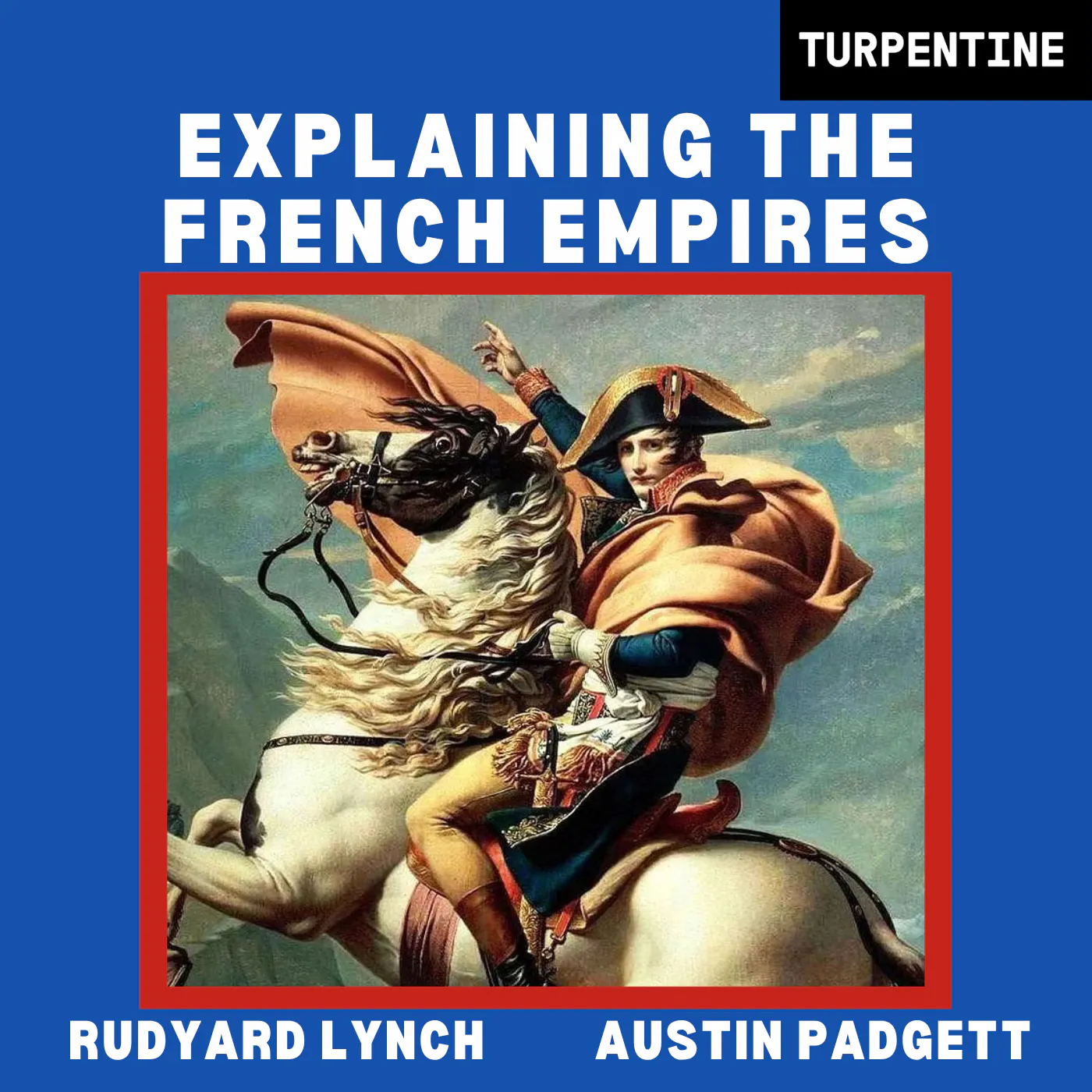
History 102 with WhatifAltHist's Rudyard Lynch and Austin Padgett
Explaining the Napoleonic Wars
01:45:48
Loading summary
Transcript107 lines
- [00:03]
Rudyard Lynch
Welcome to History 102, where YouTube creator Whatifalth hist Redyard lynch and Austin Padgett dive into critical moments in history and tease out patterns to help us predict the future. Let's jump right in.
- [00:47]
Austin Padgett
Hi, everybody. Today's topic is the Napoleonic wars with our co host Austin Padgett.
- [00:54]
Unnamed Co-host
Hello. Welcome to Napoleonic France.
- [00:58]
Austin Padgett
So there's this Twitter user called Drupka Kunle. It's something like that. He has it flipped as well, where it either goes by Kunlee Drupka or Drupka Kunle. It's a name for a Buddhist demon or saint or something like that. And he has this, this meme where it has an image of the Napoleonic Wars. And the Napoleonic wars are a really beautiful, almost novel, where Napoleon kept on comparing his life to a novel over the course of his life. And Napoleon would say, my life is so remarkable and it's so beautiful that I can't believe it's real. It's like a story. And when you look at Napoleon's life, this was a high point of European art. And so you can look at each snapshot of Napoleon's life with a beautiful painting, whether Napoleon, Napoleon at the pyramids or the Battle of Trafalgar, or Napoleon in Russia, where there's all these cinematic images of Napoleon's life. And what Kunle Drupka did is he took each of these paintings of Napoleon's life and then he just put an image and a box on it that said purely socioeconomic factors. And so the joke he's making, which I think is quite prescient, is that our current narrative of history, which is Marxist in origin, in that the Marxists took over our entire world view without us even realizing it. Where the Marxists lost the physical war with the Cold War, but they won the spiritual philosophic war. And in the Marxist WorldView, the only two variables that can influence the world are economic factors and technology as mediated through class relations. And so from a Marxist perspective, and keep in mind, Marx grew up in the shadow of Napoleon. Marx would say that Napoleon was purely caused by socioeconomic factors. And it's really remarkable how much the Marxists have obfuscated reality in their favor, or they've obfuscated our view of the world in their favor, because most of the Marxist theories are just really ridiculous once you poke them with the slightest bit of any kind of critical thought. But the Marxist theory is predominant now. So our dominant philosophic, practically religious worldview is that human agency has zero impact on world history. And the Marxists from their worldview. This is kind because all of Marxism is about taking away responsibility. But the reality which I think the Marxists subconsciously know is that it's innate, it's innately incredibly cruel to tell people that they have no impact on the world. And it's also allows the Marxists to control society and to say that our inevitable historic dialectic process will win no matter what. But this is not a video to crap on Marxism. This is a video on Napoleon. And Napoleon is the ultimate refutation of socioeconomic theories of history. Where of course I do think socioeconomics do influence history, where lots of things influence history, everything is connected to everything else. So any lots of variables influence lots of things. And trying to cherry pick one or two variables to explain everything is just insanity. But when you look at Napoleon's life, you are seeing one of the most prime examples of the personality and will of a single man dictating an entire age of history. And I think there's something profoundly beautiful in that.
- [04:37]
Unnamed Co-host
So it's the great man aspect took over with Napoleon. And in terms of the socioeconomic explanation, it's also tying the determinism to that. So it takes away the, the agency even within the socioeconomic realm. It's like what reforms could the first republic have done before Napoleon could that made a difference? And they say no, this is just how it was going to happen. But it removes agency even on the level of their own analysis.
- [05:12]
Austin Padgett
So memes are to our era what philosophy and history was to 200 years ago. And that makes me want to kill myself saying it. But it's true. Where there's a meme I was, I was showing my best friend business manager yesterday, the meme is money machine go burr. And it's these Federal Reserve guys just printing money as they work themselves, themselves to death as you their faces collapse. I'm going to put a link in the description as well as this blonde girl dancing while they play music. And there's like this kawaii music. And the joke is that the entirety of modern society is the money printer going forever destroying the society while, while people use bread and circuses like social media to deny the underlying reality of everything going to hell. And all of the comments are historians will be looking at this centuries from now to understand the crisis of the early 21st century. And the reason I say that is that you look at the cultural reactions in the Napoleonic wars and it's, it spurred an entire generation of philosophy which the Marxists and the obsession with the dialectic and material stuff and industry is a reaction against. Because so many philosophers built their worldview off Napoleon. Goethe, who was friends with Napoleon, is an easy example. Hegel built his idea of the world spirit about Napoleon. Carlyle, who is the big great man, history thinker. I'm pretty. He must have been influenced by Napoleon.
- [06:51]
Unnamed Co-host
Where.
- [06:51]
Austin Padgett
When Carlyle was growing up, all of Europe was controlled by the destiny of one great man. And Napoleon was the underlying integral force for all of the culture of his era, where Napoleon was a great conqueror and he was possibly even more so a greater statesman, but an entire generation of paintings and culture and plays and philosophy and all of that stuff stemmed from Napoleon, directly or indirectly.
- [07:27]
Unnamed Co-host
Right. And he has. He said. He said his life was kind of like a novel or something or like a story, because he's one of the few figures who won as many consecutive battles as he did. Like El said or Alexander. It's like there's only a few UFC fighters who have, you know, 30 and 1. 30 and 2 records.
- [07:48]
Austin Padgett
Yeah.
- [07:49]
Unnamed Co-host
And then it gets to the point where you ask yourself, how is this. How is this possible? Like, oh, my. That.
- [07:54]
Austin Padgett
That guy, Napoleon, he won more battles than any other major conqueror. Napoleon, similar to Hannibal, where they showed off their military genius through fighting against terrible odds, but they still lost. And Alexander and Genghis Khan are the two conquerors who succeeded. And Alexander and Genghis Khan did not win as many battles as Napoleon because they were. Europe in the early 19th century was one of the most dynamic and strongest societies ever. So when Genghis Khan was going up against Asia, these societies were mostly effeminate and decadent, where Genghis Khan on his deathbed said, I didn't win because I was that good. I won because everyone I fought was stupid and weak. And with Alexander, he conquered Persia, which was decadent, and then he conquered into India, which was also decadent. And with Napoleon, he was going up against Europe at its very prime. And so we shouldn't see Napoleon's losses as an indication of his quality as a general. And Napoleon's great flaw was he didn't know where to stop, which is normally the flaw of great men, where if you're a great man, you've had to. Great men only win through making daring risks. And when you've had too many daring risks that have worked, you go a few steps too far. And that's what Napoleon did. And one of the interesting elements of Napoleon's life is that he felt he was guided by his own destiny, where Napoleon, alongside most other important Historic figures had a very strong sense their destiny was guiding them towards a certain outcome. And when he fought at the battle of Lodi and in against the Austrians in Northern Italy, that was the moment he realized that he would become the greatest man of his age. Because he fought the Austrians, he won the campaign and he had a sort of spiritual moment on top as he was raining artillery fire across the mountains at the Austrians, where he realized that his life story would take him really far. And Napoleon's life and his power fell apart when he divorced Josephine. Which will make sense once we explain the context where Napoleon deeply loved Josephine, although she cucked him out a lot, and he divorced her for an Austrian princess. And it was said in the culture at the time that Napoleon was frequently called Mars, where people would colloquially refer to him as the God of war. And people would call, would call Josephine Isis. And so it was like a common cultural thing at the time that when Napoleon left Josephine that his entire empire would fall apart. And I don't think that's the real reason. I think it's more so that it's a correlation because frequently when things don't, when you see connections that don't logically make sense, it's a correlation thing where once Napoleon lost his roots and lost his original grounding, he went too far and then the empire fell apart.
- [11:07]
Unnamed Co-host
And how did he lose his grounding relative to Austria?
- [11:11]
Austin Padgett
That will only make sense in the context of his life. So let's get started, because if you show up in the middle of a movie without context, you will think the main characters are mad men, but everything makes sense in a specific context, even madness. And so Napoleon is from Corsica. And this is one of those interesting butterfly moments where the French didn't really think about getting Corsica, where Corsica was a part of Greater Italy and it's an island off the coast of Italy where it was consistently part of Genoa and it was really poor. Where Napoleon was from the. The aristocracy of Corsica, one of the leading families. But being one of the leading families meant you would live what in the rest of France was a middle class life. Napoleon's family were constantly in debt. They could barely afford to keep their kitchen going or to have home repairs. And the Genoese couldn't hold on to Corsica because Corsica kept rebelling. So Genoa sold Corsica to France in the middle of the 18th century and the French militarily occupied and conquered Corsica, where Corsica had a liberation movement run by a guy called Paoli. And they were constantly agitating for independence. And Napoleon was obsessed with Corsican independence when he was a young man until his early twenties, his greatest dream was liberating Corsica from France. And he later gave up those dreams because after the French Revolution, when Paoli actually did get independence in Corsica, Napoleon went back there and then he realized this guy was actually a douchebag because he got his family, got into a scrap with Paola and so he lost all of his childhood aspirations and then decided to become the conqueror of Europe. But I think there is something symbolically important in there and Napoleon's father, as one of the leading families of Corsica, he was known as the collaborator where he actually cucked out Napoleon's mom to the French governor. And France was a weird place at the time. There was a lot of affairs going on, so this wasn't beyond the pale, but there were wide scale conspiracies at the time that Napoleon was the bastard son of the French conqueror. But we know that Napoleon was Napoleon didn't have a drop of French blood. He was pure blooded Italian. His family were from Florence originally and they had migrated out to Corsica for mercantile reasons.
- [13:55]
Rudyard Lynch
We'll get back to the conversation in a moment after a word from our sponsors. What does the future hold for business? Ask nine experts and you'll get 10 answers. It's a bull market. It's a bear market. Rates will rise or fall. Can someone invent a crystal ball? Until then, over 41,000 businesses have future proofed their business with NetSuite by Oracle, the number one cloud ER, bringing accounting, financial management, inventory, HR into one fluid platform with one unified business management suite. There's one source of truth giving you the visibility and control you need to make quick decisions. With real time insights and forecasting, you're peering into the future with actionable data. When you're closing the books in days and not weeks, you're spending less time looking backwards and more time on what's next. If I had needed this product, it's what I'd use. Whether your company is earning millions or even hundreds of millions, NetSuite helps you respond to immediate challenges and sees your biggest opportunities. Speaking of opportunity, download the CFO's Guide to AI and Machine Learning at netsuite.com102. The guide is free to you at netsuite.com102netsuite.com102 so it's a new year, 2025, and one of the recurring questions I've already been receiving is should I start my own business? Can I do it all on my own? Now more than ever, my answer is A resounding yes. With tools like today's sponsor, Shopify, it's never been easier to start pursuing your dreams. Shopify makes it simple to create your brand, open for business and get your first sale. No coding or design skills required. They also help with the details like shipping, taxes, payments, and have social media tools that connect all your channels and create shoppable posts, allowing you to focus on the important stuff like growing your business. What happens if you don't act now? Will you regret it? What if someone beats you to the idea? Don't kick yourself when you hear this again in a year because you didn't do anything. Now established in 2025. Has a nice ring to it, doesn't it? Sign up for your $1 per month trial period at shopify.com momentofzen all lowercase go to shopify.com momentofzen to start selling with Shopify today. Shopify.com momentofzen.
- [16:15]
Unnamed Co-host
What do you think is the symbolism in him splitting off with. What was his name, the p. Paola. Paola. Yeah.
- [16:26]
Austin Padgett
He surrendered his youthful. He surrendered his youthful previous worldview for something bigger where no one. Very few people set out to become great men. Most of the time they get bumbled along by life and they take opportunities and then over time, your life changes course until the scope of your ambitions increases. And so I see him, him losing his previous aspirations of gaining Corsican independence as him surrendering his own self, his old self practically, and you have to burn through your old self to transmute to a higher form.
- [17:07]
Unnamed Co-host
I was thinking, it reminded me of never meet your heroes because he met the guy was like that turned him off.
- [17:13]
Austin Padgett
Yeah. And it's funny that he hero worshiped Paola and then he was a hundred times the man apparel he was.
- [17:21]
Unnamed Co-host
And I mean this upbringing and Corsican independence movement also impacted him throughout his career, as we'll get into later, in terms of how he identified with the independence movements of Poland and various other countries in Europe.
- [17:37]
Austin Padgett
I need another glass of milk. I'm going to pause and be back. Milk is good. Hi. So Napoleon was sent to the French military boarding school. And he was an aristocrat. And you could had to be an aristocrat to be an officer in l regime. France and his family had to wriggle through various loopholes to become nobility because the French monarchy did not respect the local Italian systems of nobility and they had worked themselves up into the nobility. But Napoleon was not really happy in the French military boarding schools. It was a very Spartan, very difficult life. And we actually Have Napoleon's various writings from when he was a teenager. And he was pretty angsty. He would write like fanfic about murdering people. And he would also write romance fanfic. And I like saying that because it shows that this is a pretty close society to us today, where Napoleon went to school. School. He studied modern topics. He was a voracious reader. He constantly read across his entire life. And he was also secular. And it's easy to forget the people of 200 years ago were vastly closer to us than we think culturally. You could talk to them. You would probably have. You might have similar hobbies to them. You might have similar interests, all those sorts of things. And Napoleon was an artillery captain where he was very good at math. And so he was able to move ahead in the artillery. He was also a Jacobin where he supported the French Revolution because the lion regime, which is the term for the old regime in the French Revolution, they were built around keeping those with noble birth and power. And so a lesser nobleman like Napoleon would never be able to rise through the military of the old France. And Napoleon was a young guy. I think he was like 18, 19 when the French Revolution happened. And Napoleon himself said that those over the age of 40 will never understand the revolution where the French Revolution was done almost entirely by young people.
- [20:05]
Unnamed Co-host
Yeah. Does that relate to the communist Chinese Revolution where it was, you know, very youth driven? And there's just a disconnect. And this could relate to all sorts of revolutions, I guess, positive and negative.
- [20:18]
Austin Padgett
Yeah. All revolutions are driven by young people. Because if you're a young, like I'm 20, I'm 23, I have an entire lifetime ahead of me. At least hope so. And if you're an older guy, even if you're not successful, you don't have that much time to stare down your fate. Where for me, the reason I'm motivated to do all the things I do is that I have to deal with the consequences of this society for a very long time. And the boomers in charge do not. And Right.
- [20:50]
Unnamed Co-host
And bureaucracy prevents social mobility, which matters more to the young.
- [20:54]
Austin Padgett
The apathy of the boomers to the current fate of the country is just horrifying. And I don't want to get into this. You have said it so many times. But they're completely reconciled to let society burn down. And they couldn't care less what they gave their kids.
- [21:10]
Unnamed Co-host
Geppetto. Geppetto. And the whale burning his furniture. That's what's happening.
- [21:16]
Austin Padgett
Yes. Napoleon was 24 when he became a general. So he did it really young during the French Revolution. Napoleon, I think he was, I think he was positioned in Paris and he shot down a mob of intruders where he was in Paris looking at the events of the French Revolution from a sort of distance. And he had spent that whole time period in trying to commute between supporting his family in Corsica and his one salary as an officer supported six other family members because Corsica was a clan society where you had to support your entire extended family. So as Napoleon rose up in the world, he would give his family members various jobs, like King of Sardinia, King of Spain, because in his culture he had to help his family out.
- [22:14]
Unnamed Co-host
And casual jobs, just casual.
- [22:17]
Austin Padgett
And the family, the family were horrifically in debt, which was pretty normal in that time period. France had an enormous amount of debt and one of the biggest parts of the French Revolution was having a debt jubilee. And so Napoleon's family were on the verge of bankruptcy a bunch of times and they only survived through the inconsistency of people asking them for money. So they were the top, of course, against society, but they were very poor by French standards, French noble standards. And with the French Revolution, it's funny them glossing over an incredibly important event, but there's another previous video. And it's also funny how the French Revolution and the Napoleonic period interlock with each other.
- [23:01]
Rudyard Lynch
We'll get back to the conversation in a moment after a word from our sponsors.
- [23:04]
Unnamed Sponsor
Even if you think it's a bit overhyped, AI is suddenly everywhere from self driving cars to molecular medicine to business efficiency. If it's not in your industry yet, it's coming and fast. But AI needs a lot of speed and computing power, so how do you compete without costs spiraling out of control? Time to upgrade to the next generation of the cloud. Oracle Cloud Infrastructure, or oci. OCI is a blazing, fast and secure platform for your infrastructure, database, application development, plus all of your AI and machine learning workloads. OCI costs 50% less for compute and 80% less for networking, so you're saving a pile of money. Thousands of businesses have already upgraded to oci, including Vodafone, Thomson Reuters and Super Know AI. Right now, Oracle is offering to cut your current cloud bill in half if you move to OCI for new US customers with minimum financial commitment. Offer ends March 31st. See if your company qualifies for this special offer@oracle.com cognitive that's oracle.com cognitive the.
- [24:11]
Austin Padgett
French Revolutionary government is interesting because the actual political apparatus was a complete clusterfuck where it's not Even worthwhile to keep track of all the different subparts. France went from a right wing parliamentary democracy with a king to a left wing one of the king. Then they killed the king. Then they had like they had communist communist clubs running the country. You, a woman's advocacy group or the Jacobins seized dictatorial power. You saw a triumvirate rule and France just went through all of these different political systems with no ability to actually govern the society. But the military the Lucian regime had was probably the best in the world. And their military was incredibly good because the centralized government did not intervene that much with the actual military structure. And so when once they knocked out the nobility as the top brass of leadership, the sergeants and lesser officers like Napoleon suddenly got jolted up to the highest positions of leadership. So you saw this space that did not used to have social mobility, suddenly have a lot of social mobility. And so that's why 24 year old Napoleon was a general at the battle of to law where you could make a. You could make. A lot of these generals were my age, they were like 23, 24, but they still conquered Europe. And so this is a really. France made a series of incredibly poor strategic moves that somehow worked out where France declared war on every single neighboring country in Europe at the same time. Revolutionary France is wilding because they just assumed that they would start this wave of revolutions across Europe to liberate the whole world. A lot of these people were basically Marxists or Marxists had a term and France, France was at war with Austria, Prussia, which were the two great German powers. And they had sway over practically all of central Europe and Italy. France was also at war with Britain and periodically at war with Spain. And they were in an undeclared war with America. And so France was fighting wars on every single front. But the French were able to win because they fell into a total war system and they had an incredibly competent military. And I read this book recently, it's the first total war by David Bell and it's a study of how French it's mostly the French Revolutionary War in the early Napoleonic War. And it's about how they introduced modern warfare where France conscripted all of its young men. And there was this ideal at the time that they would be a society where everyone was involved in the war effort somehow where women worked in the home front, the children would do productive stuff as well make things and the young men would fight. And it didn't actually reach that ideal, but because Europe was dominated by this very aristocratic, very restrained military System that gave the French a marked military advantage, where France had nearly 40 million people, and that made it by far the most populous country in Europe, barring Russia. And so France already had a huge population and in total, total gdp, it was by far the wealthiest country in Europe. And France had a lot going for it. But on top of that, with total war, they could mobilize these huge armies. And there wasn't really a massive military breakthrough between the thirty Years War and the Napoleonic Wars. It was still muskets and cannons, pikes had been substituted out of warfare in the early 18th century and Cavill and, and cannons and artillery became vastly more advanced. Where one of the huge military breakthroughs was the rise of light artillery and using artillery as the dominant military arm, where people forget this today, but a majority of all deaths in war are done by artillery. Less than 10% are done actually shooting each other with guns. And Napoleon, being an artillery guy, he pioneered a lot of artillery warfare because he understood its value. And, and the French were able to wage highly aggressive, these highly aggressive wars because they could muster armies of hundreds of thousands of men. Where Napoleon appear, I think Napoleon got armies of 200,000 to half a million men, while in previous European wars, 40,000 men was an enormous number. So Napoleon, the French just got these huge armies and they could use it to crush their enemies. Where in the previous European doctrine of war, first of all, there wasn't a clear demarcation between civilian and military. Military regions where soldier, the nobility would, would both appear at court and fight. And there are these huge baggage trains that followed the armies that had stuff like restaurants or prostitutes or shops, where the military was a part of the society. And you'll hear stories of the 18th century of armies having the officers of armies having dinner together before battle, or armies letting the other side shoot first out of gentlemanly conduct and ever hurting civilians or ever sacking a population was completely taboo in the 18th century. And people would go on vacation to countries they were at war with. So it was this highly genteel concept of war. And the French revolutionary conflict just completely shattered that with a total political, military, religious mobilization, which gave France this inordinate advantage. But over the course of a century, it forced the rest of Europe to adopt the French systems, which brought about the modern social structure. Because once you had to draft and arm the entire population, you could no longer have aristocratic, absolutist monarchies. So it caused this wave of liberalization in a shift leftwards across Europe.
- [30:48]
Unnamed Co-host
Yeah, it's confusing because there's A lot of dimensions going on at the same time because I'm thinking of the Celts and the Romans. Right. Where they basically get one warrior from each village, not, you know, maybe a voluntary ish kind of conscription. And they have these massive armies and existential threats and it's kind of like a return to that in a way.
- [31:11]
Austin Padgett
Yes.
- [31:12]
Unnamed Co-host
Based on the necessity of the circumstances. And then there's tons of social mobility, like you said, within the military. So people are probably joining for that since there's no social mobility anywhere else in the society. Yeah. Interesting how it took off.
- [31:31]
Austin Padgett
Yeah. So there's two things there. The first is you teased at a very important point where in classical civilization you saw these mobilization of these huge armies, where the Punic wars in Rome and Carthage were total wars. And with the civilizational cycles, classical civilization, when it was at its historical level of development comparable to the modern west, could mobilize these huge armies. But then as time passed, societies lost the ability to have this mass mobilization until they approached an apex of their civilizational development, where they could. Where societies don't operate in linear, linear straight up lines, you need to have a highly mobilized social structure and government to have total war. But what happens is that when you give the government that much power, which will always happen through total war, that the government destroys social trust. And then over centuries you'll fall into a dark age. Then you'll need aristocracy to fight. The aristocracy gradually morphs into a government, cycle restarts.
- [32:41]
Unnamed Co-host
So that's exactly it because monarchies don't last more than 200 years after the leader stops appearing on the battlefield. So it makes sense that immediately when the monarchy collapses, the replacement is this diffused. The replacement for social mobility and social control becomes military excellence.
- [33:01]
Austin Padgett
Yes, that's so fascinating because the 250 year curve, that's the curve for the time you maintain regimes and monogamous societies. The second point was that the this era of history, and especially so the, the revolutionary French were completely obsessed with the Greco Roman history. So they were actively building their social and military structures off especially Rome and Sparta, where we see the early left as hyper modernist. But they saw themselves more so as reviving this millennia old classical tradition. And that's why, that's why Napoleon named himself first consul and then emperor. And they were literally basing conscription off the Roman and Spartan parallels. So they definitely noticed that it was widely said that educated Frenchmen knew more about the histories of Greece and Rome than France because that was their educational system worked.
- [34:04]
Unnamed Co-host
If you identify a secular period in History, then you can identify secularism with some classical, you know, historical callback. And it's like the name of the, I think the, the one French government worth focusing on is after Rose, Pierre and before Napoleon, the first French Republic. Right. They're calling themselves the Republic like Rome. And they were kind of what led to Napoleon because they, they started all these wars thinking it would help their coalition with the nationalists and the nobility who were heavily involved in benefiting from the wars. And that kind of dragged them along the path where Napoleon took over. And they were so obsessed with maintaining coalitions, these really fragile coalitions of moderates that were left over after the radicals and the monarchists were kind of gotten rid of that they basically failed to do anything and started a bunch of wars. So it's, it's, it's a good corollary to the US right now because we just got past the crazy radical leftists and you can see what would derail the current administration. Getting sucked into a war or failing to make enough change on the domestic front. And the war would prevent that. If you avoid a war, you still have to get things done. And they had a bunch of rebellions to put down because they were conscripting. They kept the power centers in Paris because they were more worried about the Parisian coalitions rather than the rest of the provinces. So they had an opportunity, but they kind of failed. And that opened the door for Napoleon.
- [35:46]
Austin Padgett
I was reading a 19th century French thinker, Gustave Le Bon, and his thesis for the French. I was reading his book on the psychology of the French Revolution, and what he said is that due to absolutism, without developing a really strong capitalism or self governance is, the French people had very little. And this is what The Tocqueville, another 19th century French writer, said. The French people had developed very few social institutions for self governance and basically gaining responsibility. So that when you let the French public have power in the French Revolution, they were incapable of actually wielding power responsibly. So it just devolved into these petty disputes. And the reality is that France did need a king. It just wasn't ready for. They just, they just got tired of the lion regime. So the second that there was a man who was capable of filling those shoes, they made him the emperor. And that's what happened with Napoleon. And we have to get the seven coalitions, where the Napoleonic wars is a really difficult war to study because there's the war of the seven coalitions and each of these are different subwars with different events and in mostly different Areas. So it's harder to remember than the world wars, because the world wars are you have a few stable fronts, they just grind each other till you hit the other side's capital. But Napoleon had to conquer Austria or Prussia I think at least three times because he was never able to just conquer those countries unilaterally. In the war of the first coalition was the French Revolutionary War, we've spoken about that a little. Where French armies pushed up against the Rhine into Germany, they pushed up towards the Netherlands, they took the the centuries old fort of Luxembourg at the French had attack probably a dozen times that they had almost never been able to seize because they could just send human wave attacks against Luxembourg. And the fort was not designed to fight that many men because you just didn't mobilize armies that big in the older society. Well, Napoleon became famous the siege of Toulon, where I'm always shocked that the British were able to maintain control over the entire Mediterranean in the eight for the entire 18th and 19th centuries. Because you would think that the Spanish of the French, who were ostensibly great European powers who had shores on the Mediterranean, would be able to control that sea. But the British who have no shore on the Mediterranean, they have to sail the long way around from Spain, they were able to seize control of that so sea with ports along Gibraltar, Mallorca, later on Malta, Crete, Cyprus, Egypt. And the British were attacking the French Mediterranean naval base at Toulon, which faces towards Italy. And Napoleon was able to defend to law. And that's what made him a famous general, where he was able to rise up. And Napoleon, another thing that made him rise up was he was part of the mapping committee of the French military and the geographic committee. So he made a lot of friends trying to map out the battlefields. That gave him a lot of useful information which allowed him to get the connections to move up because a lot of the most competent people in France were there. But Napoleon became a general or he really went into his own fighting in Italy against his own kin, where he was made the commander of the Northern Italian army. And when he went there, said army was a complete mess. They didn't have shoes, they were disorganized, they were starving, they were poorly trained. And Napoleon just whipped them into shape. And Napoleon was a great general, not just for winning battles. He was. There are multiple reports on Napoleon's speaking ability and level of charisma. Apparently he was kind of. He was kind of like autistic socially in person, but he was incredibly charismatic for the troops. And he was just. He could put A spell on his men. And he always went to extra effort to make sure that his men were fed and clothed and taken care of, where he was widely loved by his men. And he did a lot of stuff to make sure that they felt taken care of. Where he would. Five years later, he would randomly run into a soldier that he had said hi to before. Five years, he would remember his name. Napoleon would memorize the names of almost every single person he met. And then if you randomly stumbled into a person years later, he'd say, oh, hi, I remember. You did blank for me. So Napoleon was quite personable, and he just steamrolled Northern Italy. Napoleon was responsible for the conquest of practically all of Italy for the French. And Northern Italy was directly or indirectly part of the Austrian Empire, where the Austrians took the former Spanish possessions like Milan, as well as conquering Venice, or, sorry, Venice and Savoy were Austrian puppet states. And after the Napoleonic Wars, Venice joined Austria. But Napoleon was able to drive down Italy. And he later on, years later, put his brother on the throne of Sicily, where Sicily had this huge guerrilla campaign against Napoleon. And he had a few squabbles with the Pope, where he would put the Pope down a few times, because revolutionary France was a militantly atheist country. And so for the longest time, they had issues conquering the rest of Europe, which was mostly Christian. But when Napoleon later gained power, he put the Church back in power because he saw the Church as a social stabilizer.
- [42:08]
Unnamed Co-host
That is interesting. And what degree did he put the Church back in power? Did he give them their lands back and stuff, or was that ship sailed? That ship was sailed.
- [42:16]
Austin Padgett
Right. Yeah. So the Church had a tremendous amount of property in France before the revolution, and the French bourgeoisie and the upper class just bought out and took the land immediately. And so after they took the land, it became too costly to. To give it back. And those people also became the backbone of that. Of that regime. And he, Napoleon himself was not particularly religious, but he understood. He believed in God, but he wasn't particularly Christian, but he understood the force of social stabilization that Christianity was. And so he brought back. He let people. Because the French Revolutionary regime literally banned Christianity. So he cut the ban, and then he let Catholic culture go back through France.
- [43:14]
Unnamed Co-host
It's interesting that the nobles who bought out the Church land formed the backbone of a lot of his support, because one of the main reasons the first French Republic failed to gain popular support is they. There was pressure after the revolution where the Church lands were confiscated by the communists and they made them part of the state. And then the republic had, you know, a pressure to sell them off. But instead of, you know, distributing them or selling them to small holders, they sold them exclusively to the big guys. So this is just like post Soviet Union where they have all these nationalized companies and then they sell them off to big oligarchs instead of, you know, like more distributed scheme. So yeah, interesting.
- [44:00]
Austin Padgett
So smallholders did buy back the land. One of the things people forget is that France in even under the Lucian regime was mostly a country run by smallholders. And you've said nobility a few times. We're talking about the ruling class. But the nobility weren't the ones in charge. It was the bureaucracy were the dominant social class in France. And then the bourgeoisie or the merchant class had a lot of power. The.
- [44:24]
Unnamed Co-host
No, that's what I meant. The bourgeoisie got most of the land deals.
- [44:28]
Austin Padgett
Yeah. This is one of these historical debates I don't want to get into because It'll become a 20 minute rabbit hole. It's difficult to answer, but there's a long lasting debate of who the most important social class the ledge of the French Revolution were. Some historians say that, some historians say the bourgeoisie, most say the bureaucracy. But we need to get these coalition wars. So first coalition war ended with France taking extending its what were considered to be its natural borders or into northern Italy as well as the Rhine. And the second coalition war was. The second coalition war is hard to describe. It involved you had the battle of Marengo, Haiti declared independence, where Haiti had its own uprising under Toussaint l' Ouverture, where that became Haiti was majority black and the black slaves rebelled and that was a horrifying war. Napoleon later sent an army to reconquer Haiti with tens of thousands of men and they almost all died of disease. So Napoleon briefly had a dream of making a Caribbean empire with the Louisiana Purchase. Or when France briefly held all the great planes before selling it to America. Napoleon did that because his original goal of making a Caribbean empire based out of Haiti and when he lost Haiti, he realized that he would need to sell Louisiana to the Americans because otherwise the British would take it. But I'm skipping a few years into the future where French Revolutionary the French Revolutionary government took the Dutch Republic, which they called the Batavian Republic. Then they took western Germany and most of Italy. And this caused with Napoleon's victory at Marengo being a decisive defeat of the Austrians in northern Italy driving them out. What happened here is that there was this awkward period of peace where France were the masters of A lot of Western Europe with the Spanish as their allies, but their government was still a mess, where they all ran between a government called the Directory or the Triumvirate. And Napoleon was by far the most popular man in France. His conquests of Italy, in a society where most men were kind of pathetic, most of the leadership were pathetic losers, meant the French people absolutely loved him. But he wasn't in a position where he could make himself dictator yet, just because that wasn't where the currents were. And so he decided to attack Egypt, which is a strange historic moment. And this was in 1799. And Napoleon had enough power, he could practically call his own shots where he, he, he conquered Egypt on his own whim. And his fantasy was to have an Alexander of the great style conquest of, of Asia, where he wanted to conquer into India. And France had previously had colonies in India, they with the Tipu Sultan of Mysore. And Napoleon's conquest of India worked. Sorry, Napoleon's conquest of Egypt worked where he landed there. And Egypt was an Ottoman possession, but it was under local Mameluke governance. And Napoleon fought against this Mameluke cavalry army, where the Mamelukes were. They were slave soldiers from the Caucasus. They were nomads who had ruled Egypt since the early 13th century, where at the Battle of the Pyramids, Napoleon's modern army faced down the Mamelukes and just slaughtered them. By that point in the early 19th century, Europe had a marked military advantage over the Middle East. And Napoleon tried to establish a modern, enlightened state in Egypt. And this was a heyday of Egyptology. And this is the origin of Egyptology, actually, because Napoleon brought all of these scientists where Napoleon was a very intellectual leader. He was seen as an intellectual in his own right at the time. And he was friends with and funded a lot of the philosophes and scientists and that stuff where they studied Egypt and brought a lot of the artifacts back to Europe, where this was the first time Europe really became aware that there is this deeply ancient civilization in Egypt. And Napoleon fought his way as far north as, as Syria, through Palestine. And it's just, it's remarkable to watch that it's this random subplot that you wouldn't otherwise think about.
- [49:24]
Unnamed Co-host
It actually makes a lot of sense if you think about it, because Alexander got to India by land, right? The west was cut off for India forever. Colonialism was around getting to India and just kind of trading spices and getting, you know, kind of foreign colony set up. So if the competition in Europe at the time is external Right. It's colonial. He's thinking about Haiti. He gets kind of blocked off in Haiti. He's also, they're not as good at the navy, but he's really good at artillery. It doesn't make as much sense to fight in Europe. So it's like, hey, wait, with these new imbalances in land army, can we just steamroll right to India through land? The thing that, you know, we forgot trying to do thousands of years ago and then that kind of ends up being impractical and then he turns back to Europe and it makes sense that he would fight in Europe because that's where artillery is going to make the biggest difference. And that's kind of what he centers his fighting around.
- [50:30]
Austin Padgett
You're right. It makes sense. Considering the ease with which Europeans could beat Asian militaries meant that he could conquer a pretty big Asian military, a pretty big Asian empire. Fairly easy. The issue was the British control of the Mediterranean, because Admiral Nelson, the top British admiral who turned the tide of this war several times, he wiped out the French fleet at the Battle of the Nile, where Napoleon had to strand his army in Egypt and flee back to Europe on a small craft. His, his, his army in Egypt, I think they mostly died. But when Napoleon got back to France, he was just treated as a hero. And he wandered around France for a bit and he launched a coup called the Brumaire, where France was under a Trinitarian government, where the, the previous democracy had failed. And it was widely considered in France that they needed to have a dictator because France had gone through a decade of chaos since the revolution and their economy had broken down, there was banditry everywhere, mass poverty, chaos, rampant killings. So the French people, they wanted to be seduced. And Napoleon was a man who was great enough to do it. And so the way I see the Brumaire period is the natural order had a certain end point it was going to reach. And so you're seeing these different switchboards get moved along so that you could see an alignment of events to reach the end come that the France's psyche demanded where Napoleon was put into power because the pre established French interests saw him as an outsider that they could use to control, much like Hitler. But then what happened is that when Napoleon got into power after launching the coup against the Director A, he just became an all encompassing force that dominated France.
- [52:48]
Unnamed Co-host
Right. Maybe they underestimated his ability to actually have a vision for managing the system.
- [52:53]
Austin Padgett
Yes, because they saw him as a general, but Napoleon was possibly a greater statesman than he was a general where, for example, the dominant legal code in the world especially so most Western countries and even non Western countries outside the Anglo Saxon sphere operate off the Napoleonic law code, where Napoleon institutionalized the dominant legal code. Napoleon also put in the metric system and he stabilized the French economy and he started recreating titles of nobility. But for his supporters, as I said before, he put the church back in. And, and there's so much other stuff I'm forgetting in there, but Napoleon really rebuilt France very quickly and he, he turned France into a highly wealthy, functioning country.
- [53:50]
Unnamed Co-host
Well, he was part of the revolution and part of those intellectual circles, so it makes sense. Were there any particular intellectual figures at the time that he leaned on or kept around his advisors?
- [54:01]
Austin Padgett
So I, I can't think of any. Now the one that comes to mind, though, who's not really an intellectual, but who is a statesman is Tallyrand, where Talley Rand was minister. And interestingly, Talleyrand fled to Philly during the crisis of the French Revolution because he was a nobleman. He was trying to avoid getting killed. And Talleyrand did all of Napoleon's diplomacy and that sort of thing, and he was brilliant at it. He was considered the best diplomat in Europe at that time. But Talleyrand was conniving and he only really supported his interests. So Talleyrand backstabbed Napoleon several times when he realized Napoleon would lose. And one time, Napoleon basically screamed, talleyrand, you're, you're, you're a silk stocking full of shit. Because he says, you, you have this nice exterior, but you're just a terrible person on the inside. And this was apparently taken really poorly by French society at the time. He's like, oh my God, Napoleon crashed out. But I think it's a reasonable criticism of Talleyrand.
- [55:07]
Unnamed Co-host
Well, they come from different worlds. So Napoleon's used to loyalty.
- [55:11]
Austin Padgett
Yeah.
- [55:12]
Unnamed Co-host
But the thing that made Talleyrand realize, realize when Napoleon was going to lose was also what made him good at his job throughout the whole period before that, because he could, he could anticipate things in negotiation.
- [55:25]
Austin Padgett
It's not cool when your men aren't loyal. But so War of the Third Kabbalah Shen, Napoleon's great rival was Britain. He hated the British. And he was also. The British media was highly sensationalist. And they made the stories like, Napoleon was short. He was average height for an Italian. They made up the stories he had a small penis. When Josephine was cheating on Napoleon with an office with a hussar officer, Napoleon, when he was in Egypt, he sent a letter back to France telling Josephine that he was going to divorce her. Where it's just so sad to see Napoleon's relationship with Josephine because he was madly in love with her and he was constantly simping, but she didn't respect him and she was cheating on him.
- [56:18]
Unnamed Co-host
But he said, small penis, big cannon.
- [56:22]
Austin Padgett
But he said he told Josephine he was going to divorce her. Then the British caught this in the Mediterranean, sent it back to Britain, first publicized it in their media, and this became a scandal where Napoleon faced many scandals that the British media sensationalized. The British invented. They didn't have a word for pr, but the British definitely had a highly advanced international public relations. And so I was. Oh, yeah. So Napoleon hated Britain, the French hated Britain, they called it Perfidious Albion. And Napoleon could conquer all of Europe, except for two great geographic issues, that being the English Channel and the scale of Russia. Napoleon could not master the sheer distance of Russia and he couldn't cross the English Channel because the British had the best military in the world. Sorry, the British had the best navy in the world, although France had 20 times the soldiers of Britain. So if the French could land an army in Britain, they would assuredly win. But due to the British military, the British naval advantage, the French could not land an army in Britain. And so Napoleon was stuck with this intractable issue of how do I take Britain? And his first option was navally, where France was building up a naval flotilla in the English Channel that wasn't strong enough to break across to Britain. And the British for a lot of the Napoleonic wars kept France under a blockade so France could not trade with the rest of the world, because the second you left these French ports was a wall of British ships. But the French were allied with the Spanish, which was a long term trend that went back a century due to the shared Bourbon monarchy. And the French and the Spanish were trying to build up their military forces at Trafalgar at the bottom of Spain to then launch an attack on Britain. And I think Trafalgar might actually be the most important part battle of the Napoleonic wars, although it wasn't a war that Napoleon fought in and it wasn't done on land because if Napoleon could get that naval advantage, he could have conquered Britain. What happens though is that Admiral Nelson, the British naval commander, was able to wipe out the entire French and Spanish fleet and he was able to do it by splitting them up because he. There was several complications where the French fleet from the West Indies was coming back so that they could unify forces to go against the British. The Spanish and the French had trouble accordion together. But Nelson, he also used some pretty innovative tactics to just wipe out the French fleet and the Spanish fleet. And after the Battle of Trafalgar, Napoleon realized it would be practically impossible to take Britain directly. So the entire rest of the war was based around trying to develop other strategies to starve Britain out economically.
- [59:25]
Unnamed Co-host
So basically Britain blockades them from the island. So their only solution is to take over the continent. To blockade Britain from the continent.
- [59:33]
Austin Padgett
Yes. This wasn't until a few years later, but Napoleon made something he called the continental system, which was the European continent could not trade with, could not trade with Britain. And if they did, he would conquer them. And so Portugal and Russia violated the continental system. So he invaded those two countries and that's actually what got him to fight with Russia, where Russia was economically dependent on trading with Britain. And Russia was big enough that they could kind of tell Napoleon to screw off. And Napoleon invaded Russia so that they would stop trading with Britain and past a certain threshold. This is a pre industrial society. I guess Britain was early industrial, but they were, they were still early enough that they didn't have these huge cities that they need to import grain from the New World from. And I keep looking at the continental system and I think to myself, this system has too many component parts to work. And it's also dependent on, for example, when the Nazis were trying to blockade Britain to starve it, I think that could have worked because Britain become a fully industrialized society that was completely dependent on foreign food. Britain was still significantly more lightly populated than France. I think even if Napoleon completely cut off Britain from continental Europe, the British could have survived biting gruel or something, or just shooting the poor who rebelled. And so whenever I see the continental system, it just seems like Napoleon was trying too hard.
- [61:11]
Unnamed Co-host
Well, right. It's interesting how I teased out the logic of that reversal of the blockade without even knowing about the continental system. So the logic of it makes sense. It's just, it turns out his only option was impossibly impractical.
- [61:27]
Austin Padgett
The other thing as well is that I don't think Napoleon should have conquered outside Western Europe, because I think, I don't think France can realistically assimilate anything outside of the former Frankish Empire, where under Charlemagne, Germany, France, parts of Spain, Italy, Benelux, Austria, Switzerland were all a single country. I think that's the furthest France can go and still maintain some kind of cultural influence. Because the thing with empires is that holding the empire is harder than conquering. It is. And lots of Empires overextend. And you know you're going to overextend because you have to think to yourself, can I actually hold to this? After generations of decay, where, for example, when we established Social Security in the 1930s, the average life expectancy was like 68. So people would take out Social Security for three years. Now when it's at 81 and our age composition is completely different. So Social Security, which was insignificant a century ago, is now going to become this horrific demon that will destroy America unless we got it. And that's how a lot of empires are, where you have to think to yourself, two generations in, after our men have grown weak, can we actually hold Poland? And the short answer was no, because Napoleon could not hold Europe even in his own lifetime, let alone with his son, who would assuredly be less competent than him. Where I split Napoleon's conquests into three lines. The first line is West Germany through Italy. That's the old Frankish Empire. I think that's the line Napoleon could have held. The second line is Prussia down to the Black Sea. And Napoleon consistently was able to beat the lands in the second line between Western Germany and the Prussia to Black Sea line, where he had to conquer Austria and Prussia at least I think like three times, because he could consistently beat their militaries. But France did not have the men to occupy Austria or Prussia. And so he kept on letting them maintain their governments would let them have the ability to keep recruiting new armies and improving and all that stuff. But then Napoleon's attempt to make it to the third line, or what the Nazis called the AA line, Ostracon on the Caspian in Archangel on the Arctic Sea, which is the edge of European Russia. Napoleon's attempt to make it to the third line just could not work because he hadn't even subjugated the second line. And so when Napoleon failed in Russia, Austria and Prussia immediately backstabbed him multiple times. And they had used his time trying to conquering Russia as an. As a period to innovate and rebuild their militaries. So Napoleon, right then they can just.
- [64:27]
Unnamed Co-host
I was just gonna say then they can attack him on the way through, but go ahead.
- [64:30]
Austin Padgett
I mean, I was gonna talk more about the Russian war, but we have three coalitions to go through.
- [64:35]
Unnamed Co-host
So I was gonna say the. The Italian republics and the first Co, the first zone of Western Europe. How much of the ease of occupying those countries was connected to their just cultural similarities versus political ideological similarities around wanting to advance a form of republicanism? Because my teacher in France, in the Sorbonne was a liberal, very, very liberal, left wing. But she taught Napoleon as a kind of a mixed figure who was like a positive revolutionary figure and that his conquests were connected to abolishing monarchy. And where was Western Europe more amenable to that? And was that why.
- [65:25]
Austin Padgett
So there were three countries where Napoleon was able to. To basically work with the locals easily, that being northern Italy, western Germany and Poland. And the reasoning for that is that those countries hadn't really experienced nationalism. They developed nationalism because the French imprinted nationalism on them in the Napoleonic wars. And I'm careful about this stuff because my background's in the Middle Ages. And these people did have some form of nationalism going back to the medieval period, but it was sort of ethnic consciousness. Their idea that we should unify as a single country around our shared nation state. That was an idea that they got from the French. And Napoleon unified the constant squabbling states of Italy and Germany, who had fallen apart in the medieval period into places like the Cisalpine Republic, which was northern Italy, or the Confederacy, the Confederacy of the Rhine, which squished together 200 or so German states in the middle of and through the process of unifying these. These countries. And I don't want to say unifying because these were relatively small places compared to the later countries of Italy or Germany. The French also worked with the. The merchants and the bureaucratic class against the nobility because a kind of lame and sclerotic nobility ran both countries. And so once you let the. The other classes rise to leadership, you saw this upswelling of a new generation of leadership that over time evolved into those countries, nationalist movements under people like Bismarck or Garibaldi. And when Napoleon invaded Russia, he pulled hundreds of thousands of men from Germany, Italy, Poland. I think actual French people were a majority of the army that went. Were a minority of the army that went into Russia. And when Napoleon later conquered Poland, he made. I think it was like the Warsaw. It was either the Duchy of Warsaw or the Warsaw Pact or whatever. I forget something. At Warsaw it was the central Polish region, which were Poland. Lithuania had recently been completely divided up by Austria, Prussia and Russia because Poland had been this. This kind of lame, failed state for a century leading up to it. But the neighboring countries were quite polite about not raping Poland until later on with the French Revolution, because the Poles, the Poles had their own revolutionary movement where they got rid of serfdom and they were having conscription and started to industrialize, run by. I think he was the guy who did fork. I think the guy who did fort Constructing in America. He was the leader or one of the major leaders in that where Poland actually went this phase of rebuilding themselves as the country in the late 18th century. And then Prussia, Russia, Austria, like, no, no, you have to be a failed state. We're going to conquer and shove you back into serfdom. And so Napoleon picked on this latent Polish nationalism and then he used the Poles as this allied wedge for his side in a region that was mostly inhospitable to him, where the Poles were surrounded by those three powers that were some of Napoleon's greatest enemies.
- [68:55]
Unnamed Co-host
So it's a good example of that dynamic where they were actually ideologically aligned and the Poles were kind of begging for Napoleon's intervention in a lot of stages.
- [69:06]
Austin Padgett
Yes. So War of the Third Coalition. Napoleon fought the Russians and the Austrians at the Battle of Austerlitz. And interestingly, the main locus of fighting for the Napoleonic War, which was a war that stretched from the Atlantic to Moscow and from Egypt to Scandinavia, the main place where most fighting occurred on average was the was around Saxony and Czechia, so fronting up against the edge of the Austrian Empire, because Napoleon was constantly fighting in eastern Germany against the Prussians and the Austrians and also the Russians. And that was the centralized because the Napoleonic wars was a pan European war. So it makes sense to the locus of the war was in the middle of the European continent, where Austerlitz Napoleon just wiped out a vastly larger Russian and Austrian combined army, where Napoleon is able to consistently win against larger armies, partly because the French were just better soldiers, but Napoleon was able to use artillery in a really good way. And Napoleon also marched his men more than any army. So Napoleon had enormous mobility where he'd march his men 30 miles every single day, like the basing it off the Roman parallel. So at Austerlitz, he smashed into the Austrian and Russian armies before they were really ready to fight, thus destroying a larger army. And that cowed both Austria and Russia, where Napoleon marched on Vienna and he humiliated them, where Russia backed out.
- [70:47]
Unnamed Co-host
It's a good example of taking advantage of the intangibles, which is also good. Roman parallel.
- [70:53]
Austin Padgett
Yes. Napoleon with the War of the Fourth Coalition was against Prussia, where Prussia. Prussia wasn't able to coordinate with Austria and Russia against Napoleon. And so he took on Russia Prussia. And Prussia was the state that later became modern, unified Germany. Although ironically, in this time period, almost no Prussia, almost no Prussian territory, was an actual modern Germany. They had the area around Berlin and then almost all of Prussia was in modern Poland. And in World War II, the Russians genocided old Prussia, which was majority German and populated with Russians. So the center of old Prussia is in modern Russia as well as Poland. And Napoleon wiped out the Prussians at the Battle of Jaina. And that was very embarrassing because Prussia had a strong military tradition that Frederick the Great had really proven Prussian military excellence. Where a generation earlier, Frederick the Gate Great. I was going to say Frederick the Gate the Gay, because he was gay. Frederick the Gay. He was one of Napoleon's great heroes. And Napoleon studied his life and actually visited his tomb when he went to Prussia as a sort of pilgrimage where Prussia had degenerated in the generations since, where Napoleon wiped them out and Napoleon marched on Berlin. But again, he was incapable of fully conquering Austria or Prussia. And this resulted in Prussia going through a period of improvement in introspection that made them the great military power that later allowed them to unify Germany, where the Prussians were so humiliated by their loss at Jaina that they got rid of serfdom. They completely reformulated their military. They rebuilt their structure so that when they would fight the French next, they'd win. And this is one of those really inspiring historic examples of a country turning things around at the right moment.
- [73:01]
Unnamed Co-host
It's really funny because the whole battle is in context of, okay, are the French going to. The French got rid of their monarchy. This is a big existential threat to the rest of Europe because how is the social movement going to affect them? Well, at least if the French aren't attacking us, maybe we won't do a coalition and attack them. But the French are attacking from an early stage, so everybody's united against them in the context of this battle. But then a lot of people are amenable to the domestic changes in their own country as a result of the French invasions. And then the French have this idea of turning everybody into a republic when it didn't actually work for them. The result was that they got a big state with a military leader, which is what they turned everybody else into, not republics.
- [73:51]
Austin Padgett
It's ironic. Humanity is a funny thing. The big issue with the Napoleonic wars is there just weren't enough Frenchmen to conquer the entire European continent. And the only major ally the French really had with the Spanish. But Napoleon backstabbed the Spanish because he saw them with contempt and he wanted. Because the Spanish were pretty lame. They were not a functional country and they lost their New World Empire, which was the only reason they had any importance due to Napoleon backstabbing them. Where Napoleon invaded Spain, tried to install his brother in charge and he also partly did it to take out Portugal, which had been a British ally since the 12th century, and Portugal did not work with the continental system. And Napoleon faced a horrific guerrilla war in Spain, where the word guerrilla actually is a Spanish term for little war, because although the Spanish government fell pretty quickly, where Napoleon's armies, they marched down to the bottom of Spain, they marched out to Portugal, they made it to the edges of Lisbon, they took the capital. But in the Spanish countryside, the Spanish peasants started to fight back and form these guerrilla organizations. And these controlled a lot of Spain. And they became an enormous thorn in Napoleon's side, where the war in Spain was potentially the most brutal of all the campaigns of the Napoleonic War. And over time, it became this massive thorn in Napoleon's side, where Napoleon was already fighting this huge intractable war in the East. But he also had to send a quarter of a million men to occupy Spain, which he initially saw as an easy side theater. And the British were sending men down to Portugal to help out their ally there, including the Duke of Wellington or Arthur Wellesley, who had become the most famous British commander. And the Duke of Wellington fought really well in Spain, where with his British army, he gradually pushed the French across the entire Iberian Peninsula, winning several impressive victories because Napoleon could never really lead in Spain because he was busy fighting in the east. But by the end of the war, the British were able to drive, they were able to fight even into the south of France. They took Toulouse in the south of France. And it's a sign of Napoleon's growing hubris that he betrayed his only state, his only major good ally. And what he thought would be a minor side campaign turned into, into just one of the, the worst decisions he made.
- [76:36]
Unnamed Co-host
When you feel like you can do everything alone, then you think you can. So he's careless about his coalition. So that's a good hubris example. And do they call it a war because one gorilla can fight 100 men?
- [76:55]
Austin Padgett
Not funny. There were also guerrilla campaigns in the south of France, in the south of Italy and across the rest of Europe. But. So Napoleon originally named. So Napoleon named himself Consul of France, which was an old Roman term. I think the Romans called their leaders consuls. And in this peak of his power around Jaina and Wagram, which we'll get to, Napoleon was the master of most of Europe and he had personally added the Netherlands, West Germany, North Germany, a lot of Italy and even Croatia from the Austrians to be the personal possessions of France as well as his numerous, numerous client states. And he also declared himself Emperor, where He went to Rome and in an utter chad move, he was going to have the Pope crown him. And then when the Pope was going to, he took the crown, it's he took the crown himself and crowned himself. Because when the Pope had crowned Charlemagne, there had been a centuries long intractable legal dispute about whether or not the Emperor or the Pope crowned him. Because who had the authority in Western Europe, was it secular or religious? And Napoleon just thought, no, I don't want this centuries long dispute with the Pope, I'm just going to crown myself. And when Napoleon became Emperor, France became significantly more authoritarian. Where Napoleon cracked down on the press, he cracked down on dissidents, he controlled more of the economy. He we can do process where Napoleon is pretty good as maniacal. Napoleon's basically as nice as you can get and have someone of his archetype where if you're a warlord who sees his authority as part of a totalitarian political ideology, Napoleon's as nice as you can be. But then over time, he became more dictatorial and more authoritarian and tyrannical. And it's funny that Napoleon had a huge publicity crisis for having several of his rivals assassinated. And you look at the 20th century and that's what Stalin would do for breakfast. And you can see how there was a decline in civilization that occurred from the 19th to the 20th centuries in the standards of European governance.
- [79:35]
Unnamed Co-host
But Napoleon, there's a decline within Napoleon's rule. Right. That parallels it.
- [79:40]
Austin Padgett
And Napoleon also got rid of Josephine, which, like, he never should have married her. She didn't respect him, but he married an Austrian princess who he, he did love, actually. And that was seen as a huge turning point because it's when Napoleon sold out his roots in order to just become a member of the European royalty. And it's crazy that Napoleon was so insecure against the European royalty, but he was better than all of them. From my perspective, Napoleon, these people were just born in positions of power. You are a great man. They should feel insecure to you.
- [80:14]
Unnamed Co-host
Well, it's like a lot of the most successful athletes or different people never got approval for their, from their parents. So they're always seeking approval from their parents, even though they've obviously exceeded their accomplishments. So it could be a similar dynamic.
- [80:28]
Austin Padgett
Yeah. I was reading Gustav Le Ball and he said the underlying unconscious, unconscious assumptions of a people are stronger than the events of a current day, where he said, with all of Napoleon's greatness, when he made a mistake, the French put a monarch who had not really done anything incredible back into power because the institution of monarchy had been so solidified into the French people's consciousness that when things got bad they defaulted back onto this previous cult on this previous political folk way they had. And there's a lot of discourse about Napoleon getting cucked by Josephine. It's funny people, especially women, when they ask you in Napoleon's life, that's always the thing that interests them. And I think it is an interesting variable and it is humiliating for Napoleon. And when you watch the Later. I didn't watch the Ridley Scott movie. I watched Death Spot of Antron Antrim's two hour review of it. So if the review is as long as a movie, you've seen enough scenes of it. But that movie, they try to portray Napoleon as this petty, immature person who was getting cucked by his wife when he was an incel. And that's more of a sign of how psychologically disturbed our society is rather than Napoleon. Because Napoleon, first of all, he did. It was a mutual thing. And he was telling. Telling Talleyrand he wanted to divorce Josephine. And what Talleyrand said is, no caring that your wife cheats on you is lower class behavior. You should just cheat on more women. Because the French aristocracy had become so degenerate by that point with constant affairs.
- [82:14]
Unnamed Co-host
And Napoleon grew up in a small town, middle class family.
- [82:17]
Austin Padgett
Yeah. And Napoleon did have a lot of affairs. I think he had like half. He had at least half a dozen mistresses. His favorite one was Polish and that was part of the culture. And it's a sign that our society tries to. We are a society that uses sexual shaming to control men. And we have no concept that men can be great enough to break out of the social rules of said society. Because our society is so petty, we cannot conceive things outside of the basically cringe social rules we have.
- [82:50]
Unnamed Co-host
Yeah. And then there's the connection to everything we were talking about the last episode with just the culture of the ruling class that's lost touch with the cultural foundation of the country.
- [83:01]
Austin Padgett
Yes. So War of the Fifth Coalition is kind of boring. It's Napoleon going against Austria and Wagram and crushing them again. I think that's when he. He took Illyria or Croatia for France from Austria. And after Jaina, Napoleon met up with a Russian army in Tilsit on the border between Lithuania and Prussia, where he spent a few days, the King of Russia. They became very close. They had a real like. They literally would write letters professing their love for each other in a straight way because they just had so much mutual admiration for each other. Where Napoleon said, I consider the czar of Russia to be my best friend. Friend. But then what happened is that Russia violated the continental system. And Russia said it would work with France if France gave them Poland. Napoleon said, no, he would rather fight Russia than give them Poland. So Napoleon amassed the largest army in European history up to that point. I think it's like half a million men, maybe 200,000 to invade Russia. And Napoleon really studied the previous failed invasion of Russia in the early 18th century under the Swedish Charles XII. So he had studied Russia a lot, he put a lot of thought into it, but it still failed. And there's this beautiful chart of the French military, the scale of the French military going across Russia. Then it has the temperature, then it has the shrinking of their military on top of the map of Russia. This is considered to be one of the greatest charts ever, because Napoleon fought his way to Moscow. And keep in mind the distance from the borderland to Moscow is equivalent from New Jersey and the Atlantic shore to Kansas City. So that's half the distance across America. And it's hard to keep that in mind when you look at the map of Europe, that this is why invading Russia is so hard. But Napoleon beat the Russian military at Borodino and this battle had a huge impact on Tolstoy, or Tolstoy's entire philosophy was based around this, where Napoleon practically beat every Russian army he fought. But he couldn't take Russia's land. Where Napoleon marched into Moscow. And he was originally going to stay the winter in Moscow to keep fighting in Russia. But the Russian people's patriotism was so strong, they burned all of Russia down so Napoleon couldn't. Sorry. They burned all of Moscow down so Napoleon couldn't have the city. So Napoleon was stuck in Moscow without supplies and he stayed there too late into the fall. So he was marching back to the rest of Europe over the winter. And that winter was absolutely brutal, where out of the hundreds of thousands of men who went into Russia, only a few thousand, a few ten thousand came out. We're at one of the highest attrition rates of any war, partly due to starvation, partly due to cold. And the Russians burnt all the food supplies. They had a scorched earth strategy and their Cossack barbarian cavalry would raid the French ranks, cutting off and murdering stragglers. And Napoleon's retreat from Russia is one of the worst military failures ever in history. Where when Napoleon got back to Poland and Lithuania, he had lost the flower of France's youth and a lot of France's Allied countries, which he would never be able to militarily replace. And on top of that, he had given Prussia and Austria and Britain time to rebuild their forces to fight him again. And he had lost the myth of invincibility that held Europe together. Where the biggest thing that holds. Holds empires together is not the actual military force. It is the myth you can. You can't beat the empire, just like.
- [87:06]
Unnamed Co-host
In the animal kingdom and, you know, strongest chimpanzee, he can't fight all the time. That happened to me after a fight where I was completely exhausted. I couldn't take another breath, so I didn't know if someone else was going to attack me. So I just stood there, like, confident after I'd beat the first guy, and that was all it took. But nobody knew. I was, like, one step away from, like, losing my breath and throwing up from exhaustion.
- [87:34]
Austin Padgett
I'm sorry.
- [87:36]
Unnamed Co-host
Yeah, but it works. Yeah.
- [87:38]
Austin Padgett
Yes, but. So everyone else in Europe then attacked Napoleon once he got back from Russia, where Austria and Prussia and Britain. Britain immediately backstabbed. Backstabbed, I want to say backstabbed, because they were. They were always his enemy. They had conquered. He had conquered them. They attacked Napoleon. And the biggest battle in European history up to that point occurred at Leipzig in Saxony, and Leipzig and Dresden, I believe. And it was called the. I think it was the Battle of the Nine Armies, because so many different European armies with hundreds of thousands of men converged on Saxony and they fought this enormous battle where they even used early forms of rockets where just the entire sky was lit up in these enormous rockets. And the battle was so huge that it stretched the ability of generals of that era to be able to just keep track of everything that was going on. And what happened in these campaigns was that the. The French really lost and they had to pull back to France itself. And so the coalitions marched across all of Europe until they reached Paris. And then Napoleon's buddies backstabbed him. His generals. Talleyrand realized that Napoleon would fight to the death, and they didn't want to fight to the death. So the French regime backstabbed Napoleon and they reinstalled the Bourbon monarchy. And then Napoleon was given this tiny island off the coast of Italy called Elba that he was king of so that he could entertain himself. So that's what kicked Napoleon out of power.
- [89:22]
Unnamed Co-host
Yeah, right. That makes sense. Is that when he was reflecting on his life as kind of an amazing thing, when he was in Elba or at that point, was he just totally, very upset about that? Like, you ruined Everything.
- [89:33]
Austin Padgett
He wasn't in Elba that long. So he was in Elba for a little bit and then he just sailed back to France.
- [89:40]
Unnamed Co-host
Right.
- [89:40]
Austin Padgett
And this is a sign.
- [89:41]
Unnamed Co-host
Wait, I can just leave?
- [89:43]
Austin Padgett
This is a sign of how weak governments were back then, because we always forget how much bigger industrial age governments are than other types of government. But there was no blockade. There was nothing stopping him from sailing back to France. So he just sailed back to France. And then when he reached the Mediterranean coast, the local French army that came there to take him, he just went up to them and then he prostrated himself, or he's an emperor. He just, he opened up his arms and he said, I am your Emperor. Take me or leave me. I'm getting that slightly wrong. But he said, I am your Emperor. You can either choose to take, reject me or you can choose to follow me. And then the army all said, no, sir, you are our Emperor. And then leading them. And then all of the French military just started backing Napoleon. And then he became Emperor of France again.
- [90:38]
Unnamed Co-host
And that's his real emperor moment, because that's how Caesar did it, right? He asked his troops, he's like, hey, I can do, do this and let what, we can all watch the Republic fail or we can go kick some ass and take over the show. And, you know, they, the troops gave him the answer. But the first time Napoleon got into power, it was through, you know, the official channels.
- [90:59]
Austin Padgett
I was official channels of becoming military dictator.
- [91:04]
Unnamed Co-host
That happens.
- [91:05]
Austin Padgett
I was reading Gustav Leblanc and he was talking at the innate fickleness of the Latin character. And you're looking at. And Gustav Lebanon is of course a French writer, but I mean, these people backstabbed Napoleon. Then literally, a few months later, all of them were supporting him again. Just keep your story straight. And so he became Emperor, started launching the attack because all of his coalition enemies started attacking him again. And he went on the offensive. But by this point, France was running out of guys, and especially they had run out of cavalry, which had been spent in Russia, so they lacked mobility. And Napoleon had said, when someone asked him casualties, he said, I was born on the battlefield. A million deaths to me is nothing. And so the French, the Napoleonic War, think they killed like 10 million people, 8 million people, which isn't. That's not, that's pretty bad, but it's not as bad as things can get. And at the Battle of Waterloo between the British, where this is one of the very few decisive battles in Napoleonic history, where the British fought on land as well as the Prussians under, I believe Prussian commander Blucher. And the British with Wellesley. They wiped out a French army in Belgium at Waterloo. And then Napoleon was captured by the British. He was originally going to flee to America, but he wasn't able to get to the boats. And then the British sent him to this tiny island rock in the South Atlantic, thousands of miles from land called St. Elba, where he was constantly under the British watch, under a British commander who didn't even like him, who wasn't respectful of him, in this filthy, rotting tropical place without female company, without things to do with terrible quality food. So the British were really, I mean it's a sign of how civilized the society is. I guess in the 20th century they just would have shot him. But in the 19th century they let this guy who caused them decades of suffering live out the last few years of his life on this crappy island in the South Atlantic. And they finally he died a few years later. And there's this story that's always stuck with me where he would play with the six year old daughter of the British commander who was, who was, who was, who was watching him. And he would make you pretend to be different animals, this little six year old girl. And this has always stuck with me, this man who has conquered all of Europe. At the end of it he's just, he's just playing with this six year old girl who probably has no idea how important this guy is. And I really see the novel effect of it because it's as if it's a sci fi story where you start a war against the five galactic confederacies and then they imprison you on a comet because you're too successful. And historians now think that he was poisoned. We used to think beforehand that he died of one of the local diseases. I mean also. So once you take away, every once you take away a person's reason to live, their body will frequently find reasons to kill them. And that's one of things we found scientifically. Once you. It's a holistic thing where if you're not in a good place, your body will naturally get sick faster. But we now think from studying his biology that he was poisoned. And Napoleon died after a few years in St. Helena while the Bourbon monarchy had been put in charge of France again, while they maintained all the institutions Napoleon built. So Napoleon made the new France, it just happened to have a Bourbon king on top of it. Where they didn't give the church its power back, the nobility didn't come back. France remained meritocratic they maintained the legal structure, they maintained the departments. So France had changed, it just happened to have the L regime in charge of again.
- [95:11]
Unnamed Co-host
It is interesting that the, the part of his legacy that you would least associate with Napoleon is what lasted longer and beyond him rather than just his military conquest. Right. You expect him to be like, have a big successful military conquest and then it all falls apart after he leaves, like Alexander the Great. But it was kind of the opposite.
- [95:32]
Austin Padgett
Yes, let's do with the Napoleonic wars is they're a very epic thing for not that many changes on the map. Because when I was a teenager and I was learning history, I was, I would only study historic events through map changes. So I thought, oh, the Protestant Reformation didn't change the map. It's not an important historic event. Oh, Alexander the Great's empire was not long lasting. It wasn't a super important event. But then as I matured, I realized that the cultural shifts and the shifts of people perceived the world were as important as the political shifts. So the 19th century was a period of conservative victory where the conservatives Europe in the year 1850 was significantly more socially conservative than it was the start of the French Revolution. Because with the victory of, of what they called the Holy League or the Christian alliance of Prussia, Austria, Russia, you saw, you saw the crushing of the French Revolution, its ideas which went under the surface and they would over the course of the next century gradually win again indirectly. But it's, it's almost as if it protests, it protesteth too much where, yes, Napoleon's enemies won. And you saw that the European order was forced to act with a sort of arbitrary calm, this sort of unnatural calm. But at the same time, no one could wash away the memories or the changes that had genuinely occurred under Napoleon. People could pretend that things had returned back to the LC regime, but they truly had nothing with the Congress of Vienna.
- [97:23]
Unnamed Co-host
Right. And the LA regime broke in a very specific way. So that, that's why I think the failure of the first French Republic is possibly the most consequential thing in European history. Because if France is able to make a post monarchical republican order function in the manner of American England, then it could have changed the whole trajectory of the rest of Western Europe and Eastern Europe, because France is kind of the middle link in between those. So it's like if France is tilting between red and blue, red and blue, it could go either way. If it lands on blue, it colors everything east of it blue. If it lands on red, then everything east of it has a higher chance of developing in the other direction.
- [98:17]
Austin Padgett
So you think, yeah, if you think of the first Republic stayed in power and Napoleon never got authority, that France would have created a political system that rippled across Europe.
- [98:28]
Unnamed Co-host
I think it would have had it, yeah. It would have had a huge impact on what the rest of Europe did. Because the French are halfway in between the rest of Europe and England. So they can translate that the other direction, just like they can translate the Eastern philosophies into England. They're the. They're like the middle piece. And I don't know if the French Republic could, could have succeeded, but I see this very similar to our current situation now, where we have the US is kind of rebelling against this global order, which is more socialists and it really threatens it, because if the US gets rid of its bureaucracy, then you're going to have pressures to get rid of bureaucracy throughout the European countries and all and everywhere else. And their ruling elite are very apprehensive about this. So they're like the monarchists to see the France and they're worried that this is going to have social change in their country. They don't want this to be successful. So you have the whole global order against it. There's a lot of potential wars going on right now, and we're doing a better job of the. The French of not getting sucked into them. But you can see obviously how that, that could derail things. And then with the French reforms, like I said, I don't know what they could have fixed. I know that they messed up the land distribution. That could be like, okay, we're going to fix regulations, but mainly just so we can build gigafactories and not actually reduce the regulation on a comprehensive level for the citizens to participate in the economy. Like, we'll be able to onshore, but, you know, so like, if we don't go far enough in these directions, then our chance at reform post socialist order is going to be missed. Things will continue to deteriorate and we'll get, you know, a strong man taking up the mantle post democracy. So. And who knows what kind of implications that could have going down the road. So. So it's like keeping the light on in America similar to keeping the light on in France. You know, different context.
- [100:37]
Austin Padgett
But the French Republic was an abject failure. I think they would have just waffled around without Napoleon because they only, they only got things together once Napoleon was in charge. The thing though, and this one, this is something that Norman Davies and De Tocqueville speak to, is that the French Revolution and the Napoleonic wars, they had been created by these trans European social issues. And so what those authors say is that if the French Revolution hadn't occurred in France, it would have occurred somewhere else in Europe. So I think if France didn't erupt in the Napoleonic wars, you would have seen some kind of political or social event further east in Europe that would have changed the system. I just don't know what that would be.
- [101:19]
Unnamed Co-host
Yeah, there would have been all the same pressures, but less of a. It would have been at least buffered and had a counter example instead of, you know, fueling each other.
- [101:30]
Austin Padgett
So yes, sounds good. Well, this was a good episode. And I will catch you next week for Secularism or the Death of God.
- [101:38]
Unnamed Co-host
Excellent. Both big topics, big implications.
- [101:42]
Austin Padgett
Peace.
- [101:45]
Rudyard Lynch
History 102 by Rudyard lynch and Austin Padgett is a podcast from Turpentine, the network behind Moment of Zen live players and econ 102. If you like the episode, subscribe, follow on YouTube. Forward to a friend and let us know what else you want us to cover. Thank you for listening.