Loading summary
Transcript55 lines
- [00:01]
Progressive Insurance Announcer
Insurance isn't one size fits all, and shopping for it shouldn't feel like squeezing into something that just doesn't fit. That's why drivers have enjoyed Progressive's Name your price tool for years. With the Name your price tool, you tell them what you want to pay and they show you options that fit your budget enough. Hunting for discounts, trying to calculate rates and tinkering with coverages. Maybe you're picking out your very first policy, or maybe you're just looking for something that works better for you and your family. Either way, they make it simple to see your options. No guesswork, no surprises. Ready to see how easy and fun shopping for car insurance can be? Visit progressive.com and give the Name your price tool a try. Take the stress out of shopping and find coverage that fits your life on your terms. Progressive Casualty Insurance Company and affiliates Price and coverage match limited by state law
- [00:55]
Home Depot Announcer
it's time to bring on the blooms at the Home Depot with Spring Garden deals. Find savings on hanging hanging baskets and flowers to brighten your backyard or any space that needs instant color. Then get everything you need to plant and protect them with low prices guaranteed
- [01:11]
History Extra Podcast Host
on soil and mulch.
- [01:13]
Home Depot Announcer
Dig into Spring garden deals for four days at the Home Depot now through May 10th exclusion supply. See homedepot.com pricematch for details.
- [01:25]
Red Bull Announcer
Ready to soundtrack your summer with Red Bull Summer All Day Play? You choose a playlist that fits your summer vibe the best. Are you a festival fanatic, a deep end dj, a road dog or a trail mixer? Just add a song to your chosen playlist and put your summer on track. Red Bull Summer All Day Play Red Bull gives you wings. Visit Red Bull.com BrightSummerAhead to learn more. See you this summer.
- [01:51]
Depop Announcer
Last night you spent two hours deciding what to wear to the party. This morning it'll take you two minutes to list it on Depop and make your money back. Just grab your phone, snap a few photos and we'll take care of the rest. The sheer dress and platform heels you'll never wear again? There's a birthday girl searching for them right now. Your one and done look is about to pay for your next night out, or at least the ride home. Your style can make you cash. Start selling on Depop, where taste recognizes taste.
- [02:26]
History Extra Podcast Host
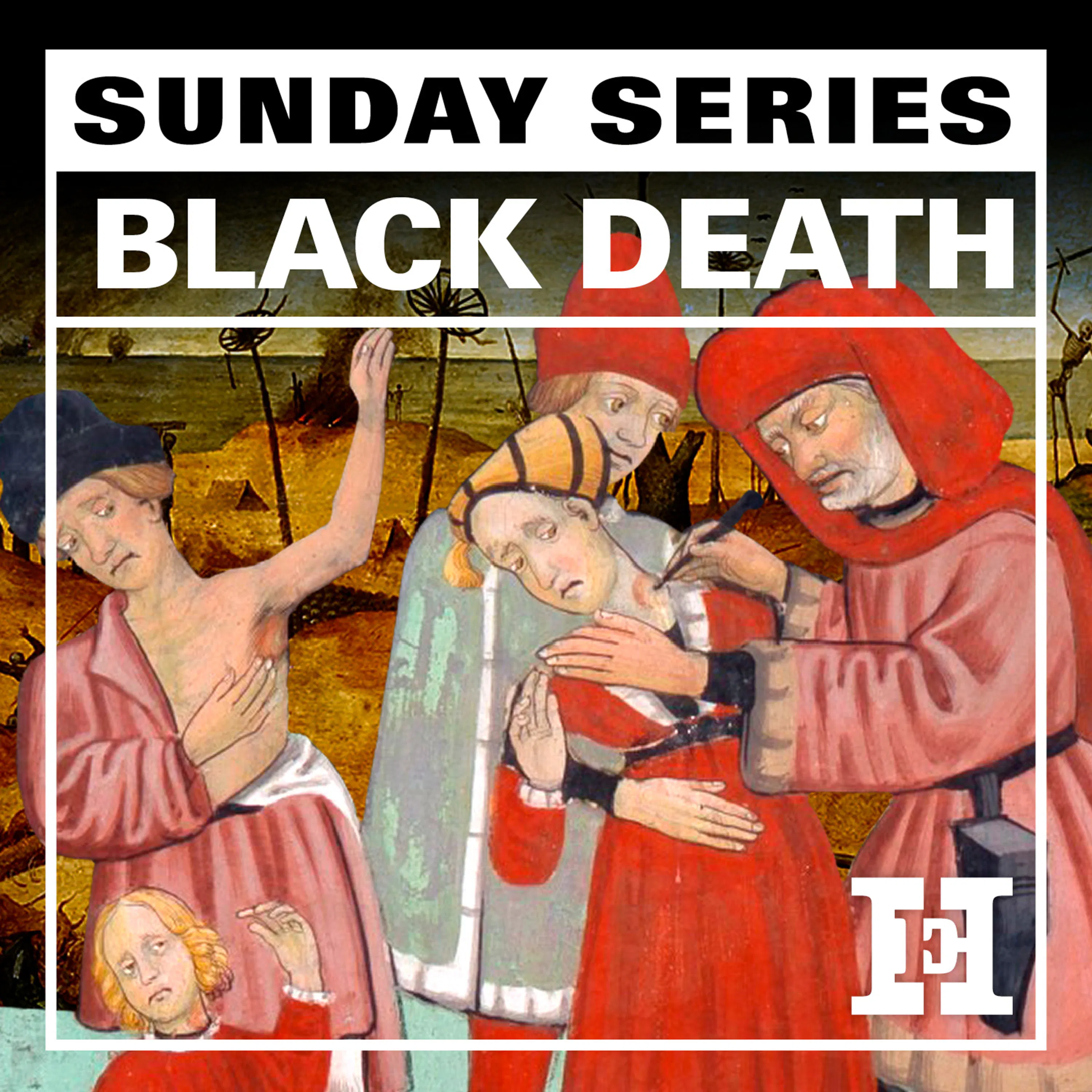
Welcome to the History Extra Podcast. It's the second episode today of our Sunday series Exploring the Black Death, and Emily Briffet is joined once again by historian Thomas Asbridge, whose latest book is the Black Death A Global History to talk through this devastating pandemic for Those
- [02:44]
Emily Briffet
who lived through it. The Black Death was a reality marked by fear, loss and uncertainty. But how did people cope with such overwhelming catastrophe? And what can contemporary records reveal about the emotional experience of living through the plague? I'm Emily Briffitts and I'm joined by historian Thomas Asbridge. In this second episode, we'll be stepping into the medieval world at the height of the pandemic, exploring human stories of despair, faith and survival.
- [03:17]
Emily Briffet (Interviewer)
Last episode, we spoke about the spread of the Black Death, and in this episode, I'm hoping that we could really touch on the human side of it, the lived experience. Now, obviously, we've spoken a little bit about some of the devastation that was caused, some of the fear, the intrepidation, but how close did societies actually come to breaking down?
- [03:38]
Thomas Asbridge
Yeah, for me, I would argue that's perhaps the question I was most interested in when I started researching the Black Death. I think it's the thing that perhaps in the end, maybe has the most to tell us when we look at the broader history of this pandemic in terms of lessons for the modern world. I think if we're going to try to understand the degree to which society came to the precipice, if you like, then maybe there's three different things we might want to consider. First, the degree to which society, social bonds started to fall apart, started to fracture. Second, how much disruption was there to burial practices, which were very important in a medieval setting? And thirdly, and quite obviously, to what extent did governments, administrations, did they stop functioning?
- [04:21]
Emily Briffet (Interviewer)
Now, these are all themes that I really hope we can cover as we talk through this. But first, I think we need to very importantly discuss what actually were the symptoms of the Black Deaths.
- [04:33]
Thomas Asbridge
Sure. One of the peculiarities that we can see from medieval records is some variety in the type of symptoms that people might exhibit. And the fact that it's very clear is that this caused some confusion amongst contemporaries, asking, is this one disease, is this multiple diseases? How does it actually work? So, in the majority of cases, someone might fall ill, start to exhibit fever, pain in various parts of their body, and within three to five days, they might develop unusual swellings, what we now typically call buboes. They might very commonly appear in the groin, under the arm, or somewhat less commonly, in the neck, and they become hot and very, very painful to the touch. At some point, those buboes might reach the stage again somewhere within three to five days, maybe six days at maximum, where the other symptoms might start to manifest themselves. A victim might start to spit up blood and Very rapidly thereafter, they would die. Our estimation of how many people might survive is around. If you've got this form of the disease and you're untreated, maybe 60% of people are going to die, so 40% survival rate. But I would stress all of the. That in particular is an estimate. There are other forms where people could start to suffer an illness in this pandemic, where they don't have these swellings. So in another form they might get blotchy dark patches on their skin, a very high fever, and within one to two days they might die. And if you've got this form, perhaps 90% of people who had this form and were untreated in modern terms, would die. The final and most lethal and most fast acting of all of these, you don't have those blotches on your skin, you don't have buboes, you just start spitting up blood. That can happen within 24 hours and certainly within 24 to 48 hours, and it's lethal in 99% of cases. So it's an exceptionally high, what we call now case mortality rate. So all three of these forms are reported in different ways by different commentators at the time. There's one remarkable, incredibly impressive commentator in Moorish Spain, in the kingdom of Granada, in the port town of Almeria. So a man called Ibn Katama, and he very clearly delineated between these three different forms and said, this is the same disease, but it can manifest itself in three different ways. Other writers said there might be two. As I said, some even suggested there were different diseases at work. What's clearly acknowledged in the majority of the medieval world and outside the Mamluk empire, for example, outside the Muslim world, is that these forms in some manner are quite easily transmitted, very rapidly transmitted, and it can potentially be very easy for this disease to travel from one person to another, or for people to catch this disease. Time and again, across the whole of the medieval world, we see writers saying, once this disease gets into a house, the whole household is going to die and they're going to be affected. And that in itself, that sense that this disease could be caught, even if you don't know exactly how you're going to catch it, bred really, really bone chilling levels of fear.
- [07:59]
Emily Briffet (Interviewer)
It's something that even just sitting here listening to it, it sounds terrifying. And we really get that sense from contemporaries then.
- [08:07]
Thomas Asbridge
Yeah, absolutely. Time and again we hear from commentators about how society reacted, how individuals and groups responded. One of the most famous accounts of the Black Death is written actually, it's in a literary work called the Decameron, but it's written by a very famous Florentine writer called Giovanni Boccaccio. And in the introduction to this work, he's essentially setting up later stories. It's based in Florence in 1348, and he describes how different parts of the city, different groups within the city, responded in different ways. But all of them are terrified. Some decide to just drown themselves and drink the pleasures of the flesh. Others try to hide themselves away. Others try to reform themselves and carry out very Christian lives. But they're all terrified because they know that this disease can get to them.
- [08:56]
Emily Briffet (Interviewer)
Now, before we touch on those relationships and reactions, I think we should just ask, were there any treatments or cures that people could hope for? Was there a hope for recovery?
- [09:08]
Thomas Asbridge
We know in very rare circumstances, we know specific examples of people who survived. There were definitely large sections of society that survived. It's not as if the totality of a settlement would be wiped out by this. Our estimate is in an affected area that perhaps 50% of the population, half of the population, were killed by this disease, or at least killed or died during the disease. The other thing we can't be certain of is how many people died just because of the breakdown of supply of food and other essential things, and perhaps the spreading of other diseases alongside it. But there are limited examples of people who wrote about catching the disease and then surviving. The most famous of them is actually a physician himself, a man called Guy de Chauliac, who was part of the team of physicians treating the Pope in Avignon. And unfortunately for Guy, he caught the Black Death probably in around June 1348. And he describes how for six weeks, he was incredibly ill, and everyone who knew him thought he was going to die, but he managed to pull through. Now, there must have been lots of other people like him, but it's very rare for them for us to actually have a written record of what that experience was like.
- [10:22]
Emily Briffet (Interviewer)
And do we know if there were any cures or remedies? How does it sit alongside the medieval understanding of the body?
- [10:31]
Thomas Asbridge
Sure. So physicians did their best. Those who were operating. We need to recognize that a lot of medical practice in the Middle Ages was based around what we would describe as received wisdom. So rather than experimenting or testing treatments out in patients, a lot of supposed experts would just go back to authoritative texts, often texts written in the Greco Roman world or received through translation from Arabic commentaries on those texts, and they'd look for their answers there. One of the most startling things that we get very, very early on in the summer of 1348, we get the King of France ordering all the most expert lecturers in the University of Paris to draw up their statement about what this disease is and how do you deal with. Sounds very impressive. And essentially it's equivalent almost of the World Health Organization today saying, you know, this is what it is, it is an absolutely bewildering text because it's so internally contradictory, because it clearly it's a group of people, one group saying, oh, it's what's happening in the, in the heavens, look at astrology, that will tell you the answer. Another, another group literally saying, oh, it's fat people who are going to get it. No, it's thin people who are going to get it. None of these people had actually treated Black Death patients. So it's all theoretical understanding of medicine and based around some of the classical features of medieval medicine, including what we call humoral theory. So the idea that you've got four humors in your body and they need to be in balance in terms of treatment, ultimately nothing that's really going to cure you. So we've got some of the classics from the medieval world. So bleeding, so bloodletting, supposedly again to cause a rebalancing of the humor. It's what we call cautery or putting some kind of corrosive substance on various parts of the body, again to influence humoral balance. One of the ones that I'm, I found most interesting to research is this substance called theriac. I don't know if you've ever come across theriac. Luckily it's not around in the, in the modern world. So it is essentially, it's the medieval cure all. It is a exceptionally complex compound of different ingredients. Could have certainly tens of ingredients, often it's more than 60 ingredients, all compiled to a very specific recipe. For the most impressive theriac, it's then aged perhaps for a year, perhaps from perhaps even 10 years. And you then consume this, either watered down into liquid or placed into your mouth because it's kind of a treacly substance. As far as we can see, the only really active ingredient in this is opium. So that opium would cause some relief from symptoms. It might ease breathing if the patient is struggling with their breathing, and it would help with pain. But it's not gonna cure you. Sadly, from the Black Death, the physicians that I was most interested in, so I mentioned Ibn Khatama in the kingdom of Granada. And there's another really fascinating individual called Gentile da Foligno, who was Working in Italy, in what's now modern day Umbria, by the city of Perugia. And both he and Ibn Khadimah really worked closely with patients and they offered lots of different options for treatment. And Gentile was a big proponent of theriac. But in the end, when we look at both the way they describe the disease and whether their treatments worked, even they acknowledged there's very little that you can do. You can try and help a patient, calm a patient down, but either they're going to survive through their own immune system, as we would understand it today, or they're going to die.
- [14:04]
Emily Briffet (Interviewer)
With that in mind, did the authorities of wherever in the world, we're obviously talking about a huge geographic scope here, did authorities try and put in place any public health measurements? We've seen such measures in our lifetimes.
- [14:17]
Thomas Asbridge
Yeah. So some do. As always, we're at the mercy of the vagaries of what survives in. In history. So we know, for example, that the authorities in Gloucester tried to cut off communication with Bristol because Bristol was one of the. It was a major port. It was one of the first places hit in the British Isles by an outbreak of the Black Death. So they tried to block all traffics, particularly coming up the River Severn, and it didn't work, unfortunately. It got into Gloucester. They put the seal on the city too late, unfortunately. Similarly, in the kingdom of England, in the autumn of 1348, King Edward III tried to close all the major ports, but again, he was much too late. He'd already been in the country for at least 3, 4 months. At a more local level, we have. So there's a city, smaller city outside Florence, a Tuscan city called Pistoia. Luckily, we have the survival of what we now call their ordinances for health. They had a very detailed record of what to do, how to deal with people coming to and from the city where you were allowed to arrive, from where you weren't. What to do with livestock. If you're going to sell meat, should you be allowed to sell meat? All of it suggests that they're trying to think of, how do you stop this disease? But they're. Because they have no idea really how it's transmitted. A lot of it's to do with the idea of miasma, somehow. Poisoned air. Is that a way. If you stop that, is that going to prevent the disease from spreading? Pretty much universally, nothing during the pandemic itself really seems to have worked. Only in very small, very few instances do we hear of the imposition of what we now think of as Quarantines that work. Probably the most infamous is from Milan, where we're told only in one source, so we can't really be certain if this is the way it worked. But one source rather grimly tells us that if a household, if a building was discovered to have someone in it who had plague, they basically bricked the building up and left everyone to die inside. And that was it, potentially. Apparently, this may have meant that Milan had a relatively small number of deaths during the Black Death, though that's quite contestable.
- [16:17]
Emily Briffet (Interviewer)
It's a high moral cost against the.
- [16:20]
Thomas Asbridge
Absolutely, yeah.
- [16:21]
Emily Briffet (Interviewer)
We spoke at the start of this episode about did social order break down? One of the things you mentioned there that would be relevant now is about burial practices. Could you tell us a bit about these at this time?
- [16:31]
Thomas Asbridge
Sure. So I think this was very important in the medieval world in the same way that it would be for us today, and it was during the recent COVID pandemic. I think for all of us, probably, there should be relatively fresh memories of, even if you weren't personally affected, how significant it was, if people weren't able to get to a funeral, weren't able to carry out the normal processes of marking someone's death and mourning someone in the same way. That was very powerful and important in the medieval world, and disruption is often recorded by people who are writing about it at the time. But there's also what we technically call a devotional or religious underpinning to this, because for many people, both in the Christian and the Muslim world and the Jewish world, if you don't follow the right burial practices and patterns, there's the fear that you might suffer in the afterlife, that you might be condemned in the Christian sense to hell, that you might not make it to heaven. So there's a lot of anxiety surrounding this. What we do know, from both chronicle and narrative accounts and from written documentary material, is that, not surprisingly, it was a huge challenge to bury half of the population. So let's say we're thinking about Florence. We're talking about certainly probably 40, maybe as high as 60,000 people dying. And this is normally within the space of less than a year. So what do you do with those bodies? It's a very grim predicament, but it's one that people had to face up to. Often we hear descriptions of, eventually the recourse to mass burial sites and mass burial pits, and there's some quite gruesome and grisly descriptions of how the dead are treated. And on the basis of that, I think we could assume that normal practice has just been abandoned. Basically, the dead are just treated with little respect. That may have been the case in a city like Cairo, where I think the scale of the problem is such that it's almost impossible to deal with, because unlike Florence or unlike London, this is a massive city with half a million people. So if you're talking about 250 to 300,000 people dying in the space of months, it becomes almost an impossibility to deal with that. We hear from narrative sources that there are piles of the dead just building up on the streets and that the dead are just thrown into pits. That may well have been the case in Cairo. What's remarkable, however, is when we think about London, London affords us a unique opportunity to go beyond text, because in London, there's a specific emergency burial site that's created at a place called East Smithfield. It's just outside what was then the city walls. Now, if you're in London and you're thinking about where it is, it's just to the side of the Tower of London. East Smithfield was created in the either the very last days of 1348 or the start of January and the months that followed 1349, just as the Black Death was really starting to take hold in the city. And we know that at least 2,000 people were buried there, perhaps significantly more than that. What's remarkable about the site is that in the 1980s, it was excavated and very, very detailed archaeological study was carried out. The skeletal remains of more than 600 individuals were collected. I've been really fortunate enough to go to the room, at least that they used to before the Museum of London Mood, where they used to keep in boxes every single one of these skeletons. And the way in which the skeletons were laid out, how they were buried, was studied in very minute detail. So now we have the archeological evidence alongside the written evidence, because we've got contemporaries in London describing what happened. But now we have this new seam of material that allows us to take an even closer look. And what's fascinating about this is that even though they're dealing with a massive crisis in London, they clearly take real care with these bodies. They orientate them east to west, as is traditional in Christian burial. And they haven't just thrown them. Even if they're in a burial trench where multiple individuals are buried side by side, they're clearly lowered down, probably with ropes, because the bodies are not disarticulated, they're laid out very carefully. Then a thin layer of soil is placed above them, and then another layer placed above that individual that suggests that they're trying to show significant respect even in the midst of the Black Death.
- [20:54]
Emily Briffet (Interviewer)
So it just also shows how different approaches to the Black Death are.
- [20:58]
Thomas Asbridge
I think this is for me, this is the fundamental truth of studying the Black Death. You cannot find the answer by studying one region or one specific moment in time. You have to look as broadly as you can.
- [21:13]
Shopify Announcer
Starting or growing your own business can be intimidating and lonely at times. Your to do list may feel endless with new tasks and lists can easily begin to overrun your life. So finding the right tool that not only helps you out, but simplifies everything as a built in business partner can be a game changer for millions of businesses. That tool is Shopify Shopify is the commerce platform behind millions of businesses around the world and 10% of all all e commerce in the US from household names like Gymshark, Rare Beauty and Heinz to brands just getting started, Shopify has hundreds of ready to use templates that can help you build a beautiful online store that matches your brand's style. And you can tackle all the important tasks in one place, from inventory to payments to analytics and more. No need to save multiple websites or try to figure out what platform is hosting the tool that you need. And if people haven't heard about your brand, you can get the word out like you have a marketing team behind you with easy to run email and social media campaigns to reach customers wherever they're scrolling or strolling. Start your business today with the industry's best business partner, Shopify, and start hearing. Sign up for your $1 per month trial today at shopify.com realm. Go to shopify.com realm that's shopify.com realm
- [22:37]
Thomas Asbridge
we gather here tonight to bring women
- [22:40]
Emily Briffet
back to their rightful place.
- [22:42]
Hulu Announcer
The Testaments, a new Hulu Original series from the executive producers of the Handmaid's Tale.
- [22:47]
Progressive Insurance Announcer
It's easier to accept a story than
- [22:49]
Emily Briffet (Interviewer)
believe that the people around you are monsters.
- [22:51]
Hulu Announcer
The battle isn't over.
- [22:53]
Depop Announcer
There comes a time when you have to take action, when you have to choose your own destiny.
- [22:58]
Emily Briffet (Interviewer)
Never quite as a team.
- [23:00]
Hulu Announcer
Watch the new Hulu Original series, the Testaments, streaming on Hulu and Hulu on Disney for bundle subscribers. Terms apply.
- [23:07]
Carrington College Announcer
Your next chapter in healthcare starts at Carrington College's School of Nursing in Portland. Join us for our open house on Tuesday, January 13th from 4 to 7pm you'll tour our campus, see live demos, meet instructors and learn about our Associate Degree in Nursing program that prepares you to become a registered nurse. Take the first step toward your nursing career. Save your spot now at Carrington. Edu Events. For information on program outcomes, visit carrington.edu.si.
- [23:39]
Emily Briffet (Interviewer)
thinking about burial practices, I'd like to talk a little bit about the psychological impact. How did people deal with grief and loss and. Yeah, I don't even know how to explain that.
- [23:51]
Thomas Asbridge
Yeah, it is a very challenging question. It raises also a very thorny issue for historians, which is this emerging field which has been coming to the fore in the last 20 years, the history of emotions. And what do we do? We think that emotions are innate and unchanging, so we have an understanding of how we might experience grief now in the 21st century. Are we expecting that that is a constant, that that's not going to alter if we look back in other periods of time? Or do we think, on the other hand, that emotions are more subject to change depending on what your society's like, what your religious beliefs might be? It's a difficult question to answer specifically, not least because very few people writing at the time of the Black Death go into close detail about their emotions. Two I would pinpoint, one would be the Italian Tuscan writer Petrarch, who becomes, in the aftermath of the Black Death, one of the most famous poets in the whole of the medieval world. He's seen as one of the founding fathers, what we now call humanism, which is essentially laying the pathway to what will become the Renaissance. He's a very influential figure and he's just starting to become what we now think of as internationally famous, as a poet for our purposes, or for my purposes as a historian of the pandemic. He's most interesting because he writes letters. He's an avid correspondent, and so he writes letters to lots of friends or associates, and he describes his experiences. And what's important about these letters is that they are written in the moment. Again, they're not written with hindsight. So we get a sense of what the experience of the Black Death was in the moment. And he describes in very, very visceral terms what he calls the shipwreck of the world. He talks about his soul almost being wrenched out of his body by the grief that he's experienced because he loses close friends. And in his purposes, the most terrible loss is of his great, what we think, unrequited love, a woman called Laura. It's very unclear whether they actually ever had an affair, because we know, or we strongly suspect that she was married or whether she was just a woman that he saw and he decided that this was the great unrequited love. Of his life. But she died during the Black Death in April 1348. And when he heard about this loss, he wrote a note inside this incredibly precious manuscript that he had of Virgil's Aeneid and various other classical texts. And we're incredibly fortunate we still have that. The original of that text, it's called the Ambrosian Virgil, it's held in a library in Milan. And he wrote a little note at the front of it, deliberately saying, I've put this here so that every single day, whenever I open this book, I will see this memory of you. So his grief was clearly very, very powerful and strong. And I don't think there's any indication in his experience of what some historians have called psychological numbing. The idea that you're exposed to death and you become inured to it. I think it was still very raw in him.
- [26:56]
Emily Briffet (Interviewer)
So you also mentioned there was another example of this.
- [26:59]
Thomas Asbridge
Yeah. So in some ways, this is even more powerful and personal. In the earlier episode, I mentioned the Byzantine, a young Byzantine official called Demetrios Codones. And like Petrarch, he's someone who wrote letters and kept copies of those letters that we now have. He wrote in the first instance about the outbreak of the Black Death in Constantinople, but he also alluded to a later outbreak in the 1360s. And in that outbreak, he lost two of his sisters, and he survived. And his final sister also survived. And this letter, this is the perhaps the most powerful expression of emotion we come across, certainly in letters describing what I can only really equate to post traumatic stress disorder. He talks about the physical effects on his body, that he starts at a sudden moment. He won't be able to breathe, he'll feel pain in his chest, he can't sleep. And he talks in very graphic terms about how his sister just doesn't stop crying, that she is just absolutely beset by grief. So I think that letter alone demonstrates that, at least for some people in the Middle Ages facing the Black Death, they did not become numbed to the experience of the plague.
- [28:12]
Emily Briffet (Interviewer)
These obviously show some quite close relationships that have been lost, that have been broken. Do familial bonds at this time strengthen or do they fracture?
- [28:22]
Thomas Asbridge
The term that's sometimes used around this is this notion of what we call abandonment, the idea that across the medieval world, during the Black Death, there was so much fear of catching this disease that you would actually turn your back on your professional associates, your friends, and even members of your own family. And famously, in the text that I mentioned earlier on by Giovanni Boccaccio, in his Decameron, he describes how husbands would turn away from their wives, wives would turn away from their children, that these. These bonds would break. Now, some historians have argued that this is just a literary text and it's just a trope, it's just a literary flourish designed to show how terrible the pandemic was. And I think that is Boccaccio's purpose. But what's striking is that that same idea is repeated in many other texts in many other parts of the medieval world. So there was a friar in Kilkenny in Ireland who described the breaking of familial bonds. Similarly, we have a chronicle from the city of Pskov in Russia illustrating exactly the same activity. So there's no way, I think, that so many sources across such a vast swathe of territory can either be copying a single copying Boccaccio's text, or just following a rumor. I think they're representing a form of reality. This is also backed up by documentary evidence. So this is a pretty obscure case, but it's something that I became absolutely fascinated by. So if we look at Genoa in the first months of 1348, there was a very. I think he must have been a very brave individual, a notary, which is essentially a legal scribe, called Guidotto Bracelli. And we know for a brief period of time in early 1348, he went through some of the suburbs to the east of Genoa, writing wills for families. He would go to their household, he'd scribble their wills down so that they could be compiled. And very fortunately, the original copies of what he wrote are still in the Genoese archive. Now, in one of those wills, he went to the household, or the house in which a woman called Clara Casale was living. Clara was married and she was living with her parents. Her will is important because in this text, it appears that she has caught the Black Death. She's, it would seem, in her last moments of life, deciding what she's going to do with her property. She's relatively wealthy. She's able to leave a fair amount of money to her two, at this point at least, surviving children. Now, she states in very specific terms that she was abandoned during her illness. And it's very striking. She leaves nothing to her husband, who's clearly still alive, and nothing to her father, who's also still living. She does leave something to her mother, who stayed by her side, but was the only person to do so. So, to me, this is documentary evidence in the form of a will indicating that abandonment was a reality, that some People, at least, were neglected by their family members, turned away by their family members. However. And there's a big however here, I don't think this is the norm. I don't think that across the medieval world, the generalized reality was that families or groups of friends turned on their neighbors, turned on their blood relatives. And we can see that in a number of instances where we look at specifics, often it's to do with wills, the creation of wills. And this is largely because to have a will drawn up during the 14th century was not a solitary activity. You needed. Often you needed a notary, so a legal scribe to write down the text. You might also have an accompanying or attending priest there at your deathbed. But crucially, you'd often have witnesses as well, as many as 10 or 12 people drawn from your local community. And in a city like Bologna in Italy, or London, we can see numerous examples of these wills being drawn up. And we can see the bonds of family still holding strong, either in who's turning up to witness, knowing that they're putting themselves in harm's way, potentially gonna catch this disease, and often do catch this disease as a result, but nonetheless willing to carry out that key function, or in the way that people are desperately trying to pass on their goods to their surviving family. So I think there's a balance. I think abandonment was a reality, but it's not the norm. And I think there's an enormous amount of societal resilience demonstrated in the bonds that do survive.
- [33:05]
Emily Briffet (Interviewer)
It's a hopeful message in some respects.
- [33:08]
Thomas Asbridge
Yeah. I think there are numerous examples of incredible bravery. There's a fishmonger from London called William Greylond, who is chosen as the executor by two people who drew up wills in the first months of 1349 in London. This is at a time when people are dropping like flies. The city is overrun by the disease. But William nonetheless makes a real point of doing everything he can to carry out what was required to be an executor. He goes to Chancery Court and makes a claim for one of these individuals so that one of their shops can be sold and the money can be passed on. Now, in the end, it looks like he paid with his life. Both he, his wife and his daughter all caught the Black Death, and certainly two of his wife and his daughter certainly died there. And then we don't have a definitive date of death for him, but he appears to have died that summer. He showed that he was willing to carry out his obligations.
- [34:07]
Emily Briffet (Interviewer)
I think it would be particularly remiss if we didn't talk about it in this conversation, there's a particularly dark chapter. It's already a dark story, but this is a particularly dark chapter, and that's the persecution of minorities. Would you mind telling us a little bit about why the Jewish communities were persecuted at this time?
- [34:24]
Thomas Asbridge
You're right. It is one of the darkest and most difficult facets of the Black Death. Very sadly, I think it reveals what I would describe as an inclination within human society, within crises, within moments of catastrophe. Time and again, we can see through history this proclivity for looking for scapegoats and for persecuting minorities, a result. And very often, Jewish populations come into the crosshairs as a result of this. In simple terms, it's a very. It's a complex story. I'll try to simplify it. In the very early stages, we do see attacks on pockets of Jewish population in settlements in different parts of the medieval world. So one of the very first happens in the port of Toulon, just to the east of Marseille in modern day France. It's an attack that takes place on Easter Sunday. And we hear in very graphic and gruesome terms that a street where lots of Jewish families lived was attacked. People were pulled out of their. Their homes, the houses were ransacked, and lots of people were murdered. At this stage, there's. There's no direct connection to the. To Jews supposedly being responsible in any way for the Black Death. They're just targeted, it seems, perhaps, because this is an opportunity to settle old grudges. And crucially, one of the subtexts of this that comes out in the trial documents for this event is that it's not just that the individuals were targeted. The people who attacked them also looked for their ledgers, the books where they kept records of the money that was owed to them. So this seems to have a financial undertone because the people who are carrying out the attacks want to be released from debts that were due. Over time, however, the attacks against the Jews start to morph. And instead of it being loosely connected to the Black Death, it becomes much more directly a supposed link directly raised. And this is in the form of what we now call the poisoning conspiracy. So the notion that somehow Jews in different parts of the world, and particularly in the Alps and then over time in Germany, had been directly involved in poisoning wells and water sources, and that this was the actual cause of the Black Death, that it wasn't a communicable disease, it's a form of poisoning and deliberate poisoning. So I think the fundamental Thing to realize when we think about the poisoning conspiracy is that although individuals carrying out trials of Jews where Jews were often tortured and forced to give up supposedly confessions of their activities, their involvement in this poisoning conspiracy, although those individuals might have thought they were getting coherent evidence, when you look at all the documents and compare them across different localities, you see that there's no real continuity. There's a different story in every different place, different conspirators. So in my mind, there's no question that these were trumped up charges. We cannot know whether the people who raised the accusations in their heart believe that the Jews were guilty or not. That will never know. I don't think the evidence doesn't survive for that. But in terms of thinking about whether Jews were actually guilty, I think there's no question that that's an impossibility. However, within those trial documents, there's a crucial step made which turns this from localized persecution to something much, much graver and much deeper. And that is that when Jews were being questioned, they were encouraged to implicate others, and not only other individuals. But in the early trial documents, we have them saying everyone in a Jewish community, whether they're children or the elderly, no matter who they were, they knew. They knew what we were doing and therefore they're guilty as well. And it's on that basis, that idea of collective responsibility, that we start to see localized persecution move to a more what I would call industrial scale, particularly across Germany. We think we have around 300 Jewish communities that are persecuted and often wiped out in the course of the Black Death. And we see very calculated moves, sometimes supported by local governing administrations. Massacre Jews often. They will build special buildings, special structures that hundreds of people will be herded into, and then that group of Jewish people will be burned alive in those buildings. That's important because it shows this is not mob violence carried out in a feral outpouring of anger. This is much more calculated. It takes time. They're building structures. There's a fabric to it, there's an organization to it. And as you say, I think it's representative of the darkest moments of the Black Death and the darkest inclinations of humankind.
- [39:22]
Emily Briffet (Interviewer)
It's really difficult to talk about and I think it's, it's. I'm finding it difficult sitting here listening to it because it's already. We're already talking about quite a morbid, devastating, quite awful subject. I would like to talk about another group of people in society at this time, and that's the flagellants. Could you tell us A bit about this particular group.
- [39:43]
Thomas Asbridge
So sometimes historians have drawn a very direct connection between the Jewish persecutions we were just discussing and the rise of this. This group we now call the flagellant movement. I don't think that that connection is necessarily as clear cut as some have suggested. I think it is. It's an expression of one critical factor, which is that religion plays a very prominent role in much of medieval life. No matter where you are on the globe, and certainly in the Christian west, what we might call the Latin or Catholic Christian West. Almost everyone conceived of their response to the Black Death in one way or another through the prism of religion. Very often they thought that this terrible pandemic had arrived because it was a punishment from God, it was a response from God. And so they saw this as a response to human sin, and they looked for ways to counteract that. In essence, what we think of as the flagellant movement emerged as an extreme expression of what we call penitential sentiment. So the idea that if you've been sinful, if God is punishing you for something, then you need to respond, you need to cleanse yourself. How are you going to do that? And in this form, we start to see groups of people moving and marching, often from community to community. And famously where they get their name from within these processions, carrying out ritual self flagellation with either whips or with flails that are tipped with iron crosses in an act of physical punishment and supposedly purification or penance. There are some strange features of this movement. Even what I've described is already pretty strange. But in medieval terms, there are some things that set them apart. And we should recognize that in almost all our sources, we're getting a view of what we call the flagellants from their enemies, from the people who saw them as dangerous, as extreme, as uncontrolled. Very often these are church sources. Really. We only have one document, which is a rare survival of an order of service from the flagellants, which gives us a view of how they saw themselves. And it's only a fleeting. I think they can be seen as very extreme, very outside the norm. But in actual fact, I think they fit a bit more into normative religious practice than we might expect. So, interestingly, they often talked about themselves as carrying out their travels for a set period of time. Often it would be 33 and a half days. That immediately should give us an insight to the fact that they're thinking of themselves as imitating Christ. In Latin terms, we call it imitatio Christi. The idea that if you're going to follow a path to salvation, you need to follow in the footsteps of Christ. And they also seem to have thought of themselves as imitating Christ's suffering on the cross. When they're whipping themselves in these rituals. In some ways, I would argue that their actions are not that dissimilar to other forms of supposed imitation of Christ, including crusading. They call themselves in different ways forms of soldiers of Christ. They call themselves people who are following in Christ's footsteps just as crusaders did. So I think they were a short lived movement. There had been somewhat similar activities in previous periods. We can go back to the 13th century to see a brief flurrying of something similar to flagellant behavior in the 1260s. But then they were relatively limited in terms of geographical scope. We see them appearing quite prominently in Germany and the Low Countries. One group of flagellants appeared in England. They came to London, carried out the processions. People didn't seem to be that impressed, I think largely because the Black Death had already been and largely gone from London. But for a time they held sway and they scared the papacy for certain.
- [43:41]
Emily Briffet (Interviewer)
Now I'd really like to recircle back to the question we spoke about at the beginning of this episode. The did social order break down? We've considered how authorities looked at this. We've looked at bonds in society and we've also looked at burial practices. So drawing upon those three areas that we've spoken about, where do you sort of stand on that argument?
- [44:06]
Thomas Asbridge
I'm gonna hedge my bets a little bit, if you'll forgive me. I don't think there's a single answer for the whole of the medieval world. I think there are places where we see society circling just above collapse. Cairo would be one place I would point to where we see administrative systems start to falter. We see a breakdown of burial practices, a mass amount of mortality. I think that would also be the case in terms of the breakdown of law and order in somewhere like the Kingdom of Aragon. So Aragon's interesting because we have relatively good survival of at least some documents. But it's an area that's suffering through a civil war as well as the pandemic. And the combination of those two things I think was a perfect storm. So in that area, I think we can see law and order fracturing quite significantly. But in other settings, let's say the city of Venice, the Republic of Venice in Italy, or indeed the city of London or large parts of England, we see quite a lot of continuity of administration. We see officials trying their best to cope with the Black Death, and often not necessarily succeeding in saving thousands of people, but at least mitigating the worst effects of the pandemic. And I think that shows a remarkable degree of bravery, endurance and resilience on the part of the medieval population.
- [45:34]
Emily Briffet (Interviewer)
Gives us a real insight into the period. Thank you very much, Thomas.
- [45:38]
Thomas Asbridge
You're very welcome.
- [45:40]
Emily Briffet
That was Dr. Thomas Asbridge, a historian of the Middle Ages specializing in the study of the Crusades, knighthood and chivalry. He is also reader in Medieval History at Queen Mary University of London and the author of the new book the Black Death A Global History, published by Alan Lane. If you'd like to find out more about the Black Death and its surrounding context, or how humanity has dealt with disease through the centuries, I've put together some essential reading, listening and viewing from the History Extra archive to help deepen your understanding. You can find a link to that in the description of this episode.
- [46:26]
Carvana Announcer
This podcast is brought to you by Carvana. Selling your car should feel like one less thing on your list. Not one more. With Carvana it is just go to Carvana.com Enter your license plate or VIN and get a real offer. Down to the penny. No back and forth, no surprises. Just an experience you can trust. Like your offer. Accept it. Schedule pickup and we'll come to you with a check in hand. Your car, your timeline, your terms. Visit Carvana.com to sell your car today. Carvana pickup fees may apply.