Loading summary
Transcript155 lines
- [00:01]
Podcast Host 1
This episode is brought to you by Progressive Insurance. Most of you listening right now are probably multitasking. Yep, while you're listening to me talk, you're probably also driving, cleaning, exercising, maybe even grocery shopping. But if you're not currently operating some kind of moving vehicle, there's something else you could be doing right now that's easy and could save you money right from your phone. Getting an auto quote from Progressive Insurance Drivers who save by switching to Progressive save nearly $750 on average. Plus auto customers qualify for an average of 7 discounts. There are discounts for having multiple vehicles on your policy, being a homeowner and more. And just like your favorite podcast, Progressive will be with you 24 7, 365 days a year so you're protected no matter what. So multitask right now. Quote your car insurance@progressive.com to to join over 28 million drivers who trust Progressive, Progressive Casualty Insurance Company and affiliates. National average 12 month savings of $744 by new customers surveyed who saved with Progressive between June 2022 and May 2023. Potential savings will vary. Discounts not available in all states and situations.
- [01:16]
Podcast Host 2
Springsteen Deliver Me From Nowhere is now streaming on Hulu and Hulu on Disney. Trying to find something real in all you always do. The artist, you know the story. You don't see Golden Globes nominee Jeremy Allen White as Bruce Springsteen. Critics are saying it's a career defining performance. Let's burn this place down. Johnny Springsteen Deliver Me From Nowhere now streaming on Hulu and Hulu on Disney.
- [01:44]
Podcast Host 1
Rated PG 13 hey, it's Brooklyn Adams and I'm partnering with Abercrombie to tell you about the newest drop from their Active brand. You personal best YPB leggings are made with buttery soft fabrics that hug you in all the right places and come in Abercrombie's viral curve Love fit designed to eliminate waist gap, paired with sports bras and super soft sweatshirts. It's activewear that supports every part of my busy lifestyle and gives me my best butt ever. Head into the new year feeling your personal best. Shop Active by Abercrombie in the app, online and in stores.
- [02:16]
Podcast Host 2
Ready to relax in your dream bath retreat without the stress of figuring out every detail yourself at the Home Depot. Your bath remodel is coming. Shop fully designed rooms and curated bath collections to go from inspiration to transformation fast. Use digital tools to visualize flooring in your space and find everything you need from tubs to toilets and all the tile in between to bring Your vision to life. The Home Depot dream baths built.
- [02:52]
Narrator/Host Intro
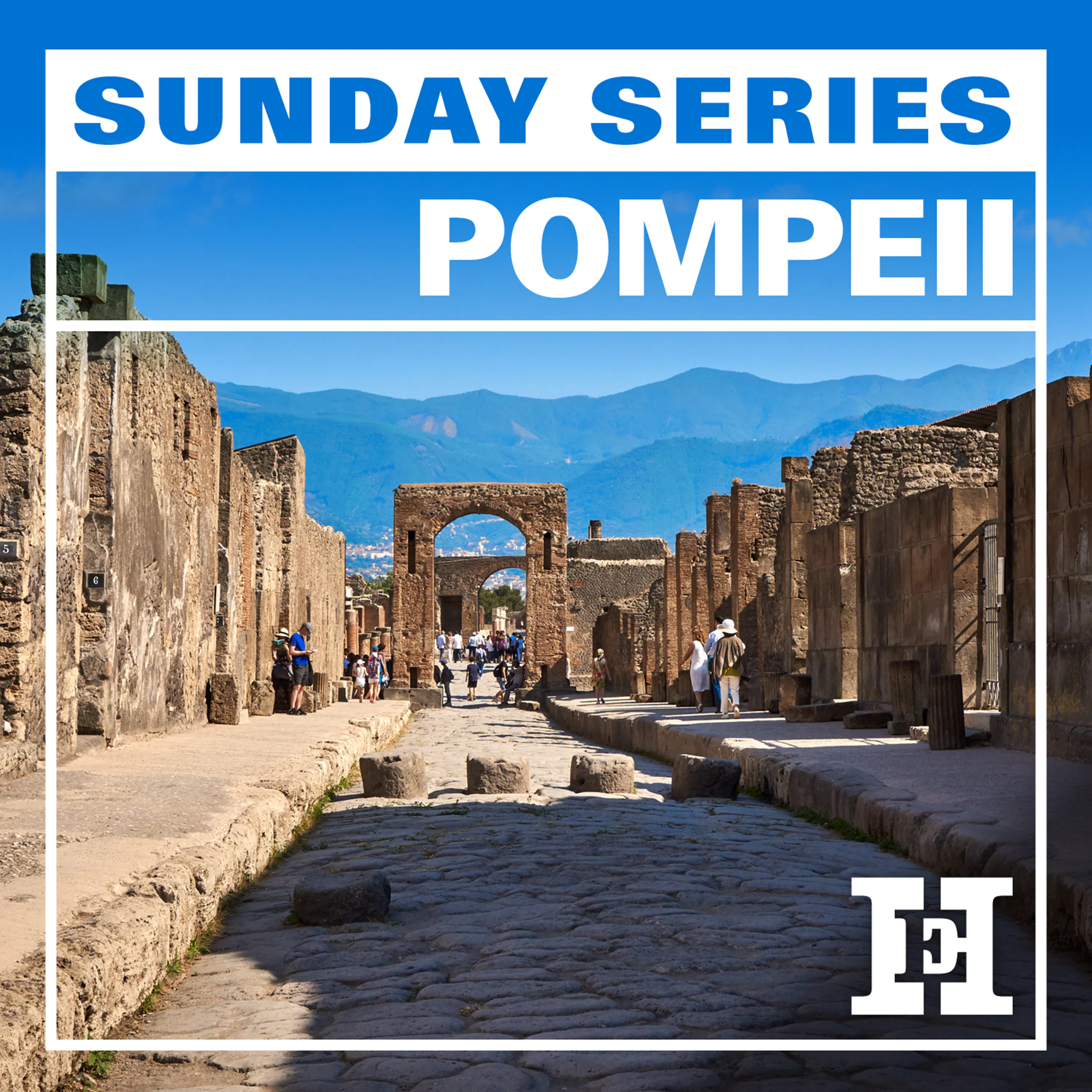
Welcome to the History Extra podcast. Today, in the third installment of our Sunday series chronicling the tragic final days of Pompeii, we're going to return to Jess Venner and Kev Lotchen, who are going to explore what happened after Vesuvius erupted and how the city eventually became the archaeological marvel we know today.
- [03:11]
Kev Lotchen
Once a thriving Roman city, life stopped suddenly in Pompeii in AD 79 when the nearby volcano Vesuvius erupted, burying its inhabitants and preserving their world underneath meters of ash. I'm Kev Volochen, and I'm joined by Dr. Jess Venner, a historian of the Roman world and an expert on Pompeii. Welcome back, Jess.
- [03:33]
Jess Venner
Thank you.
- [03:34]
Kev Lotchen
Today we're going to be talking about the aftermath of the eruption. How is it viewed in Rome and how long does it take for that news of the disaster that's befallen in the Bay of Naples to actually reach the Eternal City?
- [03:47]
Jess Venner
Yes, so it's very rapid. They would have been sending messages to Rome, probably on very fast horses. So I imagine they would have found out pretty quick. Obviously, people were also moving themselves too, but they realized quite quickly that there was a terrible, terrible thing that had happened. The Emperor Titus was the emperor. He hadn't been the emperor for very long, so this isn't a good start for him. And he was really trying to change things after Nero. So. But yes, so they found out that it had been buried, these cities had been buried that they knew of, and Pompeii was famous. Herculaneum was fam. And so they were going to try and help with relief efforts, and that's something that Titus starts to do.
- [04:26]
Kev Lotchen
So what are those relief efforts? What do they look like?
- [04:28]
Jess Venner
Yeah, so the relief efforts are quite quick. So Titus wants to be this wonderful new leader. So he hears about it and he's like, right, let's get going. We need to go and help these people. We need to sort out the refugees. So we hear from Suetonius and Cassius Dio that he is doing this. So we've got quite good records of this response to this natural disaster. So Titus dispatches ex consoles to the Bay of Naples to have a look at what's happened and also to organize rescue operations. They have no idea how bad it is until they get there. They also want to provide aid and they want to assess the damage and see if anything can be rebuilt or salvaged. And they realize pretty quickly that that's not gonna happen. So they're gonna salvage. Instead, he then started allocating huge amounts of money to support the refugees that are coming from the Bay of Naples to help them rebuild. And he's also trying to resettle them as well. So he's resettling them in different towns that are at least sort of local, that haven't been so much affected. So people are dispersing. There can't be any room for them. But it suggests that there's a lot of survivors.
- [05:40]
Kev Lotchen
Actually, that's a really interesting point we should pick up because I think there's kind of this idea that, like Pompeii hurricane wiped out. In an instant, it's all gone. But there are survivors and there are refugees.
- [05:50]
Jess Venner
Yes, exactly. They had to go somewhere. And of course they've lost all of their property. And if you were an heir, you would have wanted that property as well. So they've got to restart. And there's all these sort of things you don't think about with is the aftermath really. It's never really discussed what happened to these people. Titus was remitting taxes and he was suspending tribute payments for the region so that they would be able to recover, because you have to pay tribute to Rome to be a part of it. And he was like, okay, that's kind of ridiculous. Cause what are they gonna pay with?
- [06:25]
Kev Lotchen
Is that quite a big deal, remitting the taxes like that?
- [06:27]
Jess Venner
Yes. Yeah, yeah. Huge deal. Oh, yeah. They loved to tax the Romans. They would tax everything down to urine. Even though it's a tax force, we.
- [06:36]
Kev Lotchen
Should segue if we can. Urine tax.
- [06:39]
Jess Venner
Tell us about that urine tax. They basically realized that urine was quite a valuable resource. I think it was Nero, actually that did. Was one of the emperors, the earlier emperors, who realized that taxing urine was a really good idea because you wash.
- [06:53]
Kev Lotchen
Your clothes with urine, which sounds bananas.
- [06:57]
Jess Venner
Yes, it does. But it was very effective. And they were used to the smell, so the ammonia smell, but apparently it wasn't too smell know. But they used to leave pots out on the street for people to use. And then the Fullers would go and collect these pots. So they started taxing the urine anyway. That's an aside. So, yes, they were very big on.
- [07:18]
Kev Lotchen
Taxes, Very big on taxes. But taxes are kind of remitted for this time so that the people from Campania region presumably can get back on their feet. Do we have a sense of how many survivors and refugees there are?
- [07:30]
Jess Venner
It's really, really hard to. So much of the land around Pompeii and Herculaneum and the Other towns has been rebuilt on, so we don't know how many people are underneath those. We can't account for the population in the countryside. We don't know exactly how big that was. Slaves weren't counted. We don't know how many of them were there. So in Pompeii, we have about. I think in 2002, we had 1,049 bodies. And since then, more have been found. We've also got only a third of the city that's still to be excavated. So there's more bodies gonna be under there, inevitably. So we've got about 1600-1700 bodies. So in comparison to 20,000 population, potentially, that's about 8 to 11% mortality rate.
- [08:17]
Kev Lotchen
There's a huge number unaccounted for, and we just don't know the ratio. I suppose, then it's like how many might be deceased but unfound versus lived fulsome lives afterwards.
- [08:26]
Jess Venner
Exactly. Yeah. They could. You know, all of those people could have got out, we have no idea. But a lot of them would have been caught escaping on the roads out of the cities around Vesuvius.
- [08:38]
Kev Lotchen
So Titus has done this kind of almost relief plan, at least financially. Is there any kind of blowback for him in Rome itself?
- [08:49]
Jess Venner
Yeah. So he was trying to be, like, really, really magnanimous. Is that the right word? Leader? The ideal humane leader. And he really wanted to show that he was to Nero with how he dealt with the Great fire of Rome. Because Nero didn't deal with that very well. He started building himself a nice big palace where everyone's houses had burned down. And so they weren't too keen on that. So he was like, right, this is gonna be very, very different. But he did go and actually visit the disaster zone himself.
- [09:17]
Kev Lotchen
Oh, right, okay.
- [09:18]
Jess Venner
Yes. So it's very, very much like a politician. I will go to this disaster zone and I will look like I'm getting involved. So that was, again, a big contrast. And Cassio's Dio says he was deeply moved as a calamity affecting his own family. Now, once again, we have writers that are choosing to depict him one way or another. Titus wasn't very popular as an emperor, and none of them were actually. None of them really were until later. So initially he is being depicted as this humane emperor, and they're like, great. This might be a bit different.
- [09:54]
Kev Lotchen
One thing we spoke about with the kind of the way people viewed the eruption happening around them, was they were kind of calling on the gods or that the gods had actually abandoned them. Do you think there's any sense in the wider Roman world then, that once this disaster happened, this was somehow linked to the gods?
- [10:12]
Jess Venner
Yeah, I think so. When there's a gap in knowledge, you sort of turn to gods or mythology, and religion is a very big part of this to understand why things are happening. So the Romans always sought divine meaning in things, and they would have seen this probably as divine displeasure, the sort of the wrath of the gods, particularly as some of them thought that there were potentially giants underneath and they were trying to escape. And I mentioned how some people potentially saw. They think they saw giants in the clouds coming out of Vesuvius during the eruption. So, yeah, they're very much trying to find reason in it. And, yeah, they would have probably thought, actually, we've done something wrong here and there's a reason we're being punished, because they wouldn't have understood why it was happening necessarily.
- [10:59]
Kev Lotchen
And with that, would there have been any. Have we seen the evidence for any kind of, like, I don't know, change in behavior or kind of like celebration of gods kind of way, Almost like appeasing them?
- [11:09]
Jess Venner
That's really interesting. Not that I know of. It would be very hard to track because, as we mentioned, we don't know where these people went, and anyone that wasn't there wouldn't have been bothered because they weren't affected by it directly. So all they're seeing is all these people settling in other places and this fallout and the loss of Campania, which was a huge source of food. So from that perspective, that's probably more the way they saw it. Rather than trying to respond with religion, they probably would have made more offerings to sort of prevent this from happening further. But it would be very hard to trace. I wish we could.
- [11:46]
Kev Lotchen
Yeah, that'd be fascinating, wouldn't it? One thing I had in mind to ask you was about attempts to maybe reset or clear Pompeii, and you kind of mentioned a Titus gone, and it became a salvage operation. So are we saying that Titus and his consuls, they looked at it and gone. This is beyond repair. Let's go into asset stripping, essentially.
- [12:04]
Jess Venner
Yes.
- [12:04]
Kev Lotchen
Right, okay.
- [12:05]
Jess Venner
That is exactly what they did. So they started tunneling down, trying to find materials. So the Romans were incredibly resourceful with materials. They would melt down bronze, they would reuse marble, you often see. And it happened right into. When Christianity started appearing in Italy, they started reusing epitaphs to build walls because they were marble, you know, like they were valuable. So you've got, like, people's epitaphs on the Back of church walls or whatever this was happening from before. They were very resourceful, so they're trying to tunnel down. So if you can imagine the top of Pompeii covered in this volcanic material, we've got about, you know, varies from 4 to 6 meters, so it's pretty high. But that means you've. You've had the top layers of the buildings taken out by these pyroclastic flows. In general, big features are poking out. It's a bit like a graveyard. So you can see where the amphitheater is, for example. That's a big feature. You can probably see the top of like the Temple of Jupiter. Cause that was tall as well. So you sort of know.
- [13:04]
Kev Lotchen
So just saying, like the church spire, if you like, like stuck peeping above the.
- [13:08]
Jess Venner
It's exactly like. That's exactly it. Yes, exactly. So they've got an idea of where things are. Finding individual houses, like your own house, would be really tricky. But I think people did try. We have tunnels going through these houses, actual holes in walls. And this happened later as well because there were looters. We find there's been skeletons that have been found that aren't of A.D. 79.
- [13:32]
Podcast Host 2
So.
- [13:32]
Kev Lotchen
Well, those are people who've gone in to salvage or loot and then something's happened to them.
- [13:37]
Jess Venner
Exactly, yes. Yeah. And we've got graffiti from later excavators and stuff. It's completely mad. We also haven't got as many statues as we think we should have certain places, because they've gone. And it's very unlikely they were doing this during the eruption. But, yeah, tunnels were a good indicator of that.
- [13:54]
Kev Lotchen
I wouldn't like to be carrying a massive statue of, I don't know, Apollo during the pitch black.
- [13:58]
Jess Venner
Probably not, no. No.
- [13:59]
Kev Lotchen
It sounds a bit like almost like a prison escape. Like you kind of tunnel down and then you kind of come in, it's like, oh, this is my house. And you find the next one.
- [14:07]
Jess Venner
Yeah.
- [14:07]
Kev Lotchen
Is this kind of state sponsored, then? As in, like the state is digging tunnels to asset strip and get all this marble? Or is it kind of like, you know, we're residents of Pompeii, we've lost everything, but we want to go back. I know. Get our strongbox and trying to find our own stuff.
- [14:22]
Jess Venner
Yeah. It would have been a bit like that as well, because what else do they have? We've got these relief efforts from Titus, but we don't know how much they were given. How one would prove that they were a refugee of Pompeii.
- [14:34]
Kev Lotchen
So anyone could go, I could say, like, I was in Pompeii. Give me a hand up.
- [14:37]
Jess Venner
Exactly. How on earth would they prove it? And I think it wouldn't have probably been as successful as Tice's would have hoped, and probably not as the people of Pompeii and the surrounding region would have hoped. So they wouldn't have had anything necessarily if they'd had the foresight to think, right, I'm gonna take these documents or my jewellery. A lot of people did try and escape with jewellery and precious materials and a lot of people had pouches of money on them. You find a lot of people with loads of jewelry on. So that makes sense if they did have any. It seems.
- [15:09]
Kev Lotchen
Oh, see the thing where it's like I've got three rings on each of my ten fingers kind of vibe.
- [15:12]
Jess Venner
Yeah. Yeah. It feels like that to me because they're running around in this erupt with loads of jewellery on, like, you know, and there's a whole family that's been found on the Via della Bondanza, which is the street of abundance. It's the one where we've got the shopping street strip and there's a house on that street and there's this family of people that have been found and they all have loads of jewelry on. But they were there right up until the end of the eruption. So they weren't necessarily in the business of escaping at that point. They were hiding.
- [15:43]
Kev Lotchen
How much time passes between these kind of attempts at aid and reclamation to the city being not lost? But certainly it's not as famous as Pompeii anymore.
- [15:59]
Jess Venner
Yeah. So it's still in living memory for a little while. Obviously, the first to second centuries ad, it's still talked of, but then it seems to just sort of trail off of the maps, sadly. So they know of it. But it starts being called Civita. So, like the place of where people lived. On maps, there's a map called the Tabula Puttingeriana. I don't know if I'm saying that. Right. And it notes, the location of Pompeii is about Right. And it says Civita. So it's acknowledging that there was a city there. And clearly it's in local legend that there was one, but it's not a significant settlement anymore. So it sort of just disappears.
- [16:42]
Kev Lotchen
Yeah. It's so interesting. It's something like it's not the ruin of Pompeii, it is city settlement.
- [16:48]
Jess Venner
Yeah. Really sad. Sort of just disappears.
- [16:51]
Kev Lotchen
And does the same thing happen with Herculaneum as well?
- [16:53]
Jess Venner
Yeah. So It's a similar process. Yeah. Herculaneum is so, so buried. There is no getting down into that. Pompeii is much more so it's like four to six metres, whereas Herculaneum is 20 metres deep. There's just no getting down into that. That's just.
- [17:07]
Kev Lotchen
So they don't tunnel, they don't reclaim in the same way?
- [17:10]
Jess Venner
Not that I know of, no. Pompeii was a lot more common and as time went on, there was a lot of rain. Another reason to think it was later in the year, actually, the eruption, there was a lot of rain and that solidified the volcanic material. And so after a while it wasn't actually possible to get down with tools that they had. And then much later, when excavators discovered it, that was, that was when they started tunneling again. And getting down into the proper layers.
- [17:36]
Kev Lotchen
Does that difference in depth mean that Herculaneum is actually better preserved than Pompeii since you were looters and scavengers into it?
- [17:42]
Jess Venner
Well, yes, yeah, because it's really difficult at Pompeii because early excavators weren't very keen on certain materials. So they were treasure hunting, essentially. So they won't record things properly. Very, very hard.
- [17:57]
Kev Lotchen
For archaeologists like myself, they're not using the most finessed tools if they're looking for one specific thing.
- [18:03]
Jess Venner
No, no, no. They're doing it as quick as possible. Find the good stuff, get out. You know, they would literally destroy frescoes and they would just find like glitzy stuff and go, fabulous, let's keep that, sell it on, give it to the, you know, the king or whatever. Bones were all discarded as well. They were sort of just like bundled in together. So all this context from a lot of the city has just totally been lost because of this looting by so called archaeologists.
- [18:35]
Kev Lotchen
So called archaeologists who'd have them.
- [18:40]
Narrator/Host Intro
This History Extra podcast is brought to you by Rocket Money. Throughout history, experts have offered various solutions for ensuring your financial well being. In the medieval era, for instance, carefully managing an unlikely resource eels could ensure that you had an effective, if unusual, way of paying your debts. For steely eyed Victorian industrialist Andrew Carnegie, ruthless efficiency was key to balancing the books. But it's not always easy, as my own attempts to keep track of my finances suggest. But help is at hand. Rocket Money is a personal finance app that helps find and cancel your unwanted subscriptions, monitors your spending and helps lower your bills so you can grow your savings. Rocket Money automatically categorizes what you're spending across your accounts and letting you choose the categories and tags you need to successfully manage your finances and track patterns in your outgoings. It also consolidates checking, savings, loans and investments into a single helpful dashboard offering a crystal clear view of your financial picture. Let Rocket Money help you reach your financial goals faster. Join@RocketMoney.com HistoryExtra that's RocketMoney.com HistoryExtra RocketMoney.com HistoryExtra.
- [19:51]
Podcast Host 2
You didn't start a business just to keep the lights on. You're here to sell more today than yesterday. You're here to win. Lucky for you, Shopify built the best converting checkout on the planet. Like the just one tapping ridiculously fast acting sky high sales stacking champion at checkouts. That's the good stuff right there. So if your business is in it to win it, win with Shopify. Start your free trial today@shopify.com win.
- [20:24]
Kev Lotchen
Are you a player in the private equity industry? Troutman Pepper Lock is one of the leading national law firms focusing on middle market private equity. Our podcast PE Pathways brings on dealmakers to share their thoughts on trends and developments. We do a deep dive into the M and A industry with topics around tax, employment issues, regulatory developments, and much more. Check out PE Pathways wherever you get your podcast. We've got to the point where Pompeii, Herculaneum, they are no longer remembered by those names. Do they kind of take on a kind of folkloric kind of aspect within the Roman world? Like do people remember what happened here? Or is it just corner like oh no, no, these are just ruins.
- [21:11]
Jess Venner
Yeah. I mean the thing is, in the medieval period, obviously we have them transcribing Pliny's letters so they would have known about it. In that sense, it would have been a legend, I guess. But in terms of like living memory, I don't know of any circumstances necessarily where I think it's sort of like every now and again mentioned and then it just stops being mentioned. So we've got Pliny writing his letters 20 years later. So Tacitus for some reason is interested in this that much time later. But it does just trail off. They just stop talking about it. But absolutely in the area there would have been a memory that would have been passed on, passed on, passed on and that would have become legend because a lot of them would have tried to resettle in the area because as we've talked about before, it's very, very fertile. So you need to make the most of that. And you know, it's very, very occupied now in the Area. And so, yeah, they would have gone back and they would have talked about this and passed the stories down.
- [22:10]
Kev Lotchen
Yeah. And as you were saying to me earlier, this is a kind of like, where else would I go? Kind of mentality. Like, this is my land.
- [22:15]
Jess Venner
Yeah, exactly. And then there's free land there. Like it's going to be Roman. State would have snapped it up. But, yeah, I mean, where else would you go? Your livelihood, your occupation, your family are all there. So, yeah, where else would you go?
- [22:30]
Kev Lotchen
So Pompo is lost, as it were. I'm using that word very loosely. There's a point there gets, I suppose, rediscovered Again, I use that word very loosely. But when does that story pick up in terms of the modern European knowledge?
- [22:45]
Jess Venner
So there's this lovely character called Domenico Fontana, who was an architect and he was quite busy in Rome and Naples, and he was digging a canal to divert the river Sarno, which we know now was right next to Pompeii. So he was diverting that and he was going through. And all of the people tunneling found some ancient walls and sort of frescoes and inscriptions and they were like, oh, this is very odd, this is amazing. And they just covered it back up again. They were like, eh, you know, whatever. And this was in 1592, really, really long time ago. And then later, on 1709, we're in Herculaneum area, someone's digging a well and they find something again. And this marks the first true discovery.
- [23:38]
Kev Lotchen
Of Herculaneum, because this time they don't cover it up.
- [23:41]
Jess Venner
No, I think they have a little look and they're like, ooh, hold on a minute. Something good here. So it's 1738, we have Charles of Bourbon in charge and he was the King of Naples and he was really keen on doing what a lot of people in these positions of power have done, linking himself to classical ideas of brilliant leaders. This happens a lot. So he's like, fantastic, let's go, let's start excavating this thing and see what is there. So he goes down and they start doing these excavations quite methodically. And then we get to 10 years later and they start excavating at Pompeii. So this is 1748 now. So there's a huge gap between 1592 and 1748. They actually thought that it was Stabii or it was Herculaneum, some people. So. And then it was only later that they found an inscription in 1763, a lot of dates here, and there was an inscription which said, of the Republic of the Pompeians.
- [24:42]
Kev Lotchen
And now we know this is Pompeii.
- [24:43]
Jess Venner
And they were like, whoa, wait, this is Pompeii. And we know of Pompeii because it's in letters by Pliny, for example, or Tacitus or Pliny. The elders talked about their cherries or things like. Or their headache wine. And so, O, this is Pompeii.
- [24:59]
Kev Lotchen
So by that point, the knowledge of Pompeii and what happened, that was known, but its precise location had been lost. So suddenly it's like, ah, here we are.
- [25:06]
Jess Venner
Yeah, it's like finding Atlantis, you know, which doesn't exist. Or does it?
- [25:12]
Podcast Host 2
Or does it?
- [25:13]
Jess Venner
Yeah, well, exactly. But it's the same sort of thing where they had this legend and like you said, they didn't know where it was. And then suddenly they were like, oh, wait, this is Pompeii. This is great.
- [25:22]
Kev Lotchen
And they were excited, presumably, by, like, they know the story of.
- [25:26]
Jess Venner
Yeah, massively. Yes. And it became this wonderful, like, idealized place with all the frescoes that were coming out and particularly the treasure we've just talked about. And they would take those treasures back to the king's house and he would display them to his friends. And so he was like, quick, quick, get some more treasure. Just be tunneling like mad and getting all the good stuff out.
- [25:49]
Kev Lotchen
So Charles Bourbon, very happy. I'm curious. I don't associate his name so strongly with Pompey. Is he as well known as he should be?
- [25:57]
Jess Venner
For there's different people involved in Pompeii's history throughout the years. So we've got him, and then we've got Queen Maria Carolina of Austria. She was the wife of Ferdinand IV of Naples. So Charles of Bourbon was doing this for, like, 20 years, 1730s to 50s. And then Maria comes after this, and she was really interested. She was actually his daughter, I think. So she was like, okay, we need to be quicker here. So she starts getting them to work quicker on these excavations. She's like, awful for people like me. We're like, no, don't rush it, for goodness sake. But she turned Pompeii into a really fashionable spot for the grand tour.
- [26:36]
Kev Lotchen
Okay.
- [26:36]
Jess Venner
That's when that started happening. So she's making it really fashionable. And then they started tightening control on the finds. That is, they wanted it for themselves in their palaces. So that was interesting. But, yeah, then we've got lots of different other characters, all trying to relate it to their dynastic prestige. You know, I'm discovering this Roman city. This is mine.
- [26:58]
Kev Lotchen
There's A lot of flag planting going on.
- [27:00]
Jess Venner
There's a lot. There's a lot of that. There's a lot of competition. It's who can do this the quickest, who can find the best thing. It's fabulous because the Bourbons especially would be doing these excavations. They'd find something wonderful and they'd go, whoa, whoa, whoa, the king's coming in a couple of days. Let's cover that up. And when he comes, he can discover it with us.
- [27:20]
Kev Lotchen
It's almost like put a blanket over his stones. Like, I wonder what happens if you move this. I just don't know.
- [27:25]
Jess Venner
They would just stage it and he'd be like, oh, well, you see, I was here for that. So it was ridiculous, really, when you think about it.
- [27:31]
Kev Lotchen
That is wild. I'm really surprised that Napoleon doesn't get in on this as well.
- [27:35]
Jess Venner
Oh, Napoleon, Yeah.
- [27:37]
Kev Lotchen
Because he loves a bit of classical claiming for like appropriation. He's all over it.
- [27:41]
Jess Venner
Yeah, yeah, he is, yeah. He very much thought himself as the new Augustus.
- [27:45]
Kev Lotchen
Yeah, yeah.
- [27:46]
Jess Venner
And then we've got Mussolini as well, who does this again. So he sort of tries to as well, like Napoleon, this classical rebirth, reclaiming the classical period for our people. So it's like a messy sort of thing really, because there's all these different people coming in through the years that are trying to put their own mark on to Pompeii, which affects how things are coming out of it and what's happening to them. A lot of things ended up being sold on the black market or put into their palaces. And we don't know where they came from, what houses, what context, who they were found by. Yeah. So if you walk around the Naples Archaeological Museum. Fantastic museum. Often the labels are just Pompeii because they actually don't know where it's come from.
- [28:35]
Kev Lotchen
Somewhere in Pompeii, but somewhere.
- [28:36]
Jess Venner
Yeah, but who knows?
- [28:37]
Kev Lotchen
Temple house. Don't know. So is there a kind of like a. Almost a black market of Pompeian antiquities then? Like, I associate that kind of like wide scale looting with Egyptology, certainly.
- [28:47]
Jess Venner
Yeah.
- [28:47]
Kev Lotchen
Does the same thing happen with Pompeian Herculaneum?
- [28:50]
Jess Venner
Yes, sadly, yes. Yeah, still happens now, because people obviously dig into their own properties and find things. So there's like a legend in the area. When I was digging at Aplontis, somebody told me about this wonderful story because it's a mad story.
- [29:05]
Kev Lotchen
Excellent, love.
- [29:06]
Jess Venner
A mad story where this local Italian man, he was digging in his garden for some reason, as they tend to do, you know, digging wells and they seem. Cause they're going deep and they can find something. The legend is that he found this room. And the Americans, this is the story, were like, ooh, can we buy that?
- [29:25]
Kev Lotchen
The room?
- [29:26]
Jess Venner
Yeah. So he sold the room. I told you it was mad. And now that funded his move to America, and now he has a really popular pizza chain in America, funded with this room.
- [29:40]
Kev Lotchen
So, sorry. Okay.
- [29:41]
Jess Venner
So I don't know if it's true, but that's the sort of legends that come out where it's just so easy to find things.
- [29:48]
Kev Lotchen
I'm just so intrigued. Like we said earlier. Did we. The contents room, the physical room, like you took the walls and went, all right, there you go.
- [29:54]
Jess Venner
Yes, that's what I have in my head. I think they took the whole entirety of this room. And I don't know what this room was or what was in it or what it consisted of, but that's how extreme it can go. Yeah, it's pretty extreme. But, yes, there are, sadly, things sold on the black market. And I still see things pop up on, like, supposedly, you know, like auction sites or ebay or whatever, which say that they are from Pompeii. I mean, how you would prove that, I don't know, is probably not true most of the time, but it is a problem because they shouldn't. They shouldn't be there at all in these situations.
- [30:30]
Kev Lotchen
In terms of the modern excavation, how far along have we measured it? I think it's like two thirds, you were saying.
- [30:35]
Jess Venner
Yes, two thirds. We've got a third to go. There's good reasons that we haven't excavated those areas. But, yeah, we started again in 2018. And if you go to the site today, you can see them ongoing. So they're trying to. They're doing a. There's a huge amount of effort. The director, Gabriel Zuketriegel, is. I hope you've said his name right, is doing amazing work on giving it back to the people, particularly the local people. Because locally in Herculaneum and Pompeii, there's been this feeling that, oh, these cities are getting so much income, so much attention, and around them there was all this poverty, and they weren't really getting anything from the sites historically. That has changed in recent years. So Francesco Serrano at Herculaneum, the director, has also done this. He started building a park around it and things. So the people are starting to feel really proud of that. So, yes, there is a third to go. And we have made sure that that's been the case because as I said there was like this huge rush, particularly the 18th and 19th century, to excavate Pompeii and find treasure. We as humanity, it's a really important thing to not rush these things because you don't necessarily have the technology, the money to preserve what you get out. You know, you go there now and there's all these paintings that have been lost because they couldn't be preserved. Cause they didn't have the money or the resour resources, whatever. So it's really important that we don't rush these things. But saying that the excavations that are being done now are done so methodically and recorded properly, thankfully. So people like myself can go to that data and say we can reconstruct life from that. We're getting a lot of lower class examples of life now as well, which is really nice because that wasn't a focus previously, it was more about what are the elites doing. And that has skewed our image of Pompeii. So now we're starting to find different things and it's fascinating.
- [32:36]
Kev Lotchen
And what would be the thing that you think is missing that we haven't found yet that you'd really like to find?
- [32:42]
Jess Venner
I am an archaeobotanist, so I specialise in urban agriculture and what people ate, how it affected their lives, that sort of thing. I think there's loads of vineyards left to be found, I hope anyway. But I think that's a really important part of Pompeian life because as I mentioned, they're very agricultural as a society and. No, historically, from an archaeological point of view, it's been overlooked the importance of producing your own food, vineyards, orchards, vegetable plots, that sort of thing. So I think we may find more of those because it's in that part of the city where we've got the agricultural district and we're going just above that. So this is the southeastern corner, the north eastern corner hasn't been touched yet, so we could find all sorts. You know, recently found a private bathhouse.
- [33:27]
Kev Lotchen
Oh, cool.
- [33:28]
Jess Venner
In a house. Yeah. Which is so rare. So, so rare. Yes, it is, yeah. You have to have a huge amount of resources to have one of those yourself. And yeah, I was actually privileged to see this coming out of the ground, as in, I didn't, I didn't end up going in the end for various reasons, but I was asked to tell them what was happening, what was gonna come out and sort of like predicting whether it was a garden or not.
- [33:54]
Kev Lotchen
Okay.
- [33:55]
Jess Venner
Based on what they'd discovered. So that's still being excavated now. But you have this issue where, of course, the pumice is in these spaces. So let's picture a courtyard with a garden in the middle. So it's a peristyle garden. You have the columns around the edge. Of course, that's going to fill with pumice and it's just going to fill and fill and fill. So you're just going to have pumice. So that's then supporting the columns that have collapsed during the tremors or over time, whatever, because then it's got more material on top of it. So when you take that pumice away, you don't want it to all fall in.
- [34:25]
Kev Lotchen
Yeah.
- [34:26]
Jess Venner
So you get to this situation where you're like, ah, this is an open space. We need to reinforce the buildings and then we can dig. So it's not as straightforward as it seems. There's all these processes that you have to go through.
- [34:37]
Kev Lotchen
Hugely complicated process.
- [34:38]
Jess Venner
It is. It is hugely complicated. Yes. Yeah.
- [34:41]
Kev Lotchen
Now, if you want to know more about how these archaeological digs have transformed our understanding of Pompeii, then you can read an excellent arc on that by historian Sophie Hay in the History Extra app. It's part of my beyond the podcast picks. You can find a link to that in the episode description. Speaking of the Roman world in general, I am a huge historical history and TV fan. I would really love to know your favorite representations of Rome, the empire, not just Pompeii on silver screen or small screen.
- [35:11]
Jess Venner
Yeah. So do you know what I love? The Obviously Gladiator is gonna be in there. Of course. I really enjoyed the latest one, actually. It's like, really good fun. It's completely nuts, but it's fun. So that would be up there, I think, the eagle from years ago with Channing Tatum. I loved that when it came. I think it was like in 2002 or something.
- [35:30]
Kev Lotchen
I need to go back to that one. I haven't done it.
- [35:32]
Jess Venner
I really enjoyed it. I thought it was really good because it's set in Britain as well. So it's quite nice to see how they sort of like, would have looked at the Britons. But I've gotta mention HBO's Rome.
- [35:43]
Kev Lotchen
Yes. A classic.
- [35:44]
Jess Venner
Oh, my God. Such a good series. I only watched it for the first time a couple of years ago, I think, and never finished it, actually. That's not. It's not a reflection on how good it was.
- [35:53]
Kev Lotchen
It started so well.
- [35:54]
Jess Venner
Yeah. It was one of those where you're just like, oh, why didn't I finish that? But loved it. I just like the amount that they put into that. And the sets. Oh, my God, the sets. I've been to that set as well in Italy.
- [36:06]
Kev Lotchen
Oh, no way.
- [36:06]
Jess Venner
Yes. Chinacita. And the set is still there. It's amazing.
- [36:11]
Kev Lotchen
They just lift it up.
- [36:12]
Jess Venner
Yep.
- [36:13]
Kev Lotchen
That's incredible.
- [36:13]
Jess Venner
They sometimes use it for stuff, so you probably.
- [36:16]
Kev Lotchen
You see it in other shows. Just stop looking around.
- [36:18]
Jess Venner
Yeah, yeah. Oh, wait, that looks familiar. Yeah, exactly. And it's got, like, the temple and the forum and the calendar up and everything is brilliant.
- [36:26]
Kev Lotchen
This would be a great time to talk about our graffiti of the Week.
- [36:31]
Jess Venner
Yes, it would.
- [36:32]
Kev Lotchen
I've been asking you every episode to pick a piece of graffiti you found particularly exciting. Enlightening. Another verb of your choosing. What have you found for us this week?
- [36:43]
Jess Venner
So I have found a piece of graffiti that seems to show some gladiators.
- [36:49]
Kev Lotchen
That's cool.
- [36:50]
Jess Venner
Victory. Yes. So, again, someone's taking a lot of time to draw this out and they've got different types of gladiators and they're holding, like, palm fronds, which is the sign of victory.
- [37:01]
Kev Lotchen
All right. I really thought you were going to say a sword.
- [37:03]
Jess Venner
Yeah, no, no, they're not in this situation, actually. They seem to be walking down, like, stairs or ramps. So that might be the stairs in the amphitheatre. It's not clear where it is, but they seem to be on these different levels. And there's three gladiators, and underneath it says, companions, in our victory, you perished with the new Syrians. This is interesting for a couple of reasons. The companions were sort of seen as a collective body, but we don't know who this is referring to in this, because you would usually fight other towns as gladiators. So you'd have the Pompeians fighting the new Syrians and it got very much like football today, where they would support certain gladiators and sort of follow them through their career. So this is a good example of, like, basically the Pompeians being like, well, ha, we beat the new Syrians. This is important for another reason, because the Pompeians had a really big brawl with the new Syrians. After a gladiator fight, there was a riot at the theater at the amphitheater, and it went terribly. It went downhill so, so quick. It was in 59 AD, and they basically ended up fighting the new Syrians. They were throwing rocks. Some people were maimed and injured so badly that they had to go to Rome to be fixed. Yeah, it was really bad. And there apparently were mortalities as well. There's gladiator graffiti all over Pompeii. And like this one, they sort of depict the gladiators in quite good detail with the specific types of gladiators as well, and what they would be holding and you know, who they were and they'd put their names above them and say, this is so and so, he's won 12 times, this is so and so. He's new and he's just beat the person that's won 12 times and never lost before. You know, it gets really, really specific. But yeah, this one's nice because it seems to be alluding to this rivalry that they seem to have with Nuceria. So this is something that's very personal to them, just like it is today when you support a team in any sport. It's something that becomes a bit of your identity. So I think it's a really, really nice image into something that meant a lot to them. Gladiator fights and games in general were so important to the Romans. So yeah, we're seeing something very vivid here, a little vivid image into their rivalries and pettiness as well, which I really, really love.
- [39:18]
Kev Lotchen
Brilliant. Jess. Thank you very much.
- [39:19]
Jess Venner
You're so welcome. It's been a joy.
- [39:21]
Kev Lotchen
Again, next time we're going to be talking in more detail about what's been unearthed from Pompeii, but until then, go beyond the podcast in the History Extra app where I've curated some extra reading around Pompeii, Vesuvius and the wider Roman Empire. You can find a link to that in the episode description below.
- [39:44]
Podcast Host 2
Business Owners if you're using that flat rate square Peg merchant account, you're getting robbed. A debit card may only cost 1.5%, yet you're charged 2 point or more. With Risk Free Merchant you get true wholesale rates, saving up to 30%. Prefer zero fees. Our dual pricing solution passes them to the customer. And with our Cash Back rewards program, you earn 2.5% back every month. From high risk online to low risk mom and pop. Call 855-400-7475 or visit riskfreemerchant.com get paid to Get Paid does it feel like.
- [40:15]
Podcast Host 1
Your finances are all over the place? You don't need a hundred page financial plan or budgeting app. You need someone to talk to who gets you your money and your mindset. Your fruitful guide maps out where every dollar should go. Bills, spending, saving, investing. Then sets it all up for you. Accounts, priorities, transfers, paycheck splits. Done. Just press go and your money runs itself. Get your money mapped and learn more@frontful.com.
- [40:43]
Podcast Host 2
Your wish is your Command is being called the greatest success book of all time. With over 100,000 5 star reviews.
- [40:50]
Kev Lotchen
I went from 5k on my bank.
- [40:52]
Jess Venner
Account to 8 million.
- [40:54]
Kev Lotchen
My income doubled. I was able to retire at the age of 31.
- [40:58]
Podcast Host 2
It reveals the missing key to the law of attraction. Your Wish Is yous Command is now available on Amazon. Search youh Wish is yous Command on Amazon to get your copy today.