← History That Doesn't Suck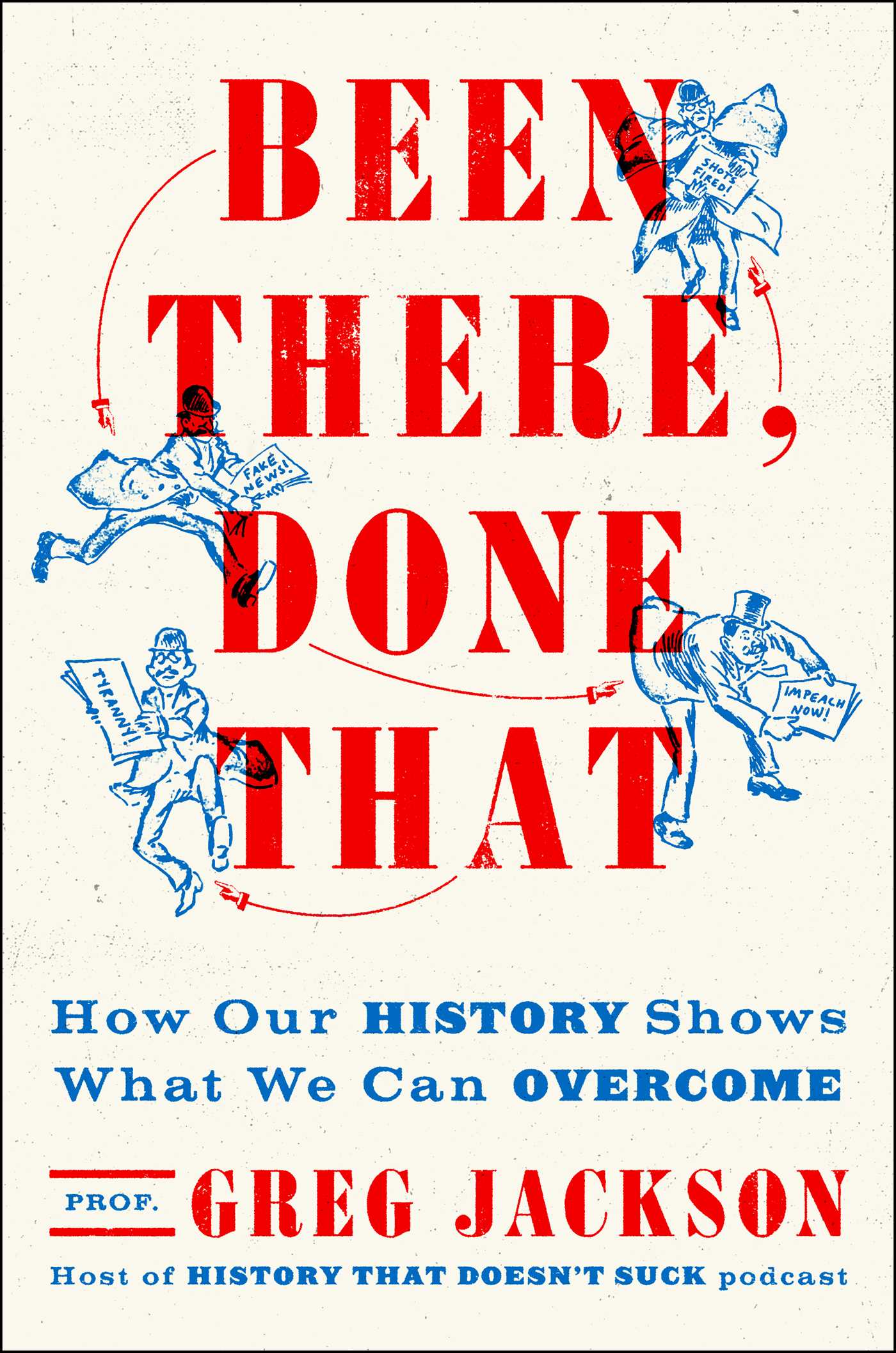
History That Doesn't Suck
Bonus: “Messy Tales,” an Excerpt from the Prof’s book, Been There, Done That
00:34:37
Loading summary
Transcript37 lines
- [00:11]
A
Welcome to History that Doesn't Suck. I'm your professor, Greg Jackson, and I'd like to tell you a story.
- [00:30]
B
Hello and welcome to a special episode
- [00:33]
A
of History that Doesn't Suck. For me, it's particularly special, probably the most personal, and I'll even say most
- [00:40]
B
vulnerable in my nearly nine years behind the podcasting mic.
- [00:44]
A
See, today, as always, I'd like to tell you a story, or rather two stories. The second of these is the introductory chapter of my new book, and thanks to my publisher, Simon and Schuster, I get to share it with you, my
- [00:59]
B
HTDS friends, a full six weeks before the book hits the shelves, and we'll
- [01:04]
A
get to that in a matter of minutes. But first, the first story is personal,
- [01:08]
B
because for once, this isn't a historical figure's tale.
- [01:13]
A
This one is mine, the story of
- [01:15]
B
why I wrote this book and in a way, why I started this podcast.
- [01:20]
A
So if I may rewind,
- [01:27]
B
there are a few reasons I started HTDS as a young professor back in 2017. Among them was a frustration with our public discourse.
- [01:35]
A
I believed that our nation's ability to talk to each other on important issues was struggling in part because our history
- [01:42]
B
and civics education have struggled for so many years, decades even, that it was starting to show up in our partisan dividend.
- [01:50]
A
There was less disagreeing while understanding and
- [01:52]
B
more demonizing across the aisle. To me, the cure was to provide the most entertaining non partisan history of our nation that I could possibly muster. One that, done right, I expected, would have episodes that sometimes made us proud, sometimes ashamed, but always helped illuminate our ability to see the complexity, difficulty and beauty in being American. And I was audacious, foolish and crazy enough to think maybe I can make a dent. You came. You listened. As the years passed, growth slowly came.
- [02:31]
A
Then it quickly came.
- [02:33]
B
That was exciting and terrifying. What I didn't expect, but should have, was how much this podcast would impact me. As the years passed, I was forced to face my own blind spots. I now stand in awe of our
- [02:48]
A
railroads and bridges and the people like
- [02:51]
B
the Roebling family and countless immigrants from around the world who died to gift us this incredible infrastructure. My appreciation for figures like George Washington and Abraham Lincoln grew into a reverence of admiration. And the Reconstruction in Indian wars episodes wrecked me as abstract numbers of removal or massacre took on faces and names, indelibly impressed on my mind. I became more of what I had hoped to give you. Even with, or perhaps blinded by, my PhD in tenure, I hadn't realized how living with these stories year after year would change me. Make me more nuanced, more generous, more inclined to see our better angels. It's been absolutely humbling. By 2021, I was thinking harder about what a miracle our unlikely union is. I wrote my stage show, I met you on the road, and I noticed something. I was seeing more and more in my classrooms, a growing despondency. More than once I was asked, how long does America have left? Increasingly, I was meeting fellow Americans, afraid that the experiment is failing, that this incredible constitutional republic is dying. And if I'm honest, I had felt enough of that fear myself to know the question deserved a serious answer. So filled with historical perspective by my years of doing this podcast, I felt compelled to to provide that answer, both for you and myself. It upended my life. Writing a book on top of HTDS doubled my research and writing load. But I did it. I finished it. I got our answer. This book Been There, Done that, How Our History Shows what We Can Overcome is exactly what the title promises. In eight chapters that take us from the early Republic to the cusp of the 20th century, it tells the tales
- [04:57]
A
of our predecessors facing challenges we too
- [05:00]
B
often mistake for being new and insurmountable today, particularly fake news, contested elections and political violence, and examines how they fought back and overcame these demons and how we can do the same today. This book forced me to spend long hours revisiting and examining the foundational premises of our union, to wrestle with them, to interrogate them, and my own beliefs and thoughts. And the outcome of doing this for the past several years is, without dismissing our very real challenges today. I believe with all my soul that the American people can prevail if we so choose, and not only survive, but thrive and create a still more perfect union. It is my legit, seriously researched, hard
- [05:52]
A
hitting and over 300 page long love letter to Lady Liberty.
- [05:57]
B
Not a childish crush, but the deep love that you can only have when you see all the faults, shortcomings and errors and yet still look that special someone in the eye and say, I choose you. And after nearly a decade of writing episodes that have made me cry at my desk as I read about our failures, or as I laid dear historical figures turned historical friends and personal heroes to rest, this book is my unyielding declaration that I choose us, we the people. And I guess I'm audacious, foolish and crazy enough to hope that in these pages and in this divisive time, I can help all of us choose us too. We've made it 250 years. Here's to 250 more to come. I'll let the chapter do the rest of the talking, save for one small request before we go there. If what follows resonates, the best way you help me reach more readers is to pre order. Bookstores watch those numbers closely when they
- [07:03]
A
decide what to stock.
- [07:04]
B
So if you like what you hear, that's the way to help. And if you'd like a signed copy of Been There, Done that, Pre order from htdspodcast.com book or catch me on
- [07:16]
A
the Road this June, where every live show includes a book signing.
- [07:20]
B
And with that, let's get to our second tale, the introductory chapter.
- [07:27]
A
Enjoy Been There, Done that. How Our History Shows what We Can Overcome Written and narrated by Professor Greg Jackson Introduction Messy Tales History doesn't repeat itself, but it often rhymes. Mark Twain, maybe it's never been worse. The refrain is common, and although I reject it, I get it. While partisan rancor has been heated across the last few decades, for many Americans all their lives, the division and dysfunction of recent years makes the 1990s or early 2000s feel like the model of decorum and civility. Our mournful ruminating doesn't even have to leave the 2020-to get that sense. Political violence, a contested presidential election, presidential impeachments, as well as attempted and successful political assassinations have all been shocking. The mere fact that the last two examples in that list are plural is staggering. Every day, it seems, we open our phones and turn on our TVs or various devices to some new horror, assuming we even trust the media. In this era of fake news, amid all these hyper partisan challenges, some of us can't help but wonder if the United States will even survive. Rather than being a milestone, might two and a half centuries be the end of the road? But what if I told you that none of this is as unprecedented as it seems? Not the violence, not the electoral doubts, not even our allegedly new challenge of fake news. That as a nation we've had similar experiences and not only survived these dark valleys, but ascended anew and overcome them to thrive thereafter. Big claims, I know, and I'll unpack all of this. But first, an example of such behavior from our past, from our origins, in fact, I'd like to tell you a story. It was a blunder. Ben Franklin knew it. He felt it in his soul almost the moment he let go of the paper. The grievous error occurred on the morning of April 18, 1782, at the hotel de Moscovi in Paris. Or, as Ben knew it, Mr. Oswald's lodgings. Richard Oswald had just arrived in Paris. Richard was the first of a team of commissioners being sent to make a truce or peace with the revolted colonies in North America, and he was a strong choice at that. The elderly Scott, with vision and only one eye, had an affinity for America, the land where he had made a fortune trading goods and enslaved souls. But his loyalty to the British crown remained steadfast. Ideally, he would establish a strong rapport with the Americans without ceding more than he should, and so far he was off to a good start with his old acquaintance Ben Franklin. The two had shared a carriage to and from the palace of Versailles the day before, and Richard took advantage of that private, if bumpy moment to pitch a British American peace agreement without France. Now Ben was at his door. Their conversation could continue. Ben loved their carriage ride chat. As a seasoned lifelong diplomat in his sixth year representing the US In France, he was delighted when Richard, so desperate to drive the wedge between America and France, implied that the United States must make peace now, lest France should make demands too humiliating for England to submit to and reawakened the will to fight. Even better was how the Scot boasted of Britain's resources to continue the war. Ben relished each kindly delivered threat. Such menaces, as the famed Philadelphian later recalled in his journal, were besides an encouragement with me remembering the adage that they who threaten are afraid, but even the best can make a mistake. And this morning that best was Ben calling at Richard at his Parisian residence. The American diplomat carried with him a letter for the Scots superior colonial secretary, Lord Shelburne. Ben shared it with his peace negotiating counterpart. Richard was pleased with every word. This done, their preliminary unofficial negotiations continued, with Ben speculating that Britain wanted not mere peace but but a true reconciliation with America. If so, he suggested that Britain offer to atone for British and allied Native American war atrocities. I therefore wished England would think of offering something to relieve those who had suffered by its scalping and burning parties. More than that, he even had a suggestion in mind. Cede Canada to the United States, laying out various political and economic reasons as to how handing Canada to the United States was actually in Britain's best interests. Ben spoke eloquently and deftly. As he did, he referenced some handwritten notes. Richard agreed he would push for this with Lord Shelburne. But might Ben give him that page of notes over 70 years old? The Scot doubted that he could remember and articulately convey Ben several points. Richard seemed sincere and begged to have it from one septuagenarian to another, Ben understood. He handed over the page. They parted exceedingly good friends. But whether it was when he walked away from Richard's door or perhaps on the carriage ride home, a sickening feeling soon struck Ben as he realized his potentially fatal step. Those notes meant only for him, gave a nod to the other side of the coin of restitution to patriot seizures of Loyalist property. While hardly equal to the dastardly deeds of the Redcoats, in Ben's eyes, he knew it would be damaging to the American cause. But Ben also knew what to do about that damnable page of notes. He would fight paper with paper back at his own long time residence on the western outskirts of Paris, the magnificent Hotel de Valentinoire in the village of Passy, then got to work at his private printing press. His years as a professional newspaperman were long behind him. But even now, well over half a century since his indentured apprenticeship to his brother James at the New England Courant, and decades since he famously published his join or die political cartoon in his own Pennsylvania Gazette, ink still flowed through the old Renaissance man's veins. Undoubtedly his fingers were slower and shakier as he reached for each piece of type than in days gone by. But what was youthful agility compared to type reading fluency? Ben read type backward and upside down with greater skill than many could read at all, and and his withered, wrinkled hands had the type set in no time. We can only imagine Ben's glee as he looked at his printed handiwork. Claiming to be a supplement to the Boston Independent Chronicle. The freshly inked page related a letter purportedly penned by Captain Gerrish of the New England Militia. It described a collection of animal pelts, a peltry that he and his men had had intercepted and to their horror found to contain scalps of our unhappy country folks. The captain's account claimed to quote yet another letter that accompanied the peltry. Written by James Crawford to the British Governor of Canada, Colonel Sir Frederick Haldimand. This itemized the dreadful contents to quote it, 43 scalps of Congress soldiers, several hundred scalps of farmers, 88 scalps of women, 193 boys scalps of various ages, 211 girls scalps big and little, and even 29 little infant scalps of various sizes. The story was horrific and it was pure fiction. Ben didn't stop there. He had to really sell the lie. Beneath the letter, he placed five fake advertisements giving it the feel of a real newspaper. It was good. If only teenage Ben could see this, that young author who under the pseudonym of Mrs. Silence Dogood, wrote letters to his print shop master older brother, tricking him into publishing what appeared to be the witticisms of a middle aged widow rather than those of his own kid brother apprentice, would undoubtedly be grinning ear to ear. But today's deception had an intended audience far beyond that of the long dead New England courant. It needed something more. Ben returned to his press to make a new draft. He set more type, placed his 14 and 1516 by 9 and an 8th inch paper and applied the ink. He waited overnight for the first side to dry, then printed on the backside or the verso, because this sheet, like a true newspaper, would not waste a single inch of parchment. By leaving blank space this time he was printing a proper double sided supplement. This second draft kept the first one's horrific, realistic, yet fabricated tale of the Revolutionary War in upstate New York, but added another completely fabricated letter. This one was attributed to a very real author, to America's most famous naval commander, John Paul Jones. In a list of grievances that faintly echoed the Declaration of Independence, John decried the deprivations of King George III against the American people. The letter blasted his Majesty for violating rights, waging war, plundering, executing, selling into bondage and otherwise destroying not less than 40,000American subjects and wasting the lives of at least an equal number of his own soldiers and sailors. Ben also kept some of the ads in this second draft. So many real details of real places. Adams Peters was selling a tan yard in medfield. It included 20 acres of land and an excellent orchard. Joseph Blaney of Salem and Dr. Samuel Danforth of Boston were selling a large tract of land that straddled Oxford, Charlton and the county of Worcester. These perfectly complemented the fake letters naming real people with some factual details. And of course, there was the nature of the supplement itself. It not only claimed to be an edition of of the very real Boston Independent Chronicle, but was believably numbered at 7:05 and backdated to March 12, which gave the alleged supplement just enough time to have crossed the ocean from Boston and reach Benn in Paris. Yes, the details were impeccable. Only the most discerning eye might notice that the typefaces were French or that the italic script was a unique one belonging only to Ben. But that was a risk the old printer would gladly take. Besides, even if such a discerning eye saw through his ruse, it would never stop what the masses would see. That those loyal to the King were far guiltier of wartime atrocities than any marching under the banners of Congress, that the Patriots were the victims, not the Loyalists. And they would see it all thanks to Ben's fake stories and fake advertisements in his fake edition of a very real Boston newspaper. It's true. Ben Franklin, the great inventor, thinker, writer, firefighter, postmaster, diplomat, delegate to both the second Continental Congress and the Constitutional Convention, the first American and esteemed newspaperman used his press in Passy, France to spread falsehoods with the hopes of getting a leg up in the peace negotiations with Britain in 1782. He sent it into the wilds of the public by mailing it to colleagues, which he did with the wink, enclosing letters that expressed, to quote him, some doubt about the supplement's claimed specifics. And it did get circulated. Or might we say the supplement was liked and shared enough to go viral? Call it what you will, but the supplement was republished in some British newspapers. In short, Ben had resorted to blatant disinformation to influence public opinion to push a political agenda. It was an astounding act of founding fake news made as questions of political violence haunted the land, a debt ridden Congress failed to pay its bills, and the very American experiment verged on the edge of collapse. I know Ben had it so easy. If only he knew how hard we'd have it. Okay, before you stop listening and jump to something else, please forgive my wry sense of humor and accept my assurances that my last line was entirely tongue in cheek. As I state unequivocally, I am by no means downplaying the anxieties and concerns of 21st century America. That is not my goal or intention at all. On the contrary, our challenges are real. The digital age has made information and knowledge more readily available than ever, and at the same time, disinformation has found the Internet to be fertile ground and social media to be the perfect fertilizer. A lot of manure there. Our trust in news media is down, yet we're only a few swipes away from reports of hyper partisan divisions, ill behaved government officials, failing institutions, electoral angst, and even political violence. It's all fed to us from the angle that will best zuck. Sorry, slip the keyboard, best suck us in as the algorithms feed us whichever slant is most likely to steal our evening hope and soul with doom scrolling. It makes you feel like the American Republic itself, if not liberal democracy around the world, is collapsing under unprecedented challenges. I know, and I'm not dismissing any of it. But without brushing off these or other very real challenges of present day, America I am making two major arguments in this book. First is that today's cries of unprecedented times range between being grossly overstated and simply not true. My point here is that just as Mark Twain is alleged to have said, history doesn't repeat itself, but it often rhymes. There's a lot of rhyming going on right now to further riff off apocryphal Twainisms. My second contention is that reports of the United States impending death have been greatly exaggerated. That isn't to say Lady Liberty is not a bit worse for wear of late, but rather that she's made of sterner stuff than many of us realize. Americans are made of sterner stuff than we realize, and our history not only shows that, but offers lessons on how we can overcome today's challenges. I'm here to tell you a story of the United States that takes us from the early Republic through the 19th century, one that weaves together tales from across this increasingly distant and forgotten period to prove that we are largely walking in our predecessors shoes, predecessors who have more to teach us about overcoming the seemingly impossible and keeping the American experiment alive than we often recognize. It's a story to remind us that even in a time when people sent telegrams rather than texts, love letters rather than DMs, and horsepower was exactly that, Americans still faced hyper partisanship. They read and questioned egregiously partisan, sensational and fake news. We'll see elements of this across several chapters, but particularly in our first tale of the early Republic's politically embattled gazettes, as well as in our last on Yellow journalism, the first golden era of fake news and the inventor of the term they endured trust eviscerating presidential elections as we'll better appreciate after absorbing such tales as the mudslinging and slightly deadly presidential election of 1828, the heinously corrupt, murder ridden presidential election of 1876, and the likewise terrible and deadly Louisiana elections of 1872. These earlier generations of Americans also knew what it was to have controversial federal officeholders including the Kane brandishing Congressman Preston Brooks, his bludgeoned victim Senator Charles Sumner, and the first impeached President Andrew Johnson. They endured deadly riots like the torture filled Baltimore Riots of 1812, and even saw an insurrection after an election. And no, that isn't an obscure reference to the Civil War. In fact, I am going to make my point without engaging the Civil War beyond a note in our chronology, because as I'll demonstrate then, these four years in the American story were far too catastrophic to have any business being compared to our present. The Civil War isn't the only major event we'll largely or entirely fly past. And that's okay, because this book is not attempting to be some sort of comprehensive history. Think of it more as a collection of episodes from America's political history. Some are familiar classics, others are deep tracks. Either way, each tale is here solely because its challenges and conflicts are so very relatable to the present. As for keeping the stories within or before the 19th century, I made that choice to help highlight just how old these challenges are. Not that the 20th century didn't offer its temptations. Even then, narrowing down which tales to tell required difficult decisions. Sorry you didn't make this book President James A. Garfield Now, I'm not saying our forebears passed down the Republic perfectly. Far from it. Their flaws got them into their self made messes. Their flaws showed throughout their struggles and when they did stick the landing well, it was more often than not, far from graceful. Literally, figuratively, or both. Casualties were left on the field of battle. In short, these are not fairy tales. At best they are messy tales and sometimes cautionary tales. Sometimes the win is merely mitigating the bad. Good doesn't always triumph immediately. We'll encounter situations where who's good and who's evil isn't clear. Even in those tales where there is a clearer distinction, we'll nonetheless find our heroes and villains are more complex than that, that they're more anti heroes and anti villains. Average people, all of whom have their admirable and unworthy traits. And isn't that wonderful? I couldn't for the life of me imagine how we would relate to or learn from them otherwise. But let me be clear. The stories ahead do not offer recommendations on the policy issue du jour, which undoubtedly has changed in the time between my writing this sentence and you hearing it. Instead, I am addressing our longer standing, overarching 21st century challenges in the hopes of offering something more useful and enduring, along the lines of Winston Churchill's exhortation to study history because in history lie all the secrets of statecraft. Close quote. As we soak up our mischievous tales from the past, each chapter will wrap with some basic civics and political thought, some of which will build from one chapter to the next. We'll lean heavily on James Madison's Federalist number 10 throughout, but also brush up against John Locke, Montesquieu, Thomas Jefferson, and still others along the way. Most importantly though, I would hope we'll come away with a better understanding of how our Republic has survived, adapted, and ultimately endured, what the basic mechanics and principles are that facilitate this incredible endurance and what we must do to continue that endurance today. To that end, allow me to define a few terms, just the ones you'll encounter most frequently, and explain my choices on phrases and framing. Yes, I'm a storytelling professor, but still a professor, so please indulge my pedantic professoring for a moment. First, liberal Democracy in an age of increasing illiberal democracy around the globe and a general watering down of the word, I want to make it clear that when I speak of our guiding principles, I am talking about a democratic system that not only seeks the consent of the majority, but guarantees the individual's rights and respects its own legal system. That is liberal democracy, which is the form of democracy that the United States seeks to secure through its republic. Between the tales ahead, which include times when these principles are absolutely trampled and our present day concerns, it's important to be clear on what the standard truly is, even as we grapple with an imperfect reality. Likewise, the stories and civic lessons ahead make more sense when the unique nature of the American Union and its federal system are not forgotten. I'll explain some of those mechanics as needed as we go, and review them as a whole at the book's end. But the term that best articulates our representative form of government, with its division of powers, checks and balances, and guarantee of rights for its citizens, is constitutional republic. The Constitution is the highest law of the land, the ultimate appeal, and as we see it get invoked, ignored, and fought over in the tales to come. We'll want to keep these specifics in mind so that we can fully grasp the significance of what's happening in these moments, our last term to define immediately is fake news. While the phrase has existed at least since the 1890s more on that later. Getting kicked around like a hacky sack at an early 2000s liberal arts college has robbed it of a clear meaning since its popularity soared to new heights between 2016 and 2017. I will stick to the definition used by scholars and journalists, which is not just news stories that are wrong, but that are intentionally so. As the Rutledge Companion to Media Disinformation and Populism tells us, contemporary use of the term fake news applies it to falsehoods packaged to look like news to deceive people. Yep, Ben Franklin of 1782 to a T. Similarly, the New York Times says that, quote, narrowly defined fake news means a made up story with an intention to deceive, often geared toward getting clicks. So even though some today use fake news anytime they don't like what they hear, or even to describe a media source that is genuinely wrong. I will hold to this definition that, like libel and slander, takes not only error but intent into account. You'll see this delineation throughout the book as fake news gets poked and prodded in earlier chapters before fully exploding in chapter eight. Finally, an important framing I hope you'll carry in your mind as we dive into these messy tales is a duality of admiration amid imperfection. A barn has more than one side, light behaves as both a wave and a particle, and in that same spirit, we do not need to choose between love of country and facing the bleakest moments of our history. On the contrary, I fervently believe that a love of country and patriotism go hand in hand with examining and learning from such messy tales. Not because we're reveling in failures, but because we're learning from the past to do better in the future. This duality follows in the footsteps of the Founders, both the first to sacrifice for this union and the first to admit it isn't perfect. I've always loved that simple yet humble admission in our Constitution's preamble. As the Founders established, not a perfect, but a quote more perfect union. Feigning perfection and calling ourselves irredeemable are equally troublesome narratives, both of which give us two dimensional takes that overlook the crucial connective tissue between them. The actual overcoming that takes us from our worst points to our best, focusing on just the valley floors or the mountain peaks fails to see the reality that we spend most of our time in between those extremes, making the arduous climb, sometimes backsliding at times, moving laterally and even struggling to move, just gasping for breath. Nonetheless, this republic is worth that climb. It is worth preserving. That's what I take from these tales and their accompanying lessons in this very book. I hope you will too. With that preservation in mind, let us commence our long 19th century story of dreadful dastardly deeds. The first tale reveals some of the lowest basest behavior and hyper partisanship you can imagine, as a few of my personal historical heroes show us their coarsest, ugliest attributes. Two of them are about to cross paths on Broadway in downtown New York City. Let's meet them there. I truly hope you enjoyed that.
- [33:46]
B
The book has Been There, Done that, How Our History Shows what We Can
- [33:49]
A
Overcome and It comes out June 16,
- [33:52]
B
three weeks before America's semiquincentennial Uncle Sam's 250th birthday. If anything, you just heard resonated. The single best thing you can do
- [34:02]
A
to help me get this book into
- [34:03]
B
more hands is to pre order now so those watchful bookstores choose to stock it. Head to htdspodcast.com book for a signed copy or grab one from your favorite
- [34:14]
A
retailer through the link.
- [34:16]
B
And as always, thank you for letting
- [34:19]
A
me tell you a story. Sa.