← HISTORY This Week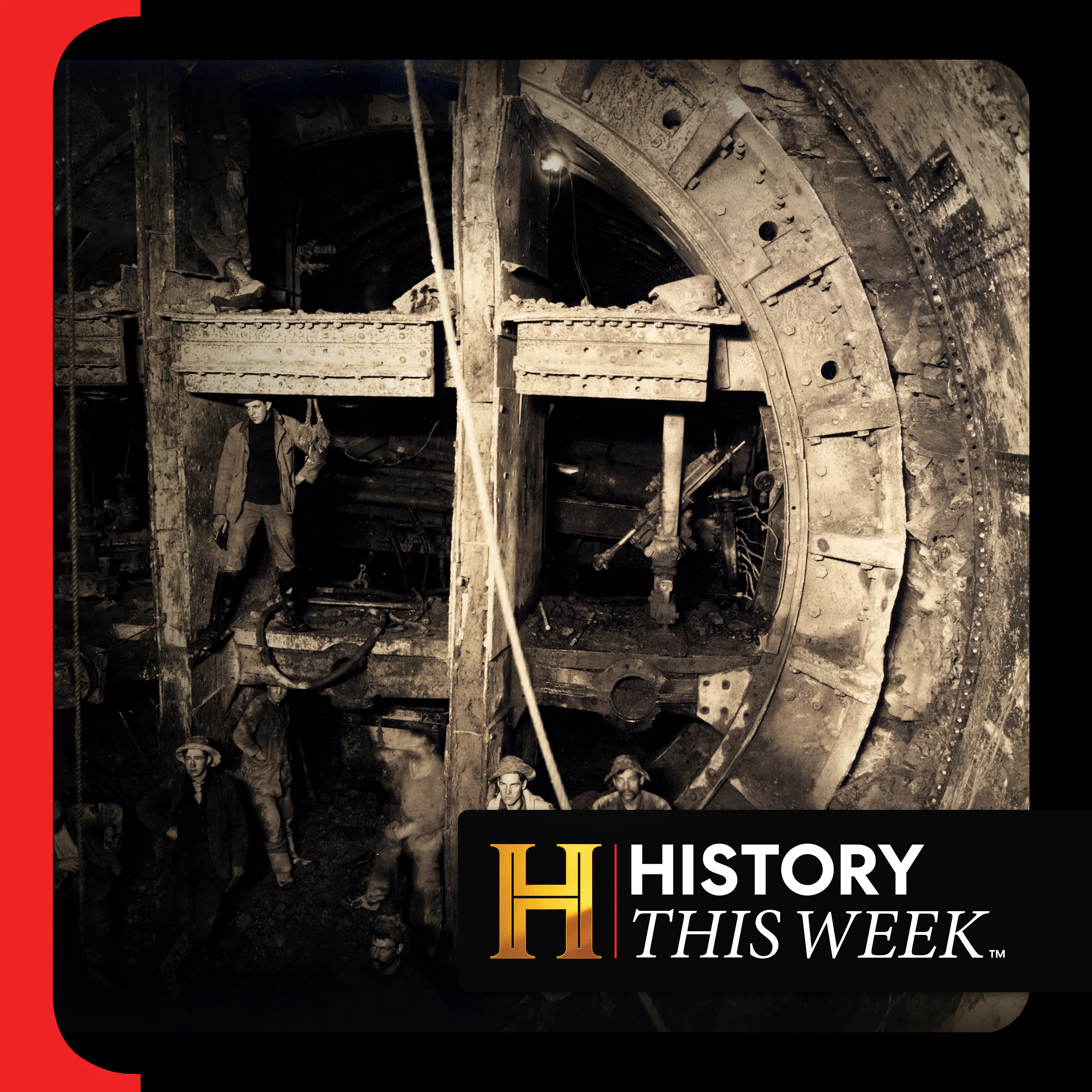
HISTORY This Week
How To Dig a Train Tunnel Under the Hudson River
00:36:16
The impossible engineering feat that 200,000 people still rely on every day.
Loading summary
Transcript120 lines
- [00:02]
Sally Helm
Hey History this Week listeners, we have something very exciting to share. This podcast has been going since 2020, but for the first time ever, we are taking it live. If you are in the New York City area, please join us for a live episode at the Tenement Museum in Downtown Manhattan. On Wednesday, March 4th at 6:30pm, I will be in conversation with historian Tyler Annbinder exploring the history of Irish immigration to the United States, cutting through some of the most common myths and looking closely at how Irish immigrants actually navigated life, work and assimilation in America. This is history where it happened in one of the most meaningful spaces in the city and we would love to see you there. We will drop a link with all the details in the episode description and you can also find the event@historythisweekpodcast.com Hope to see you there.
- [00:59]
Rosetta Stone Sponsor
One of the things I've learned producing history this week is how often history depends on language. Who can speak, who can understand, and who can be heard. And learning a new language today can still open those same doors. That's why Rosetta Stone really stands out to me. They've been the trusted leader in language Learning for over 30 years, using an immersive method that helps you learn naturally by listening, speaking and building confidence step by step. As someone who spends a lot of time researching and building complex stories, I appreciate how simple Rosetta Stone makes it to fit learning into your day. Lessons are intuitive, flexible and true. Accent gives real time feedback on pronunciation so you're not just memorizing, you're actually improving how you sound. With 25 languages and a lifetime membership that grows with you, it's a real investment in a skill that lasts. So don't wait. Unlock your language learning potential now. History this week listeners can grab Rosetta Stone's lifetime membership for 50% off. That's unlimited access to 25 language courses for life. Visit rosettastone.comhistory this week to get started and claim your 50% off today. Go to rosettastone.com history this week and.
- [02:09]
IXL Sponsor
Starting when winter days are shorter and schedules are packed, it's easy for kids to lose focus. IXL turns that winter slump into momentum with a simple, stress free way to keep skills sharp and stay engaged without adding pressure. IXL is an award winning online learning platform that helps kids truly understand what they're learning across math, language arts, science and social studies from Pre K through 12th grade. With personalized practice, instant feedback, clear explanations and progress tracking, it's easy to fit into even the busiest week. IXL is used in 96 of the top 100 school districts in the U.S. make an impact on your child's learning. Get IXL now and listeners can get an exclusive 20% off IXL membership when they sign up today at ixllearning.com audio Visit ixllearning.com audio to get the most effective learning program out there at the best price.
- [03:11]
Andy Sparberg
The History Channel Original Podcast.
- [03:16]
Sally Helm
History this week, February 14th, 1905 I'm Sally Helm. There is one thing standing between Alexander Cassatt and greatness. Cassatt is the president of the Pennsylvania railroad. As of 1900, it is the largest corporation in the world. But his trains can't get into one of the largest cities in the world, New York. They get to New Jersey and can't go any further. Passengers have to get off and catch a ferry to get into Manhattan. And for Alexander Cassatt, this is galling, undignified. It's not befitting of the great Pennsylvania Railroad. He wants to be able to bring his trains into New York. This will allow him to transport commuters, sure, but also to ultimately connect all of what is today called the Northeast Corridor. It'll become a vital link in a continuous rail line from Florida to Quebec. The one thing standing in his way is the Hudson River. The Hudson river in this spot is less than a mile wide. It shouldn't be so difficult to cross. And Alexander Cassatt knows how he wants to do it with an underground tunnel. Unfortunately, it turns out to be very, very hard to build a tunnel under the Hudson. The earth is goopy, but there are also random boulders scattered in the mud leftover from glaciers 18,000 years earlier. It is an engineering nightmare. And on this day, February 14th, all of those problems become very, very public. Around 11:00am, one of the men working underground detonates a stick of dynamite. That is nothing out of the ordinary. These men, known as the sand hogs, have dynamite as one of the tools in their arsenal, one of the ways to get through all that gloopy earth underneath the Hudson. But this time, the ground above them starts rumbling, making a muttering noise. They start to back away and mud begins to pour through the walls of the tunnel. Then, On the surface in the train yard, two men are pulling coal along some tracks when suddenly they see those tracks begin to disappear into the earth. They leap from their posts just as a whole locomotive is swallowed up by a 50 foot wide single cold. Thankfully, and surprisingly, no one is killed. The men underground manage to escape. The Weehawken sinkhole is less a tragedy and more just an embarrassment for the Pennsylvania Railroad, one of the largest corporations in world history, being stymied by mud. Poor Alexander Cassatt is said to have remarked in frustration that you could see Manhattan from the end of the company's tracks. You just couldn't reach it. We must, he said, find a way to cross today. Train tunnels under the Hudson. How did an engineer turned horse breeder turned corporate executive overcome silver, seemingly unsolvable technological problems to build these underground tunnels? And how did they become arguably the most important train tunnels in the world? The Pennsylvania Railroad was this famous, enormous corporation. In 1900, the only organization in the country with a bigger budget was the federal government. And the Pennsylvania Railroad was said to be a real, actual meritocracy.
- [08:10]
Jill Jones
Alexander Cassatt begins at the bottom, like everyone did in the railroad.
- [08:14]
Sally Helm
That's Jill Jones, a historian who wrote a book about this tunnel project. She said Cassatt started out at the company as a surveyor's assistant, earning a dollar a day.
- [08:25]
Jill Jones
But he had a meteoric rise because the man was brilliant.
- [08:30]
Sally Helm
He had a superhuman memory. He was known to reel off obscure bookkeeping facts off the top of his head. He was also good with machines. One of his longtime managers said that sometimes Cassatt could be found running a train all on his own while its engineer took a break. Cassatt has a storied career at the company. But at age 42, as Vice President of the railroad, he retires to raise and breed horses. Pretty good life. And the alternative, becoming president of the Pennsylvania Railroad. It did not look all that appealing.
- [09:08]
Jill Jones
The job of president. Pennsylvania was so demanding and so stressful that it was literally referred to as a killing job. Presidents of the Pennsylvania Railroad generally died young in office. So Cassatt left and a man named George Roberts was president and he died. Another man took his place. He died. And the railroad was really struggling, basically because America was booming and there was so much freight and they just, they were overwhelmed. So in 1899, the railroad comes to him and asks him to come back as president.
- [10:01]
Sally Helm
Basically, Alexander, you're our only hope. The board literally goes to find him in the field where he is exercising one of his horses. And he agrees. But he says he'll need free reign to improve things, to expand. And pretty immediately, he directs his focus to a mile wide river, the Hudson. Cassatt wants his trains to cross it. America's biggest and most important city at the time, New York has some geographical features that it can be kind of easy to forget about.
- [10:43]
Polly Desjarlais
We have this wackadoodle place where we're.
- [10:46]
Sally Helm
On all these islands, that is Polly desjarlais Content and research manager at the New York Transit Museum, reminding us that Manhattan is an island, one of several that makes up New York City at.
- [10:58]
Polly Desjarlais
This period of time.
- [10:59]
Jill Jones
This is the thing.
- [11:01]
Polly Desjarlais
How are we connecting these places? You know, ferries do it for a while.
- [11:06]
Sally Helm
Yeah. At this point, if you were a passenger on a Pennsylvania Railroad train and you wanted to travel to the biggest city in the country, you would have to get off in New Jersey and hop on a ferry with all your stuff. With all the other passengers, you'd navigate the crowded river waters dodging huge steamships and tiny sloops and delivery boats and pleasure yachts.
- [11:28]
Jill Jones
And one of the great surprises to me when I worked on this book was to realize how incredibly crowded the waters were.
- [11:40]
Sally Helm
But you make it through and then you get off at west street, which.
- [11:45]
Jill Jones
Was just total bedlam, you know, muddy and messy. And the whole thing did not comport with the way the Pennsylvania Railroad saw itself.
- [11:58]
Sally Helm
At least they weren't the only ones. The other railroad companies also had to dump the passengers off in New Jersey and put them on a ferry. All the other companies, except for one.
- [12:10]
Jill Jones
It was very, very galling to the Pennsylvania Railroad that their greatest rival, the Vanderbilts and the New York Central Railroad was the lone railroad whose passengers came in across a bridge.
- [12:28]
Sally Helm
Across a bridge. Much more dignified. The Vanderbilts and their New York Central Railroad had built a short bridge crossing into Manhattan from the north. Now the New York Central had nowhere near the national network of the Pennsylvania Railroad. And in some ways their trains were nothing to be jealous of.
- [12:49]
Jill Jones
These are coal fire steam locomotives and if you have not been around such a train, you don't have a clue what that pollution is like.
- [13:01]
Sally Helm
These trains would billow black smoke as they chugged along, getting in everyone's eyes. The Vanderbilt trains did briefly go underground into short tunnels right before pulling into Grand Central Station. But this could actually create another problem.
- [13:18]
Andy Sparberg
They were billowing smoke, they were very noisy.
- [13:21]
Sally Helm
That is Andy Sparberg, transit historian and 25 year veteran of the Long Island Railroad. He told us about one particularly horrible incident in these tunnels.
- [13:39]
Andy Sparberg
One train rear ended another because of the lack of visibility. It missed a signal and plowed into the rear of a train that was stopped ahead. Fifteen people were killed.
- [13:49]
Sally Helm
These trains produced so much pollution that they would cloud up the tunnel, making it impossible to see what was in front of them. Alexander Cassatt has a solution to all of this. A grand bridge across the Hudson. 14 train tracks plus lanes for pedestrians and carriages. 500 foot towers, a span suspended 185ft in the air to allow huge ships to pass underneath. It would be the largest bridge in the world. Engineering News wrote. The grandeur of the project is almost appalling.
- [14:34]
Jill Jones
The next year, the entire thing is off.
- [14:39]
Sally Helm
Yeah, the price tag was $100 million. Turns out that's too high. It's now the summer of 1901, and Cassatt is at a loss. He doesn't know how to get his trains across the Hudson, so he takes a trip to France, which is supposed to be a vacation, but turns out to be a work trip. It is there that he will find his solution. Why have I asked my H Vac guy I found on angie.com to change my grandpa's trachea tube? Because I was so amazed by how.
- [15:18]
Announcer
Quickly he replaced our air ducts.
- [15:20]
Sally Helm
I knew I could trust him to change Pop Pop's tube while I was on vacation.
- [15:23]
Mint Mobile Sponsor
Make it quick, young man.
- [15:26]
Sally Helm
Aw. See Pop Pop just I think we.
- [15:30]
Mint Mobile Sponsor
Should call a doctor. Connecting homeowners with skilled pros for over 30 years. Angie the one you trust to find the ones you trust.
- [15:38]
Rosetta Stone Sponsor
Find pros for all your home projects@angie.com.
- [15:41]
Announcer
Go behind the scenes of one of TV's most watched true crime series with the 48 Hours Postmortem podcast where correspondents and producers take you inside each case. Every Monday, listen to a new episode of 48 Hours and then join me for 48 Hours Correspondent Ann Marie Green every Tuesday for a new episode of Postmortem. Follow and listen to 48 Hours on the free Odyssey app or wherever you get your podcasts.
- [16:11]
Mint Mobile Sponsor
Well, the holidays have come and gone once again, but if you've forgotten to get that special someone in your life a gift. Well, Mint Mobile is extending their holiday offer of half off unlimited wireless. So here's the idea. You get it now, you call it an early present for next year.
- [16:26]
Sally Helm
What do you have to lose?
- [16:28]
Mint Mobile Sponsor
Give it a try@mintmobile.com Switch limited time.
- [16:31]
Sally Helm
50% off regular price for new customers. Upfront payment required $45 for three months.
- [16:35]
Natural Cycles Sponsor
$90 for six month or $180 for.
- [16:36]
Sally Helm
12 month plan taxes and fees. Extra speeds may slow after 50 gigabytes per month when network is busy.
- [16:40]
IXL Sponsor
See Terms.
- [16:44]
Sally Helm
Alexandre Cassatt goes to France to visit his sister Mary Cassatt, the now legendary impressionist painter.
- [16:52]
Jill Jones
When he is identified today, he's identified as her brother, which would have been astonishing to people at that time because she did not register at all.
- [17:03]
Sally Helm
While he's there, Alexander gets a message from his vice president, Samuel Ray.
- [17:08]
Jill Jones
He gets A telegraph from Ray saying, you know what? Go look at the. The Gare Quai d'.
- [17:15]
IXL Sponsor
Orsay.
- [17:17]
Sally Helm
The d' Orsay station had just opened in Paris. Today it has actually been turned into an art museum that houses some Mary Cassatt paintings. But back then, it is a massive palatial train hub. Seven limestone archways serve as entrances. Sculptures adorn the exterior. Lion's heads, laurel leaves, and inside, there is no smoke.
- [17:48]
Jill Jones
When he saw this, I mean, he got it immediately.
- [17:52]
Sally Helm
The trains pulling into this station are all electric, and they're coming through tunnels along the Seine river without blinding their conductors with billowing black smoke. I, Alexander Cassatt sees his future.
- [18:11]
Jill Jones
It's like we, we could come into Manhattan under the river with these electric locomotives.
- [18:24]
Sally Helm
Cassatt springs into action. On his way home from Europe, he recruits Charles Jacobs, an upbeat Englishman and one of the world's former foremost tunneling experts. Along with his vice president, Samuel Ray, they begin to plan to connect the two coasts of the Hudson with an underground tunnel.
- [18:46]
Jill Jones
They'll start on both sides of the river simultaneously, and they will come at each other to meet in the middle, far below the riverbed.
- [18:57]
Sally Helm
This tunnel will lead to a new train station as monumental as the one in Paris. It'll be named after the railroad, Penn Station. At first, the company is operating in secrecy, partly because they're buying up all this land for Penn Station and they want to get a good deal. People might demand more if they know what it's for, but also because they want to stay beneath the notice of the vast political machine that runs New York, Tammany Hall.
- [19:31]
Jill Jones
Tammany was just. It was a never ending search for bribes and boodle and, you know, rake off and whatever.
- [19:38]
Sally Helm
Tammany hall has been in power for a long time, but they have actually just recently suffered a setback. They were caught rigging the city's ice market. Ice is the main method of refrigeration at this time. And when people find out that Tammany is making money off ice while the common man's food spoils, there's an uproar. So much so that New York elects a mayor who isn't in Tammany's pocket, a reformer named Seth Low. But Low doesn't control the city's board of aldermen, aka the 40 Thieves. It actually has 79 members. And they're not all thieves, but Tammany has a majority in their pocket. And the Pennsylvania Railroad will need permission from the 40 Thieves to build their station. When they do go public, Tammany essentially.
- [20:31]
Jill Jones
Announces Their price, they let it be known that the bribe or the boodle would be $300,000.
- [20:41]
Sally Helm
But Alexander Cassatt is not having it. He's like, I am not paying that. This project is going to be a huge, huge deal for New York. Like it would be absurd to kill it. The proposal goes before the board of Aldermen and they vote it down. No boodle, no approval. But Tammany remembers a little bit on the outs and people get really mad about this. The New York Times, there is not an honest hair in the head of one of them, meaning the alderman. Scientific American, one of the most shame based exhibitions of political tyranny that ever disgraced the city. And Cassatt turns up the pressure.
- [21:23]
Jill Jones
The Pennsylvania Railroad has said, look, if you don't give us this franchise by this state, that's it. Because we have invested all this money and we cannot sit around. So if you don't give us this, we're gone and we're sorry. But you know, we were very straight.
- [21:37]
Sally Helm
With you and New York City really does want this project. The reform minded mayor Seth Low takes some of the aldermen out on his personal yacht to woo them. He writes each of them a heartfelt letter for their yes votes. And on December 16, 1902, the Board of Aldermen needs to vote again. And just enough of the 40 Thieves Break ranks with Tammany. The board approved proves Alexander Cassatt's audacious plan. I feel like today building an underwater tunnel sounds like, oh yeah, I don't know, we probably have technology to do that. But this was actually so, so hard. I mean, think about it. The tunnel is underwater. How do you build that without getting flooded? What they did was pump compressed air into the tunnel as they built it. So the water is pushing in, but the air is pushing back out. That worked, but it made for a very specific and dangerous environment. If you want access to the Hudson river tunnel site in 1903, three first you take an elevator.
- [23:11]
Jill Jones
You walked out and into the airlock where you would sit for 15 minutes while it filled up with compressed air and you got acclimated.
- [23:21]
Sally Helm
If you didn't do that, you might end up get the bends like what scuba divers can get. If you go down too quickly, you can get intense ear pain and brain fog. If you come up too quickly, dangerous bubbles can form in your blood.
- [23:40]
Jill Jones
When you emerged, it was like this hellish, very small space.
- [23:48]
Sally Helm
The workers, the sandwich hogs, are pushing the tunnel forward inch by inch.
- [23:55]
Jill Jones
It was really wet, really muddy and really chaotic under the Tunnels. I mean, it was a very controlled, orchestrated chaos.
- [24:07]
Sally Helm
At the very front of the tunnel space is this giant piece of machinery called the great head shield. It almost looks like a piece of, of a rocket ship or something.
- [24:17]
Polly Desjarlais
Essentially you have workers within this shield.
- [24:21]
Sally Helm
Polly Desirelais.
- [24:23]
Polly Desjarlais
They are picking away digging, shovels, pickaxes, whatever.
- [24:29]
Sally Helm
These compartments open up at the front of the shield, letting the workers clear all the silt and rock. Once that's out of the way, they install these rings, sections of cast on.
- [24:41]
Polly Desjarlais
Iron, which was the tunnel lining. And then they would sort of rivet all of those together.
- [24:48]
Sally Helm
Once the tunnel walls are in place, the great head shield activates these huge hydraulic jacks and lurches forward 2 and 12ft. And the workers start the whole process over. And there's really no margin for error because remember, they're building both sides of the tunnel at once from opposite shores and they're going to meet in the middle. So if the alignment gets a little off, they're going to be in big trouble. And in the spring of 1906, the engineers noticed something. Samuel Ray, vice president of the railroad, writes a secret memo to his boss, Cassatt.
- [25:39]
Jill Jones
He's really worried because they can tell the tunnels are rising and falling and they don't know why.
- [25:54]
Mint Mobile Sponsor
Hey, Sal. Hank. What's going on? We haven't worked a case in years. I just bought my car at Carvana and it was so easy. Too easy. Think something's up? You tell me. They got thousands of options, found a great car at a great price, and it got delivered the next day. It sounds like Carvana just makes it easy to buy your car, Hank. Yeah, you're right. Case closed.
- [26:17]
Sally Helm
Buy your car today on Carvana. Delivery fees may apply.
- [26:23]
Natural Cycles Sponsor
You buy organic, you read ingredient labels. You care about what goes into your body. So why not think about birth control the same way Natural Cycles is the only FDA cleared birth control app that's 100% hormone free. It's based on science and uses your body temperature to identify which days you can and cannot get pregnant. No synthetic hormones, no side effects, just science you can trust. Save 15% with code RADIO15@natural cycles.com.
- [26:54]
Announcer
A year from today. What would your dream private practice look like? Would you spend less time chasing claims or only working with clients who value your skill set? What if you had a network to reach out to for questions or free continuing education? What if you had more time for yourself? Alma empowers you to confidently accept insurance backed by an all in one EHR that simplifies scheduling, does documentation and day to day practice operations. With a network of engaged providers and free CE resources, ALMA makes it easy for you to build the practice of your dreams on your terms. ALMA believes that when therapists get the support they need, mental health care gets better for everyone. Learn more about alma@helloalma.com getstarted. Your dream practice is closer than you think. Get started now@helloalma.com.
- [27:57]
Sally Helm
Spring 1906. The tunnels under the Hudson are mysteriously shifting slowly oscillating up and down in the muddy riverbed. And nobody knows what's going on. Not Cassatt, not Ray, not even Charles Jacobs, the tunnel savant. It looks like the tunnel haters might have had a point.
- [28:20]
Jill Jones
Many, many people, engineers and so forth, basically said, you cannot safely build railroad tunnels that will be carrying 700 ton trains in tunnels like this. No one had ever built tunnels through goop like this so long, et cetera, et cetera, et cetera. So you know, this was the nightmare scenario. Always hanging over rays in Cassad's head. Would the tunnels be safe? And when they saw them moving up and down, I mean, that was really disturbing.
- [28:58]
Sally Helm
They're like, okay, we gotta figure this out.
- [29:02]
Jill Jones
Well, maybe because, you know, the, the riverbed that they're tunneling through is so soupy, they need to have heavier rings.
- [29:09]
Sally Helm
The rounded rings, these pieces of the tunnel that they're slowly putting in place. Maybe they need to be stronger.
- [29:17]
Jill Jones
So that's the next thing they do, they make heavier rings.
- [29:21]
Sally Helm
That doesn't work. The tunnels are still drifting.
- [29:25]
Jill Jones
Cassatt's under a lot of stress. He's up in Bar harbor where he has a so called cottage.
- [29:32]
Sally Helm
It's actually a very nice big house. But what is supposed to be a vacation turns into another obstacle for Alexander Cassatt.
- [29:41]
Jill Jones
He gets whooping cough from his granddaughter.
- [29:44]
Sally Helm
Cassatt is stuck in Maine, recovering. Meanwhile, the two sides of the tunnel are getting closer and closer until the big day finally arrives. September 1906. The two sides of the tunnel are set to meet in the middle of the Hudson River. The engineers have tried to account for the drifting in their calculations. And today they'll see if it worked. The sand hogs on the New York side push a pipe through the front of their tunnel shield. And sure enough, they can see and hear the New Jersey sand hogs on the other side. The Jersey guys send a box of cigars back through the pipe, conceding that the New Yorkers had beat them to the middle by a few feet. And when the two great head shields actually make contact.
- [30:45]
Jill Jones
The tunnels have met within 1/8 of an inch. It's just so, so incredible.
- [30:54]
Sally Helm
No computers, no digital anything. Just slide rules, steam engines and digging. Of course, the crew has to celebrate. It's very cute.
- [31:07]
Jill Jones
The engineers, the reporters, the sandhogs, they all march across and emerge in Manhattan, whereupon they go to Delmonico's and have a riotous celebratory lunch involving a lot of throwing of bread and food and what have you.
- [31:27]
Sally Helm
But a few people are conspicuously missing. Samuel Ray, the VP of the railroad, is too anxious about the tunnel drifting mystery to attend. Even though the two sides are now connected, they still aren't supposed to stabilized. And Alexander Cassatt is still up in.
- [31:47]
Jill Jones
Bar harbor and, you know, next thing you know, on December 28, 1906, the seventh president of the Pennsylvania Railroad dies in office.
- [32:01]
Sally Helm
The killing job strikes again. Alexander Cassatt is 67 years old. Samuel Ray doesn't take over as Pennsylvania Railroad president because at this rate, who would want to? But he does take charge of the tunnel project, and he is determined to solve this tunnel drifting mystery. Alexander Cassatt won't live to see a train pass underneath the Hudson, but Ray is going to make it happen. He and his crew put in a special gauge to monitor the movement more closely. And it all becomes clear. It's such a.
- [32:44]
Jill Jones
It's so logical.
- [32:48]
Sally Helm
The tunnels are moving with the tides. The Hudson River, Alexander Cassatt's great adversary, is kind of not really a river at all in this area. It's more of an estuary. So the tides of the Atlantic Ocean are pushing the water back and forth. When the tides are highest, the tunnels are lowest because the weight of the water is literally pressing them further down into the earth.
- [33:18]
Jill Jones
It's so amazing, you know, that it can move these incredibly heavy tunnels up and down.
- [33:31]
Sally Helm
Samuel Ray now has to figure out what to do. And he decides to do nothing. Rather than spend millions to anchor the tunnels to the bedrock, he'll just let them move like a suspension bridge or a skyscraper flexing in the wind. He looks into it and he feels confident that it will be safe. But nevertheless, he doesn't advertise this decision.
- [33:59]
Jill Jones
When I was researching this book, I realized this was the great secret about the tunnels. No one ever knew any of this. It was just absolutely kept silent.
- [34:14]
Sally Helm
And then they start sending test trains through and the tunnels seem to be holding.
- [34:22]
Jill Jones
Can you imagine what Ray must have felt? I mean, there was no way to know until the trains went through. And I mean, honestly, probably until the station was open and hundreds of trains were going through. And months had gone by and years had gone by to really, really know that the tunnels would not crack.
- [34:45]
Sally Helm
The tunnel. Tunnels do not crack. Penn Station opens to the public in November of 1910. A monument of steel and glass and pink granite. The tunnels are open. The Pennsylvania Railroad has crossed the Hudson.
- [35:03]
Jill Jones
It really transforms the whole area of New York. Really opens it up to people and makes people's lives a lot easier, easier.
- [35:12]
Mint Mobile Sponsor
And a lot better.
- [35:14]
Sally Helm
What was once considered rural land in the surrounding regions now has direct rail access to the biggest city in America. In 1917, the Hellgate Bridge opens, establishing that continuous rail line from Florida to Canada. Plus, the new trains are electric, clean, no more spewing black smoke. The United States has entered the modern age of train travel. The monumental Penn Station is actually torn down in the mid-1960s to make way for Madison Square Garden. And in 1968, the Pennsylvania Railroad ceases to exist altogether, ironically merging with Vanderbilt's New York Central. Today, the reworked Penn Station exists entirely underground. It is the busiest rail station in North America. The Hudson river tunnels are now 115 years old. They carry more than 200,000 passengers every day. Here's Polly Desjerlet.
- [36:20]
Polly Desjarlais
It is the lifeblood. This is a very overused term and it is a bit cliched, but it is true that transportation powers this region. We can't do what we do without it.
- [36:35]
Sally Helm
But these old tunnels are a little the worse for wear. Here's andy Sparberg.
- [36:43]
Andy Sparberg
In 2012, Superstorm Sandy damaged him terribly because water rushed in and went into the tunnels. And that's brackish. Salt water damaged the electrical components, the signals, the roadbed, and it took a while to make some roof rudimentary repairs. But eventually, you know, those tunnels need to be rebuilt.
- [37:01]
Sally Helm
At this point, the tunnels are deeply embedded into the economy. Patchwork fixes have kept them going, but their failure would be a catastrophe. And the project to fix them has started. It is the largest public works project in America. The Trump administration has been locked in a legal battle in an attempt to withhold the funding. But if the money is there, the plan is to build two new tunnels next to the old ones. And many of Alexander Cassatt's challenges still apply.
- [37:36]
Andy Sparberg
The tunnels, basically, they still have to go into the same river, then they've got to get into the same station that's still there. So it's a project on the scale of the original project. No question about it.
- [37:48]
Sally Helm
Turns out it's not that much easier to build tunnels in the Hudson. 125 years later. The riverbed is still goopy, and there are now even more buildings and pipes and subways to work around when you're tunneling into Penn Station. But once the two new tunnels are finished, workers will turn their attention to rehabilitating the old ones. If all goes according to plan, the tunnels that first opened in 1910 should be ready again by 2038.
- [38:18]
Announcer
Attention please.
- [38:20]
Sally Helm
This is a special announcement for passengers.
- [38:22]
Announcer
Traveling on Amtrak's train number 63 and.
- [38:25]
Jill Jones
Crossing the border into Canada.
- [38:27]
Announcer
Please present your train tickets and travel.
- [38:30]
Sally Helm
Documents to the Amtrak represent this is our first episode of the new season of History this week, so you can expect more never before heard stories just like this one hitting your feed every Monday. And thank you so much to all of our listeners. Some of you have been with us all six years of the show, and some of you are new. Welcome History this Week is a Back Pocket Studios production in partnership with the History Channel. To stay updated on all things History this week, sign up@historythisweekpodcast.com and follow us on Instagram historythisweekpodcast. If you have any thoughts or questions, send us an email@historythisweekistory.com Special thanks to our Polly Desjarlais, content and research Manager at the New York Transit Museum Jill Jones, historian and author of Conquering Building Penn Station and Its Tunnels and Andy Sparberg, retired Long island railroad manager, transit historian and author of From a Nickel to a the Journey From Board of Transportation to mta. This episode was produced and sound designed by Ben Dickstein, who loves trains. It was also produced by me, Sally Helm. I like trains too. For Back Pocket Studios. Our executive producer is Ben Dickstein from the History Channel. Our executive producers are Eli Lehrer and Liv Fiddler. Don't forget to follow rate and review History this week, wherever you get your podcasts and we'll see you next week.