← HISTORY This Week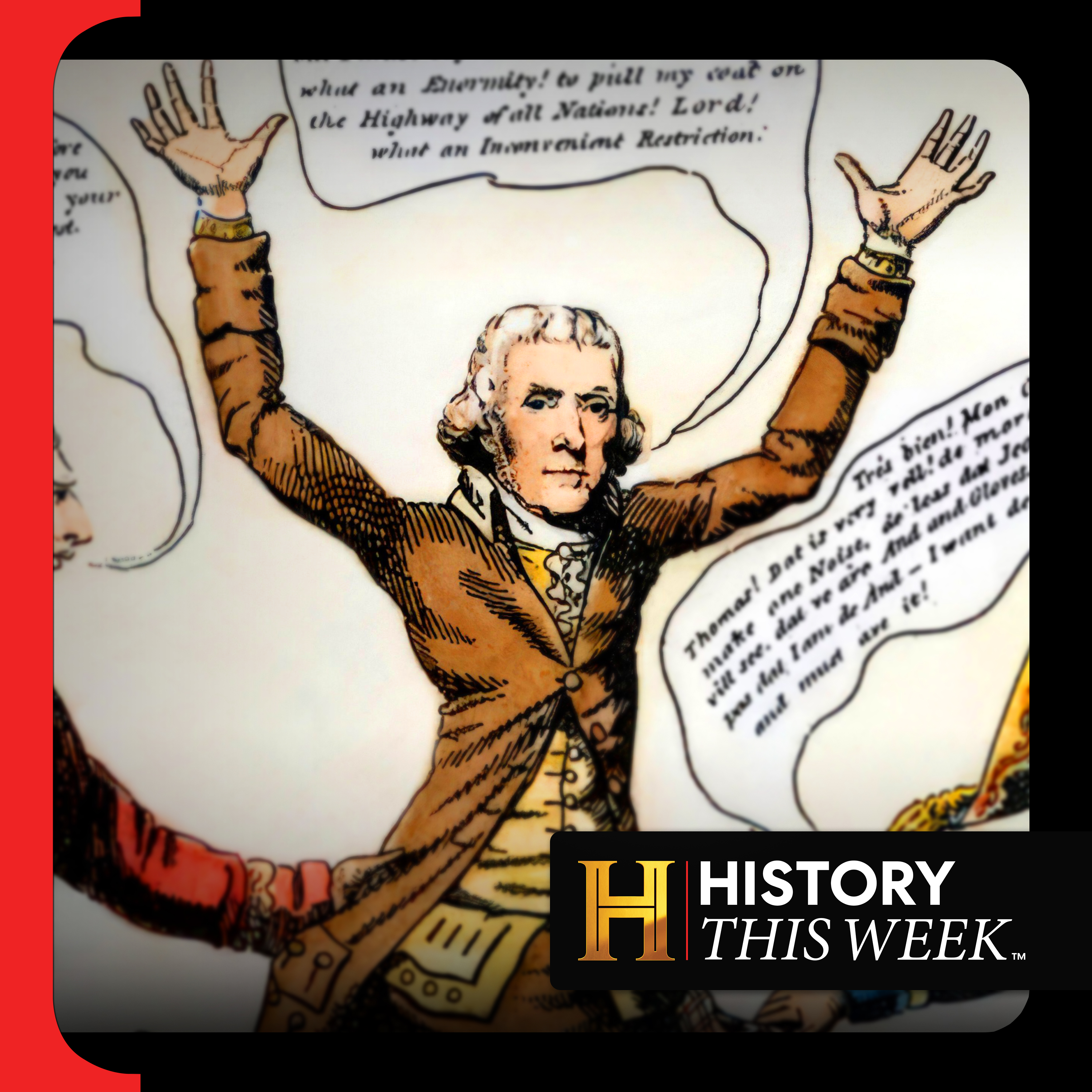
HISTORY This Week
Jefferson’s Trade War Shuts Down America
00:25:30
A growing crisis at sea leads Thomas Jefferson to make a dangerous economic gamble.
Loading summary
Transcript61 lines
- [00:00]
Sally Helm
Thinking about GLP1s to help with weight loss. Go micro with Noom. You start off with a small dose of medication, then gradually increase as your body reacts. The Noom GLP1 microdose program starts at $79 and is delivered to your door in seven days. Start your microdose GLP1 journey today at Noom.com that's N-O O M.com Noom micro changes big results initial three weeks subscription and four weeks of medication from $79 plus tax and $179 per month plus tax for 12 weeks subscription thereafter. Final pricing depends on program selection.
- [00:30]
Podcast Advertiser
You're listening to this podcast, so I know you've got a curious mind. Here's a helpful fact you might not know yet. Drivers who switch and save with Progressive save over $900 on average. Pop over to progressive.com, answer some questions and you'll get a quick quote with discounts that are easy to come by. In fact, 99% of their auto customers earn at least one discount. Visit progressive.com and see if you can enjoy a little cash back. Progressive Casualty Insurance Company and affiliates national average 12 month savings of $946 by new customers surveyed who saved with Progressive between June 202024 and May 2025. Potential savings will vary the History Channel Original Podcast
- [01:11]
Sally Helm
history this week, April 18th, 1806 I'm Sally Helm. The point of this law is that it is not directly an act of war, and it certainly doesn't sound like one. It's called an act to prohibit the importation of certain goods, wares and merchandise. Specifically goods made of leather, silk, hemp or flax, tin or brass. Not tin sheets, though those get an exception. Also window glass, playing cards. The list goes on. Starting later this year, the US says that it will not be buying any of those things for from its former colonizer, Great Britain. Today, President Thomas Jefferson signs this Non importation Act of 1806, likely in his private study, possibly with his pet mockingbird on his shoulder. And with this law, Jefferson is trying to fight fire with paper, which is not famously a very effective way to fight fire, but he's giving it a shot because the Revolutionary War is still pretty recent and the US is now in danger of getting drawn into another war with Britain, which they're not really prepared for. And anyway, Jefferson believes in the power of ideas over the power of weapons. The danger exists here because Britain is at war with France. They are fighting Napoleon and in the course of that war both countries, Britain and France, have been Apprehending American merchant ships. They don't want helpful goods making it to their enemies. And Britain has been especially bold. They have set up repeated blockades of New York harbor to stop goods from getting out to France. And not only that, they, they have also taken to boarding American vessels claiming to be looking for British deserters. But in practice, they end up just basically kidnapping Americans who work on those ships and forcing them to start fighting. In the British Navy, this is known as impressment and understandably it has people very, very angry. So that is what Thomas Jefferson is fighting against as he puts pen to paper in his surrounded by books and maps and skins brought back by Lewis and Clark. He doesn't want to fight a war war, he wants to fight a trade war. If you are going to harass our ships, we are going to stop buying your tin, except if it comes in a sheet. Protests and embargoes had worked in the years leading up to the Revolution. Think of the Boston Tea Party. But this is more than 30 years later and pretty soon things get much more complicated for Thomas Jefferson and he will decide to up the ante in a major way today. Trading blows. How did Jefferson, avatar of individual liberty, become the president who tried to suspend due process, who militarized the coastline and who nearly tore his country apart? And what can this part of his legacy teach us about the prevailing winds of global trade? The week after Jefferson signs the Non Importation Act, a little vessel called the Richard tries to sail out of New York Harbor. They're just carrying simple provisions headed to Sandy Hook on the New Jersey coast. A short trip, but not without its dangers.
- [05:19]
Harvey Strum
The British are trying to stop every ship going in and out of New York Harbor.
- [05:25]
Sally Helm
Harvey Strum, professor of history and political science at Russell Sage College, he told us the HMS Leander, a British ship of the line, floats in the harbor waiting to bully this American trading vessel. They fire a warning shot at the Richard from one of their 50 guns, a standard sign that the ship should heave toessentially, come to a stop in the water so that the British can board. But the Richard doesn't stop quickly enough and the Leander opens fire. It's supposed to be a shot across the path bow, but instead, by mistake, the cannonball hurtles towards the deck and decapitates the helmsman, John Pierce.
- [06:11]
Harvey Strum
He was the brother of the captain. And this became an international incident. The murder of an American within New York harbor. There was outrage in the city.
- [06:27]
Sally Helm
Pierce's body is brought ashore and an angry mob gathers at the docks. They intercept a boat carrying provisions for British warships and parade the confiscated food through the streets before distributing it to the poor at a local almshouse. President Jefferson responds to this incident by by banning three specific British warships from American harbors. He threatens their officers with arrest. But overall, he believes that eventually his non importation act will make a big enough dent in the British economy that they'll have to stand down. Some people in Washington disagree. One representative calls Jefferson's non importation law a milk and water bill. The opposing party accuses him of trying to fight a superpower with paper bullets. The but Jefferson is just not a big war guy.
- [07:28]
Harvey Strum
We don't enlarge a navy under Jefferson. He's opposed to it philosophically. He comes up with a somewhat stupid naval policy. Create gunboats, small gunboats to protect American shores, which were essentially useless. He is against defense expenditures. He considers it a waste of money.
- [07:49]
Sally Helm
We heard more about Jefferson's philosophy from Lawrence Hatter, associate professor of early American history at Washington State University.
- [07:57]
Lawrence Hatter
It's sometimes referred to as peaceable coercion. We don't need to go to war with them. We can do this instead because it's progressive, right? You don't have people dying for no reason or even for a good reason. I mean, it's, you know, this seems like an alternative to centuries of warfare and dynastic politics and things like that.
- [08:18]
Sally Helm
But so far, the British aren't cooperating. They continue to assail the coast. They seize other American ships like the Aurora and the Nimrod, especially rudely. They fire on a ship named the Sally. They kill the man at the helm. And In June of 1807, Jefferson's theory of peaceable coercion comes under even more direct attack. June 22. The USS Chesapeake is sailing off the Virginia Capes. It's one of six frigates in the tiny US Navy, and it isn't looking for a fight, just preparing for a trade voyage to the Mediterranean. But suddenly, a much larger British warship, the 50 gun HMS Leopard, pulls alongside. The British send a messenger aboard, demanding a routine search for deserters, which is
- [09:20]
Lawrence Hatter
kind of insulting, right? The American captain is not interested in having Royal Navy crew coming aboard a ship looking for these deserters.
- [09:28]
Sally Helm
Ships are regarded as an extension of national sovereignty. The Chesapeake is basically a piece of the United States floating on the water. So Commodore James Barron refuses to let the British search his ship, and they open fire. The American ship is completely unprepared. The deck is cluttered with cargo. The guns aren't even loaded for 20 minutes, the leopard bombards the helpless Chesapeake.
- [10:05]
Harvey Strum
They killed three Americans and wounded 18. And then they boarded the ship and took off. Four men. Two of the men were British subjects. Two were American citizens.
- [10:19]
Sally Helm
When the mangled Chesapeake limps back into port, the country falls into an uproar. Headlines scream British insolence, outrage and murder. It's a rare moment of near total
- [10:33]
Harvey Strum
national unity demonstrations in New York, New Jersey and Virginia. Everybody was ready to go to war.
- [10:41]
Sally Helm
But even while his citizens are burning British captains in effigy, the philosopher president looks for another way.
- [10:50]
Harvey Strum
Jefferson let the moment lapse.
- [10:57]
Sally Helm
Thomas Jefferson is a true believer, logic not lead. He sees himself as fundamentally different from the lions and tigers over in Europe. Instead, he will try an even more radical economic experiment, what he called his last card short of War. On December 22, 1807, Jefferson signs the embargo act into law. It bans all British imports, but also it is essentially a ban on all exports. The United States won't sell anything to the rest of the world. They're retreating into autarky, total national isolation. He is betting that Britain and France will blink first. Denied vital goods American cotton, tobacco, timber, wheat flour, corn and grain, they will have to respect the United States on the high seas. Advisors tell him that in Britain the population will starve and rise up against their government. But it is a risky gamble and the ante is the whole national economy.
- [12:19]
Podcast Advertiser
This podcast is brought to you by Wise, the app for international people using money around the Globe. With the WISE account, you can send, spend and receive in over 40 currencies with no markups and no hidden fees. Whether you're sending pesos across the pond, spending reals in Rio, or getting paid in dollars for your side gig, you'll get the mid market exchange rate on every transaction. Plus most transfers arrive in less than 20 seconds. Join 15 million customers internationally. Be smart, get wise. Download the wise app today. Ts and Cs apply.
- [12:53]
Sally Helm
Hi, my name is Lloyd Lockridge and I'm the host of a new podcast from Odyssey called Family Lore. In this podcast, I'm going to have people on to tell unusual and sometimes far fetched stories about their families. I've heard my whole life that she invented the margarita. And then we're going to investigate those stories and find out how much of it is true.
- [13:11]
Harvey Strum
He gets a patent one month before the Wright brothers.
- [13:14]
Sally Helm
Oh my God. Please follow and listen to Family Lore, an Odyssey podcast available now on Apple Podcasts, Spotify or wherever you get your shows. She loves it hot. He loves it cold. However you sleep, the pod by Eight Sleep adapts to you. Get up to $350 off with code DEEP SLEEP@8sleep.com. Christmas night, 1807 in New York harbor, about 300 ships are bobbing quietly in the dark. But around midnight, the silence shatters. Word reaches the city that Thomas Jefferson's embargo is now law. For the merchants of New York, this is an economic death sentence. Technically, they are no longer allowed to leave the port. And all hell breaks loose. Ship owners send word to their crews saying, get out now.
- [14:29]
Harvey Strum
Some ships are leaving half manned and half filled because I just gotta get a New York harbor.
- [14:38]
Sally Helm
Better to be an outlaw than to be a pauper trapped at anchor.
- [14:42]
Harvey Strum
And so it is. Total, complete chaos. Once the news arrived of the embargo.
- [14:49]
Sally Helm
Crowds of spectators gather at the wharves, cheering the ships as they flee. Customs collectors trying to enforce the law rush to choke off every exit to the Atlantic. From New York City, some. Some merchant ships escape, but others make it as far as 30 miles off coast and then get caught and brought back in. Newspapers later reported that the embargo cast a gloom over every countenance.
- [15:20]
Harvey Strum
It led to immediate depression in New York City. 40 mercantile companies go bankrupt.
- [15:26]
Sally Helm
The transformation of New York is eerie. Within months, grass had begun to grow on the wharves. The once bustling waterfront lay vacant, ships rotting at anchor, and thousands of sailors roamed the streets.
- [15:41]
Harvey Strum
Now unemployed, the New York City Common Council offers to provide food, clothes, firewood and candles to seamen move to the Brooklyn Navy Yard because what they're afraid of is that the sailors will resort to crime.
- [15:59]
Sally Helm
New York ends up creating some of the earliest public jobs programs in American history to keep the sailors busy planting trees, clearing vacant lots. And similar stories are playing out all along the eastern seaboard. Sailors in Boston march on the governor's house. The same scene repeats in Philadelphia nine days later. And it isn't just the sailors. For the farmers, who Jefferson had earlier described as the chosen people of God, his experiment is a disaster. Within hours of the embargo, news reaching Virginia, the price of flour crashes by half. In the ports, Produce rots in warehouses because it can't be sent overseas. There's such a glut of material that construction lumber becomes firewood just to recoup the cost. Smuggling, of course, explodes. Domestic trade vessels would leave port and somehow emerge in Halifax or the West Indies. Their excuse blown hundreds of miles off course by a freak wind. Jefferson orders a crackdown In February. He tells the Navy to stay, seize American merchant ships off the Delaware coast, which is probably illegal. By March, he takes the fight against smuggling to every dirt road and backwoods stream in the country, banning trade on any boat, raft, cart, wagon or sleigh, and calling on the regular army to aid in enforcement. So the smugglers get even more creative.
- [17:40]
Harvey Strum
Canadians and New Yorkers will build shacks along the northern border of New York. On one side you're in Canada, on the other side you're in New York. So they put their goods on the New York side. Then the Canadians come and take the goods and bring it into Canada.
- [18:00]
Sally Helm
Or how about a little random accident? Merchants would drive a wagon to a steep hill on the border and and then accidentally collapse their own cart and watch as barrels of flour careened into Canadian territory. In Burlington, Vermont, on Lake Champlain, the townspeople hold an emergency meeting at the courthouse in April to discuss the evils of Jefferson's trade war. They send a desperate plea to Congress. And just three days later, the President issues an edict. He says that sundry persons have been confederating on Lake Champlain.
- [18:39]
Harvey Strum
President Jefferson declares Lake Champlain in a state of insurrection.
- [18:44]
Sally Helm
Lake Champlain extends across the border into Canada, and Jefferson calls on the Governor of Vermont to deploy the militia to Windmill Point, right near the Canadian border, to stop any goods from getting through. The man who wrote the Declaration of Independence is now using militias and the army to enforce his laws on his own people. And it doesn't really work. A lot of the men in the militia are friends and family with the smugglers.
- [19:16]
Harvey Strum
Local militia units refuse to enforce the law.
- [19:21]
Sally Helm
In the summer of 1808, things escalate. A new vessel appears on Lake Champlain. It's 40ft long, pitch black, painted entirely in tar, with a flat bottom and seven oars on each side. This is the Black Snake. Fully loaded, it can smuggle 100 barrels of contraband into Canada. And in August, a federal enforcement vessel tracks it down. They corner the Black Snake up a small river. The smugglers abandon ship and take up positions on the shore. They arm a massive cannon and fire. One soldier falls. They fire again. Two more. By the time the smoke clears, two militiamen and one private citizen are dead. Eight members of the Black Snake crew are jailed for murder, and one is executed. The violence on Lake Champlain is part of an emerging national tragedy. The embargo has begun looking more and more like an occupation. By late summer 1808, the Thomas Jefferson has essentially established a military and naval blockade around his own country, reaching from Lake Ontario to New Orleans.
- [20:53]
Harvey Strum
It leads to a nosedive in his popularity.
- [20:58]
Sally Helm
His party loses big in the midterm elections. But in his State of the Union address, Thomas Jefferson tries to spin it by coming up with a whole new rationale for his embargo. One that he hopes the country will like a little bit better. I am your host, Stassi Schroeder. Welcome to Tell Me Lies, the official podcast. What's the most unhinged thing of season three? Steven because he's so evil, I do
- [21:35]
Podcast Advertiser
think he is misunderstood.
- [21:36]
Sally Helm
You see everyone face consequences. It's intoxicating. The writers just know how to trick ya. There's always a twist in this show.
- [21:43]
Lawrence Hatter
It's nothing you would expect.
- [21:44]
Sally Helm
Tell Me Lies, the official podcast now streaming and stream the new season of Tell Me Lies on Hulu and Hulu on Disney. In November 1808, in his eighth and final state of the Union address, President Jefferson tells the country that actually this whole embargo, which started with the impressment of American merchants because the Napoleonic wars, he now says actually it was meant to stimulate American manufacturing.
- [22:16]
Harvey Strum
The whole time he's stealing an idea from Alexander Hamilton. Hamilton was a strong advocate of industrialization of the United States.
- [22:27]
Sally Helm
Jefferson, in years past, had fought against Hamilton's vision. He believed that the power of America lay with the yeoman farmer, not with industrial power. But his embargo has actually helped American
- [22:41]
Harvey Strum
industry foster some limited industrialization in Rhode island and also in Dutchess County, New York. But it's not enough to counter the losses from trade.
- [22:55]
Sally Helm
It's estimated that Jefferson's trade war cost the US 5% of its GDP. Imports fall by almost 60%, exports by 80%. The prices of cotton, tobacco and flour all crater. It is a depression. And Jefferson is also faced with a harsh reality. The initial point of the embargo was to punish Great Britain to apply economic pressure so they'll stop impressing sailors. But it doesn't work. Here's Lawrence Hatter.
- [23:38]
Lawrence Hatter
American trade just wasn't that important to them and they could pivot towards different markets. So Britain develops new markets in South America to replace those in the United States.
- [23:50]
Sally Helm
The kinds of tactics that had worked in the years leading up to the American RevolutionBoycotts, after the stamp act, the Boston Tea Party, those don't work anymore. The British just redirect their trade to the Caribbean and South America. Their economy is not devastated and the people don't rise up. So the British have continued impressing American sailors throughout this whole embargo and Jefferson has lost the country. In New England, some people were Even in talks with the British to separate from the Union.
- [24:24]
Harvey Strum
So he knows the embargo is unpopular. He can also read the economic impact of the embargo. Despite his talk about industrialization, none of that happens in a year.
- [24:37]
Sally Helm
On March 1, 1809, just three days before he leaves office, Jefferson all but ends the embargo. He signed something called the Non Intercourse act, which opens up American trade to the rest of the world, though still barring Britain and France. It's a little funny that he waits so long.
- [24:58]
Lawrence Hatter
It is an interesting question, you know, why would you do that?
- [25:02]
Sally Helm
Why repeal his signature legislation just before leaving office? It is partly the power of friendship. James Madison is going to follow him in the job.
- [25:12]
Lawrence Hatter
I mean, Jefferson and Madison are very close, right? So, you know, he is concerned about, I think, Madison's presidency, and for good reason.
- [25:21]
Sally Helm
He does kind of leave James Madison with a mess. A struggling economy, impressment still running rampant. Today, the embargo is regarded as the biggest mistake of Jefferson's entire presidency. And three years later, in June of 1812, the United States goes to war with the British anyway, the War of 1812. So Jefferson did not achieve his stated aim of avoiding war, but he did do what he talked about in his State of the Union. He inadvertently launched an American industrial revolution, at least a little one. In 1803, there were only four cotton mills in the entire country. And by 1810, that number had exploded to 226. That set the country on a new trajectory that would continue for more than a century. Thomas Jefferson leaves the presidency exhausted.
- [26:19]
Lawrence Hatter
He can't wait to get back to Monticello. He had had enough. This was not a pleasant experience.
- [26:24]
Sally Helm
It's time, and he tries to put all this behind him as he lives out the rest of his life.
- [26:30]
Lawrence Hatter
If you go to Monticello and see his grave, it atlas his accomplishments.
- [26:34]
Sally Helm
Author of the Declaration of American Independence, of the Statute of Virginia for Religious Freedom, and father of the University of Virginia. But there is one thing missing, and
- [26:45]
Lawrence Hatter
you will not see President of the United States on there.
- [26:49]
Sally Helm
Jefferson's economic experiment seems to have cast a shadow over his entire presidency, even if it's not what he's remembered for today. The embargo, after all, only lasted 15 months. Although the debate over whether America can use trade as a weapon and who pays for it, that debate never really ended. Foreign. This week is a Back Pocket Studios production in partnership with the History Channel. To stay updated on all things history this week, Sign up@historythisweekpodcast.com and follow us on Instagram at History this Week Podcast if you have any thoughts or questions, you can always send us an email@historythisweekistory.com Special thanks to our guests Harvey Strum, professor of History and Political Science at Russell Sage College in Albany and Troy, New York, and Lawrence Hatter, Associate professor of Early American History at Washington State University. This episode was produced by Danny Vanone, Ben Dickstein, and me, Sally Helm. Ben also did the sound design for Back Pocket Studios. Our executive producer is once again Ben Dickstein from the History Channel. Our executive producers are Eli Lehrer and Liv Lynn Fiddler. Don't forget to follow, rate and review History this week wherever you get your podcasts, and we'll see you next week.