← HISTORY This Week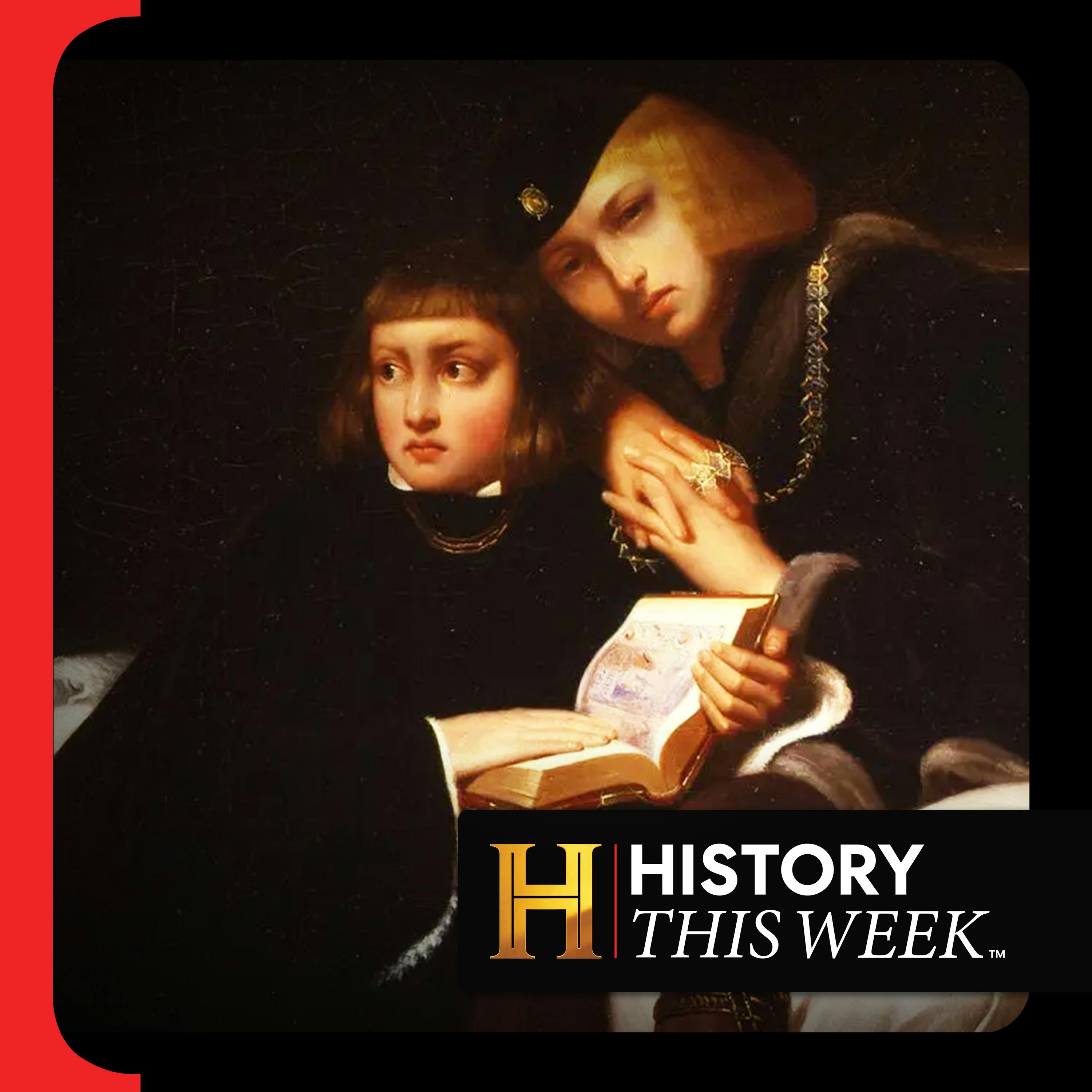
HISTORY This Week
Solving a Royal Murder Mystery | Philippa Langley Investigates the Princes in the Tower
00:42:45
Loading summary
Transcript104 lines
- [00:00]
Carvana Representative
Thanks for selling your car to Carvana. Here's your check.
- [00:03]
Customer
Whoa.
- [00:03]
Carvana Representative
When did I get here? What do you mean? I swear it was just moments ago that I accepted a great offer from Carvana online. I must have time traveled to the future. It was just moments ago. We do same day pickup. Here's your check for that great offer.
- [00:15]
Narrator
It is the future. It's.
- [00:17]
Carvana Representative
It's the present and just the convenience of Carvana. Sorry to blow your mind. It's all good. Happens all the time. Sell your car the convenient way to Carvana. Pick up.
- [00:28]
Podcast Host
Times may vary and fees may apply.
- [00:32]
Carvana Representative
Epic views, waterfall, mists, summit sunsets. It's all better outside and with alltrails you can discover the best of nature with over 450,000 trails around the world. Download the free app today and find your next adventure. The History Channel Original Podcast History this.
- [00:50]
Podcast Host
Week is now in its sixth season, which is kind of crazy, but we're continuing to grow and to bring you stories from the past that you've never heard before. There are more ways than ever to follow our show. So yes, you can listen on your podcast app, but now you can also subscribe to History this Week plus on Apple Podcasts for an ad free experience on all new episodes. Also, if you're more of a Spotify person, Spotify now lets you comment directly on individual episodes, so let us know what you think. You can also get email reminders each time an episode comes out. Sign up for that@historythisweekpodcast.com and be sure to follow us on our new Instagram page too. There's some fun stuff going on over there. As always, share History this week with your friends. Give us a five star review if you want. And if you want to reach out, shoot us an email@historythisweekistory.com Five years in, we have a ton of episodes that you can always go back and listen to, and we're also really excited about everything that's coming up. We hope you are too. For now, enjoy the latest episode.
- [01:54]
Customer
History.
- [01:54]
Podcast Host
This week, July 17, 1674 Sally I'm Sally Helm. A group of laborers is digging in the shadow of the White Tower, a famous white bricked castle. Keep if you close your eyes and picture a generic castle, you're probably imagining it just right. The White Tower is part of the Tower of London, which is basically a small citadel on the banks of the River Thames. Over the years, it's had many royal uses, and today these laborers are doing some renovations. According to the story, they're digging beneath a staircase 10ft under the ground. When they find something unexpected. Two small skeletons, children long dead. News of the discovery reaches King Charles ii. And he thinks that I know exactly who those children are. Nearly 200 years earlier, in 1483, two young boys famously disappeared from the Tower of London. 12 year old Edward V and his 9 year old brother. They arrived at the castle by June, and by autumn, they'd vanished. Over time, rumors spread that they'd been murdered. And not just that. The suspicion was they'd been killed by their uncle, the King, Richard iii, later made famous as a Shakespearean madman. And now here are two tiny skeletons which seem to confirm his savagery. King Charles II has the bones in sealed into a marble urn and interred in Westminster Abbey. But royal bones don't always stay buried. Centuries later, in 2012, a writer named Philippa Langley comes forward with a discovery. She thinks she knows the true location of a different body, the body of the boy's uncle, the infamous Richard iii. Langley has been working for years on a project, the Looking for Richard Project. Like basically everyone else, she'd initially thought of him as the Shakespearean villain. But then one day she's on a vacation in Cyprus when she reads a book that changes her mind.
- [04:37]
Customer
It was by an American academic called Paul Murray Kendall. And what Kendall did was he went back to the contemporary sources and records from Richard's own lifetime, and he spoke about this really interesting individual, but one that you could see from all of the materials was considered to be loyal, brave, devout, and just really different from.
- [05:05]
Podcast Host
The sort of villainous Shakespearean character.
- [05:09]
Customer
Yeah. So I couldn't understand why whenever we hear about Richard iii, it's the Shakespearean villain who was rolled out, because when you've got people talking about him in private letters and diaries and basically talking about his good reputation, I think you have to take those very seriously.
- [05:30]
Podcast Host
She did and started to put the pieces together. Richard had political enemies, most significantly the future King Henry Tudor, who will become Henry vii. And it looks to Langley like those enemies buried these positive accounts of Richard and instead painted him as a villain. And then their version of Richard just got repeated over and over. Shakespeare picked it up and people started thinking of it as fact. So she's found this other Richard in the archives, but she also wants to find him more literally. His burial place has never been found. And when Langley goes looking for Richard's remains, she encounters a lot of stories like that his coffin became a horse trough or his bones were tossed into a river. But she ignores the rumors and takes A forensic approach, focusing on hard facts. She zeroes in on a particular place where she thinks Richard can be found. A parking lot in Leicester, England. She hires archaeologists to look there and sure enough, they find a body.
- [06:49]
Customer
The archaeologists weren't particularly interested in them. They thought they were too far west and were probably the remains of a friar.
- [06:57]
Podcast Host
But later analysis confirms with almost 100% accuracy, it's not a friar. This is the body of King Richard iii.
- [07:08]
Customer
To find him in the exact place that my research said he would be, and also an intuition said he would be, which actually started my search for Richard, it was completely overwhelming. It really was.
- [07:22]
Podcast Host
This whole experience teaches Philippa Langley something powerful. It's possible to solve very old historical mysteries by taking a fresh, clear eyed look at the facts. And it's not long before she turns her attention to a different mystery. The disappearance of Richard's nephews, the princes in the Tower.
- [07:48]
Customer
I decided to get in touch with investigative specialists, with the police, with lawyers, with advocates and barristers. And they all said the same thing. They said, look, this is a missing persons investigation. There's no identified bodies. You have to start with a blank page. You have to drop everything and begin at the beginning.
- [08:10]
Podcast Host
Again today, a conversation with Philippa Langley, author of the Princes in the Solving History's Greatest Cold Case. Based on her research, what does Langley think really happened to the princes? Did the prime suspect, their uncle, Richard iii, actually killed Philippa Langley? Welcome to the show.
- [08:39]
Customer
Thank you for having me. It's a great honour.
- [08:42]
Podcast Host
So let's begin at the beginning. Let's begin with the princes. What do we know about what they.
- [08:45]
Customer
Were like in terms of the elder prince? He seems to have been quite a studious young man, quite an intelligent young man, very capable. We have a contemporary source that says facially he looked like a Edward iv. He looked like his father and his.
- [09:05]
Podcast Host
Name was in fact Edward.
- [09:06]
Customer
He was Edward V. He was an Edward. He was Edward V. He was the heir to the throne. Every moment of every day he was told what he would be doing. Whether it's praying, whether it was eating, whether it was studying, whether it was doing physical exercise. And you can see that he's beginning to become a proper teenager. He's beginning to push boundaries and to push against the world that he was living in.
- [09:33]
Podcast Host
How about his younger brother, Richard? What do we know about him?
- [09:37]
Customer
Yeah, it's really interesting because his younger brother seems to have been completely different and all the accounts tell us that he was very active, very physical and seemed to have been good at sports. And liked dancing, liked music and seemed to have been completely full of life. So. So the sense you get is that you've got a more quiet, studious older brother who was beginning to push against boundaries, trying to find himself and who he was. And then you've got this whirlwind of energy who was his little brother, who probably never shut up.
- [10:17]
Podcast Host
So just sort of expanding our view to the rest of their family. Their father, Edward IV was king and they also have a famous uncle who is really. So what was their relationship with Richard.
- [10:29]
Customer
Like, from what we can see? I mean, Richard then was Duke of Gloucester and he was the younger brother, as you say, of Edward iv, incredibly loyal to Edward iv. He was his leading supporter and also had most of the important jobs in the realm. So he was a very capable man. And we only have small snatches of conversations that have been recorded between Richard as Duke of Gloucester and both princes. And in all instances, Richard is very respectful and is basically following the format of the day for a Prince of Wales and for the Royal family.
- [11:18]
Podcast Host
So the Prince's upbringing is relatively normal. But then their father, the King, suddenly dies in. In April of 1483. Do we know what happened? How did he die?
- [11:32]
Customer
We don't, we don't. We're told that he got some kind of chill when he was out apparently fishing. But of course, this, you know, nobody expected Edward IV to die. It came as a huge surprise.
- [11:45]
Podcast Host
Yeah. So his sons are young, Edward is 12 and his younger brother is nine.
- [11:50]
Customer
Yeah.
- [11:50]
Podcast Host
And is it the case that Edward IV expected and planned for his 12 year old son to take the throne upon his death?
- [11:58]
Customer
Yes, absolutely. And that would be normal and that would be fully expected because he was the eldest boy, so he was definitely the heir and the Prince of Wales.
- [12:08]
Podcast Host
What role did Edward IV imagine or lay out for his brother, Richard iii?
- [12:14]
Customer
Well, this is another interesting thing because when Edward was dying, he made a number of codicils to his will, and one of these was that he wanted his brother, Richard, Duke of Gloucester, who lived in the north of England, so quite far away from London, and he wanted him to become the Protector of the Realm, to become the Lord Protector, because Edward V, his eldest son, was only 12, so you can see that he's putting his brother in charge of the realm in order so that it's secure for his son.
- [12:50]
Podcast Host
Right. Which makes some sense, given that his son is so young, that sort of is expected. So after the King's death, Richard brings his nephew to London for the coronation. And along the way, as far As I understand it, he arrests and executes some relatives of his nephew's mother, Elizabeth Woodville. I know that some historians see that as sort of evidence of his growing thirst for power. How do you see it? What do you think is going on in that incident?
- [13:18]
Customer
Yeah, again, that's the traditional account, that this was Richard always gunning for the throne and this is the proof of it. But I think if you dig deeper, the historians that have sort of gone with that account, if you like, they always ignored the fact that Richard was the Constable of England. So this meant he was in charge of homeland security. And what you can see is that the accounts that we have were telling us that there was some kind of plot. And this is why Richard then arrests these individuals and he sent them north and they remained in custody for six to eight weeks. So he didn't execute them immediately when he actually could have, because he was the Constable of England. So he had the power to do that and he could have executed them at Northampton. So you can see that he's trying to negotiate a minefield at this time.
- [14:19]
Podcast Host
And just to put a bit of a finer point on it, the plot that the Woodvilles would have had to gain power, how would that have gone? Like, what were they hoping would happen?
- [14:27]
Customer
His coronation had been arranged very hastily and very quickly so that Edward V would be crowned with no parliament. Well, if they had crowned Edward V on the 4th of May without Richard, Duke of Gloucester being there, then he would not have been able to have become the Lord Protector of Edward V. So that means Edward V could have reigned as king from day one, the moment that he was crowned. So a 12 year old boy would have become king. But the thing with Edward V was he was very close to Anthony Woodville Earl Rivers. So by default, it would have been Anthony Woodville Earl Rivers, who would have been ruling the country through Edward V.
- [15:19]
Podcast Host
So it seems like there is some power wrangling going on between Richard and the Woodvilles. So that's along the way to the coronation in May of 1483. Richard III places his nephew Edward V in the Tower of Lond and also sends for the Prince's younger brother, Richard, Duke of York, to also stay at the Tower. Tell me about that. Because I think today we usually think of the Tower of London as a prison, essentially. But is that what it would have been at the time? Like, what does it mean that he sends them to the Tower?
- [15:52]
Customer
No, you know, the palace of the Tower of London was exactly that. It was the main royal palace for London. And it held the royal apartments, the royal mint, the treasury, the garrison, the armory, and it also had 15 pubs. So it was like a small city, it was full of people. And we can estimate there was probably about 1,000 people living and working there 24 hours a day, seven days a week. So it was really, really busy. And it wasn't Richard that determined that Edward V should go to the palace of the Tower of London. And it was actually the Duke of Buckingham who said that Edward V should go to the Tower of London because where he was was too small for him and all of his attendants. So Buckingham suggested at the King's council, well, why not send him to the palace of the Tower of London because he has to leave there for coronation anyway. And so everyone agreed because this is where kings always left for their coronation from the Tower of London. And they then applied to Elizabeth Woodville, who was in sanctuary at Westminster at the time and said, look, his younger brother needs to be with his older brother brother because he's about to be crowned and so can you release him and let him go to the palace with his brother? And so that's how the two princes then ended up in the Tower, the palace of the Tower of London, five days before Edward V was due to be crowned.
- [17:24]
Podcast Host
Okay. And then a complication emerges. A sort of succession problem is brought to light by a bishop. Tell me about what happens there.
- [17:34]
Customer
Yeah, it looks like from everything that we can see from the contemporary sources is that the act of getting Richard, Duke of York and sending him to the Tower palace to ready both princes for coronation seems to have been the catalyst for this bishop coming forward. And he came forward with what was bombshell information and which basically caused a constitutional crisis.
- [18:02]
Podcast Host
When we return, a long kept secret threatens to disrupt the line of succession. Richard III has to make a a quiet life in the north or the crown. How did this decision earn him a reputation as a cold blooded killer?
- [18:24]
Carvana Representative
Want to pull off the season's freshest trends? You just need the right shoes. That's where designer shoe warehouse comes in.
- [18:32]
Customer
Loving wide leg jeans.
- [18:34]
Carvana Representative
Pair them with sleek low profile sneakers. Obsessed with the sheer trend. Try it with mesh flats, Feeling boho, comfy sandals. Nail the whole free spirited thing. Find on trend shoes from the brands you love like Birkenstock, Nike, Adidas and more. At dsw, I'm Kristen Press.
- [18:56]
Podcast Host
And I'm Tobin Heath.
- [18:57]
Carvana Representative
We're World cup winners, Olympians and the hosts of the recap show.
- [19:01]
Podcast Host
Every week we sit down with the.
- [19:02]
Carvana Representative
Icons, disruptors and game changers. On the field and beyond it to talk victories, heartbreaks, and everything in between. We've built a space where athletes, change makers and people creating the future of women's sports can show up and show off as their full, unapologetic selves. Follow and listen to the recap show wherever you get your podcasts.
- [19:24]
Advertiser
Today's podcast is sponsored by Midi Health. At any given time, 61% of adult women say they want to lose weight. But for many, that's easier said than done. If you've had trouble losing weight, don't lose hope. Midi Health uses a deep understanding of women's hormones and a combination of weight loss medications to create a customized plan for each user. Midi Health can help you achieve more effective and sustainable weight loss by addressing hormone imbalances. Midi can also prescribe proven weight loss medications that help you experience reduced appetite and and increased feelings of fullness. When paired with hormone optimization, you're not just managing your weight, you're also supporting your body's natural processes, which means you can overcome those weight loss plateaus that in the past have been so difficult to move beyond. So if you're ready to combine the power of hormones with the power of weight loss medications, visit joinmitty.com today. Discover how this innovative approach can lead you to lasting success. That's join midi.com June 1483.
- [20:31]
Podcast Host
Just before Edward V is due to be crowned king, an English bishop has come forward saying that he has information that's going to disrupt the line of succession.
- [20:43]
Customer
He told the King's council that Edward IV had been married to another woman when he married Elizabeth Woodville. So the mother of the children of Edward iv, the princes in the tower. So basically, Edward IV had committed bigamy and his children were now declared illegitimate.
- [21:08]
Podcast Host
Yeah. So it's an interesting moment. It's going to be a good moment for Richard, the dead king's brother. So I guess this must be one of the moments where people who want to see this as sort of Richard's power grab, where they drill down. Right. I can see how they might say, ah, where did this bishop get this information? Why does he bring it forward now? Is this some kind of conspiracy? Like, is that how people tell this moment of the story?
- [21:33]
Customer
Yes, I think in most of the traditional accounts, they do. But you know what, I would definitely question this is a great moment for Richard, Duke of Gloucester. Again, from what we can see from the contemporary sources, it wasn't because he's petitioned to become king by the three estates of the realm. And it takes him 24 hours to accept. And you can kind of understand that he was really happy in the North. He'd made the north his own, and his homes were there, his wife were there, his children was there. This would change his life completely. So he doesn't respond immediately.
- [22:13]
Podcast Host
He hesitates.
- [22:15]
Customer
He hesitates.
- [22:16]
Podcast Host
But he does become king. He's crowned.
- [22:18]
Customer
He does.
- [22:18]
Podcast Host
And how do people react to his coronation?
- [22:20]
Customer
What's the.
- [22:21]
Podcast Host
What's the feeling around it?
- [22:22]
Customer
Do you know? The feeling is, you can see it's really good. It's accepted by the people generally. And his coronation is one of the best attended coronations. Everybody seems to be saying, yes, this is the right thing to do. So he is the king.
- [22:41]
Podcast Host
All right, now we are coming up to the big mystery at the center of this project that you've been engaged in, because soon after the coronation, that summer, the two princes seem to disappear. Is there panic? Do people think they've been murdered?
- [22:57]
Customer
No, not at all. There is absolutely no contemporary evidence whatsoever that people had thought that the princess had been murdered during Richard's reign.
- [23:11]
Podcast Host
Richard III has become the prime suspect in this incident over time. And you pinpoint a moment where the idea that he murdered the princes arises at this particular key political juncture where someone else is trying to essentially take the throne from him. Richard III's reign is. It's relatively short. It's only about two years. Tell me about how it ended.
- [23:36]
Customer
Yeah, so you're right, it was a very short reign because Richard's reign ended at the Battle of Bosworth on 22 August, 1485. And this is when England was invaded by a pretender who was backed by France. And he had a very, very tenuous claim to the throne. And his name was Henry Tudor and he went on to become Henry vii. And I think at the time, at the Battle of Bosworth, he was about 30th in line to the throne, but he was backed by France and he had mercenaries from France. And having won that battle, he was then proclaimed king on that battlefield by his supporters. And I think one of the big things that we discovered was that the entry point of the murder story into England arrived with Henry Tudor. And we can actually date it to 14 August 1485. And this is when Henry was telling people that Richard murdered the princes in the Tower.
- [24:44]
Podcast Host
Interesting. So one of the first things you do is actually it's not about finding the princes, it's about kind of the forensics of the story.
- [24:52]
Customer
Yeah, the first two major lines of investigation that the project undertook was the first one was we had to analyze all of the contemporary records and documents and sources that we have for the reign of Richard iii, because if the princes went missing during the reign of Richard iii, this is where we're going to find where they were and evidence, potential evidence of how they died and where they were murdered. But the second line of investigation that we then had to undertook was the Battle of Bosworth. And we had to do a forensic analysis of everything that was happening around then, because this is when the worlds of Richard III and Henry Tudor, who became Henry vii, collided head on. And we knew that Henry Tudor was the mortal enemy of Richard iii. So these two lines of investigation took nearly four years just to do them.
- [25:49]
Podcast Host
So I know your project involves going through the evidence. Let's do that. What are the key clues that you uncover in terms of what really happened to the princes?
- [25:58]
Customer
So, yes, after we'd undertaken these two lines of investigation, we had to start taking the potential survival of both princes seriously because we could see no evidence anywhere for the death of either prince. But what we could see is when they're mentioned in contemporary documents and records, they're always talked about in the present tense. And there's no pious prayers or observances for their souls. So we then had to expand the investigation and we had to expand it into the reign of Henry vii.
- [26:35]
Podcast Host
Up next, Philippa Langley's team of researchers uncovers evidence of clandestine escapes, military invasions and tragic endings. Stay tuned.
- [26:52]
Narrator
Rated T for teen. Each year, thousands of adults lose their shred. It's an epidemic simply known as shred loss. But it doesn't have to be this way, because rekindling your shred is as easy as playing the new Tony hawk's Pro Skater 3 and 4. With new parks, cross platform, multiplayer and sick new game modes, we can put an end to shredded shred loss everywhere. Hit the new Tony hawk's Pro Skater 3 and 4 and show the world that the shred's not dead. Get Tony Hawk's Pro Skater 3 and 4, available now.
- [27:24]
Carvana Representative
At New Balance. We believe if you run, you're a runner, however you choose to do it. Because when you're not worried about doing things the right way, you're free to discover your way. And that's what running is all about. Run your way@newbalance.com running. Hey, business owners, we know you know the importance of maximizing every dollar. With the Delta SkyMiles Reserve business American Express card, you can make your expenses work just as hard as you. From afternoon coffee runs to stocking Office supplies and even team dinners. You can earn miles on all your business expenses. Plus you can earn 110,000 bonus miles for a limited time through July 16th. The Delta Sky Miles Reserve business card. If you travel, you know, minimum spending requirements and terms apply. Offer in 716.25.
- [28:26]
Podcast Host
Philippa Langley's initiative was called the Missing Princes Project, and she wasn't doing this project alone.
- [28:34]
Customer
By this time, we had over 300 members around the world, searching archives everywhere. And I think this is when having so many members becomes really important. And this is when we started to make the most remarkable discoveries, because we could see two things happening. We could see the destruction of documents that was taking place by Henry VII and his government in the reign of Richard iii. But then having this massive research project, we could then open the investigation into Europe. And this is where Henry's reach couldn't get to, if you like. And this is when we started finding the proof of life.
- [29:17]
Podcast Host
The proof of life. What was it? What'd you find?
- [29:20]
Customer
So I think the first main one that we found was in May 2020, and this is by Albert Jandaroy, who is a researcher in Holland, and he found in the Lille archives in northern France a receipt for weapons. And the Receipt is dated 16 December 1487, when Edward IV's eldest son, Edward V, would have been 17. And the weapons are for an invasion of England by the son of. Of Edward iv. And it says who had been expelled from his dominion. He'd been sent to the Channel Islands and put into exile. And we knew this from two contemporary sources.
- [30:07]
Podcast Host
Wow. Okay, so you're putting the story together. You've had accounts that Edward V was not killed, but rather sent away to the Channel Islands, sent to exile. And then you find, I mean, like a literal receipt of his existence, like he bought a weapon. Yeah, it sounds like that felt pretty definitive that he was at least alive when he was 17.
- [30:28]
Customer
Yeah. So to find it stating that these weapons were for the son of King Edward iv, it was huge. It was a really big moment. And I think what the police told me, it was one of the things that they said we have to do is they said you have to look in administrative records. They're the places to find truth, because they were not written for public consumption and they had no reason to lie.
- [30:52]
Podcast Host
So that's sort of a trace of the older brother, the sort of quieter one, Edward V. How about the young, rambunctious Richard? What do we know of what happened to him?
- [31:05]
Customer
Yeah, again, I think 2020 was a big year for the missing princes project. Cause there's another remarkable researcher in Holland called Natalie Naiman Bleichendoll. And Natalie discovered a document in Arnhem in Holland, in the Gelderland Arch. I described it as mind blowing and it really is because it's a four page semi legal manuscript written by the younger prince in the first person, I, Richard. And it tells his 10 year story from being in London in 1483 and being at the palace with his brother and then being taken out of the palace by John Howard, Duke of Norfolk and two guardians called Thomas and Henry Percy, and being taken to the continent where he was then kept in safekeeping. So this gave us a huge moment in terms of what was happening to the younger prince.
- [32:04]
Podcast Host
I mean, lay it out for me, it sounds like you have a sense now of what you think really happened to them after they left the Tower. What is it? If they weren't murdered, where did they go? What were their lives like from there?
- [32:16]
Customer
Yeah, well what we can see at the moment is that the elder boy was removed from the Tower in the summer of 1483 and he was taken to Pontefract Castle in Yorkshire. And I think after that Edward V, before the Battle of Bosworth, was then sent to the Channel Islands where he again was kept in close custody, because of course he could have been used to foment rebellion against Richard iii. And we are then told that he was set free in Guernsey after the Battle of Bosworth when Richard was killed and he was sent to Richard's close friend in Yorkshire who was an individual called Francis Lord Lovell. And then he was sent to Ireland with Lovell.
- [33:03]
Podcast Host
Wow, okay, so how did their lives end so far as you know?
- [33:07]
Customer
As far as we know, in terms of the younger prince, it does look like he was the individual that was executed in Tyburn in London in 1499. And he was 26 at the time.
- [33:21]
Podcast Host
Why was he executed?
- [33:22]
Customer
He had tried to invade Henry VII's kingdom three times in 1495, 1496 and 1497. And he was then captured by Henry VII. Henry VII said that he was just a French Ternay boatman's son called Perkin Warbeck. And then he was executed as Perkin Warbeck. But again, we have to dig deep and look at all of the things that were happening at the time. Cause one of the interesting things was that his face was smashed in so that nobody could recognise him as being the son of Edward iv. Because we have a drawing of him and he's the double of King Edward iv.
- [34:04]
Podcast Host
Wow.
- [34:05]
Customer
And in terms of the elder prince, we know that he must have died sometime after 1488, but certainly he was politically dead by May 1491, because at that time, his garter stall in St. George's Chapel in Windsor Castle was reallocated to the son of Henry VII and Elizabeth of York. And there's only a very limited number are allowed to be members of the garter, including the monarch. So you only would reallocate a garter stall if someone was dead or had he had given up his place. So, yeah, that's all we know about Edward V at the moment.
- [34:50]
Podcast Host
All right, let's sort of think about where we land here. I guess with the Richard III case, with your first project, I mean, you find a literal body, like, there it is. And this story, it's necessarily a little bit more speculative than that. We don't find the Prince's bodies and confirm the age that they were at their deaths. I guess. Like, are there still people in the field who take a different view here who think that Richard killed them or that something else happened?
- [35:21]
Customer
Yes, I think they are. I think a lot of them say, oh, but the princes, they were found and they're in an urn in Westminster Abbey.
- [35:30]
Podcast Host
Right. We're talking about the two child skeletons that were found in the Tower of London that we will have heard about at the beginning of the episode.
- [35:36]
Customer
Yes, absolutely. And what I would say to that is, again, we've done the big, deep dive into what we know about these remains in the urn in Westminster Abbey. And what we have concluded is there is no historical, archaeological or scientific evidence for these being the remains of the princes in the Tower. So I have called for these remains to be examined at our earliest convenience, that is tomorrow, if possible, because I want all of our modern sciences. We've got the DNA of the princes, we've got everything that we can put to these remains. Because are they as big a myth as Richard's bones being thrown into the River Soar? Yes, they absolutely are. And we can see that from what.
- [36:23]
Podcast Host
We know about them. Who do you think they were?
- [36:26]
Customer
I think they were a foundation burial because they were found 10ft down in the foundation of a building. And when you look at the archaeological level at the Tower of London, the level that they were found at was Iron Age, Saxon, Roman or early Norman. And what these were, these were burials of children put into the foundations of buildings because they believed with these burials, the buildings wouldn't fall down. And when you look at where these children were found. They were found right in an area where a Roman temple was located underneath the Tower of London.
- [37:07]
Podcast Host
I mean, it seems like one of the big complications you've been dealing with in all of your work is just this massive sense in so much of the historical literature that Richard III was a villain. Why is that such a persistent idea? Like, who did it serve to put that story out there? Yeah. And how did it really take hold?
- [37:31]
Customer
I think it's so of the Tudors. I think Henry VII in particular was a very insecure and paranoid monarch. So I think for them to continue to make this story of Richard the evil monster, the tyrant, it then makes the Tudors and Henry vii, Henry viii, look like, you know, the good choice, that they were the better monarch. And I think it simply comes down to the victors write the history, they write the story. And what the project has been really focusing on is 15th century documents, people who were there at the time, witnesses, things that are contemporaneous rather than the latest 16th century chroniclers who were writing about Richard. They weren't there and they weren't witnesses. So I think this is what I would say, you know, going forward is the police methodology is important. It's really important for the study of history. We cannot, you know, ignore lines of investigation because we might have a presumption about them or an attitude about them or want to close them off because we don't feel that they're important. We couldn't do any of that in this investigation. We had to look at everything. So I think, again, this is what I would say to the young historians is use contemporary materials from those that knew people rather than what later writers said who weren't there.
- [39:07]
Podcast Host
Philippa Langley, thank you so much for coming on History this week.
- [39:10]
Customer
Thank you, Sally. Thank you.
- [39:13]
Podcast Host
Philippa Langley is a historian, an award winning producer and author of the Princes in the Solving History's Greatest Cold Case. History this week is a Back Pocket Studios production in partnership with the History Channel. To stay updated on all things History this week, sign up@historythisweekpodcast.com and if you have any thoughts or questions, send us an email@historythisweekhistory.com this episode was produced by Corinne Wallace. It was sound designed by Ben Dickstein and also produced by me, Sally Helm for Back Pocket Studios. Our executive producer is Ben Dickstein from the History Channel. Our executive producers are Eli Lehrer and Liv Fiddler. Don't forget to follow rate and review History this week wherever you get your podcasts. And we'll see you next week.