← HISTORY This Week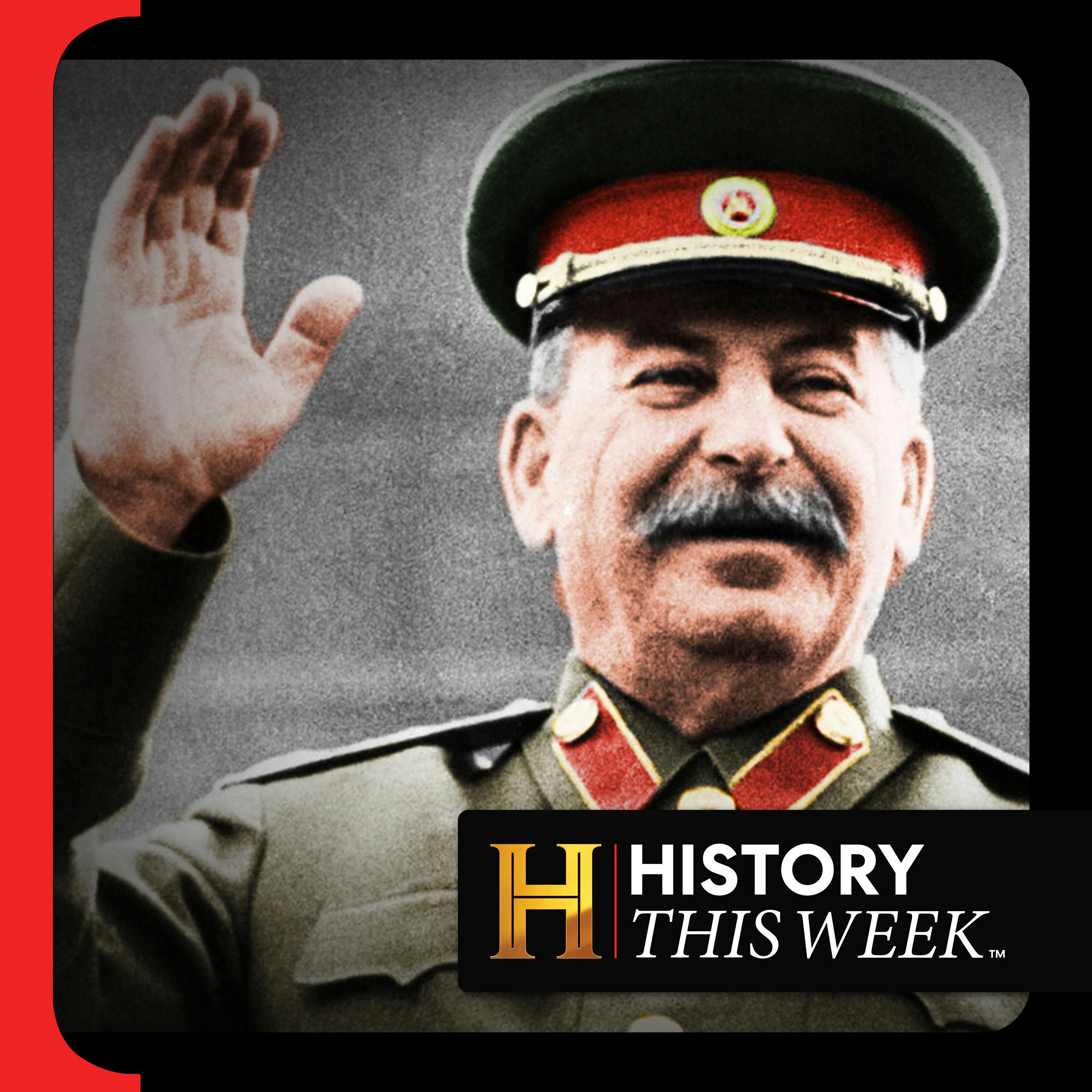
HISTORY This Week
Stalin’s War on Genetics
00:40:38
How one man’s pseudoscience reshaped Soviet biology.
Loading summary
Transcript87 lines
- [00:00]
A
Hey, Ryan Reynolds here from Mint Mobile.
- [00:02]
B
Now I don't know if you've heard, but Mint's Premium Wireless is $15 a month.
- [00:06]
A
But I'd like to offer one other perk. We have no stores. That means no small talk. Crazy weather we're having.
- [00:16]
B
No, it's not.
- [00:17]
A
It's just weather.
- [00:18]
B
It is an introvert's dream.
- [00:20]
A
Give it a try@mintmobile.com Switch upfront payment of $45 for 3 month plan, $15 per month equivalent required. New customer offer first 3 months only, then full price plan options available, taxes and fees extra. See mintmobile.com the holidays have arrived at the Home Depot and we're here to help bring the excitement with decor for every part of your home. Check out our wide assortment of easy to assemble pre lit trees so you can spend less time setting up and more time celebrating. And bring your holiday spirit outdoors with unique decor like one of our Santa inflatables. Whatever your style, find the right pieces at the right prices this holiday season at the Home Depot.
- [01:03]
C
The History Channel Original Podcast.
- [01:07]
A
History this week, October 11th, 1955. I'm John Earl. The letter will remain a secret for decades. But behind the scenes, in the Communist Party's inner sanctum, it lands like a bomb. Nearly 300 of the Soviet Union's leading scientists have signed this letter saying essentially, you need to fire the country's most influential scientific thinker, a man named Trofim Lysenko. Lysenko was born a poor farm boy and he'd risen through the ranks to dominate entire sectors of Soviet science. Within his domains, he determines which research gets funded and what's taught in schools, what the public believes, all of it. And he has some bold and unusual ideas. For example, he thinks that species of plants can instantaneously transform into other species, like wheat can become rye. And these scientists who write this letter are banding together to say, look, these ideas are ridiculous. They're holding our country back and the west is laughing at us. Lysenko has got to go. They know that the new leader of the Soviet Union, Nikita Khrushchev, is open to reform. But like Lysenko, Khrushchev is a rags to riches story. He likes this farm boy turned scientist and when he gets the letter, he's pissed. Don't touch my Lysenko, he warns, or heads will roll. Lysenko. This powerful scientist keeps his job for now. But even though the letter writing scientists have failed, the episode is a glimmer of hope. They've begun chipping away at Lysenko's power. Eventually Lysenko will fall. Today, the Lysenko affair. Who? How did a charlatan convince a superpower to renounce modern science? And what happened when pseudoscience became official government policy? Long before the scientists revolt, before anyone had ever heard of Trofim Lysenko, a man in his mid-30s stands in Abyssinia today, Ethiopia, admiring a wheat field. Nikolai Vavlov is probably wearing a three piece suit. If there's a breeze, it rustles his neatly groomed mustache. He's a world famous scientist who speaks at least five languages fluently. On his travels he's often taken for a Soviet spy. And he is here on a mission. But it's a scientific one. Davilov wants to save millions of his fellow Russians from famine. And he thinks the key might be here in Eastern Africa. The Russian empire has historically struggled to feed its people. The biggest problem, the country's extreme climate.
- [04:25]
C
Almost half of the territory covers the so called zone of uncertainty agriculture.
- [04:33]
A
Nikolai Krementsov is a historian of science at the University of Toronto and the author of Stalinist Science.
- [04:41]
C
Half of that is permafrost and you can't grow anything in permafrost. The other side is subject of continuous drought. There is simply not enough water.
- [04:57]
A
In Vavilov's lifetime alone, Russia has already suffered three major famines. Millions have died. Russian farms are the least productive in all of Europe and Vavilov's theory is that they could have better results with better seeds. This expedition to Abyssinia is just one of over a hundred that he'll undertake. In all, he'll visit five continents and 64 countries, from Afghanistan to Brazil. He makes Indiana Jones look like a homebody. Pavlov is looking for local varieties of wheat, barley and other Russian staples. If he can find a variety that's say, highly resistant to drought or colds, he can breed crops that can withstand Russia's climate. Finding the seeds to do all that would be amazing.
- [05:45]
C
We might be able to solve the most important problem. The yield, the amount of bread available to feed the Russian people.
- [05:59]
A
Pavlov's project hinges on an old idea that's just getting its scientific legs under it, that there's something in the seeds that passes traits from one generation to the next. Scientists in the 1920s knew about genes, the fundamental units of heredity, and they suspected that the genes were stored in chromosomes. But they hadn't yet discovered the molecular structure that underpinned it. DNA, the double helix. Which left room for skeptics. It's time to Meet Trofim Lysenko. Whereas Vavlov is the son of a wealthy Moscow merchant, a cosmopolitan elite type, Lysenko is a salt of the earth kid from Ukraine.
- [06:43]
C
Lysenko is a farm boy. He was born on the farm, he grew up on the farm. He never learned any foreign languages. He only learned to read and write at the age of 13.
- [06:58]
A
Whereas Vavilov is a charmer, Lysenko can be a bit prickly.
- [07:02]
C
He was kind of dry, ascetic, not.
- [07:07]
A
Very friendly even their appearance is a study in opposites. Vavlov has a friendly professor vibe. Lysenko looks like a Ukrainian Daniel Craig. Piercing eyes, sharp jawline, perfectly combed dark hair. At the time that Vavlov is standing in that wheat field in Abyssinia, Lysenko is a junior agronomist, that's an agricultural scientist. He's at a backwater research station, one of dozens across the country that Vavlov oversees. This one is about 1,000 miles south of Moscow in Soviet Azerbaijan.
- [07:42]
C
He is a rank and file breeder assigned to study the methods of sowing and growing bean plants.
- [07:55]
A
Lysenko is diligent and it's here in Azerbaijan that he begins to develop his signature idea. It starts with an observation. Certain plants require exposure to cold to stimulate their development. And Lysenko thinks if cold temperatures can make plants grow faster, why can't we use it to grow more food? Maybe it's a better way to feed Russia than Vavilov's gene based plant breeding, which takes years to produce results. Lysenko's belief that cold treatment can boost crop yields is cemented by an experiment that supposedly takes place on the family farm back in Ukraine. His father takes two sacks of grain, puts them in the snow all winter and then plants them in the spring.
- [08:48]
C
And in the summer the grain grows tremendously. He picks up a bunch of weak plants and shows it to people there, saying, look, this is what we can do.
- [09:07]
A
The Communist Party newspaper Pravda eats up the story. They love tales of ingenious peasants solving problems the eggheads like Vavilov can't. A glowing op ed hails the folksy experiment as a triumph.
- [09:23]
C
This tremendous discovery made by this unknown man called Trofim Lysenko promises to solve all our agricultural problems once and for all.
- [09:38]
A
Lysenko starts gaining a reputation in the popular media as an agricultural wizard. They call him the Barefoot Professor. But mainstream scientists are rolling their eyes. They're like, this guy doesn't even have an advanced degree. He has one.
- [09:55]
B
So.
- [09:55]
A
So scientific paper to his name and the cold treatment stuff. Exaggerated at best. But there's one important scientist who gives Lysenko a chance.
- [10:07]
B
Bavulof was very open minded and he believed that all sides should be listened to.
- [10:11]
A
William DeYoung Lambert is a historian of science at Bronx Community College, cuny and and the author of a book about Lysenko. He told us that Vavilov wasn't the kind of scientist who thought he alone had all the answers. He believes in hearing people who disagree with him and he believes in fostering young researchers like Lysenko.
- [10:30]
B
The irony here is that Ravlov is the one who in many ways is most responsible for promoting Lysenko and really helping him.
- [10:37]
A
Vavlov hears about Lysenko's work in Azerbaijan and thinks, not bad. So he invites Lysenko to present at a big agricultural conference in Leningrad in 1929. There are more than a thousand people there. Agronomists schmoozing with party leaders. Everyone is talking about how science can boost Soviet agriculture. It's a major turning point for Lysenko, and not in a good way. He gets pushback, gets sort of demolished by the real experts, guys with fancy degrees and bourgeois manners. They say, trufim, cute paper, but you didn't discover anything with your theories about the cold. We knew all this. Lysenko is crushed, and his response is to reject the scientists right back. This is the moment when he basically stops trying to be a scientist, stops conducting rigorous experiments, stops submitting articles for peer review. But he does spot a different way to climb the social ladder. Lysenko realizes that under the tightening grip of Joseph Stalin, the Soviet Union is changing. Stalin is pushing to replace the old intellectual class with new specialists from humble backgrounds. Barefoot professors are in and bourgeois experts are out.
- [12:03]
C
Now the party looks at specialists whom they entrusted with suspicion. And that suspicion could result in firing.
- [12:14]
A
Squads, literal firing squads. The year before, Stalin orchestrates a big public show trial. He's trying to industrialize the country, which is hard. And when things go wrong, he finds someone to blame. In this case, executives and engineers at a mine in southern Russia. They're accused of sabotaging their own mine, and Stalin pronounces them guilty before the trial even begins. Lysenko sees which way the wind is blowing, and he sees that he can benefit. His peasant background makes him perfectly situated to rise to power now, not based on his scientific discoveries, but based on his political and media skills. And he decides that's exactly what he's going to do. It turns out he has a Genius for climbing the Stalinist ladder. Here are three plays from his playbook. Play one Become a Pundit. Rather than trying to publish in serious academic journals, Lysenko realizes that he can promote his ideas much more effectively in the popular media. So he becomes a science pundit. He launches his own journal, no Peer review, which becomes a bullhorn for spreading his ideas.
- [13:35]
C
He publishes continuously on every single agricultural question he can imagine and creates this kind of impression that he is indeed an expert on nearly all agricultural questions.
- [13:53]
A
And not just agriculture. Lysenko also pontificates on this wonky yet very important question of how heritable traits are acquired and passed down. Nikolai Vavlov and his fellow geneticists believe, like scientists already did around the world, that traits are passed from one generation to the next in these stable units called genes. But Lysenko is pushing a very different theory. He thinks the characteristics that an organism develops during its lifetime can be passed on to its offspring. Environment and experience shape us for generations. So, for example, giraffes develop a long neck, not because of natural selection, but because they stretch their neck out a lot and then they pass that long neck onto their offspring. But the fact is, giraffes have long necks because it's encoded in their genes. This was the scientific consensus in 1930, and it's still the consensus today. But Lysenko is spreading his ideas in the popular media, and he's also doing something else. Here's play number two from Lysenko's playbook. Promise quick and easy solutions to complex problems. Lysenko knows people want bold proposals they can understand, not scientific mumbo jumbo. And he has a bold proposal. Remember the seeds in the snow? He's coined a term for that, vernalization. He basically promises that he can use it to dramatically increase yield for pretty much everything from potatoes to cotton to fruit trees. Vernalization is proven, he says, ready to save the Russian people. The days of famine will be over. It's a noble goal, but some of the solutions he's pushing are really out there. Here's William DeYoung Lambert theories like the.
- [15:52]
B
Mentor method, whereby if you graft a cutting from one plant onto another, the characteristics will be transmitted. But the thing is that the cutting has to be from an older plant, you see? So the older plant is mentoring the younger plant to teach it to grow or develop in a certain way.
- [16:10]
A
Plants teaching other plants to grow, it doesn't totally work, which could, of course, be a problem.
- [16:17]
C
If you say, I'll solve your problems and your promise does not Realize. How do you explain to your patrons the reasons for your failure?
- [16:30]
A
Lysenko has an answer.
- [16:32]
C
As in any other bureaucratic system, you shift the blame. You say, you know, we did everything we could, but the enemies undermine our work, they impede our efforts, they propagate wrong ideas, wrong techniques, and thus we cannot fulfill our promises.
- [16:59]
A
This is play number if your proposals fail, blame somebody else and then just make more proposals. When vernalization doesn't increase yields, like Lysenko promises, he says, you're doing it wrong or it's sabotage. Then he moves on to another bold proposal, and another, and another. Lysenko plays the Stalinist game like a pro, and it pays off. In 1935, he's invited to the Kremlin to speak at a big agricultural conference, and it becomes a sort of coronation.
- [17:37]
C
This is the pinnacle of the first stage of human his career, because who is present is the great teacher himself, Josef Misaryonovich Stalin.
- [17:52]
A
With Stalin watching, Lysenko lectures about vernalization, urging more farms to adopt the technique. And he is mesmerizing. Listen for yourself. You don't have to understand Russian to imagine the magical effect he had on listeners. But partway through, his speech takes a dark turn. Comrades, Lysenko says, there are dangerous enemies in the sciences. They have attacked vernalization, but their real goal is to sabotage Soviet agriculture. Stalin jumps to his feet, clapping and.
- [18:34]
C
Shouting, bravo, Comrade Lysenko, bravo.
- [18:41]
A
Stalin's endorsement places Lysenko above all other scientists. Pravda runs a front page photo of Lysenko, mid speech, angular face, parted hair, hand raised to emphasize a key point. Behind him, separated by a raised dais stamped with the hammer and sickle cell, stands Stalin in his gray tunic, the faintest hint of a smile on his face. In the audience that day, but not in the picture, is the country's top agricultural scientist, Nikolai Vavlov. Stalin had charged Vavilov with boosting grain production, but he's been struggling. The timelines are insanely aggressive, and Vavilov has fallen behind. Plant breeding takes years. After Lysenko's speech, Nikolai Vavilov is fired, and then his colleagues begin to disappear. 1937-1938 is the height of Stalin's great terror, a massive campaign of political repression that cuts across Soviet society. Millions are arrested and and either executed or sent to brutal forced labor camps, where many later die. The purges gut the military and the party, but they also devastate the intelligentsia, writers, experts and scientists. The terror was aimed at eliminating Stalin's opponents, mostly imaginary, but it also functioned to justify the regime's economic failures. Somebody had to take the fall for all the wild promises that didn't pan out. And so, on August 6, 1940, the secret police come for Vavilov. He's on an expedition looking for seeds in southwestern Ukraine. Stalin's agents bundle him into the back of a car and drive away.
- [20:39]
B
He just disappears. And when you read the correspondence of people writing about it in the west, then no one knows what's happened. We can't get any word what happened to Vavilov.
- [20:49]
A
But there is another scientist who's in the know, the man who has taken Vavilof's place as head of the Agricultural Academy. He's not in Leningrad, lysenko tells a colleague, obviously gloating. He's under arrest. This episode is brought to you by Indeed. When your computer breaks, you don't wait for it to magically start working again. You fix the problem. So why wait to hire the people your company desperately needs? Use Indeed's sponsored jobs to hire top talent fast. And even better, you only pay for results. There's no need to wait. Speed up your hiring with a $75 sponsored job credit@ Indeed.com podcast terms and conditions apply. What's up, guys? It's Candace Dillard Bassett, former real housewife.
- [21:43]
B
Of Potomac, and I'm Michael Arseneault, author of the New York Times bestseller I Can't Date Jesus. And this is Undomesticated, the podcast where.
- [21:51]
A
We aren't just saying the quiet parts out loud. We're putting it all on the kitchen table and inviting you to the function. If you're ready for some bold takes and a little bit of chaos, welcome to Undomesticated. Follow and listen to Undomesticated, available wherever you get your podcasts. My marathon isn't about time.
- [22:12]
B
It's about my 26 friends with intellectual disabilities I'm dedicating each mile to. I'm Joseph. I'm running my first bank of America.
- [22:22]
A
Chicago Marathon for Special Olympics Illinois to.
- [22:25]
B
Help give my friends a place to shine.
- [22:28]
A
Join bank of America in supporting Joseph's cause. Give if you can@bofa.com what would you like the power to do? Bank of America references to charitable organizations is not an endorsement by bank of America Corporation. The interrogations are carried out deep inside Moscow's Lubyanka prison. Nikolai Vavlov is accused of plotting against the Soviet Union. He refuses to confess, which is the surest way to get a death sentence. The exact details of the interrogations are unknown, but they begin in the early morning and last for 10, 12, 13 hours at a time. Stalin's secret police were known to employ various tortures, from beatings to sleep deprivation to more elaborate methods. For especially resistant prisoners, interrogators would produce a stranger who they'd threatened to kill unless the prisoner confessed. The torments are unbearable and eventually, Pavlov breaks. The man who devoted his life to feeding Russia and building Soviet agricultural science now confesses to plotting against it. His trial lasts five minutes. He's sentenced to death, later commuted to 20 years in a labor camp. In the bitterest of ironies, Vavilov dies in Prison in 1943 of starvation. Trofim Lysenko, meanwhile, has been enjoying a privileged life. As the country's top agricultural scientist, he has sweeping power over where research rubles go and how crops are grown. He's also tightened his grip over biology, attacking the science of genetics from the inside. But his power isn't absolutely Some criticism is still permitted, especially in scientific circles, and genetics is still taught in schools. By the late 1940s, Lysenko's old playbook isn't working like it used to. His attempts to feed the country are falling flat. The Soviet Union suffers yet another devastating famine from 1946 to 1947. But Lysenko doesn't lose his job.
- [24:44]
B
If you look at the arc of Lysenko's career, I mean, it's never tied to the success or failure of anything he's doing. Lysenko's career is tied to politics, not to science. It's not as though he's successful because he achieves something great in science at all. It's about whoever's supporting him politically.
- [24:59]
A
And luckily for Lysenko, he still has the support of the only person who really matters. Stalin doesn't just stick with Lysenko, he doubles down. Why? Why? Because not too long ago in Russia, a peasant could never rise to prominence. Stalin himself grew up in poverty. But now in the ussr, the peasants, the working people, they are in charge. At least that's the idea. You could go from a wheat field in Ukraine to the Kremlin, and that gets. At the core of Lysenko's science, he says, human organisms are born, but people are created. Stalin wants to create new Russians for a new Russia, and Lysenko is saying, yes, this is possible. Just like those giraffes with their long necks, people can be transformed. So when Lysenko needs a political shot in the arm, Stalin comes through in a big way. He orchestrates yet another big scientific conference. To shore up Lysenko and Lysenko ism by putting genetics itself on trial.
- [26:14]
B
This session is like a show trial of genetics. So you've got 700 people there, it's being heavily reported on and Prabhda, which would really send the message to the average Soviet citizen that this is a very, very big deal.
- [26:29]
A
The 1948 session of the Agricultural Academy is all about pitting Soviet science against Western science. The Cold War is just getting underway, dividing the world into competing economic systems, competing militaries, and now competing sciences. Stalin wants to argue that Soviet biology is different from and superior to Western biology. And part of that comes down to condemning this fancy new genetic stuff and saying Lysenko has it right.
- [26:59]
B
One geneticist, he actually manages to sneak into the meeting and just says, well, you know, but can't we have both sides? Does genetics have to be all bad? Can't we just be critical of it, but not completely toss it out? And the answer is absolutely not.
- [27:14]
A
At this conference, Lysenko proclaims genetics a pseudobiology. The future, he says, lies within his version of biology.
- [27:23]
B
Lysenko is getting most of the floor and he's speaking and then it's like on the third or the fourth day or something. Geneticist Zawodovsky, he just asks openly at the session, what is the position of the Central Committee?
- [27:37]
A
The Central Committee of the Communist Party. Everyone knows that what they say goes. And it's here that Lysenko reads aloud the words that echo in Soviet science for decades.
- [27:50]
B
The Central Committee has examined my report and approved it. And that's like the, you know, the 10 words that shook the world right there. That's when Lysenko has declared victory.
- [28:01]
A
The official transcript describes what happens next. Stormy applause turning into an ovation. All rise. The message is clear. Lysenkoism has become official state ideology. Genetics is now effectively banned. Resist at your own risk. After this 1948 conference, the chips fall swiftly.
- [28:30]
B
You see sweeping firings taking place across the universities and the various academies. All of his enemies are being purged and all of his allies are taking over. And the curriculum's being revised and so forth is big campaign takes place.
- [28:45]
A
The entire scientific establishment gets the message, from the provincial schoolteacher to the head of the Academy of Sciences. Incidentally, he has a name you might recognize. Vavilov. Sergei Vavlov is a renowned physicist and Nikolai's brother. He's forced to publicly admit that Lysenko's doctrines are scientifically correct and pledge to eliminate, quote, reactionary, idealistic biology. But in his diary. He shares his true Everything is so sad and shameful. This is also the moment in the story when the worst charlatans and cranks are unleashed upon the Soviet public. It's like that scene in Ghostbusters when the ghosts get loose and terrorize New York City.
- [29:33]
C
Charlatans are always around. They're usually what is called harmless cranks. They can produce whatever theories or homemade experiments. It doesn't mean much. It's a kind of normal range of scientific activities. What changes is when these cranks get access to power.
- [30:00]
A
One of the most notorious is a cell biologist named Olga lipischinskay. She's almost 80 by this time. Plump white hair, round glasses, a babushka of a scientist with some really out there ideas.
- [30:15]
B
She claimed to have created cells from bits of straw and egg yolk. I mean literally, like, you know, spontaneous creation of life. She was her own movement and she just kind of gets then brought along with the kind of cast of characters who end up becoming promoted around Lysenko.
- [30:33]
A
Say you're an average Soviet citizen living in this new pseudo scientific reality. You pick up a copy of Pravda on your way to work. You read all about Lebashinskaya's work covered in total seriousness, and you're like, okay, straw plus egg yolk equals life. Got it. Meanwhile, your kids are learning all the same stuff in school. In fact, where Lysenko left his deepest mark was on Soviet education.
- [31:01]
C
He blocked any attempts to introduce modern genetics, not to mention molecular biology, into textbooks, either for high schools or universities, medical schools or agricultural schools.
- [31:22]
A
Meaning that a generation of Soviet students learn a distorted version of biology. Here's what a textbook from this period would have contained.
- [31:31]
B
All just these big propaganda, sloganeering kind of things. And, you know, collectivization of agriculture has increased yields by this percent. But they're not learning about chromosomes and genes and crossing over and the basics of biological science. I mean, that's what biology is. By the time we get to the 1950s, it's genetics.
- [31:52]
A
Perhaps the biggest tragedy of Lysenkoism is all the brilliant biologists who never were the discoveries that never happened.
- [32:00]
B
Think of the thousands, tens of thousands of students who would have studied, say, genetics, who would have been studying contemporary biological science, who just don't, because it doesn't exist.
- [32:11]
A
This is taking place at exactly the moment when molecular biology really takes off in the West. In 1953, Watson, Crick and Franklin discover the molecular structure of DNA, the double helix. The debate about heredity is now so over, it's beyond a doubt traits are encoded in DNA. End of story. But Lysenko doesn't budge. He'll continue to say that DNA contains no hereditary material for the rest of his life. Genetics research does continue in in secret pockets within the Soviet science system, especially the military, where national security trumps ideology.
- [32:51]
B
And the reason those people become really concerned is because of the genetic damage that radiation can do. You know, now we're in an era of atomic testing.
- [33:01]
A
Frustration among scientists, real scientists, begins to simmer. They want to return to a world based on rationality and research. And then one man's heart stops and the revolt begins. When did making plans get this complicated? It's time to streamline with WhatsApp, the secure messaging app that brings the whole group together. Use polls to settle dinner plans. Send event invites and pinned messages so no one forgets mom 60th and never miss a meme or milestone. All protected with end to end encryption. It's time for WhatsApp message privately with everyone. Learn more@WhatsApp.com your teen adjective used to describe an individual whose spirit is unyielding, unconstrained, one who navigates life on their own terms, effortlessly. They do not always show up on time, but when they arrive, you notice an individual confident in their contradictions. They know the rules, but behave as if they do not exist. New Teen the new fragrance by Miu Miu Defined by you this episode is brought to you by State Farm. Listening to this podcast Smart move Being financially savvy? Smart move. Another smart move Having State Farm help you create a competitive price when you choose to bundle home and auto bundling. Just another way to save with a personal price plan. Like a good neighbor, State Farm is there. Prices are based on rating plans that vary by state. Coverage options are selected by the customer. Availability, amount of discounts and savings and eligibility vary by State. On March 5, 1953, Joseph Stalin dies. After a quarter century in power, Nikita Khrushchev becomes the new leader of the Soviet Union, ushering in a period known as the thaw. The country loosens up a bit, the Gulags start emptying out. And for the first time in almost a decade, Lysenko's critics see an opportunity. In October 1955, some scientists write a letter outlining Lysenko's errors and all the damage he's done. They're careful not to blame the state or the party. Instead, they say that Lysenko has deceived everybody. The authors also note, in essence, the west is laughing at us, which is true. Lysenko was a major source of anti Soviet propaganda, like only a terrible system could promote this guy. The scientists send the letter to the party's top leadership, demanding that Lysenko be ousted. But Khrushchev, a farm boy himself and a former close advisor to Stalin, he rejects the letter outright and sticks by Lysenko, a decision that will cost him dearly. And sure enough, in 1964, Khrushchev is ousted by party insiders. They cite, among other things, his unrealistic agricultural schemes.
- [36:21]
B
Khrushchev's support of Lysenko was one of the major reasons why he ends up being removed from power by the Politburo, supposedly was because he had actually continued to support this person, who by now more and more were realizing was actually someone who really was not doing the Soviet Union any favors whatsoever.
- [36:39]
A
The year is 1965. Khrushchev has been replaced by Leonid Brezhnev. For the first time in decades, Lysenko is without a political patron. The force field that protected him all those years suddenly vanishes. And there's an investigation into the experiments he's been doing at his dairy farm outside Moscow.
- [36:58]
B
Of course, what he's been doing all along, he finally gets caught and called out for, which is, you know, faking data. And none of the experiments are turning out to be producing any kind of results, so. So that's really kind of like when they yank the platform out from under him.
- [37:11]
A
It has become impossible to ignore the gap between Western and Soviet biology. Lysenko is now a liability. After 30 years at the Boli pulpit, he's finally ousted from his official posts. The era of Lysenkoism is over. Lysenko does retain his prestigious membership to the Academy of Sciences and the a good salary, an office and other privileges. But he's shunned by other scientists. It's 1971. Historian Loren Graham is doing research in the Soviet Union. He's been trying to interview Lysenko for years. No luck. And then one day, Graham is grabbing lunch at the House of Scientists when he spots an old man sitting alone and he realizes it's Lysenko.
- [38:07]
B
He's ostracized, you know, and that's why he's, you know, eating alone. In the famous scene, when Lauren Graham approaches him, you know, he's fallen from grace. It's like any former celebrity, I suppose, just quietly ignored.
- [38:20]
A
Graham, the historian, orders a bowl of borscht, sits next to the Lysenko says, hi, I'm so and so. Lysenko says, I know who you are. You've made serious mistakes in describing me and my work. What mistakes? Graham asks. I had nothing to do with Nikolai Vavilov's death, Lysenko says. Now Graham knows this isn't true. Lysenko called Vavlov a traitor in Stalin's presence. So he presses him. He's like, you knew Vavilov devoted his life defeating Russia and. And yet you denounced him and let the police do the rest. Lysenko suddenly gets up and walks away, and Graham thinks he's blown the whole interview. But then after a few minutes, Lysenko comes back. You are mistaken in your understanding of me, he says. You think that I am a part of the Soviet oppressive system, but I have always been an outsider. I came from a simple peasant family. Pavlov came from a wealthy family. I had to fight to be recognized. And once again, I am now an outsider. Why do you think I was sitting alone?
- [39:29]
B
And Lysenko compared himself to Soviet Jews who'd been persecuted. He identified with them, seeing himself as a victim.
- [39:37]
A
Though he had reached the heights of Soviet society, Lysenko was still the same farm boy grinding the same axe, even after shaping Soviet science for a generation.
- [39:48]
C
Science is a very powerful, frightening force. Yet simple questions of who control that great power which science is capable of unleashing, still with us.
- [40:05]
A
This problem is still with us because science is powerful. But it's also vulnerable to being misunderstood by ordinary people and misrepresented by ideologues like Lysenko. And that creates a dangerous situation because it's easier than you think to convince an entire country that life can come from some egg yolk and a bit of straw. Thanks for listening to HISTORY this Week, a Back Pocket Studios production in partnership with the History Channel. To stay updated on all things History this week, sign up@historythisweek.com and if you have any questions or thoughts, send us an email@historythisweekhistory.com Special thanks to our guests, William DeYoung Lambert, author of the Cold War Politics of Genetic An Introduction to the Lysanko Affair, and Nikolai Krementsov, author of Stalinist Science. We also used the books Lysenko's Epigenetics in Russia by Lauren Graham, the Forbidden Garden by Simon Parkin Lysenko, and the Tragedy of Soviet Science by Valeri Soyfer and other sources. This episode was produced by me, John Earl, and sound designed by Ben Dickstein. It was also produced by Sally Helm for Back Pocket Studios. Our executive producer is Ben Dickstein from the History Channel. Our executive producers are Eli Lehrer and Liv Fiddler. Don't forget to follow rate and review history this week, wherever you get your podcasts, and we'll see you next week.