← HISTORY This Week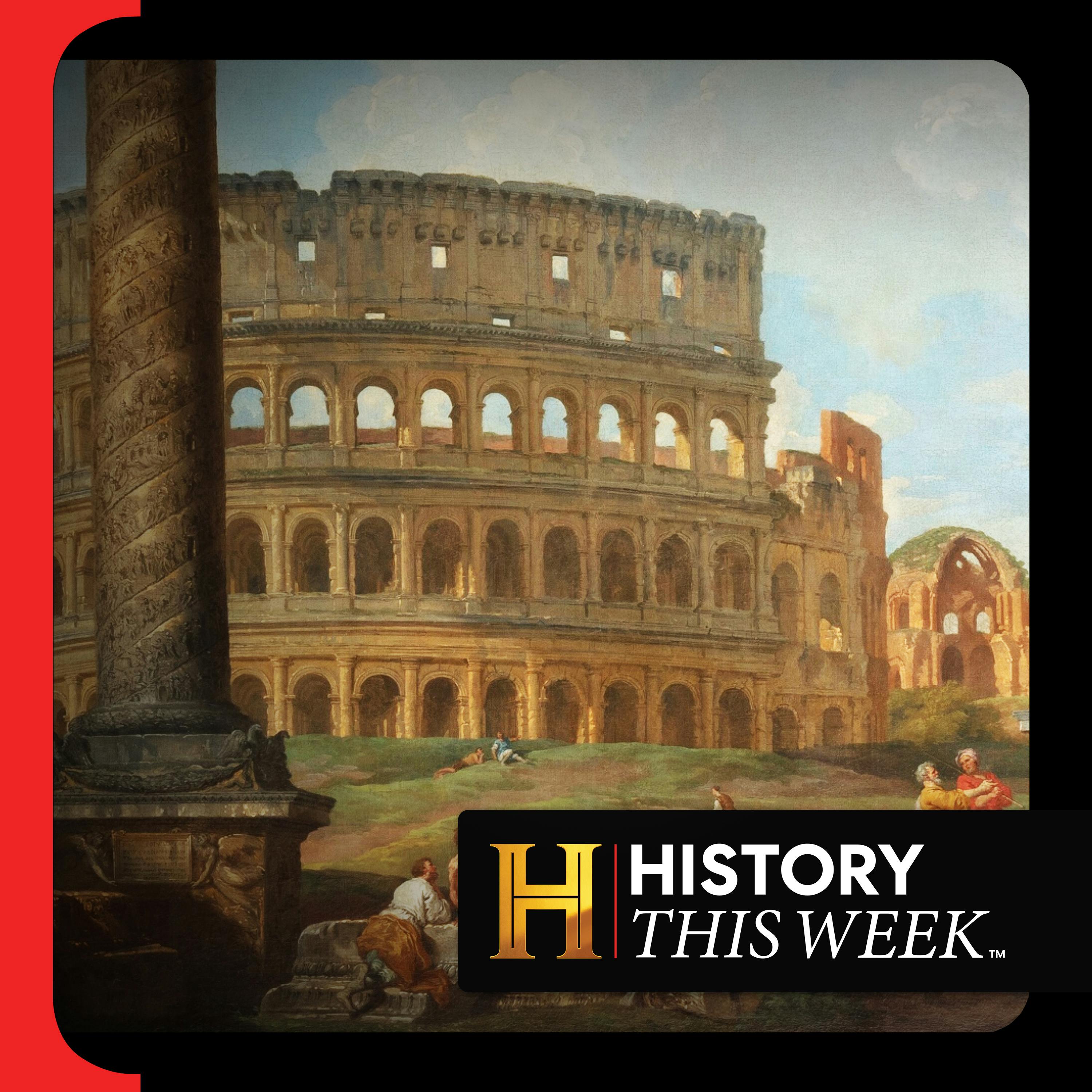
HISTORY This Week
The Colosseum Becomes a Wonder | A Conversation with Barry Strauss & Alison Futrell
00:37:23
Loading summary
Transcript124 lines
- [00:00]
Ad
If there's anything to learn from history, it's that every place has a story to tell. And to learn that story, you could just listen to our show, or you can also visit that place in person. Immerse yourself in a different culture, and Rosetta Stone makes that easy. Imagine how much richer your travel experiences will be when you can speak the local language. Rosetta Stone is the Go to Language learning solution with 30 years of experience, millions of users, and 25 languages. And it's available on both your computer and your phone, so you'll always be able to immerse yourself in your chosen language wherever you are. Rosetta Stone is intuitive. You start with words, then build to phrases, and finally progress to full sentences. Rosetta Stone offers lessons that are five minutes or an hour. The program really is designed to fit your lifestyle and language learning needs, so don't wait. Unlock your language learning potential now. History this week, listeners can grab Rosetta Stone's lifetime membership for 50% off. That's unlimited access to 25 language courses for life. Visit rosetta stone.com historythisweek to get started and claim your 50% off today. Don't miss out. Go to rosetta stone.com HistoryThisWeek and start learning today.
- [01:23]
Ben
It's smart to always have a few financial goals and a really smart one. You can set earning cash back on what you buy every day. And with Discover you can get this. Discover automatically matches all the cash back you've earned at the end of your first year. Seriously, all of it. And we trust you to make smart decisions. After all, you listen to this show. See termsiscover.com Credit Card the History Channel.
- [01:54]
Sally Helm
Original Podcast history this week, July 7, 2007 I'm Sally Helm in Lisbon, Portugal. A giant globe rises from the floor of the Benfica stadium. Dancers hover in the air around it, waving strips of white fabric like butterfly wings. Inside the globe are more dancers dressed in full on metallic silver bodysuits. The music is tense and dissonant and then it resolves into something soaring. The butterfly dancers flutter downwards. The silver dancers move as one. It is a lot, with even more to come. Famous tenor Jose Carreras performs and pop star Jennifer Lopez. And then on the floor of the stadium, a giant replica of a laptop opens as breakdancers perform in front of it and smoke cannons shoot off behind the illuminated screen. Reminds everyone of the date 7707. Now two of the spectacle's hosts, actors Hilary Swank and Ben Kingsley, stand on stage to kick off the real heart of the show.
- [03:22]
Ben
The time has come, Hillary, to announce the results of the global vote in random order. The New South Seven Wonders of the.
- [03:37]
David Strauss
World.
- [03:41]
Sally Helm
There were once seven wonders of the ancient world, but by 2007 only one, the Pyramids of Giza, still stands. We need an updated list of wonders. So says Bernard Weber, the impresario and self proclaimed adventurer behind all of this. He says his organization sifted through 100 million online votes to find the world's most exalted human built places. Not everyone is pleased with all this, especially not UNESCO, a United nations agency devoted to identifying and preserving World Heritage sites. In a statement, the agency sniffs that this stadium show is little more than mediatized entertainment. But Weber's not backing off. This ceremony is the highlight of his mediatized campaign. And finally, it's time to announce the winners.
- [04:33]
David Strauss
To announce the first of the new.
- [04:36]
Ben
Seven Wonders of the World, we must welcome the first man to set foot.
- [04:42]
David Strauss
On the moon, Neil Armstrong. The Great Wall of China.
- [04:53]
Sally Helm
Two people come up to accept the award on behalf of the Wall. They hold a plaque aloft while fire shoots off behind them. The list continues.
- [05:03]
David Strauss
Petra Jordan the statue of Christ the Redeemer.
- [05:12]
Sally Helm
One of the wonders announced today seems especially fitted to this lavish ceremony in a huge, packed arena.
- [05:20]
David Strauss
The Colosseo in Rome.
- [05:24]
Ben
The Colosseum in Rome.
- [05:27]
Sally Helm
The Colosseum in rome. Completed in 80 CE, centuries before this extravaganza in Portugal, the Colosseum hosted many a baroque and bloody spectacle. You could say it was the Benfica stadium of its day with gladiators.
- [05:45]
Alison Fottrell
Can I have each of you give me one word you would use to describe the Colosseum?
- [05:50]
Barry Strauss
Grandiose Stupendous.
- [05:56]
Sally Helm
Today the Colosseum A conversation with historians Barry Strauss and Alison Fottrell. How did grand, stupendous and sometimes deadly events unfold on the floor of this ancient arena? And how did the Romans use games to not only entertain the masses, but control them? History this Week is now in its sixth season. Kind of crazy, and we love bringing you these stories. All of our work is supported by the ads you hear on the show. But if you don't want to hear those ads, we're now introducing history this week plus. Available exclusively on Apple Podcasts for just $2.99 per month. You'll get all of our new episodes without any of the ads. And we'll be adding ad free versions of our older episodes too. So subscribe now and get your first week free. History this Week Plus Exclusively on Apple Podcasts.
- [06:53]
David Strauss
Hey.
- [06:54]
Ben
History this Week listeners. It's your producer Ben here. We operate History this week as its own business and in addition to churning out great stories for you every week, we also have to worry about business stuff like marketing the show to get it to grow. That's where Constant Contact comes in. Constant Contact's award winning marketing platform makes marketing way easier and way more effective for small businesses like ours. The best part? You don't need to know anything about marketing. With their all in one platform, you can create and manage attention grabbing campaigns in just a few clicks. Email, text, social media, events, landing pages, you name it. It's all in one place. No more juggling dozens of different tools. You get automated sending, real time reporting and tools that actually help drive sales. So you're not just marketing your business, you're growing it. That's why over half a million small businesses trust Constant Contact to stay connected, top of mind and ahead of the competition. So get a free 30 day trial when you go to constant contact.com try constant contact free for 30 days at constant contact.com constant contact.com hey, what's up flies?
- [08:09]
David Spade
This is David Spade. Dana Carvey. Look at I know we never actually left, but I'll just say it. We are back with another season of Fly on the Wall. Every episode, including ones with guests, will now be on video. Every Thursday you'll hear us and see us chatting with big name celebrities. And every Monday you're stuck with just me and Dana. We react to news, what's trending, viral clips follow and listen to Fly on the Wall everywhere you get your podcasts.
- [08:37]
Dana Carvey
She's made up her mind to live pretty smart. Learn to budget responsibly. Right from the start, she spends a little less and puts more into savings. Keeps her blood pressure low and credit score raises curtain dip right out of her life. She tracks her cash flow on a spreadsheet at night.
- [09:00]
David Strauss
Boring money moves make kind of lame songs, but they sound pretty sweet to your wallet. The NC bank brilliantly boring since 1865.
- [09:08]
Alison Fottrell
It is such a pleasure for me to have the two of you here this episode of History this week. It's kind of a special one because we are not just jumping off of an event exactly. We're sort of centering it around a place. And both of you are on the History Channel Special Colosseum so you know all about the Colosseum. Tell us about the Colosseum as it exists today.
- [09:28]
Barry Strauss
It's very hot and there are lots of people. It is one of the primary tourist areas in Rome as well. Something that's Been enhanced as the decades have gone by with the provision of people dressed up like gladiators. And I'm using, you know, air quotes here, because they're sort of fantasy gladiators.
- [09:48]
Alison Fottrell
Professor Fritzell, I know that you have worked as an archaeologist. Is that right?
- [09:52]
Barry Strauss
That is correct. I participated in a number of dirt archaeological projects.
- [09:57]
Alison Fottrell
Oh, my gosh. Well, will you tell us then, what does it look like and feel like the ruin of the Colosseum?
- [10:02]
Barry Strauss
The ruins themselves have undergone certain kinds of transitions to enable more people to appreciate different things. I guess one could say with attention to the substructures, the chambers, and the storage areas underneath the actual arena floor itself that would not have been visible to ancient attendees at any of the spectacle events, which are kind of the focus, I think, for many people as they enter into this space.
- [10:31]
Alison Fottrell
Right. You can, like, see the skeleton of it now.
- [10:33]
Barry Strauss
You can see the skeleton of it now. And you can imagine how it might have worked, though. It looks kind of like areas for very large hamsters. Exactly. A welcoming space.
- [10:45]
Alison Fottrell
What's the hamster aspect?
- [10:46]
Barry Strauss
It's the tunnels of the substructures. They're very narrow. They block out the light. There's not a lot of, you know, accommodations for seating or enjoying your leisure or what have you. Not that the seats of the actual spectators as they are preserved, look particularly enticing either.
- [11:06]
Alison Fottrell
Professor Strauss. Those tourists have to imagine what it would have been like in ancient times. Help us imagine that. What would the Colosseum have looked like at its height?
- [11:16]
David Strauss
Well, it would have been jumping, that's for sure, because we approach it as tourists and lovers of antiquity in the past. We want the past to be yieldy. People go to the Coliseum now into other ancient amphitheaters, and they see plays, they see classical music concerts. That's not what it was like. It was more like a sock in the jaw.
- [11:42]
Alison Fottrell
Yeah. Describe the vibe to me, because I think you're right. We do go as tourists, and we do imagine olden times being ye olden times, and we have a particular thing we mean by that. So, yeah. What do you think it would have felt like to be inside something?
- [11:54]
David Strauss
Like being in the stands in a football stadium, or any kind of major league sports stadium, for that matter, at a boxing event in Las Vegas or Madison Square Garden, perhaps, you know, with the emperor present, with senators present, with the gradations of people in the stands. It would have a kind of formality that our sporting events do not. Although we do have skyboxes and places for elites to sit. But I think it would have just had this raucous, lively feel about it.
- [12:29]
Barry Strauss
I agree in terms of the intensity of the feeling that one must have expected entering into this space as an ancient attendee. But I think that this also is a place for connection with power for them. And they have expectations of certain kinds of exchanges, the opportunity to vocalize their wants and desires in a way that for us is more along the lines of protesting in the streets.
- [12:59]
Alison Fottrell
And when you say relate to power, you mean the emperor?
- [13:01]
Barry Strauss
Yes, it's an opportunity to speak to the Emperor when there aren't many other kinds of opportunities that still exist for making the popular will known. The Romans were really good at saying when they liked something and when they didn't like something. And that is definitely going on in the Colosseum as well.
- [13:20]
Alison Fottrell
Are these protests that people are making, are they specific demands that are a.
- [13:22]
Barry Strauss
Part of the games, when someone is on their knees and is asking to be left alive to fight another day, asking for clemency, relief from certain kinds of taxes, food, you know, different things that people living in the city of Rome with its mass population, might request? And it's something that the Emperor is.
- [13:44]
Unknown
Actually under a lot of pressure to.
- [13:45]
Barry Strauss
Do, to give in to the demands, to recognize the wishes, and to show himself as being appropriately generous in the same spirit that they're putting on these spectacle events.
- [13:58]
Alison Fottrell
Right. Professor Strauss, I mean, you were saying that's a thing, you know, that might be different from going to Madison Square Garden, is it's not like you necessarily expect the president to be there, but at the Colosseum, the emperor would have been present.
- [14:10]
Sally Helm
Well, I do.
- [14:11]
Alison Fottrell
I mean, I want to talk about the Colosseum as a political symbol. And so I do want to start with just like, how does it come about who decides to build it and when and why?
- [14:20]
Barry Strauss
It's the Flavians.
- [14:22]
Alison Fottrell
The Flavians.
- [14:24]
Barry Strauss
A point of transition that's happening for the Flavian dynasty is the fact that they are a new imperial dynasty. So they have something to prove, they have something to demonstrate. And clearly they're making use of the building of this vast spectacle building as part of that program. They're putting it in a space that previously had been the sole purview of the Emperor Nero. His pleasure gardens, his palace, the things that he constructed so that he could enjoy the most refined and the most voluptuary life he possibly could. Much of that is either raised or transformed into spaces that benefit the Roman people. And that's very much part of the program for The Flavian dynasty.
- [15:13]
Alison Fottrell
Hmm. They're sort of taking these, like, sites of opulence where the elites and the emperors were, and being like, now these are for the people. This is one of our things. This is for you.
- [15:21]
Barry Strauss
Exactly.
- [15:22]
David Strauss
Totally agree with what my colleague has said. But I also want to point out that the Colosseum was a war monument. It's part of the Flavians attempt to give themselves legitimacy as a dynasty because they're usurpers. And Vespasian is the first emperor who is not part of the Roman nobility. His claim to fame is his military career, first in the conquest of Britain and then and more recently in the conquest of Judea. And it's under his son Titus that the great Jewish revolt is put down. The Coliseum is built in part from spoils that come from Judea. It's meant to remind people, as many other monuments of the Flavians built in Rome in this period, that their claim to fame is that they had put down this great revolt in Judea and had protected Rome from what the Romans saw as their long standing rival's long standing threat, the Parthians.
- [16:21]
Alison Fottrell
And in both cases, it's like meant to cement and solidify power in a way.
- [16:25]
David Strauss
Absolutely.
- [16:25]
Alison Fottrell
But the first way is we turn these pleasure palaces into places for the people. That's a way of saying, we're for you, you should be for us. And it's also this military monument where it's saying, remember all the great things that we've done as a people, remember our strength.
- [16:40]
David Strauss
And.
- [16:41]
Alison Fottrell
And that too is meant to sort of say, you should be for us, but also.
- [16:44]
David Strauss
And don't mess with us.
- [16:46]
Alison Fottrell
Okay, all right, great. We're letting you into the pleasure palace's be good kind of thing. Like, don't forget who's in charge.
- [16:53]
David Strauss
That's right. That's right. You know, on the one hand, it's a way for the Emperor to show his power. On the other hand, from the Emperor's point of view, it's a way for them to remember the hierarchy of the Roman world. In the Republic, the elite was so afraid of popular gatherings that there wasn't. There were no stone theaters or stone amphitheaters in Rome. Games are held on wooden stands, temporary wooden stands that were erected in the Forum. And one of the reasons it's clear is that the powers that be were afraid of having the Roman people gathering and what they might do. The fact that the emperors allow the people to have a permanent gathering place, in some sense, this is a populist gesture. And in some sense it does recognize the power of the people, but it also, in another sense, it suggests that the emperors feel confident enough of their power and authority that it's all right for the people to gather. It's a way for the Roman people to see who they are. And from the emperor's point of view, it's a way for them to remember the hierarchy of the Roman world. The seating in the Colosseum is not egalitarian.
- [18:01]
Barry Strauss
It's true that there is a strongly hierarchical setup in the permanent spectacle structures, with the elites down in front and the foreigners and the women and the poor people in the nosebleed section. But here's the thing. The Colosseum cannot hold all the people who actually live in Rome. So the idea that there are seats that are actually reserved for different representatives of the very different classes of the people of Rome says something too, that there are places that are set there for them, that they are included. And it is meant to represent basically a subset of the people of Rome as a whole.
- [18:51]
Dana Carvey
Put us in a box. Go ahead. That just gives us something to break out of the because the next generation 2025 GMC terrain elevation is raising the standard of what comes standard. As far as expectations go, why meet them when you can shatter them? What we choose to challenge, we challenge completely. We are professional grade. Visit gmc.com to learn more.
- [19:22]
Unknown
Summer's here and Nordstrom has everything you need for your best dress season ever. From beach days and weddings to weekend getaways in your everyday wardrobe. Discover stylish options under $100 from tons of your favorite brands like Mango Skims, Princess Polly and Madewell. It's easy too, with free shipping and free returns in store. Order pickup and more. Shop today in stores online@nordstrom.com or download the Nordstrom app.
- [19:51]
Dana Carvey
My day kicks off with a refreshing Celsius energy drink, then straight to the gym pre K pickup back home to meal prep. Time for my fire station shift. One more Celsius. Gotta keep the lights on when the three alarm hits. I'm ready. Celsius Live Fit. Go grab a cold refreshing Celsius at your local retailer or locate now@celsius.com.
- [20:15]
Sally Helm
You'Ve mentioned Titus. I know he's the one who holds these first big games in the Colosseum in 80 CE. What would those have been like? What events were held? Why were they happening at all?
- [20:27]
Barry Strauss
We have a lot of information about these opening games from the Book of the Spectacles written by Marshall. It talks about Beast hunters, it talks about Other kinds of executions and events that are taking place.
- [20:41]
David Strauss
There are a hundred days of spectacles. We think it's all about the gladiators. But there's only one gladiatorial event that is mentioned in it.
- [20:50]
Alison Fottrell
Yeah, let's talk about gladiators, because I think you're right. Everyone thinks Rome. Maybe the fourth word they'll think of is gladiator. Maybe the first for some people.
- [20:58]
David Strauss
Yeah, yeah.
- [20:59]
Alison Fottrell
So what is a gladiator?
- [21:00]
Barry Strauss
Gladiators are trained combatants, trained to perform as combatants, rather than people who are purely trained to fight wars or something like that.
- [21:11]
David Strauss
Typically, though, not only these were slaves and prisoners of war and they were condemned to be gladiators. Their lifespan wasn't very long. If you were a gladiator, it's not a job with a long tenure. For most people, they were fighting each other to the death in theory, although in practice, less likely they're going to be fighting to the death because you would lose your investment. If gladiators are killing each other all the time, why?
- [21:40]
Alison Fottrell
Because they would have like a sponsor, someone who was giving them money.
- [21:44]
David Strauss
Yeah, they're being supported, they're being fed, they're being trained, they're being housed. They are expensive commodities. You know, they're around for a long time. By the time we get to the Coliseum, the Romans have had gladiators for centuries.
- [21:58]
Barry Strauss
Certainly the first gladiators that we know about in Rome come from the middle of the third century and those seem to be prisoners of war who are fighting at funeral games.
- [22:10]
Alison Fottrell
It would be like a combat event at a funeral. That's what I should picture.
- [22:14]
Barry Strauss
Yeah, it's an opportunity for the heirs of these well known political leaders to show how much they're valued by expending so much effort and money on arranging these spectacular shows to go along with the funeral.
- [22:34]
Alison Fottrell
So they started as these sort of funereal games and then they sort of get professionalized. It sounds like, is that the right.
- [22:41]
Barry Strauss
Word or sort of. The giving of these kinds of events gets folded into some of the expectations that Romans have about what the state and the leaders in the state should do for them. For example, if you're running for office, if you're holding office, you could maybe arrange for it to be timed and some time that's a little bit more convenient for your political career. You're honoring your family, you're providing a big to do for the people.
- [23:09]
David Strauss
They also are sometimes used in military and even policing roles. So for instance, in the first century bc, in a period of great disorder in Rome, when there is no real police force, wealthy people hire their own personal armies composed of gladiators.
- [23:28]
Alison Fottrell
What do gladiator fights look like? By the time we get to Imperial.
- [23:32]
Barry Strauss
Rome, the Colosseum, individual gladiators are trained in different sorts of fighting techniques, depending on what kind of weapons they use, what kind of protective gear they have, what kind of shields they have. So there's the retiarius. It's someone who's using a trident and a weighted net as their main tools for the arena. So someone that looks more like a fisherman than an actual soldier. The redi re also have different kinds of protection. They don't have a shield. They don't have a helmet either. And this is important because among the gladiators, it's the Redearius, whose face you can see and who can use their face in the arena as a means of communicating with the crowd. And that seems to have worked for them. They seem to be pretty popular in Pompeii. At least a number of people are writing all kinds of graffiti about various redi Ari and how enduring they are in. In sexual ways.
- [24:34]
Unknown
You know, they have this sort of power over women.
- [24:38]
Barry Strauss
They do seem to have an allure, and part of it may be because of the high visibility of those faces. When they're wounded, you can see it, you can see them respond, and that's emotionally powerful.
- [24:51]
Alison Fottrell
This is actually just what I wanted to also ask. How do we know what we know? Like, what are the sources that you guys are mostly drawing from for all of this?
- [25:00]
David Strauss
People have tried to do statistical studies of the epigraphy.
- [25:04]
Alison Fottrell
Sorry, is epigraphy, does that mean inscriptions?
- [25:06]
David Strauss
People writing on stone, like gravestones, for example, be it the classical one or monuments. There's also this gladiator cemetery, and that's been really studied very scientifically, and that's given us a certain amount of data about the kind of injuries people had and the lifespan they had as gladiator, the age they were killed at. Of course, we also have lots and lots of graphic representations of gladiators and all sorts of different media. Sculptured, relief and graffiti and gems. And gladiatorial equipment from Pompeii.
- [25:41]
Barry Strauss
Say, mosaics, Lamps.
- [25:43]
David Strauss
Yeah, yeah, mosaics.
- [25:44]
Barry Strauss
So a range of price points available for your gladiatorial material.
- [25:49]
David Strauss
Yeah, glasses. We have souvenir glasses with gladiators on them. They're celebrated, and they have fans in Puzzuoli. So outside of Naples, there is an underground city, and there's this graffito of a gladiator on the walls there. It's so eerie. It's like you're in the New York subway and suddenly you see this graffito of a gladiator and you realize they were everywhere, everywhere in the ancient world.
- [26:16]
Alison Fottrell
The idea that gladiators are everywhere, that there's graffiti of them, that they're kind of like celebrities, but then they're also being forced to fight to the death. Often they're slaves or prisoners of war or both. Like, what sort of is their status? Are they high status, low status?
- [26:33]
Barry Strauss
By law, they are untouchables or the equivalent untouchables. They're of the same status as prostitutes and pimps.
- [26:41]
Unknown
They are people who are made to serve the pleasures of others, whose bodies can be ordered to be penetrated. So by law they're excluded from full political participation. But clearly it would not necessarily made a difference whether you could run for political office to a wide sweep of of the Roman populace who might have revered those gladiators and admired them.
- [27:06]
David Strauss
People were just, you know, obsessed. But also there's fear that gladiators can be a revolutionary force, that unless you lock them up, they can fight for one side or the other. They're dangerous people. Romans admire them, but they're also afraid of them. You're not going to be breathing easy about having gladiators living in your neighborhood. So they don't want them. In Rome. In the late republic, the gladiators are housed in Capua, which is about 125 miles to the south.
- [27:36]
Alison Fottrell
Speaking of them, sort of like being dangerous, tell me about a gladiator that people may have heard of. Who is Spartacus? Who's he and what does he do?
- [27:44]
David Strauss
So Spartacus is maybe the most famous gladiator of the ancient world. He fought in an allied unit of the Roman army. So he was experienced soldier and he became a gladiator much against his will. He was sent to Capua where he trained in one of these gladiatorial schools. And there he, with some other gladiators, led a breakout. They led a revolt. They seized weapons from the kitchen, knives, skewers, cleavers, and they used those to. To kill the guards and to break out of this gladiatorial school in Capua. And they went off to Mount Vesuvius. It's well before the famous explosion that destroys the top part of Vesuvius and covers Pompeii and Herculaneum. And they use that as a refuge and they encourage slaves from the region to join them. Yeah, it's a problem for the Romans and there is no problem Police force, really in Italy at the time. They have to raise an army of inexperienced men who march south from Rome to fight Spartacus and his fellow rebels. And they don't do very well against them.
- [28:57]
Alison Fottrell
This is an untrained army that's just been raised. A lot of these are gladiators.
- [29:01]
David Strauss
These are gladiators. They engage in a series of maneuvers, tricks, ambushes, surprises, basically wipe them floor with the Roman army.
- [29:13]
Alison Fottrell
How does it end?
- [29:14]
David Strauss
So the gladiators go south. The next year, they fight their way north. Spartacus wants them now to disperse, to go over the Alps and go to their respective homelands, east or west. But the men refuse. They want to stay in Italy. They are enjoying too much the spectacle of defeating the Romans and getting rich by looting the wealthiest countryside at this point in the Mediterranean world. And Spartacus, against his better judgment, agrees to go with them back south. Finally, the Romans raise an experienced army. The Senate gives command to Marcus Licinius Crassus, an experienced soldier, extremely wealthy man. And they are able first to trap Spartacus and his men in southern Italy. But then, when Spartacus and his men manage to break out, to then hunt them down and fight them in a climactic battle, contrary to the myth of Hollywood, Spartacus is killed in the battle. He isn't crucified. There is no famous I'm Spartacus scene.
- [30:17]
Dana Carvey
I'm Spartacus.
- [30:18]
David Strauss
I'm Spartacus. I'm Spartacus.
- [30:21]
Ben
I'm Spartacus.
- [30:22]
David Strauss
I'm Spartacus. Some of his followers are killed. Some of them, they're trapped by another army. And a third part of them go into the mountains of southern Italy. As for those who are captured, Crassus does something infamous and brutal with them. He lines the road between Capua and Rome with crucifixes. He crucifies thousands of these surviving rebels. It's a way to say to other slaves, don't rebel against Rome. And it's also a way for Crassus to advertise himself and his achievement.
- [30:58]
Alison Fottrell
Wow.
- [30:59]
Unknown
Bear in mind that Spartacus revolt is the third of a number of revolts that are called the slave wars by some of the Roman authors that we know about. There have also been small uprisings that have been going on for generations that are very much connected to Rome's habits of imperialism, habits of conquest. So Spartacus, resistance, Spartacus, battle against the enslavement as he might understand it from the Romans, would have found a ready ear amongst thousands of people in the countryside.
- [31:34]
Alison Fottrell
And it sounds like it's quite powerful and quite threatening to the people in power, which maybe is one reason that it is ultimately put down in such a brutal fashion.
- [31:41]
Barry Strauss
It is, although I should say, you.
- [31:43]
Unknown
Know, Spartacus has a lot of meaning for moderns, and part of it is because of, you know, it's a Kirk Douglass film or the other miniseries or the dozens of Spartacus novels and plays and performances going back to the 18th century, where the story of Spartacus became meaningful at a time when people were talking about, you know, maybe the aristocratic elites don't know everything and don't deserve everything.
- [32:07]
Alison Fottrell
And, I mean, I want to flash forward to the Colosseum as a symbol and how people do end up reading it over time.
- [32:13]
Sally Helm
I know that There's a moment 2,000 years later when Mussolini sort of tries to capitalize on the power of the.
- [32:20]
Alison Fottrell
Colosseum and sort of the connection to ancient Rome in general. Yeah. Professor Strauss, can you tell me about that?
- [32:26]
David Strauss
Sure. You know, Mussolini's political movement was called Fascism. And the fast gaze was the ancient Roman symbol of a public official's authority. And it was a bundle of wooden rods that were bundled together. And so Mussolini is using that, but he also uses antiquity in general to buttress his political system. He wanted to create a new Italian empire, and he wanted to turn the Italians, who are basically a very gentle people, into a military people, like the ancient Romans. There was endless propaganda about this in Fascist Italy, and one of the aspects of the propaganda was rebuilding the city of Rome to turn it into more like antiquity. So one of the things he does is he has an urban renewal project where he basically raises part of the city to create a new street that will connect the Colosseum to the Forum and to the monuments, the modern monuments and Renaissance monuments that are built around the Forum. This is called the Via DEI Imperiale, the street of the Imperial Forums. So this is how he's using ancient symbols, symbols from Imperial Rome, to try to create this new empire.
- [33:41]
Sally Helm
Great.
- [33:42]
Alison Fottrell
Well, I want to bring us forward to today. Now, how is the Colosseum still a symbol today? And what is it a symbol of, do you think?
- [33:50]
David Strauss
I think it can have different meanings for different people, if I might say. It has kind of a personal meaning for me because my father was in the US army in 1944, and he fought in the battle for Rome. He was part of the American army that marched into Rome in June of 1944. And I grew up hearing stories of him going into town and seeing the monuments like the Coliseum. And I always thought of the Coliseum as. As somehow this. This almost military symbol and the symbol of changing regimes, the fall of fascism. In a weird way, it was my own symbol.
- [34:24]
Alison Fottrell
Hmm. Yeah. Well, I think that's a good place to end. Thank you both so much for coming on the show. And as I said, you're both on the History Channel's series Coliseum, which so listeners can catch you both there to hear more about all of this. Thank you so much.
- [34:37]
David Strauss
Okay. It's great working with you, Sally. Thank you. Bye.
- [34:40]
Unknown
Thanks, Barry.
- [34:41]
Barry Strauss
It's been great.
- [34:45]
Sally Helm
Thanks for listening to history this week. For moments throughout history that are also worth watching, check your local TV listings to find out what's up on the History Channel today. If you want to get in touch, please shoot us an email at our email address historythisweekhistory.com or you can leave us a voicemail 212-351-0410. Special thanks to our guests, Alison Fottrell, co editor of the Oxford Handbook of Sport and Spectacle in the Ancient World, and Barry Strauss, author of the War that Made the Roman Empire, Antony, Cleopatra and Octavian at Actium. This episode was produced by Julia Press. It was story edited by Jim o' Grady and sound designed by Dan Rosado. History this week is also produced by Morgan Givens and me, Sally Helm. Our associate producer is Emma Fredericks, our senior producer is Ben Dickstein, our supervising producer is McCamey Lynn, and our executive producer is Jesse Katz. Don't forget to subscribe, rate and review History this week or wherever you get your podcasts, and we'll see you next week.