← HISTORY This Week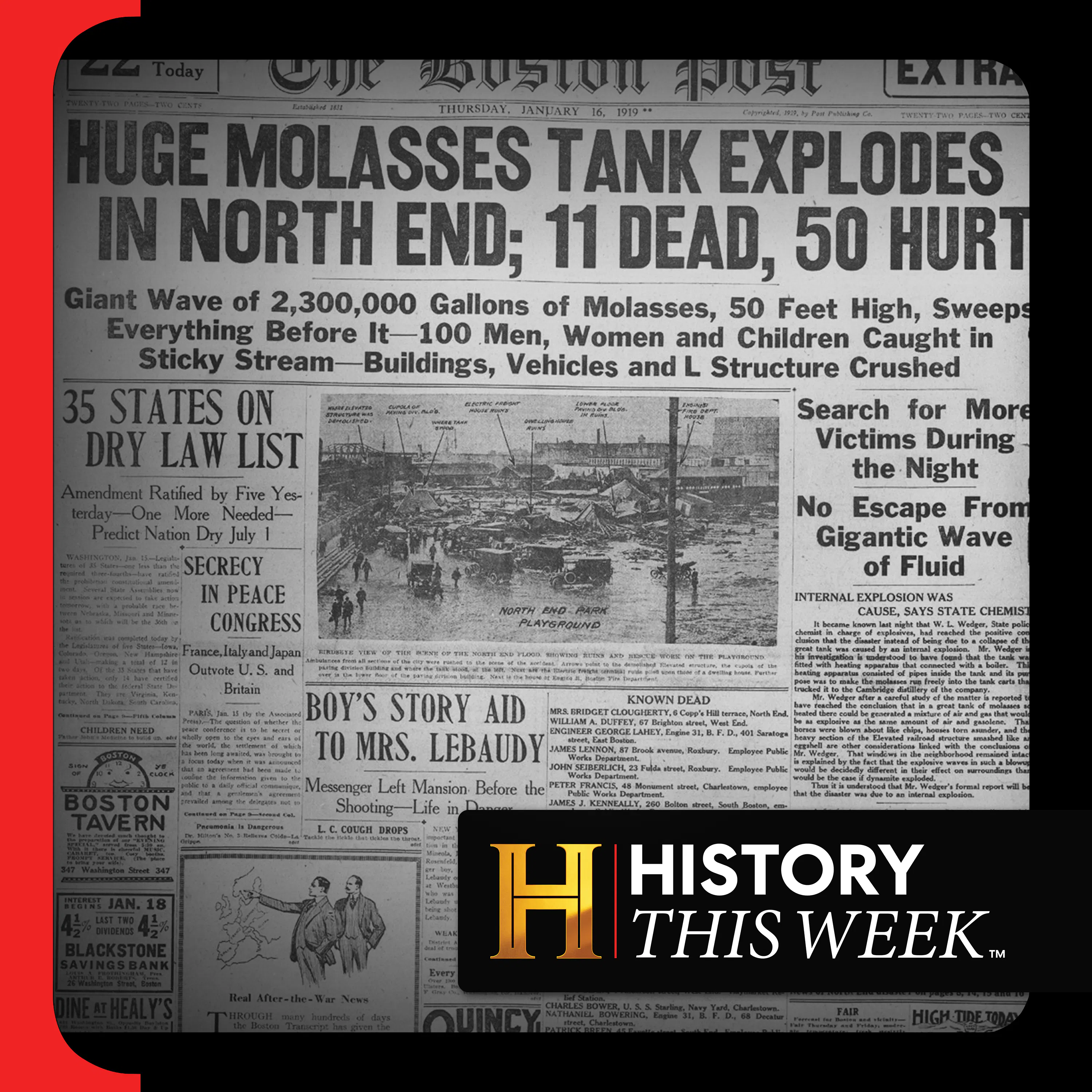
HISTORY This Week
The Great Boston Molasses Flood
00:19:57
How a bizarre industrial disaster reshaped U.S. safety laws forever.
Loading summary
Transcript30 lines
- [00:00]
Blue Apron Advertiser
When you think about meal kit companies, what do you see? Probably long, complicated recipes and subscriptions you can't escape. But with the new Blue Apron, we're doing meal delivery differently. No subscription needed, faster, easier meals and the same dedication to quality we've always had. Shop 100/Meals@blueapron.com, get 50% off your first two orders with code APRON50. Terms and conditions apply. Visit blueapron.com terms for more.
- [00:30]
Natural Cycles Advertiser
Meet Natural Cycles the only FDA cleared and CE marked birth control app that's built around your body. The Natural Cycles app pinpoints your fertile days by tracking shifts in your temperature so you can plan or prevent pregnancy naturally. It's easy to use. Simply take your temperature in the morning with our free Bluetooth thermometer included with our annual plan, or sync with your Oura ring or Apple Watch. The app analyzes your data and tells you daily whether it's a fertile or non fertile day. Natural cycles is 93% effective with typical use and 98% effective with perfect use. But beyond effective birth control, the app helps you understand your body and cycle better than ever. And unlike some period tracking apps, Natural Cycles provides an advanced data protection program to keep your information private and secure. Ready to go hormone free? Sign up for the Natural Cycles Annual plan and get a free Bluetooth thermometer plus 15% off your subscription with the code RADIO15@natural cycles.com.
- [01:34]
Narrator
January 15, 1919 it's just after lunchtime in Boston's North End, a busy section of the city that takes up about a square mile. It's this crowded patchwork of commercial and residential blocks right on the water. Laborers, residents, commuters, horses, they're all just going about their business. And then.
- [02:13]
Sally Helm
The Great Boston Molasses Flood is one of the stories strangest disasters in US History. But how could something so catastrophic ultimately have saved more lives than it cost? Maybe even your own?
- [02:29]
Steve Puglio
Think of this flood as a wave that literally scoops up everything in its path. And this one incredible disaster really changed history forever.
- [02:41]
Sally Helm
I'm Sally Helm and this is history this week. Today we go back to the Great Boston molasses flood of 1919.
- [02:56]
Narrator
Today, Boston's North End actually looks a lot like it did 100 years ago. There are these winding one lane streets. They feel really narrow because they're walled on both sides by these long rows of flat faced brick buildings. But the neighborhood didn't always look that way. Before the 19th century, the streets were lined with single family homes, even private mansions. Paul Revere lived in one. But as Boston grew, so did the booming North End port. And Boston's upper crest relocated pretty quickly when the North End streets filled with sailors and tradesmen.
- [03:43]
Sally Helm
A few decades later, a wave of.
- [03:45]
Narrator
European immigration more than doubled the population of Boston and many Irish, Jewish and Italian immigrants settled in the newly affordable North End. By the end of 1915, the North End's population had soared to 40,000 people. Living in about a square mile, it was the most densely populated neighborhood in Boston. It was one of the most densely populated neighborhoods in America. And between the crowded residential streets and the docks there stretched one of the city's biggest commercial hubs. It was called Commercial Street. What else? The Public Works Division and Bay State Railway had big industrial office buildings there. Dozens of smaller shops and stalls also lined the main drag. That is all to say that by lunchtime on any given day, Commercial street was not just busy, it was packed. And towering over all the action stood one of the North End's newest additions. A 50 foot tall, 2 1/2 million gallon steel tank filled right to the top with thick syrupy molasses. Now, why would anyone need to store the equivalent of 3 and a half Olympic swimming pools worth of molasses? Well, okay, sometimes molasses was used to make brown sugar or candy. But this particular molasses was destined to become booze. Rum to be specific. The tank that we're talking about was operated by The Purity Distilling Company, which was owned by USIA, United States Industrial Alcohol. During World War I, which had just ended, that company would have distilled the molasses into industrial alcohol to make bombs. These would be like a higher tech version of a Molotov cocktail. Molasses becoming the alcohol that fuels the blast. But now the war was over, demand for bombs was way down. So USIA shifted gears. They decided they would make that molasses into rum instead of. But just as it seemed like they were back on safe money making ground.
- [06:06]
Historical Context Narrator
Reformers had a ball after World War I as they gleefully ushered in Prohibition. Whether it was the will of the people that voted in Article 27 of the Constitution was not necessarily clear. Anyway, there were a few who minded the restrictions and some others who had a field day smashing bottles. There must have been many a tear shed as these vintage wines hit the pavement.
- [06:30]
Narrator
Prohibition was set to go into effect in exactly one year, and after that, no more selling liquor. So USAA was racing to produce and sell as much liquor as possible before that happened. That is why on January 13, USIA filled the commercial street tank Right to the top, pumping in 2.3 million gallons of molasses. For two days, the tank groaned and strained against this heavy, thick goop. And then just after noon on the 15th.
- [07:24]
Sally Helm
We heard the story from Steve Puglio.
- [07:27]
Narrator
He literally wrote the book on the great Boston Molasses flood.
- [07:30]
Steve Puglio
It's called Dark Tide, the great Boston molasses flood of 1919. When you first hear about the Boston molasses flood, I think it produces a little bit of a giggle, but it is really a terrible disaster. And on that day, just after noontime, a Boston police patrolman by the name of Frank McManus was making his routine beat walk along Commercial street when he hears what he describes as a tremendous rumbling, grinding sound and the rat tat tat of what sounds like machine gun bullets. And he turns around and he sees the tank literally disintegrating before his eyes. The rat tat tat are the thousands of rivets that hold together the steel plates of the tank. And he has the presence of mind to make one of the most unbelievable calls in history. Back to Boston police headquarters. He says, send all available rescue personnel immediately. There's a wave of molasses coming down Commercial Street. Molasses leaves the tank at about 35 miles an hour. The wave starts at about 35ft high, levels off to 20ft high, about 160ft in diameter, and quite literally scours the North End waterfront. Picks up everything in its path. People, carts, horses, trains. About 80ft from the tank was a firehouse. And when the tank gave way, the wave knocks the firehouse off of its foundation. The second floor pancakes onto the first. And several firefighters are trapped in an 18 inch crawl space, trying their best to keep their heads above molasses. Children are killed, workers are killed, city workers, immigrants are killed, Horses are killed in the great Boston Molasses flood. And so when you look at the devastation at the end of the flood, which probably in its entirety takes about 25 minutes, the entire North End waterfront is obliterated.
- [09:48]
Ben (Producer)
Hey, everyone, this is your producer, Ben. And as you probably know, each week on History, this week we talk about moments when people stepped into the unknown, crossing borders, exploring new worlds, and learning to communicate across cultures. And honestly, that spirit is what learning a new language is all about. So this year, what if you made yourself the main character in that story? Maybe you're reconnecting with your roots, leveling up your career, or gearing up for big 2026 travel plans. Rosetta Stone makes it easier than ever to start and actually stick with it. For over 30 years, Rosetta Stone has been the trusted leader in language learning. Their immersive, intuitive method teaches you the same way people have learned languages throughout history by hearing, speaking and thinking in the language itself. No English translations. You start with simple words, build to phrases, and before long you're forming full sentences designed so the learning really lasts. Lessons are easy to fit into your day, whether you've got five minutes or an hour. And with true accent, you get real time feedback on pronunciation, like having a personal language coach helping you sound natural and confident. And with a lifetime membership, you get all 25 languages forever. Learn Spanish now, Italian next year at no extra cost. So don't wait. Unlock your language learning potential now. History this week listeners can grab Rosetta Stone's lifetime membership for 50% off. That's unlimited access to 25 language courses for life. Visit rosettastone.comhistory this week to get started and claim your 50% off today. Go to rosettastone.com history this week and start learning today.
- [11:30]
Jill Schlesinger
Hi, this is Jill Schlesinger, CBS News business analyst, certified financial planner, and the host of the Jill on Money Podcast. With the new year upon us, there's no better time to take control of your financial life. And the Jill on Money Podcast is here to help. It's your questions that make it possible for me to provide unconventional and, I hope, entertaining insights on your money and more importantly, on your life. Follow and listen to Jill on Money Wherever you get your podcasts.
- [12:00]
TikTok Advertiser
Find new customers on a platform that's here to stay. With TikTok for business, anything is possible. If you've ever thought about advertising your business on TikTok, now is the time to do it. You can drive more customers to your website, sell products right in the app, and you can even use TikTok's creative tools to easily make content and find creators to help sell your products for you. Find new customers today, just open your browser, type in getstarted.TikTok.com tiktokads and grow your business fast.
- [12:31]
Narrator
So the blast was horrific and shocking and deadly. But it wasn't a total surprise. At least not to the people who lived in the shadow of this giant, leaking, groaning tank. Kids in the neighborhood would collect molasses in pails as it pooled around the bottom of the tank. So it was no secret that the construction was flawed. Even if it wasn't clear just how flawed it was. The problem was, no one in power really cared.
- [13:02]
Steve Puglio
In 1919, Boston's North End was almost exclusively Italian. There are 40,000 people who live in the North End, I'd say 98% of them are Italian. Most of them are immigrants. Many of them do not speak English. Most of them are not citizens. So they have very little to say in the way of political advocacy. They can't vote, they don't have much to say what happens in their own neighborhood. So when United States industrial alcohol decides to site the tank right in the midst of this incredibly busy community and highly congested community, there is really no opposition on the part of the North End residents. And even when the tank begins to leak, which it does Almost from day one, long 50 foot leaks of molasses coming down the side, there is almost no official outrage at this and almost no neighborhood outrage at this.
- [14:05]
Narrator
So it's pretty clear that no one in power was paying attention to the North End community before that changed when the tank went down. Newspapers all over the country picked up the story of Boston's bizarre molasses flood the next day. It was nationwide news. But the molasses stuck around far longer than the story did. I mean, it was 2.3 million gallons of basically tar filling basements, pooling in the street, gluing everything and every one that it covered in place. Many of the people who died in the flood drowned well after the initial blast because rescuers couldn't get to them.
- [14:45]
Steve Puglio
When the flood is finally over, Commercial street is in splinters. Buildings have been obliterated. Rescue personnel are on the scene. Frantic sailors have jumped off of ships in the harbor to help with the initial rescue. Firefighters are laying there, ladders out, doing their best to pull people out of this molasses. They're up to their thighs for the most part in molasses, sometimes higher.
- [15:11]
Narrator
Crews worked around the clock trying to locate the missing. All told, 21 people died and 150 more were seriously injured. Then came cleanup. Molasses doesn't exactly harden, it just congeals, so the crews couldn't break it up and cart it away. They worked for days, then weeks, trying to wash the streets clear with water from fire hydrants, but it wouldn't move the molasses. They tried using shovels and picks, even burning it away with gas torches. Nothing worked. It seemed like the North End might just be sticky forever. But then one firefighter had the idea to try salt water from Boston harbor, and that finally worked. Something about the salt content of the seawater cut the molasses just enough that crews were able to wash it away. But it wasn't just a matter of street sweeping, because Everything below street level was filled with molasses.
- [16:14]
Steve Puglio
Keep in mind that every building across the street from the tank and near the tank had its and its basements filled up to the first floor with molasses.
- [16:25]
Narrator
A banana salesman had a shop directly across the street from the tank. He had stashed over $4,000 in his shop basement and he wanted to get it back. He did. Once the cleanup crews dug out a solid 12ft of molasses and debris.
- [16:43]
Overall.
- [16:44]
Millions of gallons of ocean water were pumped into the city streets and then swept back out into the harbor, thick with molasses. It was reported that the harbor was brown for months afterwards. And years, even decades later, the locals would say that on hot days you could still smell. Took about six months for the north end to get back to normal. Buildings were rebuilt. The train line was repaired. But while Commercial street was able to eventually get back to business, usia, the company that had owned the tank, was in big trouble.
- [17:21]
Steve Puglio
In reality, the cause of the tank's destruction was that the steel was too thin. The tank was built too fast and too shoddily by unskilled workers, which caused it to leak almost from day one. The company was warned that these leaks took place. And the company was also warned by city workers that that the tank would groan and shudder and shake every time there was a delivery of molasses.
- [17:49]
Narrator
In 1920, 110 civil suits were filed against USIA. The cases were eventually consolidated into one big lawsuit between USAA and 119 plaintiffs, including the Boston Elevated Railway Company, the city of Boston, and many, many individuals who had been hurt by the flood. Now, the spill itself was, of course, a big deal, but the case was maybe even bigger. This was the first significant class action against a major US Company. The Gulf spill lawsuit. Enron, Erin Brockovich. This case paved the way for all of that. The court's investigation took over five years. More than a thousand people testified, including experts in construction. That set another huge precedent. This was one of the first cases that featured expert testimony as evidence. Finally, in April 1925, a judge ruled that USAA's negligence had led to the structural failure of the tank. Ultimately, USAA paid out $628,000 to victims and their families. That's about $9 million today. There was also another outcome, one that affects every single thing that is built in America today. You might take it for granted that plumbers have to be certified and engineers are held responsible for the structural integrity of what they build. But that just wasn't a thing before this case, architects didn't even have to sign their drawings. And that is exactly what changed. The city of Boston started requiring that architects and engineers sign their building plans. This was the first time the government was stepping in on construction in that way. And that simple act completely changed the dynamic between government and private businesses when it comes to building anything in America. From there, a wave of building codes, regulations and certification requirements swept the country.
- [19:58]
Steve Puglio
I think the best way for us to understand it today is that almost everything we take for granted in the building construction industry the fact that architects need to show their work, the fact that engineers need to sign and seal their plans, that building inspectors need to come out and look at projects before you can proceed. All of these things were made possible and made into law because of the great Boston molasses flood of 1919.
- [20:37]
Sally Helm
Thanks for listening to History this week. For more moments throughout history that are also worth watching, check your cable guide to find out what's on History today. This podcast is produced by McKamey, Lynn, Julie McGruder and me, Sally Helm. Our editor and sound designer is Dan Rosado and our executive producers are Jesse Katz and Ted Butler. Don't forget to subscribe, rate and review History this week, wherever you get your podcasts and we will see you next week.