Loading summary
Transcript82 lines
- [00:00]
Sally Helm
I've never felt like this before. It's like you just get me. I feel like my true self with you. Does that sound crazy? And it doesn't hurt that you're gorgeous. Okay, that's it. I'm taking you home with me. I mean, you can't find shoes this good just anywhere. Find a shoe for every you from brands you love like Birkenstock, Nike, Adidas and more at your DSW store or.
- [00:28]
Peter Mancall
Dsw.Com instacart is on a mission to have you not leave the couch this basketball season because between the pre game rituals and the post game interviews, it can be difficult to find time for everything else. So let Instacart take care of your game day snacks or weekly restocks and get delivery in as fast as 30 minutes because we hear it's bad luck to be hungry on game day. So download the Instacart app today and enjoy. $0 delivery fees on your first three orders. Service fees apply for three orders in 14 days. Excludes restaurants.
- [00:58]
Sally Helm
The History Channel Original Podcast history this week, June 22, 1611 I'm Sally Helm. It's not been an easy time in Henry Hudson's life. He and his men have been stranded in the Canadian Arctic. Their ship, the Discovery, got stuck in the ice, and the men have been living in crude wooden shacks on the coast with barely any food or heat, starving, freezing, waiting for the ice to thaw. Now it's thawing, and understandably, a lot of Hudson's men want to go home. They've been gone for more than a year, and it seems like their mission is a bust. But the captain, he wants to keep going. He still thinks they can accomplish their goal, finding the Northwest Passage, a theoretical trading route between Europe and South Asia that would bring untold riches to the man who discovers it. When Henry Hudson emerges from his cabin aboard the Discovery this morning, the rough time he's having gets much, much worse. His crew attacks. Their captain shouts, demanding to know what's going on, and he's told, you'll know when you're in the shallop. That's a smaller boat tied to the Discovery, used for fishing and shore excursions. And now it's being pulled up to the stern of the ship. This is a mutiny. And the mutineers ransacked the ship, ripping it apart like pirates. As they do, they confirm what they've long suspected. All this time, through these months of starvation, Hudson had been keeping food hidden away for himself. The captain is loaded onto the shallop, along with eight other Crew members, including his son, and they're cast off into the open water. The Discovery opens its sails and watches the smaller boat fade into the distance. There's only one account of this moment from a crewman named Abacuk Prickett. He writes that they sped away from Hudson and the other men as if for from an enemy.
- [03:44]
Peter Mancall
Hudson has become the enemy of the voyage. That the enemy wasn't the cold. The enemy wasn't the geographical ignorance. The enemy was this driven man who was going to kill them all if they kept following him and therefore had to go.
- [04:00]
Sally Helm
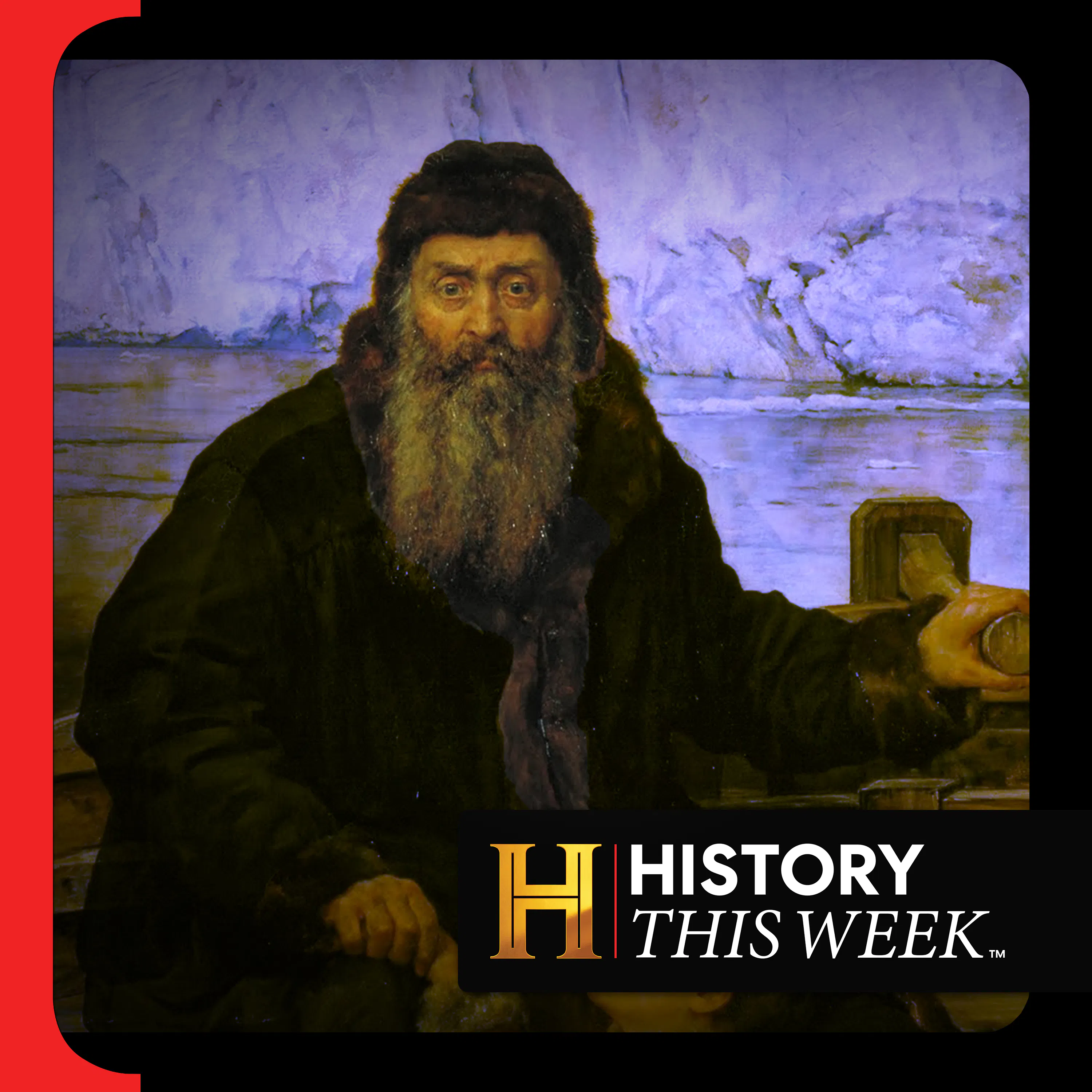
Today. The mutiny against Henry Hudson. Why did this famous captain push his crew to the brink? And what happens when they've finally had enough? We don't know much about the life of Henry Hudson. Portraits from the time show a bearded man with a narrow chin and a very impressive ruff around his neck. He may have been born in London. And when he first appears in the records, it is as a seasoned scene sea captain, someone you can trust to run a dangerous voyage in London. At the time, the early 1600s, dangerous sea voyages are the norm. Several trading companies had their headquarters there. They were bringing in all kinds of products. But historian Peter Mancall told us one stands out from the rest.
- [05:00]
Peter Mancall
In my mind, the most exciting of the things coming to London were spices.
- [05:06]
Sally Helm
Spices. The English are excited to add some cinnamon to their porridge. But it is actually more than that.
- [05:14]
Peter Mancall
We think of these spices as making our food taste better. But they believe that these spices were the cure to human health.
- [05:22]
Sally Helm
One very influential book, the Garden of Health, argued that a combination of nutmeg, almonds and hemp seed would cure insomnia and that clove and mace could prop up a weak brain.
- [05:36]
Peter Mancall
Spices are the cutting edge of scientific exploration and the key towards making people healthier.
- [05:46]
Sally Helm
If you were in England and you wanted most of these spices, you had to travel halfway around the world to what were then called the Spice Islands in the western Pacific. There were two ways to get there. One, you could travel by land across Eurasia. That took literally years. Two, you could travel by seat around the Horn of Africa and across the Indian Ocean. That also took a long time and it was risky.
- [06:13]
Peter Mancall
There's a lot of uncertainty. There's uncertainty from weather. We have a lot of stories of ships going down and there's uncertainties because you never know who you're going to meet. They never knew if there were going to be pirates out there. The English were terrified about pirates and other things that could go wrong.
- [06:30]
Sally Helm
Yeah, you might get shipwrecked in a typhoon or set upon by pirates. But if you survived, there was this other, more mundane problem. One that could mean your whole trip was for nothing.
- [06:43]
Peter Mancall
One of the real things that could go wrong and was common was the spices got stale. Cause it took so long for them to get from the Southwest Pacific to northwest Europe.
- [06:53]
Sally Helm
Imagine you've spent a year or more perfect traveling to the Spice Islands and back. You've braved hurricanes, avoided pirates, and when you arrive home, your nutmeg is too weak to cure insomnia. Your clothes have gone stale. For a weak brain, they are no help at all. So it's no wonder that European traders were dreaming of a faster route. They're convinced it must exist. A way to travel to the Spice Islands through. Through the cold, icy waters above what is now Canada.
- [07:29]
Peter Mancall
They believed that since the sun hung over the north in the wintertime, it had to melt the sea. And by the prevailing geographical theories, the North Pole melted in the summertime. So if you could get there in time, you could cross the pole in your ship. You'd have saved a huge amount of time and you'd go right down into the. You hope the warmer waters of the Pacific follow the winds they hoped and get down to the islands and then presumably turn around and come back the next year if they could figure out the winds.
- [08:04]
Sally Helm
This route becomes known as the northwest passage. Come 1609. No one has successfully found it, but many have tried. And one of the latest to give it a shot is Henry Hudson. He ends up navigating lands in what will become the United States. He travels down the coast of North America from Newfoundland to Cape Cod to Virginia and back up to New York. There he thinks he may have finally found the Northwest Passage. But it turns out he's traveling on what will come to be called the Hudson river, named after him.
- [08:42]
Peter Mancall
There's more water named for Henry Hudson than any other person who's ever lived.
- [08:47]
Sally Helm
Of course, all that comes later. For now, Hudson is just a mariner who's not from around here. He and his crew trade with indigenous tribes along the way, often peacefully. But some of the encounters do get violent. Hudson's first mate, Robert Jewett, writes in his log, on October 2, 1609, two canoes full of men with their bows and arrows shot at us after our stern, in recompense whereof we discharged six muskets. It's believed that Hudson's crew kills roughly a dozen Native Americans that day alone. The Northwest Passage doesn't appear to run through Albany. Hudson makes it that Far. And then the river gets too shallow and he has to turn around. He goes back to England and immediately prepares for another voyage, another quest for the Northwest Passage. He needs a new crop of men to join him aboard a new ship, the Discovery.
- [09:46]
Peter Mancall
The crews were typically recruited from around the docks. So Hudson or his agents probably went.
- [09:52]
Sally Helm
Around the docks recruiting a crew for what will become an ill fated mission. Some of these men are strangers to him, but Hudson brings on Robert Jewett, who had been on the previous expedition.
- [10:09]
Peter Mancall
He was basically the first mate on that expedition. And you get the sense that he's very close to Hudson himself, like the most loyal person.
- [10:16]
Sally Helm
Then there's Hudson's son John, this teenage.
- [10:20]
Peter Mancall
Kid who, you know, maybe he wanted to follow in his father's footsteps. Maybe his father demanded that he go. We really don't know much about the family dynamic of the Hudson family.
- [10:29]
Sally Helm
Hudson also recruits his longtime servant, Henry Greene, who he considers a close friend, though that's not how Greene will be painted in the aftermath of this mission.
- [10:40]
Peter Mancall
Greene is just a troublemaker, right? He's irascible, he's a schemer. And we know this about him and we know things about others because of this guy, Abacuk Prickett.
- [10:52]
Sally Helm
Abacuk Prickett is another crewman. His journal will be the only comprehensive narrative of the journey to come. The Discovery leaves London on April 17, 1610, with Hudson and his crew of 23 men heading towards North America. At first, things go fairly smoothly, though. At one point, off the coast of Greenland, a pod of whales swims right under the ship. The crew is terrified.
- [11:27]
Peter Mancall
These ships are not gigantic. A very large whale could in theory knock over a ship or at least damage a ship and a pod of whales if it wanted, which we don't have. The evidences could destroy a ship.
- [11:39]
Sally Helm
Hudson and his crew know that a lot of ships who have set out on this voyage didn't come home. They're probably wrecked in bad weather in the icy waters. But who knows? It could have been whales. When the pod passes people peacefully, Prickett writes in his journal, and he thanks God for sparing them from the cold depths. Ten weeks into the journey, the Discovery makes it to the Labrador Sea in northern Canada at the mouth of what will later be known as Hudson Strait. Remember, they have no idea what the land and water is like around them, what might be to the north or to the south, what remains ahead. But there is one very bad sign. Ice.
- [12:29]
Peter Mancall
Ice is basically always a bad sign, because to run into ice meant that they had made a miscalculation.
- [12:38]
Sally Helm
This is troubling. It's only July, and of course, a ship can't travel through solid ice. Some of the men are also starting to get sick. The so Prickett wonders if that might just be a result of how scared they are.
- [12:53]
Peter Mancall
They know the summer is getting short. They know that the ice is going to encroach. They know they can get home. They could have turned around and sailed through and gotten home.
- [13:03]
Sally Helm
Henry Hudson convenes a meeting. He pulls out a map and he says, we are 100 leagues further west than any expedition in English history. These are uncharted waters. This is true exploration. And he gives them a keep going or go home. The crew is divided. Some of them want to press on, find the Northwest Passage. But others, including some experienced mariners, are not convinced. There's no consensus. But the captain, Henry Hudson, he doesn't want to give up.
- [13:47]
Peter Mancall
Hudson seems to be saying, we are in the right place, or this is what we have to do. So there's all this sort of, you can feel this tension.
- [13:55]
Sally Helm
Hudson makes the call, we're going to continue on our quest.
- [14:01]
Peter Mancall
It's clear then that there are men who were really unhappy with this decision. They had signed up for a season. They had signed up because they thought they were going to make it to the South Sea. And now they're stuck in this cold place. And they have this driven captain who they probably thought was maniacally driven, who's basically saying, no, we're staying, but since we don't know where we are, we're gonna sail south and maybe we're gonna find warmer waters. That turned out to be a critical error.
- [14:32]
Sally Helm
A critical error indeed, because Hudson and his crew have ended up in a giant bay, what will become known as Hudson Bay. So as they sail south, they sail further and further from open waters. And soon they will be trapped. History this Week is now in its sixth season. Kind of crazy, and we love bringing you these stories. All of our work is supported by the ads you hear on the show. But if you don't want to hear those ads, we're now introducing history this week plus, available exclusively on Apple Podcasts for just $2.99 per month. You'll get all of our new episodes without any of the ads. And we'll be adding ad free versions of our older episodes, too. So subscribe now and get your first week free. History this Week plus exclusively on Apple Podcasts.
- [15:29]
Peter Mancall
Put us in a box. Go ahead. That just gives us something to break out of. Because the next generation 2025 GMC terrain elevation is raising the standard of what comes standard. As far as expectations go, why meet them when you can shatter them? What we choose to challenge, we challenge completely. We are professional grade. Visit gmc.com to learn more.
- [15:59]
Emma Greed
I'm Emma Greed and I've spent the last 20 years building, running and investing in some incredible businesses. I've co founded a multi billion dollar unicorn and had my several other companies that have generated hundreds and hundreds of millions of dollars. The more success I've had, the more people started coming to me with questions. How do you start a business? How do you raise money? How do I bounce back from failure? So it got me thinking. Why not just ask the people I aspire to the most? How did they actually do what they do? I'm so incredibly lucky to know some of the smartest minds out there and now I'm bringing their insights along with mine, unfiltered directly to you. On my new podcast, Aspire with Emma Greed, I'll dive into the big questions everyone wants to know about success in business and in life. Through weekly conversations. You'll get the tangible tools, the real no BS stories, and undeniable little hacks that actually help you level up, Listen to and follow Aspire with Emma Greed and Odyssey Podcast available now. Wherever you get your podcasts, Summer's here.
- [17:01]
Sally Helm
And Nordstrom has everything you need for your best dress season ever. From beach days, weddings to weekend getaways in your everyday wardrobe, discover stylish options under $100 from tons of your favorite brands like Mango, Skims, Princess Polly and Madewell. It's easy too, with free shipping and free returns in store order, pickup and more. Shop today in stores online@nordstrom.com or download the Nordstrom Picture, a map of Canada north of Ontario above the Great Lakes. It's like there's a giant bite taken out of it. The Enormous Stretch of Hudson Bay as summer rolls into fall, Henry Hudson is traveling along the Canadian coast, searching for the elusive Northwest Passage. Not knowing he's getting further and further away, he's thinking it must be close.
- [17:59]
Peter Mancall
I've looked at all these maps. These maps say there's a passage here. I just haven't found the entrance to it yet.
- [18:06]
Sally Helm
I need more time, but the temperature is dropping, supplies are running low. For unknown reasons, Hudson demotes his longtime first mate, Robert Jewett. It seems that tensions are rising. Prickett writes of their time drifting along the coast, that they had spent three months in a labyrinth without end. And all the while, the ice is getting thicker. By late October it's clear they're going to be trapped here all winter. The Discovery is now in James Bay, a littler bay at the bottom of the giant Hudson Bay. They abandon the Discovery in the ice, punching holes in the hull to equalize the pressure so the ship isn't crushed. They'll patch those holes when the ice thaws. In the meantime, they head to shore.
- [19:04]
Peter Mancall
They take what they can into these structures and they build these houses. Shacks, I think is a better way of putting it.
- [19:13]
Sally Helm
And it is cold.
- [19:17]
Peter Mancall
It's so cold that when Robert Boyle, a scientist at Oxford, is trying to find out what cold is, he studies these journals because this, to him, is how you understand cold as a phenomenon.
- [19:34]
Sally Helm
At some point in November, the ship's gunner dies. It could have been the cold, but it could have been something more sinister. Prickett only writes, God pardon. Master's uncharitable dealing with this man, the master being Hudson. Now, this will be an important moment because the gunner had some kind of winter coat. And after he dies, Henry Hudson gives that coat to his friend Henry. Green coats are in very short supply.
- [20:11]
Peter Mancall
They're not particularly well dressed for this. They have nothing. That's the equivalent of what Inuit or Crees have to survive. Earlier explorers had basically said, oh, those people, those Inuit, they're savages. We don't want to live like them. So they're not even embracing the strategies that would presumably have allowed them to be warmer.
- [20:33]
Sally Helm
So Greene is very happy with this inadequate coat until he and Hudson have some kind of falling out. Apparently there's a dispute over the shacks they're building on shore, and Greene sides with the ship's carpenter, not Hudson, And Hudson takes back the coat, sending Greene into a rage. Hudson tries to smooth things over, but Prickett writes, Greene never forgives him.
- [21:05]
Peter Mancall
Part of what it's hard for us to remember is just how dark it was. I mean, it's bone chillingly cold, but it's also dark. From November to March, there's hardly any light.
- [21:20]
Sally Helm
The men use what little light there is to hunt partridges. Prickett estimates that they ate as many as 1200 partridges that winter. But food is still scarce and some of the men are falling ill, which presents a dilemma.
- [21:37]
Peter Mancall
Those who were healthier in their cruel calculation that they are making are basically saying, why are we wasting our precious food on these guys who are going to die anyway? And Hudson, to his credit, I think from modern terms, says, basically, no, we're not going to cut these men off from their rations.
- [21:59]
Sally Helm
This is an honorable decision. But it leaves many crew members resentful. And soon a conspiracy theory starts floating around.
- [22:10]
Peter Mancall
There is suspicion that Hudson is hiding.
- [22:12]
Sally Helm
Things from them, namely food that he's kept stored on the disgust discovery, presumably.
- [22:20]
Peter Mancall
For himself, for his son, for his, maybe for his favorites.
- [22:24]
Sally Helm
Soon the partridges fly away. Cricket writes that the men eat moss, frogs, and some kind of a tea made with turpentine. As things are beginning to get slightly warmer, Hudson is out one day when he encounters a man, an indigenous person, likely from the Cree tribe. It is the first person the crew has seen since they were frozen in. Hudson tries to trade just like he had on his last expedition in New York. A mirror, some buttons, a hatchet and a knife for deer and beaver skins. Now, this relationship could change everything. But the Cree man, he never comes back.
- [23:12]
Peter Mancall
Hudson seems to have insulted him. This man who seemed willing to do things doesn't come back. We don't know his name. Hudson never records it. That encounter of Hudson and that Cree man, that could have changed the fate of this entire expedition. And those kind of moments are kind of hard to find in the historical record. And they're really something that is sort of like, wait, it could have gone in a different direction. Had it gone another way, we would be maybe having a very different discussion today.
- [23:44]
Sally Helm
The discovery's one chance at trading for food is squandered and the crew's morale is in tatters.
- [23:53]
Peter Mancall
It's not surprising in some sense that people then thought, we don't trust this man anymore. If we make it through winter, we've got to rethink the way forward.
- [24:13]
Sally Helm
This episode is brought to you by State Farm. Knowing you could be saving money for the things you really want is a great feeling. Talk to a State Farm agent today to learn how you can choose to bundle and save with a personal price plan. Like a good neighbor, State Farm is there. Prices are based on rating plans that vary by state. Coverage options are selected by the customer. Availability, amount of discounts and savings and eligibility vary by state. Hey, business owners, we know you know the importance of maximizing every dollar. With the Delta SkyMiles Reserve business American Express card, you can make your expenses work just as hard as you. From afternoon coffee runs to stocking office supplies and even team dinners, you can earn miles on all your business expenses. Plus you can earn 110,000 bonus miles for a limited time through July 16th. The Delta Sky Miles reserve business card. If you travel, you know, minimum spending requirements and terms apply. Offer in 7, 1625 McCrispy strips are now at McDonald's, I hope you're ready for the most dippable chicken in McDonald's history. Dip it in all the sauces. Dip it in that hot sauce in your bag. Dip it in your McFlurry. Your dip is your business. McCrispy strips at McDonald's. One thing you can say about winter, at the very least, is that it does not last forever.
- [25:32]
Peter Mancall
The seas start to soften or start to melt. The ship is still encased, but they can now go out on the water. The weather is much warmer. There's much more light, and Hudson sends.
- [25:43]
Sally Helm
Some of his men out on the shallop, the small boat attached to the Discovery. He sends them fishing, and if he'd known what would happen on that fishing excursion, he'd probably never have done.
- [25:57]
Peter Mancall
Seems that during one of these fishing expeditions, Greene and others start to basically hatch a plot. They come back having not only thought we should have a mutiny, but they've laid out the mutiny.
- [26:10]
Sally Helm
Hudson can feel that things have gotten tense. He tries to help by distributing some of the bread and cheese he's had stored on board the ship, but that only seems to make things worse. People are mad that he withheld it in the first place. On June 17, the discovery is finally freed from the ice. It's patched up, ready to go, and the crew starts to move towards open water.
- [26:42]
Peter Mancall
Henry Hudson, when he woke up in that morning in June and the ship is finally freed, is thinking, okay, we go north and west, and we just look for the Northwest Passage.
- [26:57]
Sally Helm
The men of the Discovery have survived this terrible winter. Now they could go on, find what they came for. But a segment of the crew is no longer interested in in the Northwest Passage. We have the account of what happened next only from Abacoek Prickett, he says he'd fallen ill. He's lying in bed in his cabin when he's approached by Henry Greene, who is apparently still nursing a grudge against Hudson for taking his coat. Greene is joined by some other men who are in on the plot. They say we're going to mutiny. It's been three days since they've eaten, and Greene tells Prickett he would rather be hanged at home than starved abroad. After that, more crew members visit Prickett in bed and say, I'm in. I'm in. I'm in, too. Even Robert Jewett, Hudson's longtime ally, who'd been demoted from first mate Hudson, has.
- [28:05]
Peter Mancall
Turned against Jewett's expertise, and you can feel Jewett just this resentment building in him.
- [28:12]
Sally Helm
Jewett is in, too, as Brickett tells it he doesn't want to be a victim of the mutiny himself, so he joins, but makes the conspirators swear to act in the best interest of as many of the men as possible. On the morning of June 22nd, the mutiny begins.
- [28:38]
Peter Mancall
They bind Hudson. They quickly take his son. His son, at this point 17, 18 years old, he would clearly be with his father and be enraged. Hudson's other allies, some of them are, by their words, infirm. They are less able to put up physical resistance to the mutineers.
- [28:58]
Sally Helm
Hudson, his son and seven other men are placed aboard the Shallop. In the meantime, the mutineers ransack Hudson's quarters and they find what they'd long suspected that Hudson had been hiding. Food for himself and his favorites.
- [29:15]
Peter Mancall
One of the court accusations turns out to be right, that he's not just a stubborn man, he's a deceitful full map.
- [29:24]
Sally Helm
The Shallop is cast off a tiny boat in the big cold bay. The Discovery sets sail and leaves them behind. We know the rest from Prickett. The Discovery still has to make it home. Their food is still dangerously low and they have just a fraction of their crew. They encounter some Inuit locals and try to trade. But in the middle of the negotiations, one of the Inuit men stabs Prickett in the chest.
- [30:01]
Peter Mancall
Something goes horribly wrong. The Inuit deal mortal blows.
- [30:05]
Sally Helm
Some of the men are killed, including Henry Greene. Prickett survives and makes it back to the ship. They flee. Finally, about 17 months after departing London, the Discovery returns with, of course, many fewer men. Jewett, that former first mate, he also dies before reaching home. Only eight of the original 23 crew members survive. Now, you might think that if a crew returns to London, having set their captain adrift in the Arctic, there would be consequences. But no. The powers that be in London basically just want to know what these men have found out about what that cold, isolated part of the world looks like.
- [30:57]
Peter Mancall
They would like to know what happened to Hudson, but they really want to know, does the Northwest Passage exist?
- [31:03]
Sally Helm
There is an investigation of the mutiny, but the only record of what happened is from Abacuk Prickett. And he says the masterminds here were Green and Jewett, who are now dead. I, Abacuk Prickett, just barely went along with this to save my own skin. He and the other men, they're exonerated. And there's really no way to know if the story they told is entirely true.
- [31:34]
Peter Mancall
For all we know, they were the architects of the mutiny and Prickett came up with this convenient story to exonerate all of them. You know, we don't know. It's one of the great things about this for a historian to look at is we don't really know. We know this sort of tragedy happened to Hudson, but we don't know if people are then manipulating it after the fact.
- [31:52]
Sally Helm
But the biggest mystery of course is what happened to Henry Hudson himself. Peter Mancall has his own theory.
- [32:04]
Peter Mancall
I think what happens is, I think that they, they go back to where they'd spent the winter, the territory they knew. Now it's thawed, all right, snow's gone. These fast growing arctic grasses are there, which can help if they're suffering from scurvy, which is quite likely. And I think that if they made it to the following winter, they would have then suffered again the cold and the dark and unlikely to survive. And I, I think the likely scenario is that they succumbed to various diseases or froze to death and that eventually scavenging animals ate them. I mean, I can't say we have later voyages which give us these little glimmers of clues. In the 1630s, little stakes found in the ground that maybe is where they tied up. Around 1670, they find the remains of a house that doesn't look like a native house. And it seems to suggest that maybe this is where Hudson and his men built something and native peoples left it there. I mean, one thing about the far north is that things can survive a long time. And so I think it plausible that these things were in fact left by Hudson and his men.
- [33:27]
Sally Helm
And of course there's some chance that they did survive.
- [33:33]
Peter Mancall
I have no doubt that Henry Hudson would have tried to find that Cree man or find others. Maybe they decided to walk farther south. There's been speculation for years that Hudson or his son somehow survived by walking south and carve their initials in a rock. You know, and there are people every now and then claim, hey, I found signs of Henry Hudson, but none of them have been verified and they don't seem particularly realistic. But you know, we're in the unknown when it comes to that.
- [34:14]
Sally Helm
Foreign. Thanks for listening to History this week, a Back Pocket Studios production in partnership with the History Channel. To stay updated on all things history this week, sign up@historythisweekpodcast.com and if you have any thoughts or questions, send us an email@historythisweekhistory.com Special thanks to our guest, Peter Mancall, historian at the University of Southern California and author of Fatal the Final Expedition of Henry Hudson. This episode was produced and sound designed by Ben Dickstein it was also produced by me, Sally Helm for Back Pocket Studios. Our executive producer is Ben Dickstein from the History Channel. Our executive producers are Eli Lehrer and Liv Fidler. Don't forget to follow, rate and review History this week, wherever you get your podcasts, and we'll see you next week.