Loading summary
Transcript48 lines
- [00:01]
Indeed Sponsor
This episode is brought to you by Indeed. When your computer breaks, you don't wait for it to magically start working again. You fix the problem. So why wait to hire the people your company desperately needs? Use Indeed sponsored jobs to hire top talent fast. And even better, you only pay for results. There's no need to wait. Speed up your hiring with a $75 sponsored job credit@ Indeed.com podcast. Terms and conditions apply.
- [00:30]
Ryan Reynolds
Ryan Reynolds here from Mint Mobile.
- [00:31]
Rob Attar
With the price of just about everything.
- [00:33]
Ryan Reynolds
Going up, we thought we'd bring our prices down. So to help us, we brought in a reverse auctioneer, which is apparently a.
- [00:40]
Reverse Auctioneer
Thing Mint Mobile unlimited premium wireless. 30. 30. Better get 30. Better get 20. 20, 20. Get 20, 20. Better get 15. 15, 15, 15. Just 15 bucks a month.
- [00:48]
1-800 Contacts
Sold.
- [00:49]
Ryan Reynolds
Give it a try@mintmobile.com Switch upfront payment.
- [00:53]
Francis French
Of $45 for three month plan equivalent to $15 per month required new customer offer for first three months only. Speed slow after 35 gigabytes of networks busy. Taxes and fees extra. See Mint.
- [01:00]
Meditation Guide
Close your eyes. Exhale, Feel your body relax and let go of whatever you're carrying today.
- [01:08]
Francis French
Well, I'm letting go of the worry that I wouldn't get my new contacts in time for this class. I got them delivered free from 1-800-contacts. Oh my gosh, they're so fast.
- [01:16]
Meditation Guide
And breathe.
- [01:17]
Francis French
Oh, sorry. I almost couldn't breathe when I saw the discount they gave me on my first order. Oh, sorry. Namaste.
- [01:25]
Lowe's Sponsor
Visit 1-800-contacts.com today to save on your first order.
- [01:28]
Ryan Reynolds
1-800-Contacts.
- [01:31]
GMC Advertiser
Put us in a box. Go ahead. That just gives us something to break out of. Because the next generation 2025 GMC terrain elevation is raising the standard of what comes standard. As far as expectations go, why meet them when you can shatter them? What we choose to challenge, we challenge completely. We are professional grade. Visit gmc.com to learn more.
- [02:02]
Francis French
This is a History extra production.
- [02:06]
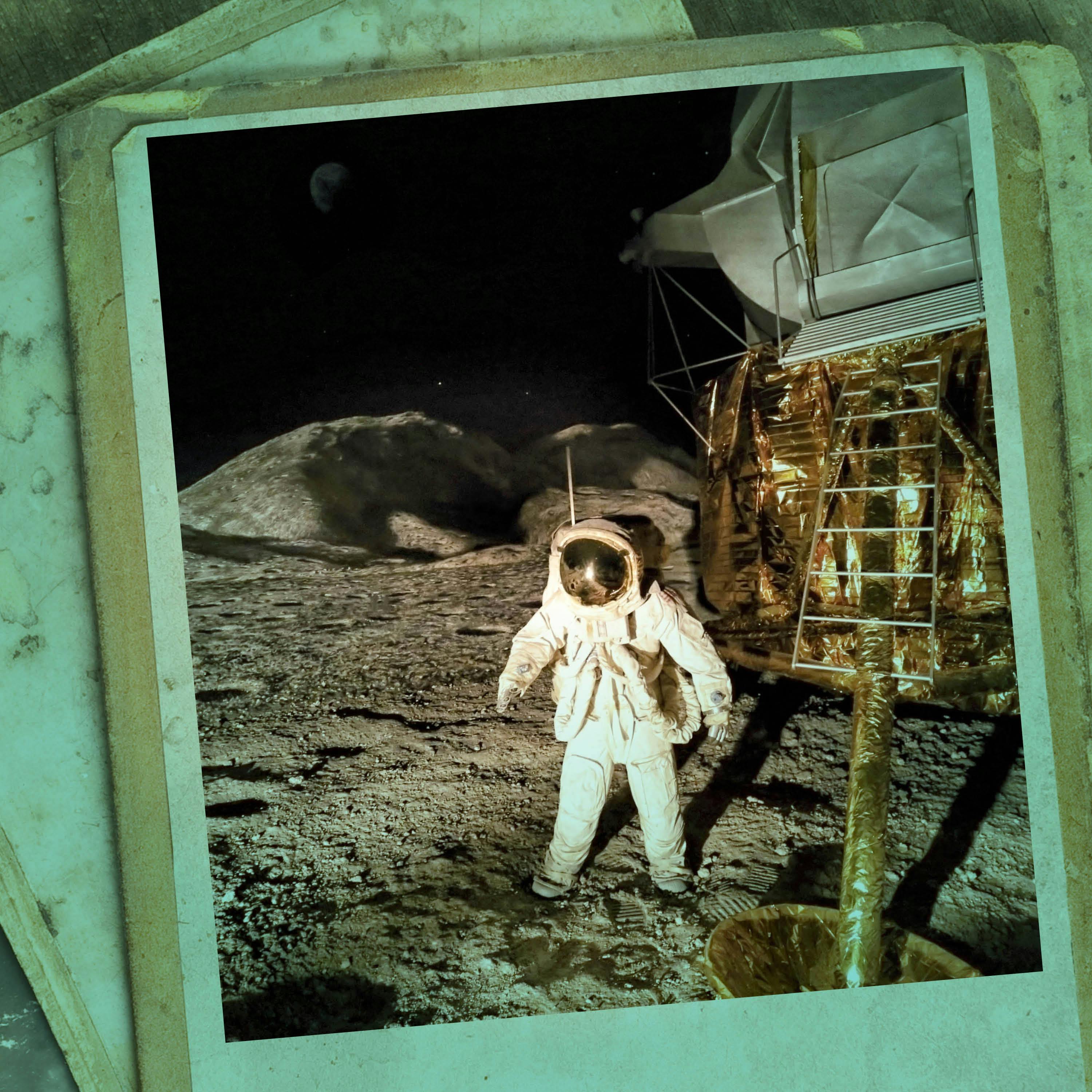
On 20 July 1969, American astronaut Neil Armstrong famously took one giant leap for mankind. The moon landing may well be the most iconic moment of the 20th century. But did it even happen at all? Might NASA and the US Government have been so desperate to overtake the Soviets in the space race that they faked the entire thing? Welcome to history's greatest conspiracy theories. I'm Rob Attar and today we're going to be delving into one of the most persistent conspiracy theories of the modern era, that the moon landing took place in a studio rather than on the moon. Our expert for this episode is Francis French, an author and journalist who specialises in the history of spaceflight and who's interviewed many of the leading figures of the space race era.
- [02:58]
Rob Attar
When did this theory begin? How closely to the actual events?
- [03:03]
Ryan Reynolds
There were some people who started talking about it even as the moon landings were happening, but it really started taking speed in the early to mid-1970s. I think that is because of the national feeling around things like Watergate. All of a sudden, the government didn't seem to be able to be trusted as much as the general public did before. Plus, the moon landings was such an amazing thing that happened in four short years. Humans went to the moon and then they were clearly not going to go back anytime soon. And people started thinking, how did we do that and not go back? So doubts began to form in general public's mind among a very select few people.
- [03:40]
Rob Attar
So that Watergate comparison is interesting because Watergate obviously is evidence that conspiracies do or can happen, although obviously that one was discovered. I mean, if a conspiracy had been hatched to fake a moon landing, how feasible would it be to keep something like that under wraps?
- [03:56]
Ryan Reynolds
The possibility of a moon landing hoax is zero to begin with. Hundreds of thousands of Americans worked on that program, and here we are half a century later, and there's been no credible evidence of any way of being able to fake it. It's clear that all that evidence would have come out by now. We know that from all the other conspiracies that have proven to be true in the world. We know that this stuff leaks out very, very quickly. There's no way that this could have been kept such a watertight secret for so long. And some of the evidence that conspiracy theorists put forward doesn't hold up under the smallest of scrutiny. Not only that, but the major thing about this one is the Russians were America's sworn Cold War enemy. They had the ability to track any spacecraft going to the moon. They could read the same signals coming back from the spacecraft as America could, as could many other radio dishes around the world. The whole world was watching these landings. They saw things go to the moon and land and come back. So clearly something was going to the moon. It would have been harder to have faked something landing on the moon under automated circumstances than it would have been with people in at that point. So the only way a conspiracy theory can hold up is if the Russians were in on it as well. And if you're into that kind of conspiracy theory, where the Russians and America were in on some kind of big conspiracy in the height of the Cold War, then we're in territory that I don't think any rational person can really stomach.
- [05:18]
Rob Attar
So, yeah, the Soviet angle is really interesting there. I mean, they would have had a strong motivation, you'd have thought, to support these conspiracy theories, but did they give them much credence at all?
- [05:27]
Ryan Reynolds
Not only did the Russians not support any of the conspiracy theories about America landing on the moon, they actually went as far as to celebrate America landing on the moon in muted ways. Clearly they had lost a space race and weren't too happy about that. But they did, in their encyclopedias and other places, certainly champion Neil Armstrong. As somebody had done a historic feat. They made sure to include him with their own achievements before, such as Sputnik, the first satellite, and Yuri Gagarin, the first person in space. So within that context of their own achievements, they were very, apparently quite happy to recognize that Apollo 11 had been a huge achievement landing people on the moon. They were clever in that they said, well, we were never going to land on the moon as well. We were actually trying to build space stations. They basically hid their own moon landing program for many, many decades. So in the way they had their own little conspiracy going on, which, having lost a race to the moon, they then pretended they'd never been in the race at all. That was a lie that came out towards the end of the fall of the Soviet Union. So there were untruths coming from the Soviet Union to be sure about their involvement in a space race. However, when it came to America landing on the moon, they were absolutely honest about saying, we saw it happen as well.
- [06:37]
Rob Attar
Now, you mentioned obviously that this was an incredible technological achievement to land people on the moon in the late 1960s. But I guess it wasn't in any way out of step with the progress that had been made thus far. It wasn't an unfeasible leap from previous space exploration.
- [06:52]
Ryan Reynolds
I think one of the reasons that people want to think it was a hoax is because it was so amazing. It's almost a compliment to NASA and Apollo that people go, this can't be possible, because in 1957, people hadn't even put anything in space. It was later in that year, in October, that we finally saw the first satellite. How is it that 12 years later, humans were walking on the surface of the moon? That seems such a short amount of time when we look at how long it takes anything to be made and flown these days. I think the fact that it actually happened is a testament to what could happen. If national will is behind something, the Technology was ready, that is true. And it was a. A way that it could be done, barely at the very cutting edge of what was possible with technology. It really took a huge amount of money, and that has to take a consistent national will. Now, with most governments, national will lasts about two to four years. The electoral cycle. Things change over. Priorities get changed somehow. A promise made by one president at the beginning of the decade was carried out by a president by the time they landed, of a different party, in fact, his sworn enemy. And Richard Nixon was no friend of jfk. They fought for the presidential election themselves. The fact that they actually managed to do it in that time is more amazing consistency of politics and money than it is anything to do with consistency of technology. The technology, in some ways, is almost the easy part. It is an incredible part of history and so unique that I can totally understand why some people initially might go, did that even really happen? But it did.
- [08:24]
Rob Attar
Why do conspiracy theorists think that NASA wanted to do this? What was in it for NASA to fake a moon landing?
- [08:31]
Ryan Reynolds
The reasons that NASA might have wanted to fake a moon landing if they couldn't have done it are actually quite sound. America had, under President Kennedy, promised to land a person on the moon by the end of a decade. It was a national goal in the height of the Cold War. It would have been embarrassing if America had turned around and not done it. Now, jfk, before he died, was talking to the Soviets about maybe doing something cooperatively. It may have gone in a different direction, and Soviets and Americans may have landed on the moon together. However, JFK died before that happened, and the fact that a martyred president had made this promise suddenly gave it an extra power it never had. So if America had not landed on the moon by the end of the decade, I think it would have been nationally embarrassing and a sign of national decline at a time where America was trying to win over many countries that were wavering between communism and capitalism. So they needed to do it. If they couldn't have done it, faking it, I can see it would have made sense. The trouble is, it would have been so difficult to have hidden that with hundreds of thousands of people, plus all of these other nations being able to follow everything to the moon, that the embarrassment of being discovered would have been way worse than the actual faking. There is, however, a wonderful movie that I think got a lot of people thinking about this, that came out in the mid-1970s, a fictional movie named Capricorn One, which is about a fake Mars landing, but is using the same rockets and spacecraft that landed on the moon in the movie. So it's clearly a movie about a fake moon landing. It's fictional. I saw it as a kid. I thought it was wonderful fiction. I never believed it. But I think a lot of people watched that movie and thought maybe this is a good reason to question what NASA did. There are some wonderful speeches in that movie that, even though it's fiction, perfectly capture why the general public had lost interest in moon landings after the first one and why, just for funding alone, NASARA might wanted to keep success going. It's a wonderful fictional tale. So sometimes in fiction we can see some real reasons. However, I think the line between believing fiction is one that we need to stay on the right side of.
- [10:41]
Rob Attar
Now, there is, of course, film footage of people walking on the moon. How do conspiracy theorists think that that was achieved? How do they think the moon landing was faked?
- [10:51]
Ryan Reynolds
I think it's easy to debunk any conspiracy theories about the footage of people walking on the moon being inaccurate, because all you have to do is look at incredibly High budget movie 2001 by Stanley Kubrick that was being filmed right before the moon landings and see that our ideas of what the surface looked like were completely changed when we actually got there. The sort of spiring mountains, it didn't look like the fiction. Once we got there, it looked quite different. However, would it have been possible to fake it? I think a lot of people who are looking for a conspiracy will look at a very bright light on what looks like a gravel pit with a dark background and go, if you're going to fake something that looks like a pretty easy studio set up to fake, it's not though. Once you look at shows like from the Earth to the Moon, which was a wonderful account of the moon landings that came out in the mid-90s that, as I recall, that had tried to cover footage of the moon landings using CGI at the time. It does. It looks fake. And that's in the 90s. It was not possible in the 60s and 70s. There are things in the footage as well that are impossible to replicate on Earth. As the lunar rovers, the cars that are driving on the moon are driving along, they kick up dust. As people are walking, they kick up dust. And that dust goes in a perfect fantail and comes down and lands absolutely flat. There's no dust cloud. It does this perfect. It's almost like kicking some water. The water droplets come up and they land completely and they've all gone out of the air. There is no air there. You can see it in that camera and you can see that it's under a slightly lower gravity as well. So the ability to fake that would have needed technology. That's not possible now. It doesn't hold up to this smallest of scrutiny. Nevertheless, conspiracy theorists will look for things. They will, they will try and find things in footage and say, look, that's fake, that's a prop. Most of these things are easily debunked. There's rocks on the surface that under certain look at certain photos that look like they have a marking on them and people say, well look, it's a prop. It's got a marking on it. That's because there's a hair on the lens. When they've been redoing the pictures, you go back to the original, it's not there.
- [12:58]
1-800 Contacts
Pro Savings Days are back at Lowe's right now. Get a four piece GE kitchen suite for under $2,000 plus get a free DeWalt 20 volt max XR8amp hour battery when you buy a select DeWalt tool. Save big with deals that work as hard as you do. Shop Pro Savings days in store or online. Today Lowe's we help you Save valid through 8. One selection varies by location while supplies last discount taking the time of purchase. See Sales Associate for details.
- [13:28]
Meditation Guide
On WhatsApp no one can see or hear your personal messages. Whether it's a voice call message or sending a password to WhatsApp, it's all just this. So whether you're sharing the streaming password in the family chat or trading those late night voice messages that could basically become a podcast, your personal messages stay between you, your friends and your family. No one else, not even us. WhatsApp message privately with everyone not all.
- [13:57]
1-800 Contacts
Meals are created equal. For instance, breakfast has the spicy egg.
- [14:03]
Ryan Reynolds
McMuffin for a limited time and lunch does it.
- [14:07]
1-800 Contacts
McDonald's breakfast comes first.
- [14:13]
Rob Attar
Now of course, many people walked on the moon, came back to earth, spoke about their experiences. How far have they sought to debunk this conspiracy theory themselves or have they tried to remain above it?
- [14:25]
Ryan Reynolds
I think the Internet made a huge difference in how much these theories got spread. And I think that made a huge difference to what the Apollo astronauts had to deal with. Because initially it was very easy to dismiss conspiracy theories as a couple of cranks writing self published books who had no background in the business. Essentially photocopied information doesn't really look particularly impressive when the Internet comes along and all of a sudden you've got very nice looking websites with all kinds of glossy pictures and all of A sudden people are beginning to think, well, this looks quite slick and professional. So then sadly, the Apollo astronauts started getting a lot more questions coming at them. Some less than reputable. Television stations started doing rather misleading shows where there's a question in the title of the show which is never really answered, but nevertheless makes people wonder things they probably shouldn't have to wander. Did we really land on the moon? It does have a knock on effect in the general public all of a sudden. I remember being at some space events where Gene Cernan, the last person to walk on the moon, when he does his Q and A, all of a sudden has to deal with somebody putting their hand up and basically telling him he never went there. There's a more dangerous edge to this. There was one gentleman who was showing up to private houses and gated communities where astronauts lived and knocking on their door and trying to get them to swear on the Bible that they went to the moon while a camera crew followed him and he tried to basically make some footage and sell copies of his documentary. This kind of came to a head at one point where Buzz Aldrin, having been called a coward and a liar to his face while being prevented from leaving a building, eventually punched one person in the face to get away. At that point, I think people realize this has gone too far and a lot of that went away from public. But it was a really sad thing that these people who were our ambassadors from humanity who landed on the moon, who have incredible experiences and we're very lucky to be able to hear them, had to deal with some of this stuff face to face and probably got quite wary of doing more things in public.
- [16:23]
Rob Attar
So how widespread would you say this conspiracy theory is? How many people actually believe in it, do we think?
- [16:29]
Ryan Reynolds
I've read some polling numbers about how many people believe whether we really went to the moon or not. And it kind of fluctuates. I think I'm quite gratified to see that it's a pretty dramatic minority. I think there's about last I read about 20% of people in European and American countries who have some questions. And it is generally of the nature of, well, I saw this picture that showed a flag or I showed this picture that showed shadows in different directions. I don't know. It probably happened, but I don't know. I haven't really looked into it. And that kind of healthy skepticism is okay. I think it's why, why not question things? As soon as they go even surface deep, they get their questions answered. It's a tiny Tiny minority of people who are absolutely hell bent on proving that it didn't happen. It's much, much less than 1%. Unfortunately, they can be quite vocal. Unfortunately, there are some elements of the media that look vocal for a controversial story and will amplify a voice that maybe does not have any other way of speaking and probably isn't worth listening to. So I'm gratified to see that most people believe it. I'm understanding of people that have some questions, why not? Let's, let's question things. I'm really gratified to see that most people get their questions answered right away.
- [17:43]
Rob Attar
And do you think there's something about the fact that this took place in the height of the Cold War that lends it to, to conspiracy theories? Is there a kind of Cold War paranoia over events like this?
- [17:53]
Ryan Reynolds
I think there might be some kind of element that it is during the heights of the Cold War because there were so many things that the governments of the world were necessarily keeping secret. No country very wisely wants to show what its latest technology is, what its latest spy plane is, what its latest missile is, because then you've given the enemy an advantage. So there were some very necessary secrets, there were some probably very necessary lies and misleading things being said in that climate. With the exact same companies doing that, working on the space program, Big aerospace contractors. Absolutely. I can see why people would have some questions. There were also some military space programs, some designed for humans, mostly designed not for humans, going on at the same time, that were kept secret for decades, again for the same reasons. So there was a lot of crossover in that. I can understand why people might think that that time would have been a time where a conspiracy could have happened. I think the time is more interesting though, in that because this happened as such a tiny sliver of humanity's entire existence and now it's half a century we've not been back. I think that is more why people begin to question. Because we went to the moon from 1968-72 with people, no time at all, Very, very small amount of time and we'd not been back. And when you say it like that, I can understand people going, well, how did we do it then? How did this piece of what seems like 21st century technology get thrown into the middle of the last century? Happen once very quickly and perfectly. Pretty much apart from a few little things like Apollo 13, even that crew survived. It went pretty well, and then we never did it again. How come? That's a legitimate question. That's a Question that a lot of people are asking. Why we've never been back to the moon. To try and go back to the moon. Because these are the kind of things that politicians and taxpayers need to know. So I can understand in terms of that kind of whether a conspiracy thought forming. If anything, it's a compliment. If anything, it shows what an amazing period of history that was and how incredible it was. They pulled it off.
- [19:53]
Rob Attar
And what do you think? Historians and space experts, NASA, is there any more they could do to try to defeat this conspiracy theory? Or is it ultimately a fruitless task?
- [20:03]
Ryan Reynolds
That's a really interesting question as to whether they even should. NASA did commission a book by a very respected space expert to basically refute all the conspiracy theories, and then they pulled the funding for it. Because I think they basically decided they could be chasing conspiracy theories forever. Is it their job to do that? Is it other people's job to defend them? Should we just say, come on, this is a silly question, let's not even answer it? That's a difficult one. NASA has released some fact sheets going back to the 1970s saying this is why the conspiracy theories are not true. I think it's mostly the job of other people to do that and let NASA get on with the amazing job they're doing of now trying to go back and send more humans to the moon. They've got enough to do. They could be chasing lies forever. Otherwise, it's a difficult one. I think people do have legitimate questions on the surface level that are very easy to answer. And somebody should answer those questions. Maybe not NASA, maybe other space people. Once that's done, I think there's a certain point that people are going to be looking for a conspiracy in the heart of something. And they will not rest ever with that one. And what can you do? You kind of feed them. If you keep going, there's a certain point where you go, thank you. Go enjoy that. I can't do this anymore. And that's some of my personal experience has been that there's a certain point where I go, we're not going to change each other's minds. Let's just leave it there.
- [21:25]
Rob Attar
And if you were speaking to someone who had some doubts about the moon landings or didn't believe them, what. What do you think the strongest evidence is that man did land on the.
- [21:34]
Ryan Reynolds
Moon in 2009, as I recall. The Lunar Reconnaissance Orbiter, which is an uncrewed spacecraft, was sent around the moon to map the moon. They took pictures of footprints, landing sites. The flags were still there. The tracks left by the rovers were still there. You could see trails. You can see trails as well. These pictures are online. There are trails across the Moon made clearly by people that would be not impossible to fake pictures. But come on, why are we still doing that in 2009? Why. Why would we still be keeping that up? There is evidence that you can actually go and say, look, here's a picture taken recently of the surface of the Moon. And you can see that the landing sites, or most of them have mirrors set up there, too, that they could ping lasers from Earth back and forward and see how far the Moon is coming closer to us or moving away. You can very accurately measure the distance to the Moon. The mirrors are there. That's unequivocal. They are tracked by people around, all around the world, not just America. Somebody put those mirrors there. Now they could have been landed by uncrewed spacecraft. There's a certain point where it becomes harder to fake it than it would to just do it. Some of the jokes about conspiracy theories, as you know, they faked the moon landings on the surface of the Moon because it was easier to film there. And that is pretty much true. Everything that the moon landings did would be pretty much impossible to do without some incredible technology that essentially it's easier to go to the Moon. We also have moon rocks, moon rocks all over the world that have been studied by scientists all over the world. NASA was very open about making sure geologists all around the world got to do those. Those rocks cannot be formed under human conditions. They have unique properties that mean they come from somewhere else. Those rocks are evidence more than anything else that people went there and brought rocks back.
- [23:15]
Rob Attar
Okay, Francis, I think I've kind of covered the main things I was going to ask you. Is there anything else really important you think I should have put to you that I haven't yet?
- [23:22]
Ryan Reynolds
So a number of conspiracy theorists have said there are radiation belts around the Earth, which are true. And those radiation belts, if you spend enough time in them, could kill a human being. That is also true. And they said that is evidence that humans could not have left Earth orbit and gone to the Moon. That is not true. Those radiation belts would only be lethal if you spent a long time in them. And the astronauts in the spacecraft, going at considerable speed, pass through them at most in a matter of minutes, probably getting at the most the equivalent of a chest X ray. So not something that would actually kill them. These are the kind of theories that are, again, easy to disprove. Another theory that comes up is People look at the pictures of the astronauts standing on the surface of the moon and say, well, there's a black sky behind. Why can't we see stars in those pictures? Again, this is something you can disprove at home. You could go and stand out in your street and look up at a street light and see if you can see any stars around that street light. When you take a photo of something that's very bright and those astronauts on the surface of the moon had that bright sunshine on them, you can see how brightly reflective their spacesuits were. Clearly any stars are just going to be washed out because the camera's not going to be able to pick those up. Astronauts could see them if they went and stood in the shade and got away from that light and were able to look up. But they're not going to come up in pictures. There's another bit of footage that they did on the surface of the moon, another bit of film footage during Apollo 15 which would have been impossible to fake. Pretty much even now it had been impossible to fake. That really shows where they were. Astronaut Dave Scott stood on the surface of the moon and in one hand he held his geology hammer and in the other hand he held a falcon feather, very, very light feather. He held them at basically sort of shoulder height and dropped them at the same time on camera and they hit the ground at the same time. Because there is no air on the moon, those things were in a vacuum. They would drop at exactly the same moment, something that Galileo had predicted centuries earlier. And Dave Scott thought this would be a fun science experiment to show that is impossible to fake with anything that they had in the late 60s and early 70s. It would be tough to do. Now I encourage people to go find that footage. It's all over the web and you can see, there it is. People are standing on the moon. They're clearly somewhere else.
- [25:34]
Francis French
That was Francis French. You can find out more about him and his work@francisfrench.com and that's all for this episode and indeed this series of history's greatest conspiracies theories. But do keep an eye on this feed as we'll be returning with more episodes soon. Thanks for listening. This episode was produced by Jack Bateman.
- [26:02]
Lowe's Sponsor
If you've been personally victimized by AI advertising, you're about to be pretty disappointed. You know, redis the world's fastest caching solution. Well, it turns out fast caching is a pretty, pretty good segue to fast short term memory. And it turns out fast accurate memory is exactly what you need to make AI agents actually work with your data. So don't blame us. It just makes sense. Redis for AI. The right infrastructure, the right tools, the only way to scale. Learn more@redis.IO Genai.