Loading summary
Transcript60 lines
- [00:00]
A
Hey friends. Olivia from Ollie. Between new routines and the ultimate group project known as parenting, you need science backed solutions that work with your life. That's where Ollie comes in. Start your mornings off right with multis made to support nutrition and immune health. Choose from our lineup of gut supporting probiotics and we've got occasional sleep support to help the whole fam chase their big dreams. Head back to class with the number one Gummy supplement brand. Stock up on ollie.com today. These statements have not been evaluated by the Food and Drug Administration. This product is not intended to diagnose, treat, cure or prevent any disease.
- [00:30]
B
These are books. I haven't read all of them, but I could if I wanted to because I can read. But have you noticed lately that way more people seem illiterate? I'm gonna like compromise with you.
- [00:41]
C
We're gonna compromise with each other.
- [00:43]
D
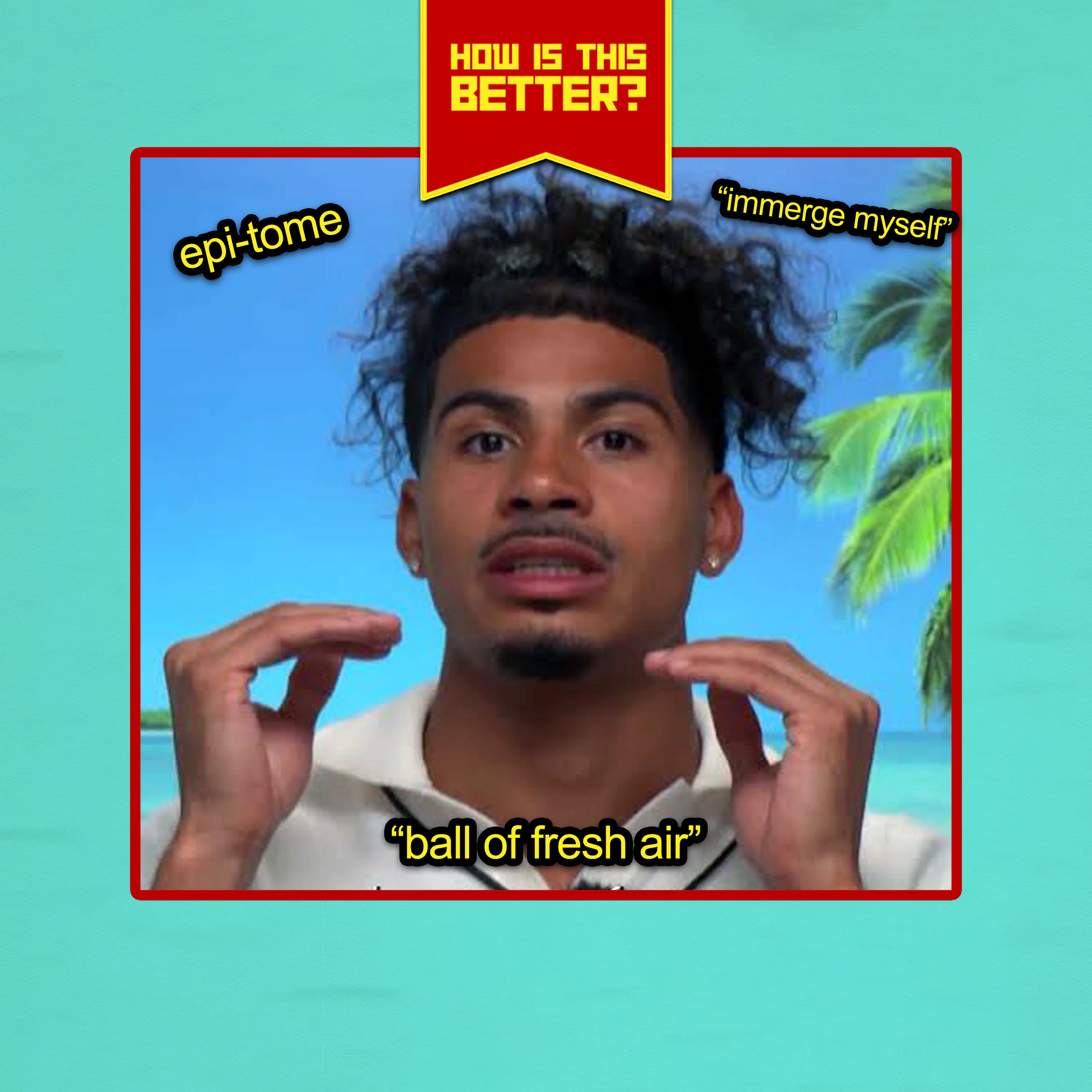
This Casa amor is like the biggest, the epitome of testing connections.
- [00:49]
B
Sure, reality TV stars have never been the epitome of educated or even curious. But this observation is supported by evidence. Studies by the National Literacy Institute in 2024 found that 21% of American adults are illiterate and that 54% of American adults read below a sixth grade reading level. That's right. Most people in this country can't get through or understand the book Holes by Louis Sakhar. That means there's zero hope for comprehension of something like the Great Gatsby, a 10th grade book that is incredibly relevant right now. And it's not just reality tv. There's a whole bunch of social media accounts and dedicated to asking young people to read pretty basic sentences correctly and explain what they mean. And. Well, Read this.
- [01:34]
C
In this card the clim.
- [01:36]
D
What the. Read this.
- [01:38]
B
In this card the climatologist.
- [01:40]
C
Climatologist.
- [01:43]
B
Analyze, analyze, analyze. And I understand the impulse to climb up on that big old well read high horse and laugh at these unfortunate children. But what if it's also not their fault? There are plenty of reasons why this is happening. Poverty, those crucial Covid years where learning took place on zoom. Lack of access for adults to get resources, the rise of social media. And again and as always, AI. But what does this mean? Like is the future just fucked? I'm Mikaela Hughes and this is how is this. We are seeing the highest illiteracy rates in the United States in 155 years. That's pretty bleak considering that back then a big chunk of the adults in the country had just been emancipated from slavery and had a pretty good excuse for not being able to read. But books are abundant now and even with this latest pivot to video, there are words everywhere. So let's talk about how living without them stunts the people who can't read.
- [02:47]
D
You know, I rather would have went viral for the Sexiest man alive than the dude who can't read.
- [02:54]
B
Yeah, totally.
- [02:54]
C
I feel that.
- [02:55]
B
I spoke with Oliver James, a motivational speaker, influencer, and now published author who's been going viral because he's teaching himself to read at 38 about his emotional journey to literacy and how it's changed his life.
- [03:10]
D
I'm 38 years old. I've been teaching myself to read on TikTok for the past four, four years. I grew up in Bethlehem, Pennsylvania where I was physically abused by my elementary school teachers. And because of that I didn't learn to read. So I pretty much took it to tick tock and started teaching myself to read at the age of 30, I think four at that time. And I've been on that journey ever since. My partner bought me a book she started. I was into motivational stuff. I was already on a journey, I'm still in a journey to try to be a motivational speaker. And I was like, what is a way I could be better? I was like, I would watch these videos and that started the speaking, that started me wanting to do this. And she bought me a quote book quotie, which is the one I started with. And I didn't understand it. I was like, it was just threw me off. I was like, why you buy me this? Like I don't understand it. And she was like, you know, these are like positive messages and stuff. They're motivation. You like motivation. Started reading them to me. I was hooked. I think like a year I read quotey and you see what I'm saying, like that I read only that book just quotes every day, some of the same ones daily. I would just be reading them and I didn't even know what I was reading. 90 times, 9 times out of 10, I was just reading off what people were like, read to me and then I read back, right? So that that motivation right there came from there, like that. Buying the book, knowing that there's motivation in books and then seeing like, okay, like I could learn something from this, like I could keep this with me and study this, like this book could be me. I was like. And that, that was like, okay, now we're on to something.
- [04:33]
B
It may seem minor, but like I noted earlier, pathways for adults to learn to read are slim. So it was a Huge benefit to Oliver to have someone in his life encourage him to read and learning more about his experiences. I had a ton of questions. I mean, how do you function in the world as an adult without the ability to read? He had a lot to say about the emotional side of it, about the pain of growth and realizing what you're missing out on. But most of you are probably wondering how we went viral in the first place. Quick history. His first attempt was a Facebook livestream that blew up so fast, it scared him into deleting the entire app the same day. It took a year to work up the nerve to try again, and this time he got sneaky about it.
- [05:16]
D
I waited a while, like, maybe like a year. And then I was like, you know what? I'm gonna. I'm start adding it into fitness because I like working out, and I'm just gonna tell people I'm reading a quote. I would read a quote, and I would exercise. I would read a quote and I would exercise. Like, just. Just doing my thing. I would do. That's what I was normally doing. And then people started to grab onto that and they were, oh, good for you, man. Like, you're reading and exercising. Like, okay, like, and I see you practicing reading. Good for you. Like, I wasn't trying to really tell people. And then I finally was like, that's when I went and said, hey, man, listen, I can't read. Yeah, that's what I'm doing. This while I'm sneaking it in there, I'm like, I'm trying to practice and learn. And like, then I went on it and I was like, it's over. I'm not going to take it down. I'm not going to delete nothing. Oh, I deleted a lot, but I stopped because it was hard. I had viral videos and I delete them. It would go viral and I would just delete it. I'd be like, no, I don't want this up.
- [06:02]
B
I told Oliver about the statistics that on average, adults in the US Are reading two books a year, which seems high. To which he replied, yeah, I was
- [06:12]
D
going say, that's dope. I was just going to say that right now. I said, dope. That's dope.
- [06:15]
B
Well, I'm curious. I mean, do you think it's important for everyone to be reading more facts?
- [06:19]
E
Yeah.
- [06:19]
D
Every day. Your brain is a part of you, man. Like, we haven't been able to figure out anything that's further advancing than reading for, like, for the. The treadmill of the brain. When you get on the Treadmill, it's for the heart. It's not for a six pack or nothing. It's for your heart, your lungs, so you could, you know, you could live longer. That's what it's really for, you know, burn them calories. Reading is for. That's, it's burning calories. Get, just, just let the, let the brain just handle it. So what happens is when something you get a passing in your life, you get a breakup, you know, I'm saying you lose your job, get a flat tire, you don't realize that reading on a constant basis will give you the ability to handle that and sit there and be like, that's all right, I'm gonna fix all that and get right back on my feet. I'm like, why? Because I have a healthy brain. I've been exercising it. It's in shape. It's in shape. It can handle what you throw at me. I'm in shape up here. That's why it's important to read.
- [07:14]
B
When we come back, the future. Is it cooked? I actually think you'll be surprised by the direction we're trending.
- [07:23]
E
Hey, it's Christy from Lululemon. I'm here at the office and we just dropped some really fun new summer colors in the flow Y styles. If you're like me, you've loved the flow Y tank and bra and as of this year it also comes in a dress and a crop tank. These are made in our buttery soft nulou fabric. And my favorite part is the built in bra. It makes it super easy to wear for yoga or honestly as an everyday basic. You can find flow Y styles in store or online@lululemon.com I get so many headaches every month.
- [07:54]
B
It could be chronic migraine, 15 or more headache days a month, each lasting four hours or more.
- [07:59]
F
Botox. Onobotulinum toxin A prevents headaches in adults with chronic migraine. It's not for Those who have 14 or fewer headache days a month. Prescription Botox is injected by your doctor. Effects of Botox may spread hours to weeks after injection causing serious symptoms. Alert your doctor right away as difficulty swallowing, speaking, breathing, eye problems or muscle weakness can be signs of a life threatening condition. Patients with these conditions before injection are at highest risk. Side effects may include allergic reactions, neck and injection site pain, fatigue and headache. Allergic reactions can include rash, welts, asthma symptoms and dizziness. Don't receive Botox if there's a skin infection. Tell your doctor your medical history, Muscle or nerve conditions including als, Lou Gehrig's disease, Myasthenia gravis or Lambert Eaton syndrome and medications including botulinum toxins as these may increase the risk of serious side effects.
- [08:44]
B
Why wait? Ask your doctor. Visit botoxchronicmigraine.com or call 1-844botox to learn more. Okay, so let's run down the facts again. The majority of American adults cannot read better than a 12 year old. And it's not only to the nation or the world's detriment. It's not great for the individuals trying to operate in a world designed with reading in mind. And it's not just the work of reading. The pleasure of reading is way, way down. The share of Americans reading just for Fun is down 43% in the last 20 years. Combine this with a government hell bent on destroying the education department and, well, it's not looking great. So I needed a professional opinion and an hour into getting one, this happened.
- [09:31]
C
Are we talking about Love island or no?
- [09:32]
B
I mean I would love to. That is Lauren Coffey, freelance education reporter, Mother Jones, Inside Higher Ed. Her beat is the slow motion collapse of American schooling. So naturally we both showed up to talk about the villa. Neither of us watched this season of us have absorbed every supercut through sheer atmospheric pressure. But respect where it's due, Lauren came to defend the accused. Before we ever sat down, she emailed my producer on behalf of the epitome guy.
- [10:04]
C
That was one of the things I emailed. I think it was like your producer where I'm like hey, just so you know, not everyone's illiterate and like I think we have to do it to take into consideration like bilingual people and like all the power to them because English is such a hard language.
- [10:15]
B
Yes.
- [10:16]
C
What's something like epitome or compromise? It is they read it in a book and if they are using it correctly, which they both did, that shows like they are reading it. But I think it goes back to like the media that you're consuming and the people that you're speaking to if you're not using and hearing words like epitome, which like I don't know the last time I heard that in my day to day life.
- [10:33]
D
Totally.
- [10:33]
C
I think that is what's leading to this mispronunciation and kind of confusion with what words to use and when and how to say them.
- [10:41]
B
Justice for that man. Saying epitome means the only place you ever met the word was on a page. Which means the man reads in a villa surrounded by abs. That's a book club of one so if he's off the hook, what are we actually watching in those supercuts?
- [10:57]
C
It's kind of showing an example of how people are having trouble verbalizing things. Eloquently saying things, and it becomes shorter sentences even. And I think that's just due to, like, our attention span and what we consume in the content that we see. And you mimic a lot. And so in something like Love island, where you're such a small bubble, if someone, you know, you start to speak the same way. But, yeah, I mean, these are young people. Like, they're 22 year olds, and they were in high school probably during the Zoom era. And this is kind of what happens then. And this is. Yeah, I mean, maybe they're big readers and we just. Jeremiah from last season has a book club. He's a big reader.
- [11:33]
B
Yeah.
- [11:33]
C
But I don't think most of them are picking up a book in their free time. And so.
- [11:37]
B
Right.
- [11:38]
C
I think it is just kind of like bringing to light yet again of like, okay, wow, like, these are how kids are talking, and this is how people are trying to express themselves. And, like, they're struggling with it. Like, what does this mean about our society? I think we're still figuring that out.
- [11:50]
B
For the record, when I asked her whether the problem was simply that everyone in the villa is too hot to read, she gave me the most important piece of journalism in this entire episode.
- [12:00]
C
I don't know what the hot is. I like to think hot girls read.
- [12:02]
B
Yeah, I say the same. Commenters leave a comment confirmed by an expert, but zoom out from the villa, her expert answer gets a lot less cute. Is the crisis real or clickbait?
- [12:17]
C
As a journalist, I'm always careful to do these extremist statements, but the experts have all said, you know, there is a crisis, and we are reaching this tipping point. Which, again, is an overused phrase, but I think it is. I mean, you look at it, and over half of adult Americans can't read past the sixth grade level. Like, if that's not a crisis, then what is?
- [12:34]
B
And here's where the whodunit falls apart, because I came in ready to blame the Zoom Covid years and Lauren took my suspect away.
- [12:42]
C
It's a mix of things. It would be nice just to point to Covid and say, this is. It's the Zoom. But it's not. Yeah, exactly. And, like, studies have shown, like, it actually hasn't impacted kids as much as we thought it would, which is good and bad, because it's like, okay, then what's the culprit? What's going on, Right? Yeah, totally. And I don't want to point fingers to anyone because we're all just trying our best out here, but, I mean, parents are reach their children less and less, and that has a huge impact on literacy rates and reading for fun. You have teachers who are more and more overworked by the day, and they're getting asked to do more on their plate. And so if they notice a student struggling, maybe in the past they would have been able to fix it. And now they're just like, look, I have to teach to the test, and Lincoln has to be dead by Christmas. And we just. We don't have time to go further into it. So it's a mix of things, right? I mean, there has been a big push when the child left behind. And focusing on the standardized testing and
- [13:31]
B
teaching to the test, Lincoln has to be dead by Christmas. A real thing teachers say about a curriculum put together by people who will never face a classroom. And while everyone was sprinting to teach the test, reading instruction itself got got.
- [13:46]
C
There's been this shift away from phonics to this thing called whole word reading, where you use context clues to guess the word, which is like, where we see like in Love island where he says, ball of fresh air versus breath of fresh air.
- [13:59]
D
Like, I'd say that she's just like
- [14:00]
B
a ball of fresh air.
- [14:02]
D
You make me comfortable.
- [14:03]
C
That's like an example of that. Which now they are, like I said earlier with Louisiana and Mississippi specifically, and other states, too, are switching back to the phonics space called science of reading. So now most states, 40 states, are like, legally teaching that, and now they're teaching teachers how to teach that specifically. So we're getting there. But it's a culmination of a lot of different things that have now led us to this point where people can't read.
- [14:24]
B
We taught an entire generation to look at a word, and guess what? Vibes based literacy, all of fresh air isn't so far off when you think about how these young adults were likely taught to read and comprehend language. And the fix Lauren's sources gave her costs less than one influencer trip to Coachella.
- [14:42]
C
Yeah, I mean, I will always advocate for teachers to get paid more. I think in this case, the people I did speak with said trainings are really important. And then I counter back with like, okay, with what time?
- [14:54]
B
Right, yeah.
- [14:55]
C
And with what money? Because schools don't have this money or time. But they've said even, like, 20 minutes in the morning can help.
- [15:02]
B
20 minutes. A country that found infinite money for a meaningless war in Iran is squinting at 20 minutes of phonics. But does that mean that idiocracy is inevitable and progress stops here? Well, it may feel that way, but the numbers offer a little bit of hope here and there. For starters, social media might encourage mind numbing scrolling sessions, but Booktok has exploded. The hashtag has hundreds of billions of posts and it's an enormous community encouraging readers and moving books at retailers. So if 57% of Americans say they're spending five hours or more staring at screens daily, maybe a book or two will cross their feed, pique their interest and encourage them to buy a book. Even Lauren, who reads the Doom for a living, has noticed.
- [15:47]
C
I do think it's becoming cool again though. I think like having your bookshelf like a lot of people and like Bookstagram and stuff book talk now you're seeing a lot of that. So I think there is hopefully a shift occurring of like reading is fun and cool.
- [16:00]
B
There's also the reality that when things become exclusive, they become cool. So I guess if words start to look like unintelligible scrawls, maybe people will be goaded into figuring it out. I'm not sure, but I would encourage you to like this video. Leave us a comment, subscribe and then log off and pick up a book. Any book, for the love of God. I'm Akilah Hughes and this is How Is this Better? See you next week. How Is this Better? Is a production of Courier. It's written and hosted by me, Akilah Hughes. It is produced by Devin Maroney. Video editing is by Shane Verkus. The rest of the team at Courier includes Marianne Kuga, Sam Hollows, and Charlotte Robertson. Please subscribe to Follow how is this Better? On all the platforms, YouTube, Apple, podcasts, Spotify, etc. And tell someone about your favorite episodes. If you're interested in sponsoring episodes or giving us products to try and try to sell, reach out to advertiseurriornewsroom.com thanks for listening and until next time, see ya.
- [17:21]
A
That refresh you've been putting off until the right deal came along, it's here. Wayfair's Black Friday in July sale is happening now so you can finally get the style you've been waiting for for less. Get up to 80% off area rugs and up to 60% off outdoor and bedroom furniture. Shop Wayfair's huge selection of styles and find the piece to fit your sty style, budget and space, plus free shipping Black Friday in July ends July 27. Shop today at Wayfair.com Wayfair Every style, every home.