Loading summary
Transcript107 lines
- [00:01]
A
Last year, we put out a video called Wrestling is Politics. At the time, we had no idea just how on the nose we were. In fact, next week, Donald Trump is hosting the UFC at the White House. For real. More on that later. We'll have a brand new video covering the spectacle of that whole thing next week. But for now, we thought we'd revisit this conversation with columnist and former WWE writer Dave Schilling about how politics and wrestling have become so intertwined. It's been almost a year since we talked with Dave, but sadly, it's still all too relevant. I'm Akilah Hughes, and this is. How is this better?
- [00:46]
B
I'm excited to talk with you. For a number of reasons, we're living through this political moment where politics feels like wrestling. It's like you have our factions in just like, the citizenry, and we. We root for our guy, and we root for them tooth and nail, and it doesn't matter what they do or how awful they are. I'm obviously talking about one person in particular.
- [01:09]
C
Who would that be?
- [01:10]
B
Yeah, exactly. Who could it be? Who could. I mean. And I'm just wondering, you know, from your perspective, how, like, why we are at this moment and why that sort of, like, I don't know, jingoism feels like, right, for politics?
- [01:27]
C
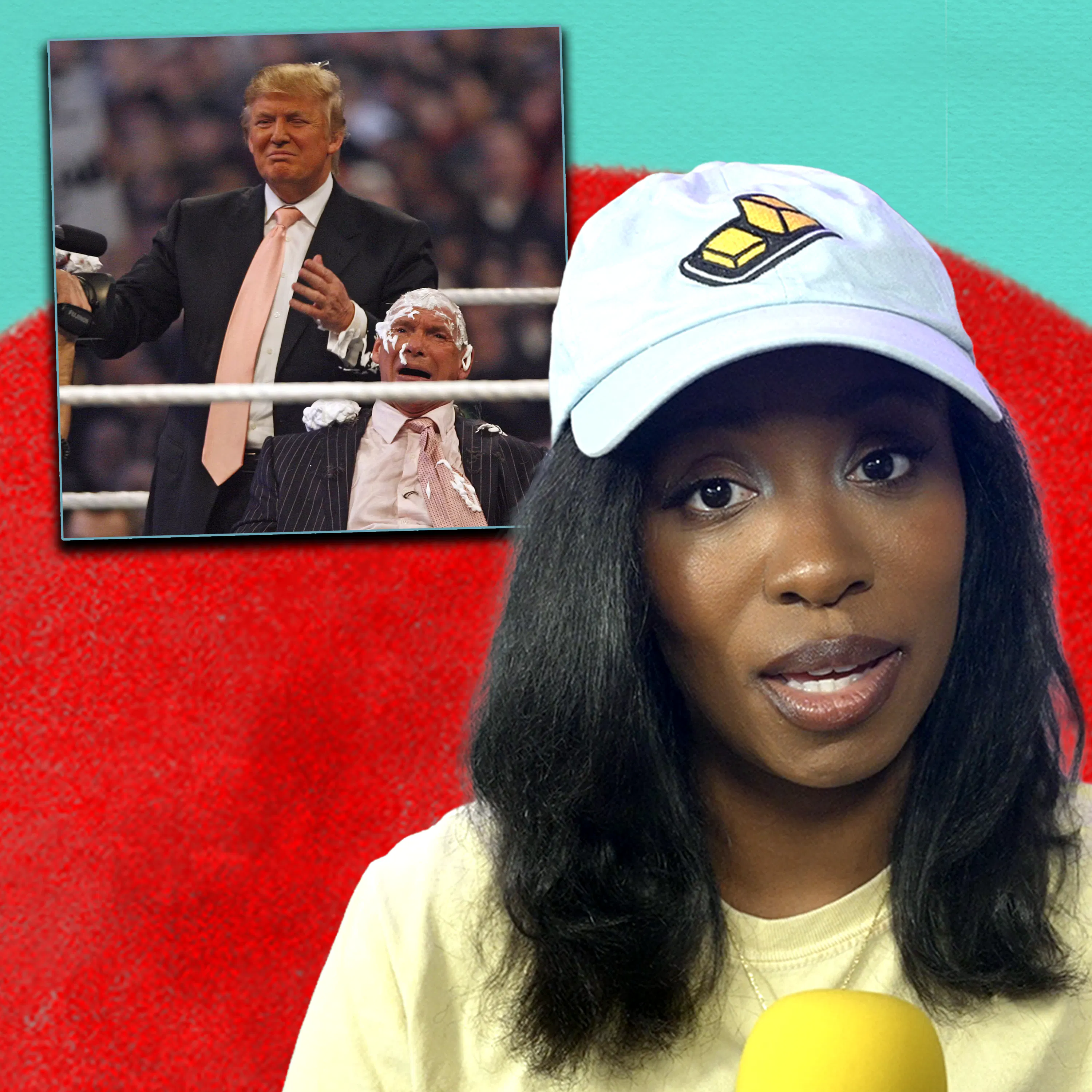
Well, I mean, I think politics and wrestling have always had one thing in common, which is lying to people. Wrestling is purposefully lying to you. It's saying this. What you're seeing right now in the. In the ring, in front of your face is real. And of course, it's not right. It's. I mean, it's real in the sense that, like, there are real fists and real feet. People are jumping and hurting themselves. It's an athletic contest that is predetermined, but it's still an athletic activity. But you're going out of your way to lie. And as a writer for wwe, it was our job to trick the audience, fool the audience, lead them one way so that we can get them to emotionally respond to a specific thing. Right? That's politics. You get up on stage and you. And you give a speech that promises things, that says things are a certain way when they're maybe not. And you're trying to inflame people's emotions. So it's very, very natural that wrestling and politics would eventually kind of meet in the middle. Obviously, Donald Trump has an experience in WWE. Multiple experiences. Right. He hosted WrestleManias 4 and 5 in the 80s at Trump Plaza in Atlantic City, and he also was at wrestlemania I believe 23 participating in what was called the battle of the billionaires, where Vince McMahon, Donald Trump had seconds, like wrestlers who would represent them and the losers wrestler would have to get their head shaved. And Trump shaved Vince McMahon's head.
- [02:58]
B
Oh, my God.
- [02:59]
C
And so he has that experience. He's in the WWE hall of Fame. So he understands just being in the public eye and being a tabloid celebrity, but also from being very intimate with Vince McMahon as a business person, as a character on screen. He understands what it takes to inflame a crowd. And that is really the power that he's been wielding since 2015.
- [03:26]
B
I am curious why one party has seemingly embraced this so wholeheartedly and like, two obviously great ends for them. And the response doesn't seem to at all understand wrestling. Like, what do you think is going on on the left that we're still trying the Obama hope and change tactics when the other side is hitting us with a metal chair in the ring?
- [03:50]
C
Well, I mean, it's, it's, it's simply. We're embarrassed, right? We're embarrassed to. Yeah. Oh, no. I would never watch pro wrestling. I would never think about how people are attracted to it or why they're attracted to it. I grew up watching it. I was 7, 8 years old when I started watching wrestling. And I was a fan, still a fan now my, my son is a fan. But most people of my socioeconomic background are embarrassed by it and think it's stupid. It's not stupid. It's actually a window into psychology and a window into how to curry favor with someone or how to make someone mad. Right. The heel, the bad guy is this figure that is more than happy to be showered with booze and anger and vitriol. That is the whole job of the heel in a wrestling match or in a wrestling story is to be so hated that you want to pay money to see them lose. And Donald Trump understands the power of being a heel. He's okay being hated. He is okay being the subject of ridicule. I mean, it obviously, like, pisses him off quite a bit. That's why he sues everyone who says anything mean about him. But, but I don't think people on the left are comfortable being hated. They want to be loved. Obama was a figure that people could rally behind because he was so nice and he was so well spoken and he was so handsome and all of these. The soft power of charisma versus the hard power of just sheer brazenness. And so that's the reason, I think, that the Democrats, certainly establishment Democrats, are so afraid of what it really takes to be that person that people say, I trust them or I want to see more of them or I'm interested in them.
- [05:39]
A
Right.
- [05:39]
B
And I think that, like, something that I bump up against consistently is, like, then who is the person that can beat Trump? And, like, obviously, Joe Biden beat Trump. My belief is, because it had everything to do with COVID and, like, the COVID response, like, we were all so sick of being told to just choke and drink bleach by someone who literally got the disease before there was a vaccine. It almost died that we all were like, you know what? I'll do anything not to have to keep listening to this. I think the media abandoned that because they wanted to get back to normal. And so there's no, you know, there's no responsibility placed on Trump for that anymore. But we have Joe Biden beating him. I think the right and the left were like, why? And now I think the question is, you know, Trump may try to run again. Trumpism is not going away. How do we combat it, do you think? Long winded intro, big preamble. But do you think that we need, like, the Rock, for example? Well, to run against him? Like, do we. I mean, the Rock might be a Republican, but do we think we need the Rock? Or, like, John Cena, somebody who's actually, like, wrestling prepared, can answer that, can overcome looking like a heel to become the person we're all cheering for. Like, is that even possible on the left? Are there people that you have in mind that have that kind of leverage?
- [07:05]
C
Well, I want to start by saying I would rather vote for a Rock than the Rock. If I was given the choice, I think the inanimate object might be more qualified. Second. You know, I don't. I don't. I don't know if there's anyone out there. There was. I had a lot of enthusiasm for Fetterman just because of his physical size that you put him next to JD Vance and it's like Andre the Giant and he's gonna eat the peanut. I don't. I don't know if there's anybody who screams pro wrestling on the left because, again, this is a respectability, politics business. When you think about the. The media apparatus of the. Of the Democratic Party, it's a lot of people. And this is no disrespect to Chris Hayes, but that look like Chris exactly. That are very, like, friendly. Like, hey, guys, you know, I'm. Yeah, like, all the Pod Save America guys are like, nice Guy clean.
- [08:04]
A
Too clean.
- [08:05]
B
They showered today.
- [08:07]
C
Trump looks like, you know, a soggy bag of mashed potatoes. He's got that scowl, and he looks.
- [08:15]
B
He's like an angry dad. He's like, I came home and the house wasn't right and the kids were afraid of him, and he's, like, kind of gross and slovenly.
- [08:24]
C
But you desperately want his approval. And I think a lot of people on the right want his approval. I don't know if there's that charisma on the left, because there's not that interest in it. Right. I mean, Gavin Newsom has a lot of faults, let's be honest. We're both in California, and so we have seen it for a long time. You know, when he was mayor, I was in college in San Francisco. Francisco. And he is as disingenuous as most people can be. Right. As a politician, he just has a lot of kind of slickness to him.
- [08:53]
B
Yes.
- [08:54]
C
But I think he. He handled the last month very well. I would still be concerned about him against a JD Vance type of figure, but I feel more positively towards him than before. Other than that, I just, you know, it's gonna be begging George Clooney or something like that.
- [09:15]
B
I mean, just. Yeah. To that end, I think that, like, we really are in this horrible moment where people have decided that politics is entertainment, has to be entertaining, has to be funny, has to be charismatic. Because, like, I'm from Kentucky. Andy Beshear is beloved in a deep red state. Like, he will never. If he could run forever for governor, he. They would make him the king. And yet he has no national appeal because he's not cool. He's not, like, a guy that people are, like, sick. I think he can, like, insult Trump in the right way where he's going to cry into his wig. It's like he's an earnest Southern man who's just, like, trans. People are people.
- [09:52]
C
Yeah. That was the thing about Biden. You know, the thing about Biden is he had that. That window of time where he was still very cogent and aware of what was happening. And he had the kind of bellicose nature that is appealing to people in the middle. Right. Like, oh, he could take him in a fight or he could return serve, you know, verbally with. With Trump. He's not going to back down. And I think, most crucially, he was not a woman. And misogyny is very much a part of our society and very much ingrained in our politics on a national level. Right. You know, the mayor of Los Angeles can be a woman, but the more people that you throw into the voting pool, the more likely it is that a woman is going to scare a lot of people. Totally. And Trump is two and, oh, against women and against one old man. He did lose. Right. Despite what the Republican Party might say, he did lose. So I think it has to. There has to be some masculine energy to it that feels icky to say no.
- [10:53]
B
It's just true.
- [10:54]
C
Yeah. Everything should be equal, right? We know where. We know where we live. If we could clone Jesse the Body Ventura and as a Democrat, I mean, I would be like, all right, sure. But he. Jesse Ventura was such a libertarian kind of kook ultimately, that even though he was able to be governor of Minnesota, I don't know if he would have had national appeal. I think he did try to run, like, in the Reform Party for president once or twice. Not sure that would have ever worked. But it was a different time back then. Right. Like, today is so different from the era when Jesse Ventura was first part of the political firmament. And I think, you know, if he was going today and wasn't, you know, working for WWE again, maybe, you know, he would have had a chance. They need Arnold Schwarzenegger to just be an American citizen.
- [11:51]
B
Somehow.
- [11:52]
C
I think Arnold would have also been a good option.
- [11:54]
B
But, yeah, he. Absolutely. That video with the katana, can you
- [11:59]
C
bring one of those to a debate?
- [12:00]
B
Right? Can he be like, this is the katana from whatever movie. Movie I'm lending. It was lent to me by Warner Brothers.
- [12:06]
C
A giant sword from Conan, and I think Trump would have wedded and your responsibility.
- [12:12]
B
We're all like, wow, we buy it. We're buying it.
- [12:14]
C
Yeah. This guy's cool as hell.
- [12:15]
B
You brought up WrestleMania in the 80s. Obviously, wrestling has gone through a lot of different phases. And I think, too, like, if we look at where our culture is in terms of just everything, I think that we're sort of at the end of Boomer's lifespan. Their peak power was in the 80s. And so do you think that maybe there'd be some hope in the idea that as these celebrities unfortunately rest in peace are dying off, maybe Trumpism will, too and will usher in a new generation and a new era? Or do you think that, like, it's actually just infecting everybody?
- [12:50]
C
Everything ends, Right? Like, I think that one of the real tragedies of the last 20 years for America is the kind of mistaken belief that electing a black president was going to solve all of our problems or that our problems had been solved. And that we'd gotten to this amazing point where we could do this thing where we prove to the world that we are really a multicultural society. Right. You couldn't, I couldn't imagine a black prime minister in the UK or even a black prime minister in Canada or various other countries that we kind of hold up as bastions of the old guard kind of liberal thinking. That just isn't going to happen. But it can happen here. And so we thought like, oh, this is great. We, you know, we figured it out. This is a new era, young people are behind this guy. And so everything is going to trickle down into, you know, a utopia. Right. It's just going to be better and better and better. But the reality is political movements end because most political movements that you've seen in the last half a century have been cult of personality based political movements. And so when that person goes away, the constituency goes away. It's not, this is not an ideas country in terms of the political landscape. It's a, it's a people country. It's a people business. Right. So when Clinton has his scandal. Scandal, excuse me, there was more than one. Yeah, listen, that guy got up to some stuff. Maybe, maybe, you know, not everyone needs problems. Yeah, exactly. Especially not, you know, that kind. So he, it was over for that movement. Al Gore wasn't Bill Clinton. And then George W. Bush was able to kind of cobble together a constituency or a coalition, so to speak, and that went away and people got sick of him after eight years. And I think we didn't get our fill of Trump, but I think we're getting to that point where maybe starting to get actually sick.
- [15:00]
B
I sure hope so.
- [15:01]
C
Fingers are crossed. You know, I'm rubbing my hands up.
- [15:04]
B
Right.
- [15:04]
C
And hoping, but I don't think there can be more. Right. You think about the, the bench of the Republican Party is, is this big, right? The Knicks have a deeper bench than the Republicans. J.D. vance is J.D. vance.
- [15:20]
B
And I don't know that he has fans. I think if tomorrow Trump threw him off of a building, people would be like, okay, people don't even like that book anymore.
- [15:28]
C
People don't even like his book. I mean, come on. Yeah, that's a wash, right? And everybody else that's in this kind of Trump world is there because they're less charismatic than him, because they're less interesting than him, because they're less appealing than him and they're willing to be barnacles on this giant oil tanker called maga. Right?
- [15:49]
B
Yeah.
- [15:49]
C
Who is there? Name me one person in the Republican Party today that would be able to pick up that flag and run with it. So, no, I don't believe that this is going to continue on forever. I think some of the terrible discourse, the emotional inflaming of politics will continue, but this very moment will not. Obama did not have a successor, and we saw that. Yeah, we've seen it in practice. So you put that really charismatic person on a pedestal. You get eight years or four years or whatever of that person, and then they go away.
- [16:30]
B
Exactly.
- [16:30]
C
Find somebody else, guys. The Democrats need to start looking for someone today, yesterday.
- [16:38]
A
We'll be right back.
- [16:46]
D
Right now, news and politics are moving awfully fast. It can feel overwhelming, to say the least. I'm Evan Osnos, a staff writer for the New Yorker. On the Political Scene podcast. We slow things down to understand how power really operates in Washington, D.C. and what it means for you. My co hosts Jane Mayer and Susan Glasser and I have decades of reporting experience. And every Friday we have conversations with insiders and experts to understand the forces remaking America. Join us Fridays for the Washington Roundtable from the Political Scene. On Mondays and Wednesdays, you can also hear insightful episodes from our New Yorker colleagues, David Remnick and Tyler Fogg, available wherever you get your podcasts.
- [17:37]
B
I guess I want to touch a little bit on your experience writing for the wwe, because I think, you know, obviously before you worked there, you were familiar with it, but you were also a political person, a person who's aware of what's happening sort of on the national level, international level. When you're in that writer's room, like, coming up with the storylines and sort of elevating a wrestler to that next level, like, okay, we're gonna have them fight someone bigger than them or more important than them, and, like, this is their sort of moment to rise, I guess, just like, paralleling with what we're hoping the left can cobble together. Like, what do you look for in that person? Or is it, like, put to you by a showrunner that it's like, this is the person, so make them the king? How does that happen?
- [18:21]
C
Oh, boy. I mean, it's. It's definitely not the. The writers room's decision, right?
- [18:26]
B
Back then you're gonna choose your fave.
- [18:28]
C
No, back then, it was Vince McMahon, you know, who was the. The person who decided, oh, this is. This is a big star. This is not. This person's winning. This person's not. This person's main eventing WrestleMania. This person isn't. But it was our job to Facilitate that vision and find ways to get people over, so to speak. To get over is to be popular with the audience or to be hated by the audience. And when I was there in 2019, the story had been built before I even got there. But then, you know, when I got there, I was part of, kind of the end of it is this wrestler, Kofi Kingston, who was in this group called the New Day. And these are the three black wrestlers. They would, you know, one of them plays the trombone, and they wear bright colors, and they would come out with cereal and throw cereal at the crowd. And they were very popular, but they had never really broken out as singles wrestlers and big stars on that level. And our job was to get Kofi Kingston to the point where he could win the WWE Championship from Daniel Bryan at WrestleMania 35 in New Jersey at the MetLife Stadium. And there was an undercurrent the whole time of like, he's, yeah, how are
- [19:38]
B
you going to win everybody over?
- [19:40]
C
Right? But also that had to be part of the story that he was black, but without saying, you shouldn't be champion because you're black. But there was. Vince McMahon would come, come out and say, you know, I don't think people like you should be champion. People like you aren't typically champion. You're a B player was a line. And it was our job to listen to the crowd that wanted him to be champion and find a way to get everybody else on board. And leaning into the underdog status, leaning into the fact that he isn't supposed to be there, makes you want it more, because you want to see that guy that you identify with triumph. And I think that's. That was true of Obama, is he's the underdog. Hillary Clinton has all the money. She's got all the support of the. Of the establishment. But we really love this guy, and he makes us feel great. And you could listen to the crowds when they were. When he was speaking, and you could hear how, like, in love with him that they were. That was true of Trump, too. I was covering the Nevada caucus in 2016 for the Guardian, and I could hear the crowd. And I knew because I was a wrestling fan, right? I'm like, oh, this guy's over. They love him.
- [20:56]
B
Yeah, yeah, it's official. Yeah.
- [20:58]
C
And so somebody in the Democratic establishment, dnc, you know, someone strategists on the level of a James Carville, someone like that, needs to think about how you get people to love someone, and they need a story, a coherent story, and they need to feel like an underdog. They need to feel like they. They're trying really hard. And Trump felt like an underdog on that stage of, like, 20 candidates and 26, 2015, 2016, during the primaries, he felt like the underdog. And he's constantly jabbing and throwing, throwing barbs at Chris Christie or Marco Rubio. And so he had that energy behind him as a baby face, as a good guy. Baby face is a wrestling term for a good guy. I don't think Kamala had that. Kamala didn't have that kind of pugilistic, underdog baby face. Sort of like, we're really rooting for her. It's more like, please don't lose. Don't blow this.
- [21:52]
B
Do it. And I also, like, I mean, to your point, about, like, I mean, the misogyny in this country, like, I don't know that women get to come in as an underdog. I think that that is, like, in the same way that, like, boys will be boys, and he's just learning, and he let him grow up. It's like, she's got to be ready, and people don't really want to vote for or rock with the person who looks too ready. And I think that, like, women, especially women her age who, like, have had to come up in a time where it was like, you have to be outwardly better, then he's been like, she can't come in and, like, make a mistake and then have us circle around her. It's like, the moment there's an ounce of cringe, it sucks. And so, like, I think it's all really fascinating. Something that I keep coming back to is, like, the Internet discourse about, like, divorced dads. And it's like, Trump's a divorced dad. Like, okay, so. But your energy doesn't suck. And then there's, like, Elon Musk with his terrible energy. And so, like, it's sort of the discourse that I have seen is that Trump represents this, like, divorced dad who's doing the best he can for his family. And then you have this bitch wife, Kamala, that, like, we're supposed to be voting for. And how do we over. How does the Democratic Party and as the left overcome the bitch wife who wants you to eat your vegetables? It has regulations. It doesn't want you to call people the arsler and all of that as, like, some sort of baggage. Like, how does that become cool? Do we need a pizza party? Like, what is it?
- [23:21]
C
Well, I mean, as a divorced dad, I can say that divorce is kind of like a wrestling match and being A parent with someone else that you don't live with is kind of like a wrestling match and that you go back and forth between being the baby face and the heel to the kid or to relatives or to their relatives or whatever. And it's about perception. The best you can do is the best you can do. But in the case of the Democratic Party, how do you make being a good person cool again? I don't know. I don't know because I feel like it was right, but I think it's.
- [23:54]
B
It was.
- [23:54]
C
Everything goes back and forth from 2008 to 2015. It was like the media was tailored to a lot of our interests, a lot of our morals, a lot of our goals and hopes and dreams for society. Something like Broad City would not exist in the modern media landscape. Right. People would just kind of be like, this is. This is hokey. Or like, yeah, this is woke and stupid.
- [24:22]
B
Why two girls?
- [24:24]
C
I don't know what will make it go back other than people getting sick of the way things are. And people are constantly getting sick of the way things are all the time, over and over again. We're like, I don't had enough of this. It's sort of like you're scrolling through YouTube and you're looking for something to watch and you watch some, you know, vlogger or video essay and you learn a couple things. You're like, I'm tired of this. This is going to be another hour, so I'm going to go to something else. Then you watch a let's play video game video, or you watch a makeup tutorial, and you just keep going back and forth between all of these different videos because you can, because you have the option. Not because you need to, but because, well, I don't have to watch this. And I think the American electorate says, I, I don't have to do this anymore. I want to do something else. I'm bored. And Exactly.
- [25:15]
B
I want to feel good for once.
- [25:16]
C
You periodically press the button, blow everything up, and then someone comes along to put it back together. And then we're like, we're bored again. It's like a kid building a Lego set. This is fine, Smash.
- [25:26]
B
Right, Exactly. I don't want this anymore.
- [25:29]
A
Right.
- [25:30]
B
Okay. That gives me a little bit of hope. That feels like there's something next. I think that that is what I bump into because also, like, the fact that wrestling has such longevity in, like, American culture, I mean, especially, you know, it. It's just in my mind, so much newer than, like, something like baseball, that the fact that it's had its, you know, lulls, obviously. Like, I grew up in the sort of vader time, like 2000.
- [25:55]
C
I love Vader.
- [25:56]
B
Love Vader. We love Vader.
- [25:59]
C
Yeah, yeah, yeah, yeah.
- [26:01]
B
And then it was, like, kind of. Not that I feel like there was a downslide, like, after the Rock kind of graduated out. Then we get this new era, and it's huge. It's maybe bigger than ever. And so I'm wondering, like, with that in mind, like, I guess just looking at the longevity of something that feels sort of one offy, like, how is. How does wrestling decide what's next? Like, how did they maintain their cultural relevance and, like, coolness?
- [26:30]
C
Wrestling is America. You know, it is. It is the most American art form, even though it's practiced in. In Mexico, Japan, other countries, the uk, you know, and they all have a wrestling tradition. They're all slightly different. But America is really the country where the carnival barker and the kind of the. The kayfabe, the show of it all became so popular, you know, in the. In the 20th century. And Vince McMahon took a very popular activity, going to see wrestling and made it even more popular by having it appeal to, you know, the masses in the Northeast and then all over the country. But he did that by putting his finger on the pulse of the country and taking its temperature over and over and over again. So Hulk Hogan in the 80s is an American hero. He makes you say your prayers and take your vitamins and all of these kind of things that he didn't actually believe because he is a horrible racist.
- [27:31]
B
He sucks.
- [27:32]
C
Disgusting human being.
- [27:33]
B
I'll go on the record. Hulk Hogan sucks.
- [27:37]
C
Happy to tell you. I was at Monday Night Raw at the beginning of the year, and Hulk Hogan came out to like to say hi to the crowd, and we booed him mercilessly. It was good. He's good. But then that stops being cool. Right. The steroid trial kind of tainted WWE. Vince McMahon was accused of distributing steroids, and that was kind of the beginning of it. Coarsening and not being as interesting to people. And there was a kind of a lull where it wasn't so popular kind of around the time Vader was around.
- [28:07]
B
Yeah.
- [28:09]
C
And then Stone Cold Steve Austin and the NWO and the Rock.
- [28:12]
B
Yeah. Triple X, the Suck it Triple H. Dx.
- [28:16]
C
Dx.
- [28:16]
B
Dx. That's right. That's right. Dx. Okay.
- [28:18]
C
Generation X. All of this kind of, like, gross, very misogynist, very homophobic, borderline racist kind of wrestling storytelling became popular because that was in the zeitgeist we Forget in the 2000s, specifically late 90s, into the early 2000s, and then kind of through the 911 era, our culture was very crass.
- [28:43]
B
Yeah.
- [28:43]
C
Howard Stern wasn't the kindly old Jewish man who interviews celebrities. He was having, you know, midgets. You shit on people. I don't know.
- [28:50]
B
Literally. Literally. Yeah.
- [28:52]
C
It was. We had the man show.
- [28:55]
B
It was like asking all of the girls what size implants they had.
- [28:59]
C
Exactly. Right. Like this is not. All of this stuff that we're experiencing is not new stuff.
- [29:04]
A
Right.
- [29:05]
C
And WWE was kind of the canary in the coal mine of south park. And Howard Stern and all of that stuff, Girls Gone Wild, that was part of the zeitgeist. And they had to do that to keep up with the culture. And then there's kind of a period of time where the Obama era is happening and they're not really sure what to do. And John Cena appears. And John Cena, of course, is a huge star today and is doing a white rapper gimmick. Or at least he was the beginning.
- [29:32]
B
That's what he started.
- [29:33]
C
Yes. So I think John Cena presaged Obama a little bit and that races and cultures can combine and we can have a white rapper be.
- [29:42]
B
Yeah. Only in this country is his story possible.
- [29:45]
C
Right, right. And. And now, you know, what is. What is culture? What is. How is WWE reflecting culture? I think, you know, you look at the fact that Cody Rhodes, who has been the kind of standard bearer of the company for a long time, is a white guy from Georgia with a black wife who has it neck tattoo of a flag.
- [30:09]
B
Yes.
- [30:10]
C
Like there's something that's like, it's almost confusing what his. What the message of WWE is besides let's make a lot of money. And I think it's different because Vince McMahon is not in charge and now his son in law, Triple H is, is in charge of the creative. And TKO, which is owned by Ari Emanuel, owns WWE.
- [30:29]
B
Wow.
- [30:31]
C
There's. It's less an auteur vision like Vince McMahon was the auteur of this never ending mov. Yeah.
- [30:38]
B
This was his cinema veritas.
- [30:40]
C
It was cinema for him. And so it's not as clear what that message is, but I do think that you can look to wrestling to see what's coming next and what will be appealing to people on a broad basis. And so maybe Cody Rhodes should run for president. I don't know.
- [31:00]
B
Yeah. That's what I'm saying. It seems like there's got to be somebody like that with some level of mass appeal, or at least confusing enough that people are like, I'll give it a shot. Because I think that's the other thing. If people think they can reduce you to one thing on the left, then you're out.
- [31:15]
C
One thing that I think is important to note about WWE in this era, Donald Trump goes to UFC fights all the time. The protests are happening, and he's at a UFC fight. You know, that's like. That says something. That's his base, right. And he goes there, and he gets all the adulation and approval and respect. And TKO group obviously has, you know, some sort of ties to Trump. And his Secretary of education is Linda McMahon. Vince McMahon's estranged wife, Triple H, and his wife Stephanie McMahon, are constantly at the White House. They post for photos with rfk, and there's clearly connections there. Right. But you know where Donald Trump never shows his face? Wwe. And you know why? Because it's confusing. It's not ideologically pure in the way the US Is, and it's trying to appeal to a broad section of the population. And so that's why I again say look to pro wrestling and the kinds of characters that are popular in pro wrestling to find a way to craft a Persona for a politician. And these are Personas like, let's. Let's not pretend that all these people are constantly real all the time. It's about approximating authenticity. It's not being truly authentic because our true authentic selves are scary.
- [32:36]
B
We're sad, are not comfortable.
- [32:39]
C
Yeah, we get. We get scared. We get angry. We have negative thoughts or thoughts that we. Antisocial thoughts, or we're really depressed about something. Like, people don't need that people don't like. Yeah. Emotional needs, physical needs, all these needs, career needs. We were these kind of sponges that are sucking up affection, and it's. It's ugly. Right. So it's all these politicians, celebrities, wrestlers. They're putting on a show for. For the world. We need to find someone who can put on a show for the world that is appealing. And I think if you look at Cody Rhodes or other good guys in wwe, there is a certain amount of vulnerability. There's a certain amount of grit and toughness, but also emotional introspection. But at the same time, if you're kind of like you're too soft, then nobody wants to see you get in a fight. So you still have to be tough.
- [33:33]
B
Yeah, there's got. It's like a. It's a delicate balance.
- [33:36]
C
Yeah. So, I mean, I think that wrestlers are always pretending wrestlers are Also always trying to carve out a constituency of their own. Right, there's what they believe, but there's also like, well, if I believe it even more and I get into a fight with somebody who believes the opposite, people will want to see more of me and more of them. And it's, it's, it. Wrestling is about inflaming emotions. And so when, when Hulk Hogan like really veers far to the right and shows up at the Republican National Convention, that is not just the Republican Party saying, we want Hulk Hogan the symbol of American virtue, even though he's a racist. On our show, Hulk Hogan sees it as a chance to get his face out there, to get people excited about him, to sell his disgusting beer. It's self promotion that never stops. And so every wrestler is constantly promoting themselves. CM Punk is a WWE wrestler and when he was in aew, the, the competing company against WWE owned by Tony Khan, he would wear Protect Trans Kids T shirts and all kinds of stuff. And he was very like visibly putting that out there that he is this, he's this liberal kind of thinker. Well, he's back in WWE under the beautiful corporate umbrella of tko. And he had said years prior, I will I going to Saudi Arabia to wrestle is disgusting and you're taking blood money. Well, he's wrestling in Saudi Arabia in like a week against John Cena. He doesn't wear those T shirts anymore. He still will, you know, kind of nod to, to things about Gaza and other, other liberal causes on social media, but it's not the same. So he's trying to maintain that fan base and maintain that, that image of himself. But at the end of the day, it's about money. And for all those guys, it's about money. That is the thing I learned the most about wrestling is that wrestlers are in the world to make money. I think that all of those people who get into wrestling who find wrestling appealing are con artists on some level. I'm not saying all of them are bad people because there are a lot of great people in wrestling, but in order to succeed, you have to be a con artist of some sort because you are lying to people. I think actors have that quality as well. And why a lot of wrestlers are good actors is because you are faking something. You are, you know how to turn the switch on and off for your Persona, for your character, but you also know how to elicit a response from a person. You know how to, to, to make someone feel something. If it's a head nod, if it's, if It's a twitch if it's something. If it's reaching out and grabbing a pear instead of an apple off the table or whatever it is. You know how to engender emotional response from an audience. And for wrestlers, every time they can do that, they say oh, I smell money or that's, that's money or something like that. Because they know that that is going to lead to someone buying your T shirt, buying a ticket to see you wrestle, buying a pay per view event, going to a live show, whatever it is, right? Going to get a signature. Mick Foley who is very vocal about his politics. He lives off of going to conventions and signing autographs and personal appearances. He needs people to like him in order to monetize himself. I don't need that. Thank God. I'm barely on social media anymore. Those days are beyond, beyond me. They're past. I'm old enough to just not care. But my career can be about other things. Wrestlers never outgrow that need for a approval and attention because it is tied to their livelihood. And I think that's true of politicians as well. They know that attention, approval, approval ratings are tied to their livelihood.
- [37:49]
A
Absolutely. That was Dave Schilling. He is a writer, humorist and podcast producer who recently wrote and directed an independent film called Can't Float about quote, a 30 something year old black man who confronts his lifelong fear of the water and the weight of us historical stereotypes about black people and swimming as he commits to finally learning how to swim. I hope you enjoyed the conversation and we'll be back next week with a new video on mixed martial arts and politics because, well, Donald Trump is in office and that's a thing. Stay tuned, we'll see you next week.
- [38:34]
B
How Is this Better?
- [38:35]
A
Is a production of Courier. It's written and hosted by me, Akilah Hughes. It is produced by Devin Maroney. Video editing is by Shane Verkus. The rest of the team at Courier includes Marianne Kuga, Sam Hollows and Charlotte Robertson. Please subscribe to follow How Is this Better? On all the platforms, YouTube, Apple, podcasts, Spotify, etc. And tell someone about your favorite episodes. If you're interested in sponsoring episodes or giving us products to try and try to sell, reach out to advertiseurion.com thanks for listening and until next time, see ya.
- [39:17]
C
Sam.