Loading summary
Transcript97 lines
- [00:01]
Akilah Hughes
This episode is brought to you by JCPenney.
- [00:03]
Ryan Broderick
And if you've been to JCPenney recently.
- [00:05]
Akilah Hughes
Yes, JCPenney, you'll know it's becoming the.
- [00:09]
Ryan Broderick
Way to find good clothes for prices.
- [00:11]
Akilah Hughes
That still make sense. They've got hidden gems for everyone and.
- [00:14]
Ryan Broderick
Every budget, with deals and rewards that.
- [00:16]
Akilah Hughes
Actually make a dent. If you already shop JCPenney, you feel like you know a secret. But if not, it's time to ask. Wait, am I sleeping on JCPenney? Shopjcpenney.com Yes, JCPenney.
- [00:29]
Ryan Broderick
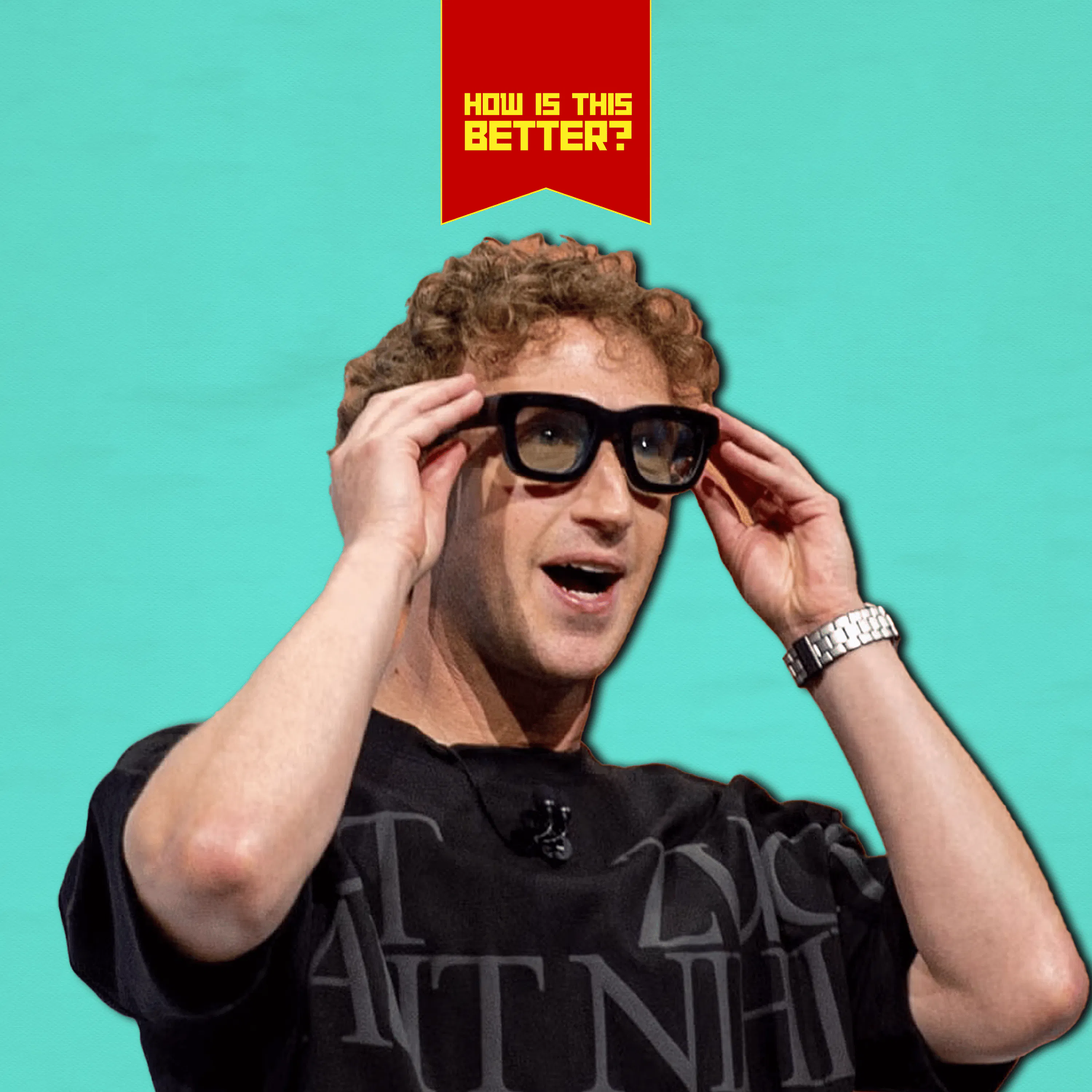
The election misinformation that really proliferated. 2020, Cambridge Analytica, that huge scandal. There's hate speech and, you know, radicalizing people. There's obviously the Instagram and teenage girls body image issues of it all. And then there's, of course, Myanmar. Facebook has a hand, and I think all of this, and obviously it can't be reduced to one person's impact, but do you think he gives a shit? It's quite a list, and it's not even the half of it. We live in a timeline where for some reason, we have to know and care about the people who make the products we use every day. I was content to not know, feeling it's none of my business. I just use it, you know, I don't know who invented the refrigerator, for example. Doesn't mean I don't appreciate it. But as stated, now we know we are intimately familiar with these men. And unfortunately, a lot of these Captain of industry types are giving at best awkward loner nerds and at worst, megalomaniacal incels. Somewhere in that Venn diagram lies Mark Zuckerberg, the millennial that holds half of the total wealth of the generation and who seemingly gave up on his overstated mission of making the world a better place. Sometime around 2015, he traded his engineer hoodie for a tall tee and a chain. No comment. And is content to appropriate every original app you love until the Internet is nothing but his personal. All from the comfort of his doomsday bunker. You do have a bunker there. Is there something you know that we don't?
- [02:03]
Akilah Hughes
No, I think that's just like a little shelter under. It's like a basement.
- [02:07]
Ryan Broderick
A little shelter. What are you worried about? Sure. Mark. I'm Akilah Hughes, and today I'm investigating the evolution of Mark Zuckerberg. In the increasingly digitally connected but socially isolated society, he's had an oversized hand in shaping. And to both asking the question, I always ask, how is this better? When you hear the name Mark Zuckerberg, what comes to mind.
- [02:32]
Akilah Hughes
I think about a rumor that I heard recently that he only eats chicken nuggets. That's the my current picture of him. In my head, I hear that he has, like, a personal chef makes artisanal chicken nuggets for him, which I feel like sums it all up quite well.
- [02:46]
Ryan Broderick
This is Ryan Broderick, host of the Panic World podcast, creator and writer, behind the Garbage Day newsletter, and prolific Internet poster. If anybody can synthesize how Zuckerberg was perceived by the public, it it's him, right? Doesn't it seem like he's sort of like a man baby, but rich?
- [03:02]
Akilah Hughes
Yeah, he's definitely stunted. I mean, I once read like a list of, like, the most influential millennials, and this was a couple years ago, and it was like, Mark Zuckerberg, MBS in Saudi Arabia, like, Stephen Miller. And I was like, oh, damn. Like, we are bad.
- [03:16]
Ryan Broderick
Yeah, we're down bad.
- [03:17]
Akilah Hughes
Damn, we're really bad. But if we're talking about, like, Mark Zuckerberg as a person, I think there's obviously the Mark Zuckerberg from the Social Network movie, the kind of like, Harvard Mark Zuckerberg. And then there's the, like, Obama era ice bucket challenge Mark Zuckerberg who's like, looks like he's in an okay, go music video. Like that kind of guy.
- [03:36]
Ryan Broderick
Right? He was peak millennial in that time.
- [03:38]
Akilah Hughes
And then there's like, congressional hearing, late stage Trump era Mark Zuckerberg. And now we have like, Muay Thai fighter, super bro, artisanal chicken nuggets, man, Mark Zuckerberg wearing like a Gen Z chain on a big shirt. Like that kind of thing.
- [03:53]
Ryan Broderick
Yes. Now that Ryan's laid out the different eras, let's look a little more close at the evolution of his personal mission.
- [03:59]
Akilah Hughes
Going public is an important milestone in our history. But here's the thing. Our mission isn't to be a public company. Our mission is to make the world more open and connected.
- [04:12]
Ryan Broderick
That evolution after the break.
- [04:19]
Akilah Hughes
This episode is brought to you by LifeLock. Between two factor authentication, strong passwords and a VPN, you try to be in control of how your info is protected.
- [04:28]
Ryan Broderick
But many other places also have it.
- [04:30]
Steven Levy
And they might not be as careful.
- [04:32]
Akilah Hughes
That's why LifeLock monitors hundreds of millions of data points a second for threats. If your identity is stolen, they'll fix it, guaranteed, or your money back.
- [04:41]
Steven Levy
Save up to 40% your first year.
- [04:43]
Akilah Hughes
Visit lifelock.com podcast for 40% off terms apply. Living with schizophrenia isn't easy, especially when.
- [04:52]
Ryan Broderick
You'Re not getting relief from Some of your symptoms. It can be hard when you're still dealing with symptoms like hearing voices or seeing things that aren't there, and negative symptoms like feeling unmotivated or avoiding social situations. If this sounds familiar, it might be.
- [05:07]
Akilah Hughes
Time to talk to your healthcare provider.
- [05:09]
Ryan Broderick
And explore a different kind of schizophrenia treatment. Discover your possibilities@treatingscz.com.
- [05:18]
Steven Levy
It sort of came on my radar maybe a little over a year into it, as something the college kids used. And I met mark in early 2006.
- [05:29]
Ryan Broderick
This is Steven Levy, journalist and author of the Inside Story.
- [05:34]
Steven Levy
Facebook was about two years old. It was a kind of awkward meeting. He could hardly answer my questions when I started asking. But a year later, I think is when you really felt that Facebook was going to break through. I think the moment was when they decided to build a platform. People don't remember much about this, but they, they thought that Facebook would be a platform that people would write applic for like you do with the iPhone. They launched it and it had a lot of second order effects. Right now people don't really use Facebook for that. But back then you could see the ambitions and how this was going to be really important. I was working at Newsweek at the time and we thought, wow, we really should do a cover story about this company which is breaking through. Other people have the same idea. They were kind of deluged and they tried to say no. We thought, whoa, you know what? The COVID of Newsweek back then, actually.
- [06:29]
Ryan Broderick
Newsweek meant something publishing generally.
- [06:33]
Steven Levy
But we decided we'd do it anyway. And he blinked at the last minute and cooperated. So we did a cover story on Facebook at Newsweek. And of course I kept up with it since then and it just got bigger and bigger and bigger.
- [06:47]
Ryan Broderick
In those early days though, not everyone was sold on Facebook.
- [06:51]
Akilah Hughes
I was resistant to, no, I wasn't resistant to it. I was curious about it. And I actually want to set the stage here with like a. This incredible study that I try to plug every time I talk about this era because I think it's like very important for understanding like kind of why Facebook wanted MySpace didn't. So your listeners can, can kind of like Google this. I'm not going to try to like get the title right, but it's really good. I believe the title is Digital Ghettos. I think that's actually what it's called. And it was describing the, the sort of reason for Facebook taking off. And it argues that because it locked its user base behind college email addresses, it created one of the first instances of like class dynamics playing out Online.
- [07:29]
Ryan Broderick
The study Ryan mentioned comes from a chapter of a book called Digital race anthology. It explores how during the mid-2000s, American teenagers choices between MySpace and Facebook were influenced by race and class dynamics.
- [07:43]
Akilah Hughes
So you very quickly got this feeling of like, oh well, like the non college educated or the, maybe the working class or poor people, they're on MySpace, right? And then you have like the Harvard kids first, then you have the Ivy League second, then you have college kids third on Facebook. So by the time that I joined Facebook in 2006, probably 2007, they had just opened it up beyond college kids. And so very quickly to me, and I was a MySpace power because you can see my haircut now, obviously.
- [08:12]
Ryan Broderick
Yeah, same. I'm always going to be an emo kid.
- [08:14]
Akilah Hughes
In 2005 I remember sort of the junk ification of MySpace happening very quickly, where all of a sudden it was just like juggalos and like your town's weed dealer on MySpace. And it was like everyone else was moving to yes. And that for me was around 2006, 2007.
- [08:29]
Ryan Broderick
So with Facebook, the newly released, newly gentrified MySpace.com clone, Zuckerberg continued his ascent in the public consciousness. Mark was absolutely revered as Facebook grew to a billion users and revolutionized the way people connect online. A few Obama years pass and Facebook's popularity has exploded. This is a new era in the Mark. The world should be better thanks to my contribution. Zuckerberg's contribution evolution. By 2010, we have Aaron Sorkin making an Oscar movie about the guy. And to this day we have tech bros and reporters glazing him, talking endlessly about his genius, when in reality what they seem to admire is his wealth. A lot of people like to believe that if they were smarter, they'd also be as rich as Mark Zuckerberg. But that's not how intelligence or money works. I'm going to hold your hand when I say this. You're never going to be as rich as Mark Zuckerberg. But then something changed. With the rise of Trump and general fascism came the indignation of a man who was no longer the progressive's golden child, but rather a middle aged man trying to remain relevant by purchasing or copying all the newer, younger, better apps. There was also the scandal that helped lead to that rise. Cambridge Analytica, which forced Zuck to testify before Congress and led to his short lived crusade against misinformation on his dying platform. The pedestal he'd been given as the millennial wunderkind using tech to welcome the future was imploding. Beneath him. In short, Mark was in his flop era, despised by the left and right through Donald Trump's first term. Fast forward to 2020, and the madness of the pandemic and presidential election in the States has caused mass delusion. And tech moguls see an opportunity. Famously a big moment for Zoom. For Mark Zuckerberg, this manifests in throwing everything into the metaverse, something that maybe he saw as making the world a better place, but everyone else saw as a joke. I also play video games as a sidebar. And so, like, seeing Mark Zuckerberg sink, I mean, a billion billions of dollars, who knows, lots of money into the metaverse when Fortnite already looks a billion times better. What was he thinking? Is it yes Men in the same way that Kanye has Yes Men? Is it the yes Men in the same way that Trump has Yes Men, where every idea is so great? You are such a genius. Yes, do it. Change the name of your company.
- [10:46]
Akilah Hughes
Even my understanding is no, no. Like they had Oculus Labs or whatever running. They had that already. It seems like very much, if not a singular idea from him. Like, it does seem like it was coming from him. And. And I mean, you could say that, like, those are yes men, but I. I don't. I don't think of it as the same way as like, people whispering in Trump's ear to get something done. This seems like something that, like, Zuckerberg was very fired up about. And here's the tell that this, that this seems like something that Zuckerberg was really interested in. I have two Oculus is right here. I use them to review stuff years ago. They are covered in dust. I have not touc them in years. But I was reviewing one of the Oculuses for a story in like, let's say 2021 or 2022. Like, lockdowns are still kind of happening. My girlfriend at the time and I are up. I'm at home, Massachusetts, with my family, and I was like, oh, I got to review this thing. You want to play Beat Saber? And so I had my parents over and we played Beat Saber and it was actually really fun. Beat Saber rips. It's great.
- [11:43]
Ryan Broderick
Yeah.
- [11:44]
Akilah Hughes
But this is how I know this is like a Zuckerberg idea. There is no way to share a communal experience of playing Beat Sa.
- [11:51]
Ryan Broderick
Right.
- [11:51]
Akilah Hughes
We had to come up with like, this janky ass system where I'd plug an iPad into the TV and then see it wirelessly. Yeah. And it's on a delay, so you can't even hear the music because the Music delay outside is screwing up the music in your ears. There's no in person way to share this very fun communal activity simply at home. And that, to me, screams Mark Zuckerberg. Because there's no way he even thought that that would happen.
- [12:14]
Ryan Broderick
Right. He was like, who else would see it?
- [12:16]
Akilah Hughes
Beat Saber is so fun. Imagine a genuine, like, party game version of Beat Saber through Oculus that could just, like, go through the computer somehow, or the TV or whatever. No. And that, to me, just screams Mark Zuckerberg.
- [12:27]
Ryan Broderick
Right. Because it's also like, we're all at home and no one's innovating. Like the, like, the couch gaming experience, where we're like. They're like, no, no, no. Because you would just talk to your friends who aren't in your house. I'm like, but what if you have a family? He's like, oh, he doesn't talk to his kids anyway.
- [12:41]
Akilah Hughes
What, all of the family members are going to sit with their headsets on and talk to each other in Metaverse? Are you out of your mind? That is the most sad, dystopian, dark thing I could imagine. Like, and of course, for him, he's not even thinking about.
- [12:52]
Ryan Broderick
Yes. And that's the thing. It's like that. What makes it out of touch, I think, is, like, he is isolated, and so he is creating for an isolated society. And I think that, like, he's solving a problem that I think he is also the force behind in a lot of ways.
- [13:05]
Akilah Hughes
Yes.
- [13:06]
Ryan Broderick
Where it's like, if we all lost WI FI connection for, like, I don't know if you saw relatively recently. I think it was in, like, Portugal and a few other countries. There was just like, the power went down. And so there's all of these just images of people playing cards in the park and, like, talking to people. And, like, they have, like, you know, a wireless radio and they're all just like, cool, we're vibing, we're outside. I mean, obviously that society isn't going to come back, you know, in full. But, like, clearly, you know, the fact that those images went viral on TikTok and everywhere else, because the world was like, oh, yeah, we could touch grass. Like, he's not innovating in the direction of grass.
- [13:40]
Akilah Hughes
No, I mean, it's a. It's a threat to his business model. It's the same way that, like, Netflix will never allow theatrical releases because their business model is killing the human connection of a movie theater. But Facebook, is that for everything? Yeah, like, physical connection is a threat to Facebook is a threat to meta. And if they can't figure out a way to insert themselves in between those interactions, they don't want them to exist. You can't really even talk about these websites with now without acknowledging that that is at minimum what they're trying to do. At minimum.
- [14:16]
Ryan Broderick
A closer look at Mark Zuckerberg's final form after the break at Capella University.
- [14:33]
Akilah Hughes
Learning online doesn't mean learning alone.
- [14:37]
Ryan Broderick
You'll get support from people who care about your success, like your enrollment specialist who gets to know you and the goals you'd like to achieve. You'll also get a designated academic coach who's with you throughout your entire program.
- [14:51]
Akilah Hughes
Plus, career coaches are available to help.
- [14:53]
Ryan Broderick
You navigate your professional goals. A different future is closer than you think with Capella University. Learn more at Capella. Edu hey guys, have you heard of Goldbelly? It's this amazing site where they ship the most iconic famous foods from restaurants across the country, anywhere, nationwide. I've never found a more perfect gift than food. Gold Belly Ship, Chicago Deep dish pizza, New York bagels, Maine lobster rolls, and even Ina Garden's famous cakes. So if you're looking for a gift for the food lover in your life, head to goldbelly.com and get 20% off your first order with promo code GIFT. That's goldbelly.com, promo code GIFT. At the same time Zuckerberg was doubling down on this isolated vision, he was also going through a pretty visible midlife crisis. You may remember the sweet baby rays, that weird pic of him painted like a ghost floating above the ocean. This final era of Mark Zuckerberg feels pretty cursed. The Ovan may have described it best when he said this to Zuckerberg.
- [15:53]
Akilah Hughes
Yeah, you seem like a guy who probably, like, watched a video of how to be a guy on YouTube or something.
- [15:59]
Ryan Broderick
You know, it's unclear who he's even trying to appeal to anymore, and very clear that whoever that is, it's not working.
- [16:07]
Steven Levy
In the most recent evolution of Mark Zuckerberg, he's passed it. He's not apologizing anymore. So he figured, you know, I went through that and you know what? It didn't do me any good. People still pounded me and the government still was on my case. I wasn't winning any friends, so why even do anything except what I really want to do? So now I think he's past that and just doesn't give any more hoots.
- [16:35]
Ryan Broderick
Well, okay, so you're actually leading me to where my brain is just sort of trying to wrap around all of this, it's so clear with the new curls and the gold chains and the, you know, hanging out with the Jake Paul's and Joe Rogans of the world, that obviously Mark Zuckerberg has gone through a major political evolution and part of it is sort of this grievance that he was under the microscope and his company was under the microscope for its impact. Do you think that it really is just the fact that he was being, you know, his company was being probed and. And he had been questioned so many times, and this is sort of a reactionary moment we're seeing from him, you know, what led to this?
- [17:13]
Steven Levy
You know, it's a big topic of discussion, you know, even among people who knew him fairly well. How much of this is him just being the way he always was or how much is somewhat of an evolution? Is it something for his business? I don't think it's necessarily for his business. I think this is who he wants to be. He's being who he wants to be, but it's different than he was before. I think there is somewhat of a political evolution. Some of it you could maybe chalk up to, you know, being middle aged and, you know. Yeah, you know, sometimes that has a weird effect on men. Seems to be happily married with a family, so he's not going totally middle aged crazy. But, you know, if a person starts spending a lot of time working out and getting into MMA fighting and political views, starts talking, as he's done, about, you know, maybe this company, you know, is. Isn't masculine enough. Right. That's. I never heard him talk about that when I was, you know, interviewing him a lot for my book, 2016 and 2020.
- [18:23]
Ryan Broderick
Right.
- [18:23]
Steven Levy
It is a little different, but I think it is clear that he's comfortable being that way. This is the way he wants, and if you don't like it, that's tough.
- [18:32]
Ryan Broderick
And if the misogyny, misinformation and general bad vibes of the graveyard that is now meta haven't put you off, there's now plenty of AI slop to turn your stomach to. It's going poorly. So Zuckerberg launches Threads. No one likes it there because it's the people that we're supposed to be looking at now trying to talk, and we don't care what they have to say. Facebook is mostly just reposted tiktoks or reels that are, you know, old tiktoks. It's about a month on delay from, like actual Zeitgeist, and it's a lot of AI Sloth. We're in the slopinization of the Internet. You know, it's a lot of Jesus at the bottom of the ocean with shrimps, blessing them and baptizing them or something.
- [19:09]
Akilah Hughes
A lot of shrimp Jesus. Yeah, a lot of that.
- [19:12]
Ryan Broderick
So what's left of the Internet that we actually grew up with, like what I would call the golden era.
- [19:17]
Akilah Hughes
Oh, I don't know. Nothing, probably. I don't think that's coming back. I think, I think it's. I think it's time to sort of accept it. Like, Blue sky will always be a niche product. And I wouldn't say it's because of, like, Facebook. It's just that, like, Facebook is part of a larger trend towards people not knowing how to read anymore.
- [19:36]
Ryan Broderick
Yeah.
- [19:37]
Akilah Hughes
And like, we just sort of have to accept that that's happening. In terms of AI slop, though, like, we can see where Facebook is headed. I was working on a thing about this today. Meta has released Meta AI, which is a social feed of only AI content. You can look at it by going to Meta AI and it is just a giant stream of people talking to Meta's AI. And it doesn't appear that people understand that this is public, but it is.
- [20:01]
Ryan Broderick
Oh no. What are people saying? What's the worst?
- [20:04]
Akilah Hughes
So a lot of it's just like garbage. Like just total garbage. But I found some like really wild stuff on there. I found this one. It's a guy, sounded like middle aged guy. And he's taught you can talk to the AI and the AI talks back and then it transcribes it and you can listen and read and then people can comment and share it and stuff. This one guy was like, hey, I just got out of prison after 30 years. I got a job at a nonprofit profit, and they just give me a promotion. And I'm really nervous. I want to know, like, what I should do. And like, I got kind of, like, I got kind of emotional. And then I found like another person being like, hey, I'm trying to figure out how to sign myself up as a caretaker for my mom through her health insurance. She's elderly. And then I've seen people be like, my dog is scared of fireworks and fourth of July is coming up. Like, what can I do? It was a fascinating morning reading through all this stuff.
- [20:45]
Ryan Broderick
Do you believe it's real people or do you think those are ones that they're feeding in there to make it look a little bit less insane?
- [20:50]
Akilah Hughes
Well, so I will say that the guy who's in Prison. He deleted the post because I think he realized it was public. So by the time I was done writing about, it was gone. But you can go and you can look at, like, people's profiles. The engagement's, like, really small. So I don't think, like, this is very popular.
- [21:04]
Ryan Broderick
Right.
- [21:05]
Akilah Hughes
But it's definitely part of Facebook's idea to, like, jettison social content and replace it with purely AI Content. Because it goes back to the thing I was talking about earlier, where it's like, you know, you have this massive global network of people who might not be able to afford Photoshop or Adobe Premiere, but now they're expected to post on the same level as influencers. So it's like, what if you give them all the same kind of starting point?
- [21:27]
Ryan Broderick
Yeah.
- [21:28]
Akilah Hughes
Once again, I just, like, come back to the humanness of it, where it's like, okay, you've made this massive, massive network. Facebook is the largest human institution in the world, surpassing the Catholic Church. Jesus, like, making Mark Zuckerberg the. Effectively the Pope.
- [21:42]
Ryan Broderick
Yeah, he's poping.
- [21:44]
Akilah Hughes
Yeah. I just look at this, and I think, like, there has to be a better, more thoughtful way from managing this many people, because, like, people deserve something better than this.
- [21:52]
Ryan Broderick
It's 2025, and the mark Zuckerberg we're getting now is. Is not great. He's part of a class of billionaires who basically provide very little to society while expecting great thanks. And he's one who seems happy to bow down to power instead of positively wielding his own.
- [22:08]
Steven Levy
Tech moguls who were there sitting there on the platform inauguration, they weren't there with an equal amount of enthusiasm. Tim Cook, I don't think was happy to be there.
- [22:21]
Ryan Broderick
Yeah, he definitely had the vibe of somebody with, like, a gun to his back.
- [22:25]
Steven Levy
Yeah, yeah, yeah, yeah. I mean, I don't think he's a Trump fan. Sundar Pichai. I don't think that was enthusiastic participation. Mark Zuckerberg, I think he's. He's vibing on Trump.
- [22:38]
Ryan Broderick
I think it's a good time to remind everyone of the question that's always at how is this better? Clearly, Zuck has plenty to gain by cozying up to Trump. Whether it's hoping Trump will call off the dogs at the FTC for the antitrust suit they filed in Trump's first administration, or if it just fits with his new Persona that, as Steven Levy said, seems to be the version of himself that he likes. Maybe both. In any case, how is it better for the rest of us? So when Mark Zuckerberg started All of this. And when he started being interviewed about it, I guess he was really quoted a lot, talking about making the world a better place. And it goes back to his sort of idea of human connection. And, you know, this is a place for friends. I guess that was like MySpace.
- [23:20]
Akilah Hughes
Sure, yeah.
- [23:20]
Ryan Broderick
But, you know, whatever their. Their cribbed version of that tagline was. And he still talks about his technology connecting people, but do you think he cares about making the world a better place at all anymore?
- [23:33]
Akilah Hughes
Ah, I don't know, man. If you say something over and over again for 15 years, like, you have to believe it, Right? Like, in some sense, I don't think he's like this evil mastermind. I know people who have dealt with him and they don't. Like, I've never heard that. I think he is just kind of dumb.
- [23:52]
Ryan Broderick
Yeah. Socially inept.
- [23:53]
Akilah Hughes
Socially inept. Like, I think he just really believes that if you offer people a compelling enough replacement for what they need, they'll thank you. And I think he's just really naive. This is like a crazy thing to say, but he believes that human connection is a net positive. But anyone who's ever known anything about history can tell you that, like, that's not really how it works.
- [24:14]
Ryan Broderick
Like, not usually the case. Right? It's not. Yeah. More communication doesn't seem to be better.
- [24:20]
Akilah Hughes
Not always.
- [24:21]
Ryan Broderick
And Steve Levy, on this question of whether Zuck abandoned any greater good ambitions along the way, he pointed to something specific that suggests maybe I'd ask him about.
- [24:33]
Steven Levy
I haven't, you know, talked to him in a while would be what happened to your passion about the status of immigrants in the country? That was, I believe, a genuine passion of his, that people coming to this country should get a fair shake. He started an organization to help people like that. He championed dreamers. So here he is allied with a person who's the total opposite of that. How do you square that?
- [25:01]
Ryan Broderick
Exactly. And I think that it's these sorts of hypocrisies that make him really fascinating. But it also, as a millennial, gives me pause about the future that may be. He is going to have a larger hand in designing than the rest of us. Seeing the trajectory of Mark Zuckerberg from upstart wunderkind, revolutionizing the way we use our phones and connect with other people online, to having a hand in genocides and election meddling, to now creating a dumpster of AI garbage and the visual shorthand of the nebbish good guy to douchey misogynist pipeline. It is my firm belief that Mark Zuckerberg has no interest in making the world a better place. His impact is no doubt impressive, but his intentions no longer have anything to do with greater good. They seem to be manifestations of problems he hasn't dealt with in himself grave insecurity, desperation to be loved, and a void where a sense of purpose actually should be. It's no wonder Facebook has been reduced to a boomer fight club clawing to be in our top eight. If you know, you know and what that means for our future and for the future of of the young men who still look up to him. The jury is still out, but my guess is it's not better. How Is this Better? Is written and hosted by me, Akilah Hughes. It is produced by Devin Maroney and edited by Shane Virkus. Kevin Dreyfus is the Managing Director and Executive Producer at Courier. RC Demezzo is VP of Brand and Social Media and Charlotte Robertson is Deputy Director of Brand and Social. Tracy Kaplan is VP of Distribution and Sales. If you want to reach out about sponsoring or advertising, reach out to inforiernewsroom.com Marianne Kuga is Director of Marketing and the original music is by Used People and artwork by Danielle Depleto.