← How Is This Better?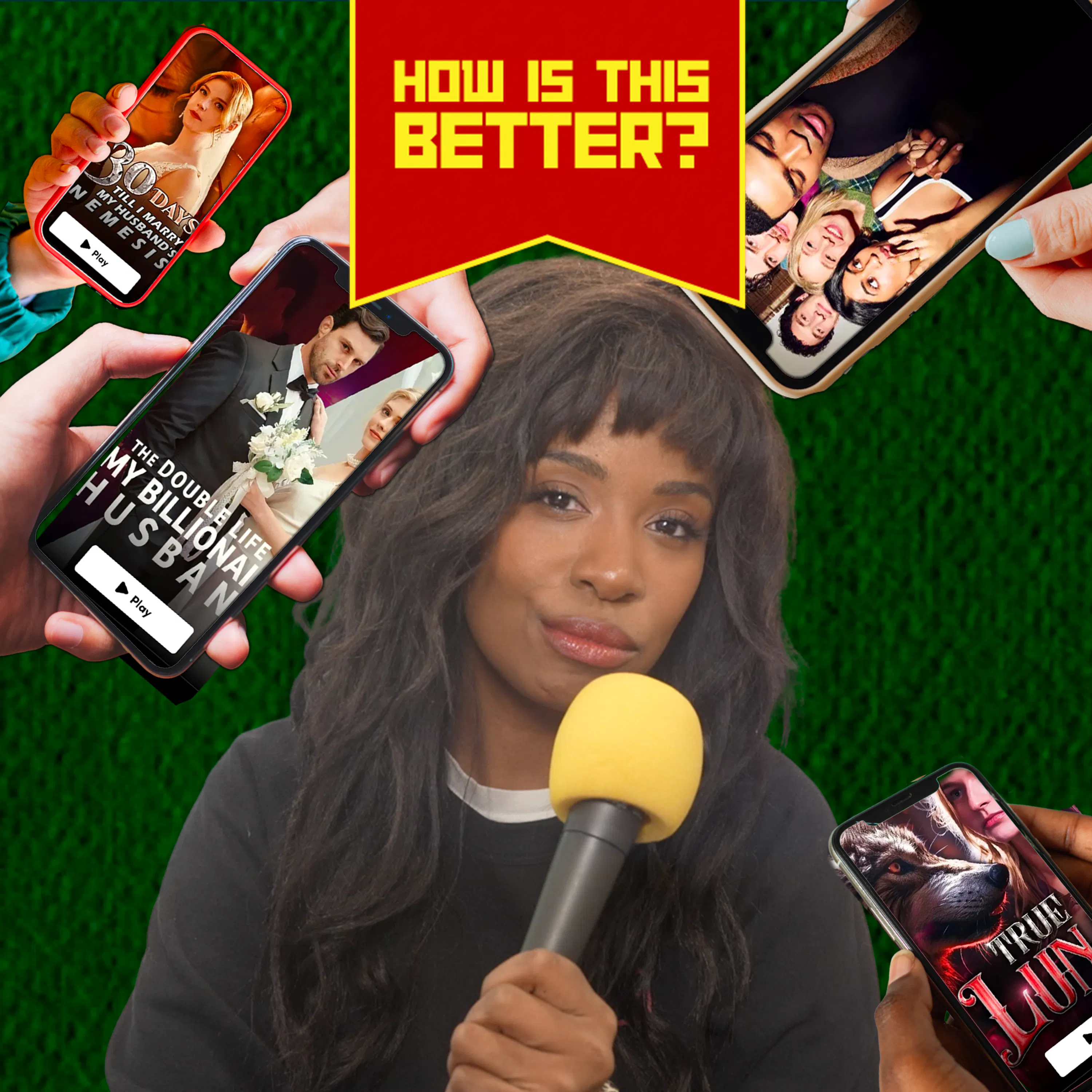
Loading summary
Transcript100 lines
- [00:00]
Akilah Hughes
Something is happening in Hollywood.
- [00:02]
Dexter Thomas
Hello. We didn't get married. That's ridiculous.
- [00:07]
Akilah Hughes
God, Will, you must be really bored.
- [00:09]
Dexter Thomas
Yes, yes, I'm bored.
- [00:11]
Jen
How many hours a day do you watch tv?
- [00:14]
Dexter Thomas
Six?
- [00:15]
Matthew Frank
Seven, if there's something good on.
- [00:16]
Akilah Hughes
While the studio system is hemorrhaging, a new way to interact with visual storytelling is emerging. Clipping. We've all seen it by now short the 30 to 90 second clips of pre existing movies and TV shows pumped out in parts for today's for your page junkies. And while promotional packaging of TV and movies isn't new, I mean we've all seen trailers before in a world within our world, this idea that entertainment can simply be digested in chunks has created new industries around just that chunks of content. So today we're investigating clipping what it is, how it's replacing movies and TV shows for entire generations and how that format is now informing a new art form, verticals created specifically with vertical micro nuance free storytelling in mind. And asking how is it better to reduce art to bite sized shareable moments? To get a better sense of what clipping is and how ubiquitous it is for promotion for TV and film, I spoke with Matthew Frank who penned an article for The Ankler in September 2025 titled Gen Z only watches TV through social clips. Hollywood is scrambling about what he learned in his deep dive into the phenomenon.
- [01:37]
Matthew Frank
This phenomenon where movies and TV shows and long pieces of content get diced up into these little minute long clips and that's a lot of the time how Gen Z and Gen Alpha and younger consumers are not only finding these titles but are also digesting the content completely and not necessarily going and watch the show or the movie in full. You can sort of track the evolution of that with, you know, how social media has evolved where, you know, over the course of the last couple years and since COVID and since TikTok, it's been a lot of not just text or images, but it's also these like short form videos where you're scrolling and you're just one after the next and there's a lot of content that needs to fill up those pipelines. There are very few things better than, you know, Hollywood IP or you know, a movie or a TV show because that's professionally produced, it's well made. Unless you know, a studio takes it down, which a lot of times they don't do because they see it as promotion. They leave it up because it's a minute long clip of, you know, Seinfeld or Friends or whatever it is. It's sort of evolved more in the last couple of years. And what's also helped is that now you have these clippers, these people who professionally do it. A lot of times it is the original rights holders and the IP holders, but in other instances it's the studios or the shows, they're putting it out through these channels that are called like crime clips or something anonymous, where they can, you know, are not necessarily like doing it through their studio, but they are, they're monetizing off of it and they're dicing up the content kind of quickly because people's attention spans are shorter. So you know, you have these one minute long clips and if you can make it something engaging in that format, it can potentially not only promote the show or the movie by, you know, directing people to that show or movie, it can also just work as a piece of content on its own.
- [03:12]
Akilah Hughes
Okay, so this makes sense to me. A studio might not want to look too promotional and seeds their IP through pages that are just about a general interest like true crime or comedy. But I guess what's weird to me at this point is that this apparently isn't converting the viewers. They're just watching the most clip worthy moments out of context.
- [03:32]
Jen
You open with a story about basically what seems like an intentional strategy behind the clipping of this FX show, Adults. It premiered on Hulu. The views on that are huge on social media. Maybe that hasn't transferred to the linear.
- [03:45]
Akilah Hughes
Version, but can you talk about sort.
- [03:47]
Jen
Of the reach of those clips on social media for that show? Like anecdotally were scenes from that show getting widely viewed by Gen Z passed around? What's sort of the vibe of that?
- [03:57]
Matthew Frank
Yeah, so out of that campaign which was run by this 22 year old named Max Peterson, who runs a company called Clip, which does normally these clipping. It's very on brand, it's very.
- [04:09]
Jen
Yes.
- [04:10]
Matthew Frank
A lot of times it's mainly for streamers like Kai Sinat or Jake Paul or whoever. You know, a lot of these people whose business is in just volume and just being on people's feeds a lot. And paying someone to have an army of 13,000 15 year olds is a good way of doing that and spreading yourself all over. So they do it. A lot of times it's podcasts or you know, individual little bits of music like you'll see in a TikTok video. It's like, oh, do you know an edit with this song? And now he started his first one with Hollywood was the FX show Adult, which was this, you know, friends, Gen Z. And he did a clipping campaign for it. It was paid for by one of the producers of the show and they ended up paying $15,000 which in the grand scheme of a marketing budget is not crazy. But it led to 2,500 videos across, you know, these feeds. 40 million views, he said, which a lot of people that I talked to for the story said you can't really look at views as being the metric because we don't know if they're converting, we don't know if they're only staying there.
- [05:06]
Akilah Hughes
Right.
- [05:06]
Matthew Frank
But you know, it is something where he got paid to do it and those clips got viewed and there were some that took off and that, you know, could have helped the show or it didn't. And you know, again, the jury is still out. It's hard to, you know, prove a lot of these things unless you're doing it directly from the studios. You're saying click here to watch more, which a lot of these aren't doing because you're trying to make it seem very organic and like something that's just kind of viral.
- [05:28]
Akilah Hughes
So what I'm hearing is that people are making a pretty penny editing these episodes down to shareable moments and people are generally interested in watching those clips. But if the clip can't actually promote the show that is converting into act actual viewership, then is the future of Hollywood just clips are shows in the.
- [05:47]
Matthew Frank
Traditional sense over talk to someone not even related to this story. It was about another story, but who basically, you know, is a 24 year old who was like, yeah, you know, I'll watch Law and Order, you know, in like little one minute clips on TikTok. But I would never go watch a full fucking episode. Like no, I would never do that.
- [06:01]
Jen
That's wild. What a show to say that about. That's like the perfect show to do nothing. They have marathons on TV for this. But I'm a different generation.
- [06:11]
Akilah Hughes
After a short break, we're going to dive into the money. Who is spending, why they're spending and what all of this says about what's to come. For Hollywood, clipping is more than just an easy way to watch only the highlights of shows and movies. It's also a burgeoning industry.
- [06:30]
Matthew Frank
I emailed with this 19 year old Russian who has made $30,000 from Simpsons clips since the start of the year.
- [06:38]
Akilah Hughes
Not too shabby. But when we talk about the money, I'm really interested in how studios are receiving the news that audiences don't necessarily need 22 minutes of action and drama and how that might inform their plans for future programming.
- [06:52]
Jen
Let's give the guy who clips the Simpsons his due. If the Simpsons clips are doing numbers.
- [06:58]
Akilah Hughes
Do you think that any studio really.
- [07:00]
Jen
Has an incentive to make new shows then if, like, there are old shows that can be clipped? You know, obviously we mentioned FX and adults, but if there's already a show that's been successful that they can kind of keep milking the IP for, do.
- [07:15]
Akilah Hughes
You see a world where that.
- [07:16]
Jen
That's actually where it heads is like, we're just gonna keep watching the same shows over and over again in different formats.
- [07:22]
Matthew Frank
I mean, that's a dark. That's a dark interpretation. But, yeah, we're listening to so much old music. We're watching so many old TV shows and movies. It's not, you know, it's harder to have something new kind of break through. I guess we could be heading towards that, but hopefully not.
- [07:36]
Jen
My final question really is, like, what is your most pessimistic or optimistic or both vision of, like, what Hollywood as a concept looks like in the next 10 years?
- [07:46]
Matthew Frank
You know, let me start pessimistically. We can end with the optimism, yeah, that, you know, the middle class is sort of being squeezed from Hollywood, which is terrible to see and to hear about because there's so many people who, you know, whether it's AI or whether it's just less appetite for new shows or movies, there's just less people who are able to be employed. And, you know, production has already moved away from California and into, you know, Canada and the UK and all these places where now if you're in Hollywood, you know, quote unquote, Hollywood proper, there's just not as many jobs in the production sense. The less shows you and movies you make, the less there's going to be big hits and the less there's going to be anything that really breaks through and allows for, you know, this reinvestment in movies and TV shows. Then there's the effect of consolidation. If Paramount swallows Warner Brothers, that's going to be one less studio. It's going to be like, significantly less jobs potentially. You know, it's a scary thing for the industry and for a lot of the workers. This does feel like a very existential moment for the industry, optimistically. I mean, it's, you know, it's tricky. There's a. There's a lot of stigma around AI and rightfully so. But you do hear a lot of, you know, these executives saying, like, hey, this is going to not necessarily take away jobs but it's going to make people a lot more efficient. We will be able to do a lot more productions and have a lot more capacity, and that could be something that allows for more product. But whenever there's a technology like AI, there is significant job loss and it's really hard to avoid that. So optimistically, I guess that's the pessimism seeping into the optimism.
- [09:07]
Akilah Hughes
TL Dr. Clipping showing up in a moment where Hollywood is in an identity crisis doesn't necessarily bode well for the future, specifically the future of middle class jobs, whether that be union jobs on set or even in the post production editing bays. When we come back, we're gonna look at a format that is essentially clipping on steroids and the big bets that studios are making.
- [09:36]
Netflix Announcer
This episode is brought to you by Netflix from the creator of Homeland. Claire Danes and Matthew Rhys star in the new Netflix series the Beast in Me as ruthless rivals whose shared darkness will set them on a collision course with fatal consequences. The Beast in Me is a riveting psychological cat and mouse story about guilt, justice and doubt. You will not want to miss this. The Beast in Me is now playing only on Netflix.
- [10:04]
Dexter Thomas
Meant for the small screen, really. Never meant to be shown on a computer screen or definitely not in a movie theater. And these go for 60 to 90 seconds each episode. It could be 50 episodes per show or something like that. It could be more, it could be less, could be a lot. But each single episode ends on a cliffhanger. So just imagine watching any soap opera or any drama and, you know, usually at the end of your 22 minute episode, whatever the case is, you know, there's some kind of a cliffhanger. This one has a cliffhanger Every single 60 to 90 seconds.
- [10:36]
Jen
Jesus.
- [10:37]
Akilah Hughes
This is Dexter Thomas, host of Kill Switch, a tech podcast about what it's like to live in the future. And I wanted to talk with him about vertical dramas, which you may have heard of, and if you have heard of them, you may think they're incredibly.
- [10:50]
Dexter Thomas
Niche, but I mean, everybody's trying to get into these things. Disney is now starting to get their hands into it. Back in August, Disney announced the latest additions to this thing that they have called the Disney accelerator. So it's basically this program where they invest in something that they think is potentially going to make some money, but it doesn't have to make money immediately for them. They get thousands of thousands of applicants, and this year they picked four companies. The first one was some kind of AI animation software. And then there's AI 3D printing manufacturer, there's some holographic display tech startups. So okay, this is all pretty futuristic slash AI stuff. Okay, I get where this is. And then the fourth one is Drama Box, which is a vertical drama app.
- [11:37]
Jen
Wow.
- [11:38]
Akilah Hughes
Just small upstarts like Disney getting involved. And before this conversation, I'll be honest, my understanding was that these were low paying gigs funded by China to supplement an actor's job at a cafe in Hollywood's crumbling economy.
- [11:52]
Jen
I mean this is something that's like really exploded.
- [11:55]
Akilah Hughes
I used to live in la and during the fires I went down to.
- [11:59]
Jen
Long beach and I was sitting on the dog beach with my dog and this other dog ran up and the parent of that dog was like introducing herself and she's like, I work at a cafe. But my like real main thing right now is these vertical dramas. And so I'm wondering, I mean this is sort of an aside, but just.
- [12:17]
Akilah Hughes
Talking about the economy of it, is.
- [12:19]
Jen
This just sort of like uber for actors too, where it's like you could get paid sort of a very low day rate to be in a bunch of these and you know, it's like supplemental income versus like a real steady union job.
- [12:32]
Dexter Thomas
I mean, define low day rate, right?
- [12:34]
Jen
You know, I mean, she was saying, and this was months ago, this was before a lot of investments. I would say this was like January. And she was saying she was making like $120 a day.
- [12:42]
Dexter Thomas
Try 10 times that.
- [12:44]
Akilah Hughes
Wow.
- [12:44]
Dexter Thomas
Guy talk to is doing a G a day, which, you know, I feel pretty comfortable with. A thousand a day. It's not bad or not terrible working conditions. It sounds like, it sounds like it's pretty chill. It's weird because I've talked to a few people who do not want to touch this stuff at all for various reasons. First off, non union, which probably doesn't like that only means a little bit to me because I don't fully understand the industry like that. But basically from what I understand is, you know, most people who work in Hollywood, they're in a union of some sort and you can't really take a non union job because that causes a whole cascade of problems. And so you, you're actually sort of not allowed to work on this stuff. Which means for better, for worse that a lot of the people who work on these shows are not traditionally from Hollywood. There's some good things about that. You could argue there's some bad things about that if you want. It sort of depends. But even without that barrier, because, you know, sometimes people, you know, kind of cross that barrier if, if they think nobody's going to catch them. But I've talked to people who told me, yo, I looked at the script and I don't want to be associated with this at all. It's a lot of violence, a lot of sex, a lot of sexual violence implied and not implied at all. Just straight up bad scripts. I mean, think of whatever you would think of in your mind as stereotypical porn script. Yeah, but there's no sex and so the fun part isn't even there. Just bad acting.
- [14:14]
Jen
You really limit the audience with just the acting for just.
- [14:19]
Dexter Thomas
Just the acting.
- [14:20]
Jen
Yeah, I just love the plots.
- [14:23]
Dexter Thomas
Yeah.
- [14:23]
Jen
Yo, no one finishes. But it's a lot of talk.
- [14:27]
Dexter Thomas
The, the real draw of this is not that it, you know, bad acting or whatever, although I think kind of the over the melodramatic stuff actually is a draw for some people. But the draw is that it's pretty engineered down to really make you curious about what happens next. I don't think there would be anybody who would watch these things and think this is a brilliantly crafted piece of art. And I say that because, listen, I was, I talked to one of the people who's kind of a pretty hot commodity because, I mean, this dude is very, very, very well known in the vertical drama community because there is a community around this. He said, I don't really think we're at the stage right now where this is high art. He wants it to be because, you know, this is somebody who came out of a pretty traditional acting background, you know, Shakespearean plays, all that sort of thing. And so he's got his heart where, yeah, he knows what he wants to make, but he also knows how he can pay his bills. But he thinks that the two could be bridged, which I don't think is impossible. But right now it's definitely not that. It's all very melodramatic. It's over the top. The situations are silly, but it provides something for the people who watch it.
- [15:44]
Akilah Hughes
Yeah, absolutely.
- [15:45]
Jen
I mean, I'm curious just about your interaction with that world, the vertical video dramas. Like, was it just curiosity?
- [15:54]
Akilah Hughes
Was it confusion?
- [15:55]
Jen
Did they show up organically in your feed one day and you were like, what is this?
- [15:59]
Dexter Thomas
No, it's a great question, actually. So I know about this actually, because a producer that we were working with, Alex, knows one of these actors, knows this guy. So he had actually a personal connection. It started mostly from him seeing his friend just become literally world famous out of nowhere. Teague has been interviewed, I think a lot of Places, actually, because people are so curious about him and so has Jen. But for me, I'm staying offline as much as possible. Yeah, I'm not on TikTok. I'm not really on the gram Twitter. I haven't touched that since before they changed the name.
- [16:35]
Jen
I'm jealous.
- [16:37]
Dexter Thomas
Yeah, I don't touch it.
- [16:38]
Jen
You're describing a very luxurious lifestyle.
- [16:41]
Dexter Thomas
I'd like what's happened to, to be real. It's not, you know, I, I partake because I need to for work, but where they're really pushing this stuff is tick tock. Because it's, it's a format that's pretty similar. The idea is that, well, if you like TikTok, you'll probably like these vertical drama apps. And it's true. That's genuinely like a fair statement and a fair statement of what the market is. But I happen to not be on it much. And so I wasn't seeing the ads for this, but anytime I mentioned it to anybody that I'm working on this vertical drama stuff, somebody would say, oh my God, I saw this on my for you page and I was like, what the heck is this? And I looked at the app, but I didn't want to buy it. And so anytime I would mention it, basically everybody around me knew exactly what I was talking about.
- [17:30]
Akilah Hughes
I was curious about who exactly the audience is for these kinds of vertical dramas. After all, there is huge investment in what seems like an inexpensive thing to shoot and people are paying. So who is the vertical drama community?
- [17:43]
Dexter Thomas
We usually tend to assume that any new media, any new technology or any new media format, the first early adopters are going to be kids. Think of video games, think of TikTok, think of any social media app or whatever. And it's usually older people who are saying, oh, I don't understand that new stuff. I prefer what I grew up with. TV's better, you know, whatever is better. I remember when we used to go to the movie theater and that's really what art is all about. But that's not the case. It sounds like, from what Jen was telling me, it sounds like actually the developers of these apps assumed that they would be able to get a young adult audience, but they weren't. And I think some of that is because they're charging money.
- [18:27]
Akilah Hughes
Yeah.
- [18:28]
Dexter Thomas
And kids don't necessarily have money. You can ask your parents for money, which is how a lot of this functions, but that just didn't end up working out. And so the primary audience with this, the early adopters here, are middle aged.
- [18:39]
Jen
Women who are like, honestly, I mean, probably people who are primed to also watch daytime television soap operas, who understand the format, even if it is, you know, now shorter and like a little bit more melodramatic.
- [18:52]
Akilah Hughes
Does that surprise you then that there's.
- [18:53]
Jen
So much investment now? Because I think typically if, like, women are the first to adopt something, it kind of fizzled out.
- [18:59]
Dexter Thomas
Well, no. So this is the really interesting thing, actually. Anything that is for women is viewed to be lower prestige. And please understand that I'm using huge Scare Quartz around everything that I'm saying here. You know, my opinion is here, but this is kind of the general view is that if women like, must be less quality artistically. And it's not even if it's necessarily made for women, it's just if women like it. So the equation is a little inverse here. The thing is, the companies making this, they don't care. They don't care who's watching it. They care that it's making money. And so the artistic value of this isn't important to them. So this is what we got to understand here, is that the companies who are making this are tech companies. And they're looking at this coming from a tech company lens. What they're interested in is watch time. What they're interested in is user acquisition, you know, maximizing the profits, turning stuff around. How can we be efficient about things?
- [19:57]
Jen
Yeah, return visits.
- [19:59]
Dexter Thomas
Yeah, return visits.
- [20:00]
Matthew Frank
All.
- [20:00]
Dexter Thomas
All these sorts of things. And so, you know, the same sort of thing that, you know, we should look at any of these apps the same way that we look at Instagram or the same way we at look, we look at Facebook, which is they want you to stay on the app. That's really all they're interested in. If it turns out that middle aged women are spending a bunch of money here, they're very happy to take their money.
- [20:22]
Akilah Hughes
I, as I'm sure we all now are, wondered if Dexter thought that the sudden success of this new shiny format meant a shift for entertainment more broadly.
- [20:32]
Dexter Thomas
There are people who have completely deleted Netflix, deleted Hulu. They've cut that. Because if you're really into, say, romance dramas and things like that, there might not really be anything out there for you. Like there's a certain format of ROM com that you might feel like isn't really getting made anymore. They're still making those. It's just vertical. It's just very short and stripped down and cut down. I mean, just, you know, imagine like a ROM com just without any real character development, without any quietness. There's no quiet scenes, no montages. It's just all dialogue, action. Slaps. There's a lot of slaps, A lot of slapping.
- [21:15]
Jen
You don't see slapping on TV as much.
- [21:17]
Dexter Thomas
Yeah, bring back the slaps. Bring back the slabs.
- [21:21]
Jen
Exactly. We, it turns out as a society, we do like slaps and we really want them.
- [21:25]
Dexter Thomas
Clearly people need to get slapped and sometimes. I don't know, man. Yeah, but there's, there's a lot of slaps. Like, there is a high dense. The, like the slap to conversation ratio on verticals is really high. I'm not playing with you. Well, because t was telling me this. He was saying he was having a conversation with somebody and they were suggesting that it's best if there's at least one slap per episode. And so we're talking, seriously, we're talking a slap per 60 seconds, which is unhinged. I mean, if you think about it, it's all about emotional hooks. And what is the fastest, most efficient way to display emotion? Violence. Physical violence. Yeah, you can yell at somebody and there's a lot of yelling also. And there's a lot of punch ins, like real big zoom ins where you see somebody's face and they're just. And if it's not a slap, it's like a door opens and everybody's like this and it cuts to them and it cuts to them and it cuts to this other person.
- [22:21]
Jen
Yeah, exactly. It creates a. Then what?
- [22:24]
Dexter Thomas
Yeah, exactly. You get the rising action, you get the climax, you get the falling, you get the resolution. Like three seconds. It's, it's very efficient. And verticals are all about efficiency.
- [22:34]
Akilah Hughes
There it is again. Efficiency. This idea that keeps cropping up everywhere in the age of AI, of convenience and of cheap manufacturing. And now it's seeping into human made art. No more iconic long shots pondering looks or reflection. Just cut to the action. A slap, a door opening, a door closing. All premise, no plot. And look, don't let me yuck anyone's yum. But if quantity becomes its own form of quality, it's only a matter of time until all entertainment becomes drive thru, fast foodified.
- [23:07]
Dexter Thomas
These are cheaper than anything that's being made in Hollywood. For example, this is from the Washington Post, but from what we've been able to tell, that places will actually tell you that these apps will actually tell you an entire vertical drama series usually is going to cost under $250,000.
- [23:24]
Jen
That's like less than an episode of anything. Like even a micro budget television production. A commercial like there's nothing that is this cheap.
- [23:32]
Dexter Thomas
Yeah. Compare that to a TV show which a single episode could be a few million easy, depending on what it is. And we're talking an entire series under $250,000. Figure that a movie at the box office this year, films are averaging something like 13 million. A full film, which again you can imagine is going to cost multiple millions of dollars. Sometimes they're losing money. A vertical series could do that easy there. There are vertical dramas that are doing that. So you put in 100k to 200k and you get out $13 million. That's a really good investment. And so there are some people who truly care about the art and the craft and getting a message. But then there are other people and a lot of people, I would argue, who are very interested in the return on investment. They're not super interested in what's in the film. And so, you know, what that means is just, okay, how can we repeat that success? So, for example, at some point somebody started making werewolf themed romances. And I think it's because they saw that there were some werewolf themed novels out there and so they said, okay, well let's try making this. And it worked. And now there's a whole bunch of werewolf themed vertical dramas like Falling in Love with the Werewolf. I don't get it. It's not for me, but apparently it's for a lot of people. And so people are going to keep cranking that out until that runs its course. But what it also means is that gender roles are very, very traditional. I'll just put it this way. I haven't seen a non white leading man.
- [25:06]
Akilah Hughes
And that's another problem that we're just scratching the surface of. When you have to make something creative that panders to our basest of instincts and with the broadest possible audience, the safest bet is stereotypes. So in that regard, it's no surprise. We're basically in the minstrel show era of Hollywood on our phones. Nothing too complicated to understand, nothing that might be out of the ordinary. It's part of this bigger flattening of culture that begs us not to be nuanced, but rather to see the world in black and white without any hint of gray.
- [25:39]
Dexter Thomas
The idea of having something on the main screen and having something in your hand, you know, vertical dramas are forcing us, I think, to be very, very frank about what's actually happening. And that's to say that, you know, scenes where somebody thinks about something or pauses to think about what they've done, you know, and and the viewer has a moment to feel that those don't exist because those don't sell. Nuance doesn't sell in basically anything. Nuance doesn't sell those times where you kind of think, man, I'm not really sure what to think about that. It's too risky, I guess, is what I'm saying.
- [26:16]
Jen
Yeah. They don't want interpretation. They want you to just keep watching.
- [26:20]
Dexter Thomas
Yeah. And it's not some master plan to make the populace stupid.
- [26:24]
Akilah Hughes
Right.
- [26:24]
Dexter Thomas
The people being stupid. It's a side product.
- [26:28]
Jen
Right.
- [26:28]
Dexter Thomas
You know what I mean? It's a side effect. Again, the point is making money.
- [26:33]
Akilah Hughes
Okay, so brass tacks.
- [26:34]
Matthew Frank
Time.
- [26:35]
Akilah Hughes
How is it better to digest media? Only in part and only media that challenges nothing and keeps us addicted through the dopamine spikes of endless cliffhangers. This may surprise you, but I don't think it's better. I also don't necessarily think it's worse. Like, of all the topics we've covered so far, the rise of AI and place of community, dark money and politics, the separation of church and state dissolving before our eyes, I think the fiction that people choose to consume may be the least of our problems. And while on a more base level, it's obviously worse to have a shadow industry with zero unions making slop that requires minimal writers, editors and craftspeople, I don't know that it's so much worse. You see, entertainment has always evolved for the times we're living in, and for better or worse, it's worse. These are the times we're living in. So is it better? No. But maybe if our society improves, proves it could be. Thanks for listening to or watching. How is this better? Make sure you're following or subscribing on your platform of choice, including our very own YouTube page@YouTube.com howis this better? And if you can leave a rating and review or comment on the episodes, because all of it is super helpful in spreading the reach of the show. And we appreciate you. How is this Better? Is written and hosted by me, Akilah Hughes. It's produced by Devin Maroney. Video editing is by Shane Verkus. Kevin Dreyfuss is Courier's national managing director and executive producer. RC Demezzo is their VP of brand and social media. And Charlotte Robertson is the deputy director of Branded Social. Samantha Hollows is the YouTube and podcast growth marketer. And Marianne Kuga is the director of marketing. Tracy Kaplan is the senior vice president of sales and distribution. And if you're interested in advertising or sponsoring, you can reach her@advertiseuriernewsroom.com show artwork is by Danielle Daniel Plateau and original theme music is by Used People.