← How Is This Better?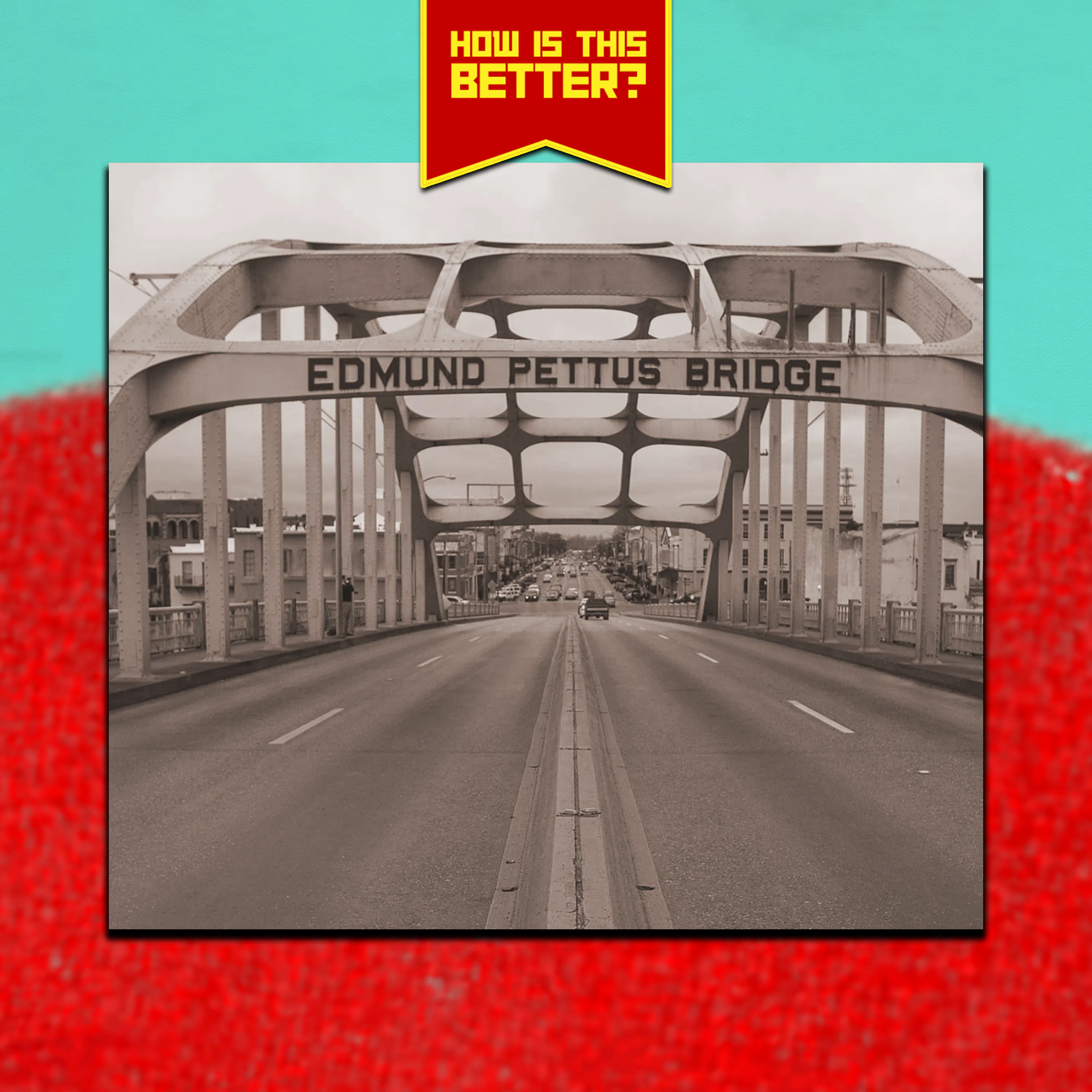
How Is This Better?
Voting Rights Were Gutted. I Went to Alabama to See What We Can Do About It.
00:20:25
Loading summary
Transcript48 lines
- [00:00]
Tacovas Store Announcer
Tacovas is the go to for premium handcrafted western boots. Stop by any store location for a warm welcome, a cold drink in hand, and a truly one of a kind shopping experience. Let our friendly staff help you find your new go to boots. Whether your first pair or your 50th. Finish things off with a complimentary boot brand to make them extra special. Come for the boots, stay for the good times. To Covis forever West.
- [00:32]
John Lewis
This ruling and the subsequent legislative actions will not have the last word.
- [00:39]
Alexandria Ocasio-Cortez
It is time for the north to pull up to the South.
- [00:44]
Unknown Activist or Speaker
You can rig a map, but you can't rig a movement.
- [00:49]
John Lewis
They may be a blow, but every blow against justice has historically awakened a sleeping giant.
- [01:03]
Akilah Hughes
I'm here in Selma, Alabama, at the Edmund Pettus Bridge behind me, the site
- [01:08]
of bloody Sunday in 1965, where 600 protesters were brutalized, beaten, had dogs sicced on them, you know, for trying to get the right to vote, for trying to, you know, protest for equal rights in this country. A couple of days later, Martin Luther King, John Lewis, a lot of other civil rights leaders came back and walked across this bridge, turned around. It's honestly one of the most iconic stories in civil rights history. I'm here just 61 years later after the Supreme Court has basically undone all of the actions that were won by the Voting Rights Act. And so we're here for a day of action, for a day of protest between here in Selma and also in Montgomery to talk to people about what's happening in this country when it comes to voting rights and representation, not only in the south, but across the country.
- [01:58]
Last weekend, when I traveled to Selma in Montgomery, Alabama, for a national day of action for voting rights. The day was billed as all roads lead to the south, and it was organized in response to the latest and perhaps final attack on the Voting Rights act of 1965 from a captured, ideologically driven Supreme Court. The Voting Rights act was originally passed to protect black voters from Jim Crow era discrimination across the South. It not only guaranteed access to the ballot, but but also created protections against racial gerrymandering efforts to dilute the political power of black and brown communities. But over the last decade, the John Roberts Supreme Court has steadily chipped away at those protections, beginning with Shelby County v. Holder in 2013. And just weeks ago in Louisiana via Calais, the court delivered a blow that effectively gutted the landmark legislation. The All Roads Lead to the south event brought together voters, organizers, lawyers, activists and elected officials in Selma and Montgomery. I went there to hear directly from the people on the front lines about what comes next, both now for the important upcoming midterms and beyond. What is it going to take to not just restore voting rights, but actually build a better, stronger, multiracial democracy that can survive these attacks?
- [03:10]
John Lewis
Today we return to the very grounds where my parents and the Freedom family stood when black voter registration was scarce, when discrimination was the norm, and when violence was the price of seeking dignity.
- [03:26]
Akilah Hughes
This is Dr. King. Not that one, but in fact that one's youngest daughter. On stage, Bernice A. King spoke about how deeply personal this is for her, how this decision is an attack on her parents legacy.
- [03:38]
John Lewis
And 61 years later, we come back as new generations to the same hallowed place to reclaim and redeem that legacy because of the recent Supreme Court hearing demands our presence. It was not only a legal decision, y', all, it was a moral. It is a moral disgrace and a shameless assault on black political power. It strikes at the very heart of my father's and my mother's sacrifice. And it is a direct attack on generations of people like John Lewis, Hosea Williams, Ralph Abernethy, Juanita Abernathy, Amelia Boynton, Jimmie Lee Jackson, Cheyenne Webb, Connecticut, Vivian Fannie, Lou Hamer, and my uncle A.D. king, and countless others who faced dogs and batons and bombs and billy clubs so that black people in all marginalized communities could participate fully in this democracy.
- [04:46]
Akilah Hughes
I had the chance to speak with her backstage and I started by asking how it felt to be back here fighting the same fight her parents did.
- [04:53]
Bernice A. King
I think the reality is something that Bryan Stevens often reminds himself, that as my father and them were fighting to dismantle segregation in the south, people did not realize in the struggle for true genuine inequality, equality, that we also had to do something to undo these systems and structures, right, that had been put in place and that we had to keep together in coalition. And I think we lost some ground when President Obama won because people got a little uncomfortable thinking that was a point of arrival when my mother reminds us all the time the struggle is a never ending process. Freedom is never really won. You earn it and win it in every generation. So it doesn't surprise me. I'm extremely disappointed. And I showed up today because I'm like, you're not gonna take my parents legacy and sacrifice from us. And to stand back on the grounds that my father stood on 61 years ago to reclaim that legacy. I was only 2 at the time. And so we have to make sure going forward that we stay connected and coordinated in our efforts to push back against injustice and Inequality and white supremacy, not just pushed back against it. We gotta help Booth define a new world.
- [06:12]
Akilah Hughes
Yeah.
- [06:13]
Bernice A. King
So that requires stick to itness. Yes. Because the ones who have been organizing with evil intentions, they work overtime.
- [06:25]
Akilah Hughes
Yeah.
- [06:25]
Bernice A. King
They're committed. As Daddy said, one of the tragic still of human history is that the children of darkness are often more zealous and determined than the children of light. And so we have got to increase our zeal and determination.
- [06:37]
Akilah Hughes
You said in your speech, you know, we are on the move. The midterms are right around the corner. Do you have a message to people, especially young people? Maybe it's their first election. How can they get activated in their communities? How can they get people to get out the vote?
- [06:51]
Bernice A. King
I think everyone is connected to somebody who questions whether or not they should vote. All of us are. I think it's important for us to help everybody to understand that voting is our avenue to have a voice in the policies that affect our daily lives. There is no other avenue to do that because those policies are very dangerous. And we need people in place who can help us begin to correct some of those policies. So we need to make sure we vote like never before. We need to make sure that we are encouraging other people to vote. We need to make sure we're educating people about the importance of voting and being engaged. Cause it's deeper than voting. Voting is just one part of a continuum in democracy. We have to be engaged. We have to be, you know, conscious of what's happening in our communities. And again, we gotta align. This is not a fight for a single person or a single group or group of people. This is our fight for humanity. And those of us who stand on the side of what's righteous. Yeah. And what's true. And just have to band together and stay together. That's the most important. And coordinate our efforts.
- [08:02]
Akilah Hughes
For many, the immediate impact of the Calais decision came as a shock. Even though primary elections are underway, Republican legislators in Southern states were ready to respond quickly to create an advantage for the midterms. Louisiana, Alabama, South Carolina, Texas, Florida and Tennessee all moved aggressively to redraw or maintain racially gerrymandered congressional maps. For Tennessee State Representative Justin Pierson, who's running for the US House of Representatives, that means he's finding himself running in a completely newly drawn map. I talked with Representative Pierson after he spoke.
- [08:34]
You've been dealing with a lot on the front lines in Tennessee. You've seen the gerrymandering firsthand. What message do you have? I think for the coastal elites, for the Coastal media that doesn't seem to understand that, like, what's happening in the south is going to happen everywhere if we don't all tap it.
- [08:50]
Justin Pearson
Absolutely. What we are seeing is the Neo Confederacy rising. When you look at the old Confederacy, they tried to separate from the Union, but this Confederacy is building its tentacles of white supremacy within the Union and institutions of power. And for people who are not as proximate. We need for you to show up in the south, come stand, fight, invest alongside us.
- [09:10]
Akilah Hughes
Absolutely. And then I guess with the midterms coming up, what message do you have to get out the vote to get people to, you know, talk to the people who don't have a voting plan,
- [09:19]
Janae
don't have a way to the polls?
- [09:21]
Akilah Hughes
How do you inspire people to move in that direction?
- [09:23]
Justin Pearson
Absolutely. It's two quick things. One, they're doing everything that they possibly can to take away our right to vote, to take away our access to the resources that we need in order to build our communities. And none of that is accidental. All of this is the consequence of decisions that were made at the ballot box. So what is the second thing? The second thing is if you do not vote, whoever goes to the polls is voting for you. They are voting your interests. Now, does somebody else know you better than you? Does somebody else know your community and your family, your needs, better than you? Of course not. Your responsibility, if you have the ability to vote, to register, to show up at the polls and to choose candidates who believe what you believe and want the vision for this country that you want.
- [10:03]
Akilah Hughes
When we come back, we hear from AOC and the attorney who defended voting rights before the Supreme Court in Louisiana v. Calais.
- [10:10]
Unknown Activist or Speaker
We are still here. We are here because a white supremacist dictator known as President Donald Trump thought he could silence us. We are here because they thought they could divide us into black and white, rich and poor, Southern and north. They thought they could stop a movement. You can rig a map, but you can't rig a movement. We are here because our ancestors marched on these streets, in these halls, in this building for us to be here. We are here because they did not quit on the western coast of Africa, through the Middle Passage, on any continent. Backup field. They didn't quit at the bottom of any lynching tree. They didn't quit when mass incarceration took us from our families or a crack epidemic criminalized us while the President of the United States poisoned us. They didn't quit. And we are still here because of it. And we ain't going nowhere this moment. And this time requires each of our collective action for transformation. This isn't a one show. This ain't about your ego and the amount of followers and influences you got. This is about how we build power in the south and together to change this country. And I'm almost done. It's because we believe in three words being actualized. We the people. We the people. We, we, we. We the people who believe. We the people who will not bow down. We who will not quit. We who will fight until justice rolls down like waters and righteousness like an ever flowing stream. Let's get to work.
- [12:24]
Evan Osnos
Right now, news and politics are moving awfully fast. It can feel overwhelming, to say the least. I'm Evan Osnos, a staff writer for the New Yorker on the Political Scene podcast. We slow things down to understand how power really operates in Washington, D.C. and what it means for you. My co hosts Jane Mayer and Susan Glasser and I have decades of reporting experience. And every Friday we have conversations with insiders and experts to understand the forces remaking America. Join us Fridays for the Washington Roundtable from the Political Scene on Mondays and Wednesdays. You can also hear insightful episodes from our New Yorker colleagues, David Remnick and Tyler Foggatt, available wherever you get your podcasts.
- [13:15]
All Freeclear Advertiser
Trying to be a bit more mindful of things you buy for you and your family? Well, when it comes to laundry, choose All Freeclair. 100% free from dyes and perfumes, AllFreeclear uses only essential ingredients that tackle tough stains and odors. And it's gentle on the skin. It's a powerful clean you can feel good about. So go on, pick up a bottle of all freeclear for your next laundry day.
- [13:44]
Akilah Hughes
Louisiana v. Calais wasn't just another bad ruling. It was the culmination of a decades long effort to dismantle the Voting Rights act piece by piece. And few people understand that better than Janae. No, she defended the Voting Rights act in the case.
- [13:58]
Janae
I mean, clearly it's extremely dismaying, it's frustrating and it's scary. Yeah, it's actually scary. Not just because we're seeing progress being erased in mere days after this decision, but because what lies on the other side? A lot of people are talking about the redrawing of lines and the political power, but we have not asked the question, why do they desperately seek this power and what will they do with it?
- [14:27]
Akilah Hughes
Right. Okay.
- [14:28]
Janae
And what does that mean for black communities who will have no representatives in these governing bodies, in state legislatures and city councils, and even less representation in Congress? What Will that mean for us? So it is a scary moment, but that's why we're here. That's why we're fighting back.
- [14:44]
Akilah Hughes
Exactly. And we always show up 100%. I'm curious what you think this means for the rest of the country. I think a lot of times the media is on the coast and they don't get that the south is massive. And they also think that this issue only happens here. So in Virginia, they voted to change the maps. That was struck down by the same Supreme Court. So do you think that this will have a ripple effect to this decision? Do you think LAY is now going to be implemented and maybe even more democratic states are going to have to fight against this?
- [15:12]
Bernice A. King
Absolutely.
- [15:13]
Janae
What we wanted to say is all roads lead to the south, meaning every part of this country is impacted by what happens in the South. The south was the birthplace of this multiracial democracy right here in Alabama, you know, just a few miles away in Selma. And it culminated in the march here in Montgomery. And there's a reason that New York was part of the Voting Rights act, was a covered jurisdiction up until 2013, when the Supreme Court struck its first blow to the Voting Rights Act. There's a reason, and that's because race discrimination knows no borders, knows no boundaries, doesn't have a geographic limitation. Now, most black people are in the south, and that's why we see most racial discrimination in the South. But it's not limited to the south. And we should never believe that. Yeah, this is a national issue.
- [15:59]
Akilah Hughes
Absolutely. And I guess my last. My last question for you is like, where do we go from here? Obviously, the midterms are crucially important. We need voters to get out there. But I guess in terms of, like, educating people about the fact that this is happening, the fact that it could be more widespread, the fact that this is now an unchecked power from the scotus, I guess. What would you like to see happen next?
- [16:21]
Janae
I would like to see record breaking turnout from all American voters. I want to see a real contest. If you really believe in your ideals, whatever they are, if you believe in your party, whoever they may be, come to the polls. Let's duke it out in a real arena that's legitimate, that is governed by principles and fairness. Let's have that debate and conversation at the polls and not rigorous rigged polls on rigged maps. Let's do it for real.
- [16:51]
Akilah Hughes
Yeah.
- [16:51]
Janae
If you're that confident, let's go.
- [16:54]
Akilah Hughes
Amen.
- [16:56]
Not all of the speakers in Montgomery were Southern, but the message from the stage was Clear. If voting rights are under attack in the south, then the rest of the country has to show up too.
- [17:05]
Alexandria Ocasio-Cortez
I am here today because I want to make sure that we all understand that Montgomery is not alone, that you all are not alone. And for all of those watching today, when they ask, what do we do in this moment, I feel helpless. What action can I take? It is time for the north to pull up to the South. It is time for New York to pull up to Alabama. It is time for all of us to come to Georgia, to Louisiana, to Tennessee, to Mississippi and let them know exactly what they have uncorked with this injustice.
- [17:51]
Akilah Hughes
If you didn't already recognize her voice, that was Representative Alexandria Ocasio Cortez. Here she is again.
- [17:57]
Alexandria Ocasio-Cortez
It was right here in Montgomery where we saw some of the most cruel repression in the history of America. Where we also saw the highest angels of American history rise to create our democracy. Because it wasn't until the Voting Rights act of 19, it wasn't until the Voting Rights act that was passed that we even had a democracy in this country. There was no democracy in America until every human being born here was guaranteed and protected the right to vote. They think they can draw us out of power. They do not know the sleeping giant that they just awakened.
- [18:48]
Akilah Hughes
Reflecting on my time in Selma and Montgomery, I'm struck and inspired by the message of persistence. It would be easy to be just angry. It's infuriating to take an over 60 year step back. But the message I kept hearing and the one I'm holding on to is about fighting for a future that's still possible. Justin Pearson said it best. You can rig a map, but you can't rig a movement. And this movement isn't going anywhere. I'm told by the all roads lead to the south organizers that the Montgomery rally is the first of many more mobilizations to come. Here's what I know. We have to show up in record numbers in the midterms and then we have to continue to push for solutions to restore the voting power of black and brown communities throughout the south and the country. I'm Akilah Hughes and this is How Is this Better?
- [19:45]
How Is this Better? Is a production of Courier. It's written and hosted by me, Akilah Hughes. It is produced by Devin Maroney. Video editing is by Shane Verkus. The rest of the team at Courier includes Marianne Kuga, Sam Hollows and Charlotte Robertson. Please subscribe to follow. How is this Better? On all the platforms, YouTube, Apple, podcasts, Spotify, etc. And tell someone about your favorite episodes. If you're interested in sponsoring episodes or giving us products to try and try to sell, reach out to advertiseurriorn. Thanks for listening and until next time, see ya.