Loading summary
Transcript28 lines
- [00:00]
A
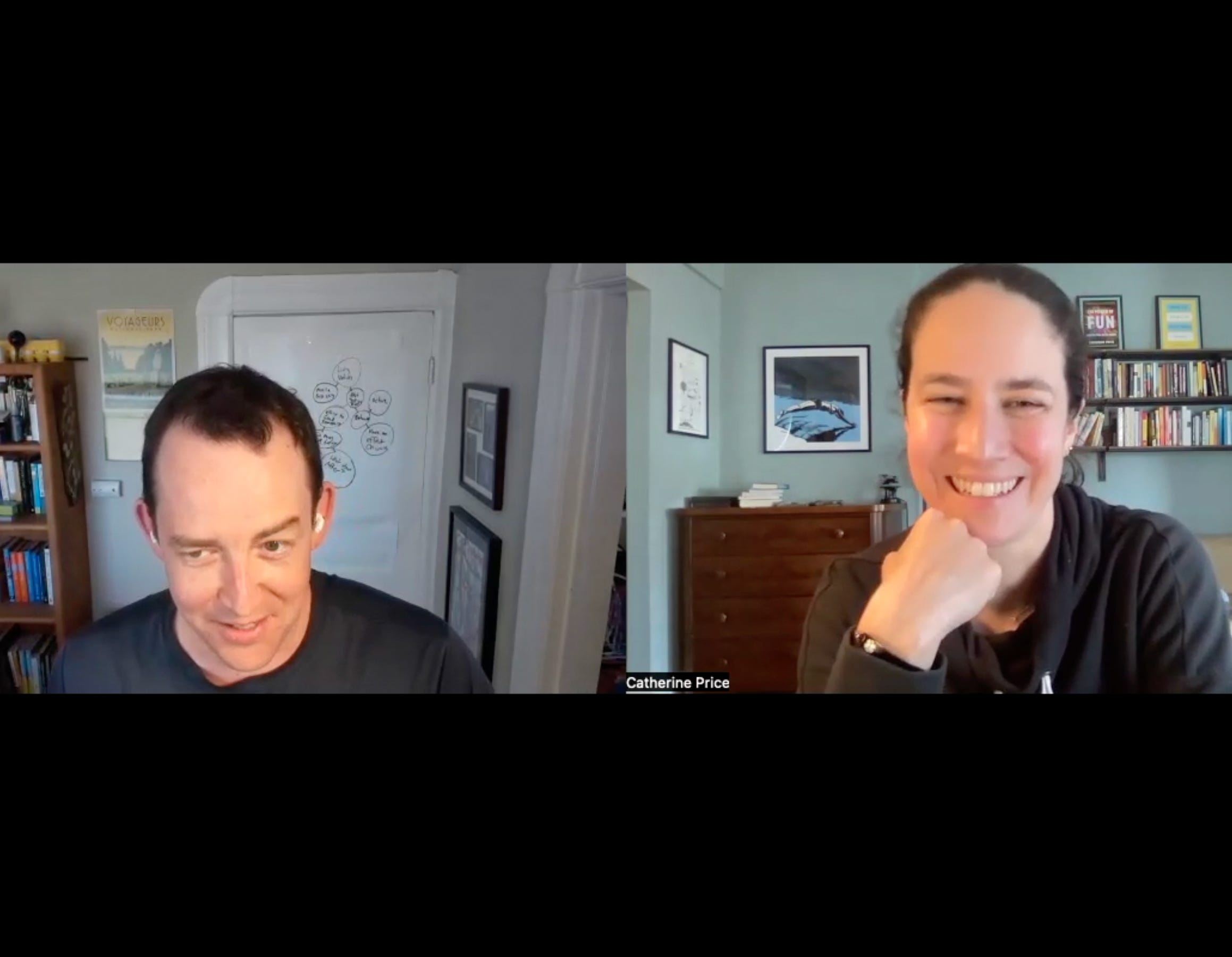
Hello everyone. I'm Katherine Price. I am the author of the Power of Fun and how to break up with your phone and the how to feel alive substack newsletter. I'm so happy that you all are with me and us today. I'm here with Devin McNulty, who's the co founder and brain tender in chief of Funmentum Labs, which is a consultancy group dedicated to harnessing the power of fun in a workplace setting as a way to unleash creativity and productivity and teamwork and all sorts of good things. And we are here today for our first installment of our Fun at work collaboration where we are taking questions from the fun squad in particular and trying to brainstorm answers to your vexing challenges when it comes to how to have more work. Sorry, more work in a fun place setting. That's great. More fun in a workplace setting. Devin, before we get into the details and the definition of fun, anything you want to add?
- [00:53]
B
Oh, just that, you know, Funmentum Labs, we've come in through the marketing and advertising world and we have a sister agency, funworks, that's still a full service agency. And what we do is we use fun and play to deliver breakthrough results for companies. And we've been doing this for over 10 years with big companies like ESPN, Visa, Google, tons and tons of them. And it's always the same. Everybody's very skeptical about it. Is this going to be worth my time? Is this going to be worth my money? And then at the end it's like, wow, we cut out however many weeks out of our process. We wow. I can't believe this type of attitude and approach helped us come to a decision faster. And that's the thing that just always makes me so excited, is that we are getting the best of both worlds. We're actually making work a little bit of a better place to be while giving those bottom line results that all businesses need in order to justify. So that's just what makes me excited and that's why I'm excited to be talking to you here today, Kathy.
- [01:51]
A
Devin is just very excited in general, as we all will learn soon enough, if you have not gathered already in a wonderful way. Also, he just started his own substack newsletter and it's called Fun at Work. And I'll drop a link into that in my post about this, but you all should check it out and sign up because I personally learn stuff and I'm inspired every single time we talk and I'm quite confident that you all will have the same experience. So, Devin, and I have been working together for over a year now and playing together honestly in a collaboration about how to harness the power of fun. And as I mentioned, we are doing a series where people can actually send us their workplace questions. So members of the Fun Squad can send them in. Everyone else can benefit benefit from those questions. But if you do want to send us questions personally, please become a member of the Fun Squad, which is basically my paid subscribers. But we have a couple questions from the audience and we're very excited to dive in and give some ideas for things you can do to solve those. But before we do that, we wanted to quickly refresh everyone on how we're defining fun, because we thought that would be a very important thing to frame our discussion with. Thank you, Devin. Devin is holding up a copy of my book, the Power of Fun. As many of you probably already know, in my book, I define fun as the confluence of three factors. And those factors are playfulness, connection, and flow. And so if I actually were visually prepared for this, I would be showing you a Venn diagram right now where playfulness, connection, and flow would all overlap and the center of those three circles would be what I would consider to be true fun. And to quickly clarify, playfulness really just refers to your attitude, so you don't necessarily have to literally be playing games. That often makes adults freak out a bit. It's about the attitude you bring to things, about having a lighthearted spirit, finding ways to laugh, not taking yourself too seriously. Devin has a background in improv. He can talk to us at length about playfulness and the power of play in all forms. Connection refers to actually feeling like you have a special shared experience with other people. Some people do report having fun alone, but vast majority of stories people share with me, there are other people involved. And then flow is the state you get into when you're totally actively engaged and present in your current experience, often to the point that you lose track of time. It's when you're in the zone. And the most quintessential example is an athlete playing a game or a musician playing a piece of music. It's very different from a passive kind of times flying because I'm staring at Netflix state. That's junk flow, not what we're talking about. This is active and engaged. And what I've personally noticed is that in the vast majority of stories that people tell me about fun, you do have all three of these factors present. But the thing about playfulness, connection, and flow is they're all also very good for us. When they happen on their own. They're extremely powerful. Each of those three has lots of research behind why it's good for our mental and our physical health, not to mention creativity and productivity. And one of the things I love about defining fun as the confluence of playfulness, connection, flow, and flow is it takes this nebulous concept of fun that can seem kind of unattainable or just out of reach. What does that mean to have fun? How could you possibly do that more in your life, let alone in a workplace setting? And it makes it much more concrete and tangible. If we can fill the moments of our lives with more playfulness, connection, or flow, our lives are going to be better. And that's true in a personal context and it's also true in a professional context. So Devin and I just wanted to frame it that way because that's the lens through which we're approaching these problems and these challenges you shared with us. How can we add more playfulness, connection, and or flow to these situations? Because at the very least, it'll make them more enjoyable and we might hit the bullseye and actually make them fun. So that's my spiel. Devin, anything else you want to add before we jump into our first vexing problem?
- [05:28]
B
Just that we use this definition of playfulness, connection, and flow to show that when we talk about fun at work, we're not talking about something that's frivolous. It's also important to have those kinds of work outings that have nothing to do with getting work done. That is important. But also using playfulness, connection and flow in the process of completing the weekly work tasks is what I'm truly interested in. So I'll just leave it at that. Keep going.
- [05:57]
A
Great. Sounds good. I also apologize to anyone who thought it was a good idea to listen to this at like 1.5 speed, because I've had a lot of coffee today. All right, Devin, let's dive in. We have three problems today. Challenges.
- [06:10]
B
Uhhuh. Conundrums. Yes. All right, let's do this. So you want me to. You want me to paraphrase them? I'm happy to. All right, so the first one is from Christy. And the challenge here is basically people not getting their stuff into Christie on time in kind of like a non profit grants setting. But I think this is normal for many people. And so, you know, they meet bi weekly, but people only show up when they feel like it. They're oftentimes missing. And she has a lot of these misconnections because of remote work, and she Prides herself on excellence. And so when people turn in late, inaccurate or incomplete data, it's a real fun killer for him. And she feels like, hey, no one really cares about grant compliance, even though it's like, the lifeblood of a nonprofit. It's her job to care, but people are not prioritizing these deadlines, and it makes her feel bad at her job. And she is the project manager, and so she loves her job and the people, but her colleagues are not prioritizing getting her this very necessary data and information for the grant work. So I have some thoughts on this. But, Katherine, do you have anything you want to say at the top before I dive in?
- [07:28]
A
Just that I think I totally hear Christy on this challenge, that it's very difficult where you have standards, and then you're having difficulty getting the people on your team to live up to those standards, and it's reflecting poorly not just on them, but also on you. So I'm very curious, Devin, to hear what you think can be done and what role fun can play in this.
- [07:47]
B
Yes. Okay. So if you spend any time with me, which you're about to. I love books, and so I'll always reference the first, most important book, which is the Power of Fun by Katherine Price before I go into other authors books, but truly love that book. And so this is another one of my favorites. It's called Switch, and it's by Chip and Dan Heath. And so when I read this a little bit ago, I immediately thought of this story from this book. And they talk about someone named Barbara who deals with people that always turn in expense reports late, which is exactly the same. And so basically, the clinic is talking about. They don't use this words, but I would use positive psychology, I think, okay, what's the standard script for this kind of work moment? It's the nagging email. That's it. That's what we're always used to, you know, nag, nag, nag, which I'm not trying to denigrate that behavior. I get it. That's what I've done too, in a project manager role. But one thing that really changed my mind was they say, actually a really powerful thing you can do is to focus on the bright spots. So if you say, oh, my God, 38% of my employees are not getting their expense reports in on time. What about the 62% that are that? And so the first thing you might try is just asking the people that are actually doing it, well, hey, what are you doing? Like, hey, how is this working? What kind of process do you have in place? Like. Like, do you have a certain time of the month? Or for her, if it's more one off, it's like, when you see my requests, like, how does that work for you? And just really taking. We oftentimes have a negative news bias, as Katherine and I were talking about before we started recording. So we always are focusing on the problems. The problems, the problems. But if you actually look at, hey, what is working well? And we oftentimes take that for granted, what is working well and who is doing it? Get into the details, find some of those bright spots, and then ask, are there any, like, insights or tips or clues that I can try to scale to the people that aren't doing as well is sort of like one of the first ideas here.
- [09:52]
A
It's interesting, Dylan, because I think what you're saying also is like, going back to our factors like that to connect with those people. So identify a bright spot and then use that as a way to connect. And it has two benefits. Hopefully you'll get good ideas from the people who are already doing well, but you're also connecting with them and affirming them and, like, giving them a little boost to be like, hey, you're really doing a good job at this. So much so that I, your boss, want to learn or your manager want to learn from you.
- [10:18]
B
Absolutely. And so there's kind of this concept of social proof, which is actually really well done, and Robert Cialdini's influence, and ignore the fact that this is in Spanish. I'm just trying to read so many
- [10:32]
A
productivity and inspirational books that he just does multiple languages. He can't.
- [10:38]
B
But, you know, he talks about how people are really cognizant of social proof. And so this is kind of back to that connection thing, which is if you send out lots of emails saying everybody is always late with their expense reports, everybody's constantly not turning them in on time. What it does is it actually establishes this dynamic almost of like, oh, right, that's just how things are done here. And the project manager has to constantly, like, track people down. And it almost like, gives you a little bit of a pass. I'm part of the herd. And so if you flip that around and say, actually message, more like 62% of employees are getting this in on time. And this is where some playfulness could come in, where rather than the negative, like, it's like, yeah, like, we're getting this in on time. And this is how that makes me feel when people do this. Or, like, we're banding together. Like, there's different. I won't, like, make up playful ideas, but you could think of different playful ways of every month talking about the people that are doing it and the positive feelings that it makes you feel. 1. It kind of just breaks the script. Like, I think a lot of us are used to tuning out nagging, negative stuff. Oh, I'm too busy. Too many other things to do. So that's kind of like one sort of playful connection element there. Anything to add? I have some other things.
- [11:56]
A
Yes. I think it also makes a lot of sense to actually call people out by name in those emails to be like, many thanks to Devin, for example, for always being on top of scheduling our calls. Like, just actually explicitly praising them. It reminds me of something that our pediatrician said. My husband and I had gone in for some checkup with our daughter, and we were asking, you know, what do you do if your kid, like, doesn't seem to hear you or listen? As any parent out there knows, it can be incredibly frustrating. And she was like, oh, well, you could start by praising her for when she does. You know what? I really love when you listen the first time. So I hear my husband. I need to get better at it, honestly. But he's been doing that a bunch. Like, anytime she does listen for, you know, immediately we're like, I love it when you listen to me the first time. I love it when I don't have to ask you three times. So obviously you don't want to be that potentially condescending to a employee or colleague. But that general idea, I think is what you're getting at is like, notice what's going well and highlight that. Because then it motivates everybody to live up to that standard instead of setting this tone of negativity, which our traditional nagging approach, slash parenting style might.
- [12:56]
B
Yes, yes, it is crazy. As also a parent of young kids, how much of the parenting world intersects with the work world. And so another big thing. And again, I'm taking this off from Switch, which is like, literally one of my favorite books. Top five up there with Power Fun.
- [13:12]
A
I know that's one of your top five. He loves Switch. Guys, I need to read Switch. I put it on my own list.
- [13:17]
B
I know I talk about all the time, but it really changed my life and how I see things. Another one is finding the feeling. And so this is very much with that connection thing. Like, if you're in that place where you're like, you need to do this expense report, but if you do it, there's no positive benefit to your work stream. It's just another task that takes away from the more pressing deadlines that you're actually judged on. You can do, you can go down the path of being like, and if you don't get it in on time, then punishments and consequences. But in this book, they go through like, it really doesn't work. And it's a ton of overhead to enforce punishment. But what's better is find the person inside of your org who's affected by this and make them visible. So in their example, they say, find Maria from accounting and talk about how if people don't get their expense reports in on time, Maria is not going to be able to do the monthly audit and she's going to suffer. And so now it becomes less about this, like, faceless task and it's more like, do it for Maria. Do it for Maria. And so in Christy's example, one, it could be like, maybe it's her, maybe she's Maria. And so maybe it's a little bit of vulnerability. And it's not with this, like, guys, you're really hurting me. But it's just like, hey, here's some of the ramifications. And then especially if it's like, here's some of the ramifications towards grants, like, there's, there's a way of, of play that out even more and be like, when we don't get this information, then the grants, then the grants, you know, can suffer and, and we all like go belly up. But when I say that, it sounds very negative. But I think the thing that is attention grabbing about it is when you take that kind of almost a little playful twist to it where you like make fun of being a little bit of a doomer about it, but still like getting that message across. Because again, you don't want to be in that, that mind state of the constant nag, nag, nag, doom, doom, doom. Because then people just tune you out because, you know, the, the, the nonprofit stays open, they keep not turning their stuff in on time and it keeps staying open. But there's ways of bringing some dimension to the ramifications and connecting it to a specific person and doing it in a little bit of a place, playful way while celebrating. Oh, one thing I was going to say, you know, if you're celebrating the people that are doing it correctly and if you've actually done the work to like interview them about how they're doing it, you could be like, you know, 70% of people get their information in, you know within a day of request. And Ben does it so well. Here's his secret and how he does it. So you're not only like reinforcing that we do this, but you are like calling up specific strategies. That would be how I would start. And then the last thing I would just say is. And then we should keep going for time. Catherine. But like, last thing I would say is just like, what's like fun? You know, you're remote. Remote is hard. So fun moments on slack little celebrations memes like, you are in a hard position. You're asking people to do work and they don't get any benefit out of it. So how can you give them some benefits of doing it? It's just a tax on their week. It doesn't help them with their goals. So can there be fun little celebrations on slack? You know, is there a fun jingle to this? Like bringing some of that levity to it is also will probably help you, Cristy, because you are put in this uncomfortable position of constantly being the naysayer. So that's, that's my, my top level approach to that.
- [16:47]
A
I think it's important just to know that it doesn't take much if you even had like a leader. But like, you don't actually have to have real rewards. Like if you just have like a kind of playful leaderboard of like, who this week got their thing in first. And then you have a moment on zoom where you, you know, make confetti go off or whatever. I don't know. I don't understand zoom filters. But you do something where it's like, yay to Devin for being awesome this week. And it just adds an element of playfulness. But you are subconsciously, not even that subtly, I guess, broadcasting that like all the rest of you. It'd be really great if you got this on time too. I think that that could be a way to come about it too.
- [17:20]
B
Okay, so just, just to review.
- [17:22]
A
Yes.
- [17:22]
B
Just review two things. Don't just focus on the negative and all the the problem people. Find the positive and figure out how to scale those bright spots and then connect the consequences of inaction to a specific person and then playfully connect it to these, like bigger consequences would be my thing. Let's go to the next one.
- [17:42]
A
Yes. And connect with the people to interview them and find that stuff out. Next one is a real challenge. It's from Ginger. She's a stay at home mom and homeschool mom and she's having challenges in the area of the kitchen. She says she is yet to find fun in the kitchen as we are home for three meals a day. She's tried many things, none of which she's found fun like pre planning, looking at recipe books, cooking blogs, trying to get the kids in the kitchen, helping out and music. But she can't muster fun. What's more, all of her household members have different diets. What diets you ask? A raw vegan husband, a teenage boy who is a meat eater, a daughter who has a limited amount of food she will eat a and herself a gluten free non red meat eater. She also feels that she overcooks and burns half of what she makes. And she doesn't like the fact that if her kids don't eat it, food goes to waste. She's taken cooking classes, she's done a lot of stuff, she's tried takeout all sorts of things not going well. And she says if I could just handle this and enjoy it even 5% more, I do think life would be easier. Devin and I agree, your life would be easier. So we were like, oh man, this is like weirdly the most challenging one. Um, Devin, can I punt it to you for a first thought and then we can.
- [18:48]
B
Of course. Okay, so I'll in full transparency to Catherine, I was like, I don't know if I'm even qualified to talk about this. Like I'm a little more in the, in the standard work category and I have young kids and I also deal with this problem of, of food. And you have a very tough situation. I was saying to Catherine before we recorded, like it almost sounds like you're sort of a short order cook. It's like I'm cooking this meal for my raw vegan husband, I'm cooking this meat for my son. And so the first thing I would do. And so from, from your answer you're like, I've tried to involve them in the process of the kitchen, I've tried to get them involved, but it's not happening. So I think how Catherine and I netted on this is what might be most fun for you is actually just remove some pressure in that they are not becoming involved in this. Like, you know, they all have these very specific diets, but they're not willing to do any work and work with you on like how to make your life easier. So what I might do is rather than diving in and saying like, I have to go to like cooking blogs, I really have to figure out how to make them all happy. You probably have about two to three meals that each of them is Like a standard meal that they like. And what I might do is just start saying, look, I'm just gonna make these two to three things that I know how to make. I can do it without looking at a recipe book. I can sort of. I have it memorized. I'm going to make them for you all. And I'm going to listen to my favorite podcast or book. I'm going to listen to this podcast while I do it, because it's not that mentally taxing. And I'm going to take back some of my weekly mental energy on this and use some of that cooking time for my own fun and delight. I'm going to, you know, I do this all the time with like, cooking or washing dishes from all my kids. I listen to the power of fun. I listen to these books, and that gets me into a little bit of a flow. So. And then if the complaints start, hey, you're always cooking the same two to three things for me. That's when it's like, great, I will work with you, but you have to come and meet me here because right now all there's like the, there's the physical burden of cooking and then there's the mental burden of like, how am I going to provide for this? And they all have these different needs. So in some ways it's like I might just. Yeah, that, that's where I'd leave it. Catherine, what do you have to say about that?
- [21:06]
A
Well, I would say, first of all, just want to affirm that's a tough situation and that is work. You know, that's a lot of work. Like Devin says, you're before functioning as a short order cook for three other people, all of whom have different desires. And I think that, yes, there's a lot of pressure in that situation. So I agree with Devin that maybe stepping out a bit and being like, okay, well, I know this needs to happen. How can I make it as safe, simple as possible for myself also. What do you want to eat? Ginger. What would make you happy? Because maybe you should focus on. That's where the creativity goes, is maybe like experimenting with things for you. And then you have like a couple of options that you know are solid for your family. But like Devin's saying, if they want more than that, they can step up and start to do things. Because if you think about, I mean, there's just, there's so much work that you're doing. I love the idea that he has of trying to make it a little bit more on autopilot in terms of the cooking itself, because I. When you say you just need it to be 5% better, like, that gives us a lot of room to play with. And so if you could just make it on autopilot so you didn't have to make decisions about the food, I think that might free yourself up to feel a little less pressured to begin with. But also, as Devin's saying, to find something that feels like a teensy bit more fun, like, a little bit like the podcast. Listening to music like that makes you want to dance around while you're cooking. But if you're also handling all the mental logistics of the decisions, that's going to be tough. And on that note, I also want to say that when we think about preparing meals for our family, we typically only think about the cooking part of it. There's an excellent book that I'd recommend to everyone. My turn to show, a book called Fair Play. It's by Eve Rodsky, and it's all about dividing up household tasks as if you're actually a business. So it's very useful for anyone who's feeling like they're doing the majority of the mental labor in their house or that they're not actually feeling fully supported by their partner or whoever they're running the household with. But. But the reason I'm thinking about this in particular with the cooking is that Eve Rosky points out in her book explicitly that when you talk about cooking a meal, it's not just the cooking of the meal that's the execution of the meal, but there's also the conception of the meal and there's planning. So she talks about conception, planning, and execution for any task that needs to get done. And a lot of times we forget that conception and planning are essential there. So if I say, oh, I cooked dinner tonight, look at me. Yay, me, like you should all I should get credit for this. But in reality, my husband thought of the meal, and he also went shopping for the meal. Like, that's actually two thirds of the work right there. And I think there may be a way here, Ginger, to turn this around so that if you just need it to be 5% easier, what Devin's suggesting would kind of take some of the conception work off your plate, because you wouldn't have to be coming up with all these new ideas. You'd have a set menu of ideas that you're just recycling. But then maybe you can get a family member to help you shop, you know, take some of that logistical burden off of your plate so that your job solely is to function as the cooker of that. And I would also say if you can do that, you may end up freeing up a little bit of mental space and hopefully a bit of time for yourself that you could use to pursue fun or connection, playfulness, whatever, outside of the kitchen. Because honestly, like, I used to love cooking. Then I got diagnosed with type 1 diabetes when I was 22. I hate cooking now. I'd be happy if I never had to cook again. And so I don't try to find fun in cooking anymore. Really, really. Like, it's tolerable, but I try to find other things I enjoy. So just want to give you the invitation to explore, like, where else you might find fun and then just make cooking easier and less odious. Those are my thoughts.
- [24:32]
B
Yes, I love it. I will leave it there in the interest of time, but that's a tough one. We don't have all the answers. And I will just say, for all of this, I'm giving you what the wisdom I've accumulated and also from all these authors. But I'm not saying I have slam dunks in any of this. And I hope that this podcast episode is inspiring some of the rest of you to submit more questions, because this can be an ongoing conversation. And even if for a lucky couple, if you actually want to come on with Katherine and I, you might be able to do that if you sign up for the Fun Squad. Okay, last one comes from someone named Andrew. And he wrote a pretty funny, very long message that I'm going to paraphrase as. There was a strong leader who was an industry legend, had an undeniable creative genius for headline grabbing promotions that centered around fun. And he wrote a book about it and he was always talking about the power of fun. And it's funny because this, like kind of hits a little close to home. I think for Catherine and I were like, oh, this kind of sounds like us. But then the problem was that while all these books were, like lining the shelves of the office he worked at this same guy privately would be berating and ranting at his employees over the phone. And this guy's talking about working for this person and how he'd fantasize, he'd look at all these books that were talking about the power of Fu, and he just fantasize putting them into a volcano. Because the lack of authentic authenticity to this message was so demoralizing. And what he's saying is, like, look for a lot of these different things. If you are a paranoid rancher or raver, people don't forget that when you do a single ice cream bar Sunday on the first Friday of the month, like if you're an aloof leader who's only comfortable around a small circle of confidants, then it's going to be a challenge. And so I love this question, this, this post, even though it sounds like a hard situation. And I will cap it off with this guy said, look, that was a crappy experience over a decade ago. I've actually had some really great workplaces since then. But this is just like, I don't necessarily have advice for being an employee with this kind of tyrant boss besides do what I did a while ago, which is just figure out how to leave. Like, it's a lot of work to try to change somebody who is in that power situation over you. There's ways to do it. We could go further into it, but I'm not going to. But I just want to sort of reaffirm this idea that when you were talking about fun in the workplace as a leader, it's about encouraging playfulness, connection and flow. It's not about doing these single one off events but, but then spending 99% of your time in this time frame. And so just a few things that I think really get to the power of when we talk about fun. One is just having a sense of the knowledge that no matter how smart or experienced anybody is, we are wrong at least 50% of the time about everything. And so just having a little bit of that, taking a step back and just saying like, Look, I have 20 more years experience than you, but I am always wrong. And I'm always in this frame of wanting to learn, even from junior people. It does a few things. One, it gives you the true ability to keep getting smarter and better and it gives the people that are you have power over the feeling like this is a fun workplace that respects my opinion. And I'm not saying that means that you have to do what other people say. It's that you have to like truly listen. And when I say active listening, I mean like asking follow up questions if you don't understand something, trying to like really understand what their thought is. And then you can make your decision that goes completely against what they said. But just having a little bit of that, that feeling of like, oh, and here's why I did that. And I think it's like, so this other book I want to reference, humor seriously by these two Stanford professors. They talk about the power of humor in the workplace, especially for leaders, and the playfulness of having A little bit of self deprecating humor is so powerful. And so you know, this, this person who's talking about fun out there, but is living a very different life. Like, I don't know the true details, but he lost this employee. He's probably losing tons of employees. Like, it's taking a lot of toll on him. And to put myself in this person's shoes, they're probably feeling the pressure. It's always the pressure. We have to make sure this event's good. That's why I'm yelling at my employees. We have to make sure we meet this deadline. But the thing about life is that the events and the deadlines and whatever it is, it just comes and it never stops. And so if you look back on your life and the totality of it, it's like, how did I act during those pressure moments? Because let's say you missed the deadline or the event wasn't as perfect as you thought. Is it the end of the world? No, it's not. In fact, you learn and you keep getting stronger and you're building a team around you of people that feel listened to and respected and feel that positive energy. I don't know, like, I could talk, I could keep going lots of different places. Katherine, what's your response to this?
- [29:33]
A
No, I agree with all that and I actually think that this is a great segue into our next episode, which is that Devin and I actually recently had a chance to talk with a woman named Rosalyn who's. She was one of our favorite folks from our fund intervention workshops last year and she is at Citi and is a leader and she had some really wonderful examples, concrete examples of things that she's done with her own team to create a fun workplace setting in which people feel connected and they feel seen and they feel appreciated by her. And as a result they do amazing work. So I think this is actually a perfect spot to stop for now and say that we will have more concrete suggestions in our next episode with our friend Rosalind. So I would just say thank you to everybody who submitted questions. Again, this is from Katherine Price. This is from the how to Feel Alive substack newsletter. And if you go to how to Feel Alive, just Google that and Katherine Price, you will find it. And paid subscribers, the Fun Squad members can submit their questions to me and Devin and we will do our best to answer them. And this is Devin McNulty, co founder and brain tender in chief of Fundmentum Labs and. And he also has his own substack newsletter, Fun at work, which I will also link to anything else you want to add, Devin, before we sign off for today? No.
- [30:47]
B
Well, I say no and no, but actually I just want to express my sincere appreciation for all of you that listened all the way to the end. I really do want more of your questions because it always helps me think better. I love there's an endless amount, a sea of problems, and I just love the counterintuitive solutions because we oftentimes default to a lot of the same things. I always call them the secret levers of the universe. It's why I have like a million printouts from all my favorite books. And it's just why it's these counterintuitive things that are oftentimes more on the positive track than the negative track that can get better results. And it's that Venn diagram of, like, results and better life at work, which I'm interested in. And I love creating for companies and for people. So keep. Keep engaging and keep submitting your questions because I could go through them forever.
- [31:45]
A
Yes, please do. And those of you whose questions we just attempted to answer, please let us know how it goes. If you try any of these ideas, we'd love to hear it. As Devin was saying, it's all work in progress. We have ideas, but not necessarily all the answers. And we would just love to continue to work and play with all of you to make our suggestions better so that all of us can have more fun in all areas of their of our lives. So thank you everyone for listening. Thank you, Devin, and we'll see you next time.
- [32:10]
B
Bye.