Podcast
How We Heard It
Hosted by howweheardit · EN
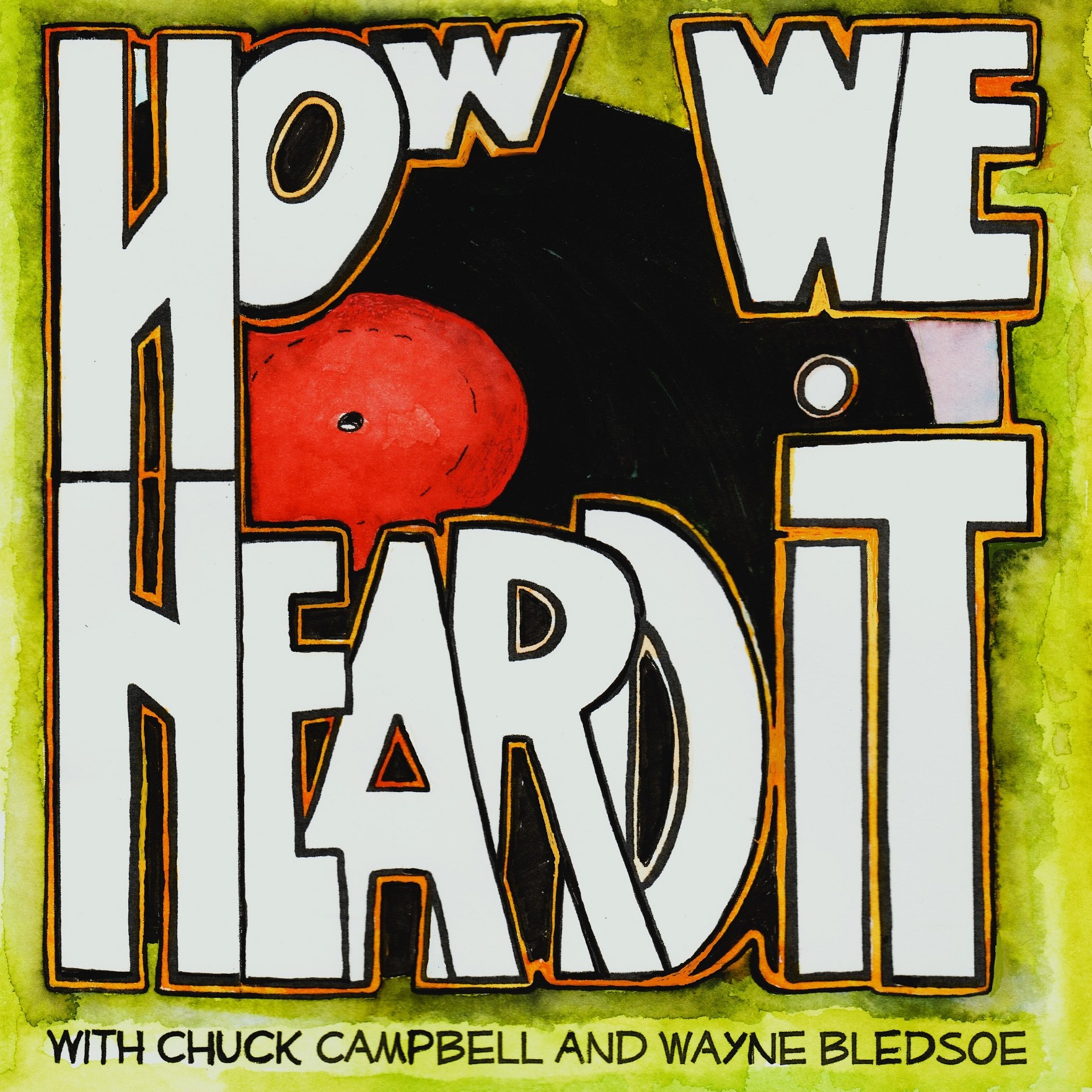
Veteran entertainment journalists, music columnists and longtime friends Wayne Bledsoe and Chuck Campbell host ”How We Heard It,” a breezy and sometimes offbeat take on how music and movies got to where they are today and where it’s all going.
They break down who are the most promising Generation Z singers one minute and the next they debate who are the most overrated acts from the past. Sexy songs, soundtracks, controversies and weird movies find their way into the discussion, and they also weigh in with recommendations on who to hear and what to see in music and film from the past and present.
Wayne and Chuck have more than 65 years of experience in professional journalism between them, but they don’t waste time indulging in scholarly breakdowns of their institutional knowledge. Instead, they share behind-the-scenes stories about their odd, funny, inspirational and embarrassing encounters with celebrities, managers, fans and readers. And they laugh at themselves and each other. A lot. Because being an entertainment journalist does that to you.
An important third voice in the ”How We Heard It” podcast is engineer John Baker, himself a musician and producer who reins in Wayne and Chuck when they need it. John’s tastes are a little bit Wayne and a little bit Chuck, and he’s a friendly sort.
Wayne’s primary role in his nearly four decades at the Knoxville News-Sentinel was his work as an entertainment writer and critic. He currently hosts ”The Six O’Clock Swerve” weekly radio show on WUTK, 90.3 FM in Knoxville, he’s a former Grammy nominee, and he’s an organizer of the annual concert series ”Waynestock: For the Love of Drew and Rylan.” He’s also an artist and unconventional garden writer - see more at www.waynebledsoe.com.
Chuck started his career in journalism at the Daytona Beach News-Journal in Florida before joining the staff in Knoxville. He has reviewed more than 5,500 albums, and his column was distributed by the New York Times, Gannett, Cox News Service and the Scripps Howard News Service. He was an entertainment and travel editor in both Florida and Tennessee and a regional news planner for Gannett’s South Region.
”How We Heard It” is a Cozy Planet Productions podcast recorded at The Arbor Studio in Knoxville, Tennessee. Send requests, comments and suggestions to HowWeHeardIt@gmail.com
43episodes
Episodes
Newest firstAll episodes
What would we do if the world had no music?
Mar 2801:32:18Tap to summarizeWhat would we do without music? It's a question the hosts of "How We Heard It" hated to even contemplate. Would this mean we wouldn't have songbirds? Would we not hear the wind in the trees or the waves in the ocean? What about the rhythm of a heartbeat? Would humans not hum or whistle? Even if those elements were in play, imagine no concerts, no music at games or bars, no music to accompany driving or workouts, no music at weddings, church services or funerals. Then the hosts decided to modify the question: What if music existed, but it weren't commercially available to us? If we didn't have agency over our music, we couldn't create playlists, share music with friends or use it for romance. A lack of music, or even a lack of control over the music we hear, would limit out ability to bond with others and likely decrease our empathy. It would also make music less effective as a means of comfort or relief from depression, thus leading to feelings of isolation. And what about those whose careers are intertwined with music? Your hosts - which include two music journalists and a musician/producer - consider what they might be doing without music. Let's just say you wouldn't want them as your psychiatrist.
Transcribe →Here's why young people don't like "classic" rock or pop
Mar 2101:27:30Tap to summarizeLast week the hosts of "How We Heard It" explored the many reasons people stop listening to new music as they get older. The bottom line: New music speaks to us less and less as we age, our friends stop listening to new music so we don't have anyone to share the experience, we have less time to absorb new music, and our aging brains find new music difficult to process. (Myth: New music was better in our youth than it is today.) This week your hosts look at another major (though not quite as pervasive) phenomenon: Why don't young people enjoy the classic acts and hits from before their time? Some of their reasons are similar to those of the older listeners not listening to new music: For example, young people tend to listen to what their friends enjoy (which tends to be new music), and they often feel disconnected from artists in the past and put off by the themes and lifestyles of those artists. And there are more reasons - from the production values of the past to the vast library of popular music that exists today, accumulated over some 70 years. Where do you even start? Ever the problem-solvers, the podcast hosts offer suggestions on how music lovers of all ages can find and sample undiscovered music and enhance their lives. If you refuse to budge from one era of music, you're only denying yourself joy.
Transcribe →Why do we give up on new music as we age? (It's not what you think.)
Mar 1401:19:57Tap to summarizeMany of us fall in love with music around puberty and it plays an important part in our lives as we transition into adulthood, get through school and break out on our own. Music helps us shape our identity and bonds us with our friends. It's there when we're lonely or feeling isolated. It's there when we experience infatuations and find love. It consoles us when we lose love or suffer other kinds of heartbreak. The artists we most admire feel like an unofficial part of our families. But somewhere along the way - maybe in our late 20s or early 30s - many of us lose interest in new music and simply replay the music of our youth. We tell ourselves new music isn't as good as the music we grew up with, but we're only fooling ourselves. We tell ourselves new music doesn't relate to us anymore, but many of those artists who made music when we were young are still making music, often more mature music, and we aren't listening to their new material. Could it be we're too busy with life to keep up with music? We aren't interested anymore because our friends aren't interested anymore? Maybe and maybe. It could also be that your brain simply finds it harder to process new music and you're just physically more comfortable with the rewards of the nostalgic power of familiar music than you are with the challenge of getting to know something new. This week on "How We Heard It," your hosts explore the myths and realities of the changing role music has in our lives and practical ways you can continue to experience the joy of new music, which is good for your mental and physical health. You could even fall in love with music all over again.
Transcribe →How we met ... and other memories triggered by music
Mar 701:34:11Tap to summarizeIn 2025 the hosts of "How We Heard It" decided to dig through their individual music collections just to see what they would find, and they turned up music they had long forgotten as well as music they didn't even know they had and music they didn't even recognize. And with many of the discoveries came memories of their pasts and realizations about the evolution of music and the changes in their individual tastes in music. They funneled their discoveries into an episode of the podcast in November, which prompted another dig through the collections and another episode in December. The guys are at it again this week, and this time what they find triggers memories of everything from sharing music with their families to an emotional encounter in Berlin, as well as the discovery of bizarre music they haven't thought about in years. This week Chuck and Wayne also remember how they met, initially pitted against one another as natural rivals until they realized their skills and interest in music made them a well-rounded team, not two like-minded opponents locking horns on a music battleground. More importantly, it was the beginning of a friendship that has endured for decades. Have you looked through your music collection lately? You might be surprised about what you find and how it makes you feel.
Transcribe →These are some of the best hooks in music history!
Feb 2801:25:51Tap to summarizeEvery song's got to have a hook - or at least it does if you want it to be popular. A song can have the best vocalists, the best instrumentalists and the best lyrics, but unless it has a great hook, it'll never be all that it can be. And unlike words, voices and music, it's hard to articulate how hooks even work; they hit us on a primal level that can't fully be explained. The most common hook in popular music comes with a punch - for instance, it's often in the chorus, where the song's title is directly or indirectly referenced and the arrangement rides a crescendo. But sometimes a hook is in the verses or the bridge, sometimes it's an instrumental passage like a guitar solo, and sometimes it's a sudden pivot, like a dramatic change in tempo. One-hit wonders frequently find the magic to a good hook only once, while more savvy artists have a knack for hooks. On this week's episode of "How We Heard It," your hosts talk about some of the greatest hooks in modern music history, whether they came from Buddy Holly or Motown, The Who or The Kinks, David Bowie or Cheap Trick, New Wave or disco, Sheryl Crow or Weezer, Kendrick Lamar or Mariah Carey, and Olivia Rodrigo or Taylor Swift. Have you ever been captivated by a song and you aren't sure why? It was probably the hook.
Transcribe →What music would you want on a deserted island?
Feb 2101:15:12Tap to summarizeIt's a question we like to ask but one we usually can't confidently answer: What one album would you want with you on a deserted island? Forget the fact you aren't going to have electricity on a deserted island or any equipment that plays music. Never mind you might spend the rest of your life alone on this mysterious island. Your task is to narrow down all of music to just one album to entertain you while you live out the last of your days. On this week's episode of "How We Heard It," your hosts decide to play the game - after adjusting it to what 10 albums they would want because, let's face it, none of these guys could ever narrow it down to just one. They used different criteria. One more or less narrowed it down to the 10 albums he most enjoys for their artistry. Another considered the 10 albums with which he generally feels the strongest connection. And another looked for a selection of albums that would keep him the most grounded during any potential situation that might arise while living alone on a deserted island. Many other factors weighed in while they considered major artists, from the Beatles to Taylor Swift, and genres ranging from calypso to rock and exotica to electronica. And if you asked them to do it again, they all agreed that their lists would undoubtedly change from one day to the next. What about you? What music would you want to possibly last you for the rest of your life?
Transcribe →Here's why we hate these terrible love songs!
Feb 1401:22:35Tap to summarizeA great love song will warm your heart with its magic, stirring an internal passion that's hard to explain. A bad love song will make you cringe, laugh and/or yawn. And frankly, there are more bad love songs than good ones floating around out there in the music universe. Last year, the hosts of "How We Heard It" celebrated Valentine's Day by shaking out some of the best love songs in modern history, performed by artists who articulated the power of emotion and cast a spell with sound. This year, Wayne, Chuck and John go claws out at the horrible love songs that have flooded the public consciousness with lazy formula, unconvincing delivery, awkward messages and incomprehensible weirdness. The guys feed off each other in this episode, generally agreeing with each other on the worst offenders and having quite a few laughs as they go. They also reach a consensus that many of the worst songs tended to come from some of the most powerful artists in the most dominant genre of the time. Disclaimer: All of us (including your hosts) love some songs that are arguably subpar. If you and your loved one happened to bond over a song we poke fun of, just go on with your bad selves. We won't tell if you don't.
Transcribe →Here's a soundtrack for when your life is changing
Feb 701:22:35Tap to summarizeChange is inevitable, so embrace it. OK, maybe it's not always as positive as all that. But change presents opportunity, and even if you dread it, you can usually find a silver lining to the dark cloud. Music can help with any kind of change. Naturally there are songs about embracing a new relationship and songs about moving on from a bad one. Yet music addresses everything from adopting a positive attitude to escaping an oppressive environment to facing down the grieving process. In this episode of "How We Heard It," your hosts explore songs about change and suggest some of the better ones to help you get to where you want to be. Meanwhile, host Wayne Bledsoe talks about his ambitions and plans for his upcoming retirement from his day job, inspiring both happiness and envy in his co-hosts. Then, as they sometimes do, Wayne, Chuck and John go off on a tangent, this time talking about some of their weirdest jobs. One of them used to dress as a rabbit and deliver singing messages. Another used to search through beans at a restaurant, looking for rocks. And the third used to deal blackjack at pop-up casinos for business conventions. They were fun jobs while they lasted, but the guys all moved on. Because as Sheryl Crow sings, "A change will do you good."
Transcribe →Ranking the movies: History's "biggest" films haven't always been the best ... or even good
Jan 3101:23:10Tap to summarizeLast time on "How We Heard It," your hosts looked at the top-selling music artists from the 1960s to the 2020s and ranked them, decade by decade. They debated, argued and came to some consensus as they considered all of music's biggest acts from the Beatles to Taylor Swift. This time around, they decided to rank the best and worst movies that were tops at the box office from the 1960s to the 2020s, and let's just say they were taken by surprise at just how much the film industry has changed over the years. The box office take in the 1960s and 1970s was topped by such varied and ambitious films as "The Sound of Music," "The Graduate," "2001: A Space Odyssey," "Star Wars," "Jaws" and "The Godfather." Meanwhile, four of the top 10 films from the 2010s were all from the "Avengers" franchise, and the top six movies so far in the 2020s have all been sequels. Has Hollywood become too dependent on redundancy, or do film audiences simply prefer sequels to brand-new stories? Are superhero movies and action films succeeding at the expense of other genres like comedies, dramas and romance? What new movies have been bucking modern trends? And were the old movies really so great in the first place? "How We Heard It" weighs in on these and other questions as your hosts relive some of their favorite times at the movies ... as well as some of the most numbing ones.
Transcribe →These are the best, and worst, top-selling music acts from the 1960s to the 2020s
Jan 2401:20:48Tap to summarizeLike all good music nerds, the hosts of "How We Heard It" frequently advocate for lesser-known acts they think deserve more attention. But Wayne, Chuck and John like to balance the podcast by also talking about the biggest names through the years, and in this episode they talk about the most popular of them all, ranking them against each other. The premise: The guys explore the top-10-selling music acts from each decade, from the 1960s to the 2020s, and they take turns picking their favorite act as well as their least favorite act from each decade. This war of the giants includes battles like The Beatles vs. Elvis Presley vs. The Rolling Stones (from the 1960s) to Michael Jackson vs. Madonna vs. Prince (from the 1980s) to Adele vs. Taylor Swift vs. Drake (from the 2010s). The guys argue, then agree, then argue some more ... and sometimes they even hurt each other's feelings. At least a little bit. Even a casual music listener is going to know just about all of these artists and might have just as much trouble picking the best of the best, not to mention the worst of the best. Give it a shot and you'll see.
Transcribe →