
Podcast
I Am Interchange
Hosted by Tate Chamberlin · EN
I Am Interchange immerses you in the world of adventure journalism, where we fearlessly explore the monumental global changes, inequalities, and urgent issues surrounding the UN Sustainable Development Goals. Through raw, unfiltered storytelling, we dive into the tension within these goals and share the stories from the front lines of systems change.
16episodes
Episodes
Newest firstAll episodes

Follow the Food
2w ago00:52:07Tap to summarizeOkay, think about the last tomato you ate. Not a good one. A regular one — grocery store, middle of winter, pale on the inside, kind of mealy. Doesn't really taste like anything. That tomato traveled further than most people go on vacation. Picked green, somewhere warm, weeks before you saw it. Put in a room and gassed with ethylene so it would turn red on schedule, because red is what we reach for. And it was bred — over decades, deliberately — not to taste good but to survive the truck. And the part that got me, when I first started paying attention to this stuff, is that nobody exactly chose that. There's no villain. It's just what you get when the whole system is built to move food cheap and far, and the person actually growing it has the least say of anyone in the chain. That's the world Tate Chamberlin wanted to spend some time in. So he sat down with four people who've each, in their own way, made food their life's work — Katie Stebbins, Tim West, Paola DealMeida, and Sanah Baig. They get into the stuff you'd expect. How you even fall into food activism in the first place — for most of them it started small, learning to cook, getting curious about where the thing on the plate actually came from. Food safety. The tomato supply chain, which is somehow more insane the closer you look. Why a small farmer basically cannot win against processing and subsidies, no matter how good they are at farming. But the part I keep thinking about came later, when the conversation turned to the Farm Bill. Because most people hear "Farm Bill" and picture, you know, corn. Tractors. It's not that. It's school lunches. It's SNAP. It's the thing quietly deciding whether a kid eats. One of them makes the case that we've been calling it the wrong name this whole time — that it's really a community bill, and we should start treating it like one. So that's today. How food got personal for these four, and what it would actually take to keep the local stuff alive. Pull up a chair.
Transcribe →
Unfinished Republic
Jun 2900:53:20Tap to summarizeHere's something worth sitting with: the people who govern us mostly come from a narrow slice of the rest of us. Lawyers, for one. In the United States, they fill more than half of Congress. But it's wider than any single profession — it's wealth. The system favors the people who already have. Running for office costs money. Holding office rewards money. And so the rules end up written, again and again, by people who were already winning. When a single class writes the operating system for an entire country, you get a country that can only run one kind of program. Tate Chamberlin wanted to ask what the alternative even looks like. So he brought a few people together to find out. Because democracy was supposed to be the thing that belonged to everyone. Rule by the people — all of them, not the few who could afford a seat at the table. But somewhere along the way it narrowed. The choices got fewer. Two parties. One acceptable range of disagreement. And underneath it, quietly, the thing nobody campaigns on — the monopoly of violence. A state that alone holds the right to use force, and uses it to keep the arrangement exactly as it is. This conversation was recorded at Frontier Tower in San Francisco, at the Next Democracy Summit. Four people, four vantage points. Artur Py, from Ukraine, where the right to govern yourself is something people are fighting and dying to hold onto. Nicole Klau Ibarra, from Mexico, watching her own democracy bend under its own pressures. And Gage Olesen and Bruce McHenry, both based in the United States, both asking whether two parties and a settled status quo is really the best a free people can do. What they're reaching for is hard to name but easy to feel. A world with room in it for more than one world. Many ways of living together, not one imposed on all the rest. And the question that keeps surfacing — the one that outlasts any election: what kind of self-governance do we leave the people who come after us? That's today. Stay with us.
Transcribe →
Open Source Society
Jun 700:49:58Tap to summarizeThere's a word that keeps coming up when you talk to people who build software for a living. The word is fork. To fork something means you take an existing codebase — someone else's rules — and you branch off. You make your own version. You run it your own way. And nobody can stop you. We're at Frontier Tower in San Francisco. At the Next Democracy Summit. Ruzgar Imski is a Playnet contributor exploring organizations as games and games as organizations. How might we play organizations into existence? And in so doing overcome the division between game designers and game players, rule-makers and rule-abiders, between legislators and citizens. Kate Lee builds systems too. What if you forked a city ordinance? What if you forked a federal statute? If code is law, put it in a repository, let people propose changes. Real changes. Actual line edits, submitted by anyone, reviewed in public, merged or rejected with a record of why. And underneath all of that is a harder question she keeps returning to — who owns your identity. Not your passport. Your digital twin. The version of you accumulating in systems you've never seen, built from searches and purchases and patterns and memories you didn't consciously hand over. AI is storing that now. Learning from it. And the person it knows best might be you — but you have no access to what it remembers. No access to your own externalized memory. Tate Chamberlin put them in a room together. Two people who build systems and still want to talk about what those systems are actually doing to governance, to identity, to the idea of sovereignty in a world where code writes code and AI inherits the keys. The game has been running for a while now. Someone designed it. It's up to us to change it. Today, Ruzgar, Kate and I are on a quest to open-source society and democracy.
Transcribe →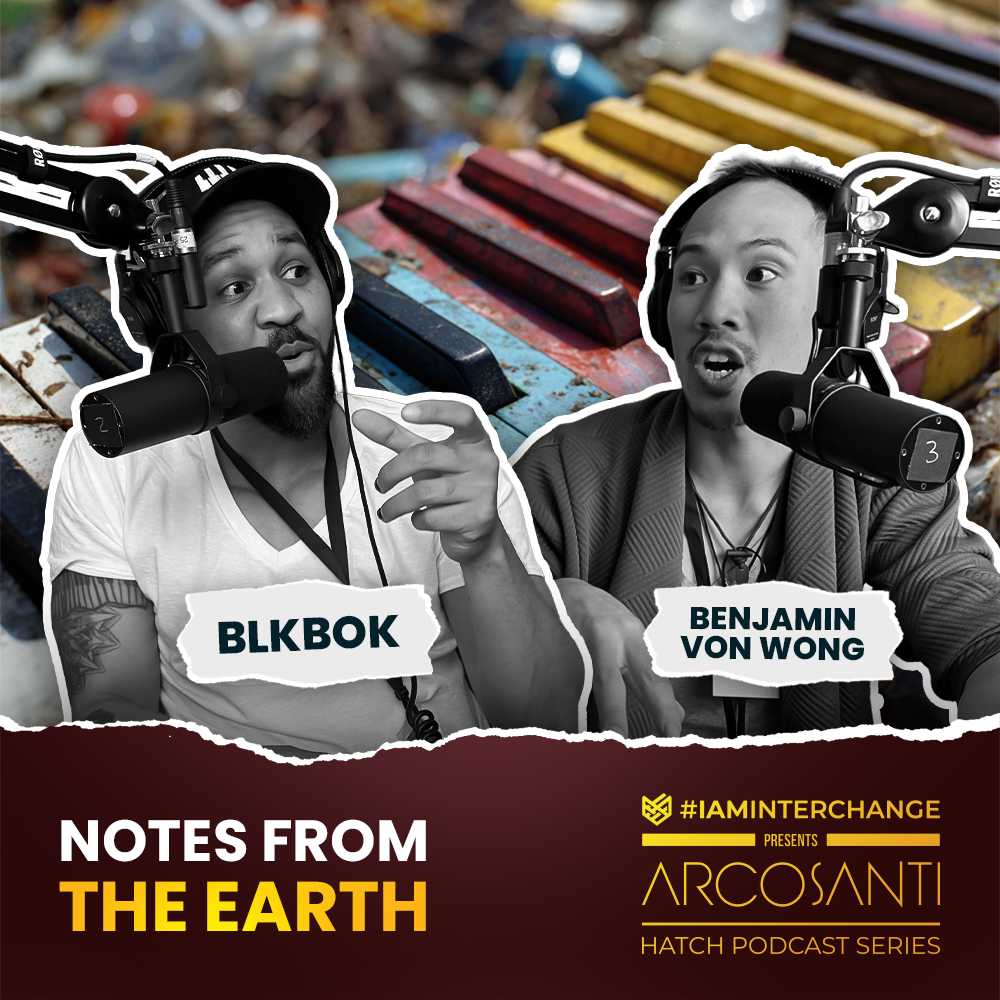
Notes from the Earth
May 500:57:51Tap to summarizeThere's a moment. A specific moment when someone decides to stop waiting for permission. Maybe it's quiet. Maybe nobody's watching. But something shifts — and the path they were supposed to take starts to look a lot less interesting than the one they're about to make up entirely. Today, we're talking to two people who made that choice — in completely different directions, for completely different reasons, with the same kind of unshakeable commitment. Benjamin Von Wong is an environmental activist and visual artist whose work is almost impossible to look away from. Giant, haunting installations built from plastic waste. Images that don't let you off the hook. His activism isn't about him — it never has been. It's about fighting for something so much larger than any one person that the work almost demands you forget who made it. He's trying to change systems. Actual systems. And he's using beauty to do it. BLKBOK is a neoclassical pianist selling out concert halls and collaborating with some of the biggest names in music. Here's the thing though. Nobody taught him how to do any of it. No conservatory. No formal training. No one handing him a roadmap to the rooms he now walks into like he belongs there — because he does. He figured it out. All of it. And that self-taught, street-smart, stubbornly specific version of himself is exactly the thing that got him there. Choosing classical music when the world had a very different game in mind for him. Two artists. Two completely different relationships to the word change. One fighting for the planet. One rewriting who gets to sit at the piano. And somehow, both asking the same question underneath it all — how do we show up and actually influence anything? Do we do it because someone is looking? Or do we do it anyway?
Transcribe →
The Amazon is Breathing
Mar 3100:58:57Tap to summarizeHere's the thing about the Amazon basin. There's a number scientists use when they talk about it — the number of species living there that we haven't discovered yet. And here's what's strange about that number: we don't know what it is. We can't know what it is. We only know it's enormous. That somewhere in that forest right now, there are creatures going about their lives, doing whatever it is they do — and not a single human being on earth knows their name. Think about that for a second. We are losing something we have never even met. The Amazon produces its own weather. It talks to the ocean. Indigenous peoples have lived inside it, and with it, for thousands of years — and they will tell you, if you ask them, that the forest is worth more standing than cut. That it is not a resource waiting to be used. That it is the resource. That it is the economy — if only we could learn to see it that way. We think we know the Amazon. We've seen the pictures. We've heard the statistics. But we don't know it. Not really. Today on the show — what happens when a forest reaches a tipping point. What wildlife monitoring and illegal human activity in one of the most remote places on earth are actually telling us. And what a shift toward a bio-economy might mean for the future of a place that is, in some ways, the future of everything. I'm Tate Chamberlin. My guests today are Indrani Pal-Chaudhuri and Paola de Almeida. Stay with us.
Transcribe →
Water in the West
Mar 1200:47:53Tap to summarizeWater doesn't begin at the tap. It begins in the dark—underground, in aquifers older than memory. As snow in mountain air. As vapor. As storm. Something that refuses to stay still. By the time it reaches us, it has already lived many lives. There's a saying in the West: whiskey is for drinking, water is for fighting. A line that carries history inside it—compacts, canals, courtrooms. Water hasn't always been political. For most of human history, it simply existed. But today, especially across the western United States, it often is. This episode begins in the Arizona desert, at Arcosanti. In 1970, architect Paolo Soleri and The Cosanti Foundation began building this place in central Arizona. The idea was arcology—architecture shaped by ecology. A community trying to imagine living with the land instead of against it. Curved concrete rises from the desert. Light pours through open space. A place built on questions. It was also the site of the HATCH Summit—artists, scientists, entrepreneurs, policymakers, storytellers. People trying to collaborate their way toward something more resilient. Which makes it the right place to talk about water. Because water means different things at once. For some, it's sacred. For others, it's infrastructure—reservoirs, pipelines, allocations and rights. In the western United States, those rights often follow a simple rule: first come, first served. Use it—or lose it. That logic shaped rivers like the Colorado—now feeding cities, farms, and reservoirs like Lake Powell. But reservoirs drop. Snowpack shrinks. And "management" starts to sound more like triage. And this story doesn't stop in Arizona. In the Andes, salt flats hold the lithium powering electric vehicles. In Bogotá, officials count the days in their reservoirs as the possibility of "Day Zero" enters the conversation. Different places. Same question. What does it mean to live with water? In this conversation, Tate chamberlin sits down with Michellsey Benally, David Purkey, and Joel Barnes to explore that question—what a water right really is, who decides, and what it might mean to remember that water was never just a resource in the first place. Because water keeps moving. And the question is how we move with it.
Transcribe →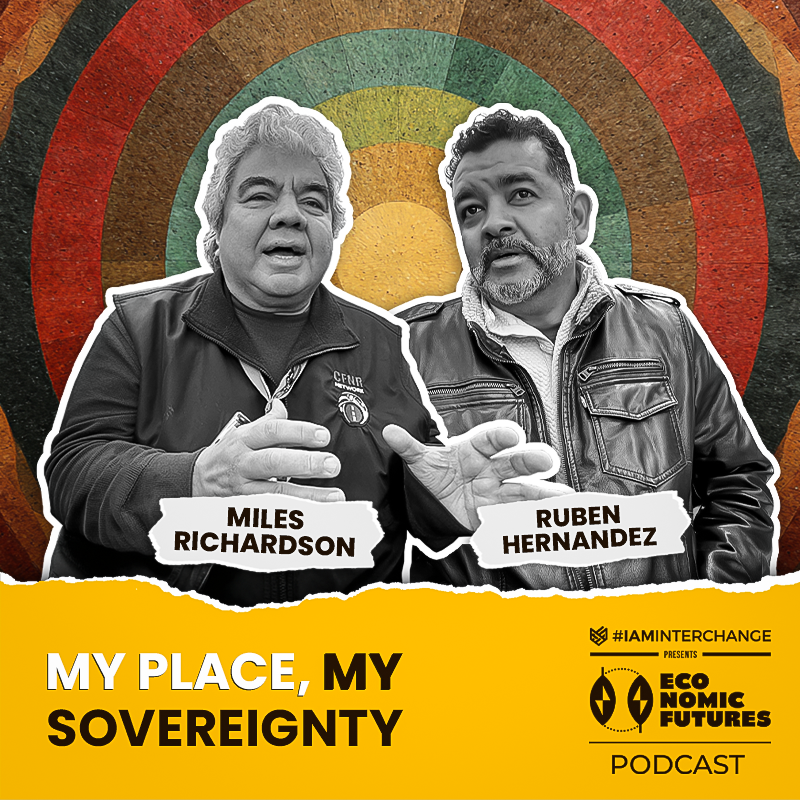
My Place, My Sovereignty
Feb 1900:39:46Tap to summarizeThis is the third episode. The last in a three-part series. My Place, My Sovereignty. Recorded at the Eco Nomic Futures Summit. A gathering about systems—but really about people. About land. About new economies. I'm Tate Chamberlin. In this episode, I'm joined by Ruben Hernandes and Miles Richardson. The conversation starts with a simple idea that turns out not to be simple at all: knowing where you come from. For some people, lineage is clear. Stories passed down. Names remembered. Teachings held—who we are, what we stand for, where we belong. That clarity is a kind of privilege. From there, the story widens. We talk about building Indigenous economies—not as theory, but as relationship. To people. To place. To the earth itself. There's talk of sovereignty. Of sovereign wealth. Because economic activity matters. We all need it. But the system we're living inside now is built on something else—monetary capital. Scarcity. The idea that there's never enough. What Indigenous communities offer is a different application altogether. An economy rooted in reciprocity. In looking after each other. In the understanding that we're all in this together. And that idea scales up—to something much bigger. A world sense. A human challenge. Because sovereignty, in the end, isn't just about control. It's about responsibility. Stay with us.
Transcribe →
Gangstagrass
Feb 100:54:47Tap to summarizeThis story starts at Arbor Day Farm in Nebraska City, Nebraska. At the HATCH Summit. A gathering about world-building and cultivating relationships—set in a town with a long memory, including its role in the Underground Railroad. And from there, it moves to music. To Gangstagrass. They're Emmy-nominated. Billboard-charting. And they're also the soundtrack for Dispatch from the Heartland. Hip hop and bluegrass sit together here— banjo and bars, rhythm and rhyme— without explanation. Just present. Tate Chamberlin sat down with Gangstagrass— Dolio The Sleuth, B.E. Farrow, Rench, Sleevs, Danjo Whitener, and R-SON, the Voice of Rason. There's a quote they have that keeps coming back: We all do better when we all do better. Can't get better than that. That quote opens up a longer story. One that passes through blackface minstrelsy— an old form of Entertainment in the United States where white performers painted their faces black and acted out cruel, exaggerated versions of Black life, earning premium wages while doing it, taking work, money, and stages away from Black performers, turning real people into jokes and stereotypes. Those images didn't stay on the stage. They moved into songs. Movies. Cartoons. Into culture. This is a story about Music. About memory. About relationship. About Afrofuturism— not as escape, but as continuity. A future imagined with the past fully in frame.
Transcribe →
BioCulture
Jan 1300:43:19Tap to summarizeThis is episode two, recorded at Eco Nomic Futures in San Francisco. Not a conference exactly—more a meeting point. Where conversations crossed paths around food, land, economics, and what happens when systems lose their connection to life. Tate Chamberlin is joined by Jacob Huhn and Warinkwi Flores. This episode is called BioCulture. It's about systems—the ones we live inside now, and the ones that came before them. Indigenous economies were relational, not extractive. Land, food, and water weren't commodities. They were responsibilities. Those systems didn't fail. They were interrupted. From there, the conversation moves into the present. Food as product. Life as data. Supply chains so long and familiar, they disappear. Corn becomes a way to see how meaning gets stripped as things move farther from their origins. We talk about data, the rights of nature, and economies embedded within life—not separate from it. A reminder that the future isn't something we have to invent. It's something we already know how to return to. Stay with us.
Transcribe →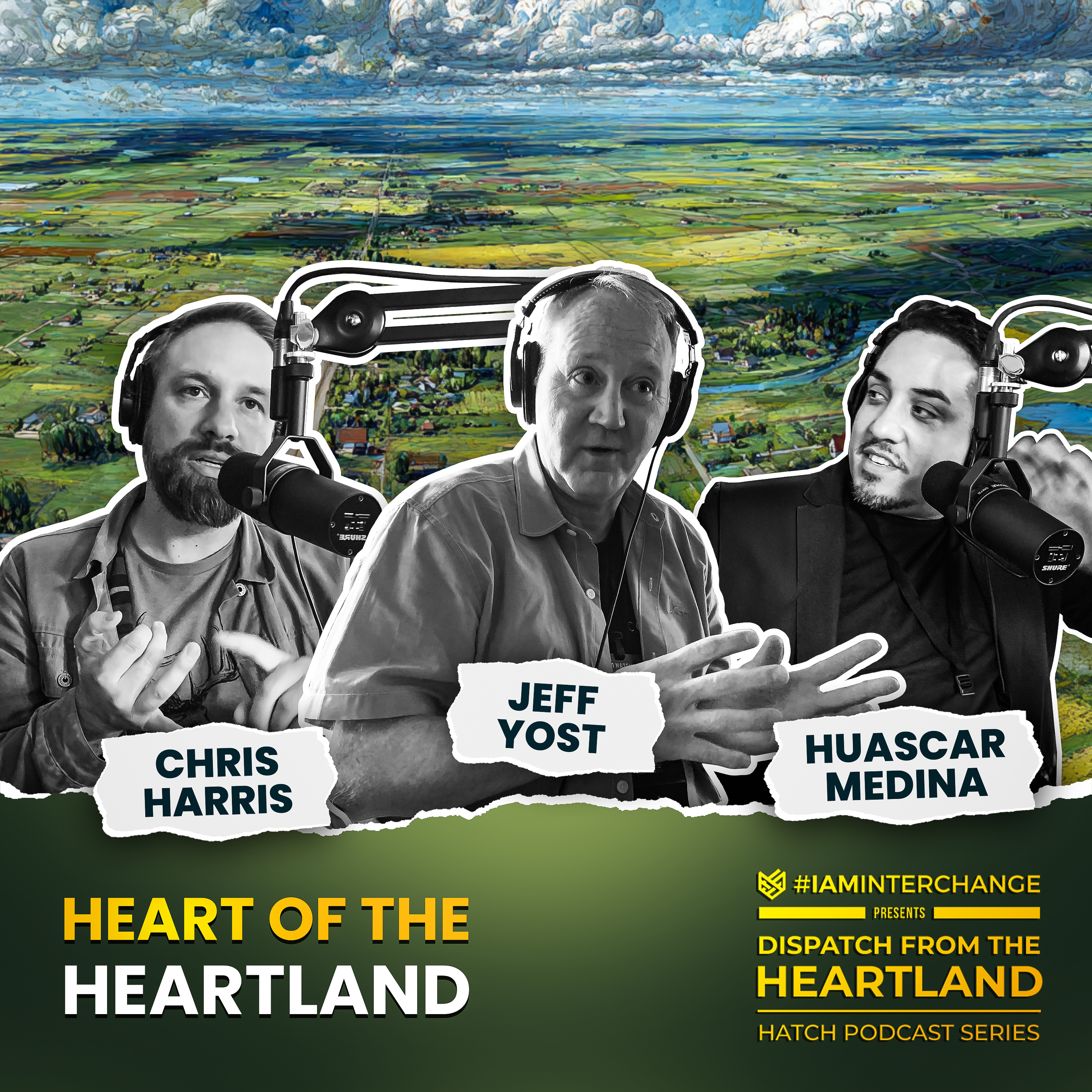
Heart of the Heartland
Dec 1900:59:18Tap to summarizeToday, we're somewhere that feels both familiar and overlooked at the same time—Arbor Day Farm in Nebraska City, Nebraska. The kind of place people call flyover country, a place many don't think twice about, even as the people who live here are quietly shaping a future the rest of us will eventually feel. I'm Tate Chamberlin, talking with Jeff Yost, Chris Harris, and Huascar Medina—three voices who don't see the Heartland as an accident of birth, but a choice. A commitment. A belief that local decisions should be made… well, locally. By the people who actually walk these streets, and raise their kids here, and imagine what this place could become. Because if you really want to understand a community, you don't just start with the data. You start with the people who see it up close—teachers, shop owners, artists, local organizers—the ones who understand the rhythms of a place in a way reports never quite catch. The people who can show you what a community is actually like, not just what it looks like on paper. And right now, these towns—these counties—are in motion. Old systems giving way to new ones. A moment where risk tolerance suddenly matters. Where one wrong move can feel fatal. And the arts—the artists—help us inch forward anyway. They make us brave in ways spreadsheets never will. There's also the quieter story: young people leaving for opportunities somewhere else, communities slowly thinning out, the talent and energy of a place drifting outward like smoke. And the equally powerful force coming behind it—the massive transfer of land and assets from one generation to the next, often to heirs who don't live here anymore. The early signs of a company-town future, unless something different takes hold. And somewhere inside all of this—inside the questions about belonging and the future of work and what makes a place worth staying in—is the story we're following today. Not an invitation. A moment. A snapshot. A look at how the Heartland, by choice, is writing its next chapter in real time.
Transcribe →